As the world marked Human Rights Day, Canada reiterated the importance of the protection and promotion of human rights defenders and their critical work. Mélanie Joly, Minister of Foreign Affairs, announced $1.85 million in funding for two projects that support child human rights defenders and a free and independent media worldwide.
Canada is contributing $850,000 to a three-year project led by Child Rights Connect to empower, to protect and promote the rights of child human rights defenders, who are increasingly engaged in global human rights challenges, without the same legal protections as adults. This funding will help Child Rights Connect promote safe and sustainable human rights advocacy by child human rights defenders in Togo, Thailand, Moldova and Brazil.
Canada will also contribute an additional $1 million to the Global Media Defence Fund, bringing Canada’s total contribution to the fund to $4 million. Administered by UNESCO, the Global Media Defence Fund works to enhance the protection of journalists and media organizations so they can carry out their critical work without fear of violence, censorship or intimidation. The fund will also ensure public access to diverse and reliable sources of news and information. [see also: https://humanrightsdefenders.blog/2024/02/12/investigative-journalism-in-arab-states-the-threats-to-journalists/]
“In the face of growing challenges to human rights globally, the work of human rights defenders and the protection of media freedom are more important than ever. Canada stands unwavering in its commitment to working with partners to safeguard and expand the protection and promotion of human rights defenders and journalists around the world.” – Mélanie Joly, Minister of Foreign Affairs
On International Human Rights Day, the Open Society Foundations reaffirmed their vision for a shared humanity where everyone can thrive, continuing the philanthropy’s role as the world’s largest private funder promoting rights, equity, and justice.
Under the leadership of Chair Alex Soros, the philanthropy is streamlining its programming to support new voices and approaches that align with today’s emerging forms of organizing and leadership. The Foundations will pursue targeted time-bound efforts, provide long-term institutional support, and retain the flexibility to respond to crises through rapid response funds.
Binaifer Nowrojee, president of the Open Society Foundations, said:
Across the world, we are seeing inspiring and powerful movements working to shape a future framed by human rights. Standing with them as allies, we will deepen, broaden, reimagine, and catalyze efforts to advance a new vision of human rights that is not bounded by historic double standards, exclusions, and inequities.
We are crafting and implementing thoughtful, future-focused strategies for change that will leverage gains made through key openings and convert them into wins. Our investments will aim to work with groups to build on and sustain these wins over time. We are committed to listening and to being informed by the needs of allies leading the fights for rights, equity, and justice.
The commitments include multiyear investments across a broad range of issues and geographies, including:
Rights protection: Supporting human rights advocacy as well as protection of rights defenders at risk, particularly environmental and women’s groups
Inclusion: Ensuring marginalized and vulnerable groups can fully exercise their rights without fear of violence or discrimination
Public safety: Promoting communities-centered approaches to tackling repressive or militarized responses to violence and public safety
Accountability: Supporting human rights–based litigation in national, regional, and international courts
Political participation: Supporting new champions and nonpartisan movements of inclusive and accountable democratic practice in specific countries and globally
Economic rights: Developing and promoting new state-led economic models for a green transformation to advance economic and social rights
In 2025, Open Society will be approving further programming to promote rights, equity, and justice.
Open Society has also approved funding across other areas, including ideas, impact investing, advocacy, and higher education.
The “Life is hanging on by a thread” campaign will shine a light on the countless stories of human rights defenders and environmentalists who risk their lives for their causes.
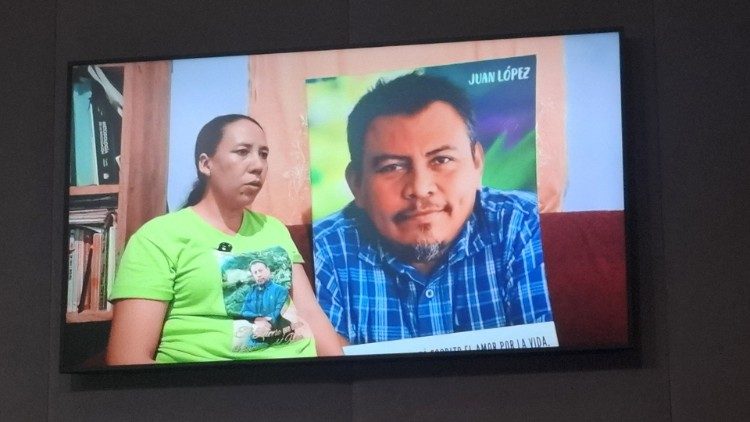
On September 14, Juan Antonio López, a city council member and environmental activist was murdered in Honduras. He was a member of the Mesoamerican Ecclesial Network and international organizations recognized his work. His assassination underscored the vulnerable situation of human rights defenders and leaders throughout Latin America.
In response, the Latin American Bishops’ Conference, together with the Platform for Peace, Democracy, and Human Rights and the Latin American Protection Community, is launching the campaign “Life is hanging on by a thread.”
The official launch of the campaign is scheduled for December 10, which will be held virtually to bring representatives from all over Latin America. It will coincide with events being held in Honduras to honour López.
The goal of the “Life is hanging on by a thread” campaign is to shine a light on symbolic cases of human rights and environmental defenders in Latin America and the Caribbean. Various testimonies of people defending human rights and indigenous peoples will come to light.
Promoters of the campaign stress its importance because “situations like the murder of Juan Antonio López are not isolated events, but part of a systematic pattern in Latin America, one of the deadliest regions for environmental and human rights defenders.” Global Witness, an international NGO, reports that 85% of environmental defenders who were killed in 2023 took place in Latin America. Specifically, in Honduras, 18 environmentalists were murdered last year. [see: https://humanrightsdefenders.blog/2024/09/18/global-witness-2023-2024-annual-report-violent-erasure-of-land-and-environmental-defenders/]
Juan Antonio López was an environmentalist killed on September 14, 2024
The campaign will end on December 10, 2025, coinciding with the Jubilee of Hope.
Here a few highlights for this year from UN and NGOs sources:
While commemorating the 76th anniversary of the Universal Declaration of Human Rights, the United Nations Secretary-General Antonio Guterres said that “human rights are under assault”. “Whether economic, social, civic, cultural or political, when one right is undermined, all rights are undermined,” Guterres said in a post on X. “Let’s protect, defend and uphold all human rights for all people,” he added. In a video message, The UN secretary-general said “we must stand up for all rights — always.”
..As we mark Human Rights Day 2024, we are reminded that human rights are not abstract ideals. They are vital tools for addressing these pressing challenges and advancing dignity and justice for all.
… the United Nations Development Programme (UNDP) works to support human rights solutions that strengthen accountability, protect communities and foster peace, recovery, and stability. This includes partnering with National Human Rights Institutions, which often represent the frontline defenders of human rights. … Local initiatives also remain key. That includes women in Somalia who are being supported to lead peace efforts including assisting those facing violence, discrimination, and injustice. “I have resolved numerous local disputes…I feel motivated when I see I have been able to change people’s lives positively,” says Fatuma who led a local Peace Working Group.
As the accelerating climate emergency threatens the ability of current and future generations to enjoy their right to a clean, healthy, and sustainable environment, UNDP is focusing on access to justice, working with the United Nations Environment Programme (UNEP) and OHCHR to help communities claim their rights. …The private sector also has a pivotal role to play. UNDP supports the implementation of the UN Guiding Principles on Business and Human Rights including to advance sustainable practices that protect the environment. Indeed, technology offers both risks and opportunities to advance human rights. The Global Digital Compact aims to create an inclusive, open, safe, and secure digital space that respects, protects and promotes human rights. Tech-enabled UNDP tools like iVerify and eMonitor+ deployed in over 25 countries to monitor and address false narratives and hate speech show the potential. It is now crucial to adopt a rights-based approach to technologies like A.I., addressing ethical challenges, protecting data, and tackling biases to mitigate risks today and unlock immense benefits for the generations to come. [https://humanrightsdefenders.blog/2024/09/27/united-nations-adopts-ground-breaking-pact-for-the-future-to-transform-global-governance/]
——
The NGO Index on Censorship spotlights four people standing up for human rights around the world:
Despite the declaration, all around the world human rights are being challenged, degraded and attacked. That is why this year, on Human Rights Day, we pay tribute to five human rights defenders who have worked tirelessly to defend people’s rights and have been persecuted as a result.
Jemimah Steinfeld, CEO at Index on Censorship said: “In this increasingly polarised and authoritarian world these people stand out as beacons of hope and light. It’s depressing to think that over 75 years since the Declaration, we still need a day like this but that should not detract from the bravery and fortitude of these people. May their example show us all how we can all better fight injustice.”
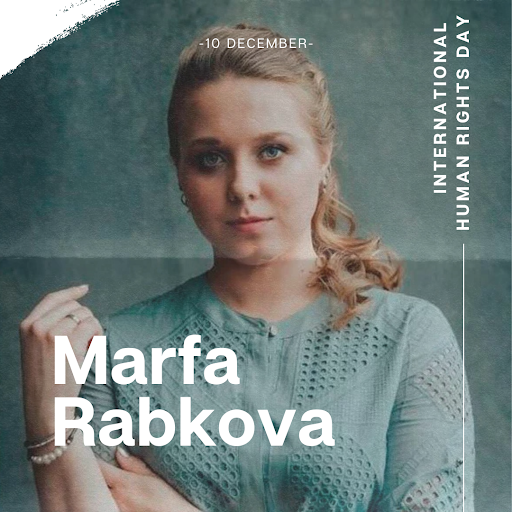
Marfa Rabkova (Belarus) Marfa Rabkova is a human rights defender who has been behind bars since 17 September 2020. She has long been targeted by the Belarusian authorities as a result of her civic activism. Marfa became head of the volunteer service at the Human Rights Centre Viasna in 2019. During the 2020 presidential election, she joined the “Human Rights Defenders for Free Elections” campaign, which registered over 1,500 election observers. When peaceful protests began to take place after the election, she helped document evidence of torture and violence against demonstrators. Marfa was indicted on a long list of charges, including inciting social hostility to the government and leading a criminal organisation. She was sentenced to 14 years and 9 months in prison in September 2022, after nearly two years of pre-trial detention. Index on Censorship calls for her immediate and unconditional release. See also: https://humanrightsdefenders.blog/2021/03/22/belarus-end-reprisals-against-human-rights-defenders/
On 4 December 2024, Aytan Farhadova in OC media reported that human rights defender Rufat Safarov was detained in Azerbaijan a week before he was set to be awarded the Human Rights Defender of the Year award by US State Secretary Antony Blinken. That day, Safarov’s lawyer, Elchin Sadigov, posted on Facebook that Safarov was accused of hooliganism and fraud resulting in major damage.
Sadigov later posted a message written by Safarov, in which he explained that he was planning to visit the US two days after receiving his visa in order to accept the Global Human Rights Defender Award from Blinken. [not totally clear which award is referred to – ed]
‘So I was awarded as a strong human rights defender of the year. Because the United States initially nominated me, I express my deep gratitude to [Mark] Libby, the US Ambassador in Azerbaijan, and Mr Blinken, US Secretary of State, who supported my candidacy.’
State Department’s Deputy Spokesperson, Vedant Patel, during a press briefing on Tuesday, said: We’re deeply concerned by reports that human rights defender Rufat Safarov has been detained in Azerbaijan’, Patel said, adding that they were ‘closely monitoring the case.’
Frank Schwabe, the head of the German delegation of the Parliamentary Assembly of the Council of Europe (PACE), criticised Safaravo’s arrest, saying that PACE will ‘respond to this in January’.
Safarov, a former prosecutor’s office official who spoke out against human rights abuses by the government, was sentenced to nine years in prison on charges of bribery, fraud, and human rights violations in 2016. He was released from prison alongside almost 400 others after Azerbaijani President Ilham Aliyev issued an amnesty to mark Novruz in 2019.
Walter Ngano, on Friday, 29 November 2024, wrote about three nationals in Kenya being honoured as Human Rights Defenders, illustrating again how awards can function at the national level.
Three Kenyan activists were feted at an awards ceremony on Friday, November 29, recognizing them for their commitment to protecting human rights. Boniface Mwangi, Hanifa Adan, and Hussein Khalid were awarded the Human Rights Defender of the Year award during the Human Rights Defenders (HRD) Awards. The event was held at the Royal Danish Embassy in Nairobi, Kenya.
The three, who are prominent activists in Kenya, were jointly awarded the prize, which is under the Working Group on Human Rights Defenders in Kenya, which brings together Civic Society Organizations and development partners concerned with the protection of HRDs.
The three were honoured for the role they played in the June-August Gen Z protests that were witnessed in Kenya in 2024. Together, they managed to lead Kenyans in advocating for the withdrawal of the Finance Bill, 2024.
Hussein was honoured for his contribution to ensuring access to justice for survivors and families of victims of rights violations. Hanifa, on the other hand, was awarded for her dedication to the promotion of public integrity in Kenya.
The aim of the ceremony is to honour and publicly recognise the important work of HRDs in Kenya by giving out awards to men and women who have demonstrated courage and impact in the promotion and protection of human rights and fundamental freedoms.
While speaking after winning the award, Hanifa Adan expressed her joy at winning the award and dedicated the award to Kenyans who lost their lives in the June-August Gen Z protests witnessed in 2024. The award was her fourth in 2024.
“I feel honoured to have won the Human Rights Defender of the Year Award. It’s such an honour, and this is my fourth award this year. I dedicate this award to each and every comrade that we lost during the Gen Z protests,” Hanifa noted.
Hussein Khalid while receiving his award expressed his surprise at being feted but acknowledged the role of activism in the country this year. “I am really shocked by this, but when I look back, it is because of the so many days and sleepless nights we spent doing post-mortems and autopsies for the comrades that we lost in the protests,” Khalid stated. The activist went ahead to request a moment’s silence for the deceased.
Nonhlanhla Dlamini heads SWAGAA – the Swatini Action Group Against Abuse, a local Eswatini organisation whose primary focus is on ending gender-based violence in the country. Since 1990, SWAGAA has provided care, support, prevention, and access to justice for victims and survivors of gender-based violence, by working with community leaders, community members, and the Government, as well as providing counselling for GBV victims. For the International Day for Women Human Rights Defenders, Dlamini answers questions about GBV, her inspirations and why it was necessary for her to become one of the first women elected as a member of parliament in Eswatini.
1. What was that specific inspiring moment or experience that made you decide to focus on gender-based violence?
What actually motivated me was an incident where a relative of mine was raped at the age of six by a stranger. We didn’t find the person. SWAGAA already existed, but I didn’t know anything about them. Then in 1997, I saw an advertisement [for SWAGAA] in the newspaper. And when I learned about what they were doing, I asked myself why I didn’t know about the organization when I had this problem because I had no one to talk to. I had no one to support me. We reported the matter to the police, but nothing ever happened. We’re so frustrated. So, when I saw the position, I just knew this was my job. And my objective was, I want people to know about SWAGAA. I wanted SWAGAA to be a household name.
2. How do you stay motivated and have you ever questioned your journey?
I have several times, particularly when I get hurt, because, you know, sometimes this world can be very cruel. And I ask myself, how could people do such an evil thing? I do get depressed. And when I’m very depressed, I’m like, you know, out of all the jobs that I could be doing, why am I even doing this job? Then I get some motivation with some of the success stories. If I quit, who else is going to do it? I kind of feel I’m compelled to do it because there’s a whole lot of people that are looking up to me for help. So, I continue.
3. You were elected MP back in the early 2000s, the first woman ever for your constituency. What made you decide you had to run?
… The mistake that we make as advocates and women’s rights activists is that we’re always pushing for others to go and make the change that we want to see. So, I made a decision; I was going to stand for the next elections, which were in 2008. I realized that for years, I’ve been part of a vote for a woman campaign, pushing women to stand for elections. But I’ve never thought of myself one day running for elections. I ran the race to Parliament. I was nominated. I was widely supported. I won the primary elections. It was easy for the primary elections, but the secondary elections were not easy. And I was the only woman against seven men. It was very rough. It was very testing. But I pushed with everything that I had. And I won the elections, and I became a member of Parliament. And the first motion that I moved in Parliament, was that the Minister of Justice bring the sexual offenses and domestic violence bill within 30 days. And his response was no. I kept asking, and that is how the bill was finally seen by Parliament.
4. Let’s look to the future. If you could change one thing about the situation of gender-based violence in Eswatini, what would it be?
The most critical thing is prevention. Prevention, prevention, because once it happens, it’s difficult to pick up the pieces. …
5. Do you consider yourself a woman human rights defender? Why?
Of course I do, 100 percent. I consider myself a human rights defender because due to the nature of the work that I’m doing, I am continuously standing up for the rights of women and girls in Eswatini. And I have advocated for better legislation in the country. I have advocated for better services in the country, be it in the police, be it in the hospitals, be it in the justice system. I have done everything that I think needs to be done under the sun to make sure that I stand for the rights of the citizens of this country. And I’m saying this because I also know people believe in me. I’ve done all I possibly can to advocate for the rights of women and children in the country.
Are you a human rights defender keen to use the UN to push for change at home? If so, apply for the 2025 edition of ISHR’s flagship training, the Human Rights Defender Advocacy Programme (HRDAP)!
Learn more about why you should apply for HRDAP by watching this video!
What is the Human Rights Defender Advocacy Programme 2025 (HRDAP25)?
The course equips human rights defenders with the knowledge and skills to integrate the UN human rights system into their existing work at the national level in a strategic manner and provides an opportunity for participants to prepare for and engage in advocacy activities at the UN with the aim to effect change back home.
Online course topics – ISHR
Defenders will complete a 10-week hybrid learning programme, online and offline, which will include:
Accessing the HRDAP Platform, where they can complete e-learning courses on each key UN human rights mechanism and on advocacy strategies, and access interactive learning materials and case studies on the ISHR Academy
Taking part in live Q&A sessions with human rights experts
Receiving a continuous personalised advocacy support and coaching in order to develop concrete advocacy objectives to make strategic use of the international human rights system taking into account the local context
Building networks around the world, and learning from peers from a range of regions working on a range of human rights issues
Applying their knowledge to case-studies scenarios and enhancing their advocacy toolbox according to their specific needs (elevator pitch, SMART recommendations…)
Receiving support and advocacy accompaniment to conduct activities during the 59th and 60th Human Rights Council sessions and other relevant opportunities.
Participants will have the unique opportunity to apply their knowledge and skills while being in Geneva as well as to meet and share with their peers and experts (UN staff, diplomats, supporting NGOs…). The blended format of the course allows defenders to continue their vital work on the ground, while diving into the inner workings of each key UN human rights mechanism and gaining first-hand experience from advocates and UN staff on how civil society can strategically engage in the international human rights space. The methodology we use is interactive and learner-centred and encourage participation of everyone.
By participating in HRDAP, defenders:
Gain knowledge and tools, which they can use to ensure their voice is central in international human rights decision-making
Explore and compare the benefits of engagement with the Human Rights Council, the Special Procedures, the OHCHR, the Universal Periodic Review and the Treaty Bodies, and examine how they can use them to bolster their work at the national level
Develop strategies and advocacy techniques to increase the potential of their national and regional advocacy work
This programme is directed at experienced human rights defenders working in non-governmental organisations, with existing advocacy experience at the national level and some prior knowledge of the international human rights system.
ISHR supports, and promotes solidarity with and between, defenders working in the following areas or contexts, which we recognise as intersectional and interdependent:
Equality, dignity and non-discrimination
Environmental justice and sustainability
International accountability for the repression of human rights defenders
Transparency and rule of law
The hybrid programme will bring together around 16 committed human rights defenders from different backgrounds, who work on a wide range of areas that are linked with our programmes to ensure a sustainable collaboration. This can include, but is not limited to, defenders working on the following thematics: women rights; Indigenous people’s rights; the human rights of LGBTIQ+ persons; anti-racism; reclaiming civil society space and increasing protection of human rights defenders.
What do former HRDAPers say?
16 human rights defenders from 15 countries took part in the last edition, HRDAP24. At the end of the training, 98% of the participants were either extremely satisfied or very satisfied with the programme and felt that they would be able to apply what they learnt to their own day-to-day work. Find out more about the outcomes of HRDAP24 here.
First, download and read carefully the HRDAP 2025 Programme Description to find out more about modalities, requirements and funding. If you meet the criteria, take some time to apply using this online form before midnight Geneva time on Friday 10 January 2025!
As only a limited number of human rights defenders are able to participate in HRDAP each year, in addition to our range of guides and handbooks, ISHR has developed an e-learning space in English, French and Spanish to help human rights defenders strengthen their advocacy skills with the UN for greater impact on the ground: the ISHR Academy. The learning modules demystify the UN human rights system and build capacity to push for change. Discover new tools, insider tips, defender stories, and more!
The 2024 Asia Democracy and Human Rights Award (ADHRA) will be awarded to Odhikar in recognition of “the civil and political rights advocacy they have carried out and expanded in Bangladesh for three decades, despite challenges such as harassment, imprisonment, and surveillance,” TFD said in a press release.
It is hoped that the award will “encourage their work and those in the same field” so they “realize their efforts and perseverance have not gone unnoticed,” said the TFD, a nonprofit organization funded by Taiwan’s government.
Founded in 1994, the group has “deepened democracy and human rights in Bangladesh” through research, advocacy, and training, as well as government oversight efforts, the foundation said.
Odhikar, which means “rights” in Bengali, was founded by human rights activist Adilur Rahman Khan, who currently serves as the group’s secretary.
According to its website, Odhikar’s principal objectives include raising awareness of human rights and its various abuses, and promoting a vibrant democratic system through election monitoring in Bangladesh.
The Bengali group has issued annual reports since 1996 that document human rights abuses, extrajudicial killings, involuntary disappearances and other violations, the TFD said.
The TFD also highlighted Odhikar’s role in urging the Bengali government to ratify the Rome Statute for the International Criminal Court in 2010, which subsequently led the country to contribute to investigations into the persecution of the Rohingya people.
TFD’s award ceremony will be held in Taipei on Dec. 10, the foundation said, adding that the award winner would receive a trophy and a grant of US$100,000.
The undersigned human rights organisations, which together represent the Jury for the Martin Ennals Award for Human Rights Defenders, condemn the continued harassment against 2021 Martin Ennals Award Finalist and woman human rights defender from Turkmenistan, Soltan Achilova. This morning, Soltan Achilova and her daughter were once again prevented from travelling to Geneva. As in 2023, Soltan Achilova was set to be recognized for her valuable contributions to the documentation of human rights violations in Turkmenistan by the Martin Ennals Foundation.
Soltan Achilova is a woman human rights defender and journalist, who continues to work in Turkmenistan, one of the most repressive and isolated countries in the world, ranking 176th out of 180 countries in terms of press freedom and working conditions for journalists. She has been reporting about her country for over a decade. Her pictures of daily life are one of the few sources of documentation of human rights violations occurring in Turkmenistan. As a result of this work, she remains under constant surveillance by Turkmen authorities and has suffered numerous incidents of harassment, intimidation, and threats. Despite the challenges, Soltan Achilova persists in her human rights work, regularly sending information and pictures outside the country so that government authorities can be held accountable. [see: https://humanrightsdefenders.blog/tag/soltan-achilova/]
On the morning of 20 November 2024, Soltan Achilova and her daughter Maya Achilova were scheduled to travel from Ashgabat to Geneva, to participate in the Martin Ennals Award ceremony. At 6:30 a.m. local time, according to the information received by the Martin Ennals Foundation, a group of law enforcement officers pushed Soltan Achilova, her daughter and her daughter’s husband into an ambulance and brought them to the specialised hospital “Infectious Disease Control Centre” in the Choganly neighbourhood of Ashgabat, located near the Ashgabat International Airport. Maya Achilova reported to the Foundation that her husband, her mother and herself are being retained at the medical facility, guarded by the security forces, and that one of the security service agents is in possession of the keys to Soltan Achilova’s apartment. Thereby, Turkmen authorities have once again prevented Soltan Achilova from travelling to Geneva, Switzerland, where she would finally be recognized as a Finalist of the 2021 Martin Ennals Award for her documentation of land grabs and forced evictions of ordinary citizens in Ashgabat.
Turkmen authorities have prevented woman human rights defender Soltan Achilova from traveling freely outside of her country on several occasions; the latest occurring as recently as November 2023. In the early hours of 18 November 2023, Soltan Achilova and her daughter were stopped by Turkmen government officials from boarding their flight to Switzerland. A customs official took their passports, wet them with a damp rag and declared the passports to be ruined, preventing Soltan and Maya Achilova from boarding the plane. Despite receiving assurances at high-level from Turkmen authorities that Soltan Achilova would not be prevented from traveling once again, the authorities continue to harass the woman human rights defender with travel restrictions and arbitrary detention.
The human rights organisations that make up the Jury of the Martin Ennals Award, as well as the Martin Ennals Foundation, once again condemn Turkmen authorities for their continued harassment of woman human rights defender and photojournalist Soltan Achilova and her family members and call for their immediate release. The organisations jointly call upon the Turkmen authorities to provide all the necessary assistance to enable her travel outside of Turkmenistan. Finally, the organisations renew their calls for Turkmenistan to fully implement their human rights obligations, including, inter alia, allowing human rights defenders and journalists to conduct their work without fear of reprisals.
Following the writing of this statement, an article containing further details was published by the Chronicles of Turkmenistan, an online publication of the Turkmen Initiative for Human Rights, which, according to its author, has also been in contact with Soltan Achilova’s family.