Posts Tagged ‘philanthropy’

Study finds that human rights defenders can stop democratic backsliding

May 8, 2026

On 14 November 2025 Kate Kroeger and Kellea Miller wrote for the Alliance blog how philanthropy can show up in solidarity with movements defending democracy

There is a nearly six-fold increase in the chance of protecting societies from democratic backsliding when strong civil resistance campaigns are involved.

This striking finding from the University of Texas at Dallas and Johns Hopkins University—that social movements and resistance campaigns can increase the likelihood of protecting democracy to 51.7 percent from 7.5 percent—should compel funders to action, especially in this moment of rising authoritarianism around the world.

The philanthropic sector faces both an unprecedented opportunity and a moral imperative: to invest in the proven strategies that can safeguard democracy and our future, including the future of our planet. Yet, progressive movements leading civil resistance to authoritarianism, particularly grassroots organisations, remain chronically underfunded and the organisers, activists, and movements at the forefronts of this work during an era of overlapping crises are working with minimal resources while confronting burnout, reprisals, and trauma.

In order to be part of the solution, we must first clarify who and what we’re investing in. New research from Human Rights Funders Network projects that human rights-focused ODA will decline by up to $1.9 billion or 31 percent annually by 2026. By investing in grassroots organisations—including unregistered efforts—that focus on structurally excluded populations, philanthropy can stave off the worst outcomes of the funding crisis. The frontline movements and communities bearing the brunt of and addressing authoritarianism and climate change are not merely beneficiaries or recipients of aid. They are the leaders and strategists philanthropy can support and learn from. We cannot forget that it’s Indigenous communities who protect the majority of our planet’s biodiversity and lead the resistance to fossil fuel expansion thereby being one of the largest forces to combat climate chaos. Grassroots communities also grow the majority of the world’s food grown with agroecological methods. It’s relationship-building by movements that is key to shifting pillar loyalty to defend democracy. These are rooted, place-based, local innovations and solutions that have deep breadth and experience and can drive the systemic change our world desperately needs. 

To address the breadth of crises we’re facing, philanthropy must act as an ecosystem and fund ecosystems. Now is the time to fund movements within communities, in networks and ecosystems with one another. It’s not about one issue or one community, but about ensuring that democratic resistance is funded at every level. In order to do so, philanthropy must demonstrate collective action instead of operating in siloed strategies. There are powerful examples of philanthropy coming together to address crises in recent memory, including during the peak of the Covid pandemic and in response to the invasion of Ukraine, that can be replicated. For example, in response to the pandemic, philanthropy was not only able to invest more than $20 billion dollars in communities around the world, but also effectively act as a convener for information sharing and to foster collaboration across governmental and private sector stakeholders. Funding social movement ecosystems is also a risk mitigation strategy, ensuring that risk is spread across groups both for funders and movements.

Realistic risk assessment and mitigation strategies allow philanthropy to act with courage. Philanthropic institutions must clearly identify the real risks facing them and prepare to address them in order to step up in this moment. While there are risks facing private foundations, including but not limited to being questioned by governmental entities about their grantmaking, many of these risks are short term and administrative and can be mitigated through, among other strategies, working in tandem with other funders. For movements, however, the risks are existential. Movements for climate and environmental justice are among the most targeted in the world, because they take on corporate interests, agribusiness, extractive industries, and organised crime. In 2024 alone, more than 320 human rights defenders were killed. Fully 85 percent of targeted killings of activists in Latin America are those of environmental and climate justice defenders. It is true that funders need to move cautiously to preserve their ability to fund these very movements and activists on the frontlines, but they must not confuse caution with abandoning those risking their lives to protect our planet and fight for human rights for all.

How philanthropy supports those defending democracy at the ground level is as important as the dollar amounts. If funders were waiting for an emergency moment to throw away their playbook and fund with trust and abundance, we have arrived at that moment. Long, arduous, and bureaucratic systems and processes for grantmaking are not designed to meet the moment of poly crisis we’re in. Funders can use this moment to redesign their processes to meet not only the needs of movements but the complexity and pace of current crises. It’s essential that donors normalise long-term, unrestricted funding, resource movement infrastructure, and support collective care for activists on the frontlines. Legal defense, digital security, crisis communications, media trainings, and spaces for defenders to build intersectional and shared strategies require resources in order for movements to survive and succeed. Defenders are operating under extremely risky conditions with bare bones support, while fighting burnout and reprisals. Investing in collective care, such as wellbeing spaces, health insurance, retirement, and transition funds, is as important for the survival of movements as infrastructure support.

Over the past few months, there have been numerous convenings and conversations on what philanthropy should do in the current political and funding landscape. The answer is clear. Philanthropy should invest in strategies that succeed in protecting democracy and our planet and time and time again, we’ve seen that those are led by grassroots and frontline activists and movements. These movements will continue to exist whether funders step up or not. The question, in the words of activist and former Co-Executive Director of Highlander Center Ash-Lee Woodard Henderson, is whether they’ll be resourced to win.

Kate Kroeger is the executive director of Urgent Action Fund for Feminist Activism. Kellea Miller is the executive director of Human Rights Funders Network. Samir Doshi is director of Just Transitions at CS Fund.

https://www.alliancemagazine.org/blog/how-philanthropy-can-show-up-in-solidarity-with-movements-defending-democracy/

McGovern Foundation awards $73.5 million for human-centered Artificial Intelligence

January 6, 2025
McGovern Foundation awards $73.5 million for human-centered AI

The Boston-based Patrick J. McGovern Foundation has announced on 23 December 2024 grants totaling $73.5 million in 2024 in support of human-centered AI.

Awarded to 144 nonprofit, academic, and governmental organizations in 11 countries, the grants will support the development and delivery of AI solutions built for long-term societal benefit and the creation of institutions designed to address the opportunities and challenges this emerging era presents. Grants will support organizations leveraging data science and AI to drive tangible change in a variety of areas with urgency, including climate change, human rights, media and journalism, crisis response, digital literacy, and health equity.

Gifts include $200,000 to MIT Solveto support the 2025 AI for Humanity Prize; $364,000 to Clear Globalto enable scalable, multilingual, voice-powered communication and information channels for crisis-affected communities; $1.25 million to the Aspen Instituteto enhance public understanding and policy discourse around AI; and $1.5 million to United Nations Educational, Scientific and Cultural Organization(UNESCO) to advance ethical AI governance through civil society networks, policy frameworks, and knowledge resources.

Amnesty Internationalto support Amnesty’s Algorithmic Accountability Lab to mobilize and empower civil society to evaluate AI systems and pursue accountability for AI-driven harms ($750,000)

HURIDOCSto use machine learning to enhance human rights data management and advocacy ($400,000)

This is not a moment to react; it’s a moment to lead,” said McGovern Foundation president Vilas Dhar. “We believe that by investing in AI solutions grounded in human values, we can harness technology’s immense potential to benefit communities and individuals alike. AI can amplify human dignity, protect the vulnerable, drive global prosperity, and become a force for good.

https://philanthropynewsdigest.org/news/mcgovern-foundation-awards-73.5-million-for-human-centered-ai

10 December 2024: Open Society reaffirms its commitment to human rights

December 12, 2024

On International Human Rights Day, the Open Society Foundations reaffirmed their vision for a shared humanity where everyone can thrive, continuing the philanthropy’s role as the world’s largest private funder promoting rights, equity, and justice.

Under the leadership of Chair Alex Soros, the philanthropy is streamlining its programming to support new voices and approaches that align with today’s emerging forms of organizing and leadership. The Foundations will pursue targeted time-bound efforts, provide long-term institutional support, and retain the flexibility to respond to crises through rapid response funds.

Binaifer Nowrojee, president of the Open Society Foundations, said: 

Across the world, we are seeing inspiring and powerful movements working to shape a future framed by human rights. Standing with them as allies, we will deepen, broaden, reimagine, and catalyze efforts to advance a new vision of human rights that is not bounded by historic double standards, exclusions, and inequities.

We are crafting and implementing thoughtful, future-focused strategies for change that will leverage gains made through key openings and convert them into wins. Our investments will aim to work with groups to build on and sustain these wins over time. We are committed to listening and to being informed by the needs of allies leading the fights for rights, equity, and justice.

The commitments include multiyear investments across a broad range of issues and geographies, including:

  • Rights protection: Supporting human rights advocacy as well as protection of rights defenders at risk, particularly environmental and women’s groups
  • Inclusion: Ensuring marginalized and vulnerable groups can fully exercise their rights without fear of violence or discrimination
  • Public safety: Promoting communities-centered approaches to tackling repressive or militarized responses to violence and public safety
  • Accountability: Supporting human rights–based litigation in national, regional, and international courts
  • Political participation: Supporting new champions and nonpartisan movements of inclusive and accountable democratic practice in specific countries and globally
  • Economic rights: Developing and promoting new state-led economic models for a green transformation to advance economic and social rights

In 2025, Open Society will be approving further programming to promote rights, equity, and justice.

Open Society has also approved funding across other areas, including ideas, impact investing, advocacy, and higher education.

https://www.opensocietyfoundations.org/newsroom/open-society-reaffirms-its-commitment-to-human-rights

https://www.opensocietyfoundations.org/voices/strengthening-protection-for-rights-defenders

New ProtectDefenders.eu study reveals urgent need for increased funding and support for human rights defenders

June 14, 2024

In the study The Landscape of Public International Funding for Human Rights Defenders, released on 12 June 2024, ProtectDefenders.eu sheds light on the critical challenges faced by human rights defenders (HRDs) worldwide, specifically focusing on their financing by public actors.

The research, which combines an analysis of financial data over a period of four years with interviews, investigations, and input from defenders, underscores the pressing need for greater financial support and resources to safeguard the invaluable work of human rights defenders in promoting and protecting human rights globally.

The ProtectDefenders.eu study reveals and documents a concerning trend: while the need for support for HRDs has never been greater, funding levels have stagnated, with only marginal increases observed over the examined period. Despite rhetoric emphasising the importance of prioritising human rights prioritisation, the actual allocation of resources has failed to keep pace with the deteriorating global situation, representing a mere 0.11% of total Official Development Assistance (ODA) annually.

Key findings from the study include:

  • Disparity in funding: While some donors have demonstrated a strong commitment to supporting HRDs, others have allocated minimal resources, with wide variations observed among donor contributions. This disparity is also evident among different groups of defenders and thematic areas, as well as in funding dynamics by region, with a concerning decrease in attention to the MENA region
  • Challenges in accessing funds: HRDs continue to face obstacles in accessing international funds, including restrictive funding requirements and bureaucratic hurdles
  • Need for core funding: There is a critical need for core, flexible, and sustainable funding to enable HRDs to effectively carry out their vital work
  • Lack in localisation efforts: The study emphasises the importance of localising HRD protection programs and ensuring that funding reaches grassroots organisations and movements.

This research underscores the urgent need for action to better support human rights defenders and is a call to action for donors, policymakers, and stakeholders to stand in solidarity with human rights defenders,” said Gerald Staberock, Chair of the Board of ProtectDefenders.eu and Secretary-General of the World Organisation against Torture. “HRDs play a vital role in advancing human rights and democracy worldwide, yet they continue to face increasing risks and challenges. It is imperative that donors and stakeholders heed the recommendations outlined in this study to ensure that HRDs receive the support they need to carry out their crucial work.”

In response to these findings, the study presents a series of detailed recommendations aimed at addressing the funding gap and improving support for HRDs. These recommendations include increasing overall funding levels, reducing restrictions on grants, enhancing political and diplomatic support, and investing in donors’ own capacities to better understand the needs and contexts of HRDs.

ProtectDefenders.eu issues a clear call to all donors and public actors to urgently address this situation. Specifically, the demands include:

  1. Increase in public funding: Advocating for an increase in public funding for HRDs from 0.11% to 0.5% for the period 2025-2028.
  2. Building trust through core grants: Urging for more core grants with reduced restrictions, audits, lower result expectations, and extended support horizons.
  3. Directing more grants locally: Advocating for a higher proportion of grants to be allocated to local NGOs to ensure funding reaches grassroots organizations and movements.
  4. Establishment of HRD principles for regranting: Calling upon the community of donors and financiers of HRD work to establish HRD Principles for Regranting, outlining guidelines for more effective and equitable distribution of funds.

The full report, along with its recommendations, can be accessed here.

https://protectdefenders.eu/projects/research-institutional-funding-human-rights-defenders/

https://www.omct.org/en/resources/news-releases/new-protectdefenders-eu-study-reveals-urgent-need-for-increased-funding-and-support-for-human-rights-defenders

Excellent background piece to Hungary’s Stop-Soros mania

May 18, 2018

published a long, interesting article entitled “The Open Society Foundations — and their enemies“. It is very much linked to the anti-Soros drive earlier reported [https://humanrightsdefenders.blog/2018/05/09/urgently-seeking-professors-to-stop-the-anti-soros-bill-in-hungary/] but digs deeper and looks at the various dilemmas facing the Open Society Fund and similar donors in authoritarian/populist settings. The relocation of the Budapest office provides a timely backdrop.

George Soros founded the Open Society Foundations. Photo by: Mirko Ries / World Economic Forum / CC BY-NC-SA

Here some interesting quotes but the whole article is worth reading:

The risk that Open Society weighs is not the potential for its activities to create controversy, but for that controversy to prevent the foundation from being able to carry out its activities. “We don’t exist to defend ourselves. We exist to make change out there,” .. “If we only existed to protect ourselves, then that would be their victory….That is a classical philanthropic reaction — let’s not go anywhere near that, because that’s controversial. If you do that, if you allow controversy … to stop you from doing things, then an authoritarian government or a reactionary player in society … have a very easy task.” — Jordi Vaquer, Open Society Foundations’ regional director for Europe

..Hungary’s Prime Minister Viktor Orban is not alone in flinging those accusations — Soros is a favorite boogeyman for pro-Brexit voters in the United Kingdom, populists across Eastern Europe, and even Republicans in the United States. But in Hungary, the anti-Soros campaign has moved to the very center of political life. Orban’s party and supporters invoke Soros’ name and image to paint an apocalyptic vision of what might happen if the Hungarian-American financier, his foundation, and the NGOs they support are allowed to carry out their alleged “globalist” agenda.

Devex spoke to Gabor Gyulai, director of the Refugee Programme at the Hungarian Helsinki Committee, and another NGO Power of Humanity.

“In countries where millions of people are actively working in solidarity with refugees, or with LGBTI people, or with victims of domestic violence, civil society organizations have something they can build on to shape a message that will attract broader support. In a society where the vast majority believes that what you are standing up for is not a valid cause, there is much less to build on, said Gyulai, an expert on refugee issues who is also working with the United Nations to build a global network of open access courses on asylum law. The problem gets even more difficult when the state is actively working to prevent that kind of coalition from forming.”  Less than a week after Devex met with him, Gyulai’s name appeared on the list of “Soros mercenaries.”

…..

The risk that Open Society weighs is not the potential for its activities to create controversy, but for that controversy to prevent the foundation from being able to carry out its activities. “We don’t exist to defend ourselves. We exist to make change out there,” Vaquer said. “If we only existed to protect ourselves, then that would be their victory….That is a classical philanthropic reaction — let’s not go anywhere near that, because that’s controversial. If you do that, if you allow controversy … to stop you from doing things, then an authoritarian government or a reactionary player in society … have a very easy task.” — Jordi Vaquer, Open Society Foundations’ regional director for Europe

….

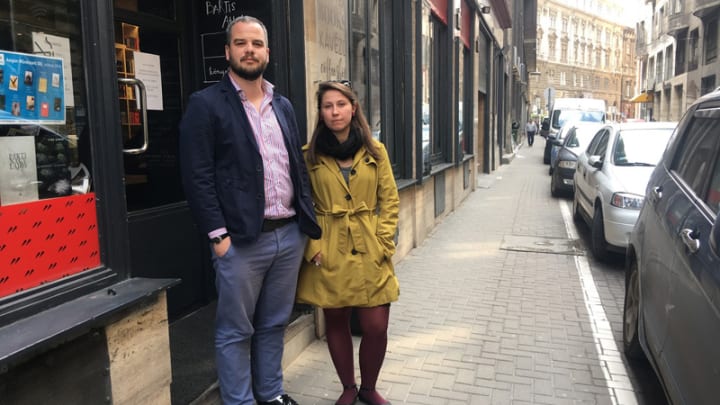
Zoltan Mester (left) and Vilja Arato, employees of the With the Power of Humanity Foundation. Michael Igoe/Devex

Among With the Power of Humanity’s staff, the debate over what is and is not an encroachment into party politics plays out constantly, Mester said. “Every day it’s a big fight … because especially in this time and especially in Hungary, everybody thinks that political is something bad … In Hungary if you say ‘political,’ you think about … party politicians.”…

“George Soros could have done many other things with his fortune, but that was the vision from the start — that those two were going to be the pillars of the ways in which he would then seek to define open society,” Vaquer said. “If you look at our budget 30 years later, that’s still what we are doing overwhelmingly. We’re still supporting civil society organizations and individuals. We haven’t changed that.”

The Open Society Foundations office in Budapest, Hungary. Devex/Michael Igoe

Faced with a constant barrage of accusations that they are part of George Soros’ secret plan to meddle in national politics, some of Open Society’s grantees find themselves responding to the obligatory questions that follow…..In accusing the foundation of orchestrating a global campaign to transform Europe and erode countries’ national sovereignty, OSF’s enemies ascribe much more power and reach to the organization than its employees and grantees would ever claim to have. It is tempting to do the same thing when asking if Open Society has been successful in achieving its goals. The declines in democratic freedom currently underway in many countries where Open Society operates might raise questions about whether the foundation and its benefactor have been operating with the right theory of change.

….

With the erosion of the values and norms it promotes, Open Society is not necessarily thinking differently about how the foundation measures its impact, but its leaders are coming to terms with a more realistic view of what is possible. “I think it has made us extremely aware of the limitations of what can be achieved with cross-border philanthropic activity,” Vaquer said. “It was perhaps a product of the exceptional time that was the 1990s that OSF had such a disproportionate impact on some places, in terms of being part of their political transformation, but that was probably exceptional.”

Igoe michael 1

[Michael Igoe is a Senior Reporter with Devex, based in Washington, D.C. He covers U.S. foreign aid, global health, climate change, and development finance. Prior to joining Devex, Michael researched water management and climate change adaptation in post-Soviet Central Asia, where he also wrote for EurasiaNet. Michael earned his bachelor’s degree from Bowdoin College, where he majored in Russian, and his master’s degree from the University of Montana, where he studied international conservation and development.]
….