Tomorrow 17 December there will be a Special session of the Human Rights Council on preventing further deterioration [now that is diplomatic language!] of the human rights situation in Burundi. The International Service for Human Rights (ISHR) is using the occasion to organize a side event on: “Escalation of Violence in Burundi: Human rights defenders voices from the ground” from 09.00-10.00 am in Room XII, Palais des Nations, Geneva. It will be webcast live on www.ishr.ch/webcast. Follow on twitter using the hash-tag #BurundiHRDs.
Panelists (moderator Nicolas Agostini of FIDH):
Mr PierreClaver Mbonimpa, Association for the Protection of Human Rights and Incarcerated Persons (APRODH), MEA Laureate 2007.
Last weekend, HURIDOCS office in Geneva and the office of an ally organization were burglarized; two of its desktop computers were stolen. Computers were the only stolen items at both offices, but it’s not possible to say whether the theft was specifically for information stored on the hard drives or just for the computers themselves. Either way, it states confidently in a message that they have not experienced a data breach, because both computers were encrypted and locked with strong passwords. They also didn’t lose any data, because it’s safely stored in Casebox. Here’s how to protect your information and yourself, critical for human rights defenders, in case of physical computer theft:
Lock your computer with a strong and unique password. All passwords should be strong and unique, but perhaps even most importantly for your computer itself. Simple passwords are more easily hacked by ‘brute force’ (guessing until success), seen by someone glancing as you type, or determined from camera footage (that’s why Snowden typed his passwords under a blanket in Citzenfour). There are some good tips for better passwords.
Safeguard all passwords. Do not keep your passwords written on paper near your computer. A multitude of secure passwords will be impossible to keep in mind, so we recommend using a password manager like KeePassX instead; KeePassX also rates the strength of your passwords.
Consistently lock your screen when you step away. Theft can happen very quickly and obviously, unexpectedly. Encrypt your hard drive. If it’s encrypted, no one else can read it. Check your settings in Filevault on Mac and Bitlocker or Veracrypt on Windows.
Regularly back up your encrypted hard drive to another location. If your computer is stolen, you’ll still have all of your information. If you use a password manager like KeePassX, your backup will include a locked file containing all of your passwords. To further protect yourself against privacy breaches and malicious threats, we also recommend to: Scan your hard drive for viruses at least once a week with updated antivirus software like Sophos or Avast.
Update your computer’s operating system and all critical software as soon as updates become available. These updates are often to better protect you from breaches. Set up two-factor authentication and two-step verification on all critical accounts like email, social networks, Apple ID, and shared workspaces. Change your passwords often.
HURIDOCS conclusion: If you’ve taken the above steps and your computer is stolen, you won’t need to worry about your data being stolen along with it. We strongly recommend all human rights defenders take these precautions.
At the occasion of the publication of the second (revised and updated) edition of Human Rights: A Very Short Introduction by Andrew Clapham, Professor of Public International Law (Oxford University Press), the Graduate Institute interviewed him, on 2 December, about the climate and long-term outlook for human rights. Andrew Clapham will be teaching a Spring 2016 course on The International Framework for the Protection of Human Rights as part of the Graduate Institute’s Master and PhD programmes in International Law. The book has an accompanying website which links to the main texts discussed.
How should we understand the concept of “human rights”?
Andrew Clapham: I have heard serious people in Geneva refer to human rights as ‘aspirations’ and I have heard it said that human rights are a ‘soft subject’. Both these misconceptions should be knocked on their heads. Human rights belong to all individuals and not to some future utopia. If those rights are violated, it represents a violation of the law, not the disruption of a dream. Human rights treaties and customary law are as ‘hard’ as trade or investment law. There are courts and prosecutors. Those convicted of genocide or torture go to prison. States found in violation of human right pay out millions in compensation. Of course there are violations of the law but that does not make the rights themselves imaginary.
Where are the main failures in the protection of human rights in 2015, and what can be done about them?
Clearly there are egregious violations of human rights today. The right to life is being viciously violated in Syria; torture remains widespread in multiple countries; discrimination is everywhere; rights to food, education, health care and adequate housing are being denied around the world; but the human rights framework is used to frame the complaints about such issues and to design policies which prevent future violations. The failure to end the suffering in Syria sits with leaders who have the capacity to change things. The enforcement of human rights can play a role in prosecuting those who have committed crimes under human rights law and ensuring that everyone has the right to seek asylum. The human rights framework can also be used to try to build a more stable and respectful society after the conflict
When is it justifiable for states to curtail or limit human rights?
Some rights, such as the right not to be tortured or the right not to be held in slavery can never be curtailed or limited; other rights related, say, to freedom of expression may have to be limited to protect the rights of others. Inciting racial violence is not protected by an absolute right to freedom of expression. Today, it is obvious that the right to privacy in one’s email correspondence is not absolute; it may have to be limited to protect others from threats to their lives through terrorist attacks. The discussion is over what procedures are necessary to limit such a right; should it be authorized by a judge, by the police, by a government minister?
Will we have a very different conception of human rights in 2065?
I doubt that any of the rights now included in the international texts will disappear, but their scope may be reduced or expanded. For example, there may be different expectations of privacy in 2065 – the right to be forgotten on the internet is only just emerging. In recent years we have seen new catalogues of rights for persons with disabilities and for indigenous peoples. I am confident that new rights for the elderly will be developed by 2065, and there will surely be developments along the lines of the right to a healthy environment. I suppose that eventually, some of the rights reasoning will be applied to sentient animals and the concept of animal rights will be more commonplace and less ‘aspirational’, but that is perhaps still quite a long way away.
“Yes there is!” according to True Heroes Films (THF)
A recent assessment of the communication practice of Geneva-based human rights organisations carried out by THF showed that many of them face the same challenges.
The guidelines are by necessity of a general nature and are based on the experience of NGOs in the Geneva area, but they they may help also others in thinking about their communications problems: Read the rest of this entry »
This one minute trailer by THF is a good introduction to tonight’s MEA ceremony. Starts shortly after 18h00 Geneva time and can be followed on www.martinennalsaward.org.
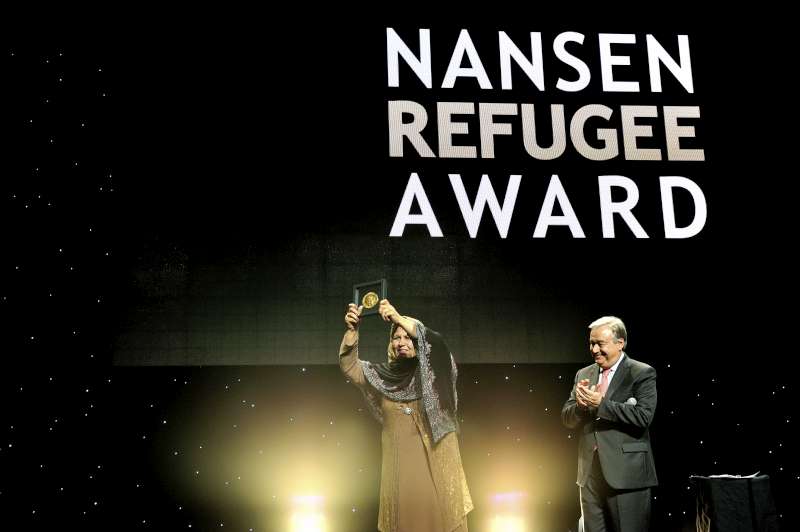
October seems to be very much the season of awards. Tonight is the MEA announcement and yesterday UNHCR presented the 2015 Nansen Refugee Award to Afghan refugee teacher Aqeela Asifi:
Aqeela Asifimade it her mission over more than 20 years in exile to bring education to refugee girls in a remote community in Pakistan. Asifi has been recognised for her tireless dedication to education for Afghan refugee girls in the Kot Chandana refugee village in Mianwali, Pakistan – while herself overcoming the struggles of life in exile. Despite minimal resources and significant cultural challenges, Asifi has guided a thousand refugee girls through their primary education.
“When I first set up my school I was not very optimistic. This success is beyond my expectations. Let the dove of peace be our messenger, let us shun the culture of war and weapons and let us promote the culture of pen and education. That’s the only way, my dear brothers and sisters, that we can bring peace and prosperity to our country.” Asifi said.
The Award ceremony, in Geneva’s Bâtiment des Forces Motrices, featured performances from UNICEF Goodwill Ambassador and two-time Grammy winner, Angelique Kidjo, and UNHCR Honorary Lifetime Goodwill Ambassador, Barbara Hendricks.
For those wanting to submit candidates for the 2016 MEA, please note that the nominations deadline is one month earlier than in the past, i.e. 9 November 2015. Nominations can be submitted electronically at www.martinennalsaward.org
The Jury of the Award is composed of the following NGOs:
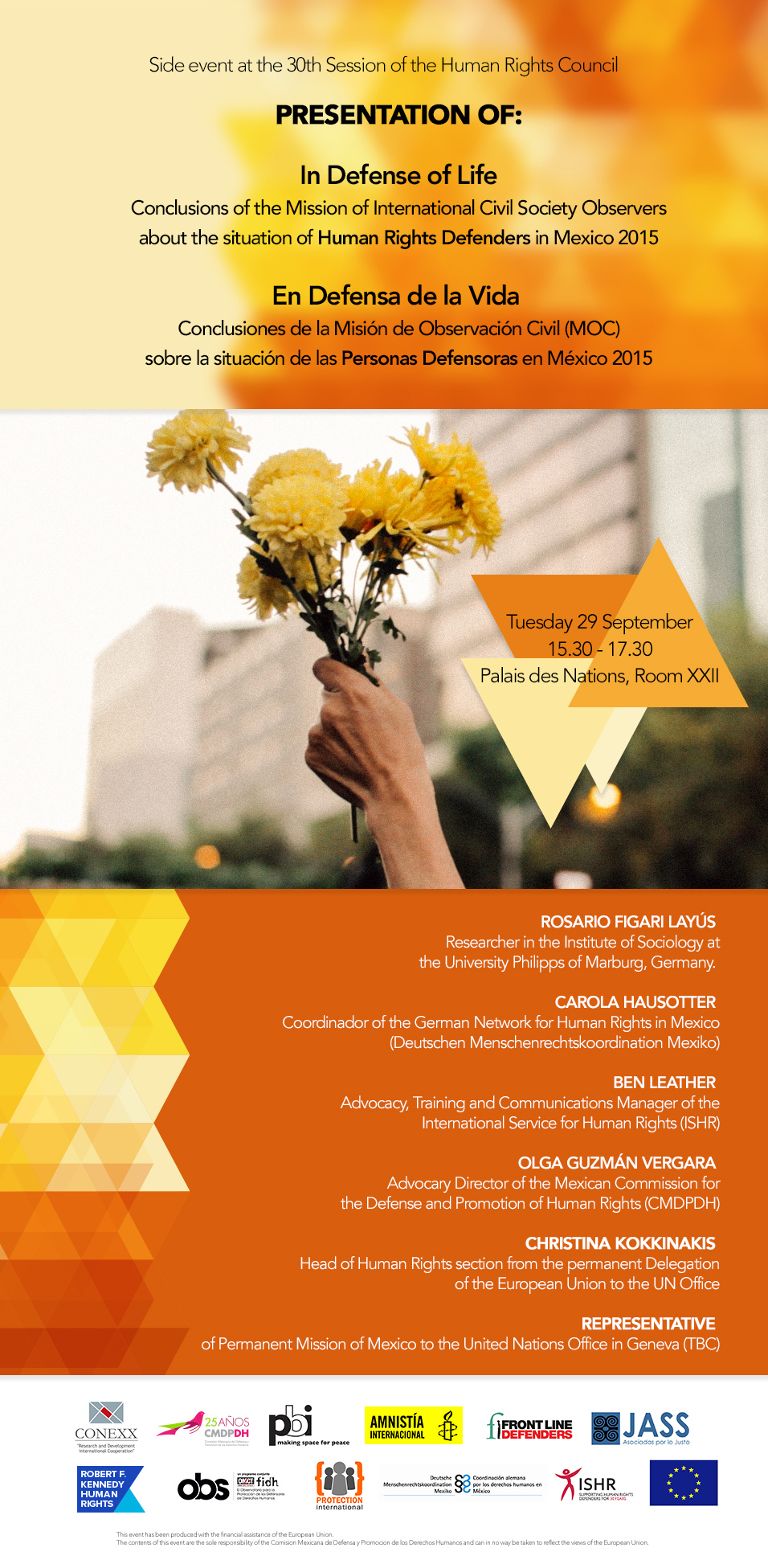
On Tuesday 29 September (15h30 – 17h30, Palais des Nations, Room XXII, Geneva), the CMDPDH, Asociación Civil and ISHR organise a side event about the situation for human rights defenders in Mexico. [A Mission of International Observers visited Mexico in November 2015 and will present its conclusions – under the title “In Defense of Life” – to the Mexican Government within the framework of the 30th session of the Human Rights Council.]
Panelists in the event are::
Rosario Figari Layús – Researcher in the Institute for Interdisciplinary Research on Conflict and Violence (IKG) at the University of Bielefeld, Germany.
Carola Hausotter – Coordinador of the German Network for Human Rights in Mexico (Deutschen Menschenrechtskoordination Mexiko)
Ben Leather – Advocacy, Training and Communications Manager of the International Service for Human Rights (ISHR)
Olga Guzmán Vergara – Advocary Director of the Mexican Commission for the Defense and Promotion of Human Rights (CMDPDH)
Ambassador Jorge Lomónaco Tonda – Permanent Representative of Mexico to the UN in Geneva (TBC)
Christina Kokkinakis – Head of Human Rights section from the Permanent Delegation of the European Union to the UN in Geneva
In this short video produced by True Heroes Films (THF) spokespeople for armed non-state actors explain why they feel they have to adhere to humanitarian standards. The definition of human rights defenders excludes those who advocate or use violence but the importance of them respecting basic standards is a crucial, long-term issue.
This Geneva Call short video features 13 high-level representatives of armed non-State actors (ANSAs) from 10 countries, including Syria, Burma/Myanmar and Sudan. In it, they explain why they think it is so important to enter into a dialogue with Geneva Call on humanitarian norms and the protection of civilian populations. Although ANSAs are responsible for violations of humanitarian norms in many conflicts, it is possible to engage them in a dialogue about respecting those norms.
It is in ANSAs’ interests to respect humanitarian norms, not only to gain support from populations in the areas they control but also to maintain a good reputation. Complying with humanitarian norms often sits well with the political or religious values that are at the root of their struggle, and compliance can make them more credible interlocutors when peace negotiations take place.
These statements were filmed at Geneva Call’s Third Meeting of Signatories in November 2014. This meeting in Geneva brought together 70 high-level representatives of 36 ANSAs from 14 different countries.

 Last weekend,





 Hans Thoolen on Human Rights Defenders and their awards