Posts Tagged ‘funding’

First assessment of Human Rights under the Trump Administration by HRW

March 5, 2025

Amy Braunschweiger speaks with Human Rights Watch’s US Program Director Tanya Greene, who leads research within the United States, as well as Washington Director Sarah Yager, who advocates with the US government on global issues, about the slew of executive orders President Trump has issued, the damage to human rights his administration’s policies have already done, and where we go from here.The text – reproduced in full below, was published on 3 March 2025.

See also: https://youtu.be/N_hCOCVuJsA?si=t2lUEb3Fw8XWH7Vo where UN human rights chief Volker Türk has voiced deep concerns for hostilities happening across the globe, including a “fundamental shift in direction” of the US. He expressed concern over a peace deal in the Russia-Ukraine war that did not involve Kyiv.

President Trump has been governing by executive orders. Could you give us some quick background on executive orders and what they do?

TG: An executive order is a presidential directive regarding federal government operations and policies. Their reach and power can be extraordinary, including because they often impact federally funded non-governmental entities, like universities and housing providers. Executive orders should be based on existing law, and are often operationalized through agency action, such as the departments of labor, homeland security, or education.

Many of Trump’s executive orders are facing court challenges arguing that they are unconstitutional or otherwise illegal. For example, his executive order denying citizenship to children of undocumented people born in the United States has been stayed by the courts pending a legal challenge. It is widely seen as a clear violation of the 14th amendment to the Constitution.

Although the implementation of executive orders is not always automatic, widespread responses have been preemptive, anticipatory, and fearful, which is likely what Trump intended in this blitz of actions.

SY: These executive orders show how split the United States is. In 2016, Trump’s executive orders reversed former President Barack Obama’s. Then Joe Biden reversed Trump’s orders. And today, Trump reverses Biden’s. But this isn’t typical. It shows the divisive nature of US politics.

It’s also not typical that so many of these current orders are harmful to human rights.

Many of Trump’s executive orders harm human rights, both in the United States and around the world. Meanwhile, billionaire Elon Musk’s “Department of Government Efficiency,” or DOGE, is laying off masses of federal employees at various agencies. What are we most concerned about inside the US?

TG:  Whatever its supposed intentions, DOGE is slashing and burning to the point that a growing number of federal agencies are crippled by lack of resources, staff, and competent leadership. DOGE is also taking down websites and data that we rely on, both as human rights defenders and as the general public seeks information. For instance, hospitals across the country can no longer obtain important public health data from the Centers for Disease Control and Prevention.

Human Rights Watch is investigating the treatment of immigrant children, racial justice impacts, environmental concerns, healthcare access, rights of lesbian, gay, bi-sexual, and transgender people, and reproductive freedoms. You have a president that says diversity, equity and inclusion (DEI) is “dangerous, demeaning and immoral” but offers no ways to fight racial injustice, and yet one of his executive orders allows for resettling certain supposedly-persecuted white South Africans in the US, just after an earlier order closed the refugee admissions door on all other refugees worldwide.

Immigration enforcement raids and other enforcement activities in the last month have targeted all immigrant communities, disproportionately those of color. Enforcement has targeted immigrants regardless of how long they have been in the United States and without considering their contributions to their communities, as well as people in the process of an immigration proceeding, where a judge decides if they can stay in the US.  As a result, there are communities in which many people are terrified and some avoid going to church or the hospital, and many children don’t go to school.

There is also an order now in place defunding reproductive justice and abortion access both in the US and around the world.

The stock value of GEO Group, a company the US government has long contracted with to run private immigration detention facilities, went up immediately after Trump’s election, presumably in anticipation of ramped-up immigration detention in private facilities. Human Rights Watch has long called for investment in community-based public safety solutions rather than more prisons.

What are we worried about in terms of US foreign policy?

SY: The foreign aid freeze and termination of thousands of State Department grants is a key focus for us right now, though of course there are new concerns that rise up every day. The aid being stopped has had awful consequences around the world. People will die needlessly because of this one policy decision.

There is also an impact on civil and political rights abroad. Russian independent media outlets, which have been doing an amazing job exposing the Kremlin’s repression and debunking the official propaganda, received significant US-funding. Terminating aid will severely undercut that work. The same thing with Belarusian independent media.

Many human rights defenders targeted by their governments lived in US-funded safe houses, which are now closed.

Small human rights groups, some the only ones in their country, are on the verge of closing. We’re going to see the ripple effects and deaths in populations unable to stand up for their freedoms without this funding and the political support the United States gave.

Aside from the aid freeze, Trump and Secretary of Defense Pete Hegseth fired the military’s top lawyers. Military lawyers are supposed to ensure US military operations abide by international law, the laws of war.  This could mean far more harm to civilians, who are supposed to be protected, when the US military is in an armed conflict. In fact, Trump also just lifted limits on US commanders authorizing airstrikes and special operations raids outside of war zones, which rolls back 20 years of work to ensure only combatants are targeted and only in recognized armed conflicts.

These kinds of actions will have long-term ramifications on how people around the world view the United States.

When there’s so much happening in a short period of time, how does Human Rights Watch approach its work?

TG: We remember our priorities and how we can make a difference. There’s a lot of noise and distraction so we have to be thoughtful about putting limited resources into efforts that have impact. Our research on immigration raids or deportation flights might be used in partner litigation; our interviews with witnesses to abuses help support policymakers advocating in support of human rights.

As an organization with colleagues who deal with repressive states and authoritarian regimes globally, those of us working in the US are informed of effective strategies and lessons learned as we encounter them here. And we can share this information with partners on the ground and policymakers, too.

SY: We were not caught off guard by this. We were able to plan. I do think the speed, the apparent vindictiveness, and the level of chaos of Trump’s first month in office shocked many people. But we planned for this. We had a strategy that we are now implementing. We are going to engage with every policymaker that we can. We know for a fact many on both sides of the aisle don’t agree with what is happening. We are going to document the Trump administration’s impact on human rights around the world, and we’re going to try and block or end those policies. We are working together with our partners, some of whom focus on strategic litigation – litigation designed to advance respect for and protection of rights.

How is Human Rights Watch responding to this? What is our work inside the US focusing on?

TG: All the areas of work I mentioned are under attack by the new administration.

The immigration space is fraught with misinformation that stokes fears and prejudices, but we counter that with fact-finding and with the stories of the real people who are harmed by dehumanizing rhetoric and policies.  We will build on our track record of careful research on problematic immigration policies from previous administrations, including the first Trump administration, exposing harmful policies such as inhuman and degrading immigration detention and the separation of migrant children from their parents. We are continuing this work, documenting what’s happening to people and using it to advocate for change.

We’ve seen US Immigration and Customs Enforcement (ICE) deporting Iranian families with children to Panama with an agreement that the US will pay for Panama to deport them to Iran. A country cannot lawfully send Iranian asylum seekers to Panama without hearing their claims and just be done with it – sending them back to a country to face persecution violates international refugee law. The administration is also preparing to deport unaccompanied immigrant children – not just cruel and terrifyingly dangerous, but a human rights violation.

In the democracy space, some US voters seem ready to trade freedoms away for supposed gains that are ultimately long-term losses, like increased surveillance, that will embolden and enable bad actors in government.

In the racial equality space, we’ve been working on education, and that is a battle zone. We are doing research to expose state-level policies that censor and distort school curricula in ways that are inconsistent with human rights norms—measures that target the histories and experiences of Black, Indigenous and LGBT people in particular. If those efforts succeed they will be exported to other states.

How is our work responding to changes in the foreign policy space?

SY: The Trump executive order putting in place a sanctions program targeting the International Criminal Court has already done damage. We are working to convince the Senate not to legislate more sanctions, and to make sure other governments step up to defend the court from US pressure.

We continue to focus on some of the conflicts where we think the Trump administration could play a valuable role. When it comes to Sudan, where the US government itself said a genocide took place, the US could pressure allies like the United Arab Emirates to stop supplying weapons to the Rapid Support Forces, one of the abusive warring parties there.

President Trump says he wants to be a peacemaker. There are ways he could do that, but so far we are seeing very worrying foreign policy proposals. For example, Ukraine’s future is being discussed by the United States and Russia without Ukraine, and in Gaza, Trump has proposed permanently and forcibly displacing the Palestinian population, which would amount to crimes against humanity and ethnic cleansing.

Some people would say there is no way to engage with this administration on human rights.

SY: Engaging is certainly more challenging. But we don’t want to just walk away from our advocacy with US officials. Then you give up the power of the human rights movement, and any opportunity to change the minds of policymakers. There are still people in this administration who care about human rights. They may talk about it differently, they may be focused on particular places or issues. We’ll start there and make our case for the US role in lessening suffering and protecting rights around the world, not only because it’s good but because it’s smart and it’s in the US interest.

And there’s Congress, which needs to step up as a check on the power of the White House. We will continue to work with House representatives and Senators on both sides of the aisle.

TG:  The fear that the administration is cultivating among the public is dangerous, and information is so critical in response. That’s why we respond with research, arming people with facts. We know there are members of congress and state leadership like governors that support human rights. They are also empowered by our work.

What can people in the US do in this situation?

SY: If we want to see rights on the agenda, we need to see people in the United States reaching out to their representatives in Congress. They were elected to bring to Washington the needs and desires of their people.

Also, if you see a person acting with courage in these difficult times, thank them. We’re going so fast, and we push and yell and scream, and then when a policymaker, a celebrity, or the head of a local food bank steps out and does the right thing, we move on. Stop for a minute and recognize the people doing the right thing. Make the space for them to keep doing that important work of holding the line.

TG: Also, you too can be that person. Share the information. Have the conversations with your friends and family, provide what you know, encourage exchange of real information. It’s about building community. One of the strongest weapons we have is our unity, and we can each do something to build that.

Religious communities and school groups and community centers, there are many places we can plug in to make a difference. Support your local homeless shelter or food pantry. Sponsor or reach out to refugees and immigrants living in your localities. I think the big risk is feeling powerless and unplugging. I know the temptation is great. We each don’t have to do everything. But if we all do something, that’s more than nothing. And don’t be afraid to hear “no” or lose on your first try. No is the first step to yes.

And remember that there have been people in this country who have been targeted for abuse and destruction by the government their entire time in this country. Us as Black people, Indigenous people. And we’ve not only survived but thrived, and there are lessons to be learned from those struggles. And for the rest of the US population, we are a nation of mostly immigrants who came here to escape ills like human rights abuses or poverty. So gain strength from that.

We’re doing this work for the next generation as well as the present. Not only are we trying to protect rights for them, we are also modeling what to do when you have problems and face difficulties.

https://www.hrw.org/news/2025/03/03/interview-snapshot-rights-under-trump-administration

Impact of US funding freeze on human rights defenders

February 6, 2025

The suspension and, in some cases the termination, of US foreign aid is having profound and adverse human rights impacts, threatening the very existence says Phil Lynch of ISHR in his Director’s update: “Impact of US funding freeze on human rights defenders and ISHRe of many human rights defenders, organisations and institutions“.

ISHR is directly affected by the US funding freeze. The suspension of US government funds means we’ve already had to terminate, defer or reduce activities to support human rights defenders working in highly restrictive contexts.

Together with announced and anticipated reductions in support for human rights organisations from some other governments and institutional philanthropy, it has also required that we take a number of significant anticipatory cost-saving measures, reducing our capacity to support human rights defenders globally.

The US funding freeze is also very adversely affecting a number of our national NGO partners, including those supporting human rights defenders in countries such as Afghanistan, China and Venezuela, among others. If you are in any position to support these organisations we would be delighted to connect you.

As I have recently written together with incoming and outgoing ISHR Board Chairs Taaka Awori and Vrinda Grover, we simply can’t afford to give up hope in our shared work for freedom, equality and justice. But we will not win and cannot survive on starvation rations.

We need investors – governments, foundations, corporations and individuals – to join us and create the resources that enable us to be sustainable, innovative and impactful. We particularly need medium and small States to step up investment, not only because it is the right thing to do, but also because their interests are not served by the law of the jungle where might is right.

This investment needs to be made in civil society at the national, regional and international levels, as well as in the international human rights system to which frontline defenders increasingly turn when justice and accountability are denied at the national level. The realisation of human rights will provide an unmatched return on investment.

..

And we invite you to take action for a fairer future now, whether by sharing our training and information  material, amplifying our messages on social media, making a donation or in-kind contribution, or participating in our campaigns. Your every action makes a difference. 

https://ishr.ch/latest-updates/directors-update-impact-of-us-funding-freeze-on-human-rights-defenders-and-ishr

https://www.freiheit.org/sub-saharan-africa/are-trumps-policies-holding-human-rights-organisations-hostage

and later:
https://www.amnestyusa.org/reports/lives-at-risk-chaotic-and-abrupt-cuts-to-foreign-aid-put-millions-of-lives-at-risk/

McGovern Foundation awards $73.5 million for human-centered Artificial Intelligence

January 6, 2025
McGovern Foundation awards $73.5 million for human-centered AI

The Boston-based Patrick J. McGovern Foundation has announced on 23 December 2024 grants totaling $73.5 million in 2024 in support of human-centered AI.

Awarded to 144 nonprofit, academic, and governmental organizations in 11 countries, the grants will support the development and delivery of AI solutions built for long-term societal benefit and the creation of institutions designed to address the opportunities and challenges this emerging era presents. Grants will support organizations leveraging data science and AI to drive tangible change in a variety of areas with urgency, including climate change, human rights, media and journalism, crisis response, digital literacy, and health equity.

Gifts include $200,000 to MIT Solveto support the 2025 AI for Humanity Prize; $364,000 to Clear Globalto enable scalable, multilingual, voice-powered communication and information channels for crisis-affected communities; $1.25 million to the Aspen Instituteto enhance public understanding and policy discourse around AI; and $1.5 million to United Nations Educational, Scientific and Cultural Organization(UNESCO) to advance ethical AI governance through civil society networks, policy frameworks, and knowledge resources.

Amnesty Internationalto support Amnesty’s Algorithmic Accountability Lab to mobilize and empower civil society to evaluate AI systems and pursue accountability for AI-driven harms ($750,000)

HURIDOCSto use machine learning to enhance human rights data management and advocacy ($400,000)

This is not a moment to react; it’s a moment to lead,” said McGovern Foundation president Vilas Dhar. “We believe that by investing in AI solutions grounded in human values, we can harness technology’s immense potential to benefit communities and individuals alike. AI can amplify human dignity, protect the vulnerable, drive global prosperity, and become a force for good.

https://philanthropynewsdigest.org/news/mcgovern-foundation-awards-73.5-million-for-human-centered-ai

Canadian Minister Joly announces funding for child human rights defenders and independent media

December 17, 2024

As the world marked Human Rights Day, Canada reiterated the importance of the protection and promotion of human rights defenders and their critical work. Mélanie Joly, Minister of Foreign Affairs, announced $1.85 million in funding for two projects that support child human rights defenders and a free and independent media worldwide.

Canada is contributing $850,000 to a three-year project led by Child Rights Connect to empower, to protect and promote the rights of child human rights defenders, who are increasingly engaged in global human rights challenges, without the same legal protections as adults. This funding will help Child Rights Connect promote safe and sustainable human rights advocacy by child human rights defenders in Togo, Thailand, Moldova and Brazil.

Canada will also contribute an additional $1 million to the Global Media Defence Fund, bringing Canada’s total contribution to the fund to $4 million. Administered by UNESCO, the Global Media Defence Fund works to enhance the protection of journalists and media organizations so they can carry out their critical work without fear of violence, censorship or intimidation. The fund will also ensure public access to diverse and reliable sources of news and information. [see also: https://humanrightsdefenders.blog/2024/02/12/investigative-journalism-in-arab-states-the-threats-to-journalists/]

In the face of growing challenges to human rights globally, the work of human rights defenders and the protection of media freedom are more important than ever. Canada stands unwavering in its commitment to working with partners to safeguard and expand the protection and promotion of human rights defenders and journalists around the world.” – Mélanie Joly, Minister of Foreign Affairs

https://reliefweb.int/report/world/minister-joly-announces-support-human-rights-defenders-and-media-freedom

10 December 2024: Open Society reaffirms its commitment to human rights

December 12, 2024

On International Human Rights Day, the Open Society Foundations reaffirmed their vision for a shared humanity where everyone can thrive, continuing the philanthropy’s role as the world’s largest private funder promoting rights, equity, and justice.

Under the leadership of Chair Alex Soros, the philanthropy is streamlining its programming to support new voices and approaches that align with today’s emerging forms of organizing and leadership. The Foundations will pursue targeted time-bound efforts, provide long-term institutional support, and retain the flexibility to respond to crises through rapid response funds.

Binaifer Nowrojee, president of the Open Society Foundations, said: 

Across the world, we are seeing inspiring and powerful movements working to shape a future framed by human rights. Standing with them as allies, we will deepen, broaden, reimagine, and catalyze efforts to advance a new vision of human rights that is not bounded by historic double standards, exclusions, and inequities.

We are crafting and implementing thoughtful, future-focused strategies for change that will leverage gains made through key openings and convert them into wins. Our investments will aim to work with groups to build on and sustain these wins over time. We are committed to listening and to being informed by the needs of allies leading the fights for rights, equity, and justice.

The commitments include multiyear investments across a broad range of issues and geographies, including:

  • Rights protection: Supporting human rights advocacy as well as protection of rights defenders at risk, particularly environmental and women’s groups
  • Inclusion: Ensuring marginalized and vulnerable groups can fully exercise their rights without fear of violence or discrimination
  • Public safety: Promoting communities-centered approaches to tackling repressive or militarized responses to violence and public safety
  • Accountability: Supporting human rights–based litigation in national, regional, and international courts
  • Political participation: Supporting new champions and nonpartisan movements of inclusive and accountable democratic practice in specific countries and globally
  • Economic rights: Developing and promoting new state-led economic models for a green transformation to advance economic and social rights

In 2025, Open Society will be approving further programming to promote rights, equity, and justice.

Open Society has also approved funding across other areas, including ideas, impact investing, advocacy, and higher education.

https://www.opensocietyfoundations.org/newsroom/open-society-reaffirms-its-commitment-to-human-rights

https://www.opensocietyfoundations.org/voices/strengthening-protection-for-rights-defenders

Humanists International awarded grants to 13 projects worldwide through 2024 Grants Program

July 1, 2024

Humanists International announced on 24 June 2024 that it has awarded grants to 13 projects worldwide. This initiative, awarding a total of £36,300 through the 2024 Grants Program, provides financial support to bolster humanist endeavors and empower organizations working to advance humanist values across the globe.

The grant program in 2024 was made possible thanks to a very generous legacy gift left to the organization by the late Professor Dabir Tehrani, who was a long-standing supporter of Humanists International.

The call for applications, opened from April to May, attracted a wide range of proposals. Selected projects, kicking off this month, will continue until January 2025. Grants were awarded exclusively to Members and Associates of Humanists International, focusing on five key areas:

  • Development Grants: Supporting the growth and sustainability of humanist organizations, particularly in developing countries.
  • Digital Humanism Grants: Encouraging projects that utilize technology to promote humanist values online.
  • Humanist Ceremonies Grants: Building capacity for humanist celebrants to offer alternative ceremonies like weddings and funerals.
  • Regional Networking Meetings Grants: Facilitating gatherings and collaboration between humanist organizations within specific regions.
  • Young Humanist Grants: Empowering young people to become active participants in the humanist movement.

For members interested in applying for future grants, Humanists International also offers the year-round Cafe Humaniste Grant. This program supports small, in-person, or online gatherings where members can discuss any topic related to humanism.

Dooyum Dominic Ingye, Project Head at Advocacy for Alleged Witches, one of the grant recipients, said:

“We are truly honored and grateful that the Advocacy for Alleged Witches (AFAW) has been selected to receive the Humanists International Development Grant for our project. This funding will make a significant difference in our ability to advocate for justice, provide legal aid, and empower alleged witches to stand up against the discrimination and violence they face.”

Javan Lev Poblador, Membership Development Officer of Humanists International, commented:

“We are delighted to support these 13 projects making a tangible difference in local and international communities by promoting humanism. These grants will equip our Members and Associates with vital resources to grow and extend their impact.”

https://humanists.international/2024/06/humanists-international-supports-13-global-humanist-projects-in-2024/

What is the human rights funders network (HRFN)?

June 24, 2024

Human rights funders network (HRFN) is a NETWORK OF FUNDERS in the global south, east, and north dedicated to resourcing HUMAN RIGHTS ACTION around the world. Its members boldly SUPPORT MOVEMENTS leading us toward a more just future.

For almost 30 years, Human Rights Funders Network (HRFN) has brought funders together to collaborate, strategize, and advance the field of global human rights grantmaking. Today, we are crafting an HRFN that relentlessly builds toward justice, works with love, and continues to serve as a space for funders to strategize together and with movements.

Its vision is a peaceful future where rights are protected and upheld, the planet is cared for, and all people can live and love with dignity.

Learn more about HRFN programs, member events, and emerging human rights issues.

New ProtectDefenders.eu study reveals urgent need for increased funding and support for human rights defenders

June 14, 2024

In the study The Landscape of Public International Funding for Human Rights Defenders, released on 12 June 2024, ProtectDefenders.eu sheds light on the critical challenges faced by human rights defenders (HRDs) worldwide, specifically focusing on their financing by public actors.

The research, which combines an analysis of financial data over a period of four years with interviews, investigations, and input from defenders, underscores the pressing need for greater financial support and resources to safeguard the invaluable work of human rights defenders in promoting and protecting human rights globally.

The ProtectDefenders.eu study reveals and documents a concerning trend: while the need for support for HRDs has never been greater, funding levels have stagnated, with only marginal increases observed over the examined period. Despite rhetoric emphasising the importance of prioritising human rights prioritisation, the actual allocation of resources has failed to keep pace with the deteriorating global situation, representing a mere 0.11% of total Official Development Assistance (ODA) annually.

Key findings from the study include:

  • Disparity in funding: While some donors have demonstrated a strong commitment to supporting HRDs, others have allocated minimal resources, with wide variations observed among donor contributions. This disparity is also evident among different groups of defenders and thematic areas, as well as in funding dynamics by region, with a concerning decrease in attention to the MENA region
  • Challenges in accessing funds: HRDs continue to face obstacles in accessing international funds, including restrictive funding requirements and bureaucratic hurdles
  • Need for core funding: There is a critical need for core, flexible, and sustainable funding to enable HRDs to effectively carry out their vital work
  • Lack in localisation efforts: The study emphasises the importance of localising HRD protection programs and ensuring that funding reaches grassroots organisations and movements.

This research underscores the urgent need for action to better support human rights defenders and is a call to action for donors, policymakers, and stakeholders to stand in solidarity with human rights defenders,” said Gerald Staberock, Chair of the Board of ProtectDefenders.eu and Secretary-General of the World Organisation against Torture. “HRDs play a vital role in advancing human rights and democracy worldwide, yet they continue to face increasing risks and challenges. It is imperative that donors and stakeholders heed the recommendations outlined in this study to ensure that HRDs receive the support they need to carry out their crucial work.”

In response to these findings, the study presents a series of detailed recommendations aimed at addressing the funding gap and improving support for HRDs. These recommendations include increasing overall funding levels, reducing restrictions on grants, enhancing political and diplomatic support, and investing in donors’ own capacities to better understand the needs and contexts of HRDs.

ProtectDefenders.eu issues a clear call to all donors and public actors to urgently address this situation. Specifically, the demands include:

  1. Increase in public funding: Advocating for an increase in public funding for HRDs from 0.11% to 0.5% for the period 2025-2028.
  2. Building trust through core grants: Urging for more core grants with reduced restrictions, audits, lower result expectations, and extended support horizons.
  3. Directing more grants locally: Advocating for a higher proportion of grants to be allocated to local NGOs to ensure funding reaches grassroots organizations and movements.
  4. Establishment of HRD principles for regranting: Calling upon the community of donors and financiers of HRD work to establish HRD Principles for Regranting, outlining guidelines for more effective and equitable distribution of funds.

The full report, along with its recommendations, can be accessed here.

https://protectdefenders.eu/projects/research-institutional-funding-human-rights-defenders/

https://www.omct.org/en/resources/news-releases/new-protectdefenders-eu-study-reveals-urgent-need-for-increased-funding-and-support-for-human-rights-defenders

Funding for individual women human rights defenders

June 8, 2024

Safety Net funding is for individual women human rights defenders (WHRDs) from or working in conflict and crisis affected countries, who, due to their commitments to human rights and peace, currently face – or have faced risks – with resulting impacts that continue to threaten their safety and work. SAFETY NET DOES NOT FUND CIVIL SOCIETY ORGANIZATIONS OR PROGRAM IMPLEMENTATION.

The WPHF Window for WHRDs Safety Net aims to improve the security and protection of WHRDs by providing for, but not limited to: 

  • Temporary relocation costs (e.g. accommodation, food and transportation) 
  • Security and protection costs (e.g. secure transportation, digital or physical security training) 
  • Equipment (e.g. mobile phone, computer, security system and cameras) 
  • Self-care (e.g. physical or mental health support) 
  • Legal assistance  
  • Repatriation costs, to facilitate return and reintegration in home country

Safety Net grants are provided for amounts up to USD 10,000 (subject to revision by the NGO partners of the WPHF Window for WHRDs) to cover needs for a duration of up to six months.

Eligibility Criteria

  • Gender: women and those who identify as women. This includes lesbian, gay, transgender and intersex (LGBTI) human rights defenders.
  • Age: 18 years old and above. 
  • Country of origin: from/working in conflict and crisis-affected contexts. *See for reference countries that might be eligible for support: List of matters of which the UN Security Council is seized: S/2023/10
  • Human rights activities: provides details of peaceful engagement in the advancement of human rights, either individually or through a civil society organization.
  • Threats and risks:
    • Demonstrates current or past serious security risks for her and/or her dependents, because of her commitment to human rights and peace; AND/OR
    • Demonstrates that risks are – or have been such – that her ability to keep working on behalf of human rights and peace is threatened.
  • Grant and duration: the requested funding cannot exceed USD 10,000, or cover needs beyond an anticipated 6-month period. 

Decision-making process

You can submit your application using one of the two below methods below

Offline: click the below button to download a Word version of this form, then email it to WPHF-WHRD@unwomen.orgAPPLICATION FORM – FLEXIBLE FUNDINGE nglish

Online: complete the secure, data encrypted application form below, then click the ‘Submit’ button at the bottom of the page. APPLICATION FORM

The Window for WHRDs is demand-driven and accepts requests on a rolling basis. 

For further information on safe online communication, please see: https://ssd.eff.org/en/module/communicating-others. We also encourage you to visit: https://www.accessnow.org/help/ to access 24/7 help in multiple languages to protect yourself online.

WPHF Funding Window for WHRDs NGO Partners 

NHRF Annual Report for 2023

June 4, 2024

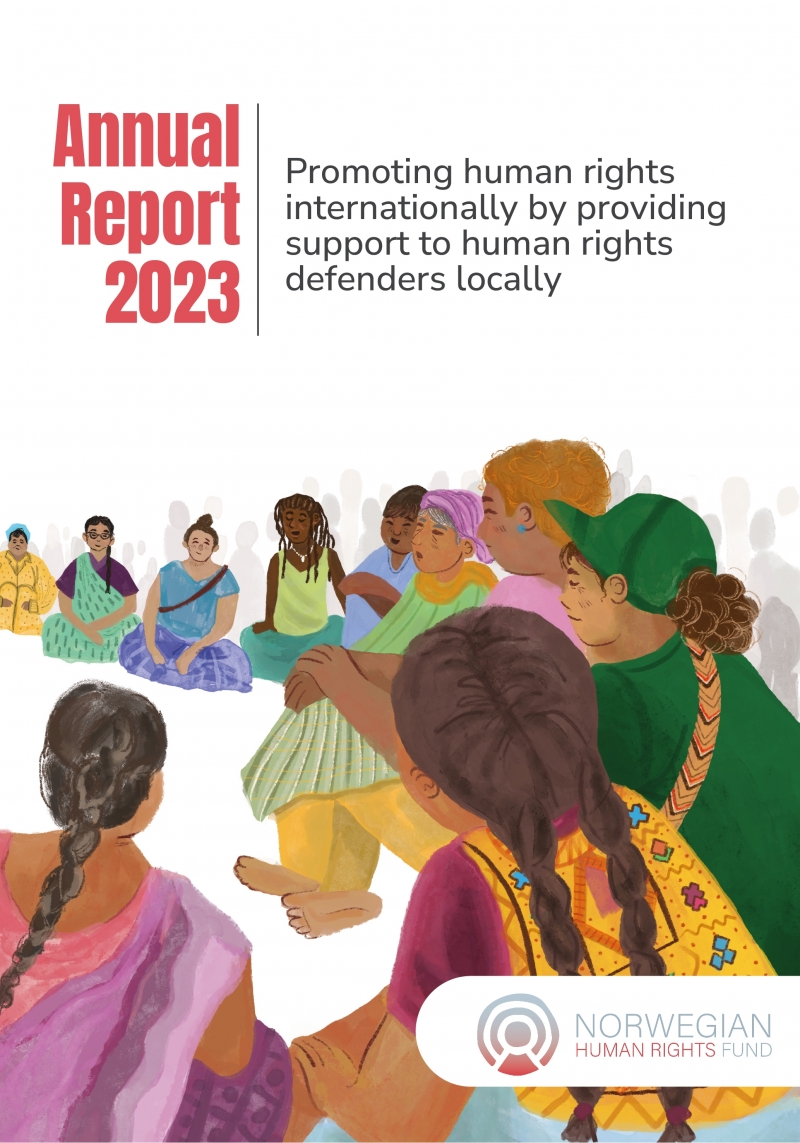
In the NHRF Annual Report for 2023, you will find comprehensive information on the NHRF’s activities and the remarkable work carried out by its grantee partners throughout the year.

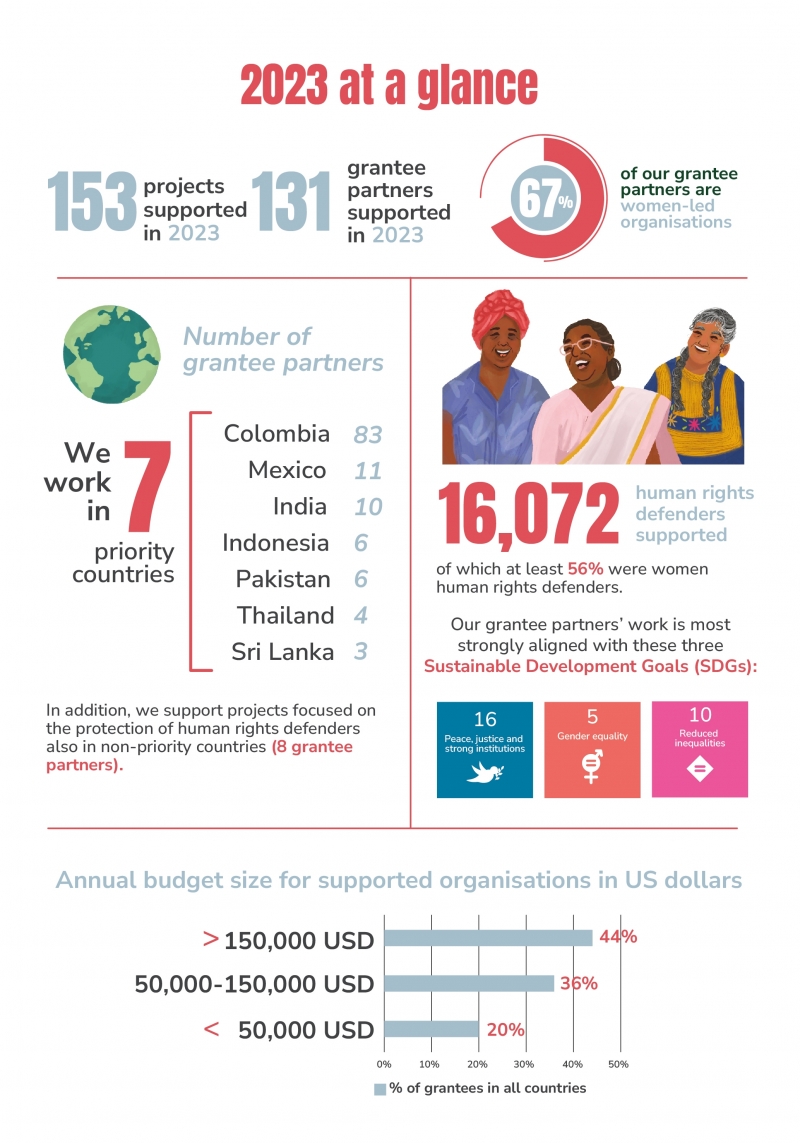
In 2023, NHRF supported 153 projects and 131 grantee partners in 7 priority countries. Through these projects, 16,072 human rights defenders were supported, of which at least 56% were women human rights defenders.

Scroll down this page to read the full annual report or open it here. You will find annual reports from previous years at the end of this page.

Image
Image

https://nhrf.no/our-impact/annual-reports