Posts Tagged ‘Front Line (NGO)’
January 16, 2016
Calls of nomination for two major human rights awards are now open:
The  Front Line Defenders Award for Human Rights Defenders at Risk was established in 2005. The Award seeks to focus international attention on the human rights defender’s work, thus contributing to the recipient’s personal security, and a cash prize of Euro 15,000 is awarded to the Award recipient and his/her organisation in an effort to support the continuation of this important work. If you would like to nominate a human rights defender for the Twelfth Annual Front Line Defenders Award for Human Rights Defenders at Risk (2016), please click on the following link to access a secure online nomination form: https://www.frontlinedefenders.org/secure/nomination.php (English). Age deadline is Friday 19 February 2016.
The Parliamentary Assembly of the Council of Europe (PACE), in partnership with the Vaclav Havel Library and the Charta 77 Foundation, has today issued a call for nominations for the 2016 Václav Havel Human Rights Prize, which will be awarded on 10 October in Strasbourg. The Prize aims to reward outstanding civil society action in defending human rights in Europe and beyond. Candidates should have made a real difference to the human rights situation of a given group, been instrumental in uncovering systemic violations on a large scale, or have successfully mobilised public opinion or the international community for a given cause. The Václav Havel Human Rights Prize consists of a sum of €60,000. The deadline is 30 April 2016. More details can be found at http://assembly.coe.int/nw/xml/News/News-View-EN.asp?newsid=5976&lang=2&cat=37.
—-
For more on these and other awards see True Heroes’ awards Digest:
http://www.brandsaviors.com/thedigest/award/front-line-defenders-award
http://www.brandsaviors.com/thedigest/award/václav-havel-prize-human-rights
Posted in awards, Front Line, Human Rights Defenders | Leave a Comment »
Tags: call for nominations, Council of Europe, digest of human rights awards, Front Line (NGO), Front Line Defenders Award for Human Rights Defenders at Risk, human rights awards, Parliamentary Assembly of the Council of Europe, THF, Vaclav Havel, Vaclav Havel Human Rights Prize
January 13, 2016
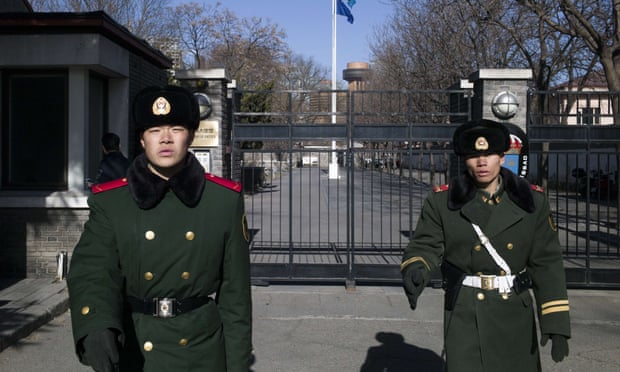
Perhaps one should be ‘grateful’ that China on 3 January 2016 decided to detain the Swedish human rights campaigner Peter Dahlin (first foreigner to be detained for ‘endangering state security’) as this helped international media the take note of the extraordinary crackdown by Chinese president Xi Jinping who is now widely considered to be China’s most authoritarian leader in decades. Here a short overview of the most notable cases in the first two weeks of 2016:
Paramilitary guards stand in front of the gates of Sweden’s embassy in Beijing on Wednesday. Photograph: Fred Dufour/AFP/Getty Images
Read the rest of this entry »
Posted in Front Line, human rights, Human Rights Defenders, OMCT | 2 Comments »
Tags: Cai Xin, China, crackdown, Deng Xiaoming, detention, Fengrui (law firm), Front Line (NGO), Gui Minhai, He Xiaobo, Human Rights Defenders, human rights lawyers, Meng Han, Peter Dahlin, Shu Xiangxin, Sweden, Wang Qiushi, Wang Yu, Zeng Feiyang, Zhou Shifeng, Zhu Xiaomei
January 11, 2016

reports that on 23 December 2015, the Supreme Court confirmed the 2012 sentencing of human rights defender Ms Chiranuch Premchaiporn to eight months’ imprisonment, suspended for one year, and a fine of 20,000 baht, for failing to delete allegedly offensive comments about the Thai monarchy, which had been posted on the now-defunct Prachatai web forum.
Chiranuch Premchaiporn [https://frontlinedefenders.org/ChiranuchPremchaiporn] is executive director of Prachatai, an independent news website that reports on human rights, social and political issues in Thailand and Southeast Asia. She was the webmaster of the now defunct Prachatai web board which was set up to promote the exchange of information and opinion on Thai political and social issues. Chiranuch Premchaiporn was the recipient of the International Women’s Media Foundation Courage in Journalism Award in May 2011 and the Human Rights Watch Hellman/Hammet Award in September 2011.
The Supreme Court ruling confirmed the verdicts of the Court of Appeals and the Court of First Instance, which were made against the human rights defender in November 2013 and May 2012 respectively. Chiranuch Premchaiporn was convicted under Article 15 of the 2007 Computer Crime Act (CCA) for allowing the alleged offensive comments to remain on the Prachatai web forum for 20 days. Article 15 of the CCA states that any service provider intentionally supporting or consenting to the importation of illegal computer content, as provided for in Article 14 of the CCA, shall be subjected to the same penalty as that imposed upon a person committing an offence under Article 14.
Front Line Defenders expresses concern at the decision of the Supreme Court to confirm the sentence against Chiranuch Premchaiporn, and thus to continue the use of the Computer Crime Act to silence and intimidate human rights defenders in Thailand. Front Line Defenders fears for the potential chilling effect of the decision on the exercise of freedom of expression in Thailand, and the restrictive effect of this on the work of human rights defenders.
Posted in awards, Front Line, Human Rights Defenders | Leave a Comment »
Tags: Chiranuch Premchaiporn, Computer Crime Act (Thailand), freedom of expression, Front Line (NGO), Hellman/Hammet Award, Human Rights Defenders, Journalist, lese majeste, Prachatai, woman human rights defender
January 6, 2016
has some openings for staff, interns and volunteers in an open and transparent manner. All positions are advertised via their website:
During a recruitment process Front Line does not generally review applications received until after the closing date. Shortlisting can take some time given the volume of applications it receives, but all applications receive a reply by email.
Source: Recruitment & Volunteering | Front Line Defenders
Posted in Front Line, human rights, Human Rights Defenders | Leave a Comment »
Tags: Dublin, Front Line (NGO), Front Line Defenders, internships, job opportunity, recruitment, vacancy, volunteers
December 21, 2015
Two cases of women human rights defenders in Central America as reported by Front Line Defenders.
El Salvador Read the rest of this entry »
Posted in Front Line, human rights, Human Rights Defenders | Leave a Comment »
Tags: Asociación para una Ciudadanía Participativa (Honduras), AWID, Bertha de Leon, break-ins, COFADEH, Dina Meza, El Salvador, Front Line (NGO), harassment, Honduras, Study Foundation for the Application of the Law (Salvador), Teresa Naves, threats, women human rights defenders
December 20, 2015
The Institute for Human Rights and Business has published: Human Rights Defenders and Business – Searching for Common Ground. This is the fourth in a series of Occasional Papers by IHRB to provide independent analysis and policy recommendations about timely subjects on the business and human rights agenda. In this instance, this paper is co-published with Civil Rights Defendersand Front Line Defenders, both organisations with practical research, campaigning, and advocacy experience of the issues raised in the paper.
As cases in this Paper show, journalists exposing corruption, Internet activists demanding accountability, and community activists campaigning for land rights have all faced pressure.
More than sixty governments have passed laws in the last three years to place restraints on the ability of human rights defenders to hold their governments to account. Among those targeted are individuals and organisations who challenge economic policies or business conduct. Human rights defenders’ activities are being criminalised and they face surveillance, intimidation, lawsuits, arrests, and torture – in some cases, even death.
Companies are engaging with civil society, but mutual suspicions remain. Companies share common goals with human rights defenders – accountability, transparency, the rule of law, and due process. Companies should build on these common interests and engage human rights defenders, and where possible, speak out in their defense. To download:
The same institution – to mark International Human Rights Day 2015 – published the seventh annual list of the Top 10 Business & Human Rights Issues for the 2016 (these issues are not ranked in order of importance). The one specific on human rights defenders reads:
More than sixty governments have passed laws in the past three years to place restraints on the ability of human rights defenders to hold their governments to account for actions that undermine respect for international standards. Among those targeted are individuals and organisations who champion alternate economic paradigms or challenge government policies or business conduct. Some have faced intimidation, surveillance, lawsuits, arrests, and torture.
Despite some progress over the past two decades, suppression of activists too often continues. The UN has passed a resolution recognising the legitimate role of peaceful activists who call out abusive behaviours, including business actions that undermine respect for human rights. Yet a growing number of governments are also passing new laws to restrain civil society activities.
Human rights defenders are like canaries in a mine. When they campaign against abuses, they highlight society’s fundamental problems, such as lack of accountability, transparency, or the rule of law. Courts have jailed journalists exposing corruption, governments have tried Internet activists, authorities have prevented activists from travelling abroad, and states have cracked down on funding sources of non-governmental organisations. International financial institutionsare also under focus. The international community is increasingly paying attention to their cause. At the 2015 UN Forum on Business & Human Rights, there was special focus on human rights defenders and the role of business.
In the year ahead, some governments, businesses, and NGOs will likely sharpen criticism of states that unjustifiably attack human rights defenders, as well as the companies that benefit from such crackdowns and choose to say nothing. With rising concerns over terrorism and the resulting tendency in many countries to emphasise security threats over protecting human freedoms, the road ahead for those who dissent will not be easy. The combined voice of global business will be critical in effectively promoting the legitimate role of individuals and organisations that champion human rights principles and standards in societies around the world.
Sources:
Top 10 Business and Human Rights Issues for 2016 – Top 10 Emerging Issues
http://www.ihrb.org/publications/reports/human-rights-defenders.html?utm_source=IHRB+Subscribers&utm_campaign=0e75f77298-eNews_Update_Quarterly_Update_2&utm_medium=email&utm_term=0_94694639e6-0e75f77298-120645865
see also: https://thoolen.wordpress.com/tag/business-and-human-rights/
Posted in books, Civil Rights Defenders (NGO), Front Line, human rights, Human Rights Defenders | Leave a Comment »
Tags: 2016, Business and human rights, Civil Rights Defenders, Front Line (NGO), Human Rights Defenders, Human Rights Defenders and Business - Searching for Common Ground, IHRB, Institute for Human Rights and Business, international human rights day, Ken Saro-Wiwa, reprisals, restrictive laws
December 18, 2015

Nicki Minaj and Jose Eduardo dos Santos. Photo illustration by Sofya Levina. Images by Frazer Harrison/Getty Images and Alexander Joe/Getty Images.
The Human Rights Foundation (through Thor Halvorssen and George Ayittey) is asking whether Nicki Minaj will “take the high road or a blood diamond paycheck“? On Saturday afternoon the American rapper Nicki Minaj will bring her award-winning talent to the Angolan capital of Luanda. It isn’t a world tour stop, but a special engagement at a “Christmas Festival” sponsored by Unitel, a telecommunications company controlled by Angola’s dictatorship.
[Two years ago, Mariah Carey was paid $1 million to perform in Angola at another one of the regime’s holiday parties. Since she had promised to never perform for dictators again after singing for Libya’s Qaddafi family, the public wasn’t forgiving the second time around. The result was a global PR scandal that led Carey to sever ties with Jermaine Dupri, the manager who arranged the visit. – https://thoolen.wordpress.com/2013/12/19/mariah-carey-needs-better-informed-staff-and-donate-her-1-million-fee-to-human-rights-defenders-in-angola/].
The situation of human rights defenders in Angola is most precarious:
15 pro-democracy activists were detained in June 2015 and their trial started only after almost five months of arbitrary detention. The persons on trial include rapper (!) Henrique Luaty Beirão (a.k.a. Brigadeiro Mata-Frakuxz), Manuel Nito Alves, Nuno Alvaro Dala, Nelson Dibango Mendes Dos Santos, Alfonso Jojo Matias (a.k.a. Mbanza Hamza), Sedrick de Carvalho, Fernando António Tómas (a.k.a. Nicola Radical), Hitler Chiconda (a.k.a. Samussuku), Italiano Arante Kivuvu, Benedito Dali (a.k.a. Dito Dali), Albano Bingobingo (a.k.a. Albano Liberdade), José Gomes Hata (a.k.a. Cheik Hata), Inocénio De Brito (a.k.a. Drux), Domingos da Cruz as well as of Osvaldo Caholo. (Ms. Rosa Kusso Conde and Ms. Laurinda Manuel Gouveia are also facing the same charges, but are not detained. [The Angola 15 are youth activists arrested in June 2015 for discussing democratic reforms and peaceful protest. Most of them are known pro-democracy activists, who have been organizing peaceful protests often repressed by the authorities against the 35-year-regime of Angolan President Eduardo Dos Santos since 2011. On September 16, 2015, they were charged with “preparatory acts of rebellion” and “plotting against the President and other institutions”, both of which constitute crimes against the security of the Angolan State. Several experts and international institutions have called for their release, including the European Parliament and the UN Special Rapporteur on the situation of human rights defenders, Michel Forst.]
On 15 December 2015 the Luanda Provincial Tribunal approved the request of the Public Prosecutor to place the pro-democracy activists detained since June 2015 under house arrest as of December 18. According to a public statement made by the General Attorney, this decision precedes the entry into force on December 18, 2015, of a new legislation on preventive measures adopted in September 2015, aimed at reducing prison overcrowding and excessive pre-trial detentions – and thus not the result of international pressure!. “The decision to place the Angola 15 under house arrest is a positive step towards the recognition of their rights. The Angolan authorities must now end all forms of judicial harassment against the activists and put an end to their ordeal by immediately and unconditionally releasing them”, FIDH President Karim Lahidji said.
Interesting is also to note here how two quasi-NGOs (in the NGO world, called GONGOs – Governmental Non-Governmental Organizations – masquerading as protectors of the rights of the people while working as the mouthpiece for the government) tried to block a resolution by the NGO forum surrounding the session of the African Commission on Human and Peoples’ Rights in November 2015.
Front Line Defenders also has followed the case of the Angola 15 and other human rights defenders in detail: https://www.frontlinedefenders.org/search/node/angola
Sources:
Nicki Minaj shouldn’t perform for Angolan dictator Jose Eduardo dos Santos.
http://www.omct.org/human-rights-defenders/urgent-interventions/angola/2015/12/d23533/
https://www.fidh.org/en/issues/human-rights-defenders/angola-the-angola-15-must-be-released-and-their-right-to-a-fair-trial
http://newint.org/blog/2015/12/16/angola-human-rights-trial/
http://allafrica.com/stories/201511051396.html
https://www.fidh.org/en/region/Africa/angola/angola-rafael-marques-de-morais-sentenced-to-a-six-month-suspended
Posted in FIDH, Front Line, human rights, Human Rights Defenders, Observatory for the Protection of Human Rights Defenders, OMCT | 2 Comments »
Tags: African Commission on Human and Peoples' Rights, Angola, Angola 15, celebrities, Front Line (NGO), Human Rights Foundation, illegal detention, José Eduardo dos Santos, Mariah Carey, Nicki Minaj, Observatory for the Protection of Human Rights Defenders, Rafael Marques de Morais, Thor Halvorssen
December 16, 2015
Tomorrow 17 December there will be a
Special session of the Human Rights Council on preventing further deterioration [now that is diplomatic language!] of the human rights situation in
Burundi. The International Service for Human Rights
(ISHR) is using the occasion to organize a side event on: “Escalation of Violence in Burundi: Human rights defenders voices from the ground” from 09.00-10.00 am in Room XII, Palais des Nations, Geneva. It will be webcast live on
www.ishr.ch/webcast. Follow on twitter using the hash-tag #BurundiHRDs.

Panelists (moderator Nicolas Agostini of FIDH):
- Mr Pierre Claver Mbonimpa, Association for the Protection of Human Rights and Incarcerated Persons (APRODH), MEA Laureate 2007.
- Ms Margaret Barankitse, Maison Shalom
- Mr Anschaire Nikoyagize, Ligue ITEKA
- Ms Carina Tertsakian, Human Rights Watch
Read the rest of this entry »
Posted in human rights, Human Rights Council, Human Rights Defenders, UN | Leave a Comment »
Tags: African Union, Anschaire Nikoyagize, Burundi, Centre for African Journalists, East and Horn of Africa Human Rights Defenders Project, Front Line (NGO), Geneva, Human Rights Defenders, ISHR, Journalist, Pierre Claver Mbonimpa, side event, special session, UN Human Rights Council, webcast, Zeid Ra'ad Al Hussein
November 23, 2015
With International Women Human Rights Defenders Day coming up (29 November) I will pay special attention to questions that concern them. Here a case of police harassment from Front Line concerning Tanzania: Read the rest of this entry »
Posted in Front Line, human rights, Human Rights Defenders | Leave a Comment »
Tags: arbitrary arrest, elections, freedom of association, Front Line (NGO), Human Rights Defenders, Imelda Urio, International Women Human Rights Defenders Day, judicial harassment, Legal and Human Rights Centre, police behavior, Tanzania, Tanzanian Civil Society Election Consortium, woman human rights defender
September 17, 2015
On 15 September 2015, the Turin Court of Appeal ruled to release Algerian human rights defender Mr Rachid Mesli, who has been under house arrest since 22 August 2015, and to allow him to leave the country, as reported by Front Line Defenders.
The human rights defender was released before the end of the 40 day period during which the Algerian government could submit a formal request for extradition. The Court recognised Rachid Mesli’s important and peaceful work in the defence of human rights, as well as the high risk of torture he would face if returned to Algeria. While the court is yet to make its final decision on the extradition warrant, the release order highlighted that, according to the information received, Rachid Mesli’s human rights activities were not in any way related to terrorism.
On 22 August, the Italian court placed the human rights defender under house arrest following three days in detention in Aosta prison. Rachid Mesli was arrested on 19 August 2015 (https://www.frontlinedefenders.org/node/29390) as he travelled to Italy on holiday with his wife and son. The arrest occurred as a result of an arrest warrant issued by the Algerian authorities in April 2002 on terrorism-related charges.
[Rachid Mesli is the Legal Director of Alkarama, an independent human rights organisation based in Geneva that works to assist victims of extra-judicial executions, disappearances, torture and arbitrary detention in Arab states. And this is not first effort by the Algerian government see: https://thoolen.wordpress.com/2012/01/20/mourad-dhina-algerian-head-of-the-human-rights-organization-alkarama-detained-in-france/]
Interesting tot note Front Line Defenders’ call on Interpol to ensure the legitimacy of all warrants issued by its members and to put in place safeguards so that the system cannot be abused in order to target human rights defenders.
Posted in Front Line, Human Rights Defenders | Leave a Comment »
Tags: al-karama, Algeria, Alkarama, Arab region, arrest, France, Front Line (NGO), Human rights defender, Mourad Dhina, NGO, Rachid Mesli, Switzerland, terrorism


 Hans Thoolen on Human Rights Defenders and their awards