On 25 February 2026 Humanists International launched its flagship publication, the 2025 Freedom of Thought Report
The Freedom of Thought Report by Humanists International assesses every country in the world on the basis of human rights and the legal status with regard to humanists, atheists, and the non-religious.
Systemic, legal discrimination can include such things as established state churches (resulting in religious privilege), religious instruction provided without secular ethical alternative classes in schools, through to severe punishments such as prison for crimes of “insulting” religion, or death merely for expressing your atheism.
This landmark report is the only worldwide index dedicated to monitoring how laws and state authorities treat humanists, atheists, and the non-religious. At a time of shrinking civic space and growing threats to democracy, this work is more urgent than ever. The report analyzes human rights in every country in the world and documents discriminatory national laws ranging from religious instruction without secular alternatives in schools to death sentences for renouncing religion. This year, the Key Countries edition assesses the right to freedom of religion or belief in a world of rising authoritarianism.
Focus on Bangladesh, El Salvador, Georgia, Kenya, Lebanon, Malaysia, Malta, Myanmar, Sudan, and the USA, the report captures positive developments while highlighting instances of democratic backsliding and religious nationalism.
The International Bar Association’s Human Rights Institute (IBAHRI) is offering a free online training course for human rights defenders working on cases relating to freedom of religion or belief (FoRB).
Taking place from 17–27 February, the programme is divided into 16 sessions covering all the theoretical and practical knowledge required to promote and protect the fundamental right to FoRB.
The programme will be delivered by leading experts in the field of human rights and/or FoRB, including Dr Nazila Ghanea, United Nations Special Rapporteur on FoRB; Professor Fernand de Varennes, former UN Special Rapporteur on minority issues; the Honourable Hina Jilani, IBAHRI co-chair, member of The Elders and advocate of the Supreme Court of Pakistan; and Rangita de Silva de Alwis, IBAHRI vice chair and a member of the treaty body to the UN Convention on the Elimination of All Forms of Discrimination against Women.
The IBAHRI is delivering the training in collaboration with the Rule of Law Expertise UK (ROLE UK). ROLE UK is a programme of the Advocates for International Development (A4ID), funded by the Foreign, Commonwealth & Development Office. A4ID is a global charity working to strengthen the rule of law in developing countries by supporting partnerships to provide high-quality pro bono legal and judicial expertise.
The prominent Nigerian atheist, who was freed on 8 January 2024 after serving more than four years in prison for blasphemy, is now living in a safe house as his legal team fear his life may be in danger…
In 2024, the UN Working Group on Arbitrary Detention (UNWGAD) released its opinion that the Nigerian State violated international law by detaining Bala. Concluding that he was wrongfully imprisoned for exercising his right to freedom of thought, conscience, religion or belief and that because of this violation no trial should have taken place.
Humanists International welcomes news of the release of Mubarak Bala, however, it reiterates that he should never have been detained in the first place. The organization once again thanks all those individuals and organizations without whose support this work would not have been possible. The organization hopes that Bala will one day be able to return to his homeland, and resume his work.
Andrew Copson, President of Humanists International stated:
“Today, we celebrate Mubarak Bala’s release – a hard-won victory that fills us with immense joy and relief. This triumph would not have been possible without the unwavering dedication of Humanists International’s staff, the tireless advocacy of Leo Igwe, the expertise of James Ibor and Bala’s legal team, and the invaluable support of our partner organizations. We extend our deepest gratitude to each and every one of them. While we rejoice in Mubarak’s freedom, we remain committed to fighting for the countless others who remain unjustly imprisoned for their beliefs. Their struggle is our struggle, and we will not relent until they too are free.”
On 14 June 2023 FORUM-ASIA announced the upcoming 2023 Human Rights Data Release by affiliate member, the Human Rights Measurement Initiatives (HRMI) based in New Zealand. HRMI will this June unveil the latest findings on civil and political rights, economic and social rights (ESR), and human rights in East Asia. On June 22nd, HRMI will present the civil and political rights data, including the measurement of Freedom of Religion and Belief in nine countries, as well as scores for Bangladesh, Thailand, and the Maldives. On June 29th, they will reveal the economic and social rights data, highlighting the crucial role of ESR data in increasing investment in low-income countries and its correlation with wealth improvement. Furthermore, on June 28th, HRMI will delve into the human rights situation in China, Hong Kong, and Taiwan, exploring topics such as the evolving freedom of opinion and expression and the impact of Hong Kong’s National Security Law. Esteemed guest panelists will share their valuable insights and provide context to the scores.
2023 civil and political rights data, including measuring Freedom of Religion and Belief in 9 countries, producing scores for Bangladesh, Thailand, and the Maldives, producing people at risk data about sex workers, and much more.
You can register for the zoom webinar here, it will also be livestreamed on Youtube here.
2023 economic and social rights (ESR) data, including the role of ESR data in increasing investment in low income countries, how improving ESRs increases wealth, and much more.
You can register for our zoom webinar here, it will also be livestreamed on Youtube here.
China, Hong Kong, and Taiwan’s 2023 human rights data, including how freedom of opinion and expression are evolving in these countries, the impact of Hong Kong’s National Security Law on human rights, and much more.
You can join the zoom webinar here (no registration required), it will also be livestreamed on Youtube here.
A recent BBC documentary is about the challenges faced by humanists and atheists in Nigeria. The film was released this week and focuses on Mubarak Bala, reporting on the events that took place in the run-up to his unjust and disproportionate sentencing in April 2022.Mubarak, who is the President of the Humanist Association of Nigeria, is currently serving a 24-year prison sentence, in connection with a series of Facebook posts that some deemed to be ‘blasphemous’ and ‘likely to cause a public disturbance’. See also: https://humanrightsdefenders.blog/2021/08/27/mubarak-bala-wins-humanist-international-2021-freedom-of-thought-award/
Leo Igwe, Humanists International Board Member & Founding member of the Humanist Association of Nigeria, has been spearheading the campaign for his release since he was first arrested in April 2020.: “The launch of the documentary marks more than 30 months since Mubarak was separated from his family. I’m so proud of his wife, Amina, for the strength she has shown, but you can see in her interview how hard this has been for her. Perhaps the most chilling part of the documentary is when the lawyer who brought about the complaint against Mubarak simply cannot hide his pleasure at the outcome of the sentence, despite the devastating impact on the family. He says: “I really feel bad for the wife and the little son” but the smile on his face tells a very different story.”
Following this week’s decision, Mubarak now has one year left of his sentence to serve however our work is not over; the state still has the opportunity to appeal. We will continue to monitor the situation closely and will work to support Mubarak until his safe release.
Born in Kano state, northern Nigeria, in 1984 and a chemical engineer by training, Mubarak Bala is a prominent member of the Humanist movement. As President of the Humanist Association of Nigeria, he has played a vital role in the Humanist community in Nigeria.
Bala has been working to promote freedom of religion or belief in Nigeria and has been an outspoken religious critic in the conservative northern region, where open religious opposition is unusual. He has campaigned for the decriminalization of apostasy and blasphemy laws in states that implement Sharia in northern Nigeria. In addition he has engaged in human rights education and raised awareness on the importance of freedom of thought and conscience to peace, progress and stability in the region. He has organized meetings and conferences to enlighten the local populace especially those inclined to religious extremism and radical Islam due to indoctrination, lack of understanding or misinformation about freedom of religion or belief.
Bala has been held in detention since his arrest on 28 April 2020. Held for 15 months without any charge, Bala now faces charges of public disturbance in connection with Facebook posts deemed “blasphemous” he is alleged to have published in April 2020. In addition to being arbitrarily detained for 15 months, there have been several other violations of his rights to a fair trial, which include denying Bala access to his legal counsel until October 2020, failing to comply with a Federal High Court order to release Bala on bail, and consistent attempts to obstruct Bala’s legal team.
Andrew Copson, President of Humanists International, commented: “Mubarak Bala is an honorable humanist who has experienced great hardship and persecution in his realization of a life lived true to his values. Today he is a prisoner of conscience, whose thoughts are freer than he himself.”
“On behalf of my husband Mubarak Bala, I really want to thank humanists all over the world for this wonderful honour. This award has really shown that the world still cares for Mubarak, and that Mubarak has not been forgotten. This is to show that humanity is above all regardless of religion and belief. I thank Humanists International for your utmost support and care for Mubarak’s family. We don’t know how to thank you enough, all I can say is thanks a zillion! And I know this is indeed a phase which will come to pass soon. I also want to thank the Humanists Association of Nigeria who has struggled these past months for Mubarak’s release. You have all really shown so much love and care for Mubarak and we really appreciate it.“
Seven UN human rights experts on Thursday 29 April 2021 demanded the release of a Nigerian atheist and humanist, Mubarak Bala, who has been detained without charge by the police for a year over alleged blasphemy.
The experts’ demand add to calls by many human rights groups, including Amnesty International, in the last one year for the release of the activist who faces death penalty if convicted under the law being operated in many parts of Northern Nigeria.
Mr Bala who is the president of Humanist Association of Nigeria, was arrested at his home in Kaduna State on April 28, 2020 over his Facebook post considered to be critical of Islam. His post reportedly caused outrage among Muslims in many parts of highly conservative northern part of the country.
The detainee whose arrest was prompted by a petition by a lawyer, S.S Umar, backed by some Islamic figures, was later transferred to the neighbouring Kano State.
His whereabouts remained unknown to his family and lawyer for many months before he was later granted access to them.
Delivering judgment in a fundamental human rights enforcement suit filed on his behalf, a judge of the Federal High Court in Abuja, Inyang Ekwo, on December 21, 2020, declared Mr Bala’s detention illegal and ordered his immediate release.
The court also ruled that the denial of his ability to choose his own legal representation, constituted gross infringements of his rights to personal liberty, fair hearing, freedom of thought, expression and movement.
It awarded damages of N250,000 damages in his favour.
TRT World published a summary of a report by the South Asia Collective “India and Pakistan no different on how they treat minorities”. Please note that Turkish Radio and Television Corporation is the national public broadcaster of Turkey. One looks there in vain for information on human rights violations in Turkey itself. Still the report referred to (produced with the financial support of the European Union and the Norwegian Agency for Development Cooperation) is of interest:
The past ten years have been abysmal for minorities and civil rights activists in South Asian countries including India, Pakistan and Sri Lanka, according to the South Asia State of Minorities Report 2020.
Governments have introduced repressive laws that curb freedom of expression, persecute journalists and bar people from organising peaceful demonstrations, says the report published by the South Asia Collective, an international group of activists and NGOs. Some laws disproportionately target minorities such as Muslims in India and Sri Lanka, and Christians in Pakistan. One policy that transcends almost all the regional governments is their attempt to restrict the role of NGOs – especially if they receive funding from abroad.
India, where minorities have faced state-sanctioned violence since the Hindu nationalist Bharatiya Janata Party (BJP) was re-elected last year, has handicapped foreign NGOs by setting limits on how they can spend money received from international donors. Most of the affected NGOs are the ones that work in areas which highlight abuse of power, government indifference towards the plight of minorities, and the brutality of security forces. [see also: https://humanrightsdefenders.blog/2020/07/06/istanbul-court-jails-four-human-rights-defenders-on-terror-charges-seven-acquitted/]
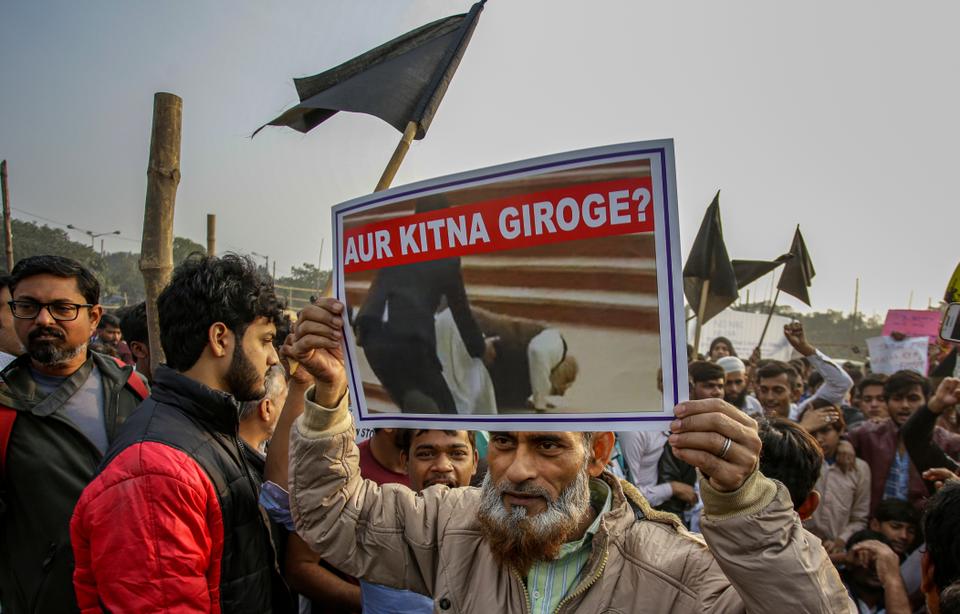
New Delhi’s discriminatory amendment to citizenship law has further alienated India’s Muslims. (AP Archive)
Other policy changes such as requiring NGOs to register with income tax authorities every five years are a similar tool of “administrative harassment”. ..
The intimidation is not limited to NGOs as journalists reporting on creeping BJP authoritarianism often feel the wrath of the state. “…between 25 March and 31 May 2020, at least 55 Indian journalists faced arrest, physical assaults, destruction of property, threats or registration of FIRs (police reports),” the report said.
New Delhi increasingly relies on internet controls to curb dissent. Internet shutdowns jumped to 106 in 2019 from only six in 2014 as authorities used different laws to control the flow of information. Kashmir faced a complete internet blackout for months after the Muslim-majority region’s nominal autonomy was withdrawn last year…
India is also using the draconian Unlawful Activities Prevention Act to target Dalits, a caste of Hindus who face widespread discrimination under the country’s hierarchical caste system… Changes in the Citizenship Act that target Muslim migrants and the brutal police reponse to subsequent protests — in which 22 people were shot dead in Utter Pradesh state in a single day — further illustrate the worsening status of minorities in India.
In neighbouring Pakistan, India’s archrival, minorities and those activists trying to help them, fare no better.
“NGOs and INGOs (international NGOs) are subject to extensive regulation involving multiple, lengthy procedures of registration, security clearance, and approvals for funding,” the report said.
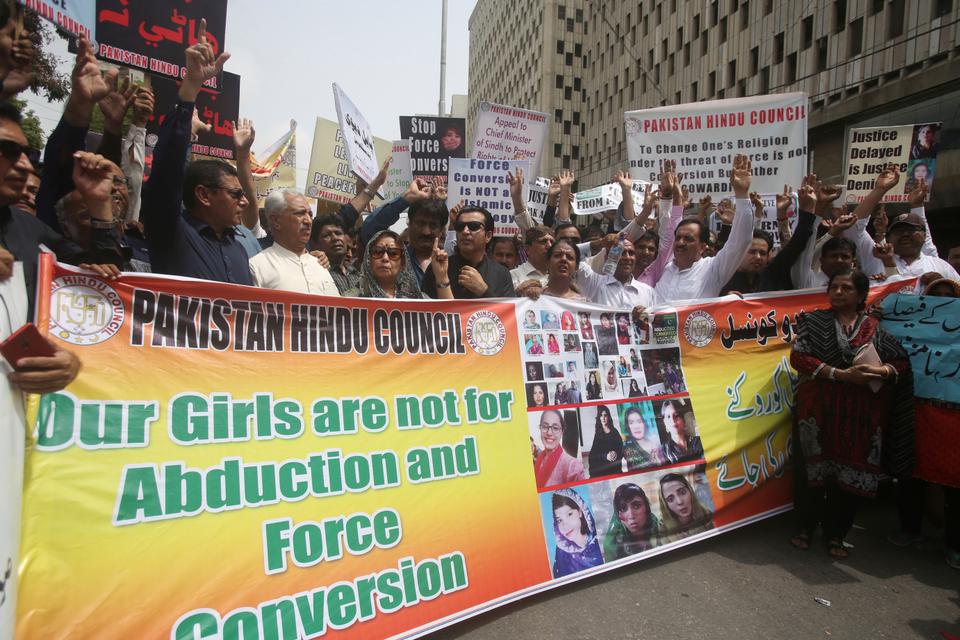
The Christians and Hindus in Pakistan regularly complain that young girls are forced to convert to Islam. (AP Archive)
In recent years, Islamabad has increased vigilance on NGOs which it fears might be working on a foreign agenda to promote dissent. What will particularly bother Pakistan’s policymakers is the report’s focus on how the country’s Blasphemy Law, meant to protect religious sentiments, continues to be misused against minorities.
“In reality, the law explicitly discriminates against Ahmadiyas since parts of it criminalise public expression of Ahmadiya beliefs and prohibit Ahmadiyas from calling themselves Muslims, praying in Muslim sites of worship and propagating their faith.” Just this week, a report by the United States Commission on International Rights Freedom pointed out that Pakistan accounts for nearly half of the incidents of mob violence against alleged blasphemers.
At times, people accused of blasphemy are killed in court in front of police and lawyers. Christians, another minority, are frequently targeted while authorities do little to protect them. For instance, a church constructed in the Toba Tek Singh district of Punjab province had to be sealed in 2016 after local Muslims agitated against it. This alienation doesn’t stop at the places of worship – young Chrsitan students are continuously harassed by their peers to convert to Islam, the report said.
Similarly, Sri Lanka witnessed rising levels of intolerance towards minorities in recent years, especially as successive governments tried to pacify extremist Buddhists to garner their votes. Muslims in Sri Lanka have felt a wave of discrimination and official apathy after the suicide attacks that killed more than 200 people last year. “After the Easter attacks, Muslims, particularly a large number of Muslim men, were arrested seemingly without reasonable cause.” Jingoistic government-aligned media has helped paint Muslims as the villain in Sri Lanka.
“The incitement of hatred and vitriol by media outlets continues unabated. For example, Muslim Covid-19 patients were identified by their faith, unlike other patients, and blamed by the media for spreading coronavirus.”
Humanists International has announced on 14 December its 2021 Grants Scheme: six grant programs for a total budget of £122,000
One of Humanists International’s strategic aims is “to have successful and sustainable member organizations in every part of the world.” In order to achieve this aim, Humanists International runs on a yearly basis a Growth & Development Plan to provide funding, training, intellectual resources and other forms of support to let humanist organizations around the world develop and flourish.
The 2021 Grants Scheme that has been announced today consists of six different grant programs:
Development Grants (£50,000)
Digital Humanism Grants (£25,000)
Regional Networking Meetings Grants (£15,000)
Humanist Ceremonies Grants (£10,000)
Young Humanist Grants (£16,000)
Café Humaniste Online Grants (£6,000)
All details about the six grant programs, the eligibility and selection criteria, and how to apply for a grant are available on the website under the Growth & Development page.
International Human Rights Day 2020 is coming up and here is an early save the date for the Humanists International.
Since 2012 Humanists International has published the Freedom of Thought Report to monitor the rights and treatment of humanists, atheists and non-religious people in every country in the world. This year, the thematic focus of the Report is COVID-19, and its impact on the non-religious people globally. In particular we have seen the establishment of restrictions on:
– Women’s rights – Media freedom, protest and access to information – Individuals at risk
Here is the list of the event speakers:- Andrew Copson President of Humanists International
– Dr Ahmed Shaheed UN Special Rapporteur on Freedom of Religion or Belief
– Emma Wadsworth-Jones Humanists International’s Casework & Campaigns Manager
– Mohamed Cheikh Ould Mkhaitir Mauritanian blogger and anti-slavery activist
– Debbie Goddard, Vice-President of American Atheists
– Rev. Fred Davie, Commissioner of The United States Commission on International Religious Freedom

 Hans Thoolen on Human Rights Defenders and their awards