The World Tribune of 28 June 2020 reports on the fight sparked by North Korean defectors sending balloons with leaflets to their former homeland, which has brought both Koreas once again to the brink of war. Now Signe Poulsen, head of the Seoul office of the UN Office of High Commissioner for Human Rights, has stated that sending the leaflets is an exercise of the right to freedom of expression.
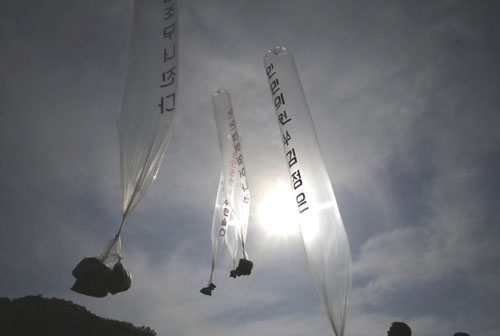
In this April 29, 2016 file photo, members of a South Korean civic group send leaflets denouncing the North Korean regime in Tanhyeon, Paju, near the North Korean border. / Korea Times photo by Choi Won-Suk
Both the North and South Korean governments have threatened the defectors in the South who have sought to counter communist “fake news” by sending real news North over the DMZ. The leaflets also often contain U.S. one-dollar bills and USB memory sticks meant to encourage North Koreans to pick up the leaflets.
Now the defectors have been targeted by hastily-passed legislation forbidding the practice. Poulsen made the remarks amid heightening tensions on the Korean Peninsula after the North threatened to retaliate against the South for what it called Seoul’s “connivance” at the floating of anti-Pyongyang materials in large balloons.
The government of South Korean President Moon Jae-In, sought to legislate a ban on leafleting and filed a criminal complaints against two defector groups who carry out such launches, the Korea Times reported on June 23. The provincial government of Gyeonggi, located near the border with the North and where a lot of leafleting takes places, issued an administrative order last week banning the entry into border areas to fly leaflets.
In “Media oppression is a shifting landscape” by Sevanti Ninan (a media commentator and founder-editor of TheHoot.org) published on 29 June 2020 in the Indian Telegraph you wil find a good analysis of the problems of news gathering in the current situation. It is about India but the analysis would be valid for many countries.
Arms of the government see journalism (of all kinds) not as a useful source of feedback at a time when the population is in distress but as a nuisance to be squashed. Fake news is no longer seen only as an electronic menace but as reporting with malign intent, whether in Kashmir or elsewhere. Pexels
For some years now, the growing challenge to journalism has come from the increasing use of predictable laws (think of sedition and criminal defamation in the Indian Penal Code)….but media oppression is a shifting landscape. Tracking its changing features is just the first challenge. While the onset of Covid-19 has led to the government putting hitherto under-used laws to work, such as the Disaster Management Act and the Epidemic Diseases Act, these have been used in tandem with Sections of the IPC to criminalize reporting of the government’s response to the pandemic as well of the outcomes of its handling, such as the migrant exodus. Panicky administrations across the country have, so far, used no less than 14 Sections of the IPC and Sections of the IT Act (including the one that was struck down), the DMA, the Unlawful Activities (Prevention) Act, the Motor Vehicles Act and the provisions of Scheduled Castes and Tribes (Prevention of Atrocities) Act to issue showcause notices, lodge first information reports against reporters and arrest, confine and torture them.
If newsgathering is being criminalized in some parts of the country, it is being policed in Jammu and Kashmir… it has been gifted a 50-page media policy, which makes the government the arbiter of fake news and mandates background checks of media owners and editors if they are to receive government advertising. Charming! Who knows what will follow elsewhere in the country.
Overall then, a convergence of factors is at work. Arms of the government see journalism (of all kinds) not as a useful source of feedback at a time when the population is in distress but as a nuisance to be squashed. …
Electronically disseminated fake news, until now, was in the domain of technology. But when the charge is levelled at reporting on the ground in far-flung areas of the country, it enters the domain of physical fact-finding. Busting fake news with internet tools is one thing. Doing it for field reporting is quite another.…..
..What support structures can be put in place? The country has a Press Council, a Human Rights Commission and numerous courts. But it needs a growing network of human rights defenders, a galvanizing force created by an alliance of journalist organizations, concerned lawyers and civil society stalwarts to map a strategy for this canvas. The Press Council is selective in what it takes note of; one must also ask whether its censure changes anything on the ground.
So far, the response to a sustained assault on journalism has been statements issued by media bodies themselves. But journalists need allies at a time like this; solidarity within their own ranks is not enough to put pressure on the oppressors. Just as civil society has come together to keep alive a human rights campaign for the release of Gautam Navlakha, Sudha Bhardwaj and others in the Bhima Koregaon case, journalists, particularly the embattled, invisible ones the districts, now need ballast in their fight to keep up the pressure.
Precedents will be set if the misuse of laws goes unchallenged. District magistrates across states labelling reporting as fake news will be further emboldened without a pushback.
The European Court of Human Rights (ECHR) ruled that France violated the freedom of expression of pro-Palestinian activists who were convicted of campaigning for a boycott of Israeli products and pressuring that country to end the occupation of Palestine.
The ruling refers to a 2009 French justice conviction against 11 activists from the BDS (Boycott, Divestment and Sanctions) movement for “economic discrimination” for protesting and distributing leaflets against Israeli products in a supermarket in eastern France.
BDS has called for boycotts against Israeli companies, universities and cultural institutions in what it says is a non-violent campaign against Israeli abuses in Palestine, while Israel claims that the movement masks attempts to delegitimize or destroy the Jewish state.
“This important court ruling is a decisive victory for freedom of expression, for human rights defenders and for the BDS movement for Palestinian freedom, justice and equality,” said Rita Ahmad of the Palestinian-led movement. Most of the international community considers Israeli settlement in the West Bank illegal.
The ECHR ruling orders the French government to pay € 101,000 in general damages to the activists, as the criminal conviction “had no relevant and sufficient basis” and violated the freedom of expression of the protesters. The French government has three months to appeal the decision
Israel promotes a number of legislative initiatives against BDS abroad, particularly in the United States and Europe. The United States House of Representatives passed a bipartisan resolution last year condemning the boycott of Israel as detrimental to peace efforts. The German Parliament passed a resolution last year describing the movement’s methods as “anti-Semitic” and reminiscent of Nazi-era calls to boycott Jews. BDS activists deny the charges of anti-Semitism and say discrimination laws have been used to unfairly attack them. See also: https://humanrightsdefenders.blog/2019/09/25/revoking-of-kamila-shamsies-dortmund-book-award-is-fiercely-contested/
Amnesty International expressed hope that the ruling “will send a clear message to all European states that they must stop the prosecution of peaceful activists.”
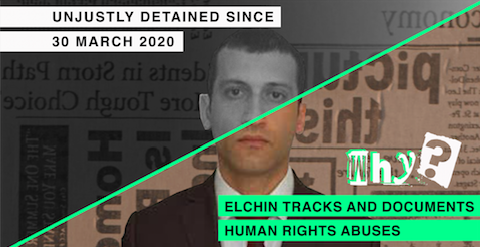
As a human rights lawyer and journalist, Elchin Mammadis used to speaking his mind. The 42-year old attorney presides over the Social Union of Legal Education of Sumgait Youth (SULESY), a non-governmental organisation that provides free legal assistance to low income families and non-profits. His busy schedule also includesda job as the editor in chief of Yukselish Namine, a newspaper specializing in human rights concerns. On 30 March 2020, a few days after he had published online a critical report on the human rights situation in Azerbaijan, police officers arrested Elchin at his home in Sumgait, a town north of the capital Baku. The police claimed to have found stolen jewellery at his office.
The next day, Sumgait City Court remanded Elchin Mammad in custody for three months as a criminal suspect. The father of two young children remains detained under trumped-up charges at Shuvalan pre-trial detention centre no. 3. This latest twist is nothing new to Elchin. He has faced harassment from the authorities in connection with his human rights work since 2015, when his organisation was investigated. He was subjected to arbitrary detention, repeatedly summoned and questioned by the police. He was also placed under travel restrictions in connection with the investigation.
On 15 May, the government officially stated that there are 46 COVID-19 infected inmates in the country. This puts Elchin’s life at risk, particularly as he suffers from hepatitis C. Azerbaijan’s prison system is plagued by severe overcrowding, while food, medication, sanitation, and even drinking water are substandard. This has led to the European Court of Human Rights repeatedly ruling that detention conditions in the country amount to inhuman and degrading treatment. In times of pandemic, such an environment risks becoming an incubator for the novel coronavirus.
Elchin’s case is particularly emblematic of the Azerbaijani authorities’ abusive and arbitrary methods used to silence critical voices. In 2014, the government launched an unprecedented crackdown on civil society. Prominent human rights defenders joined other political prisoners in Azerbaijan’s jails, on fabricated criminal charges of financial irregularities. Although most were released after spending years in prison, as a result of international pressure, the situation of defenders remains precarious
The authorities have seized the coronavirus outbreak as an opportunity to intensify the crackdown on civil society. On 19 March, President Ilham Aliyev used his yearly address to the nation on the Novruz Bayrami holiday to promise “new rules” for the duration of the pandemic, threatening to clear the country of “traitors” and “enemies” and to “isolate the fifth column”. To people like Elchin, who has dedicated his life to the defence of the downtrodden, these ominous words might now ring like a death sentence.
On 21 April, Reuters reported that Facebook has begun to significantly step up its censorship of “anti-state” posts in the country. This follows pressure from the authorities, including what the company suspects were deliberate restrictions placed on its local servers by state-owned telecommunications companies that caused Facebook to become unusable for periods of time. The next day Amnesty International demanded that Facebook reverses immediately its decision. “The revelation that Facebook is caving to Viet Nam’s far-reaching demands for censorship is a devastating turning point for freedom of expression in Viet Nam and beyond,” said William Nee, Business and Human Rights Advisor at Amnesty International. “The Vietnamese authorities’ ruthless suppression of freedom of expression is nothing new, but Facebook’s shift in policy makes them complicit.”
“Facebook must base its content regulation on international human rights standards for freedom of expression, not on the arbitrary whims of a rights-abusing government. Facebook has a responsibility to respect freedom of expression by refusing to cooperate with these indefensible takedown requests.” The Vietnamese authorities have a long track record of characterizing legitimate criticism as “anti-state” and prosecuting human rights defenders for “conducting propaganda against the state.” The authorities have been actively suppressing online speech amid the COVID-19 pandemic and escalating repressive tactics in recent weeks. “It is shocking that the Vietnamese authorities are further restricting its peoples’ access to information in the midst of a pandemic. The Vietnamese authorities are notorious for harassing peaceful critics and whistleblowers. This move will keep the world even more in the dark about what is really happening in Viet Nam,” said William Nee.
Facebook’s decision follows years of efforts by Vietnamese authorities to profoundly undermine freedom of expression online, during which they prosecuted an increasing number of peaceful government critics for their online activity and introduced a repressive cybersecurity law that requires technology companies to hand over potentially vast amounts of data, including personal information, and to censor users’ posts. “Facebook’s compliance with these demands sets a dangerous precedent. Governments around the world will see this as an open invitation to enlist Facebook in the service of state censorship. It does all tech firms a terrible disservice by making them vulnerable to the same type of pressure and harassment from repressive governments,” said William Nee…
In a report published last year, Amnesty International found that around 10% of Viet Nam’s prisoners of conscience – individuals jailed solely for peacefully exercising their human rights – were jailed in relation to their Facebook activity. In January 2020, the Vietnamese authorities launched an unprecedented crackdown on social media, including Facebook and YouTube, in an attempt to silence public discussion of a high-profile land dispute in the village of Dong Tam, which has attracted persistent allegations of corruption and led to deadly clashes between security forces and villagers. The crackdown has only intensified since the onset of COVID-19. Between January and mid-March, a total of 654 people were summoned to police stations across Viet Nam to attend “working sessions” with police related to their Facebook posts connected to the virus, among whom 146 were subjected to financial fines and the rest were forced to delete their posts. On 15 April, authorities introduced a sweeping new decree, 15/2020, which imposes new penalties on alleged social media content which falls foul of vague and arbitrary restrictions. The decree further empowers the government to force tech companies to comply with arbitrary censorship and surveillance measures.
The 2020 World Press Freedom Index, annualy compiled by Reporters Without Borders (RSF), shows that the coming decade will be decisive for the future of journalism, with the Covid-19 pandemic highlighting and amplifying the many crises that threaten the right to freely reported, independent, diverse and reliable information.
This 2020 edition of the Index, which evaluates the situation for journalists each year in 180 countries and territories, suggests that the next ten years will be pivotal for press freedom because of converging crises affecting the future of journalism: a geopolitical crisis (due to the aggressiveness of authoritarian regimes); a technological crisis (due to a lack of democratic guarantees); a democratic crisis (due to polarisation and repressive policies); a crisis of trust (due to suspicion and even hatred of the media); and an economic crisis (impoverishing quality journalism).
These five areas of crisis – the effects of which the Index’s methodology allows us to evaluate – are now compounded by a global public health crisis.
“We are entering a decisive decade for journalism linked to crises that affect its future,” RSF secretary-general Christophe Deloire said. “The coronavirus pandemic illustrates the negative factors threatening the right to reliable information, and is itself an exacerbating factor. What will freedom of information, pluralism and reliability look like in 2030? The answer to that question is being determined today.”
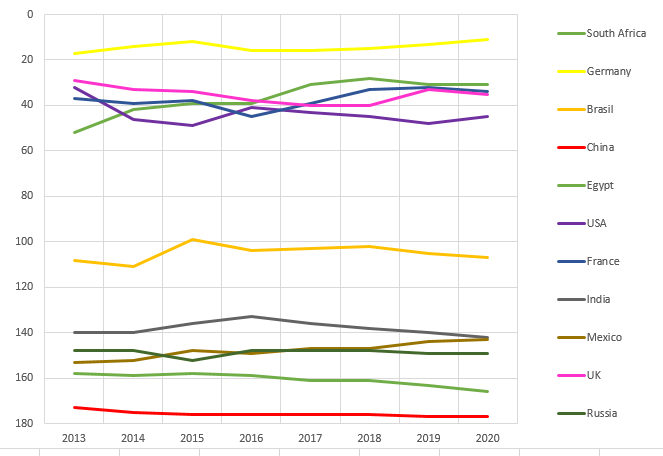
There is a clear correlation between suppression of media freedom in response to the coronavirus pandemic, and a country’s ranking in the Index. Both China (177th) and Iran (down 3 at 173rd) censored their major coronavirus outbreaks extensively. In Iraq (down 6 at 162nd), the authorities stripped Reuters of its licence for three months after it published a story questioning official coronavirus figures. Even in Europe, Prime Minister Viktor Orbán of Hungary (down 2 at 89th), had a “coronavirus” law passed with penalties of up to five years in prison for false information, a completely disproportionate and coercive measure.
“The public health crisis provides authoritarian governments with an opportunity to implement the notorious “shock doctrine” – to take advantage of the fact that politics are on hold, the public is stunned and protests are out of the question, in order to impose measures that would be impossible in normal times,” Deloire added. “For this decisive decade to not be a disastrous one, people of goodwill, whoever they are, must campaign for journalists to be able to fulfil their role as society’s trusted third parties, which means they must have the capacity to do so.”
Evolution of some countries ranked since 2013
The main findings of the 2020 Index: Norway tops the Index for the fourth year in a row in 2020, while Finland is again the runner-up. Denmark (up 2 at 3rd) is next as both Sweden (down 1 at 4th) and the Netherlands (down 1 at 5th) have fallen as a result of increases in cyber-harassment. The other end of the Index has seen little change. North Korea (down 1 at 180th) has taken the last position from Turkmenistan, while Eritrea (178th) continues to be Africa’s worst-ranked country.
Malaysia (101st) and the Maldives (79th) registered the biggest rises in the 2020 Index – 22nd and 19th, respectively – thanks to the beneficial effects of changes of government through the polls. The third biggest leap was by Sudan (159th), which rose 16 places after Omar al-Bashir’s removal. The list of biggest declines in the 2020 Index is topped by Haiti, where journalists have often been targeted during violent nationwide protests for the past two years. After falling 21 places, it is now ranked 83rd. The other two biggest falls were in Africa – by Comoros (down 19 at 75th) and Benin (down 17 at 113th), both of which have seen a surge in press freedom violations.
Gabriel Ewepu in the Vanguard of 5 March 2020 reports that 95 Civil Society Organisations (CSOs), under the auspices of Coalition of Civil Society Organizations for Protection of Civic Space, called on the Nigerian Senate to reject the Anti-Social Media Bill. This call was contained in a statement signed by leaders of the 95 during a media conference in Abuja. The statement reads in part:
The European Union launched a call for nominations for the “Samir Kassir Award for Freedom of the Press” at the Delegation of the European Union to Lebanon. During the press conference, Ambassador Ralph Tarraf reaffirmed the European Union’s commitment to pursue Samir Kassir’s struggle for free speech and an independent free press. [for more on this and many other awards relating to freedom of the press, see: http://www.trueheroesfilms.org/thedigest/awards/samir-kassir-award-for-freedom-of-the-press]
The contest is open to candidates from North Africa, the Middle East, and the Gulf until 1 April, 2020, and three awards will be granted for: the best opinion article, investigative article, and audiovisual news report. The contributions must be centered on subjects relating to rule of law, human rights, good governance, fight against corruption, freedom of expression, democratic development and citizen participation. The jury will be composed of seven voting members from Arab and European media and one observer representing the European Union. The names of the jury members will be communicated during the prize-awarding ceremony, which will take place on 2 June 2020 in Beirut, marking the 15th memorial of Samir Kassir’s assassination.
On 24 February, 2020 over 50 NGOs and individuals reminded the UAE authorities that “ Freedom of expression must be upheld at all times, not only tolerated during Hay Festival Abu Dhabi”
As the Hay Festival Abu Dhabi opens on February 25–28, 2020 in the United Arab Emirates, we the undersigned call on the Emirati authorities to demonstrate their respect for the right to freedom of expression by freeing all human rights defenders imprisoned for expressing themselves peacefully online, including academics, writers, a poet, and lawyers. In the context of the Hay Festival, the UAE’s Ministry of Tolerance is promoting a platform for freedom of expression, while keeping behind bars Emirati citizens and residents who shared their own views and opinions. We support the efforts of festival participants to speak up in favor of all those whose voices have been silenced in the UAE. We further support calls for the UAE authorities to comply with international standards for prisoners, including by allowing prisoners of conscience to receive books and reading materials.The country’s most prominent human rights defender, Ahmed Mansoor, is currently serving a 10-year prison sentence after being convicted on the spurious charge of “insulting the status and prestige of the UAE and its symbols including its leaders” in reprisal for his peaceful human rights activism, including posts on social media. [see also: https://humanrightsdefenders.blog/tag/ahmed-mansoor/]……
Other prisoners have been tortured in prison in the UAE. A Polish fitness expert, Artur Ligęska, was held in the same isolation ward as Mansoor, in conditions he described as “medieval.” After his charges were dismissed and he was freed in May 2019, Ligęska wrote a book in which he recounted the prison conditions in Al-Sadr’s isolation wing, where prisoners were held without running water for many months in very unhygienic conditions, and some were subjected to torture, abuse, and sexual assault. He was instrumental in getting the news about Mansoor’s hunger strike out to the world from prison in March 2019, at great personal risk.
Other human rights defenders have faced similar mistreatment in prison, where they are often held in isolation, resorting to hunger strikes to try to bring attention to their unjust imprisonment and ill-treatment in detention, such as human rights lawyersDr. Mohammed Al-Roken and Dr. Mohammed Al-Mansoori...
,,,
The Hay Festival Abu Dhabi is supported by the UAE’s Ministry of Tolerance in a country that does not tolerate dissenting voices. Regrettably, the UAE government devotes more effort to concealing its human rights abuses than to addressing them and invests heavily in the funding and sponsorship of institutions, events, and initiatives that are aimed at projecting a favorable image to the outside world.
With the world’s eyes on the Hay Festival Abu Dhabi, we urge the Emirati government to consider using this opportunity to unconditionally release our jailed friends and colleagues, and in the interim, to at least allow prisoners of conscience to receive books and reading materials, to have regular visits with family, to be allowed outside of their isolation cells to visit the canteen or go outside in the sun. In particular, we ask that Ahmed Mansoor be given a bed and a mattress so that he no longer has to sleep on the floor, and that prison officials cease punishing him for public appeals that are made on his behalf. We ask the authorities to improve their prison conditions as a sign of goodwill and respect for people who wish to organize and participate in events in the UAE, such as the Hay Festival Abu Dhabi or the upcoming Expo 2020 Dubai, in the future. By doing so, the UAE would demonstrate that the Hay Festival is an opportunity to back up its promise of tolerance with actions that include the courageous contributors to freedom of expression who live in the country. [see also: https://humanrightsdefenders.blog/2019/10/26/celebrity-endorsements-and-the-dubai-expo-on-the-one-hand-and-the-other/]
Members of the pro-democracy Civic party carry portraits of Gui Minhai and Lee Bo during a protest in Hong Kong. Photograph: Bobby Yip/Reuters
Lily Kuo reported for the Guardian on A Chinese court has sentenced the Swedish bookseller to 10 years in prison for “providing intelligence” overseas, deepening diplomatic tensions as Sweden demanded that China release him.
A court in Ningbo said on Tuesday that Gui had been found guilty and would be stripped of political rights for five years in addition to his prison term. The brief statement said Gui had pleaded guilty and would not be appealing against his case. The Swedish foreign minister, Ann Linde, told Radio Sweden: “We have always been clear that we demand that Gui Minhai be released so he is able to reunite with his daughter, his family and that demand remains…We demand immediate access to our Swedish citizen in order to give him all consular support that he is entitled to.”
“Gui appears to have been tried and convicted in secret, denying him any chance of a fair trial,” said Patrick Poon, a China researcher at Amnesty International, calling the verdict “deplorable” and based on unsubstantiated charges.



 Hans Thoolen on Human Rights Defenders and their awards