Posts Tagged ‘national ngos’

Results of the 61st Human Rights Council as seen by NGOs

April 19, 2026

At the 61st Human Rights Council session, civil society organisations shared reflections on key outcomes and highlighted gaps in addressing crucial issues and situations.

On the ‘Urgent debate to discuss the recent military aggression launched by the Islamic Republic of Iran against Bahrain, Jordan, Kuwait, Oman, Qatar, Saudi Arabia, and the United Arab Emirates on 28 February 2026′ and the ‘Urgent debate to discuss the Protection of Children and Educational Institutions in International Armed Conflicts: The Aerial Attacks on Shajareh Tayyebeh Girls’ School in Minab, Iran, as a Grave Breach of International Humanitarian Law and International Human Rights Law’, we urge the Council to consistently expose violations by all parties, demand accountability for all violations of international law.

This is essential for atrocity prevention, preserving the Council’s legitimacy and the universal application of human rights. The Council must avoid one-sided framing, adopt a comprehensive, non-selective approach to the conflict and apply objective criteria to all situations and address their root causes, regardless of the perpetrator. One dimension of violence cannot be addressed while silence is maintained on its causes and broader context. The military attacks by the US and Israel across the region are not isolated events, but interconnected acts rooted in a decades-long history of impunity, from the US invasion of Iraq twenty-three years ago, to Israel’s genocide against the Palestinian people and air strikes in Lebanon.

As regional hostilities have escalated rapidly across the Middle East and threaten to escalate further, we urgently call for all parties to protect civilians and adhere to international law. This includes ending unlawful attacks, such as deliberate, indiscriminate or disproportionate attacks that harm civilians and civilian infrastructure.

In Iran, people face the dual risk of further atrocities at the hands of the authorities, who have shut off internet and communications channels and threatened further massacres of anyone who dares to voice dissent, and U.S. and Israeli strikes on civilians including on Shajareh Tayyebeh Girls’ School in Minab, constituting violations of international humanitarian law.

Iranian strikes have resulted in at least 11 civilian deaths and 268 injuries in  Gulf Cooperation Council (GCC) countries, with the majority of victims being migrant workers. Iran has struck civilian residential buildings, and civilian airports and unlawfully targeted civilian objects such as financial centres. These are violations of international humanitarian law.

In some GCC countries, current hostilities are being used as the opportunity to further crack down on any dissenting voices no matter how peaceful it is. We urge the GCC States not to use the conflict to further silence protected speech.

At a time where the UN Secretary-General has warned of an ‘imminent financial collapse’, as Member States continue to withhold or delay their contributions, the increase in military spending should instead be invested in improving people’s lives through securing their human rights, which – as the UN Charter recognises – are a precondition for peace. As of 30 March, only 97 Member States have paid their regular budget contributions for 2026, leaving the UN unable to function effectively. The US alone owes USD 2.19 billion to the UN’s regular budget, accounting for more than 95 percent of the current shortfall.

Special Procedures have been strongly affected by the UN funding crisis. We caution States that making short-sighted adjustments may lead to longer-term gaps in protection and normative developments. We advise against blanket reductions in Special Procedures’ reporting to the UN General Assembly, and emphasise that any changes should be mandate-specific, in meaningful consultation with all stakeholders, particularly affected communities and mandate holders, provide clear and transparent justification for proposals through a case-by-case analysis and an assessment of the foreseeable gains and losses, as well as the impact on the political visibility of the issues concerned…

We welcome the resolution to extend the mandate of the Special Rapporteur on the right to freedom of opinion and expression. For over thirty years, the mandate has played an essential role in the promotion and protection of the right to freedom of expression and been a force in the development of progressive international human rights standards.

TWe regret, however, that the resolution decreases the annual reporting to the General Assembly. The General Assembly is an important space to continue supporting the realisation of economic, social and cultural rights, including the right to adequate housing and we hope this is reconsidered in the next renewal. We also call on States to consider incorporating the Guiding Principles on Resettlement presented during this session.

We welcome the resolution to extend the mandate of the Special Rapporteur on the situation of human rights defenders for three years. See https://humanrightsdefenders.blog/2026/03/10/andrea-bolanos-vargas-next-special-rapporteur-on-human-rights-defenders/

We also welcome the inclusion of the paragraph noting civil society initiatives to mark the twenty-fifth anniversary of the Declaration on Human Rights Defenders, in particular the Declaration +25, as well as the language on reprisals against mandate holders, situations of armed conflict and occupation and funding cuts having delivered a series of shocks to the human rights defender ecosystem and its ability to provide protection.

We regret that one report by the SR to the General Assembly was removed given the current context of increased risks and attacks on human rights defenders and shrinking civic space, there is a need to demonstrate support to defenders and maintain annual reporting to the General Assembly. The General Assembly is an important space to build political awareness, understanding and support for the work of defenders.

We welcome the joint statement delivered by Albania, on behalf of Albania, Chile, Kenya, Kyrgyzstan and the Netherlands, and endorsed by 91 States, renewing political commitment to defend human rights multilateralism.

We welcome the adoption of a new resolution on the human rights situation in Belarus, renewing the mandates of both the Special Rapporteur and the Group of Independent Experts. The resolution rightly reflects the continued deterioration of the human rights situation in the country, including the persistence of grave violations and the growing use of transnational repression against Belarusians forced into exile. It also continues to draw welcome attention to the complementary process underway at the ILO under Article 33.

We welcome the resolution on Myanmar which unequivocally condemns the Myanmar military’s attempts to legitimise its coup attempt in February 2021 through the unilateral convening of elections that were neither free nor fair nor inclusive. The resolution crucially recognised that, as the military orchestrated the elections in limited geographical territories under its control, it continued airstrikes and violence, resulting in the deaths and injuries of hundreds of civilians and stepped up political imprisonment, including of individuals who criticised these so-called elections.

Human Rights Council resolutions on the occupied Palestinian territory (OPT) should adopt a rights-based approach and be implemented to ensure justice and reparations for the Palestinian people. The Council should address the situation in the context of the root causes, including colonial-apartheid and Israel’s ongoing forced displacement and transfer of the Palestinian people.

We reiterate our solidarity with with Palestinian organisations and human rights defenders worldwide working to uphold international law in the face of Israel’s genocide and colonial apartheid against the Palestinian people. States that continue to provide military, economic, and political support to Israel, while  suppressing fundamental freedoms, as well as attacking independent courts and experts, and defunding humanitarian aid (UNRWA), may be complicit in the commission of international crimes.

The extension of the mandate of the Commission on Human Rights in South Sudan (CHRSS) is an important step, but continued and stronger action remains needed as rising violence, inflammatory rhetoric, and ethnic mobilisation increase the risk of a return to large-scale conflict and mass atrocities. The Council, alongside regional actors, should maintain close scrutiny, press South Sudanese parties to resume dialogue, and advance accountability, including through establishing the long-delayed Hybrid Court for South Sudan, as essential steps to protect civilians, break cycles of impunity, and promote sustainable peace. As concerns continue to mount over South Sudan’s relapse into civil war, the Council must keep all options on the table, including convening a special session on the country.

We welcome the full renewal of Syria Commission of Inquiry’s mandate as originally established in 2011, thereby reaffirming that the fact finding and reporting mandate has remained unchanged in scope and fully independent in its implementation, notwithstanding its consideration under Item 2.

We welcome the inclusion of functions to provide advice, insofar as it contributes to ensuring Syria’s compliance with its obligations under international human rights law, in a way that does not constrain the Commission’s core investigative and reporting functions. We stress concern at the potential review in 2027, reiterating the need for any review to be based on objective criteria on the human rights situation and sustained dialogue with Syrian human rights organisations.

We welcome the adoption of a new resolution on Ukraine, renewing the mandate of the Independent International Commission of Inquiry at a time when the need for accountability remains immense. The resolution also gives welcome attention to the grave situation of children in occupied territories, as Russia continues its campaign of forced ‘russification’, indoctrination and militarisation, alongside broader efforts to erase Ukrainian identity.

In his global update, the High Commissioner once more ‘regret the lack of follow-up by the authorities on previous recommendations and on accountability, to protect the rights of Uyghurs and other Muslim minorities in Xinjiang, and of Tibetans in their regions.’ More than two years since the OHCHR’s August 2022 Xinjiang report found China to be responsible for possible international crimes, including crimes against humanity, the report’s recommendations remain unaddressed and violations unabated.

Since, UN human rights bodies have further documented widespread and systematic human rights violations across China, including through the CERD’s adoption of an Early Warning and Urgent Decision, and Special Procedures findings that Uyghur forced labour may amount to forcible transfer and/or enslavement as a crime against humanity. This Council should urgently address its selective impunity on China and adopt a resolution establishing a monitoring and reporting mechanism in line with long-standing calls by Special Procedures.

In light of the human rights crisis in Ethiopia, the stalled transitional justice process, violence in several regions, especially in Amhara and Oromia, and mounting risks of a regional conflict with Eritrea, the Council should urgently strengthen its response by reinstating the International Commission of Human Rights Experts on Ethiopia (ICHREE) or establishing a new independent mechanism. At a time of growing instability across the Horn of Africa, and as grievances stemming from the 2020-2022 war are unresolved, stronger Council action is essential to ensure scrutiny, deter further abuses, and help prevent a regional escalation with devastating consequences for civilians.

The situation in Libya was not sufficiently addressed during this session, despite clear evidence that two years of technical assistance under resolution 56/16 have failed to deliver tangible progress on accountability. While Libya’s UPR outcome was adopted, the authorities rejected a significant number of key recommendations, including those on abolishing the death penalty and establishing a moratorium on executions, ending abuses against migrants and refugees, and closing detention centres associated with torture and killings.

Recent developments, including the arbitrary arrest and continued prosecution of civil society activist Al‑Mahdi Abdel Ati and persistent reports of torture and abuse in detention facilities housing migrants and refugees, demonstrate that arbitrary detention, enforced disappearances, torture, repression of civil society, and serious violations against migrants and refugees persist. These ongoing failures underscore the urgent need for stronger scrutiny and engagement from the Council.

We regret that both the High Commissioner for Human Rights and States refused to heed the civil society call that followed widespread violations in relation to the post-October 2025 election protests in Tanzania. NGOs had urged the Council to act on Tanzania’s crackdown, calling for a public briefing by the High Commissioner, followed by a debate. Despite reports of hundreds killed, a continuing crackdown on dissent, and serious concerns about the credibility of the national commission of inquiry, no multilateral action followed. The Council should find ways to increase pressure on national authorities, including to ensure genuine accountability for violations.

We are concerned about the deteriorating human rights situation and erosion of the rule of law in the United States, as well as its commission of, or complicity in, grave violations abroad, including in Venezuela, Palestine, Iran, the Caribbean and Pacific. The Trump Administration’s refusal to participate in the UPR undermines a core accountability mechanism and should be condemned by the Council. To prevent a wider erosion of engagement, and in light of extensive evidence of violations at home and abroad, we urge increased monitoring, reporting and scrutiny of the U.S. by Special Procedures and the High Commissioner.

In occupied Western Sahara, civic space remains severely restricted where defenders and journalists, in particular youth, face arbitrary detention, violations of fair trial, ill-treatment, intimidation and reprisals due to their peaceful advocacy for self-determination. The Council should ensure unhindered access for OHCHR and Special Procedures to Western Sahara, urge Morocco to guarantee rights of freedom of expression, peaceful assembly, and association including by releasing all individuals arbitrarily detained and upholding fair trial standards, and ending reprisals, against Saharawi defenders advocating for self-determination.

Signatories:

  1. Accion Antirracista (RacismoMX)
  2. Addameer for Prisoner Support and Human Rights Association
  3. Al-Haq
  4. Cairo Institute for Human Rights Studies
  5. Casa Marielle Franco Brasil 
  6. Centro de Estudios Legales y Sociales (CELS)
  7. CIVICUS 
  8. Coalizão Negra por Direitos (Brazil)
  9. Egyptian Initiative for Personal Rights (EIPR) 
  10. Europe Brazil Office
  11. Asian Forum for Human Rights and Development (FORUM-ASIA)
  12. Geledes – Instituto da Mulher Negra 
  13. Gulf Centre for Human Rights
  14. Hivos
  15. Humanists International
  16. ILGA World
  17. Instituto Brasileiro de Direitos Humanos
  18. Instituto Decodifica
  19. Instituto Liberdade e Emancipação – ILÊ
  20. International Service for Human Rights (ISHR)
  21. Rede de Mulheres Negras de Pernambuco
  22. World Organisation Against Torture (OMCT) 

https://ishr.ch/latest-updates/hrc61-civil-society-presents-key-takeaways-from-the-session
Nigeria: almost a hundred NGOs call on the Senate to reject Anti-Social Media Bill

March 5, 2020
Gabriel Ewepu in the Vanguard of 5 March 2020 reports that 95 Civil Society Organisations (CSOs), under the auspices of Coalition of Civil Society Organizations for Protection of Civic Space, called on the Nigerian Senate to reject the Anti-Social Media Bill. This call was contained in a statement signed by leaders of the 95 during a media conference in Abuja. The statement reads in part:

Read the rest of this entry »

Gaston Chillier speaks about the values of his NGO, CELS, in Argentina

November 10, 2019

In an interview with Carly Graf of the Buenos Aires Times, Gaston Chillier, the executive director of Centre for Legal and Social Studies (CELS), one of Argentina’s most influential human rights groups, reflects on the organisation’s four-decade fight and the battles that still lie ahead.

Eventually, the grassroots organisation grew into the Centro de Estudios Sociales y Legales (CELS). It would play a fundamental role in bringing to light the abuses and crimes against humanity committed by the military dictatorship and in promoting human rights reform once the regime fell. However, the work did not end with the fall of the military government – over the coming decades, CELS would go on to become increasingly influential in defending the dignity and protecting the human rights of all Argentines. As CELS celebrates the 40th anniversary of its founding, its executive director, Gastón Chillier, spoke with the Times to discuss the organisation’s history, future and the most pressing human rights issues in Argentina today.


How does the CELS of today compare to the CELS of 40 years ago?

There are many lines of continuity between now and then. It was founded by a group of people with family members who had been “disappeared,” intending to denounce the military government and fight for justice. We continue with that commitment and fight against impunity. Of course, there have been some changes that have broadened our vision beyond only combating institutional violence — the greatest of which is that we now advocate and incorporate groups who don’t have a direct tie to the dictatorship. In the 1990s, we brought into the fold groups like immigrants, the indigeneous, union workers, men and more. In the last 15 years, we’ve worked hard to defend the right to protest. I think of our organisation as many different sectors coming together for a grand commitment to defend human rights.

What is the state of the human rights movement in Argentina?

Argentina has a society that’s mobilised across distinct generations and across distinct movements. We have activated and incorporated a wide variety of interests in a way that’s only grown and amplified the human rights movement. What we have now is something much larger and more diverse, but with objectives that we share in common.

What are the biggest challenges to the movement?

Currently, the regional trend of re-militarisation. First, there’s the use of the armed forces to maintain internal security, using the excuse of things like terrorism or drug-trafficking to justify it. This has led to grave systemic violations like what we’re seeing in Colombia, Mexico and Chile. Then, there’s the return of former military actors to positions of political power. We’re seeing the emergence of leaders on the far right, far more conservative and bolstered politically by rhetoric that directly threatens the rights of most people. We see this in Bolsonaro in Brazil. Many of those leaders also have a strong tie to the business sector and they promote the concentration of wealth and the perpetuation of inequality.

How would you evaluate outgoing president Mauricio Macri and his government in this context?

Obviously, Macri is not the same as someone like Bolsonaro or Donald Trump. But, it seems to me, there are many elements of Macri’s government that do resemble this movement towards the right. His policies are more neoliberal, and his term ended with a phenomenal economic crisis, with thousands more poor people and with higher levels of inequality. He also supported the intensified use of armed forces and police, even if it meant abuse. So, no, he’s not like those others, but he still has a very poor record in these matters.

What do you anticipate from Alberto Fernández in terms of human rights?

I can’t speak to the agenda. But I do believe his election signifies a consensus in Argentina to reject militarisation and the creep towards authoritarianism. It seems there’s a widespread understanding of the importance of human rights. Macri’s one of the only leaders in the region in recent years that wasn’t able to maintain his mandate through re-election.

What do you say to critics who say CELS has become too partisan?

I don’t have a defensive response. We’re consistent with our founders. When we participate in a campaign, it’s because we want to bring in a government with the best human rights platform. Today, individual members of our organisation have their own opinions and, of course, we don’t prohibit them from having those. As for our organisation as a whole, we have an agenda of values, not of politics or partisanship.

Let’s talk about specific human rights issues Argentina faces today. First, the prosecution of crimes against humanity.

These didn’t slow down during Macri’s administration, really, because there aren’t ways for him to simply stop the judicial process. That said, the surrounding agencies that could make things go faster didn’t necessarily help […]

Also, there was such a backlash when the government said the“2×1” [ruling] was applicable in these cases, that the courts and Congress quickly corrected course, saying it couldn’t be used for perpetrators of crimes against humanity. And, now, whenever world leaders come like Trump, Angela Merkel or many others, one of the first things they’re taken to see is the Parque de la Memoria or the ESMA [former Navy Mechanics School, used a clandestine detention centre during dictatorship].

Therefore, I think this government finally understands what it was ignorant to before — here’s great relevance and importance to finding justice and memorialising Argentina’s past both here and worldwide.

And what about the push for abortion reform?

With Macri, we had a lot of ambiguity, especially last year during the failed legalisation fight. But then, we saw him and Maria Eugenia Vidal, the outgoing governor of Buenos Aires Province, with the blue scarf — a sign of the anti-abortion movement — at the end of this campaign […] With Alberto Fernández, we have an explicit position. I believe he’s expected to achieve it, and that he will push it through the legislature […]

Even though the Catholic Church and conservative northern provinces still wield great influence , I think it’s now inevitable, it’s just a matter of time […]

Argentina’s society, especially its younger generations, realise that this is a question of public health and another part of the inequality discussion. It is going to be over soon.

There have been cases too about the use of lethal force by security forces…

It’s one of those things that’s not necessa r ily documented, but it’s clearly risen in recent years, especially under Macri. It’s obvious through the political discourse there’s more support and alignment with security forces. In the case of a potential abuse — as in the case of Luis Chocobar — the government will often protect, ally itself with and celebrate police instead of investigating the officer or guaranteeing the victim’s family justice […]

Fernández is going to have to do a lot to reinstate a feeling of trust and legitimacy in the security forces and to disarm these policies promoted by the highest offices of power.

And what’s your view on the health of Argentina’s institutions?

The legacy of the last four years in this respect is very poor, as poor as the economic legacy […] We see this even in the report that came out from the office of the United Nations High Commissioner for Human Rights last week. It points out a number of potential abuses and interventions that could violate the law.

Now, the government under Cristina Fernández de Kirchner didn’t have a good record with institutional corruption, especially as it relates to the Judiciary, but Macri’s government has recorded the same kind of levels […] and Macri ran his campaign selling anti-corruption and transparency as one of the legacies of his administration.

This report goes against that message entirely […] There’s been corruption in our institutions for at least 30 years, not only under him, but it’s led to having a Justice Ministry without any credibility. It would be great to see the incoming government address it.

http://www.batimes.com.ar/news/argentina/gaston-chillier-cels-has-an-agenda-of-values-not-of-politics-or-partisanship.phtml

Human Rights Defender Linda Kasonde creates new NGO in Zambia

September 9, 2019

lets Linda Kasondeexplain her Chapter One Foundation. She says the formation has been born from the growing threat on human rights, constitutionalism and the rule of law in Zambia. Chapter One Foundation is named after Chapter One of the Laws of Zambia which contains the Constitution.

Kasonde who is executive director of the foundation noted that Increased inequality, growing populism and weakening of public institutions and public accountability were affecting the country’s ability to deliver on the sustainable development goals. “Human rights, the people that defend human rights, constitutionalism and the rule of law are facing a growing threat the world over and Zambia is no exception. Increased inequality, growing populism and weakening of public institutions and public accountability is affecting our ability to deliver on the sustainable development goals that Zambia has signed up to. The mere existence of public institutions is not enough to ensure the promotion and protection of human rights; these public institutions must also be guided by certain principles that ensure the institutions truly function for the benefit of society,” she stated.

Chapter One Foundation is financially supported by the Swedish Embassy, the National Endowment for Democracy, ActionAid Zambia and Caritas Zambia who all recognise the growing need to defend the civic space in Zambia. It is these principles that guide the work of Chapter One Foundation, our goal is to see a Zambia where citizens are freely and actively participating in the governance of Zambia, and where “we the people” take our rightful place as the authors of our own destiny. To achieve this, we recognize that we have to put the individual at the heart of our work, that is why human rights are at the core of what we do.”

See also: https://humanrightsdefenders.blog/2018/10/09/profile-of-human-rights-defenders-godfrey-malembeka-zambia/

Interview with Kenyan human rights defender Okiya Omtatah

September 3, 2019
The Kenyan newspaper the Daily Nation of 1 September 2019 carries a long profile of the human rights defender Okiya Omtatah. See also: https://humanrightsdefenders.blog/2018/12/03/human-rights-defenders-in-kenya-honored-with-national-awards/

Okiya Omtatah

Activist Okiya Omtatah at Milimani Law Courts on September 14, 2018. PHOTO | FILE | NATION MEDIA GROUP

1. The many petitions you have presented in court on behalf of Kenyans and the fact that you have succeeded in many of them points to a void in our public life as ordinary citizens created by the government through its many agencies. Sir, who is sleeping on the job that has prompted you to step in? How can we hold these public servants or institutions responsible as taxpayers for sustainable quality service delivery? Komen Moris, Eldoret

My activism is anchored on the Constitution of Kenya, 2010. My overriding objective is to the immense power of the Constitution to have the Judiciary entrench constitutionalism and the rule of law in the conduct of public affairs.

Hence, all the petitions I have filed concern public law, and they fall in three broad categories: motions challenging decisions of law-making institutions where I contest the constitutionality of statutes by Parliament or by county assemblies, and both the constitutionality and legality of subsidiary legislation; motions contesting the constitutional and legal validity of policy decisions and other administrative actions of the executive at both national and county levels, and motions seeking to protect public property from thieving public officials and private individuals.

From my experience, the struggle is against contemptuous disregard of the constitutionally prescribed limits and powers of government, and affirmation that Kenyans are not subjects but sovereign citizens with their rights and fundamental freedoms enshrined in the Bill of Rights. From the above, it follows that the solution to our problems is to uphold the Constitution. However, it is clear our political leadership has failed in its duty to whip us as a nation into fully implementing the Constitution so as to realise its great promise.

2. Not long ago you called on Kenyans to contribute towards instituting a suit against all the MPs over house allowances they had awarded themselves. How did this initiative go and how much were you able to raise? Githuku Mungai

The initiative was not for instituting the case but to pay for the costs of serving the petition on the MPs through full page adverts published in the Daily Nation and Standard newspapers as ordered by the High Court. I required at least a million shillings but only raised some Sh130,000.

3. Over the course of your public life, you have largely been plastered with two labels: a defender of public interest by many and a rebel to a few. This can be attributed to the many cases you have argued out in the corridors of justice, among them bank capping rates, judges retirement age, most recently the CBA-NIC tax waiver. These cases largely touch on the crucial interests of the ordinary citizen. I can’t help but ask, what is the philosophy behind what you do? Do you feel intimidated or shaken by the weight of cases you take on considering the fact that in many cases you take them on your own? Kagwera Raphael, Kisii

The philosophy behind what I do is the Gospel of Christ, who preached about God’s love and divine mercy, and continues to reveal that the Kingdom of God is among us and therefore we must do right. At creation time, God gave Adam and Eve the power over all that he had created, but He did not give them the power over themselves; He gave them the law.

And when they broke that law they lost the Garden of Eden. Hence, the rule of men is doomed since it is anathema to the will of God. Only the rule of law works. Hence, humanity cannot rule itself and prosper except by the laws anchored on promoting the rights and fundamental freedoms of all people – and that includes obeying the Constitution of Kenya, which largely mirrors the Gospel of Christ. I don’t feel threatened or intimidated by the cases I take on since I take them up as part of my apostolate. And for as long as God wants to use me to call upon all Kenyans to obey the law, I will be available to do so.

4. Having had a peaceful, respectful, issue-based and effective campaign for the Busia senatorial race during the 2017 elections, one which didn’t turn out as most of us had expected, what is your objective opinion on Kenyan politics and campaigns? Kagwera Raphael, Kisii

My Busia senatorial race was a very rewarding experience for me. Though I vied on a Ford-Kenya ticket in an ODM stronghold and, literally, I had no money to match what the incumbent unleashed, I chose the route of civic and political education to agitate for resource-based leadership and it worked very well. It was a neck and neck race where I got more than 100,000 votes, and the difference between me and the Senator wasn’t much. But even though we can’t cap the amounts of money candidates spend on campaigns, the amounts and their sources must be disclosed to law enforcement. That way, it will at least reduce the distortion illicit money has on the democratic process, especially on poverty-stricken populations scavenging for basics. We must also eradicate mass poverty at the grassroots.

5. Your nature of work in the areas of human rights demands that you really need a good and reliable sponsorship so to speak, or stable source of income from where you can get resources to mount the kind of legal challenges you undertake. What is the source of your income? What is your reaction to allegations that you are often paid to institute the cases you do? Francis Njuguna, Kibichoi

First of all I don’t need a lot of money because I don’t hire lawyers to research, draft and prosecute my cases. I do so myself. Second, I lead a very simple lifestyle which is basically a source of income through the savings I make. I have seen people who earn much more than I do lead very miserable lives due to reckless lifestyles. As for allegations, they are just that. It is human nature to speculate where you have no facts. And it is written in the Holy Book that John the Baptist ate not and he was called a madman; Christ ate and drunk and He was called a glutton.

6. Our history is full of examples of good human rights activists including yourself, Kepta Ombati, Cyprian Nyamwamu, Boniface Mwangi, among others who tried to unsuccessfully run for political office. No doubt, political office is an expansion of activism and movement work. What should good activists do to win elections and continue their good work as politicians? Raphael Obonyo, Nairobi

They should not give up and I don’t think they have. The society is changing and, soon, we will have issue-based politics and one’s ethnicity or capacity to give handouts will not be trump cards at elections. While still at it, I point out that Prof Kivutha Kibwana, the Makueni Governor who has performed exceptionally well, was and is an activist who was elected into office and has delivered on his convictions.

7. There is a popular joke in Kenya about the Judiciary: ‘Why hire a lawyer when you can buy a judge?’ Former Chief Justice Dr Willy Mutunga began ambitious efforts to transform Kenya’s courts and earn back the people’s trust. What is your assessment of the transformation at the Judiciary given that you frequently interact with them? Raphael Obonyo, Nairobi

The joke is just a joke. Whereas one or two judges may not be up to scratch, most judges and other judicial officers are very hard working individuals who deliver for Kenyans in very difficult situations. The Kenyan Judiciary is the only arm of government that retains and espouses Kenya’s republican character. We cannot compare the Judiciary to the Executive and the Legislature, at both national and county levels, which are totally captive to ethnicity and corruption

8. Due to the nature of your work, sometimes you challenge decisions of the powerful and mighty. Don’t you ever fear for your life when making such challenges? Have you ever received threats to have you drop the matter you are pursuing? Emmanuel Lesikito

Though I take precaution, I know that there are no human beings who are mighty and powerful. Only God is mighty and powerful. So I have no fear of any man and their threats, since God is my shield. No man can destroy my soul.

9. Of all the advocacy and litigation cases that you have undertaken in the interest of the public good, explain the one case that posed the greatest challenge and possibly a danger to your life. Nyongesa Chris Makhanu, Nairobi

A 2012 petition where I challenged the flawed procurement of the BVR kits which failed to work on Election Day. I was offered a bribe of Sh9 million to drop the case but I refused. I then applied to court for police protection but Justice Majanja dismissed my application. Two days later I was attacked by two men who hit my head with metal bars and left me for dead. As they were clobbering me, I could hear them say something to the effect that “Ulikataa pesa sasa utakufa na kesi yako pia itakufa” (You refused our offer; we are going to kill you and your case is going to collapse). But God saved me.

10. Do you really always read Kenyan’s mood before you move to court? I am referring to the case on the new currency, which by and large has been welcomed by a majority of Kenyans. Bernard Nyang’ondi, Mombasa

No, I am driven by fidelity to the law and the public interest.

11. Thank you for fighting for the common person. My question is: Fresh job seekers are required to produce a Certificate of Good Conduct and clearance certificate from Ethics and Anti-corruption Commission, among others. These requirements make me wonder, do jobseekers have to pay for not committing crime? Do they have to pay for not being corrupt? Why have you never gone to court to challenge these primitive requirements? Evans Muteti, Mombasa

Justice Odunga declared those requirements to be unconstitutional in the case that was filed by Justice GBM Kariuki. I also filed another case on the same — but it is pending at the High Court — to allow the Supreme Court to determine whether it will allow the High Court to proceed or it will hear an advisory reference on the same issue that was filed by the Kenya National Commission on Human Rights (KNCHR).

12 Sir, you are known to be one of the most relentless and leading human rights defenders in Kenya. You are no guest in our courts and all these court cases require resources. What motivates you? Geoffrey Oyoo, Embakasi East

The Holy Scripture, especially the teachings on the salt and light of the world; the Good Samaritan, and the call to be witnesses of Christ.

13. Recently, a young woman died at KNH after she developed maternal complications due to negligence by staff on duty. Of course many other preventable deaths occur in public hospitals due to negligence. Don’t you think it is more worthwhile to fight for the rights of such helpless victims as opposed to, say, pursuing elitist court cases like the one on new currency notes? Stephen Kathurima, Nairobi

There are no elites under the law. All are equal. Secondly, I believe in draining the swamp not waiting to kill every snake and mosquito that escapes from the swamp. The mess in our hospitals and other institutions is a rule of law problem. Let’s drain the swamp by implementing the Constitution and upholding the rule of law.

https://www.nation.co.ke/news/One-on-one-with-activist-Okiya-Omtatah/1056-5256164-l8pfwyz/index.html


UNESCO-Madanjeet Singh Prize 2018 shared by Canadian film maker and Kenyan NGO

September 30, 2018

© Timea Hajdrak / The Coexist Initiative

On 16 November 2018, UNESCO Director-General Audrey Azoulay will award the 2018 edition of the UNESCO-Madanjeet Singh Prize for the Promotion of Tolerance and Non-violence to filmmaker Manon Barbeau (Canada) and the NGO The Coexist Initiative (Kenya). An international jury recommended the two laureates in recognition of their work in human rights, promotion of tolerance and inclusion.

Manon Barbeau, an innovative social entrepreneur and filmmaker, is awarded for her defense of human rights and tolerance through the art of cinema and a wide range of activities that she develops through Wapikoni Mobile Studios, amplifying the voices of indigenous people. Wapikoni hosts educational workshops and film screenings to raise awareness and educate the wider public about indigenous cultures, languages and identities. It also provides mentorship and capacity building in audiovisual creation to indigenous youth, allowing them to master digital tools by directing short films and musical works.

The Coexist Initiative is awarded the Prize for its promotion of gender equality, social justice and human rights, with particular focus on women and girls. The Coexist Initiative is a non-profit organization working to end violence against women, particularly through an approach that tackles harmful cultural practices and negative stereotypes based on gender. It moreover advocates for the rights and empowerment of women and girls by better involving men, boys and community leaders in the work of the association.

For more on this award: http://trueheroesfilms.org/thedigest/awards/unesco-madanjeet-singh-prize-for-the-promotion-of-tolerance-and-non-violence

https://en.unesco.org/news/canadian-filmmaker-and-kenyan-ngo-receive-unesco-madanjeet-singh-prize-2018

http://www.uniindia.com/canadian-filmmaker-and-kenyan-ngo-to-receive-unesco-madanjeet-singh-prize/world/news/1364773.html

Conectas tries to balance Brazil’s human rights commitments at home and abroad

January 30, 2015

Under the title “Home and abroad: balancing Brazil’s human rights commitments”, Muriel Asseraf – in Open Democracy of 22 january 2015 – has written an interesting piece highlighting the role of the major NGO Conectas, whose strategy is based on “the conviction that human rights defenders and their organizations in the global south hold the key to an international order more diverse and committed to the respect of human rights”. A good read for the weekend! Read the rest of this entry »

UN Special Rapporteur on Violence Against Women concludes mission to India

April 29, 2013

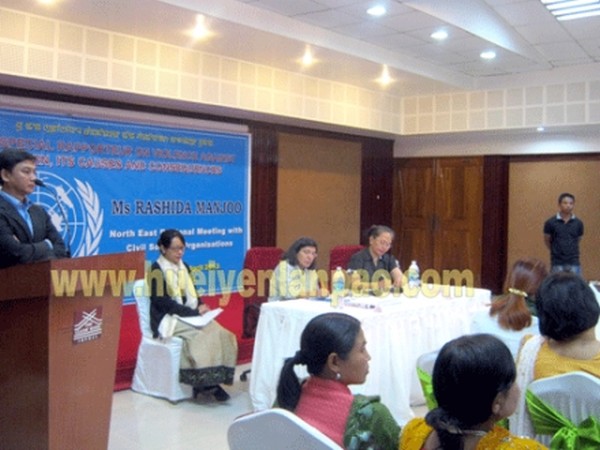
Executive Director of HRA Babloo Loitongbam delivering the vote of thanks of the meeting

(Executive Director of HRA Babloo Loitongbam delivering the vote of thanks of the meeting)

The Indian agency E-Paonet reports in some detail on the visit by a UN Special Rapporteur to India. Let’s start by acknowledging India’s willingness to accept the Rapporteur (unlike other countries such as Eritrea I just reported on today)!

The Rapporteur in question is Rashida Manjoo the United Nations Special Rapporteur on Violence Against Women, its Causes and Consequences who held a consultative meeting with representatives of civil society organizations, women human rights defenders, victims and other advocates working on violence against women at Classic Hotel, on 28 April. As many as forty separate depositions were made during the meeting, the largest one during her current 10-day long official mission to India from April 22 to May 1. After hearing all the depositions, Rashida observed that it was not her mandate to comment on the depositions made before her, but assured that her report and recommendations would be based on facts and they would be placed on the table of the forthcoming session of the United Nations Commission on Human Rights, which is scheduled to take place June this year at Geneva for necessary actions. Read the rest of this entry »