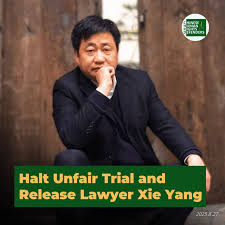
A court in China sentenced the prominent human rights lawyer Xie Yang to five years in prison on March 23, 2026, on politically motivated charges of “inciting subversion of state power,” Human Rights Watch said on 24 March 2026. The Chinese government should immediately quash the conviction, which followed serious procedural violations and years of persecution, and free Xie unconditionally
The Changsha Intermediate People’s Court cited several of Xie’s WeChat posts as the basis for the verdict, Xie’s former wife, Chen Guiqiu, posted on social media. The court also ordered the confiscation of 100,000 yuan (US$14,500).
“The Chinese authorities’ prosecution of Xie Yang and the court’s harsh sentence reflects Beijing’s utter contempt for the rule of law,” said Maya Wang, deputy Asia director at Human Rights Watch. “This case not only aimed to persecute a brave human rights lawyer like Xie, but to intimidate all lawyers seeking to protect Chinese people’s rights.”
Xie’s trial violated the right to a fair trial by an independent and impartial court as provided under international human rights law, Human Rights Watch said. In addition, the proceedings violated China’s Criminal Procedural Law, which guarantees a right to a defense (articles 33-35), public trial hearings (article 188), and time limits for a criminal investigation. With time served, Xie’s sentence is expected to go to January 2027.
The United Nations Working Group on Arbitrary Detention has recognized Xie’s detention as arbitrary and called for his immediate release.
Xie, 54, from Changsha, Hunan province, began practicing law in 2011. He has defended activists and victims of rights abuses in politically sensitive cases, including cases of religious persecution and land rights disputes.
Xie has faced repeated retaliation for his work. In July 2015, during the nationwide arrests of human rights lawyers known as the “709 crackdown,” Xie was tortured and subjected to enforced disappearance, convicted of “inciting subversion,” and imprisoned until 2017.
The authorities detained him again in January 2022 after he pressed for the release of a young teacher who had been forcibly committed to a psychiatric facility for criticizing censorship in education. Police raided Xie’s home, tortured him in custody, and held him on charges of “inciting subversion” and “picking quarrels and provoking trouble,” said the US-based Chinese Human Rights Defenders.
“Foreign governments should continue to speak out for human rights lawyers like Xie Yang because this kind of support is most important when the circumstances are so dire,” Wang said. “Vocal international support could improve Xie’s treatment, and crucially, help give him and others in China the strength to persevere.”
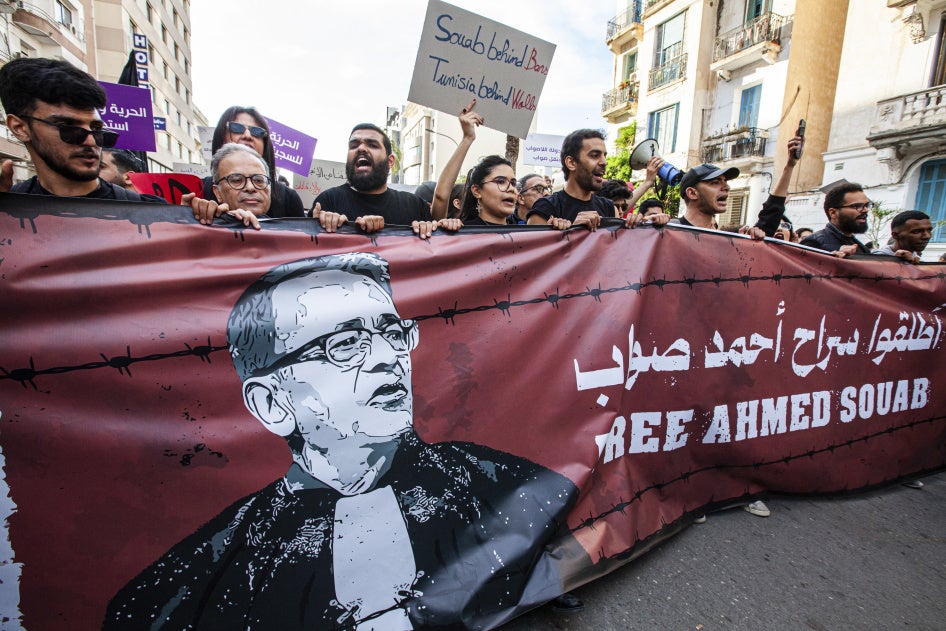
A Tunisian lawyer and human rights defender, Ahmed Souab, who was sentenced to prison on terrorism-related charges, will face a new trial on appeal on February 12, 2026, Human Rights Watch said. The Tunisian authorities should immediately drop the unfounded charges and release him, and stop retaliating against critics and the lawyers defending them.
Tunisian authorities prosecuted Souab, 69, for statements he made outside of court while representing defendants in a notorious case of “conspiracy against state security.” On October 31, 2025, a Tunis anti-terrorism court sentenced him to five years in prison and three years of administrative supervision. His trial lasted just minutes; Souab was not present, and journalists were reportedly barred from attending.
“Ahmed Souab, a lawyer, former administrative judge, and fierce advocate for judicial independence, is behind bars simply for his defense work and outspoken views,” said Bassam Khawaja, deputy Middle East and North Africa director at Human Rights Watch. “His abusive prosecution for defending others from abusive prosecution shows the sheer extent of the Tunisian authorities’ crackdown on any dissent.”
Anti-terrorism agents arrested Souab in his home on April 21, following comments he made after the “conspiracy case” verdict on April 19. That day, 37 people, including lawyers, activists, and opponents, were sentenced after a sham trial for terrorism and security-related offenses to prison terms ranging from 4 to 66 years.
Standing outside the headquarters of Tunis Bar Association, Souab reportedly said: “It seems that it is not the detainees who have a knife turned on them, but rather, it’s the president of the chamber who has a knife [at his throat].” Video excerpts of his statement circulated widely on social media. Souab’s defense committee explained that he was referring to pressure exerted on judges.
Human Rights Watch has documented the authorities’ repeated attacks on the judiciary in Tunisia, including President Kais Saied’s dismantling of the High Judicial Council in February 2022. The attacks have severely undermined the rule of law, allowed the executive to weaponize the judiciary for political ends, and jeopardized Tunisians’ right to a fair trial, Human Rights Watch said.
The Tunisian authorities are increasingly relying on remote trials for terrorism cases, especially for politically motivated trials against dissidents. The practice of remote trial by video is inherently abusive, including by undermining detainees’ right to be brought physically before a judge to assess their well-being and the legality and conditions of their detention.
On October 31, Souab was convicted of “endangering the lives of people entitled to protection by deliberately disclosing information that could reveal their identities” and of “making threats in connection with a terrorist offense,” his family told Human Rights Watch.
Souab’s family said he has a history of cardiac conditions and experienced a deterioration in his health in prison. He has suffered several nosebleeds, the cause of which was not determined, they said.
Over the past three years, the authorities have increasingly relied on an aggressive legal toolbox, including unfounded security and terrorism charges under the penal code and 2015 Counterterrorism Law, to target critics and lawyers with judicial harassment, abusive criminal prosecution, arbitrary detention, and travel bans for the legitimate exercise of their profession. see also: https://humanrightsdefenders.blog/tag/tunisia/
On 19 February 2026, an important group of NGOs stated that the international community must call for the immediate release of Umar Khalid
On Jan. 5, 2026, the Indian Supreme Court denied bail to human rights defender and student activist Umar Khalid, who has been detained for over five years without trial, in violation of India’s obligations under international human rights law. The undersigned organisations are disturbed by the Court’s decision. As domestic legal remedies have proven ineffective, we urge the international community to take urgent and coordinated action.
Khalid was arrested on Sept. 13, 2020, after he became a prominent face of nationwide peaceful protests against the discriminatory Citizenship Amendment Act, a law excluding Muslims from eligibility for a fast-tracked path to Indian citizenship. Khalid’s unfounded prosecution stems solely from the exercise of his rights to freedom of expression and peaceful assembly.
Khalid was charged under India’s anti-terror law, the Unlawful Activities (Prevention) Act (UAPA), as well as other laws, for a total of 29 charges. The UAPA has been criticised by the UN Working Group on Arbitrary Detention and several other UN Special Procedures mandate holders, particularly for its vague definitions and restrictive bail provisions that enable prolonged pre-trial detention. Indian authorities have frequently used these anti-terror legislations to detain political dissenters, human rights defenders, activists, and Muslims by keeping them in prison for extensive periods of time prior to trial. Indian grassroots organisation People’s Union for Civil Liberty has demonstrated through its investigation how UAPA has been systematically abused to silence dissent.
Since his arrest, Khalid has been languishing in Delhi’s Tihar jail for over five years awaiting trial. According to the Supreme Court, this excessively long pre-trial detention has not “crossed the threshold of constitutional impermissibility,” but Khalid should not be detained at all — he is being held simply for exercising his rights. The Supreme Court’s Jan. 5, 2026, decision also forbids Khalid from applying for bail for one year. His trial is yet to begin.
In the same judgment in which the Court denied bail to Khalid, it released his co-defendants in the case, activists Gulfisha Fatima, Shifa Ur Rehman, Meeran Haider, Saleem Khan, and Shadab Ahmed, a development the undersigned organisations welcome. However, Khalid’s co-defendants, released on bail, are not entirely free. The Supreme Court imposed strict bail conditions: a blanket ban on participating in “any programme or address”, attending “any gathering, rally or meeting, whether physically or virtually” and on circulating “any post either in electronic or physical form or circulate any hand bills, posters, banners, etc. in any form whatsoever.” These conditions violate their rights to freedom of expression and association.
All of Khalid’s co-defendants remain at risk of re-arrest if eventually convicted in the case. This includes activist Safoora Zargar, who was charged in the same case but released on bail in June 2020 due to her pregnancy, and following a decision of the United Nations Working Group on Arbitrary Detention rendering her detention arbitrary.
The Indian judicial system has failed Umar Khalid and his co-defendants. It is time for the international community to take meaningful and coordinated action. Governments, particularly those with strong bilateral relationships with India, should publicly and privately call for Umar Khalid’s immediate and unconditional release and raise his case in all high-level diplomatic engagements.
As a sitting member of the UN Human Rights Council, India should be reminded of its commitment under UN General Assembly Resolution 60/251 to “uphold the highest standard in the promotion and protection of human rights.”
Pending the acquittal of Khalid and his co-defendants, diplomatic missions in New Delhi should also closely monitor court proceedings and reaffirm the importance of due process and presumption of innocence.
Signed by;
Human Rights Foundation
Hindus for Human Rights
Diaspora in Action for Human Rights and Democracy (DAHRD)
Amnesty International
InSAAF India
Indian American Muslim Council
UK Indian Muslim Council
Scottish Indians for Justice
India Alliance Paris
South Asia Solidarity, UK
South Asia Justice Campaign
Joint Committee to Stop Repression in India
India Labour Solidarity
Freedom House
India Civil Watch International
Karwaan-e-Mohabba
World Organisation Against Torture (OMCT), within the framework of the Observatory for the Protection of Human Rights Defenders
Free Voices Collective e.V.
International Federation for Human Rights (FIDH), within the framework of the Observatory for the Protection of Human Rights Defenders
On 29 January 2026 ISHR, in collaboration with its various partners, announced that it has established a network of legal professionals for the protection of human rights defenders in Africa
Legal professionals and human rights defenders from several African countries came together to finalise the establishment of a network for the protection of human rights defenders in Africa.
This Network aims to be a space for collaboration, solidarity and strategic legal action, with a view to strengthening the collective response to violations of the rights of human rights defenders in Africa. Its establishment is part of a project implemented by the International Service for Human Rights with the support of Open Society Foundations, and in collaboration with national and regional human rights networks.
Participants at this regional meeting reviewed the Network’s founding charter, defining its principles, governance and operating procedures, and identifying common priorities for strengthening the legal protection of human rights defenders on the continent.
Participants noted that in some African countries, violations, criminalisation and impunity persist, even in contexts with specific legal frameworks. Emphasising the need to move beyond isolated approaches, participants agreed to strengthen regional coordination among legal professionals.
During the meeting, the Network members agreed on a set of common principles and values, including a defender-centred approach, commitment, solidarity, independence, apoliticality, professionalism, integrity, and confidentiality. They also defined clear criteria for the Network’s engagement in situations of violations, in order to ensure responsible, strategic actions that respect the safety of defenders.
The meeting also served as an opportunity to discuss the legal challenges faced by defenders in different national contexts, as well as regional and international mechanisms that could strengthen their access to justice and protection.
The members of the Network committed to continuing the work begun at this meeting and to translating the adopted recommendations into concrete actions:
For countries that have not yet adopted an act on the recognition and protection of human rights defenders, to adopt such legislation.
For countries that have adopted such legislation, to implement it and establish national mechanisms for the protection of human rights defenders.
Mahin Horri in an OpEd in Eurasia review of 25 relates that in a display of international solidarity, more than 400 prominent women leaders from across the globe issued an urgent public statement on December 23, 2025, demanding the immediate release of Zahra Tabari, a political prisoner currently facing imminent execution in Iran. The signatories include Nobel Peace Prize laureates, former heads of state, United Nations officials, and human rights defenders who have united to condemn the Iranian regime’s use of the death penalty to silence political dissent.
The appeal, organized by Justice for the Victims of the 1988 Massacre in Iran (JVMI), highlights the regime’s brutal gender apartheid and its specific targeting of women who challenge the mullahs’ tyranny. Signatories include former Prime Minister of Ukraine Yulia Tymoshenko, former Swiss President Micheline Calmy-Rey, and 2022 Nobel Peace Prize Laureate Oleksandra Matviichuk. They warn that in Iran today, “daring to hold a sign declaring women’s resistance to oppression is now punishable by death.”
Zahra Tabari, a 67-year-old mother and electrical engineer from Babol, has become a symbol of the Iranian people’s refusal to bow to dictatorship. She was sentenced to death in October 2025 by the so-called Revolutionary Court in Rasht on charges of “cooperating with the People’s Mojahedin Organization of Iran (PMOI/MEK).” Her specific act of defiance was holding a banner bearing the slogan “Woman, Resistance, Freedom”—a phrase that has gained traction among female political prisoners as a call for active opposition to the regime.
The judicial process leading to her sentence was a complete mockery of justice. Presided over by the henchman judge Ahmad Darvish Goftar, the trial lasted merely 10 minutes and was conducted via video conference. Tabari was denied access to legal representation of her choice. Her persecution is also rooted in a historical vendetta; her cousin, Dr. Tabari, a PMOI member, was executed by the regime in 1983.
Tabari’s case is not an isolated incident but part of a systematic campaign of terror orchestrated by Supreme Leader Ali Khamenei. Following calls by state media in July 2025 to repeat the 1988 massacre of political prisoners, the judiciary has accelerated the issuance of death sentences. Currently, at least 18 political prisoners are on death row for their support of the PMOI.
In early December 2025, the regime notified Karim Khojasteh, a 62-year-old engineer and former political prisoner from the 1980s, of his death sentence for “Baqi” (armed rebellion). Just one day later, the judiciary reconfirmed the death sentences of six other political prisoners—Babak Alipour, Pouya Ghobadi, Vahid Bani Amerian, Mohammad Taghavi, Akbar Daneshvarkar, and Abolhassan Montazer—in hearings that lasted only minutes. Furthermore, 22-year-old honors student Ehsan Faridi recently had his death sentence for “Corruption on Earth” upheld, despite his lawyer citing serious procedural flaws.
Boxing champion and political prisoner Mohammad Javad Vafaei Sani, also faces imminent execution as the regime judiciary has upheld his death sentence multiple times.
This surge in executions—totalling over 2,500 since the inauguration of the regime’s president Masoud Pezeshkian in August 2024, with 335 executions in November 2025 alone—exposes the regime’s profound vulnerability. The mullahs are terrified by the growing influence of the PMOI Resistance Units and the younger generation’s rejection of the theocracy. The focus on executing educated professionals, former political prisoners, and young students like Faridi is a calculated attempt to terrorize the very demographics leading the uprising.
In a landmark ruling for fundamental freedoms in Colombia, the Inter-American Court of Human Rights found that for over two decades the state government harassed, surveilled, and persecuted members of a lawyer’s group that defends human rights defenders, activists, and indigenous people, putting the attorneys’ lives at risk.
The ruling is a major victory for civil rights in Colombia, which has a long history of abuse and violence against human rights defenders, including murders and death threats. The case involved the unlawful and arbitrary surveillance of members of the Jose Alvear Restrepo Lawyers Collective (CAJAR), a Colombian human rights organization defending victims of political persecution and community activists for over 40 years.
The court found that since at least 1999, Colombian authorities carried out a constant campaign of pervasive secret surveillance of CAJAR members and their families. That state violated their rights to life, personal integrity, private life, freedom of expression and association, and more, the Court said. It noted the particular impact experienced by women defenders and those who had to leave the country amid threat, attacks, and harassment for representing victims.
The decision is the first by the Inter-American Court to find a State responsible for violating the right to defend human rights. The court is a human rights tribunal that interprets and applies the American Convention on Human Rights, an international treaty ratified by over 20 states in Latin America and the Caribbean.
In 2022, EFF, Article 19, Fundación Karisma, and Privacy International, represented by Berkeley Law’s International Human Rights Law Clinic, filed an amicus brief in the case. EFF and partners urged the court to rule that Colombia’s legal framework regulating intelligence activity and the surveillance of CAJAR and their families violated a constellation of human rights and forced them to limit their activities, change homes, and go into exile to avoid violence, threats, and harassment.
Colombia’s intelligence network was behind abusive surveillance practices in violation of the American Convention and did not prevent authorities from unlawfully surveilling, harassing, and attacking CAJAR members, EFF told the court. Even after Colombia enacted a new intelligence law, authorities continued to carry out unlawful communications surveillance against CAJAR members, using an expansive and invasive spying system to target and disrupt the work of not just CAJAR but other human rights defenders and journalists.
In examining Colombia’s intelligence law and surveillance actions, the court elaborated on key Inter-American and other international human rights standards, and advanced significant conclusions for the protection of privacy, freedom of expression, and the right to defend human rights.
The court delved into criteria for intelligence gathering powers, limitations, and controls. It highlighted the need for independent oversight of intelligence activities and effective remedies against arbitrary actions. It also elaborated on standards for the collection, management, and access to personal data held by intelligence agencies, and recognized the protection of informational self-determination by the American Convention.
On 1 April 2024, Media and Law Studies Association (MLSA is a human rights organization committed to protecting freedom of expression, press freedom, the right to assemble and protest, and access to information in Turkey. It serves as a vital platform where journalism and legal expertise merge to safeguard these freedoms, particularly for journalists, lawyers, and human rights defenders facing increasing challenges). SEMRA PELEK wrote about Mine Özerden, a human rights defender now detained for 700 days. The detailed statement if woth reading in full:
From Mine Özerden’s standpoint, the Gezi Trial began with an unsubstantiated criminal complaint. Despite efforts, no informant was identified. Tax inspectors investigated the allegations but couldn’t confirm them. The court ruled the phone taps used as evidence were illegal. Nonetheless, Özerden was sentenced to 18 years and has been in prison for nearly two years.
“I’ve said this repeatedly, and I’ll say it again: I still can’t comprehend why I’m here, and there hasn’t been anyone who could logically explain it to me yet.”
With these words, Mine Özerden began her defense during the session of the Gezi Trial held at the Istanbul 13th Heavy Penal Court on October 8, 2021. She posed the same question during her defense at the session held on January 17, 2022. Özerden has been asking the same question at every hearing since the initial session of the Gezi Trial on June 25, 2019. However, in the years that have passed, she has received no answer to her question throughout the entire legal process.
Mine Özerden’s lawyer requested an explanation from the prosecutor through the court regarding this matter. However, the court rejected the request: “The request for a statement from the Public Prosecutor regarding which acts and crimes are being attributed to the defendant Mine Özerden by the defense attorney has been rejected…”
The court failed to provide any justification or further clarification of the rejection. However, according to the Code of Criminal Procedure, every defendant has the right to effectively present their defense, and the right to “be informed.” This means that prosecutors and courts are obligated to inform the defendant of the accusations against them to ensure a fair trial. The laws clearly state this right, however, Mine Özerden was not granted this right throughout the entire trial, and the judiciary system did not provide any logical explanation for this.
Let’s ask a question of our own here: Is there no answer to Ozerden’s question in the 657-page indictment written by the prosecution, which led to Osman Kavala’s aggravated life sentence and the 18-year sentences that Mine Özerden, Çiğdem Mater, Tayfun Kahraman, and Can Atalay have been given in the Gezi Trials? They are currently convicted of serious charges such as “attempting to overthrow the Republic of Turkey by force and violence” and “aiding this attempt,” which means the higher Court of Cassation also signed off on the decision. In the document of approval released by the Court of Cassation, is there any answer to the aforementioned question? No, there isn’t!
Scrutinizing the Gezi Trial files, one question remains: Why is Mine Özerden in prison?
And you can’t find the answer to that question. After poring over the files line by line, one can’t help but be reminded of Kafka’s novel, The Trial. So much so that you could replace the protagonist Josef K.’s name with Mine Özerden’s: “Somebody must have made a false accusation against Mine Özerden, for she was arrested one morning without having done anything wrong.”
This is exactly how the Gezi Trial, which today stands like a specter against the freedom of expression and assembly not only of the defendants but of the whole society, began for Mine Özerden.
Let’s start from the beginning: On September 26, 2013, a “criminal complaint” was sent via email to the Istanbul Communication Electronics Branch Directorate. According to the indictment, the person, who didn’t provide their name in “criminal complaint number 11167,” claimed to have “important information regarding the Gezi protests” and alleged that “before the protests began in Taksim, Mine Özerden opened bank accounts for several individuals under the direction of Osman Kavala from the Open Society Foundation.” According to the informant’s claim, the money collected in these accounts was intended to purchase “gas masks, bandages, and goggles,” which would then be “distributed to protesters.”
In the thousands of pages of the Gezi Trial file, this is the sole allegation concerning Mine Özerden.
Following up on this allegation requires due diligence in seeking the facts. Unlike Kafka’s novel, Özerden’s experiences are not allegorical but real; she has been held in Bakırköy Women’s Prison for nearly two years due to this unsubstantiated criminal complaint.
In the indictment, the prosecutor – after quoting the informant’s claim in quotation marks and bold black letters – immediately indicates in the next sentence that they “could not locate the informant”: “Upon the instruction of our Republic Prosecutor’s Office, an investigation was conducted into the IP address to obtain a detailed statement from the informant, however, no identification was made.”
In other words, the informant could not be found. So, were the bank accounts alleged by the informant opened?
No!
That, in fact, is the following sentence, where the prosecutor offers his admission that the informant could not be found. In the indictment, Istanbul Foundation’s 1st Regional Directorate’s investigation of the accounts of the Open Society Foundation, eventually preparing a report on this inquiry, but the report clearly stated that “no determination could be made regarding these allegations.”
In other words, the claim of an unidentified informant could not be substantiated.
On April 22, 2022 Mine Özerden’s lawyer submitted Tax documents, which proved that the informant’s claim was false to the file.
The court dismissed the Tax Inspectorate report and did not consider it as evidence.
Fact Two: No bank accounts opened; no purchase was made
Typically (in any rule-of-law state), when an informant cannot be found and an unsubstantiated criminal complaint is involved, the case is closed with a verdict of non-prosecution.
Moreover, according to the established jurisprudence of the Court of Cassation, evaluating a purely unsubstantiated complaint on its own is also unlawful. Thus, this jurisprudence also warranted closing the case at this stage. The law is clear: you cannot prosecute anyone with a non-existent crime and an unsubstantiated allegation.
However, instead of closing the file at this point, the prosecutor opened another investigation completely unrelated to the Gezi inquiry. Mine Özerden was incidentally wiretapped within the scope of this investigation. It wasn’t until much later, when the Gezi Trial indictment was prepared, that the fact Özerden had been coincidentally wiretapped in this investigation emerged. When her lawyer officially questioned this, it was revealed that Özerden had never been a suspect in this investigation. Furthermore, there was no wiretap order issued against her in this investigation. Her lawyer had requested wiretap orders from the court, neither the police nor the prosecution had submitted these orders to the file.
In one of these coincidental wiretaps included in the Gezi Trial indictment despite having no relevance to the Gezi investigation, Mine Özerden had a conversation with Osman Kavala on May 30, 2013. In this conversation, Mine Özerden mentioned to Osman Kavala that she had received “some offers.” Someone suggested, “Let’s buy gas masks and distribute them to the youth.” The conversation continued with discussions on how this could be done, such as “maybe opening a bank account.” It was nothing more than an exchange of ideas, with the conversation ending with the suggestion, “One of the volunteers could probably do that.”
The claim of the unidentified informant was based on this conversation. Özerden, who was coincidentally wiretapped in an investigation, where she was not a suspect, was accused on the basis of this wiretap turned into a criminal complaint. Özerden’s lawyer requested the full resolution of this wiretap. However, neither the complete resolutions of wiretaps nor the wiretap recordings were found by the prosecution and were never submitted to the file.
The conversation between Mine Özerden and Osman Kavala remained at the level of ideas because the content of the conversation was not substantiated during the investigation and trial process. No bank account was found to have been opened. Something that doesn’t exist can’t be found in the first place.
There is no evidence in the file that gas masks, bandages, or goggles were purchased. Not a single invoice exists, nor is there any evidence anywhere that these items were found.
So, suppose even one piece of evidence existed in the file – for example, if a bank account had been opened or if an invoice for goggles had been found – what would happen? Opening a bank account and buying gas masks, bandages, or goggles is not a crime under any law. Therefore, Özerden’s lawyer brought goggles, gas masks, and bandages to the trial and asked the panel, “Is acquiring these items a crime?”
Fact Three: No Press Statements or Meetings were Found to Constitute a Crime or Incitement to Commit a Crime
Despite the lack of concrete evidence, the indictment directed the accusation of “aiding an attempt to overthrow the Government of the Republic of Turkey by force and violence” against Mine Özerden. To strengthen such a serious accusation, the prosecutor highlighted Özerden’s voluntary coordination of the Taksim Platform and her continued membership in the board of directors of Anadolu Kültür, where she had worked years ago.
The Taksim Platform was established as a peaceful dialogue platform, holding weekly exchange of ideas meetings, and organizing art events. Although the activities of the platform fell within the scope of freedom of assembly and expression, it was criminalized in the indictment, yet no crime associated with the platform can be found.
Not a single press statement by the platform was included in the indictment. There was not any piece of evidence regarding which press statement or meeting of the platform, on which date, would constitute a crime according to the law. There was also no evidence that any post or statement released by the Taksim Platform could constitute a crime or incitement to violence in the indictment or the file.
The rationale behind the establishment of the Taksim Platform and all updates, statements and press releases ever released by the platform is still accessible today on the website taksimplatformu.com. So, if there had been even the slightest evidence that Taksim Platform was inciting violence, it would be easy for the prosecution to find and include in the indictment.
Moreover, the accusations against Özerden based on her membership in the board of directors of Anadolu Kültür were already refuted explicitly by the Tax Inspectorate report.
Fact four: Özerden was not in Istanbul during the Gezi protests.
It gets even stranger from here. In the indictment, Özerden is accused of organizing meetings of the Taksim Platform in Istanbul during the Gezi protests, attending the platform’s meetings, and even participating in violent actions in Gezi Park.
But the problem here is this: Mine Özerden was not in Istanbul during the Gezi protests.
The Gezi protests began on May 31, 2013. However, Özerden was working at a language school in Fethiye from June 1 to July 31, 2013. Furthermore, not a single video, photograph, or technical surveillance recorded by the police indicating Özerden’s presence in Istanbul during that period has been included in the case file.
However, official Social Security Institution (SGK) records proving Özerden’s presence in Fethiye during that period were submitted to the court. But neither the prosecutor during the investigation process nor the Istanbul 13th Heavy Penal Court during the trial took this into account. The Court of Cassation 3rd Criminal Chamber, which upheld the 18-year prison sentence, also did not. .
Even if it were the opposite, if Mine Özerden were in Istanbul during that time, it still wouldn’t prove anything. Being in Istanbul during the Gezi protests, organizing a meeting, or attending one is not a crime. On the contrary, the right to assembly and freedom of expression are protected by the Constitution.
Fact Five: Wiretapping is Illegal
So, what was written about Mine Özerden on all those pages in the indictment whenthere was no concrete evidence of a crime against her?
The indictment merely contains pages of phone conversations between Özerden and her friends! These conversations delve into personal matters, discussing, for instance, the exhaustion of life and the beauty of getting away from some stressors of life. In one conversation, for instance, Mine Özerden advises a friend to attend a conference in Istanbul where world-renowned philosophers Slavoj Žižek and Alain Badiou are speakers. The conference, titled ‘Globalization and the New Left,’ was organized by Bakırköy Municipality and MonoKL publications. However, this advice was included in the indictment as if it were a crime.
Similarly, Özerden’s response of “enjoy the beautiful weather, how lovely” to a friend saying “the weather was even better two or three days ago” is also included in the indictment as part of these casual conversations. None of the phone taps contain any reference to the organization of the Gezi protests. Instead, they clutter the file. Moreover, these wiretaps are illegal!
The Istanbul 13th High Criminal Court, which handled the case, determined that the wiretaps were illegal. In its decision dated February 18, 2020, acquitting 16 defendants in the Gezi trial, including Osman Kavala, Mücella Yapıcı, Can Atalay, Yiğit Aksakoğlu, Tayfun Kahraman, Çiğdem Mater, Mine Özerden, Yiğit Ekmekçi, and Ali Hakan Altınay, the court made the following legal assessment:
“We have 53 wiretap orders in our file. It is understood that the first wiretap order was issued for the offense of ‘forming and leading a criminal organization,’ not for the offense of ‘crimes against the government.’ Later, it was observed that Article 312 of the Turkish Penal Code (crimes against the government) was added to the requests and decisions for extending the wiretapping. However, Article 312 was not among the crimes subject to legal wiretapping as listed in Article 135/8 of the Criminal Procedure Code at that time. There is no wiretap order issued after that date. Therefore, it is accepted that the wiretap recordings are in violation of the law and are illegal evidence, considering the established precedents of the Court of Cassation and the principle that ‘the fruit of the poisonous tree is also poisonous.’ Hence, the wiretaps included in the indictment are considered as prohibited evidence.”
In other words, all phone conversations used as evidence against Mine Özerden, along with other defendants, were the fruits of the poisonous tree. In summary, the real crime was the wiretapping of phones.
But as if that weren’t enough, a new term called ‘revaluation’ was coined to justify the inclusion of wiretap recordings in the indictment. The indictment stated that “the revaluation of all evidence concerning the investigation, especially the wiretaps, was ordered.” However, there is no procedure called ‘revaluation’ in the Code of Criminal Procedure. Mine Özerden asks: “Isn’t this openly insulting to use the word ‘revaluation’?”
They Were Convicted with the “Poisonous Fruit of the Poisonous Tree”
Ultimately, the acquittal verdicts were overturned. Despite no additional evidence being presented to substantiate the allegations, the convictions handed down by the Istanbul 13th High Criminal Court on April 25, 2022, against Osman Kavala, Can Atalay, Çiğdem Mater, Mine Özerden, and Tayfun Kahraman were upheld by the Court of Cassation’s 3rd Criminal Chamber.
Osman Kavala, who was sentenced to an aggravated life sentence for the allegation of “attempting to overthrow the Government of the Republic of Turkey,” has been in prison for over six years. Can Atalay, Çiğdem Mater, Mine Özerden, and Tayfun Kahraman, who were each sentenced to 18 years in prison for “aiding this attempt,” have been deprived of their freedom for 700 days.
Responding to our questions from prison, Mine Özerden made the following comment regarding the entire legal process:
“Not only do the institutions and decision-makers of the country I am a citizen of fail to protect our rights, but they also increasingly violate our fundamental, constitutional, and legal rights more and more everyday. For nearly two years, we have been deprived of our physical freedom without reason, evidence, or truth…
I find myself involuntarily caught in a senseless quarrel of irrationality and illogic. We are continuously instrumentalized by different political segments with various affiliations. My wish is for people from all walks of life to stand up against injustice and for a collective will demanding basic human rights to emerge.”
Mine Özerden still awaits a logical explanation as to why she is being tried, why she is being punished, and why she has been held at Bakırköy Women’s Prison for years.
Instead of explaining, the judiciary merely extends to her the poisonous fruit of a poisonous tree.
On 12 March 2024 the recently appointed UN Special Rapporteur on the promotion and protection of human rights while countering terrorism, Ben Saul, warned that two decades of prolific global efforts to counter terrorism have not been matched by an equally robust commitment to human rights.
In his first report to the Human Rights Council, the Special Rapporteur painted a counter-terrorism landscape strewn with human rights violations, including unlawful killings, arbitrary detention, torture, unfair trials, privacy infringements from mass surveillance, and the criminalisation of freedoms of expression, assembly, association and political participation. For earlier posts on this topic, see: https://humanrightsdefenders.blog/tag/anti-terrorism-legislation/
“The misuse of counter-terrorism measures not only violates the rights of suspected criminals but can also jeopardise the freedoms of the innocent,” Saul said.
He condemned the rampant weaponisation of overly-broad terrorism offences against civil society, including political opponents, activists, human rights defenders, journalists, minorities, and students. Unjustified and protracted states of emergency continue to undermine human rights, the expert warned.
“Excessive military violence in response to terrorism also destroys fundamental rights, including through violations of international humanitarian law and international criminal law,” Saul said. “Cross-border military violence is increasingly used by states even when it is not justified under the international law of self-defence.”
“Many states have also failed to address the root causes of terrorism, including state violations of human rights – while impunity for those violations is endemic,” he said.
Saul said regrettably, the UN has been part of the problem, by encouraging authoritarian regimes to strengthen counter-terrorism laws in the absence of a rule of law culture or human rights safeguards. “The UN must also do better to meaningfully consult civil society on counter-terrorism,” he said.
Announcing his priorities for his three-year term, the Special Rapporteur said his focus would include ensuring regional organisations respect human rights when countering terrorism; all coercive administrative measures used to prevent terrorism comply with human rights; and States are held accountable for large-scale violations of human rights resulting from counter terrorism – and victims receive full and effective remedies.
Saul will also continue the efforts of his predecessor on preventing the abuse of counter-terrorism measures against civil society; protecting the 70,000 people arbitrarily detained in north-east Syria in the conflict against ISIL; protecting detainees and transferees from the detention facility at Guantánamo Bay, Cuba; ensuring that the UN safeguards human rights in its counter-terrorism work, regulating new technologies used in counter-terrorism; and protecting the victims of terrorism.
“Human rights in counter-terrorism are at increased risk because of rising authoritarianism, surging domestic polarisation and extremism, geopolitical competition, dysfunction in the Security Council and new tools, including social media, for fuelling dehumanisation, vilification, incitement and misinformation,” the Special Rapporteur warned.
“Double standards and selectivity by major powers in the enforcement of human rights is also eroding public confidence in the credibility of the international human rights system,” he said. “States must move beyond rhetorical commitment to human rights and instead place human rights at the heart of all counter-terrorism measures.”
Responding to news that the Emirati authorities have begun a mass prosecution on trumped-up terrorism charges of more than 80 Emirati human rights activists – including renowned currently-jailed Emirati human rights activists who have already spent a decade behind bars – Aya Majzoub, Amnesty International’s Middle East and North Africa Deputy Director, said:
“To begin hearings in a new sham mass trial in the midst of what it billed as ‘the most inclusive COP ever’, is a jaw-dropping show of contempt for human rights by the Emirati authorities. The timing appears to be deliberately intended to send a clear message to the world that it will not tolerate the slightest peaceful dissent and that the authorities have no intention of reforming the country’s dire rights record. COP28 has already laid bare the barriers of fear and legalised repression that smother dissent in the UAE.
“The UAE must immediately release all arbitrarily-detained prisoners, drop charges against them and end their ruthless assault on human rights and freedoms.”
The new mass trial – first reported by the Emirates Detainees Advocacy Centre and confirmed to Amnesty by exiled Emirati activists – is a joint prosecution of more than 80 defendants, including victims of a past mass trial such as Mohamed al-Siddiq, father of the late exiled Emirati human rights defender Alaa al-Siddiq, prisoners of conscience such as Khalid al-Nuaimi, Hadef al-Owais, Nasser bin Ghaith and Sultan al-Qasimi, and longstanding human rights defenders such as Mohamed al-Roken and Ahmed Mansoor (see below).
Fresh charges against Ahmed Mansoor
Last month, Amnesty UK campaigners flew a protest plane over Manchester City FC’s Etihad Stadium carrying a large banner saying “UAE – Free Ahmed Mansoor”. Mansoor is a blogger, poet and leading Emirati human rights activist who has been in jail and kept in solitary confinement in the UAE since 2017 as a direct result of his campaigning activity. In 2017, Mansoor was convicted on charges which included “insulting the status and prestige of the UAE and its symbols”, “publishing false information to damage the UAE’s reputation abroad” and “portraying the UAE as a lawless land”. The following year, Mansoor was sentenced to ten years’ imprisonment, with the sentencing court also ordering that he be placed under surveillance for three years after release. His conviction and sentence were upheld by the country’s supreme court on 31 December 2018.
On 10 November 2023 the Caucasian Knot reported that the ECtHR had found a violation of the rights of Krasnodar activist Nikitin. Alexander Konstantinovich Nikitin is a Russian former submarine officer and nuclear safety inspector turned environmentalist. In 1996 he was accused of espionage for revealing the perils of decaying nuclear submarines, and in 2000 he became the first Russian to be completely acquitted of a charge of treason in the Soviet or post-Soviet era. Nikitin is still engaged in environmental and human rights issues in Russia. He is the head of Bellona Foundation’s Saint Petersburg branch, and is engaged in environmental and nuclear safety projects, as well as in human rights cases. He is a widely recognised HRD, see: https://www.trueheroesfilms.org/thedigest/laureates/D519B52C-D0C3-4B3B-B8F6-798A34B1BF04
The European Court of Human Rights (ECtHR) has awarded compensation of EUR 5000 to Alexei Nikitin, a Krasnodar activist. Nikitin was detained at an action against increasing prices for public transport in 2018 and at a rally in support of Alexei Navalny* in 2021.
Navalny’s offices are recognized as extremist organizations and banned in Russia. Alexei Navalny is a founder of the Anti-Corruption Foundation (known as FBK), an NCO that is included by the Russian Ministry of Justice (MoJ) into the register of NCOs performing functions of a foreign agent. The NCO is also recognized by a court as extremist and banned in the territory of Russia.




 Hans Thoolen on Human Rights Defenders and their awards