Posts Tagged ‘China’

China’s “Residential Surveillance at a Designated Location” needs to disappear!

February 5, 2022

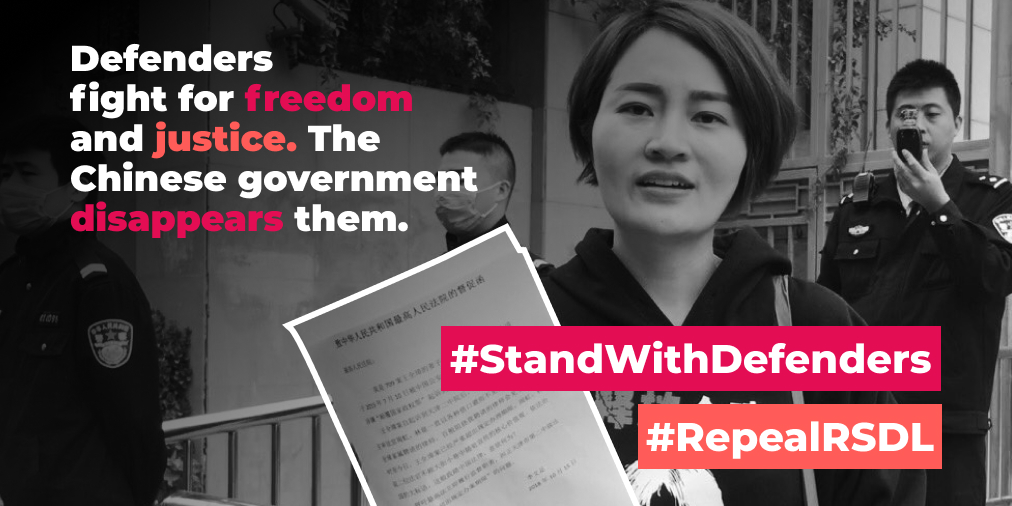
In China, brave activists are trying to improve the daily life of their fellow citizens and defend their rights to speak freely, to be treated on an equal footing with others, to protest peacefully, or to practice a religion. But the Chinese government fears that their actions will challenge its power and that their criticisms will undermine it. Like the Uyghur and Tibetan peoples, many who stand up for human rights are repressed and silenced, and the authorities have found a very effective way to do that: they disappear them.

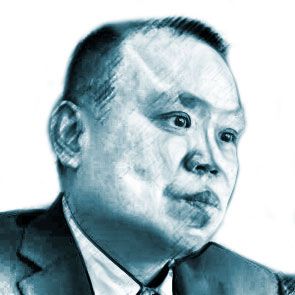
On 22 October 2020, exactly a year ago, lawyer Chang Weiping was disappeared under ‘Residential Surveillance at a Designated Location’ (or ‘RSDL’) for ‘inciting subversion of State power.’ Lawyer Chang is a human rights lawyer, who has bravely defended sensitive cases of victims of sexual harassment during China’s ‘Me Too’. He has also worked with victims of discriminatory practices due to their sexual orientation or HIV status, or targeted for speaking freely or practicing their religion. Ten days before his disappearance, he had published a video denouncing torture he had endured when he was first held under RSDL in January 2020, after attending a meeting with other activists a month earlier. UN experts have publicly called for his release. No one knows where he is held. [see also: https://www.trueheroesfilms.org/thedigest/laureates/2e6ec951-79e7-4a36-b077-76bfe05e3817]

Since 2012, China’s rubber-stamp legislative body passed and amended several articles in its Criminal Procedure Law that give police the power to take people into custody without disclosing where they will be held: this is called ‘Residential Surveillance at a Designated Location’. When this happens, people are denied all contact with the outside world, even with their family or a lawyer, for up to six months. No one knows where they are. They are interrogated and often tortured to extract confessions. Meanwhile, despite the barriers and risks they have to overcome, their families persist in seeking knowledge about their loved one’s fate and justice for what they suffered.

United Nations experts are clear: RSDL is a form of enforced disappearance. With estimations of up to 57.000 individuals under RSDL, enforced disappearances are endemic in China. RSDL tears families apart, and is intended to instill fear into China’s human rights movement. See also: https://humanrightsdefenders.blog/2018/01/10/more-on-residential-surveillance-in-a-designated-location-rsdl-in-china/

Many human rights activists have stopped promoting dignity, peace and justice in their communities because they fear to be disappeared by the police. This practice – enforced disappearance – is absolutely wrong and prohibited under international law. Everyone should be able to speak their mind and participate in the life of their communities. 

ISHR, Safeguard Defenders, The Rights Practice and The 29 Principles are mobilising the international community to put pressure on China to #RepealRSDL and end enforced disappearances against human rights defenders.

They want the Chinese government to repeal RSDL (articles 74 to 79 of China’s Criminal Procedure Law), and to bring truth and justice to victims.

RSDL should be high on the agenda of any human rights exchange with the Chinese government. We want governments worldwide to speak out and use all bilateral and multilateral channels to press the Chinese government to #RepealRSDL. We want the UN to amplify its monitoring of RSDL in China, and to sustain its pressure on the authorities to respect international law and to #RepealRSDL.

Feeling supported is vital for disappeared defenders and their relatives. We want the media, human rights groups and activists across the world to pay closer attention to RSDL, to raise awareness around them, and to stand in solidarity with disappeared Chinese human rights defenders and their relatives.

How do we achieve this? 

We are working hard to: 

  • Increase the awareness and legal understanding of government officials and diplomats, UN experts, journalists, and human rights groups, there is a short document that explains clearly what UN experts have said about RSDL, and are spreading the word online and offline.
  • Mobilise diplomatic missions, through meetings and letters, and encourage them to speak out on RSDL at the UN and in other spaces; 
  • Push UN experts to take up individual cases and pay a closer look at the use and impact of RSDL in light of China’s obligations under international human rights law ;
  • Encourage governments, activists, and concerned individuals to stand in solidarity with disappeared human rights defenders and their relatives

What can you do? 

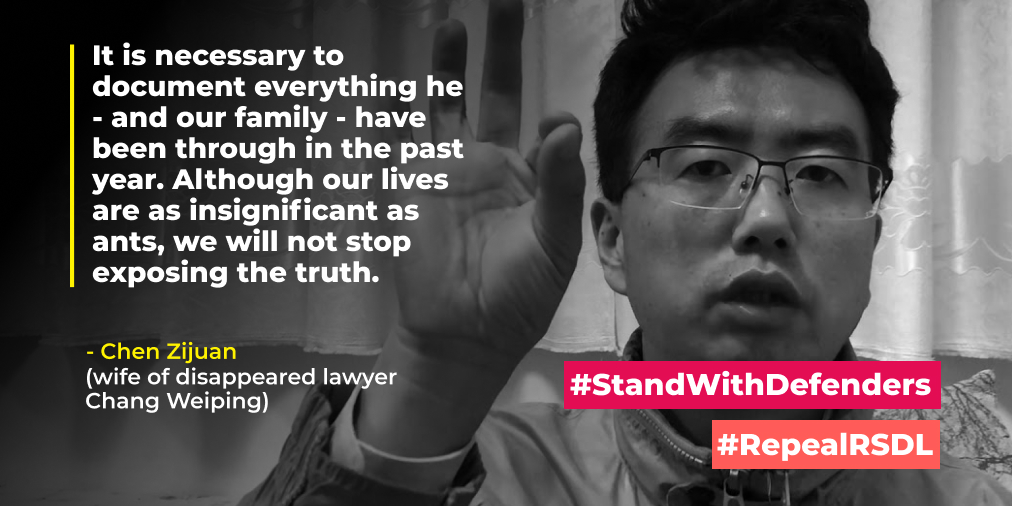
Stand in solidarity! Feeling supported is vital for disappeared defenders and their relatives. Send a solidarity message with Chen Zijuan, lawyer Chang’s wife: write a postcard, and share it with her on your social media by clicking on the image below. Don’t hesitate to personalise it before tweeting. Alternatively you can copy paste this link in your browser: https://ctt.ac/477cf

You can also raise awareness! Check out the informational and communication material in our ‘Campaign Toolbox’, and share it with your country’s ministry of foreign affairs, a journalist you know, your friends or your social media followers – and remember to tag @ISHRglobal, and #StandWithDefenders #RepealRSDL.

https://ishr.ch/action/campaigns/call-on-china-to-free-defenders-and-repealrsdl/

Dutch university closes human rights centre funded by China

January 29, 2022

The Scholars at Risk Media Review of January 2022, carries an in-depth article about a university funding row which has raised fears of Chinese influence, written by Yojana Sharma on 26 January 2022:

The Free University of Amsterdam (Vrije Universiteit Amsterdam or VU Amsterdam) in the Netherlands has said it will return Chinese funding for its Cross Cultural Human Rights Centre (CCHRC) after an embarrassing row over Chinese influence on academia when it emerged that several of the centre’s academics publicly denied China oppresses Uyghur peoples. See also: https://chinachange.org/2020/04/30/one-chinese-gongos-war-against-global-human-rights/

But the row in the Netherlands amid other recent controversies over Chinese funding of university centres and Confucius Institutes in Germany and the United Kingdom has also made university disclosure of foreign funding more urgent, academics said. In 2018, 2019 and 2020, the CCHRC at VU Amsterdam received a subsidy of between €250,000 (US$282,000) and €300,000 (US$339,000) from the Southwest University of Political Science and Law in Chongqing, China.

According to documents obtained by Dutch broadcaster NOS, the Chinese university was the sole financial contributor to the CCHRC during those years, which has raised eyebrows.

VU Amsterdam has said it would return the money it had already received from China for this year, NOS revealed last week. But the university only backed down after the damaging revelations prompted a public outcry and strong statements by the Dutch education minister and others condemning the activities of the centre.

On Wednesday NOS said the activities of the Centre were being suspended, with all its lectures for students cancelled, ascribing the decision to the executive board and deans of the university. The Centre’s activities were already in doubt after the return of funds, making it dependent on the university or other donors for its continued survival.

The row blew up just as the Dutch education ministry is due to present its National Guidelines on Knowledge Security on 31 January and to announce its ‘Government-wide knowledge security front-office’, which is expected to have an advisory role and support universities in identifying risks.

It also followed the publication last week of the European Commission ‘toolkit’ for universities on how to deal with foreign interference.

Dutch Education Minister Robbert Dijkgraaf responded swiftly and unequivocally to the report, saying he was “very shocked” that the funding arrangement signalled possible academic dependence.

“It is urgent and sensible that the Free University now takes action quickly. Scientific core values such as academic freedom, integrity and independence must always be guaranteed,” he said in a statement.

The minister added: “It is important that Dutch knowledge institutions are and remain alert to possible risks of undesired influence by other countries and that they take adequate measures to safeguard academic core values, especially when it comes to universal values like human rights.”

The centre runs an academic journal and organises conferences. Its mission, laid down in the financing agreement with the Chinese university, is to draw attention to a “global view of human rights”, and specifically to the way in which non-Western countries such as China view human rights.

University’s lukewarm initial response

After a lukewarm initial response when the university merely underlined that “as befits the Free University, the research of the CCHRC is independent, interdisciplinary, dialogical and socially relevant”, it added to its statement just hours later, saying “even the appearance of dependence is unacceptable” and announced that it was “taking appropriate measures”, including halting the funding from China.

The university said it has not yet decided whether it will also refund subsidies from previous years, but it said it would first conduct an investigation to determine “whether the independence of the institute’s research has been safeguarded on all fronts”.

The CCHRC website noted in October 2020 that a delegation of people affiliated to the centre ‘recently’ visited the western Chinese region of Xinjiang… the CCHRC website noted: “The situation we encountered in the four cities in this trip did not reflect the grim situation as depicted in the Western reports. There is definitely no discrimination of Uyghurs or other minorities in the region.”

CCHRC Director Tom Zwart, professor at Utrecht University, who is also a frequent guest at Chinese state events and on Chinese state television, told NOS any similarities between the centre’s positions online and those of the Communist Party were “coincidental” and were not steered by any direct influence. Zwart described the CCHRC website as a place for “uncensored free thought”, ascribing the comments on its webpages to individuals “who do not represent the organisation as a whole”.

On 26 January CCHRC released a new statement on its website saying the website would be “temporarily taken offline” in order “to check whether a sufficiently clear distinction is made between statements made on behalf of the Centre and opinions and observations made in a personal capacity.”

It added: “[The] Centre explicitly endorses the conclusions of the United Nations regarding the systematic violation of the Uyghur human rights. In this vein, the Centre’s director, in the presence of members of the Chinese State Council and the Politburo, called on 8 April 2021 to respect and protect the rights of Uyghurs and stop repressive anti-terrorism policies.”

Ingrid d’Hooghe, an expert on China-Europe relations and senior research fellow at the Leiden Asia Centre, Leiden University in the Netherlands, said: “The director of the Centre said in an interview which was also on TV that they were fully independent, there was nothing that made them say what they were saying. But apparently it did not cross their mind that even if they are independent, it doesn’t look like it.

Dutch academic Lokman Tsui, a researcher on digital freedoms and a former assistant professor at the Chinese University of Hong Kong, said via Twitter: “Important to note: until this year, they [the university in Chongqing] were the only funder. Problematic, because it’s hard to be independent if your research centre relies on one single funder. Problematic also, because public universities in China are closely affiliated with the Chinese Communist Party.”

Tsui added: “But whether the research centre is independent or not is also beside the question. The more important question is: Why is the university allowing its integrity and its reputation to be compromised by accepting money meant to validate China’s atrocious human rights record?”

Need for disclosure legislation

“We need legislation that universities have to make funding public,” Fulda said, pointing to Section 117 of the United States Higher Education Act which requires universities that receive foreign gifts of US$250,000 or more within a calendar year to file a disclosure report to the government.

Other draft foreign influence bills, including the Senate Bill S.1169 in the US, are currently attempting to tighten those rules, including reducing the amount that has to be declared by institutions and individuals if the funding comes from certain countries such as China, after a number of universities failed to report substantial foreign gifts under Section 117.

An amendment to the UK Higher Education Bill tabled on 12 January in the House of Commons would require disclosures of foreign funds of £50,000 (US$68,000) going back 10 years.

“The question is, if the Dutch government or other governments in Europe issued new regulations where universities were forced to make these contracts public, whether it would change things, and I think it would,” said Fulda.

Leiden Asia Centre’s d’Hooghe said: “There is no regulation that forces people to register somewhere what kind of collaboration they have. With new regulations in Australia and, to a certain extent, in the US and Canada, you have to become public with that kind of information. Not so in the Netherlands.”

“It’s not necessarily that people want to keep it a secret, it’s just not something that is done routinely. So at top levels in the university, but often even at the faculty level, the departments don’t have a good overview of exactly what kind of research is being done with whom, and how this is financed,” she said

The Association of Universities in the Netherlands (VSNU) published a “Framework for Knowledge Security” in July 2021 that outlined risks and the need for monitoring research collaboration, as well as recommending that universities set up their own internal ‘knowledge security advisory team’ to include experts such as cybersecurity specialists.

The focus is on building risk awareness but does not go as far as requiring disclosure of foreign funding. Some universities have pointed out that they cannot ‘police’ research or researchers on behalf of the government.

Who will investigate?

The Netherlands Inspectorate of Education has not indicated that it will carry out a broader investigation into China influence at universities in the country, saying in a statement following the VU Amsterdam row: “No other signals about Chinese influence are known to the inspectorate.”

Sophie Richardson, China director at Human Rights Watch, said in a statement that the Inspectorate of Education “would be wise to do more homework in this area”.

“In a decade of documenting Chinese government threats to academic freedom around the world, Human Rights Watch has found threats at universities from Australia to the United States, and proposed a code of conduct to help mitigate these risks.

“One key step: universities should publicly disclose all direct and indirect Chinese government funding and a list of projects and exchanges with Chinese government counterparts on an annual basis,” she said.

“In showing its permeability to Chinese government influence, the Free University shouldn’t limit its response simply to returning the funding. It should urgently assess whether students and scholars of and from China on its campus are subjected to harassment or surveillance,” which she noted had been well documented elsewhere, notably in Australia, Canada, the UK and the US.

“University leadership and scholars should assess whether censorship and self-censorship have eroded the curriculum or classroom debate,” Richardson added.

“The Free University should also join forces with counterparts across Europe – from Berlin to Cambridge to Budapest – who have faced similar problems, and agree to share information and adopt common standards with the goal of collectively resisting Beijing’s efforts to curtail academic freedom. The list of potential participants – supposedly ‘free’ universities – is disturbingly long.”

EU toolkit for universities: will it make a difference?

The EU issued a toolkit for universities on 18 January. Although it is comprehensive, d’Hooghe noted that “these rules are not binding because the EU has no competence in the area of education”. Universities are outside Brussels’ remit.

She saw it more as a “service to EU member states who still don’t have national rules, who find it very difficult to develop them or don’t have the capacity to develop them”.

While many ongoing collaboration projects with Chinese universities continue, despite academics and researchers being unable to travel due to pandemic restrictions, d’Hooghe said she knew of many who “are staying away” from starting new projects with China, in part due to risks, including reputational risks.

But she noted that legislation on a national level regarding foreign influence could be tricky. “University autonomy is regarded as an important value and very important for science to advance, so universities are very reluctant to be limited by binding regulations.”

https://www.hrw.org/news/2022/01/20/dutch-university-hit-chinese-government-funding-scandal

seehttps://www.theguardian.com/education/2025/nov/03/uk-university-halted-human-rights-research-after-pressure-from-china

Some rich and famous people favour money over rights

January 24, 2022

Tara Everton and Jenny Wang posted in the human Rights Foundation a diatribe “Ignorance and Reluctance of the Rich and the Famous” which is well worth reading in full:

In a recent episode of the podcast “All-In,” Chamath Palihapitiya, billionaire venture capitalist, stakeholder of the Golden State Warriors, and Chairman of Virgin Galactic, commented that “nobody cares about what’s happening to the Uyghurs… Of all the things that I care about, it is below my line.” 

Palihapitiya has joined the growing list of wealthy Western elites, including Elon Musk, Ray Dalio, Craig Smith, and more, who have openly turned a blind eye to the suffering of millions of people living under the Chinese Communist Party (CCP)’s repression. 

The reason for doing so is simple: to remain in the good graces of the CCP to line their own pockets.

The world is witnessing the Chinese government’s belligerence and disregard for human dignity. In the past several decades, China’s authoritarian regime has tightened its grip on power by conducting mass crackdowns on Chinese human rights defenders, spearheading an unprecedented 21st century genocide against the Uyghur Muslims in Xinjiang, and implementing incessant policing in Tibet and Hong Kong. Despite the regime’s ongoing abysmal human rights record, highly influential entrepreneurs, business tycoons, and elites have all too willingly stayed silent.

Greed and lust for access to the Chinese market have made profit-driven elites eager to acquiesce to the CCP’s authoritarian ideals. When these figures harbor these types of views – and express them so casually on prominent platforms – human rights are in grave danger. 

The blatant ignorance of Western elites and billionaires is stunning. For example, founder of Tesla, Elon Musk, brazenly disregarded the testimonies and evidence coming out of Xinjiang about the genocide, and recently opened a Tesla showroom in the region. Similarly, Ray Dalio, founder of Bridgewater Associates, has shamelessly fawned over the Chinese government’s mass crackdowns toward achieving “common prosperity,” and even claimed that the United States should follow suit — a stance that has garnered him praise from Chinese state media. Most recently, Craig Smith, CEO of Burton Snowboards’ China subsidiary, showed concerning indifference to the Uyghur genocide by stating that he has no problem doing business in Xinjiang  — even after sharing that he is well-aware of the reports about genocide.

Palihapitiya’s recent brazen remarks are just one example out of far too many. 

Palihapitiya and his fellow tycoons are trained in social combat. Palihapitiya, in response to the resulting backlash, “recognized” he came across “lacking empathy,” citing his personal experience as a refugee and concern for all human rights. The Golden State Warriors subsequently tried to publicly distance themselves from Palihapitiya – while still dancing around using direct verbiage about China and the Uyghur genocide. All too similarly, Dalio took to social media soon after his fumble to admit he “answered sloppily” to questions about China. Elites are quick to undergo damage control – yet the real damage has already been done.

With the power of celebrity and money comes responsibility. Businessmen and elites could undoubtedly make a dent in the CCP’s growing control just as corporate divestment campaigns did to help bring an end to apartheid in South Africa. These individuals can speak up, but egregiously, they are reluctant and choose not to. Driven instead by financial gain, they uncritically whitewash the Chinese regime’s abuses and in turn, act as agents of influence for Xi Jinping. 

They choose money over morals. However, you do not have to – and you should not. Connect with your government officials. Policymakers and legislators need to engage with civil society groups and independent experts to ensure their foreign policies and economic negotiations are not complicit to the Chinese government’s crimes. Call your elected officials to stress their moral and legal obligation to respect, protect, and fulfil fundamental human rights. Shop responsibly. There’s a 1 in 5 chance that your clothes are linked to Uyghur forced labor. Consider supporting brands that have publicly committed to ending such forced labor, and urge your favorite brands to disclose not only how products are made but also who makes them. Support activists. The CCP actively intimidates and pressures brave individuals outside of China who stand up for human rights. Follow them on social media, donate to their campaigns, and support organizations that provide platforms for their activism. 
Human rights are not a “luxury belief,” and complicity is not “below [your] line.” As a concerned global citizen, do what you can to stand up to the Chinese regime. We can do better than the billionaires. Full stop.

That it can be done differently is shown inter alia by: https://humanrightsdefenders.blog/2021/02/08/celebrities-who-risked-their-careers-for-human-rights-you-always-have-a-choice/

https://mailchi.mp/hrf.org/the-ignorance-and-reluctance-of-the-rich-and-the-famous?e=f80cec329e

China goes after dissidents abroad

January 18, 2022

On 18 January 2022 a new report by Safeguard Defenders, inspired Al-Jazeera (Erin Hale) to write about how the Chinese authorities are trying to coerce critics thousands of miles from home into returning.

Wang Jingyou was living in Turkey last year when he found that the 7,000 kilometres (4350 miles) between him and his homeland was no obstacle to an offended Chinese state. Wang had left China after voicing his support on TikTok for Hong Kong’s democracy protests, but after he questioned the outcome of an Indian-Chinese border clash on social media in February 2021, mainland authorities sprung into action.

Within half an hour of the post, police in his hometown of Chongqing had visited his parents. Then they detained them. They said Wang, who is in his early twenties, had “slandered and belittled heroes” while also “picking quarrels”, two charges that in China are often used to silence government critics.

“I’m not in China, I’m in Europe,” Wang told Al Jazeera. “I just said something. I didn’t do anything and they put my (name) on a wanted (list) in the government website, in the official media, also in the Ministry of Foreign Affairs too.”

Wang soon found himself on a months-long journey of harassment that saw him detained while flying through Dubai in April 2021 and threatened with deportation to China – which he narrowly avoided when his story became international news. Wang and his fiancée travelled through several countries before they eventually claimed asylum in the Netherlands, but not before China had cancelled their passports.

“We are in the Netherlands, but they also have many, many ways to find us,” Wang said, alleging that even with a Dutch phone number he continues to receive threatening text messages and phone calls.

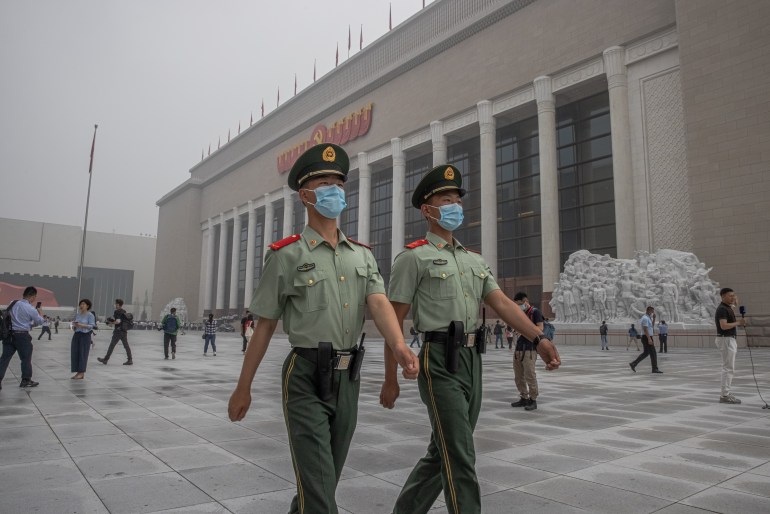
Chinese paramilitary police in summer unoforms march outside a new museum to the Chinese Commuist Party

Wang’s story may sound dramatic, but it is far from extraordinary in Xi Jinping’s China, according to human rights watchdog Safeguard Defenders, which released a new report on Tuesday on the country’s widespread practice of “involuntary returns”. Such pressure has been used on more than 10,000 alleged Chinese “fugitives” who since 2014 have been coerced into returning from abroad to face detention or prosecution for alleged corruption and other crimes, the report said citing official data.

Methods to “encourage” return can vary from harassment and coercion of friends and family online, to approaching a citizen overseas through Chinese or domestic security agents, and more “irregular” methods like state-sponsored kidnapping, Safeguard Defenders said. In some cases, authorities may freeze family assets or even threaten to remove children from families.

Kidnappings typically occur in countries with a strong relationship with China, like Thailand or Myanmar, but Safeguard Defenders said as many as 10 people may have been kidnapped from among Australia’s large Chinese diaspora in recent years.

The list also includes the 2015 disappearance of five staff members associated with a Hong Kong book store specialising in books banned in China. One bookseller, Gui Minhai, disappeared in Thailand while the others went missing on trips to China, only to later emerge in Chinese detention

China has also made use of Interpol “red notices“, which flag a citizen to police and immigration departments around the world so they can be deported back home, where they face a 99 percent conviction rate if prosecuted, the watchdog said.

“Involuntary returns” have become increasingly common since China first launched an ambitious anti-corruption campaign in 2012, followed by Operation Foxhunt in 2014 to repatriate Communist Party officials facing corruption charges who have fled abroad, and the broader Operation Sky Net in 2015 to target money laundering.

While nominally law-enforcement based, Operation Foxhunt has been described as a “campaign to enforce political loyalty, avoid in-Party factionalism and to more generally instil Party discipline”, Safeguard Defenders said in the report.

Both campaigns have corresponded to a 700 percent jump in Chinese people seeking asylum abroad between 2012 and 2020 as China’s already limited civil and political rights have been curtailed even further under President Xi, the rights group said.

That number does not include the 88,000 Hong Kong people who applied to resettle in the UK in 2021 under a new immigration scheme, after the imposition of a national security law for the Chinese territory that Amnesty says has “decimated” freedoms and rights that Beijing had promised to respect until at least 2047.

More than 175,000 people have been officially recognised as refugees, but that has not kept Chinese authorities from orchestrating “involuntary returns” whether they are government defectors, Falun Gong practitioners, human rights defenders, political dissidents, or even ordinary citizens like Wang who have fallen afoul of increasingly strict authorities.

Wang says he was just doing what millions of other people do everyday — sharing his views on social media.

“We didn’t do anything against China,” he said. “I wrote something. I never thought they would (begin to) watch me.”

https://safeguarddefenders.com/en/blog/involuntary-returns-report-exposes-long-arm-policing-overseas

https://www.aljazeera.com/news/2022/1/18/china-critics-overseas-feel-the-long-reach-of-beijing-report

https://www.theguardian.com/world/2022/jan/18/china-forced-2500-fugitives-back-from-overseas-during-pandemic-report-finds

Human Rights Watch advises new German Government

December 22, 2021
A man wearing a suit raises his right hand
Germany’s new Chancellor Olaf Scholz (left) and Baerbel Bas, President of the Bundestag, during the swearing-in of the new Federal Government in Berlin, December 8, 2021.  © 2021 Florian Gaertner/picture-alliance/dpa/AP Images

On 10 December 2021, David Fischer, HRW’s Media Coordinator, Germany published “A Human Rights Roadmap for Germany’s New Government

…The climate crisis threatens catastrophic impacts on human rights, and ambitious climate action by the government to reduce greenhouse gas emissions is critical if Germany – the European Union’s biggest greenhouse gas emitter – is to help prevent the worst of those impacts.  The new government’s coalition agreement, a non-binding roadmap for legislative action, calls for elimination of coal energy “ideally” by 2030, promises a roll-back of subsidies for fossil fuels and legislation to deal with climate change adaptation planning. These are positive steps but insufficient to reach Germany’s contribution toward the global goal in the Paris Agreement of limiting global warming to 1.5°C above pre-industrial levels.

In addition to the climate crisis, the new coalition between the Social Democrat Party (SPD), the Free Democrats (FDP) and the Greens (Die Grünen) will have to tackle challenges to the rule of law within the EU, stand up for human rights against autocrats in China and Russia, and address the many challenges arising from the pandemic.

The coalition agreement makes promising commitments to advance the rights of lesbian, gay, bisexual, and transgender (LGBT) people, including to change the law on legal gender recognition for transgender people so that it is based on self-determination. The coalition also commits to protecting human rights in supply chains in line with the UN Guiding Principles on Business and Human Rights that include the right to a remedy for victims. It proposes to increase the capacity of German courts to prosecute universal jurisdiction cases such as the trial on state-sponsored torture in Syria.

Within Europe, the new government intends to push for judgements of the European Court of Human Rights to have greater impact and “be implemented in all member states”. It supports the use of mechanisms and sanctions to enforce the rule of law in European Union member states. It also calls for shared responsibility for migrants and refugees among member states, an end to pushbacks at EU borders and for the border agency Frontex to respect human rights.

Scholz’s new government will now need to live up to expectations on human rights and prove that what the coalition dubbed “Germany’s responsibility for Europe and the World” is expressed in actions and not just words.

See also: https://www.justsecurity.org/79618/how-germanys-new-government-might-pursue-its-values-based-foreign-policy-in-europe/

https://www.hrw.org/news/2021/12/08/human-rights-roadmap-germanys-new-government

Franco-German Prize for Human Rights 2021

December 17, 2021

Germany and France honoured this year 15 people who have made outstanding contributions to the protection of human rights, campaigning for causes including women’s rights in Afghanistan, the freedom of the press in South Africa and children who are born as a result of rape in wartime.

On 10 December, international Human Rights Day, Foreign Minister Annalena Baerbock and French Foreign Minister Jean‑Yves Le Drian presented fifteen people with the Franco-German Prize for Human Rights. This award recognises the efforts of all those who work tirelessly every day to advance the causes of human rights and the rule of law. It is presented decentralised by the French and German missions in various locations around the world.

Chang Weiping a Chinese human rights lawyer.

Jake Epelle who works to combat the ongoing stigmatisation and discrimination faced by people with albinism in Nigeria.

Noelah Godfrey Msuya who promotes the rights of children and women in Tanzania.

Monika Borgmann who is a German-Lebanese documentary-maker.

Jacques Letang who is a judge and lawyer in Haiti.

Cristina Palabay from the Philippines who leads the national association Karapatan.

Alexandrine Victoire Saizonou who is an advocate for women’s and children’s rights in Benin.

Ajna Jusic from Bosnia discovered at the age of 15 that she was born as a result of rape during wartime, and since then she has advocated for others in the same situation.

Erika Lorena Aifán Dávila is a judge who has been the target of constant attacks from the authorities of Guatemala.

Nebahat Akkoc is the Managing Director of the NGO Kamer in Turkey.

The Venezuelan Education-Action Program on Human Rights or PROVEA.

Narges Mohammadi who is spokesperson and vice chairman of the Iranian organisation Defenders of Human Rights Center.

May Sabai Phyu is a Kachin activist from Myanmar/Burma.

Shaharzad Akbar is an Afghan human rights defender who campaigns in particular for the rights of women in Afghanistan.

Tabelo Timse is an investigative journalist and a member of an independent non‑profit media centre in South Africa.

https://www.auswaertiges-amt.de/en/aussenpolitik/themen/menschenrechte/franco-german-prize/2501086

2021 Reporters Without Borders (RSF) Press Freedom Awards

November 21, 2021

On 20 November 2021 Pacific Media Watch reported that the 2021 Reporters Without Borders (RSF) Press Freedom Awards have been given to Chinese journalist Zhang Zhan in the courage category, Palestinian journalist Majdoleen Hassona in the independence category, and the Pegasus Project in the impact category.

RSF president Pierre Haski announces the 29th RSF Press Freedom Awards in Paris. Video: RSF

RSF’s press freedom prizes are awarded every year to journalists or media that have made a notable contribution to the defence or promotion of freedom of the press in the world. This is the 29th year they have been awarded. The 2021 awards have been given in three categories — journalistic courage, impact and independence.

Courage Prize
The 2021 Prize for Courage, which aims to support and salute journalists, media outlets or NGOs that have displayed courage in the practice, defence or promotion of journalism, has been awarded to Chinese journalist Zhang Zhan.

Zhang Zhan

Despite constant threats, this lawyer-turned-journalist covered the covid-19 outbreak in the city of Wuhan in February 2020, live-streaming video reports on social media that showed the city’s streets and hospitals, and the families of the sick. Her reporting from the heart of the pandemic’s initial epicentre was one of the main sources of independent information about the health situation in Wuhan at the time.

After being arrested in May 2020 and held incommunicado for several months without any official reason being provided, Zhang Zhan was sentenced on 28 December 2020 to four years in prison for “picking quarrels and provoking trouble”. In protest against this injustice and the mistreatment to which she was subjected, she went on a hunger strike that resulted in her being shackled and force-fed. Her friends and family now fear for her life, and her health has worsened dramatically in recent weeks. See also: https://humanrightsdefenders.blog/2021/11/06/chinese-journalist-zhang-zhan-at-imminent-risk-of-death/

Independence Prize
The 2021 Prize for Independence, which rewards journalists, media outlets or NGOs that have resisted financial, political, economic or religious pressure in a noteworthy manner, has been awarded to Palestinian journalist Majdoleen Hassona.

Majdoleen Hassona
Majdoleen Hassona

Before joining the Turkish TV channel TRT and relocating to Istanbul, this Palestinian journalist was often harassed and prosecuted by both Israeli and Palestinian authorities for her critical reporting. While on a return visit to the West Bank in August 2019 with her fiancé (also a TRT journalist based in Turkey), she was stopped at an Israeli checkpoint and was told that she was subject to a ban on leaving the territory that had been issued by Israeli intelligence “for security reasons”. She has been stranded in the West Bank ever since but decided to resume reporting there and covered the anti-government protests in June 2021 following the death of the activist Nizar Banat.

Impact Prize
The 2021 Prize for Impact, which rewards journalists, media outlets or NGOS that have contributed to clear improvements in journalistic freedom, independence and pluralism, or increased awareness of these issues, has been awarded to the Pegasus Project.

The Pegasus Project
The Pegasus Project

The Pegasus Project is an investigation by an international consortium of more than 80 journalists from 17 media outlets* in 11 different countries that was coordinated by the NGO Forbidden Stories with technical support from experts at Amnesty International’s Security Lab. Based on a leak of more than 50,000 phone numbers targeted by Pegasus, spyware made by the Israeli company NSO Group, the Pegasus Project revealed that nearly 200 journalists were targeted for spying by 11 governments — both autocratic and democratic — which had acquired licences to use Pegasus. This investigation has made people aware of the extent of the surveillance to which journalists are exposed and has led many media outlets and RSF to file complaints and demand a moratorium on surveillance technology sales. See also: https://humanrightsdefenders.blog/2021/11/10/palestinian-ngos-dubbed-terrorist-were-hacked-with-pegasus-spyware/

“For defying censorship and alerting the world to the reality of the nascent pandemic, the laureate in the ‘courage’ category is now in prison and her state of health is extremely worrying,” said RSF secretary-general Christophe Deloire.

“For displaying a critical attitude and perseverance, the laureate in the ‘independence category has been unable to leave Israeli-controlled territory for the past two years. “For having revealed the scale of the surveillance to which journalists can be subjected, some of the journalists who are laureates in the ‘impact’ category are now being prosecuted by governments.

https://rsf.org/en/news/chinese-journalist-palestinian-journalist-and-pegasus-project-receive-2021-rsf-press-freedom-awards

Interpol: UAE Major General and Chinese Public Security Official are not good candidates for Interpol!

November 16, 2021

INTERPOL is going to have its General Assembly on the 23 – 24 November 2021 in Lyon. The election of both its President and a member of the Executive Committee look terrible. Already in 2017 there was a problem: see https://humanrightsdefenders.blog/2017/04/20/interpol-headed-by-chinese-police-official-human-rights-defenders-fearsome/. (The former chairman of Interpol Meng Hongwei was also a ministry of public security official, serving as vice-minister. However, Meng’s Interpol term ended prematurely in 2018 when he disappeared during a visit to China and was later jailed for 13 years on bribery charges, amid Xi Jinping’s anti-graft campaign targeting millions of officials.)

Several prominent members of the European Parliament (MEPs) have warned that the appointment of the Emirati official Major General Ahmed Nasser Al-Raisi to the position of president of Interpol would “undermine the mission and reputation” of the global police organisation. In a letter sent to the European Commission president, three MEPs urged European Union (EU) states to elect an Interpol chief that comes “from a country with an established criminal justice system and longstanding respect for human rights”.

The Gulf Center for Human Rights (GCHR), the French League for Human Rights and the International Federation for Human Rights are also concerned about the candidacy of Major General Ahmed Nasser Al-Raisi call to reject him.

Ahmed Al-Raisi has been Inspector General of the UAE’s Interior Ministry since 2015 and is also in charge of the UAE police force. Under his leadership, forces have carried out repeated and systematic arbitrary detentions and tortured prisoners of conscience and human rights defenders with complete impunity. One of the most emblematic cases concerns human rights defender Ahmed Mansour. Winner of the 2015 Martin Ennals Award and member of the GCHR steering committee, Ahmed Mansour has been imprisoned since March 2017 and sentenced to ten years’ imprisonment in 2018 for, according to the authorities, criticising the Emirati government and tarnishing his country’s image on social networks. Since 2017, he has been held in solitary confinement in Al-Sadr prison, in a 4m2 cell, without access to medical, hygiene, water or sanitary facilities. The inhumane conditions of Ahmed Mansour’s imprisonment have been the subject of several appeals without any favourable response from the Emirati authorities. [see: https://humanrightsdefenders.blog/tag/ahmed-mansoor/]

According to reports of several NGOs, torture is used systematically in detention centres in order to obtain confessions of guilt or testimonies against other detainees, particularly in the prisons of Al-Razeen, Al-Wathba and Al-Sadr. In addition, some prisons, such as Al-Awair prison and the Al-Barsha police detention centre, are overcrowded and unsanitary, making it extremely difficult to comply with social distancing and recommended hygiene practices in the context of the COVID-19 pandemic….In addition, prisoners are regularly denied medication and medical treatment for pre-existing health problems or illnesses developed during detention. Several UN experts have condemned these practices and expressed their concerns to the UAE authorities in recent years, but the authorities have not changed their practices.

Such inhumane treatment is recurrent in the UAE and is in flagrant contravention of international law and the Nelson Mandela Rules on the Treatment of Prisoners. While Major General Al-Raisi is, by virtue of his office, responsible for investigating complaints of abuse by the police and security forces in his country, none have been conclusively investigated. In the absence of any enforceable accountability mechanisms in the UAE, the GCHR has filed a complaint in France, against General Major Al-Raisi for acts of torture. Unfortunately, Interpol did not listen: https://www.businessinsider.com/interpol-president-uae-official-accused-of-torture-elected-2021-11

Another problematic candidate is Hu Binchen, the deputy director-general of the Chinese Ministry of international cooperation department, who is one of three candidates vying for two seats as Asia delegates on the committee.

The 13-member executive committee oversees the work of Interpol’s general secretariat and helps set future policy. Interpol controls a number of databases containing identifying details of people and property, which assist in global policing. It also operates the system of red notices, which are requests “to locate and provisionally arrest an individual pending extradition”.

However, there are long-running concerns over governments or authorities misusing the system to track down dissidents. While there are clear rules against the use of red notices on refugees, high-profile cases have shown countries are repeatedly able to obtain red notices, against Interpol policy.

Activists and advocacy groups, as well as 50 members of an international cross-party group of legislators, the Inter-parliamentary Alliance on China, have lodged their objections at Hu’s potential election to the committee, noting alleged attempts by China to use the red notice system to target exiled Uyghur activists.

“By electing Hu Binchen to the executive committee, the general assembly would be giving a green light to the PRC government to continue their misuse of Interpol and would place the tens of thousands of Hong Kong, Uyghur, Tibetan, Taiwanese and Chinese dissidents living abroad at even graver risk,” said the letter from the Alliance, citing the July detention of Uyghur activist Idris Hassan in Morocco.

Allowing Interpol to be used as a vehicle for the PRC government’s repressive policies does great harm to its international standing.”

The human rights group Safeguard Defenders said the Chinese ministry’s international cooperation department, in which Hu is a senior official, oversaw operations named Sky Net and Fox Hunt, chasing down fugitives overseas. It alleged “teams were sent by the ministry “to intimidate and harass ethnic Chinese to force them to return to China ‘voluntarily’”. In a report also released on Monday, Safeguard Defenders said there had been a tenfold increase in the issuance of Chinese red notices between 2000 and 2020.

A later development is that 259 organizations, call on INTERPOL to immediately ban the Myanmar military junta from representing Myanmar as a member of INTERPOL. They demand that the military junta is excluded from the upcoming 89th INTERPOL General Assembly and all benefits and future cooperation that membership entails. [see: https://www.forum-asia.org/?p=36143]

https://www.fidh.org/en/issues/litigation/open-letter-to-the-representatives-of-the-member-states-of-the

https://www.middleeasteye.net/news/eu-lawmakers-say-uae-police-chief-would-undermine-interpols-reputation

https://www.theguardian.com/world/2021/nov/15/chinese-official-seeks-interpol-role-sparking-fears-for-dissidents

https://www.business-standard.com/article/news-ani/china-s-nominee-to-interpol-committee-opposed-by-lawmakers-from-20-countries-121111600231_1.html

https://www.theguardian.com/world/2021/nov/20/uae-nominee-interpol-ahmed-naser-al-raisi-torture-claims

https://www.thestar.com/news/world/europe/2021/11/22/interpol-election-raises-rights-concerns-about-fair-policing.html

Write for Rights 2021 launched

November 8, 2021

AI has launched the world’s biggest letter writing campaign to help 10 human rights defenders around the world facing.

Millions of letters, emails and texts will be sent to support people who have been jailed, attacked or disappeared 

Amnesty International has launched its flagship annual letter-writing campaign, Write for Rights to support 10 activists from around the world who have been attacked, jailed, harassed or disappeared for standing up for their rights.

This year, Write for Rights – which is funded by players of the People’s Postcode Lottery – will be supporting ten individuals, including:

  • Imoleayo Adeyeun Michael from Nigeria, who faces years behind bars for joining the #EndSARS protests against the notorious Special Anti-Robbery Squad last year;
  • Janna Jihad, a 15-year-old journalist from Palestine, who faces harassment and death threats for reporting on the racist brutality her community experiences;
  • Zhang Zhan, a citizen journalist from China who faces four years in prison for attempting to expose the extent of the Covid-19 crisis; [see also https://humanrightsdefenders.blog/2021/11/06/chinese-journalist-zhang-zhan-at-imminent-risk-of-death/]
  • Sphere, a Ukrainian LGBTI and women’s rights NGO, which is struggling to operate against frequent homophobic attacks, threats and intimidation;
  • Mohamed Baker, an Egyptian human rights lawyer denied a trial and put behind bars for his work supporting people who have been imprisoned unjustly; and
  • Ciham Ali Ahmed, a US-Eritrean national, who was arrested nine years ago at the Sudanese border when she was trying to flee Eritrea aged 15 and has not been seen since. 

Sacha Deshmukh, CEO of Amnesty UK, said:

“These individuals have been thrown behind bars, attacked, harassed or disappeared just for standing up for their rights. By coming together, people around the world have the power to raise their profile and increase their chances of protection or release.

“Sending a letter or email might seem like a small act, but when sent in their thousands they can have a huge impact. People in power are forced to listen. 

Amnesty International’s Write for Rights campaign: Write for Rights goes back to the very roots of Amnesty International, which was founded in 1961, with Amnesty’s early campaigners writing letters of support to those affected by human rights abuses, as well as letters of concern to governments around the world.

During last year’s Write for Rights campaign [see: https://humanrightsdefenders.blog/2020/11/09/amnesty-internationals-write-for-rights-campaign-2020-launched/] :

  • More than 360,000 actions were taken for Algerian journalist Khaled Drareni, who was imprisoned for his reporting on the Hirak protest movement. He was provisionally released in February 2021.
  • Over 300,000 messages were sent to and on behalf of Paing Phyo Min, a satirical poet and student leader jailed for criticising the military in Myanmar. He was freed early in April 2021.
  • More than 777,000 actions were taken for Saudi women’s rights campaigner Nassima al-Sada. As a result, a G20 summit hosted by Saudi Arabia was overshadowed by international calls to free Nassima and other women human rights defenders. Nassima has since been conditionally released.

View latest press releases 01 Nov 2021

https://www.amnesty.org.uk/press-releases/worlds-biggest-letter-writing-campaign-launches-help-10-people-around-world-facing

Chinese Journalist Zhang Zhan at imminent risk of death

November 6, 2021

On 4 November 2021 the Observatory for the Protection of Human Rights Defenders, a partnership of the World Organisation Against Torture (OMCT) and FIDH, has received new information and requests your urgent intervention in the following situation in China.

New information:

The Observatory has been informed by the Network of Chinese Human Rights Defenders (CHRD) about the imminent risk of death of freelance journalist Zhang Zhan, who has been detained since May 2020 as a reprisal for her coverage of the Covid-19 pandemic from February 2020 until her arrest. Ms. Zhang is a former lawyer whose licence was suspended in retaliation for her activism and a well-known and outspoken journalist on the situation of human rights in China. See also: https://humanrightsdefenders.blog/2021/01/06/china-eu-deal-what-about-human-rights/

According to the relatives of Zhang Zhan, the journalists’ life is at imminent risk of death as a result of the partial hunger strike she started in June 2020 to protest her arbitrary detention and later her sentencing. The mother of Zhang Zhan was allowed to have a videocall with her daughter on October 28, 2021, after which she reported that the journalist weights less than 40 kg, is unable to walk unassisted and cannot raise her head without assistance. Her health is extremely poor, as she suffers from severe malnutrition, a gastric ulcer and swollen legs and feet. During her detention, she has been restrained and force-fed via a nasal tube.

The relatives of Zhang Zhan have been consistently denied their right to visit the journalist and only been allowed to communicate with her by video calls on two occasions, on October 28 and February 2021, and by a phone call on August 2021. Moreover, Zhang Zhan’s mother requested the Chinese security police the permission to visit the journalist in prison to persuade her to abandon the hunger strike. At the time of publication of this Urgent Appeal, she had not received a reply.

The Observatory recalls that Zhang Zhan was hospitalised in a prison hospital between July 21 and August 11, 2021 due to her deteriorating health conditions. During her hospitalisation, she was tied to a hospital bed and force-fed by prison authorities. On August 11, she was transferred back to the Shanghai Women’s Prison, where she remained detained at the time of this Urgent Appeal.

The Observatory further recalls that on May 14, 2020, Zhang Zhan went missing in Wuhan, Hubei Province, one day after releasing a video that criticised the government’s measures to contain the virus, claiming the authorities were being negligent. Zhang Zhan had travelled to Wuhan from her home in Shanghai in early February 2020 to report from the epicenter of the Covid-19 pandemic. She reported numerous stories, including the detention of other independent reporters and harassment of families of victims seeking accountability, via her WeChat, Twitter, and YouTube accounts.

After seven months of pre-trial detention, on December 28, 2020, the Shanghai Pudong People’s Court found Zhang Zhan guilty of “picking quarrels and provoking trouble” (Article 293 of China’s Criminal Law) and sentenced her to four years in prison. The court rejected the application filed by Zhang Zhan’s lawyers to request bail, live streaming of the trial, and a time extension of the proceedings. Their requests to have the defense witnesses appear in court to present exculpatory evidence was also rejected by the court. Zhang Zhan attended her trial in a wheelchair because of her poor health.

The Observatory is deeply concerned about the health conditions and risk of death of Zhang Zhan and urges the Chinese authorities to immediately and unconditionally release her and grant her immediate access to adequate and comprehensive medical treatment.

https://www.fidh.org/en/issues/human-rights-defenders/china-journalist-zhang-zhan-at-imminent-risk-of-death

https://www.republicworld.com/world-news/china/human-rights-watch-calls-for-immediate-release-of-chinese-journalist-who-reported-on-covid.html