Posts Tagged ‘Brazil’

Alarming criminalisation of human rights defenders in Latin America

February 27, 2016

The criminalization of human rights defenders in the context of the extraction of natural resources and megaprojects is becoming a very worrisome phenomenon in Latin America, denounces the Observatory in a report published today in Mexico. Entitled “The criminalization of human rights defenders in the context of industrial projects: a regional phenomenon in Latin America”, this document points to the role of businesses, civil servants, public prosecutors, judges, and the State. The report issued by OMCT and FIDH (in the context of their Observatory for Human Rights Defenders) on 25 February 2016 describes the specific cases of human rights defenders criminalized in eight Latin American countries (Brazil, Colombia, Ecuador, Guatemala, Honduras, Mexico, Nicaragua and Peru).


The report especially stresses two core issues common to all the countries studied: Read the rest of this entry »

8 Must-Read Stories from the US Human Rights Reports selected by Catherine Russell

July 2, 2015
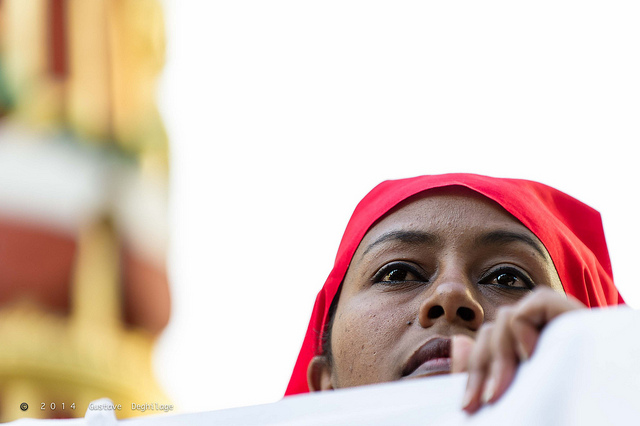
Catherine Russell, the U.S. Ambassador-at-Large for Global Women’s Issues, wrote in the Huffington Post of 1 July 2015 a piece which highlights 8 stories about women taken from the State Department’s annual human rights reports, that she says would not reach the evening news but are a must. Here is her selection:

2015-07-01-1435772655-6505904-HRRblog.jpg

[Photo: Gustave Deghilage ]

In Nepal, a mother may be denied the ability to confer her Nepali citizenship to her children if the father’s identity is unknown or he is not Nepali. This is not uncommon: 27 countries discriminate against women in their ability to pass citizenship on to their children. Too often this results in a child who is stateless, meaning he or she may not be able to access basic services like health care and education.

In Afghanistan, a survey found that 39 percent of Afghan women between the ages of 20 and 24 were married before the age of 18 — making them part of a global trend where one in three girls in the developing world is married as a child — and Afghan women who marry later in life often don’t have a choice in their marriage. These stories and statistics exist despite laws against early and forced marriage.

A story in the Nigerian report highlights the case of a college student who reported that a soldier lured her to a police station and raped her repeatedly. The soldier was reportedly “disciplined” for leaving his post, but as of December nothing else had happened.

In Burma, there is an effort underway to enact legislation that would mandate that women can’t have children more than once every three years. There are obvious questions as to how such a law would be enforced. Many are concerned that it would only be enforced in areas where many members of minority groups live.

Fortunately, the news is not all bad.

In Afghanistan, the national electoral commission’s gender unit focused on women’s political participation in the 2014 election, and increased the number of women who helped determine their country’s future.

In Brazil, the federal government operates a toll-free nationwide hotline for women to report intimate partner violence, while in India, a partnership between state government and civil society led to the launch of a crisis center for survivors of rape, dowry harassment, and domestic violence.

Another partnership — between government and civil society in Guinea — is helping to educate Guinean health workers on the dangers of female genital mutilation. The report says that more than 60 health facilities have integrated FGM/C prevention into their services thanks to this effort.


You can follow Catherine Russell on Twitter: www.twitter.com/AmbCathyRussell

8 Must-Read Stories From the Human Rights Reports | Catherine Russell.

Killings of environmental human rights defenders up again compared to last year!

April 24, 2015

Jeremy Hance – writing in Mongabay on 20 April, under the title “Killings of environmental activists jumped by 20 percent last year confirms again the terrible truth that it is in the countryside, away from monitors, and in disputes over land issues that the most gruesome repression takes place and the leader is..Brazil! [for last year’s report see: https://thoolen.wordpress.com/2014/04/16/environment-deadly-for-human-rights-defenders-says-global-witness/]

Soy field in the Brazilian Amazon. Again this year, Brazil has the highest number of murders of environmental and land defenders. Photo by: Rhett A. Butler.
Soy field in the Brazilian Amazon.  Photo by: Rhett A. Butler.

The assassination, murder, and extrajudicial killing of environmental activists rose by 20 percent last year, according to a new grim report by Global Witness. The organization documented 116 killings in 2014 across 17 countries with the highest number in Brazil, which saw 29 environmental and land defenders killed. Still, the report is a major understatement of the problem as data across much of Africa, China, the Middle East, and Central Asia remains scarce to non-existent.

Across the world environmental defenders are being shot dead in broad daylight, kidnapped, threatened, or tried as terrorists for standing in the way of so-called ‘development’,” said Billy Kyte, a campaigner with Global Witness. “The true authors of these crimes—a powerful nexus of corporate and state interests—are escaping unpunished. Urgent action is needed to protect citizens and bring perpetrators to justice.

Most of the deaths last year—116 of them—were related to disputes over land. But mining was linked to 25 deaths, and hydroelectric dams and agribusiness to 14 each. Indigenous people also remain among the most targeted.

In 2014, 47 indigenous people were killed defending their natural resources, 40 percent of the total deaths of environmental and land defenders,” reads Global Witness’s new report, entitled How Many More?. This year’s report follows a landmark document last year that tracked environmental activist killing—all 908 of them—over a dozen years.

Environmental activist killings by sector. Image courtesy of Global Witness.

Human rights defenders are stigmatized (as ‘anti-development’) and criminalized in order to silence their opposition.

While Brazil had the highest number of environmental activist murders in 2014, the most dangerous place to be an environmental activist was actually Honduras, according to Global Witness. During the last five years (2010-2014), Honduras lost 101 activists, giving it the highest rate of environmental activist killings per capita.

“A UN Human Rights Council resolution addressing the heightened risk posed to environmental and land defenders would be a start,” Kyte said. “But, in the end, governments themselves have to take responsibility and ensure impartial, exhaustive investigations into killings of these activists. And they have to bring perpetrators to account. Many targeted assassinations of activists are being passed off as ‘common’ murders and are going unnoticed.

Environmental activist killings by country. Those in red were indigenous people. Image courtesy of Global Witness.

Read more:  http://news.mongabay.com/2015/0420-hance-activist-murder-rise.html#ixzz3XxWqLdTV


Killings of environmental activists jumped by 20 percent last year.

Monday 2 March, start of the #idefend campaign

February 28, 2015

On Monday 2 March 2015 starts the “#idefend – Making sure civil society has its voice” campaign. It is an initiative of the Delegation of the European Union to the UN in Geneva in partnership with the Office of the High Commissioner for Human Rights and the Permanent Missions of Brazil, the Republic of Korea and Tunisia.

The #idefend campaign takes a public stance to support the voices of civil society.#idefend aims at expressing solidarity with all those human rights defenders and civil society actors, whose dedication and everyday work improve the human rights of people in every corner of the world. Join the campaign and help empower those who speak up for human rights!

Human rights defenders are not violent seditionists, criminals, nor bloody revolutionaries, as so many governments like to portray them. They are the best of us, all of us. And they have a message. To all governments, we say: focus on their message. Listen to what they are saying. Understand the message, talk to them about it, be persuaded or persuade, without violence, instead of silencing them, punishing them, their families, and their communities.
Zeid Ra’ad Al Hussein, UN High Commissioner for Human Rights

Sadly, over the past years, we have observed a worrying trend at the Human Rights Council: Human Rights Defenders and civil society representatives are hampered from speaking at the Council, sometimes they are harassed upon their arrival to Geneva, or subject to reprisals in their home country upon their return. This is not acceptable.
Peter Sørensen, Head of the EU Delegation to the United Nations

#idefend | Making sure civil society has its voice.

Coalition of human rights defenders and others call on Olympic Committee to change its ways

February 26, 2015

The IOC Executive Committee is meeting in Rio de Janeiro these days (26-28 February) to discuss implementation of Agenda 2020, its “strategic roadmap for the future of the Olympic Movement”. The IOC’s adopted agenda requires Olympic host countries to respect anti-discrimination measures and labor standards, improve transparency, and promote good governance.

The new Sport and Rights Alliance (SRA see below for membership) addressed a letter to the IOC saying that too often major sports events have seen people forcibly evicted from their homes to make way for infrastructure, workers exploited, campaigners locked up, the environment damaged beyond repair and notoriously opaque bidding processes,” … “The recommendations in the IOC’s Agenda 2020 are a chance to change that and ensure human rights, the environment and anti-corruption measures are central to all stages of the Olympic Games, from bidding, through to the development and delivery phase to final reporting.Read the rest of this entry »

Conectas tries to balance Brazil’s human rights commitments at home and abroad

January 30, 2015

Under the title “Home and abroad: balancing Brazil’s human rights commitments”, Muriel Asseraf – in Open Democracy of 22 january 2015 – has written an interesting piece highlighting the role of the major NGO Conectas, whose strategy is based on “the conviction that human rights defenders and their organizations in the global south hold the key to an international order more diverse and committed to the respect of human rights”. A good read for the weekend! Read the rest of this entry »

Human rights defenders from York: Valdênia Paulino Lanfranchi

January 24, 2015
On 16 February 2015, the York Press carried a feature story by Stephen Lewis about 5 human rights defenders in the temporary shelter programme at York University. The aim of the placements is to give those fighting for human rights around the world a breather, as well as the chance to forge contacts with other human rights workers and organisations around the world.
 

Valdênia grew up in the slums – or favelas – of Sao Paolo, Brazil’s biggest city. Home for her mother, father, three brothers, two sisters and herself was a small house with a tin roof. Her mother took in sewing. Her father worked in a factory until, in his mid-40s, he became ill. Because of poverty, many children end up on the streets, where they’re at risk of violence, abuse, disease and hunger. They have little chance of an education – and many girls end up in prostitution, Valdênia says.

When she was 14, Valdênia helped open a ‘safe’ house for young girls who worked as prostitutes. The police didn’t approve. “Who controls prostitution?” she says. “The policemen, and the men who have money.”

York Press:
Valdênia Paulino Lanfranchi

She lived with the girls for ten years, then helped open two human rights centres to help families in the favelas. She went to university, and got degrees in education and law. Eventually, after suffering repeated attacks and threats, she and her husband Renato, also a human rights worker, moved to Paraiba, in north-eastern Brazil. There Valdênia, now 47, joined the Oscar Romero human rights centre, working to protect the rights of local ‘indigenous’ people.

She also, in 2011, became Police Ombudsman for Paraiba – the first woman to hold the post. It brought her into conflicts with ‘those in power’. “I was then a victim of everything from raids on the headquarters of our organisations to sexual violence and death threats.” Brazil is supposed to be one of the world’s emerging democracies. “But we have more than 100 human rights defenders threatened with death,” she says. “We have inequality, poverty, hunger. Why? What has happened?”

5 human rights defenders in York tell their incredible stories (From York Press).

Czechs set example: an activist human rights foreign policy

January 23, 2015

Vaclav Havel. Picture: EPA

Vaclav Havel. Picture: EPA
In an opinion piece in BDLive of 22 January 2015, John Stremlau, discusses the outcome of an International Conference “Foreign Policy on Human Rights for the 21st Century” held in Prague, Czech Republic, and draws lessons for other countries , especially South Africa. Although the article implicitly overstates the human rights credentials of the BRICS nations, it makes interesting weekend reading:

“SOUTH Africans are not the only ones debating the role of human rights in foreign policy. Twenty-five years after Czechs achieved their peaceful democratic revolution, they too are debating whether their foreign policy is contrary to the ideals of Vaclav Havel and the others who risked their lives to secure freedom at home and influence abroad as a human rights leader.

To air these issues, the Czech foreign ministry recently convened an international conference, titled Foreign Policy on Human Rights for the 21st Century. Several hundred Czechs attended and there was extensive national media coverage. Eighteen foreign human rights activists and practitioners were invited as panellists, from the US, European Union, Africa, Latin America and Asia.

In his opening address, the foreign minister suggested there could be alternative and attractive ways to frame Czechs’ post-Havel human rights foreign policy — one, he said, that would be less identified with US selective use of force to secure human rights. As an alternative, he suggested closer alignment with Brics nations, which he suggested were wisely emphasising social and economic over political and civil rights.

Overall, the proceedings revealed no disagreement over the enduring universality of basic human rights, with political and civil rights as necessary preconditions for realising all other rights and frequent references to the importance of the Czech example as an inspiration to others and the basis for its international influence and leadership.

Surprisingly little was said about the advantages or dangers for human rights of Chinese autocratic capitalism. The sharpest criticisms were of the threats to Czech national security from Russia, including abetting of human rights abuses in nearby former Soviet republics.

The controversial role of human rights in US foreign policy, however, got the most attention.

Several speakers complained about US “double standards” in human rights interventions; an over-reliance on military means; the disregard for human rights in the use of torture, drones, and detention without trial in combating terrorism; and a culture of impunity that allows even those found guilty to avoid punishment.

On this, too, Czech and South African foreign policies converge.

South African participants would have likely found the final panel most relevant, especially the views of former struggle veterans, who showed dismay over the present government’s less assertive defence of human rights defenders, in China and elsewhere.

SA does not, of course, face a security threat comparable to the one the Czechs face from Russia, but the panellists still hold that a more activist human rights foreign policy is a better political defence than accommodation.

With the US absorbed with overcoming the consequences of its past misadventures in Iraq and the Middle East, the Czechs seek partners beyond Western Europe.

The Czech foreign ministry may have envisioned a different outcome, but most Czech speakers appear to be seeking, above all, compatible and reliable democratic partners, whose human rights foreign policies are more in line with those of the human rights heroes who once risked their lives to transform the then Czechoslovakia. Such partnerships would be valuable in shoring up national commitments to human rights in domestic and foreign policy. But it was argued that government policies in support of human rights lacked sufficient coherence at home and abroad.

SA and the Czech Republic may have different national interests but they do share vital values and are facing challenges in adapting them to conditions at home and abroad.

Perhaps the Department of International Relations and Co-operation should consult the Czech foreign ministry about convening in Pretoria a 2015 sequel to the international conference just held in Prague, and with a similar agenda, although instead of focusing on a dialogue between Europe and the US, SA might include a topic on the Brics in human rights dialogue.

The Czechs set a good example by adopting a broad agenda and inviting a diverse array of opinions, and allowing a free-wheeling debate, attributes South Africans appreciate and which might advance a debate here of the importance of foreign policy on human rights.”

John Stremlau is visiting professor in the Department of International Relations at Wits University.
Czechs set example for SA on human rights | Opinion & Analysis | BDlive.

John Legend writes for Amnesty International’s Write for Rights campaign.

December 18, 2014

Award-winning singer/songwriter John Legend joined Amnesty International USA as part of its annual Write for Rights campaign. For Human Rights Day 2014 the Write for Rights cases included Chelsea Manning, victims of gun violence in the USA and Brazil, and women and girls of El Salvador impacted by the country’s abortion ban.

JOHN LEGEND:
Writing is a transformative experience.
I write songs to express myself.
I write songs to give hope.
I write songs to heal the hurt.
I write because living free from violence is a human right.
I write because I refuse to accept this is ‘just the way it is.’
I write because leaders who let their police forces jail, beat and kill people who are simply, peacefully trying to express themselves need to know the world is watching.
I write because I take injustice personally. Because there are no throwaway lives.
I write because silence feeds violence.
I write because lyrics change music, but letters change lives.

Human Rights Defender Charles Harper Honoured by Argentinian Government

September 19, 2014
(From left to right — Charles Harper, Estela Barnes de Carlotto, Ambassador Alberto D’Alotto and Bishop-emeritus Aldo Etchegoyen. Photo: Argentinian mission in Geneva)

A former World Council of Churches (WCC) official from Brazil, Rev. Charles Harper, has been honoured with the Order Comendador de Mayo, a high decoration of the Argentine government for his emblematic legacy of struggles for human rights in the ecumenical movement. Harper, was WCC’s director of the Human Rights Resource Office for Latin America from 1973 to 1992. He received this honour in a ceremony held on 16 September in Geneva, Switzerland. Harper, born to an American missionary father working in Brazil, joined the anti-colonial struggle through the Committee for Assistance to Evacuees (CIMADE). At CIMADE, he worked with young people and Algerian immigrants in Marseille, France, in the early 1960s. With CIMADE and later as director of the John Knox International Reformed Centre, Harper supported church leaders persecuted in Mozambique, Angola and Cape Verde. Many of those become key actors in the independence struggles of their countries. At the WCC, Harper coördinated a number of systematic international initiatives denouncing human rights violations in Latin America. He created strong networks to protect the persecuted, imprisoned and tortured people in the region.

Accompanying human rights movements in the 1970s, the WCC was able to respond to the calls for solidarity at regional and global levels. Harper’s work at the WCC was initiated by the WCC member churches in Latin America, following a dialogue held with the WCC’s Commission on International Affairs, chaired then by the renowned jurist Dr Theo van Boven, who also received an honour from the Argentine government in 2012.

In his speech Harper pointed out the current global challenges that a new generation of human rights advocates has to deal with. “Thirty years later – today – the challenges facing the world community of nations, both as international and ecumenical family, not only persist but become more intense: The World Council of Churches, an instrument of unity and service to humanity, strives to accompany churches and groups related to them in critical situations to defend human rights and human dignity, fighting impunity, demanding punitive justice, and building just and peaceful societies.”

At the ceremony, Ambassador Alberto D’Alotto said, “Protestant churches have played an important role in defending human rights and in starting movements for human rights in my country. They helped in founding human rights organizations and sponsored their consolidation, and managed international financing much needed in the beginning…..The churches helped to find ways to overcome the information blockade imposed by the military authorities, giving international visibility to what was happening in Argentina and denouncing the military repression in international forums,” he said.

via Human Rights Defender Charles Harper Honoured by Argentinian Government – Standard Newswire.