Posts Tagged ‘Amnesty International’

International Women’s Day 2022

March 8, 2022

International Women’s Day is today 8 March and celebratory events are being held around the world. This year’s theme is #BreakTheBias, aimed at imagining “a world free of bias, stereotypes, and discrimination.” While this special day offers hope for gender equity, it is also a reminder of the omnipresent phenomenon of violence against women, which exists regardless of the day, and needs to be addressed in a fundamental way.

See also: https://www.humanrightscareers.com/issues/why-international-womens-day-is-important/

There is too much to choose from (as usual); for last year’s see: https://humanrightsdefenders.blog/2021/03/08/celebrating-international-womens-day-in-2021/]

Still, here some concrete samples:

Upasana Rana reports Global Voices of 7 March on Nepal [https://globalvoices.org/2022/03/07/this-international-womens-day-lets-come-together-against-violence/]

On the same site Njeri Wangari tells us about how Feminist music icons from around Africa to celebrate this International Women’s Day. See her Spotify playlist with hits from artists like Fatoumata Diawara, Cesária Évora, Shishani Vranckx, Thandiswa Mazwai, and more.

Amnesty International issued a statement “International Women’s Day: Dramatic deterioration in respect for women’s rights and gender equality must be decisively reversed

  • Alarming assaults on women’s rights around the world in 2021/22. 
  • Legal protections dismantled, and women human rights defenders now at unprecedented risk.
  • Protection and promotion of women’s and girls’ rights and support for women human rights defenders crucial, including for Covid-19 recovery. 
  • Governments must act decisively to reverse regressions and uphold human rights for women and girls. 

Catastrophic attacks on human rights and gender equality over the past twelve months have lowered protection for and upped threats against women and girls across the globe.  On International Women’s Day, the organization called for bold action to reverse erosions of human rights for women and girls.   

 “Events in 2021 and in the early months of 2022 have conspired to crush the rights and dignity of millions of women and girls.  The world’s crises do not impact equally, let alone fairly. The disproportionate impacts on women’s and girls’ rights are well-documented yet still neglected, when not ignored outright.  But the facts are clear. The Covid-19 pandemic, the overwhelming rollback on women’s rights in Afghanistan, the widespread sexual violence characterizing the conflict in Ethiopia, attacks on abortion access in the US and Turkey’s withdrawal from the landmark Istanbul Convention on Gender Based Violence: each is a grave erosion of rights in its own terms but taken together? We must stand up to and stare down this global assault on women’s and girls’ dignity,” said Amnesty’s Secretary General, Agnès Callamard. [see https://www.amnesty.org/en/latest/news/2022/03/international-womens-day-dramatic-deterioration-in-respect-for-womens-rights-and-gender-equality-must-be-decisively-reversed/]

Human Rights Watch focuses on Afghanistan: On International Women’s Day, we should remember Afghanistan, and consider what the state of women’s rights there means for the struggle for gender equality worldwide. The Taliban were notorious for violating women’s rights when they ruled Afghanistan from 1996 to 2001. So, when the Taliban took control of Afghanistan again on August 15 last year, Afghan women’s rights defenders were deeply skeptical that the new rulers would be any different from the Taliban that controlled the country before, despite their pledges to respect women’s rights. They were right.

In less than seven months since taking over, the Taliban have:

  • closed most girls’ secondary schools;
  • created barriers to women and girls pursuing higher education;
  • banned women from most paid employment;
  • abolished the Ministry of Women’s Affairs;
  • restricted women’s movement including blocking them from leaving the country alone;
  • dismantled Afghanistan’s system that provided protection from gender-based violence;
  • created barriers to women and girls accessing health care;
  • beaten and abducted women’s rights protesters;
  • silenced female journalists;
  • banned women’s sports; and
  • appointed a men-only administration.

Afghanistan is not the only country where women’s rights are under attack this International Women’s Day. But the speed and extent of the obliteration of women’s rights in Afghanistan is a warning to women around the world about the fragility of progress toward equality, how quickly it can vanish, and how few will defend it. We should all be in solidarity with Afghan women; their fight is a fight for women’s rights everywhere. [See: https://www.hrw.org/news/2022/03/08/standing-afghan-women-and-girls-international-womens-day]

Caitlin Fitzsimmons in the Sydney Morning Herald of 6 March argues that “International Women’s Day highlights climate justice as a feminist issue”. Women are on the front lines of the global climate crisis, making up 80 per cent of the 21.5 million people displaced every year by climate-related events. [See: https://www.smh.com.au/environment/climate-change/international-women-s-day-highlights-climate-justice-as-a-feminist-issue-20220303-p5a1ba.html]

On International Women’s Day, UN Human Rights stands with women and girls human rights defenders of all ages, backgrounds & identities leading our collective struggle to protect our climate and environment. See.g.:

Meet Brianna Frueran, a Pacific climate change activist fighting for her native Samoan islands’ survival.

Meet Mya Pol, a content creator from the United States who advocates for disability rights and educates people about environmentalism on her social media platform.

https://news.un.org/en/story/2022/03/1113872

Amnesty joins debate on Apartheid versus Palestinians but reactions debase struggle against real antisemitism

February 4, 2022

In Newsweek of 3 February 2022 Omar Baddar, Director of the Arab American Institute, published an opinion piece entitled “Amnesty Settles It: It’s Time for U.S. Accountability on Israel”.

Amnesty International, issued on 1 February 2022 an extensive report titled “Israel’s Apartheid against Palestinians: Cruel System of Domination and Crime against Humanity.” As the report documents, “Israel has imposed a system of oppression and domination over Palestinians wherever it exercises control over the enjoyment of their right.” The report further found that Israel’s policies are part of a “systematic as well as widespread attack directed against the Palestinian population, and that the inhuman or inhumane acts committed within the context of this attack have been committed with the intention to maintain this system and amount to the crime against humanity of apartheid.

In recent years, some leading Israeli human rights organizations have started using the word apartheid to describe their government’s systems of oppression. Last year, Human Rights Watch, one of the best-known American human rights organization, similarly accused Israel of apartheid. Amnesty International following suit this week has solidified the human rights community’s emerging consensus on Israeli apartheid. See: https://humanrightsdefenders.blog/2021/01/18/israel-and-apartheid-israeli-human-rights-group-stirs-debate/ and https://humanrightsdefenders.blog/2021/07/09/israel-and-the-international-crime-of-apartheid-a-response-by-human-rights-watch-worth-studying-in-full/

Omar Baddar, states: The most important consequence of this consensus is that it lays to rest the false but popular notion of an “Israeli-Palestinian conflict” between two equal sides. The new consensus instead frames the issue more accurately as a struggle between an oppressor and an oppressed people. In the same way that Apartheid in South Africa and Jim Crow segregation in the American South denied people the ability to live in freedom with their full rights simply because of who they are, Israel also denies freedom to Palestinians and many basic rights to Palestinians just because they are Palestinians.

Like the Human Rights Watch report before it, what’s remarkable about the new Amnesty report is how extensive and detailed it is. Amnesty did its due diligence and made sure that its central claims are backed by a mountain of evidence, meticulously documenting unlawful killings, forced displacement and systemic discrimination on a massive scale. Unsurprisingly, the devastating and irreproachable nature of this report triggered a meltdown among Israel’s apologists. See for this also: https://yubanet.com/world/human-rights-organizations-from-israel-condemn-vicious-attacks-on-amnesty-international/

Unable to argue with the substance of the Amnesty report, pro-Israel groups have resorted either to blindly asserting—as AIPAC did—that Amnesty was lying, or baselessly claiming—as the ADL did—that the report would spark antisemitic attacks. The latter is nothing short of a cynical weaponization of antisemitism—which, in fact, is a serious and rising scourge in America and across the world—unscrupulously exploited in order to silence criticism of Israeli government policy.

We cannot have the open debate we need in a free society if speaking honestly about Israeli policy results in smears of bigotry. By misusing the charge of antisemitism in this fashion, Israel’s apologists aren’t just harming the human rights defenders being smeared by it; they’re also harming the real effort to eliminate antisemitism—a goal that we all have a moral obligation to come together and accomplish.

What this Amnesty report should have done is serve as a wake-up call to an American political establishment that prioritizes pandering over sensible policy, and that has turned a blind eye to a grave injustice for far too long. After all, it is U.S. military funding, to the unrivaled tune of $3.8 billion per year, which enables the Israeli military to maintain its suffocating grip on the occupied Palestinian population, and it is U.S. diplomatic protection, through more than 40 vetoes at the UN Security Council and beyond, that shields Israel from accountability for its crimes.

And yet, despite repeatedly claiming to prioritize human rights in its foreign policy, the Biden administration’s reaction to this report was utterly disappointing. The administration rejected it out of hand.

The Amnesty report bemoans the fact that, “for over seven decades, the international community has stood by as Israel has been given free rein to dispossess, segregate, control, oppress and dominate Palestinians.” It criticizes countries like ours that have “actively supported Israel’s violations by supplying it with arms, equipment and other tools to perpetrate crimes under international law and by providing diplomatic cover, including at the UN Security Council, to shield it from accountability.” The report also reiterated its call for “states to immediately suspend the direct and indirect supply, sale or transfer of all weapons, munitions and other military and security equipment.”

https://www.newsweek.com/amnesty-settles-it-its-time-us-accountability-israel-opinion-1675876

https://www.juancole.com/2022/02/prolonged-occupation-palestinians.html

https://www.thecitizen.in/index.php/en/NewsDetail/index/6/21449/Why-Is-Israel-Fearful-of-Amnestys-Apartheid-Report

Rights Arcade – a game to help human rights education

January 24, 2022

This International Day of Education, Amnesty International has launched Rights Arcade, a free human rights game app which aims to educate the next generation of human rights defenders about rights such as freedom of expression and freedom of peaceful assembly.

Rights Arcade is designed to strengthen the human rights movement through action-oriented education. The games will boost players’ knowledge about human rights and encourage people to take action on human rights issues.  

One of Rights Arcade’s key features is a self-paced approach that allows players to learn, reflect and take action at their own pace while navigating through the game’s stories.

This game has been designed to empower and encourage people everywhere, but especially younger audiences, to learn about human rights in an engaging manner,” said Agnès Callamard, Amnesty International’s Secretary General.

Young people are pivotal in setting the human rights agenda, today and for the future. Reaching them in the spaces they inhabit, or with which they engage regularly, is key to enabling new generations of activists and empowering them to fight for, and protect, human rights – now and in the future.”

The players take a human rights journey through the experiences of three real-life people: Ahmed Kabir Kishor, a cartoonist unjustly charged under the Digital Security Act in Bangladesh [see: https://humanrightsdefenders.blog/2020/06/16/30-information-heroes-honored-by-reporters-without-borders/] Zhang Zhan, a citizen journalist sentenced to four years in prison for reporting about Covid-19 in China [see: https://humanrightsdefenders.blog/2021/11/06/chinese-journalist-zhang-zhan-at-imminent-risk-of-death/]; and Panusaya Sithijirawattanakul, a student activist facing more than 25 charges for protesting in Thailand [see: https://humanrightsdefenders.blog/2021/01/04/new-year-new-charges-against-thai-protesters-the-lese-majesty-law-in-thailand/].

The game’s stories, which are fictionalized experiences inspired by real world events, are driven by a player’s choices.

The player gets to play the role and navigate the experiences of the three central characters, making decisions based on their own understanding of human rights and unpacking how human rights concepts apply in daily life.

People around the world will be able to access a collection of three games currently available in four languages: English, Simplified Chinese, Thai and Korean.

Rights Arcade can be downloaded on iOS and Android devices, ensuring its accessibility in regions with poor internet connectivity.

Rights Arcade will be regularly updated to accommodate learning in more languages, and with new game offerings in the months and years to come.

Greece’s mistaken deterrence: migrants and aid workers facing heavy prison sentences

November 17, 2021
An abandoned life jacket in the Aegean Sea in 2016 | Photo: Picture-alliance/AP Photo/L.Pitarakis

A post by Marion MacGregor published on 15 November 2021in ‘Infomigrants’ brings out an awful truth which I have to face up to even though Greece is my adopted country. In the face of Turkey ‘weaponsing’ migrants, it is trying its hands at deterrence in the hope that it will diminish the pressure of inflows

Greece and other European countries are increasingly using the threat of criminal proceedings against aid workers and those migrants who ended up being marked as migrant smugglers.

Hanad Abdi Mohammad is in prison, he says, because of something he was forced to do. The Somali is serving an impossibly long sentence of 142 years (!) after he was convicted last December for driving an inflatable dinghy carrying migrants to Greece. He says that he didn’t have a choice, because the smuggler hit him in the face and threatened him with a gun before abandoning the boat in rough seas. As 28-year-old Mohammad told journalists and members of the European Parliament who visited the prison last week, he “didn’t think saving people is a crime.”

In the same prison on the Greek island of Chios two men from Afghanistan, Amir Zaheri and Akif Rasouli, both in their 20s, are also serving sentences of 50 years for similar criminal offences. The men’s convictions and staggering prison terms show how far Greece is ready to go in order to stop migrants in their tracks.

On the day the smuggler abandoned them at sea between Turkey and Greece, Mohammad and nearly three dozen other migrants were only concerned about their lives. Mohammad says that he called the Turkish coast guard repeatedly, begging to be rescued. But when it arrived, the Turkish patrol boat circled the migrants’ dinghy sending water into the boat and gradually pushing it toward Greece. In the chaos, two women fell overboard and drowned, AP reports.

The survivors were finally rescued by the Greek coast guard, and Mohammad helped others onto the rescue boat. He admitted to having driven the boat after the smuggler left. It didn’t cross his mind that would lead to him being prosecuted as a smuggler.

It’s not possible that someone who comes to claim asylum in Greece is threatened with such heavy sentences simply because they were forced, by circumstances or pressure, to take over handling a boat,” one of the lawyers representing the three imprisoned in Chios, Alexandros Georgoulis, told AP. Greek authorities, he said, “are essentially baptizing the smuggled as the smuggler.”

From file: Sara Mardini and Seán Binder | Screenshot from Amnesty International Ireland

Greek authorities have also accused aid workers and volunteers helping migrants in Greece of serious crimes. In one widely publicized case, the Syrian human rights worker Sara Mardini, a refugee herself, and an Irish volunteer Sean Binder were arrested and detained for months in 2018 on suspicion of espionage, money laundering, human trafficking and other offenses. Due to face trial on the island of Lesbos alongside 22 other civil society activists later this week, Binder says he is “terrified.”

I’ve had a taste of life in prison on Chios. It was all scabies and bed bugs with 17 of us packed in a cell,” Binder told The Guardian. “The police holding cells were even worse, the most awful place on earth; squalid, windowless rooms full of asylum seekers just there because authorities had nowhere else to put them.”

Giorgos Kosmopoulos, a campaigner with an Amnesty International group which plans to monitor the trial in Greece, says that this is not only happening there. “Human rights defenders across Europe are being criminalized … for helping refugees and migrants,” he told The Guardian. See also: https://humanrightsdefenders.blog/2020/10/09/mary-lawlor-condemns-criminalization-of-those-saving-lives-in-the-mediterranean/

AP reports that, according to the European Union Agency for Fundamental Rights, Germany, Italy, Malta, the Netherlands, Spain and Greece have initiated 58 investigations and legal proceedings since 2016 against private entities involved in search and rescue.

I think it’s important to challenge these in the courts, to not at all sit back and accept that we should be cast as smugglers or spies because I offered CPR, (or) more often than not just a smile, to someone in distress,” Binder told the news agency. “It is preposterous that we should be cast as criminals. I don’t accept it….It doesn’t matter who you are, you don’t deserve to drown in the sea.

Binder told The Guardian that he has not bought a return ticket to the UK, where he has been studying. He and Mardini face a maximum eight-year sentence, convertible into a fine. They are still under investigation for offences which could carry 25-year sentences if they are convicted.

In my view, the problem can only be tackled in a European context [see e.g. https://ec.europa.eu/home-affairs/what-we-do/policies/legal-migration-and-integration_en%5D but it seems most member states cling to outdated notion of sovereignty.

Not directly related but possibly relevant is recent legislation in Greece, adopted on November 11, 2021, that makes it a criminal offence to spread “fake news.” Human Rights Watch said that the Greek government should immediately move to revoke the provision, which is incompatible with freedom of expression and media freedom. “In Greece, you now risk jail for speaking out on important issues of public interest, if the government claims it’s false,” said Eva Cossé, Greece researcher at Human Rights Watch. “The criminal sanctions risk making journalists and virtually anyone else afraid to report on or to debate important issues such as the handling of Covid-19 or migration or government economic policy.

While the trial began Thursday, it was almost immediately suspended. The court’s decision to adjourn, said 27-year-old Binder, a diver and German national, “is further proof of the absurdity of this case.”

https://www.commondreams.org/news/2021/11/18/drop-charges-greece-delays-trial-humanitarians-who-aided-refugees-sea

https://www.infomigrants.net/en/post/36487/greece-migrants-and-aid-workers-facing-decades-in-prison

https://www.independent.ie/regionals/kerryman/news/kerry-aid-worker-faces-trial-in-greece-41058865.html

https://www.hrw.org/news/2021/11/17/greece-alleged-fake-news-made-crime

https://reliefweb.int/report/greece/greece-guilty-verdict-migrant-rights-defenders-could-mean-more-deaths-sea-un-expert

https://www.ansamed.info/ansamed/en/news/sections/politics/2021/11/19/trial-of-aid-workers-in-greece-is-adjourned-amid-protests_5de29280-fde8-4c77-b7c2-ef878c497157.html

See also in March 2022: https://www.hrw.org/news/2022/03/17/ray-hope-fight-against-greeces-border-abuses,

and on 12 April: https://www.ohchr.org/en/press-releases/2022/04/un-committee-enforced-disappearances-publishes-findings-greece-and-niger

NGO ‘LGBT-Network’ and 5 human rights lawyers branded “foreign agents” in Russia

November 10, 2021

Reacting to the news that LGBT-Network, a prominent Russian group defending the rights of lesbian, gay, bisexual, transgender and intersex (LGBTI) people, and five human rights lawyers from Komanda 29 have been added by the Ministry of Justice to its list of “foreign agents”, Natalia Zviagina, Amnesty International’s Moscow Office Director, said:

“Beyond shameful, the justice ministry’s decision reveals that committed, principled lawyers defending the rights of people targeted in politically motivated cases and frontline LGBTI rights defenders are unwelcome and “foreign” in Putin’s Russia.

“LGBT-Network has exposed heinous crimes against gay men in Chechnya and helped evacuate people at risk to safety where they can speak about these atrocities. Now LGBT-Network is, itself, a victim of the persecution that is being increasingly targeted at all human rights defenders – openly, viciously and cynically.

“The authorities cite the need to protect “national interests” and resist “foreign influence” in their incessant destruction of Russia’s civil society. But what’s really in the national interest is to protect, uphold and respect all human rights for everyone. These reprisals against human rights defenders and civil society organizations must stop, and the ‘foreign agents’ and ‘undesirable organizations’ laws must be repealed immediately.”

Late on 8 November, the Russian Ministry of Justice included the LGBT-Network and five lawyers from the recently dissolved human rights group, Komanda 29 (Team 29), including its founder Ivan Pavlov, a prominent lawyer, on the list of “foreign agents.” Ivan Pavlov and his colleagues have courageously provided help to civil society and political activists and groups that have been targeted by the authorities, including Aleksei Navalny’s Anti-Corruption Foundation. See also: https://humanrightsdefenders.blog/2019/11/19/russias-foreign-agents-bill-goes-in-overdrive/

The Russian LGBT-Network played a crucial role in the exposure of a brutal “anti-gay” campaign in Chechnya during which dozens of men were abducted, tortured and several believed to have been killed for their real or perceived sexual orientation. The group also provided shelter for victims of homophobic attacks from Chechnya and elsewhere around the country, and helped with their relocation to safer locations within and outside Russia.

Write for Rights 2021 launched

November 8, 2021

AI has launched the world’s biggest letter writing campaign to help 10 human rights defenders around the world facing.

Millions of letters, emails and texts will be sent to support people who have been jailed, attacked or disappeared 

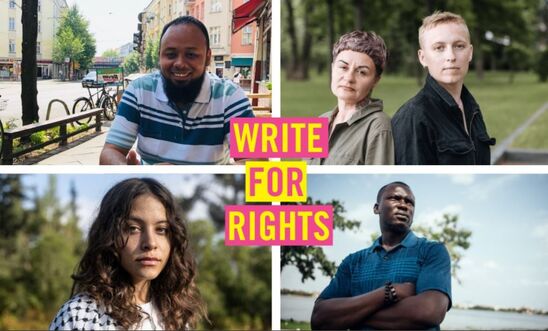
Amnesty International has launched its flagship annual letter-writing campaign, Write for Rights to support 10 activists from around the world who have been attacked, jailed, harassed or disappeared for standing up for their rights.

This year, Write for Rights – which is funded by players of the People’s Postcode Lottery – will be supporting ten individuals, including:

  • Imoleayo Adeyeun Michael from Nigeria, who faces years behind bars for joining the #EndSARS protests against the notorious Special Anti-Robbery Squad last year;
  • Janna Jihad, a 15-year-old journalist from Palestine, who faces harassment and death threats for reporting on the racist brutality her community experiences;
  • Zhang Zhan, a citizen journalist from China who faces four years in prison for attempting to expose the extent of the Covid-19 crisis; [see also https://humanrightsdefenders.blog/2021/11/06/chinese-journalist-zhang-zhan-at-imminent-risk-of-death/]
  • Sphere, a Ukrainian LGBTI and women’s rights NGO, which is struggling to operate against frequent homophobic attacks, threats and intimidation;
  • Mohamed Baker, an Egyptian human rights lawyer denied a trial and put behind bars for his work supporting people who have been imprisoned unjustly; and
  • Ciham Ali Ahmed, a US-Eritrean national, who was arrested nine years ago at the Sudanese border when she was trying to flee Eritrea aged 15 and has not been seen since. 

Sacha Deshmukh, CEO of Amnesty UK, said:

“These individuals have been thrown behind bars, attacked, harassed or disappeared just for standing up for their rights. By coming together, people around the world have the power to raise their profile and increase their chances of protection or release.

“Sending a letter or email might seem like a small act, but when sent in their thousands they can have a huge impact. People in power are forced to listen. 

Amnesty International’s Write for Rights campaign: Write for Rights goes back to the very roots of Amnesty International, which was founded in 1961, with Amnesty’s early campaigners writing letters of support to those affected by human rights abuses, as well as letters of concern to governments around the world.

During last year’s Write for Rights campaign [see: https://humanrightsdefenders.blog/2020/11/09/amnesty-internationals-write-for-rights-campaign-2020-launched/] :

  • More than 360,000 actions were taken for Algerian journalist Khaled Drareni, who was imprisoned for his reporting on the Hirak protest movement. He was provisionally released in February 2021.
  • Over 300,000 messages were sent to and on behalf of Paing Phyo Min, a satirical poet and student leader jailed for criticising the military in Myanmar. He was freed early in April 2021.
  • More than 777,000 actions were taken for Saudi women’s rights campaigner Nassima al-Sada. As a result, a G20 summit hosted by Saudi Arabia was overshadowed by international calls to free Nassima and other women human rights defenders. Nassima has since been conditionally released.

View latest press releases 01 Nov 2021

https://www.amnesty.org.uk/press-releases/worlds-biggest-letter-writing-campaign-launches-help-10-people-around-world-facing

Assault by Israel on Palestinian human rights NGOs

October 23, 2021

As if the fight against terrorists is not already complex enough, Israel has muddied the water more by accusing six prominent Palestinian human rights groups of being terrorist organisations, saying they have undercover links to a militant movement. Not surprisingly. most of the groups document alleged human rights violations by Israel and the Palestinian Authority.

The six are Al-Haq, a human rights group founded in 1979, [and the winner of 5 human rights awards, see: https://www.trueheroesfilms.org/thedigest/laureates/0F74BF45-72C4-9FDD-F96D-2B87BF6C7728] Addameer, Defence for Children International – Palestine, the Bisan Center for Research and Development, the Union of Palestinian Women’s Committees and the Union of Agricultural Work Committees.

The Israeli defence ministry said they were linked to the Popular Front for the Liberation of Palestine (PFLP), a secular political movement with an armed wing that in the past carried out attacks against Israel. The groups “were active under the cover of civil society organisations, but in practice belong and constitute an arm of the [PFLP] leadership, the main activity of which is the liberation of Palestine and destruction of Israel”, the defence ministry said. It claimed they were “controlled by senior leaders” of the PFLP and employed its members, including some who had “participated in terror activity”. The groups serve as a “central source” of financing for the PFLP and had received “large sums of money from European countries and international organisations”, the defence ministry said.

The groups, well known for their human rights work, have indeed quite openly received funding from EU member states, the United Nations and other donors.

Shawan Jabarin, the director of Al-Haq, said the move was an attempt to stifle criticism. “They may be able to close us down. They can seize our funding. They can arrest us. But they cannot stop our firm and unshakeable belief that this occupation must be held accountable for its crimes,he told the Times of Israel.

The Israeli human rights group B’Tselem called the government’s declaration “an act characteristic of totalitarian regimes, with the clear purpose of shutting down these organisations”. It added: “B’Tselem stands in solidarity with our Palestinian colleagues, is proud of our joint work over the years and is steadfast to continue so.”

Human Rights Watch and Amnesty International, who work closely with many of these groups, said in a joint statement:

This appalling and unjust decision is an attack by the Israeli government on the international human rights movement. For decades, Israeli authorities have systematically sought to muzzle human rights monitoring and punish those who criticize its repressive rule over Palestinians. While staff members of our organizations have faced deportation and travel bans, Palestinian human rights defenders have always borne the brunt of the repression. This decision is an alarming escalation that threatens to shut down the work of Palestine’s most prominent civil society organizations. The decades-long failure of the international community to challenge grave Israeli human rights abuses and impose meaningful consequences for them has emboldened Israeli authorities to act in this brazen manner.

How the international community responds will be a true test of its resolve to protect human rights defenders. We are proud to work with our Palestinian partners and have been doing so for decades. They represent the best of global civil society. We stand with them in challenging this outrageous decision.

The US Department of State spokesperson Ned Price said his office had not been given advance warning of the designation. “We will be engaging our Israeli partners for more information regarding the basis for the designation,” Price said on a telephone briefing with reporters in Washington.

The move by the Israeli government represents a challenge for the many European countries that provide financing to the six organizations, European governments, .. now risk being accused of funding terrorism if they continue financing the six groups. One senior European official working in the region admitted the move was likely aimed at putting pressure on donors’ decision-making but said there needed to be an analysis of any evidence put forward by Israel, said CNN Europe.

See also the 4 November post by Just Security: https://www.justsecurity.org/78884/the-downstream-effects-of-israels-terrorist-designation-on-human-rights-defenders-in-the-us/

See also: https://humanrightsdefenders.blog/2019/11/27/al-haq-named-2019-recipient-of-human-rights-and-business-award/

https://www.theguardian.com/world/2021/oct/22/israel-labels-palestinian-human-rights-groups-terrorist-organisations

https://www.aljazeera.com/news/2021/10/22/israel-palestinian-human-rights-groups-terrorism

https://www.msn.com/en-gb/news/world/stars-sign-letter-criticising-israel-s-move-to-label-palestinian-charities-as-terror-organisations/ar-AAQNM7

See also: https://www.commondreams.org/news/2022/01/06/dont-abandon-us-palestinian-rights-group-rebukes-dutch-government-halting-funding

https://news.un.org/en/story/2021/10/1103982

11 human rights defenders you need to follow on Instagram

September 14, 2021

Amnesty has collaborated with 11 artists, creatives and campaigners to illustrate the four basic freedoms on social media Four basic freedoms outlined in 1948 Universal Declaration of Human Rights have been reimagined as Freedom to Explore, Be, Imagine and Rebel

We [want to] inspire a new generation to know their rights – and claim them – Sacha Deshmukh

Amnesty International UK has collaborated with 11 artists to help a new generation of human rights defenders to better understand the four fundamental freedoms that every person has a right to.

Outlined in 1948, the Universal Declaration of Human Rights was based on four basic freedoms – freedom of speech, freedom to worship, freedom from want and freedom from fear.

But many young people today are unaware of the human rights they are entitled to, despite living at a moment in history when many of these basic freedoms are at risk of being taken away.

Now Amnesty has reimagined these four tenets for a modern audience, redefining the broad categories as the:

  • Freedom to Explore
  • Freedom to Be
  • Freedom to Imagine
  • Freedom to Rebel

Over the coming weeks, artists, creatives and campaigners will be sharing their interpretations of what these freedoms mean to them on Instagram.

Sacha Deshmukh, CEO of Amnesty International UK, said:

From the pandemic to the climate crisis to conflicts unfolding across the planet – we live in a world of unprecedented uncertainty. But there is hope.

“Sixty years after Amnesty International was founded, we are collaborating with 11 fantastic artists, creatives and campaigners to reimagine the four basic freedoms – inspiring a new generation to know their rights and claim them.

“Knowledge is power and at a time when many basic human rights are under threat, these artists are vital beacons of hope for their followers – and the wider world.”

11 artists who want to change the world for the better

  • Basma Khalifa (she/her @basmakhalifa) is a Sudanese multi-disciplinary creative and hosts the ‘Unpretty Podcast’ which discusses perceptions of beauty through the lens of people of colour. Basma has worked with BBC1, BBC3, Facebook, Apple and Vice. 
  • Das Penman (they/she @das.penman) Das started their Instagram page during lockdown as a means of creative expression but it has since grown into a safe space for discussions about politics, mental health and everything in between. Das combines a passion for drawing with current affairs to create the “Daisy Mail”, a round-up of news stories to help followers stay informed.
  • Jacob V Joyce (they/them @jacobvjoyce) is a non-binary artist with a focus on queer and decolonial narratives. Joyce’s work ranges from afro-futurist world building workshops to mural painting, comic books, performance art and punk music.
  • Joy Yamusangie (they/them @joyyamusangie) specialises in illustration, experimenting with a range of processes to produce mixed media pieces. Joy explores themes of memory, intimacy, race and culture from a personal perspective.
  • Bee Illustrates (they/them @beeillustrates) is a queer illustrator who uses their art to educate, empower and inform people on a range of topics including mental health, LGBTQ+ and anti-racism.
  • Radam Ridwan (they/them @radamridwan) is a queer non-binary multi-disciplinary artist of Indonesian heritage. Radam’s work centres on QTIPOC empowerment and has been published internationally with features in VICE, Vogue Italia, gal-dem and Gay Times.
  • Tahmina Begum (she/her @tahminaxbegum) is a journalist and has featured in HuffPostUK, Women’s Health, I-D, Dazed, Refinery29, Glamour, The Independent, Metro, The i and gal-dem.  She covers a wide scope of topics centring around the lives of Muslim women and women of colour.
  • Jaz O’Hara (she/her @theworldwidetribe) is a motivational speaker, podcaster and the founder of The Worldwide Tribe, an organisation supporting refugees and asylum seekers globally.
  • Anshika Khullar (they/them @aorists) also known as Aorists is an award-winning Indian, non-binary transgender artist with an interest in intersectional feminist narratives.  In addition to their editorial and literary projects, Anshika has appeared as a guest speaker and created video content for the Tate.
  • Antony Amourdoux (he/him @antony_amourdoux) was a Great British Bake Off 2018 contestant and remains a passionate baker. Antony was born in Pondicherry, India, where he learned to bake with his father. He supports a number of causes including LGBTQ rights.
  • Jess (she/her @thechroniciconic) campaigns about the unseen injustices around disability, mental health and neurodiversity by sharing both her lived experience and the voices of others. Jess’ goal is to destigmatise and normalise conversations on these subjects.

https://www.amnesty.org.uk/press-releases/know-your-freedoms-11-human-rights-defenders-you-need-follow-instagram-right-now

UAE’s new human rights institute: sounds like a joke

September 3, 2021

On 2 September 2021 Deutsche Welle reports on “UAE’s new human rights institute: Real change or ‘image washing’?” State media has trumpeted the creation of a new human rights body set to work in line with global principles. But the UAE’s critics say the move is audacious and a joke.

THe UAE has been heavily criticized for the way it treats international laborers and human rights defenders [see e.g.: https://humanrightsdefenders.blog/2021/06/15/mary-lawlor-calls-again-on-uae-to-release-prominent-human-rights-defenders/ and https://humanrightsdefenders.blog/2020/09/02/vloggers-selling-their-souls-to-boost-image-of-arab-regimes/]

The United Arab Emirates announced earlier this week that it would set up an independent national human rights organization. The new institution will open an office in Abu Dhabi and, according to the UAE’s state media, “aims to promote and protect human rights and freedoms” in accordance with the local and international laws and guidelines.

The new organization — official name: UAE National Human Rights Institution — already has a hotline that anyone can call if they wish to report human rights abuses.

DW tried calling the number over two days this week. Even though local media said the hotline was active, several attempts failed. Either the calls were not answered or the connection was dropped. DW has reached out to the UAE Embassy in Berlin for further information on the new institution, but has yet to receive a response.

This is just another tactic, part of the UAE’s decade-long whitewashing campaign to make themselves look like a tolerant, respectful and open country,” said Hiba Zayadin, a researcher with Human Rights Watch, who focuses on abuses in the Gulf states.

But the situation on the ground is very different,” she told DW. “In fact, there is absolutely no room for dissent in the UAE. There have been no independent civil society groups there since 2012 and so many people have been jailed. There is a lot of fear of retaliation for speaking out and a high level of censorship, even amongst UAE-based international journalists and academics.” 

Other human rights organizations and media watchdogs have come to similar conclusions.

Reporters Without Borders has highlighted the lack of independent media and the UAE’s draconian cybercrime law from 2012. It ranks the country 131st in the world for press freedom out of 180.

UAE activist Ahmed Mansoor (was arrested in 2017 [see: https://www.trueheroesfilms.org/thedigest/laureates/074ACCD4-A327-4A21-B056-440C4C378A1A]

Amnesty International maintains a long list of “prisoners of conscience” in the UAE, “including well-known human rights defender Ahmed Mansoor,” who is serving a 10-year prison sentence for posts on social media about human rights violations in the UAE.

In June, the UN’s special rapporteur on the situation of human rights defenders called on the UAE to release a number of people who had been imprisoned since 2013 for speaking out against the government.

“They should have never been detained in the first place for legitimately exercising the freedoms that all people are entitled to,” said Mary Lawlor.

Social media users in the Middle East were also critical about the announcement of the human rights organization. “The UAE and human rights don’t really go together,” one Twitter user wrote.

This is the joke of the season,” UK-based researcher Fahad al-Ghofaili, quipped on the same website.

The UAE has said the new body will be set up in line with the so-called Paris Principles.

Those standards, officially adopted by the United Nations in 1993, essentially outline how a national human rights institution’s leadership should be selected, how it will be funded and staffed and how it can cooperate with both civil society organizations and the government, but also remain independent.

Alexis Thiry, a legal adviser at Geneva-based legal advocacy organization MENA Rights Group, told DW it was too early to know if the new UAE organization would be sticking to the Paris Principles, as promised. This was because the rights group had not yet been able to read a publicly available version of the law, UAE Federal Law number 12 of 2021, that enabled the creation of the institution, said Thiry.

It is difficult to have an opinion about the forthcoming independence of the [institution] and its compliance with the Paris Principles,” he explained. “At this stage, it is also too early to comment on the performance of the institution since its members have yet to be appointed, to our knowledge.”

Despite its modern outward appearance, the UAE is regularly criticized about its human rights record

When a new institution like this is formed, it often applies for accreditation with the Global Alliance of National Human Rights Institutions to see if it is adhering to the Paris Principles. The MENA Rights Group often provides assessments to the Global Alliance, which has 118 member organizations from around the world.

From the information the legal advisory group did have, it seemed that the UAE’s new law would be similar to those in neighbouring countries, such as Saudi Arabia, Qatar and Bahrain. All of these countries already have national human rights institutions. But according to the Geneva-based lawyers, none of the national human rights institutions in Bahrain, Oman, Qatar or Saudi Arabia fully comply with the Paris Principles.

However, if the UAE’s attempts at creating this institution are really genuine, then organizations like Human Rights Watch and Amnesty would welcome that, activists said. In promotional materials, UAE media said the institution “would seek to cooperate and deal with the UN and concerned international bodies.”

It will be interesting to see if the UAE are now willing to engage with external organizations,” Human Rights Watch researcher Zayadin noted.

Despite multiple attempts asking UAE authorities to respond to allegations of abuse inside the country, and to get access to prisoners there, Zayadin said her organization has never received any response from the government.

A very first step towards a genuine commitment to improving human rights in the country would be to allow international, independent monitors access to the country,” said Zayadin. “An even more important step would be to release from prison all those who have been unjustly detained simply for exercising their right to free expression and association.”

https://www.dw.com/en/uaes-new-human-rights-institute-genuine-or-joke/a-59061415

Today is the International Day of the Victims of Enforced Disappearances, also in Nepal 

August 30, 2021

Enforced disappearance refers to the arrest, detention or abduction of persons by agents of the State, or those acting with State authorization or support, whose whereabouts are unknown.

Once largely the product of military dictatorships, it has become a global problem, according to the UN, with hundreds of thousands of people “disappeared” in more than 80 countries. Impunity remains widespread.

While strictly prohibited under international human rights law, the SG, Mr. Guterres said enforced disappearance continues to be used across the world as a method of repression, terror, and stifling dissent.

Paradoxically, it is sometimes used under the pretext of countering crime or terrorism. Lawyers, witnesses, political opposition, and human rights defenders are particularly at risk,” he added. 

Having been removed from the protection of the law, victims, who can include children, are deprived of all their rights and are at the mercy of their captors. 

They are frequently tortured and know that it is unlikely anyone will come to their aid.  Some are even killed. 

Enforced disappearance deprives families and communities of the right to know the truth about their loved ones, of accountability, justice and reparation,” the Secretary-General said.

The COVID-19 pandemic has added to the agony and anguish of enforced disappearance, by limiting capacities to search for missing persons and investigate alleged enforced disappearance.”

It was established by the UN General Assembly, which adopted a resolution in December 2010 expressing deep concern about the rise in incidents in various regions, and increasing reports of harassment, ill-treatment and intimidation of witnesses of disappearances, or relatives of people who were disappeared.

The resolution also welcomed the adoption of the International Convention for the Protection of All Persons from Enforced Disappearance, which calls for countries to take measures to hold perpetrators criminally responsible.

“The Convention for the Protection of all Persons against Enforced Disappearances is indispensable in helping to tackle this cowardly practice. But it requires the will and commitment of those with the power to do so,” the Secretary-General said. “States must fulfil their obligations to prevent enforced disappearance, to search for the victims, and to investigate, prosecute and punish the perpetrators.”

Mr. Guterres reiterated his call for countries to ratify the Convention, and to work with the UN Committee that monitors its implementation, as well as the Working Group on Enforced Disappearances, which assists families in determining the fate of their loved ones.

On this day Amnesty International, Human Rights Watch and the International Commission of Jurists (ICJ) issued a statement that the government of Nepal should promptly enforce Supreme Court rulings and permit the regular courts to try cases of enforced disappearance and other grave international crimes. On the International Day of the Victims of Enforced Disappearances, August 30, 2021, thousands of Nepali families are no closer to knowing the truth of what happened to their missing loved ones than they were when the country’s armed conflict ended 15 years ago.

Nepal’s Supreme Court has repeatedly ordered the government to investigate gross violations of human rights and international humanitarian law during the conflict from 1996 to 2006, and to conduct a meaningful, effective transitional justice process to establish the truth and provide justice for thousands of cases of serious abuses.

The Nepali government stands in blatant violation of express orders of the Supreme Court by failing to conduct a credible, timely transitional justice process,” said Mandira Sharma, senior legal adviser for South Asia at the ICJ.

See also: https://humanrightsdefenders.blog/2021/03/17/where-is-somchai-a-brave-wifes-17-year-quest-for-the-truth/

The International Day of the Victims of Enforced Disappearances

https://www.hrw.org/news/2021/08/30/nepal-stop-stalling-enforced-disappearance-inquiries