Archive for the 'ISHR' Category

Meet Angélique Razafindrazoary, a Malagasy environmental human rights defender

July 17, 2025

Angélique is a Malagasy environmental and community rights defender who founded the Razany Vohibola Association in 2016. She represents over 3,000 villagers from four communities near the Vohibola Forest and leads efforts to preserve one of Madagascar’s last remaining primary forests.

Under her leadership, and in collaboration with the Ministry of the Environment, villagers have formed patrols to monitor and protect the forest against illegal logging, poaching, and the growing impacts of climate change. Angélique and her community face ongoing threats, including direct intimidation and violence from the authorities. One of her colleagues, patrol officer Mick, was killed for speaking out against illegal land grabbing, yet his death remains unpunished by local authorities.

Despite these grave risks, Angélique continues to advocate for justice and environmental protection. She also calls for structural change, urging the Malagasy government to pass a law that protects human rights defenders and holds public officials accountable.

There is currently no law to protect human rights defenders in Madagascar. We need this law to pass. The army and the gendarmes must be trained to understand who we are so they can become our allies.

https://ishr.ch/defender-stories/human-rights-defenders-story-angelique-razafindrazoary-from-madagascar/?mc_cid=9dba72a00d&mc_eid=d1945ebb90

Human rights defender story: Judith Maroy, from the Democratic Republic of the Congo

July 16, 2025

What we need first is peace. (…) The international community, the UN, has the ability to end what’s happening in eastern RDC – what is happening today in the East is truly alarming.’

Judith Maroy is a Congolese journalist and human rights defender from Bukavu, in the South Kivu province of the Democratic Republic of the Congo.

Judith began her advocacy work through LUCHA, a youth-led citizen movement demanding social justice, democratic governance, and equality. She later became a journalist with La Prunelle RDC and co-founded a local organisation advocating for the rights of women, youth, and Indigenous communities.

She is calling for a just, peaceful Congo where young people have opportunities, women’s voices are heard, and no one is displaced in their own country.

https://ishr.ch/defender-stories/human-rights-defender-story-judith-maroy-from-the-democratic-republic-of-the-congo

New ISHR handbook on reprisals for human rights defenders

July 10, 2025

On 30 June 2025, ISHR launched its updated Reprisals Handbook in four languages (English, Simplified Chinese, Uyghur and Tibetan), an essential resource for all stakeholders concerned about intimidation and reprisals against those cooperating with international or regional human rights systems.

The UN as well as regional human rights bodies are often the last space where human rights defenders, rights holders, victims and witnesses can denounce violations and abuses. They must be free and safe to cooperate with and give evidence and testimony to these human rights bodies. They must be protected against any form of intimidation or reprisal in association with this engagement.

This handbook is aimed first and foremost at human rights defenders who engage with regional and international human rights systems. The focus is in particular on the United Nations (UN) human rights system, the African Commission on Human and Peoples’ Rights (ACHPR) and the Inter-American Commission on Human Rights (IACHR). 

The handbook highlights the risks that defenders can face from interacting with those systems, and suggests ways in which defenders can leverage the weight of the UN and regional human rights mechanisms to provide some degree of protection against those risks. In doing so, it does not aim to provide a fully comprehensive protection solution. In all cases, defenders should consider which option might be best, based on the context and particulars of a case.

ISHR also aims at diversifying the formats available for defenders to access relevant content, including by publishing a Reprisals Toolkit and a video in the languages mentioned above.


The International Service for Human Rights (ISHR) seeks to ensure that national, international and regional human rights systems have the policies, mechanisms and protocols in place to prevent reprisals and ensure accountability where they occur. ISHR also brings cases of alleged intimidation and reprisals to the attention of relevant officials to press for effective preventative measures and responses, including through our #EndReprisals campaigns. ISHR also maintains the #EndReprisals database, which documents cases of reprisals reported by the UN Secretary-General.

For more information on how to use the UN bodies and mechanisms referred to throughout this handbook, visit the ISHR Academy, which provides free courses in English, Spanish and French.

https://ishr.ch/latest-updates/new-ishr-handbook-on-reprisals-for-human-rights-defenders

The 46/2 Collective demands protection of Nicaraguan opponents exiled in Costa Rica

June 30, 2025

ISHR and the Colectivo 46/2 condemn the assassination of opposition leader Samcam Ruìz by the Nicaraguan Government.

In the joint letter published on 23 June 2025 The 46/2 Collective denounces to the international community the assassination of retired Nicaraguan Army Major Roberto Samcam Ruíz, which took place on 19 June in his home in San José, Costa Rica.

Samcam Ruíz was a strong voice of denunciation against the Ortega-Murillo dictatorship, denouncing the Nicaraguan army and pointing it out as a participant in the repression and extrajudicial executions committed since 2018. He had also denounced an espionage network against opposition refugees in Costa Rica.

The retired major was one of the 94 Nicaraguans denationalised in February 2023 by the dictatorship and since 11 July 2018 had been a refugee in Costa Rica due to persecution and criminalisation by the dictatorship of Daniel Ortega and Rosario Murillo. He obtained Spanish nationality on 26 July 2023.

The assassination of the former retired military officer is not the first attack against opponents on Costa Rican soil.  In 2023, opposition member Joao Maldonado and his wife were shot at with the clear intention of killing them. Maldonado had already suffered another attack in 2021, also in San José, Costa Rica. In 2022, the Nicaraguan opposition leader Rodolfo Rojas was found dead in Honduras. According to relatives, he had been lured to Honduras from Costa Rica, where he had gone into exile. To the list must be added the murder of another refugee, Jaime Luis Ortega, in 2024, in Upala, a canton on the border with Nicaragua. Following these events, Roberto Samcam had spoken to the press, pointing out the direct involvement of the Ortega Murillo regime and indicating that he knew that his life was at risk.

Although the investigations into Samcam’s murder are ongoing, the circumstances of the murder and the profile of the victim raise strong suspicions that it may be a political crime with possible transnational links. This murder takes place in a context in which various human rights organisations have been documenting a sustained pattern of surveillance, threats, harassment and acts of intimidation directed against Nicaraguans in exile in the region, especially in Costa Rica.

We consider that this crime should be analysed and investigated as part of a broader strategy of transnational repression promoted by the Nicaraguan regime to persecute and silence dissent outside its borders, in open violation of the human rights of refugees and exiles. This transnational repression has been documented by the Group of Experts on Human Rights in Nicaragua (GHREN), who have pointed out that ‘The Government’s repressive actions transcend the country’s borders and affect people who are opponents or perceived as such abroad. The government has also continued to target family members of opponents inside Nicaragua, including children, by mere association, as a way of punishing opponents and/or deterring them from speaking out wherever they are’.

Given the gravity of this crime and the sustained pattern of transnational repression against exiled Nicaraguans, we urgently call on the international community to demand that the Nicaraguan State immediately cease all forms of persecution, surveillance and violence against dissidents in exile. We also request that the international community strengthen political, technical and financial support for the protection mechanisms for human rights defenders in exile. We also urge the establishment of bilateral or multilateral channels of communication with the host countries of Nicaraguans in order to assess the security situation and articulate preventive responses to possible acts of transnational persecution. Finally, we call on international human rights bodies to urgently follow up on these cases as part of a systematic pattern of cross-border repression, and to ensure justice and truth for the victims.

Signatories:

  • Collective Nicaragua Never Again
  • Centre for International Law and Justice – CEJIL
  • International Federation for Human Rights – FIDH
  • International Institute on Race, Equality and Human Rights
  • Autonomous Women’s Movement – MAM
  • World Organisation Against Torture (OMCT)
  • Peace Brigades International – PBI
  • International Network on Human Rights Europe – RIDHE
  • Legal Defence, Registry and Memory Unit – UDJUDR
  • Open ballot boxes
  • International Service for Human Rights – ISHR

Additional information:

The 46/2 Collective is a coalition of 19 international, regional and Nicaraguan human rights organisations that regularly informs the international community about the lack of action by the Nicaraguan regime to meet its international human rights obligations.  

https://ishr.ch/latest-updates/the-international-community-must-act-to-protect-nicaraguan-opponents-in-exile-in-costa-rica

ISHR Executive Director Phil Lynch called on States to support the work of defenders and to pay their UN due

June 24, 2025

Watch a recording of the statement at an interactive dialogue on the annual report of the High Commissioner by ISHR Executive Director Phil Lynch

High Commissioner, this statement addresses four themes from your update.

First, the work of human rights defenders is essential for the realisation of all human rights. We deplore the criminalisation and arbitrary detention of defenders in all regions. We call for the release of Eduardo Torres in Venezuela, Ibrahim Metwally in Egypt, Mahmoud Khalil in the US, and Sophia Huang Xueqin in China, among thousands of defenders imprisoned globally for their work for freedom and justice.

Second, principled respect for international law protects us from tyranny. The failure of States with influence to end Israel’s genocide against Palestinians, and the double standards of States which fail to condemn Russia’s atrocity crimes in Ukraine, erode the foundations of peace, security and development everywhere.

Third, impunity for atrocity crimes denies justice to victims and fuels violations. This Council should mandate investigative mechanisms on Afghanistan and China. All States should respect international courts and sanction authorities – including US officials – who seek to pervert international justice.

Finally, no business, however efficient, can survive when customers don’t pay their bills. States which don’t pay their UN dues in full or on time, especially the US and China, benefit from the system while causing a liquidity crisis, with devastating human rights impacts. They should lose the right to vote at the General Assembly and the Security Council until they pay their dues. Humanity’s future depends on all States increasing their human rights investment.

Thank you.

https://ishr.ch/latest-updates/hrc59-humanitys-future-depends-on-all-states-increasing-their-human-rights-investment

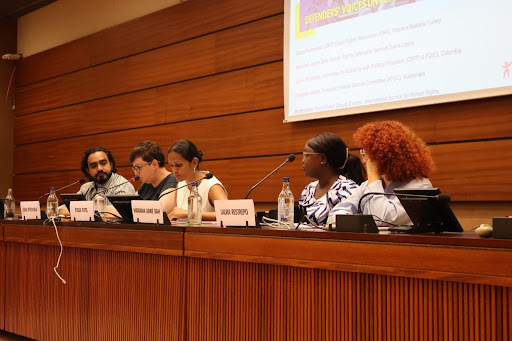
16 June side event: Human Rights Defenders’ voices on reforming the UN human rights system

June 12, 2025

This event will take place on 16 June 2025, from 1:00PM – 2:00PM CEST, in Room XXV, of the Palais des Nations in Geneva Add to calendar pdf Download event flyer

In the face of the triple planetary environmental crisis, of conflict, genocide and apartheid, of the consolidation of authoritarian ideologies and narratives around the globe, and the erosion of the rule of law as well as the closing of civic space, never have we needed a robust international human rights system so badly.

But the UN human rights system is in crisis. As essential users and actors of the system, human rights defenders’ views are valuable. The event provides a space to be hearing directly from them not only about why they need an effective, efficient, responsive UN human rights system to support their activism especially in the current context, but also about the ways in which the UN system needs to grow, evolve, adapt and reform itself to deal with the crisis of credibility and legitimacy it is currently facing.

Panelists:

  • Laura Restrepo, Committee for Solidarity with Political Prisoners (CSPP) & FDSS, Colombia
  • Mariama Jumie Bah , Human Rights Defenders Network Sierra Leone
  • Elena Petrovska , LGBTI Equal Rights Association (ERA), Western Balkans/Turkey
  • Douglas Javier Juárez Dávila, American Friends Service Committee (AFSC), Guatemala

Moderator: Pooja Patel, Deputy Director, ISHR

RSVP Needed: no – Location: Physical

https://ishr.ch/events/defenders-voices-on-reforming-the-un-human-rights-system

https://ishr.ch/latest-updates/hopes-and-expectations-of-human-rights-defenders-on-the-reform-of-the-un-human-rights-system

Travel bans are Reprisals!

May 28, 2025

The Issue

Some States are using travel bans to punish and silence human rights defenders who dare to speak out at the United Nations. These acts of reprisal — from confiscating passports to unjustly labeling activists as terrorists — are designed to isolate, intimidate, and silence voices demanding accountability and justice.  A travel ban may be less visible than a prison cell, but its impact is no less damaging. It prevents defenders from attending UN meetings, carrying out their work, reuniting with loved ones, or seeking safety.

This is the lived reality for: 

These are not isolated cases — they are part of a pattern of reprisals meant to silence dissent and deter others from engaging with the UN.  

What the International Service for Human Rights demand is: 

  • The lifting of travel bans and restrictions against Loujain, Mohamed, Anexa, and Kadar. 
  • The inclusion of their cases in the UN Secretary-General’s annual report on reprisals. This is the first step to recognise they are cases of reprisals which need to be addressed and resolved. 
  • Concrete action from States to publicly condemn and raise these cases at the Human Rights Council and General Assembly.  
    According to our research, we found that more publicity and peer-pressure bring more probability for the reprisal case to be resolved (i.e. here, for the bans to be lifted). 
  • The establishment of clear UN protocols to prevent and respond to acts of reprisal. 

You can help us achieve our goals:  

The first step, is for the Secretary-General to include these cases in his reprisals report. You can contribute by:

👉 Signing our petition to the UN Secretary-General to ensure Loujain, Mohamed, Anexa, and Kadar are included.

Together, we can #EndReprisals.

Find out more about the campaign.https://www.change.org/p/their-voices-defend-human-rights-travel-bans-silence-them-endreprisals

https://www.change.org/p/their-voices-defend-human-rights-travel-bans-silence-them-endreprisals

Venezuela: Where is Eduardo Torres? 

May 13, 2025

ISHR, T

ISHR, the Observatory for the Protection of Human Rights Defenders, a partnership of the World Organisation Against Torture (OMCT) and the International Federation for Human Rights (FIDH), request your urgent intervention in the following situation in Venezuela.

The Observatory has been informed of the disappearance of Mr. Eduardo Torres, a labour lawyer who has been a member for over five years of the Venezuelan Education-Action Program on Human Rights (PROVEA), an FIDH member organisation.

According to witnesses, Eduardo Torres was last seen on Friday, 9 May 2025 at 4:00 p.m. in Parque Central in Caracas, after attending a meeting. At that moment, Mr. Torres contacted his family and informed them he was heading home, near Av. Fuerzas Armadas in Caracas, but he never arrived.

Seeking information about Eduardo Torres’ whereabouts, his wife, Ms. Emiselys Nuñez, accompanied by PROVEA members, have visited various detention centres in Caracas, including the Bolivarian National Intelligence Service (SEBIN) at El Helicoide, several National Bolivarian Police (PNB) stations in Maripérez, Boleíta and Petare, as well as the General Directorate of Military Counterintelligence (DGCIM) in Boleíta. As of the publication of this urgent appeal, his whereabouts remain unknown.

On 11 May 2025, Ms. Emiselys Nuñez and PROVEA’s legal team went to the Palace of Justice to submit a “Habeas Corpus” petition before the Judge of First Instance in Control Functions of the Criminal Judicial Circuit of the Metropolitan Area of Caracas, Specialised in protection matters, to request information on whether Eduardo Torres had been detained by the Venezuelan State. However, after more than seven hours of waiting, they were not “authorised” to receive the document, without providing details, and in clear violation of Article 27 of the National Constitution and Articles 2, 3, and 4 of the Organic Law of Personal Liberty and Security.

On 12 May 2025, the PROVEA team, along with Mr. Torres’ wife and mother, went to the Constitutional Chamber of the Supreme Court of Justice and handed the “Habeas Corpus” petition at 12:10 pm.

The Observatory highlights that Mr. Torres has been repeatedly been subjected to threats and acts of harassment by Venezuelan police officers. Like the rest of the PROVEA team, he is a beneficiary of precautionary protection measures granted by the Inter-American Commission on Human Rights (IACHR) due to repeated threats, criminalisation, and harassment in connection with his human rights work in Venezuela.

The Observatory recalls that on 7 January 2025, Mr. Carlos Correa, former PROVEA coordinator, was intercepted in the centre of the capital Caracas by hooded officials. His whereabouts remained unknown for several days before he was released on 16 January 2025.

The Observatory also recalls that on 15 October 2024, the passport of Mr. Torres, among other human rights defenders and/or persons identified as opponents, was cancelled in a selective and discretionary manner as a mechanism of repression and intimidation to prevent him from leaving the country and/or cooperating with international protection mechanisms, thus violating his rights to identity, free transit and mobility.

The Observatory expresses its deepest concern due to the high probability that Mr. Eduardo Torres is in a condition of arbitrary detention and enforced disappearance, due to his work as a human rights defender and given the constant threats against him. If confirmed, these acts would increase the risk of torture and ill-treatment against him.

The Observatory underlines that this disappearance occurs two weeks before the national and regional elections scheduled for 25 May 2025, again highlighting the risks against human rights defenders in Venezuela and exemplifying a systematic attempt to silence all critical voices committed to human rights and democracy in the country.

The Observatory urges the Venezuelan authorities to guarantee the physical and psychological security of Mr. Eduardo Torres, to disclose his whereabouts and to proceed to his immediate and unconditional release, in case he is indeed detained by State actors.

https://www.fidh.org/en/issues/human-rights-defenders/venezuela-disappearance-of-eduardo-torres-member-of-provea

Environmental defenders and the Escazú Agreement

April 28, 2025

From 7-10 April, the Latin American and Caribbean Forum on Environmental Human Rights Defenders brought together environmental defenders, Indigenous Peoples, civil society, and government representatives in Basseterre, Saint Kitts and Nevis.

The Escazú Agreement is a landmark regional human rights treaty that guarantees access to environmental information, public participation and justice in Latin America and the Caribbean. Article 9 describes States’ obligation to protect human rights defenders in environmental matters and guarantee their rights, including those related to access to information, participation, and justice, as set forth in the agreement.  

As of today, 17 countries are parties to the agreement, while other key countries in the region still haven’t signed or ratified it. In February 2025, Special Procedures mandate holders sent a communication to these countries urging them to sign and ratify the agreement.  

The 2024 Action Plan adopted by the parties to the Escazú Agreement aims to implement practical protections for human rights defenders in environmental matters. It outlines capacity building and assessment, calling for urgent national action to address immediate threats and ensure the continuity of defenders’ work.

Since April 2024, individuals who believe that a State is not complying with its obligations as a party to the Escazú Agreement can send information (‘communications’) to the treaty’s Implementation and Compliance Support Committee. At a 2024 Conference of the Parties (COP) to the Agreement, States agreed to incorporate a gender perspective within the Escazú Agreement, recognising the unique risks faced by women human rights defenders in environmental matters.

This decision further requires States to consider gender-based violence and ensure women’s participation, enhancing security and effectiveness for all defenders. 

At the Forum on Environmental Human Rights Defenders, the #EscazuEnlaCorteIDH initiative was presented during the Third Forum. This initiative seeks to ensure that Escazú standards are included in the Inter-American Court’s forthcoming advisory opinion on the climate emergency.

A central piece of this effort was the amicus brief co-submitted by ISHR. 

see also: https://humanrightsdefenders.blog/tag/escazu-agreement/

https://ishr.ch/latest-updates/better-protection-and-participation-of-environmental-human-rights-defenders-through-effective-implementation-of-the-escazu-agreement

China’s tactics to block voices of human rights defenders at the UN – major report

April 28, 2025

In a new report, ISHR analyses China’s tactics to restrict access for independent civil society actors in UN human rights bodies. The report provides an analysis of China’s membership of the UN Committee on NGOs, the growing presence of Chinese Government-Organised NGOs (GONGOs), and patterns of intimidation and reprisals by the Chinese government.

In the report, published on 28 April 2025 the International Service for Human Rights (ISHR) uncovers the tactics deployed by the Chinese government to restrict access to UN human rights bodies to independent civil society actors and human rights defenders, and intimidate and retaliate against those who do so.  

These tactics include using its membership of the UN Committee on NGOs to systematically defer NGO applications, increasing the presence of GONGOs to limit space for independent NGOs and advance pro-government narratives, systematically committing acts of intimidation and reprisals against those seeking to cooperate with the UN, weaponising procedural tactics to silence NGO speakers and threatening diplomats not to meet with them, and opposing reform initiatives and efforts at norm-setting on safe and unhindered civil society participation at the Human Rights Council. 

These tactics strongly contrast China’s stated commitment to being a reliable multilateral leader. They stem from the Chinese Party-State’s primary foreign policy objective of shielding itself from human rights criticism and enhancing its international image by restricting and deterring critical civil society voices, crowding out civil society space with GONGOs, and stalling and diverting reform initiatives. 

While China is the focus of this report, the issues addressed are systemic. Based on this report’s findings, ISHR puts forward a set of targeted recommendations to UN bodies and Member States, aimed at protecting civil society space from interference and restrictions. The recommendations are designed to strengthen UN processes and prevent any State from manipulating international mechanisms to suppress independent voices. These include: 

  • Reforming the Committee on NGOs to increase transparency, limit abuse of deferrals, and ensure fair access to UN bodies for independent NGOs;
  • Strengthening protection mechanisms against reprisals, including rapid response to incidents inside UN premises, public accountability for perpetrators, and consistent long-term follow-up on unresolved cases; 
  • Curbing the influence of GONGOs by distinguishing clearly between independent and State-organised NGOs, and better documenting their presence and impact; and, 
  • Strengthening measures at the Human Rights Council and other UN bodies to make civil society participation safer, more inclusive, and less vulnerable to obstruction

The report has been featured prominently in a global investigation by the International Consortium of Investigative Journalists (ICIJ) launched on 28 April 2025.

See also the earlier report in February 2023: https://humanrightsdefenders.blog/2023/02/08/ngo-report-on-chinas-influencing-of-un-human-rights-bodies/

https://ishr.ch/defenders-toolbox/resources/un-access-china-report

https://www.france24.com/en/live-news/20250428-china-deploys-army-of-fake-ngos-at-un-to-intimidate-critics-media-probe