Archive for the 'HRW' Category

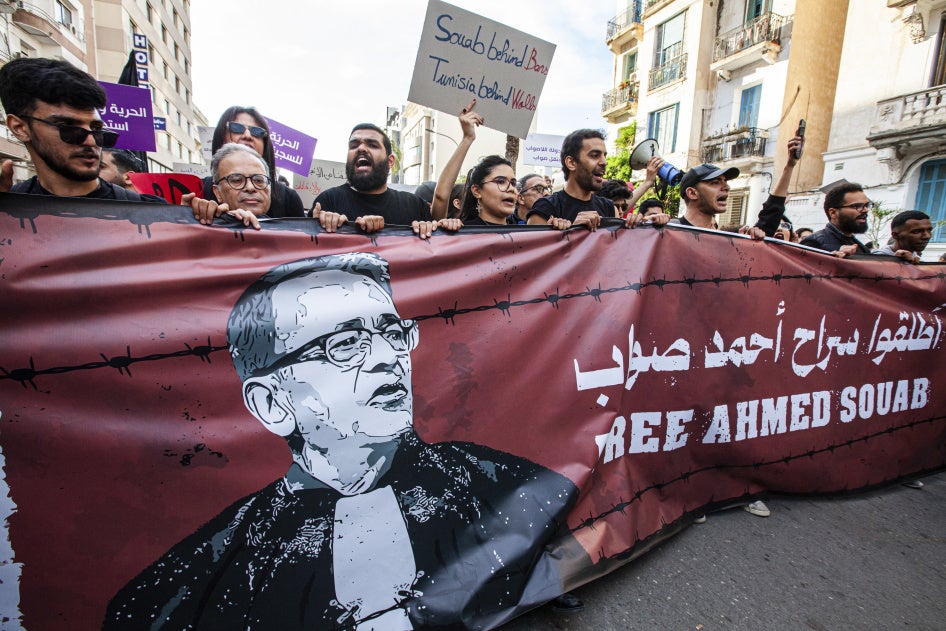
Human Rights Watch and Amnesty International condemn Tunisia’s ‘assault on the rule of law’

November 15, 2025

On 14 November 2025, Al Jazeera (Mariamne Everett) and other media reported that international NGOs, such as Human Rights Watch and Amnesty International, have decried a sharp decline in civil liberties and a pervading “injustice” in Tunisia since President Kais Saied came to power in 2019, as authorities escalate their crackdown on the opposition, activists and foreign nongovernmental organisations.

Tunisian authorities have increasingly escalated their crackdown on human rights defenders and independent non-governmental organizations (NGOs) through arbitrary arrests, detention, asset freezes, bank restrictions and court-ordered suspensions, all under the pretext of fighting ‘suspicious’ foreign funding and shielding ‘national interests’,” Amnesty International said in a statement on Friday.

Tunisia’s crackdown on civil society has reached an unprecedented level, according to Amnesty, as six NGO workers and human rights defenders from the Tunisian Council for Refugees are “being criminally prosecuted on charges solely related to their legitimate work supporting refugees and asylum seekers”. The trial’s opening session, initially scheduled for October 16, has been adjourned to November 24.

Within the past four months, Tunisia has temporarily suspended the activities of at least 14 Tunisian and international NGOs, said Amnesty, including the Tunisian Association of Democratic Women and the World Organisation against Torture.

Human Rights Watch said in a statement on Friday that Tunis’s Court of Appeal will hear on November 17 the appeal of more than 30 people “unjustly sentenced to heavy prison terms in a politically motivated ‘Conspiracy Case’” mass trial in April.

Four of those detained are on hunger strike, including one who, according to his lawyers, was subjected to physical violence in prison on November 11.

The defendants were charged with plotting to destabilise the country under various articles of Tunisia’s Penal Code and the 2015 Counterterrorism Law. Human Rights Watch, which reviewed the judicial documents, said the charges are unfounded and lack credible evidence. The NGO has called on the court to immediately overturn the convictions and ensure the release of all those detained.

The 37 people detained include opponents of Saied, lawyers, activists and researchers. Their prison terms range from four to 66 years for “conspiracy against state security” and terrorism offences. Jawhar Ben Mbarek – cofounder of Tunisia’s main opposition alliance, the National Salvation Front – began a hunger strike on October 29 to protest his arbitrary detention. Ben Mbarek was sentenced to 18 years behind bars on charges of “conspiracy against state security” and “belonging to a terrorist group”.

Note that on 10 November the Martin Ennals Award announced that Saadia Mosbah, a leading Tunisian human rights activist and co-founder of Mnemty (‘My Dream’), was selected as a runner up. [see https://humanrightsdefenders.blog/2025/11/10/breaking-news-women-human-rights-defenders-recognised-with-the-2025-martin-ennals-award/]

https://www.aljazeera.com/amp/news/2025/11/14/rights-groups-decry-tunisias-injustice-crackdown-on-activists

https://www.ft.com/content/15a04a32-f975-4f5e-9748-874f8e26cbe5

https://www.rfi.fr/en/africa/20251130-prominent-tunisian-activist-chaima-issa-arrested-as-hundreds-protest-clampdown-on-dissent

https://thearabweekly.com/tunisia-calls-eu-parliament-rights-resolution-blatant-interference-releases-high-profile-lawyer

Transnational repression by China reaches New York

November 8, 2025

On 6 November 2025 Human Rights Watch issued a press release on how Chinese Police Harass Filmmakers, Families to Undermine Free Expression Abroad

9da2a6d2-e1fd-4b3d-a322-ba3c24f25b37
A still from Jiangnan Xu’s film “Friends from Jiangnan.” © Zhu Rikun

Chinese authorities harassed several dozen Chinese film directors and producers, as well as their families in China, causing them to pull films from the inaugural IndieChina Film Festival in New York City. On November 6, 2025, the festival’s organizer, Zhu Riku, announced that the film festival, scheduled for November 8-15, had been “suspended.”

The Chinese government reached around the globe to shut down a film festival in New York City,” said Yalkun Uluyol, China researcher at Human Rights Watch. “This latest act of transnational repression demonstrates the Chinese government’s aim to control what the world sees and learns about China.

Chiang Seeta, a Chinese artist and activist, reported that nearly all participating directors in China faced intimidation. Even directors abroad, including those who are not Chinese nationals, reported that their relatives and friends in China were receiving threatening calls from police, said Chiang.

On November 1, the organizers issued an announcement on social media saying they had received messages from some film directors and producers and their families about Chinese government harassment: “We are deeply concerned about the situation. … [I]f you are under pressure not to attend the festival … we fully understand and respect it.” By November 4, more than two-thirds of participating films had cancelled their screenings.

After the festival was suspended, Zhu issued a statement that the decision was not out of fear, but rather to “stop harassment of … directors, guests, former staff, and volunteers associated with the festival, including my friends and family.”

Independent film festivals in China have faced intensifying crackdowns over the past decade, Human Rights Watch said. The Chinese authorities have shut down all three major independent film festivals in China: Yunfest, founded in 2003; the China Independent Film Festival, founded in 2003; and Beijing Independent Film Festival, founded in 2006.

When the authorities shut down the last screening of the Beijing Independent Film Festival in 2014, they cut off electricity from the venue, confiscated documents from the organizer’s office, and forced the organizers to sign a paper promising not to hold the festival. Many festival organizers have tried without success to adapt, for instance by changing their format to screenings at multiple venues.

The 14th China Independent Film Festival was shuttered in 2018, the last time such a festival took place in China.

A court in January 2025 sentenced Chen Pinlin, known as Plato, to three-and-a-half years in prison for allegedly “picking quarrels and provoking trouble” after he made a documentary about the “white paper protests” during Covid-19 lockdowns. Transnational repression can be defined as government efforts to silence or deter dissent by committing human rights abuses against their own nationals living abroad, their families at home, or members of the country’s diaspora. [see also: https://humanrightsdefenders.blog/2025/10/17/un-report-highlights-chinas-targeting-of-human-rights-defenders-abroad/]

The Chinese government’s transnational repression of the arts has not been limited to film. Chinese officials interfered with an exhibition in Bangkok and censored artwork by Uyghur, Tibetan, and Hongkonger artists in August.

https://www.hrw.org/news/2025/11/07/china-authorities-shut-down-film-festival-in-new-york

https://www.europarl.europa.eu/news/en/agenda/briefing/2025-11-12/10/combating-transnational-repression-of-human-rights-defenders

https://ishr.ch/latest-updates/un-experts-warn-of-surge-in-transnational-repression-targeting-defenders-from-china-and-southeast-asia

Incredible number of NGOs (3700!!) condemn attacks on civil society in USA

October 9, 2025

Human Rights Watch stands with civil society and signed this letter, alongside more than 3700 other organizations, condemning the Trump administration’s attacks. It is a testament to our community’s solidarity.

“We are a coalition of nonprofit and nonpartisan organizations formed to champion causes dear to all Americans. We work in communities across the country to protect our air and water, our right to vote, to worship, and to organize; we fight for consumers, workers, and our children; we advocate for civil and human rights at home and abroad; we have made it safer to drive on our roads, easier to start a business, and healthier to live in our cities. We span the full ideological spectrum. And today, we stand together for our democracy and in solidarity with the nonprofit groups unjustly and illegally targeted by the Trump administration, including in a new September 25 presidential memorandum. 

We of course unequivocally reject political violence. But we won’t mince words. No president–Democrat or Republican–should have the power to punish nonprofit organizations simply because he disagrees with them. That is not about protecting Americans or defending the public interest. It is about using unchecked power to silence opposition and voices he disagrees with. That is un-American and flies in the face of the Constitution, including the First Amendment bar on targeting organizations for their advocacy. 

Charities perform crucial functions in every community across our country, including providing healthcare, housing, education, religious services, food and water, and so much more. Like other nonprofits, the organizations threatened by President Trump have a mission to serve the public good and are composed of everyday people fighting for dignity, safety, and opportunity. 

This attack on nonprofits is not happening in a vacuum, but as a part of a wholesale offensive against organizations and individuals that advocate for ideas or serve communities that the president finds objectionable, and that seek to enforce the rule of law against the federal government. Whether the target is a church, an environmental or good government group, a refugee assistance organization, university, a law firm, or a former or current government official, weaponizing the executive branch to punish their speech or their views is illegal and wrong. It is also an attack on the very notion that government power must serve the people, not those in office. 

Charitable organizations serve our communities in various ways, playing a central role in public protection, health, accountability, anti-discrimination, and in creating the moral fabric of our nation. That is, of course, precisely why this administration is targeting them. They know that the organizations they are attacking exist to lift up the voices of everyday Americans and shine the spotlight of accountability on those who seek to abuse power. 

Political violence is unacceptable. But efforts by the president of the United States to defund, discredit, and dismantle nonprofit groups he simply disagrees with are reprehensible and dangerous—a violation of a fundamental freedom in America. This Administration is trying to bully people into silence but speaking out is, and has always been, our collective mission. We stand with those wrongly targeted and with each other. No exceptions.”

https://www.hrw.org/news/2025/10/08/an-open-letter-rejecting-presidential-attacks-on-nonprofit-organizations

https://www.commondreams.org/news/letitia-james-indicted

Egyptian human rights defender Alaa Abdel Fattah finally free!

September 23, 2025

Egyptian media reported on 22 September, 2025, that President Abdel Fattah al-Sisi had issued a presidential pardon for the imprisoned Egyptian-British activist Alaa Abdel Fattah. On 23 September the Guardian, HRW and others reported that the British-Egyptian human rights activist Alaa Abd el-Fattah has indeed been released from jail after serving six years for sharing a Facebook post.

Early on Tuesday morning his campaign said in a statement that Abd el-Fattah was released from Wadi Natron prison and was now in his home in Cairo. “I can’t even describe what I feel,” his mother, Laila Soueif, said from her house in Giza as she stood next to her son surrounded by family and friends. “We’re happy, of course. But our greatest joy will come when there are no [political] prisoners in Egypt,” she added.

Peter Greste, an Australian journalist who was imprisoned alongside Abd el-Fattah, told Australian Associated Press: “It’s absolutely wonderful news, I’m absolutely overjoyed, I think it vindicates all the work and the efforts of the people who lined up behind him. See also: https://humanrightsdefenders.blog/2025/01/19/i-owe-alaa-abd-el-fattah-my-life-which-is-why-i-am-going-on-a-hunger-strike-to-help-free-him/

Alaa Abd el-Fattah stands next to his mother, Laila Soueif, and sister, Sanaa, at their home in Giza.
Alaa Abd el-Fattah stands next to his mother, Laila Soueif, and sister, Sanaa, at their home in Giza. Photograph: Mohamed Abd El Ghany/Reuters

Amnesty International’s Erika Guevara Rosas said the release was welcome but long overdue. “His pardon ends a grave injustice and is a testament to the tireless efforts of his family and lawyers, including his courageous mother Laila Soueif and activists all over the world who have been relentlessly demanding his release,” she said. The following quote can be attributed to Amr Magdi, senior Middle East and North Africa researcher at Human Rights Watch: “President Sisi’s pardon of the imprisoned Egyptian activist Alaa Abdel Fattah is long overdue good news. Though we celebrate his pardon.

The campaign for Abd el-Fattah’s release was led by his family, including his mother, who was admitted to hospital in London twice after going on hunger strikes trying to secure his release. The UK prime minister, Keir Starmer, is also known to have telephoned Sisi three times to lobby for Abd el-Fattah’s release. see: https://humanrightsdefenders.blog/2022/07/07/mona-seifs-letter-a-cry-for-help-for-alaa/

https://www.theguardian.com/world/video/2025/sep/23/egyptian-british-activist-alaa-abd-el-fattah-reunited-with-family-after-release-from-prison-video

https://www.hrw.org/news/2025/09/22/egypt-presidential-pardon-for-activist-alaa-abdel-fattah

https://www.theguardian.com/world/2025/nov/14/british-egyptian-activist-alaa-abd-el-fattah-stopped-from-flying-to-uk-says-family

Deluge of NGO criticism greets 2024 US State Department Report on human rights

August 20, 2025

The Trump administration’s omission of key sections and manipulation of certain countries’ rights abuses degrade and politicize the 2025 US State Department human rights report, Human Rights Watch, Amnesty International, Human Rights First and many other NGOs concluded .

On August 12, 2025, the State Department released its “Country Reports on Human Rights Practices” covering the year 2024. The report omits several categories of rights violations that were standard in past editions, including women, LGBT people, persons with disabilities, corruption in government, and freedom of peaceful assembly. The administration has also grossly mischaracterized the human rights records of abusive governments with which it has or is currently seeking friendly relations.

By undermining the credibility of the report, the administration puts human rights defenders at risk, weakens protections for asylum seekers, and undercuts the global fight against authoritarianism. 

This year’s human rights report may strictly keep with the minimum statutory requirements but does not acknowledge the reality of widespread human rights violations against whole groups of people in many locations.  As a result, Congress now lacks a widely trusted, comprehensive tool from its own government to appropriately oversee US foreign policy and commit resources. Many of the sections and rights abuses that the report omits are extremely important to understanding the trends and developments of human rights globally, Human Rights Watch said.

On Israel, the State Department disregards the Israeli authorities’ mass forced displacement of Palestinians in Gaza, their use of starvation as a weapon of war, and their deliberate deprivation of water, electricity, medical aid, and other goods necessary for civilians’ survival, actions that amount to war crimes, crimes against humanity, and acts of genocide. The State Department also fails to mention vast damage and destruction to Gaza’s essential infrastructure and the majority of homes, schools, universities, and hospitals.

The report is dishonest about abuses in some third countries to which the US is deporting people, stating that the US found “no credible reports of significant human rights abuses” in El Salvador, although they cite “reports” of extrajudicial executions, enforced disappearance, and mistreatment by police. The administration has transferred to El Salvador’s prisons, despite evidence of torture and other abuses. 

The State Department glosses over the Hungarian government’s escalating efforts to undermine democratic institutions and the rule of law, including severe curbs on civil society and independent media, and abuses against LGBT people and migrants. It also fails to acknowledge that Russian authorities have widely used politically motivated imprisonment as a tool in their crackdown on dissent, and its prosecutions of individuals for “extremism” for their alleged affiliation with the LGBT movement. 

Compare: https://humanrightsdefenders.blog/2024/05/04/us-state-department-2023-country-reports/

https://www.hrw.org/news/2025/08/12/us-rights-report-mixes-facts-deception-political-spin

https://www.amnestyusa.org/press-releases/u-s-state-departments-human-rights-report-puts-politics-above-human-rights/

https://www.state.gov/reports/2024-country-reports-on-human-rights-practices/

https://theweek.com/politics/state-department-stance-human-rights

https://www.bushcenter.org/publications/what-to-know-about-the-state-departments-new-human-rights-reports

NGOs alarmed by draft law “TRANSPARENCY OF PUBLIC LIFE” in Hungary

May 27, 2025

Human Rights Watch, Civil Rights Defenders and many, many other NGOs are deeply alarmed by a new legislative proposal in Hungary that, if passed, would institutionalise sweeping, opaque, and politically motivated repression of independent civil society, the press, and private organisations that receive foreign support or have any kind of income that the Hungarian government feels would threaten the country’s sovereignty. 

The draft law, which is deceptively titled ‘On the Transparency of Public Life’, would give the authorities unchecked powers, allowing it to recommend the registration of organisations deemed to be ‘influencing public life’ with foreign funding in ways that ‘threaten Hungary’s sovereignty’. Because this phrasing is vague and ideologically loaded, it risks including any kind of criticism of government policy, including the promotion of human rights, press freedom, gender equality, and the rule of law. 

Potential disastrous consequences

  • No legal remedy: If the government demands an organisation register itself, the organisation in question would not be able to appeal this decision. Once listed, organisations would have no access to effective legal redress; 
  • Broad definitions: ‘Foreign support’ is defined as any financial input, no matter how small, from practically any international source (including EU institutions and dual citizens) as well as commercial revenue; 
  • Sweeping prohibitions and sanctions: Listed organisations would have to seek permission from the tax authorities to receive foreign support. Financial institutions would be required to report and block transfers, meaning NGOs would effectively be permanently monitored; 
  • Loss of domestic support: Listed organisations would lose access to Hungary’s 1% income tax donation scheme, which would prevent them from receiving support from regular Hungarian citizens; 
  • Political targeting: Leaders of registered organisations would be labelled ‘politically exposed persons’, which would expose their private financial transactions to invasive scrutiny; 
  • Severe penalties: Any violations could lead to fines of up to 25 times the amount received, suspension of the organisation’s advocacy activities, and even forced closure.

EU must speak out against proposed law

Hungary’s draft law is not about transparency: it is a calculated attempt to criminalise dissent, silence watchdogs, and entrench one-party control over the democratic public sphere and civic space. If passed, the law would violate multiple provisions of the EU Charter of Fundamental Rights and the European Convention on Human Rights, including freedom of expression and association and the right to an effective remedy. 

In an open letter to President Ursula von der Leyen and Commissioner Michael McGrath of 22 May 2025, the NGOs urge to take the following immediate steps:

  • Immediately request the Court of Justice of the European Union (CJEU) to grant interim measures in the ongoing infringement procedure on the Law on the Defence of National Sovereignty (Case C-829/24). The Sovereignty Protection Office is crucial to the new bill and therefore this is an imminent and effective way to halt the progress and impact of the bill. Cognizant of the impending danger, the European Parliament and civil society have been calling for this step since 2024. Interim measures are designed to prevent irreparable harm — in this case, the effective paralysis of civil society organisations, independent media and dissenting voices – and with this new development comprehensive interim measures should be requested immediately.
  • At the same time, call on the Hungarian government to withdraw the bill and if unsuccessful, open a new infringement procedure on new violations that are not linked to the ongoing case on the Defence of National Sovereignty.
  • With the forthcoming Article 7 hearing on Hungary on 27 May 2025 and recognising the escalation of a systematic breakdown of the rule of law, support the Council of the EU to move to a vote on Article 7(1).

This new bill represents a severe and existential threat to democratic principles, human rights and the rule of law in Hungary and in the EU as a whole. If the existing tools are not effectively deployed, we risk an unravelling of the rules on which the EU was founded and a clear step towards authoritarian practices. We call on you to stand in solidarity with Hungarian civil society and their counterparts across the region and remain available to provide additional information and support.

https://www.hrw.org/news/2025/05/23/open-letter-hungarian-bill-entitled-transparency-public-life

https://www.coe.int/nb/web/commissioner/-/commissioner-asks-hungary-s-parliament-not-to-adopt-law-that-stifles-civil-society

Hong Kong: Targeting of Exiled Activists’ Families Escalates

May 16, 2025

Father of Anna Kwok Charged with National Security Crime

The Hong Kong police arrested the father of a prominent US-based activist, Anna Kwok, on April 30, 2025, and charged him with a national security crime, Human Rights Watch said today. The arrest of Kwok Yin-sang was the first such prosecution of a family member of an exiled activist. Hong Kong authorities should immediately drop all charges and release him.

The Hong Kong authorities have recently intensified their harassment of the families of 19 wanted Hong Kong activists living in exile. Punishments and harassment against individuals for the alleged actions of another person is a form of collective punishment, prohibited by international human rights law.

The Chinese government has increased its appalling use of collective punishment against family members of peaceful activists from Hong Kong,” said Yalkun Uluyol, China researcher at Human Rights Watch. “The Hong Kong authorities should immediately and unconditionally release Anna Kwok’s father and cease harassing families of Hong Kong activists.”

On May 2, national security police formally charged Kwok Yin-sang, 68, with “directly or indirectly” dealing with the finances of an “absconder” under section 90 of the Safeguarding National Security Ordinance, which carries a punishment of up to seven years in prison. Kwok Yin-sang remains in custody with a bail hearing scheduled for May 8. Anna Kwok’s brother was also arrested on April 30 but has been released on bail pending further investigation.

Anna Kwok, 28, is the executive director of Hong Kong Democracy Council, a nongovernmental organization based in Washington, DC. In July 2023, she was among a first group of eight people against whom the Hong Kong police issued arrests warrants and HK$1 million (US$129,000) bounties for violating Hong Kong’s National Security Law.

Since then, Hong Kong police have issued similar baseless arrest warrants and bounties against 11 other exiled Hong Kong activists.

Hong Kong authorities have sought to intimidate dozens of family members of the 19 “wanted” individuals, primarily by interrogating them. In the case of Ted Hui, a resident of Australia, they also confiscated HK$800,000 (US$103,000) from him and his family for having allegedly violated the National Security Law.

There has been a new wave of harassment against these families in recent months, Human Rights Watch said. After the Hong Kong police issued the third group of arrests and bounties against six exiled activists in December 2024, they began to harass their families. In January, police interrogated eight family members and former colleagues of the UK-based scholar Chung Kim-wah, and raided the office of the Hong Kong Public Opinion Research Institute, with which Chung was formerly associated.

In February the police questioned the aunts and an uncle of Carmen Lau, a UK-based activist and former district councilor. On March 18, police interrogated the stepfather of the activist Tony Chung, who is in the UK.

On April 10, national security police took the parents of the US-based activist Frances Hui into custody for questioning.

The 19 wanted activists have also faced various other forms of harassment. In June and December 2024, the Hong Kong government cancelled the passports of 13 wanted activists, including Anna Kwok. In March, Lau and Chung reported that anonymous individuals sent letters to residents in various London neighborhoods urging them to hand in the activists to the Chinese Embassy in London, citing the warrants and bounties against them. Similar letters were sent to Melbourne-based Kevin Yam, a democracy activist and an Australian citizen.

Many of the 19 activists, including Kwok and Frances Hui, have reported online harassment campaigns, including rape and death threats, since the government issued the warrants and bounties against them. The media reported that an online campaign, which exhibited signs of a previous Chinese government influence operation, sought to mobilize far-right people in the UK to attack activists on the bounty list.

The 19 wanted activists live in the UK, US, Canada, and Australia. The US government in March sanctioned six officials in Hong Kong for using the National Security Law “extraterritorially to intimidate, silence, and harass” the activists. The other three governments have issued statements condemning the arrest warrants, but have not taken action to hold Hong Kong officials accountable. The US government is also the only one that has arrested someone for allegedly harassing a Hong Kong activist on its soil, though the person was later acquitted.

The Chinese government has used two draconian national security laws, the National Security Law of 2020 and the Safeguarding National Security Ordinance of 2024, to dismantle the city’s pro-democracy movement and take away its fundamental freedoms, which are enshrined in Hong Kong’s de facto constitution, the Basic Law. Over 200,000 Hong Kongers have left Hong Kong, among them protesters and activists who have continued their activism abroad.

The AustralianUK, and US governments, the European Union, and the United Nations High Commissioner for Human Rights have all publicly expressed concerns about the two security laws.

“Beijing isn’t likely to stop abuses against the families of exiled activists unless affected governments send a strong message that such repression carries a cost,” Uluyol said. “They should fully investigate and sanction Chinese and Hong Kong officials involved, and pass strong laws to protect their residents and citizens from transnational abuses.”

https://www.hrw.org/news/2025/05/04/hong-kong-targeting-exiled-activists-families-escalates

UAE: Dissidents, Relatives Designated ‘Terrorists’

April 30, 2025

Emirati authorities have designated as “terrorist” 11 political dissidents and their relatives as well as 8 companies they own, reflecting the country’s indiscriminate use of overbroad counterterrorism laws and contempt for due process, Human Rights Watch said on 22 April 2025.

On January 8, 2025, Emirati authorities announced a cabinet decision unilaterally adding the 11 individuals and 8 companies to its terrorism list for their alleged links to the Muslim Brotherhood, without due process. The authorities did not inform these individuals or entities prior to the designation, nor was there any opportunity to respond to or contest the allegations. The move represents an escalation of the United Arab Emirates’ (UAE) transnational repression, targeting not only dissidents but also their family members.

“Throwing nineteen people and companies onto a list of alleged terrorists without any semblance of due process, and with serious ramifications for their livelihoods, makes a mockery of the rule of law,” said Joey Shea, United Arab Emirates researcher at Human Rights Watch…

Human Rights Watch found that all eight companies are solely registered in the United Kingdom and are owned or previously owned by exiled Emirati dissidents or their relatives. At least nine of the eleven designated individuals are political dissidents or their relatives. Only two of the eleven have been convicted or accused of a terrorist offense, though both under questionable circumstances, according to informed sources and the Emirates Detainees Advocacy Center (EDAC), a human rights organization supporting imprisoned human rights defenders in the UAE. One was convicted in absentia as part of the grossly unfair “UAE94” mass trial of political dissidents in 2013. The other was accused in a separate case related to supporting the “UAE94” detainees.

Individuals on the list found out about the designation only after the Emirates News Agency (WAM), the UAE’s official state news agency, published it on its website. It came as “a real shock, it was very difficult,” one of the people named told Human Rights Watch.

Human Rights Watch searched for the individuals and companies on global terror and financial sanctions lists, including the United Nations Global Sanctions list, the European Union Sanctions list, and the Consolidated List of Financial Sanctions Targets in the UK. None of them are included in these internationally recognized lists.

The UAE’s 2014 counterterrorism law uses an overly broad definition of terrorism and allows the executive branch to designate individuals and entities as terrorists without any corresponding legal requirement to demonstrate the objective basis of the claim. It does not set out a clear procedure for how this authority should be exercised, nor does it provide for any oversight.

Designated individuals face immediate asset freezes and property confiscation under the counterterrorism law and Cabinet Decision No. 74/2020. Those in the UAE, including relatives or friends, face a possible sentence of life in prison for communicating with anyone on the list. Human Rights Watch found that the designation has negatively affected individuals’ careers and personal finances, including through lost career opportunities and clients.

Exiled Emirati dissidents said the designations are part of the UAE’s ongoing crackdown on dissent and political opposition. “They want to hurt us as much as possible,” one individual whose name appeared on the list said.

Over the last decade, Emirati authorities have repeatedly targeted the Muslim Brotherhood and its Emirati branch, the Reform and Social Guidance Association (Al-Islah), in a widespread crackdown. Al-Islah is a nonviolent group that engaged in peaceful political debate in the UAE for many years prior to the crackdown and advocated greater adherence to Islamic precepts. Many of the detainees from the grossly unfair “UAE94” mass trial in 2013 are members of Al-Islah. The UAE designated the Muslim Brotherhood as a terrorist organization in 2014.

The 2014 counterterrorism law enables the courts to convict peaceful government critics as terrorists and sentence them to death. The law has been repeatedly used against political dissidents. In July 2024, 53 human rights defenders and political dissidents were sentenced to abusively long terms in the country’s second-largest unfair mass trial.

The UN’s first special rapporteur on counterterrorism and human rights has said that terrorism should be defined as narrowly as possible, warning that “the adoption of overly broad definitions … carries the potential for deliberate misuse of the term … as well as unintended human rights abuses.”

…The UAE appears to be escalating its persecution beyond openly outspoken dissidents to include family members who have not participated in politics nor spoken publicly about the country’s human rights record. “Many people whose names are on the list, they didn’t speak loudly against the government,” one person said.

In 2021, the UAE added 38 individuals and 15 entities to its terrorism list, including 4 prominent exiled Emirati dissidents. Human Rights Watch found that 14 of the 38 individuals and two of the entities are on other international global terror and financial sanctions lists. None of the individuals nor entities added on January 2025 were found on other internationally recognized lists…

https://www.hrw.org/news/2025/04/22/uae-dissidents-relatives-designated-terrorists

First assessment of Human Rights under the Trump Administration by HRW

March 5, 2025

Amy Braunschweiger speaks with Human Rights Watch’s US Program Director Tanya Greene, who leads research within the United States, as well as Washington Director Sarah Yager, who advocates with the US government on global issues, about the slew of executive orders President Trump has issued, the damage to human rights his administration’s policies have already done, and where we go from here.The text – reproduced in full below, was published on 3 March 2025.

See also: https://youtu.be/N_hCOCVuJsA?si=t2lUEb3Fw8XWH7Vo where UN human rights chief Volker Türk has voiced deep concerns for hostilities happening across the globe, including a “fundamental shift in direction” of the US. He expressed concern over a peace deal in the Russia-Ukraine war that did not involve Kyiv.

President Trump has been governing by executive orders. Could you give us some quick background on executive orders and what they do?

TG: An executive order is a presidential directive regarding federal government operations and policies. Their reach and power can be extraordinary, including because they often impact federally funded non-governmental entities, like universities and housing providers. Executive orders should be based on existing law, and are often operationalized through agency action, such as the departments of labor, homeland security, or education.

Many of Trump’s executive orders are facing court challenges arguing that they are unconstitutional or otherwise illegal. For example, his executive order denying citizenship to children of undocumented people born in the United States has been stayed by the courts pending a legal challenge. It is widely seen as a clear violation of the 14th amendment to the Constitution.

Although the implementation of executive orders is not always automatic, widespread responses have been preemptive, anticipatory, and fearful, which is likely what Trump intended in this blitz of actions.

SY: These executive orders show how split the United States is. In 2016, Trump’s executive orders reversed former President Barack Obama’s. Then Joe Biden reversed Trump’s orders. And today, Trump reverses Biden’s. But this isn’t typical. It shows the divisive nature of US politics.

It’s also not typical that so many of these current orders are harmful to human rights.

Many of Trump’s executive orders harm human rights, both in the United States and around the world. Meanwhile, billionaire Elon Musk’s “Department of Government Efficiency,” or DOGE, is laying off masses of federal employees at various agencies. What are we most concerned about inside the US?

TG:  Whatever its supposed intentions, DOGE is slashing and burning to the point that a growing number of federal agencies are crippled by lack of resources, staff, and competent leadership. DOGE is also taking down websites and data that we rely on, both as human rights defenders and as the general public seeks information. For instance, hospitals across the country can no longer obtain important public health data from the Centers for Disease Control and Prevention.

Human Rights Watch is investigating the treatment of immigrant children, racial justice impacts, environmental concerns, healthcare access, rights of lesbian, gay, bi-sexual, and transgender people, and reproductive freedoms. You have a president that says diversity, equity and inclusion (DEI) is “dangerous, demeaning and immoral” but offers no ways to fight racial injustice, and yet one of his executive orders allows for resettling certain supposedly-persecuted white South Africans in the US, just after an earlier order closed the refugee admissions door on all other refugees worldwide.

Immigration enforcement raids and other enforcement activities in the last month have targeted all immigrant communities, disproportionately those of color. Enforcement has targeted immigrants regardless of how long they have been in the United States and without considering their contributions to their communities, as well as people in the process of an immigration proceeding, where a judge decides if they can stay in the US.  As a result, there are communities in which many people are terrified and some avoid going to church or the hospital, and many children don’t go to school.

There is also an order now in place defunding reproductive justice and abortion access both in the US and around the world.

The stock value of GEO Group, a company the US government has long contracted with to run private immigration detention facilities, went up immediately after Trump’s election, presumably in anticipation of ramped-up immigration detention in private facilities. Human Rights Watch has long called for investment in community-based public safety solutions rather than more prisons.

What are we worried about in terms of US foreign policy?

SY: The foreign aid freeze and termination of thousands of State Department grants is a key focus for us right now, though of course there are new concerns that rise up every day. The aid being stopped has had awful consequences around the world. People will die needlessly because of this one policy decision.

There is also an impact on civil and political rights abroad. Russian independent media outlets, which have been doing an amazing job exposing the Kremlin’s repression and debunking the official propaganda, received significant US-funding. Terminating aid will severely undercut that work. The same thing with Belarusian independent media.

Many human rights defenders targeted by their governments lived in US-funded safe houses, which are now closed.

Small human rights groups, some the only ones in their country, are on the verge of closing. We’re going to see the ripple effects and deaths in populations unable to stand up for their freedoms without this funding and the political support the United States gave.

Aside from the aid freeze, Trump and Secretary of Defense Pete Hegseth fired the military’s top lawyers. Military lawyers are supposed to ensure US military operations abide by international law, the laws of war.  This could mean far more harm to civilians, who are supposed to be protected, when the US military is in an armed conflict. In fact, Trump also just lifted limits on US commanders authorizing airstrikes and special operations raids outside of war zones, which rolls back 20 years of work to ensure only combatants are targeted and only in recognized armed conflicts.

These kinds of actions will have long-term ramifications on how people around the world view the United States.

When there’s so much happening in a short period of time, how does Human Rights Watch approach its work?

TG: We remember our priorities and how we can make a difference. There’s a lot of noise and distraction so we have to be thoughtful about putting limited resources into efforts that have impact. Our research on immigration raids or deportation flights might be used in partner litigation; our interviews with witnesses to abuses help support policymakers advocating in support of human rights.

As an organization with colleagues who deal with repressive states and authoritarian regimes globally, those of us working in the US are informed of effective strategies and lessons learned as we encounter them here. And we can share this information with partners on the ground and policymakers, too.

SY: We were not caught off guard by this. We were able to plan. I do think the speed, the apparent vindictiveness, and the level of chaos of Trump’s first month in office shocked many people. But we planned for this. We had a strategy that we are now implementing. We are going to engage with every policymaker that we can. We know for a fact many on both sides of the aisle don’t agree with what is happening. We are going to document the Trump administration’s impact on human rights around the world, and we’re going to try and block or end those policies. We are working together with our partners, some of whom focus on strategic litigation – litigation designed to advance respect for and protection of rights.

How is Human Rights Watch responding to this? What is our work inside the US focusing on?

TG: All the areas of work I mentioned are under attack by the new administration.

The immigration space is fraught with misinformation that stokes fears and prejudices, but we counter that with fact-finding and with the stories of the real people who are harmed by dehumanizing rhetoric and policies.  We will build on our track record of careful research on problematic immigration policies from previous administrations, including the first Trump administration, exposing harmful policies such as inhuman and degrading immigration detention and the separation of migrant children from their parents. We are continuing this work, documenting what’s happening to people and using it to advocate for change.

We’ve seen US Immigration and Customs Enforcement (ICE) deporting Iranian families with children to Panama with an agreement that the US will pay for Panama to deport them to Iran. A country cannot lawfully send Iranian asylum seekers to Panama without hearing their claims and just be done with it – sending them back to a country to face persecution violates international refugee law. The administration is also preparing to deport unaccompanied immigrant children – not just cruel and terrifyingly dangerous, but a human rights violation.

In the democracy space, some US voters seem ready to trade freedoms away for supposed gains that are ultimately long-term losses, like increased surveillance, that will embolden and enable bad actors in government.

In the racial equality space, we’ve been working on education, and that is a battle zone. We are doing research to expose state-level policies that censor and distort school curricula in ways that are inconsistent with human rights norms—measures that target the histories and experiences of Black, Indigenous and LGBT people in particular. If those efforts succeed they will be exported to other states.

How is our work responding to changes in the foreign policy space?

SY: The Trump executive order putting in place a sanctions program targeting the International Criminal Court has already done damage. We are working to convince the Senate not to legislate more sanctions, and to make sure other governments step up to defend the court from US pressure.

We continue to focus on some of the conflicts where we think the Trump administration could play a valuable role. When it comes to Sudan, where the US government itself said a genocide took place, the US could pressure allies like the United Arab Emirates to stop supplying weapons to the Rapid Support Forces, one of the abusive warring parties there.

President Trump says he wants to be a peacemaker. There are ways he could do that, but so far we are seeing very worrying foreign policy proposals. For example, Ukraine’s future is being discussed by the United States and Russia without Ukraine, and in Gaza, Trump has proposed permanently and forcibly displacing the Palestinian population, which would amount to crimes against humanity and ethnic cleansing.

Some people would say there is no way to engage with this administration on human rights.

SY: Engaging is certainly more challenging. But we don’t want to just walk away from our advocacy with US officials. Then you give up the power of the human rights movement, and any opportunity to change the minds of policymakers. There are still people in this administration who care about human rights. They may talk about it differently, they may be focused on particular places or issues. We’ll start there and make our case for the US role in lessening suffering and protecting rights around the world, not only because it’s good but because it’s smart and it’s in the US interest.

And there’s Congress, which needs to step up as a check on the power of the White House. We will continue to work with House representatives and Senators on both sides of the aisle.

TG:  The fear that the administration is cultivating among the public is dangerous, and information is so critical in response. That’s why we respond with research, arming people with facts. We know there are members of congress and state leadership like governors that support human rights. They are also empowered by our work.

What can people in the US do in this situation?

SY: If we want to see rights on the agenda, we need to see people in the United States reaching out to their representatives in Congress. They were elected to bring to Washington the needs and desires of their people.

Also, if you see a person acting with courage in these difficult times, thank them. We’re going so fast, and we push and yell and scream, and then when a policymaker, a celebrity, or the head of a local food bank steps out and does the right thing, we move on. Stop for a minute and recognize the people doing the right thing. Make the space for them to keep doing that important work of holding the line.

TG: Also, you too can be that person. Share the information. Have the conversations with your friends and family, provide what you know, encourage exchange of real information. It’s about building community. One of the strongest weapons we have is our unity, and we can each do something to build that.

Religious communities and school groups and community centers, there are many places we can plug in to make a difference. Support your local homeless shelter or food pantry. Sponsor or reach out to refugees and immigrants living in your localities. I think the big risk is feeling powerless and unplugging. I know the temptation is great. We each don’t have to do everything. But if we all do something, that’s more than nothing. And don’t be afraid to hear “no” or lose on your first try. No is the first step to yes.

And remember that there have been people in this country who have been targeted for abuse and destruction by the government their entire time in this country. Us as Black people, Indigenous people. And we’ve not only survived but thrived, and there are lessons to be learned from those struggles. And for the rest of the US population, we are a nation of mostly immigrants who came here to escape ills like human rights abuses or poverty. So gain strength from that.

We’re doing this work for the next generation as well as the present. Not only are we trying to protect rights for them, we are also modeling what to do when you have problems and face difficulties.

https://www.hrw.org/news/2025/03/03/interview-snapshot-rights-under-trump-administration

UN experts call for justice for Tunisian human rights defender Sihem Bensedrine

August 12, 2024

UN experts called on the Tunisian authorities to respect the right to judicial guarantees and judicial protection of Sihem Bensedrine, who was arrested on 1 August 2024.

“In a context marked by the suppression of numerous dissenting voices, the arrest of Ms Bensedrine raises serious concerns about the respect of the right to freedom of opinion and expression in Tunisia and has a chilling effect on journalists, human rights defenders and civil society in general,” the experts said.

https://www.trueheroesfilms.org/thedigest/laureates/5A2E5622-80B0-425E-A2AE-2703983126B4

Bensedrine is the former President of the Truth and Dignity Commission (TVD) which documented the crimes committed under previous regimes, and a journalist who has long denounced human rights violations in the country.

Since 2021, she has been involved in a judicial investigation into the alleged falsification of a chapter in the TVD´s final report regarding corruption in the banking system. The independent human rights experts have already held discussions with the Tunisian government concerning this investigation.

“This arrest could amount to judicial harassment of Ms Bensedrine for work she has undertaken as President of the Truth and Dignity Commission,” the experts said. “It appears to be aimed at discrediting information contained in the Commission’s report, which could give rise to legal proceedings against alleged perpetrators of corruption under the previous regimes.”

The Special Rapporteurs urged Tunisia to uphold its obligation to protect members of commissions of enquiry into gross human rights violations from defamation and civil or criminal proceedings brought against them because of their work, or the content of their reports.

“We call for strict respect for Ms Bensedrine’s right to judicial guarantees, including the right to a fair trial by due process, impartiality and independence, and for an end to abusive proceedings and reprisals against her.”

The experts: Bernard Duhaime, Special Rapporteur on the promotion of truth, justice, reparation and guarantees of non-recurrence; Irene Khan, Special Rapporteur on freedom of opinion and expression; Mary Lawlor, Special Rapporteur on the situation of human rights defenders.

https://www.miragenews.com/un-experts-demand-justice-for-tunisian-rights-1292532/

https://www.ohchr.org/en/press-releases/2024/08/un-experts-call-justice-tunisian-human-rights-defender

https://www.hrw.org/news/2024/08/12/tunisia-hollows-out-its-media-landscape-ahead-elections

but then in February2025 comes the good news over releases:https://www.france24.com/en/live-news/20250219-tunisia-court-orders-release-of-top-rights-activist