A joint letter by 6 international NGOs (International committee of Jurists, Amnesty International, Asia Forum for Human Rights and Development, CIVICUS, the International Movement Against Discrimination and All Forms of Racism, and the International Service for Human Rights) to the UN Human Rights Council and the Sri Lankan government cites a number of recent incidents in which human rights defenders in the country were intimidated. Sri Lanka has vowed not to cooperate with the UN probe saying it infringed on the country’s sovereignty. Sri Lanka has rejected a UNHRC resolution in March that called for an international investigation into allegations that 40,000 civilians were killed in the final months of the civil war that ended in 2009.
The government spokesman and media minister, Keheliya Rambukwella, has reportedly threatened all those who intend to provide information to the UN investigation and promised to “take appropriate action based on the evidence the detractors give“. “We stress that threats, harassment, intimidation and reprisals against persons who engage with the UN are prohibited by international human rights law,” the letter said. “While we affirm the importance of exercising the right to free expression by journalists and others, we stress that the exercise of speech that serves to significantly risk inciting violence, hostility or discrimination against persons is unacceptable“.
Gulnara Karimova(pictured above), the glamorous daughter of Uzbekistan’s president, used to be one of the more powerful people in Central Asia. But now, in secret recordings obtained by the BBC, she says she and her teenaged daughter are being treated “worse than dogs” and need urgent medical help since she has fallen out with her dictator father President Islam Karimov. The BBC news correspondent Natalia Antelava on 21 August reports on this exceptional story. Natalia Antelava reports that in March 2014, she received and authenticated a handwritten letter from Karimova, in which she said she and her daughter had been placed under house arrest and now the short audio recordings were smuggled out of Uzbekistan.
Uzbekistan has a history of human rights violations and Karimova has fully played her role in this sorry state of affairs (see e.g. https://thoolen.wordpress.com/2011/07/04/daughter-of-uzbek-dictator-loses-defamation-case-in-paris/. Stroehlein of Human Rights Watch (which will publish next month a report on wrongfully imprisoned people in the country) is understandably cautious when it comes to Karimova’s recent concern for human rights in Uzbekistan, since it follows a decade-long period when the woman known as “Googoosha” wielded immense power in the country. “She almost certainly had top-level regime access to critical information regarding serious and systematic rights abuses in Uzbekistan, and she has had many opportunities to hand that information over to journalists and human rights groups,” he says . “She hasn’t.”
Many newspapers, including the Guardian of 21 August, carry the news of the demise of human rights defender and early member of Amnesty International,Helen Bamber. She died aged 89. Bamber was a psychotherapist who began helping victims of torture and atrocities aged 20 when she started working with survivors of the Holocaust.
She used her vast experience to work with actor Colin Firth on his film The Railway Man, an account of a British officer captured by the Japanese during the second world war and made to work on the Thai-Burma railway. Firth said his encounter with Bamber was life-changing and the compassion she showed had touched him for life. He said that even in old age and ill-health Bamber continued to be determined to do all she could to help those affected by slavery, torture and human rights abuses: “Her courage, wisdom and pragmatism were formidable – and what she did worked.”
Actress Emma Thompson, who is president of the Helen Bamber Foundation, said: “Not only is she a great listener and an incredible interpreter, but she never lets her imagination run dry…She resists institutionalism. She knows which borders should be crossed and melds them together.”
The same day as the Indonesian Supreme Court rejects the challenge against president-elect Joko “Jokowi” Widodo, the Jakarta Post reports that human rights defenders urge him stand firm in advancing human rights in Indonesia immediately after the People’s Consultative Assembly MPR inaugurates him and his vice president-elect Jusuf Kalla on 20 October. International NGO Forum on Indonesian Development [INFID] program officer Hilman Handoni hoped that Jokowi would increase the number of ‘human rights-friendly’ cities in the country (i.e. a city based on the concept of protecting a plural society and facilities friendly to the disabled, women, children and the elderly]. Human rights watchdog Imparsial researcher Swandaru added that he hoped Jokowi would give stronger protection to human rights defenders because many of them were still facing serious threats for advancing human rights in the country. Chrisbiantoro of the Commission for Missing Persons and Victims of Violence [Kontras] said he hoped Jokowi would strengthen the National Commission on Human Rights’ Komnas HAM capacities, which have been widely criticized for having weakened due to previous government, leaving many rights abuse cases unresolved: “Let’s see unresolved cases such as the murder cases of human rights activist Munir Said Thalib and journalist Fuad Muhammad Syafruddin or Udin. Their killers are still free. That’s Jokowi’s homework ”
The Kashmir Reader on 20 August 2014 reported that Mary Aileen Diez Bacalso, the Secretary General of Manila-based Asian Federation Against Involuntary Disappearances (AFAD), was deported after her arrival at the Mumbai International Airport, India. “I’m sure that I was prevented from entering the country because of my work for the AFAD, and for the Association of Parents of Disappeared Persons (APDP) on the issue of enforced disappearances, on the mass graves, and on the persecution of human rights defenders in Kashmir,” Bacalso told over phone from Manila.Bacalso said it was not the first time that India denied a visa to an AFAD official from visiting the country. She said that the matter was reported to the United Nations Working Group on Enforced Disappearances and to the UN Committee on Enforced Disappearances.
“And India ironically signed the International Convention for the Protection of all the persons from enforced disappearance. And in that convention it states that the families of the disappeared have the right to organize themselves and also to work for truth and justice…” she added.
The AFAD Secretary General explained that she was not on an official but a personal visit to Mumbai on her friend’s invitation. “I was going to stay in Mumbai as a tourist for only four days. …I was not planning to go to Kashmir.”
Upon her arrival at the Mumbai airport on August 17 the officials told her that she had done something ‘bad’ during her five-day visit to India in November 2009. [Prior to her visit, the Indian embassy in Philippines told her travel agent that Philippine nationals can obtain a 20-day visa upon arrival
Yesterday,19 August 2014, three United Nations human rights experts [The Special Rapporteur on the situation of human rights defenders, Michel Forst, the Special Rapporteur on the rights to freedom of peaceful assembly and of association, Maina Kiai, and the Special Rapporteur on the promotion and protection of the right to freedom or opinion and expression, David Kaye] alsoy condemned the growing tendency to prosecute prominent human rights defenders in Azerbaijan, and urged the Government “to show leadership and reverse the trend of repression, criminalization and prosecution of human rights work in the country.” Yesterday I referred to the UN expert group on business and human rights (currently in the country, see: https://thoolen.wordpress.com/2014/08/18/un-expert-group-on-business-and-human-rights-on-timely-visit-to-azerbaijan/) and reports of several major NGOs (see my post of yesterday: https://thoolen.wordpress.com/2014/08/18/azerbaijan-a-hot-summer-in-summary/)
The UN experts highlighted the specific cases of Leyla Yunus, director of the Azerbaijani Institute of Peace and Democracy; Arif Yunus, head of Conflict Studies in the Institute of Peace and Democracy; Rasul Jafarov, coordinator of Art of Democracy and head of Human Rights Club; and Intigam Aliyev, chair of Legal Education Society. “Azerbaijan’s recent membership of the UN Committee on Non-Governmental Organizations does not square well with the authorities’ actions directed at stifling freedoms on the ground,” the UN rights experts noted.
An array of international human rights organisations have over the last weeks focused on Azerbaijan. These four reports together give a shocking picture of the kind of repression that awaits human rights defenders: Read the rest of this entry »
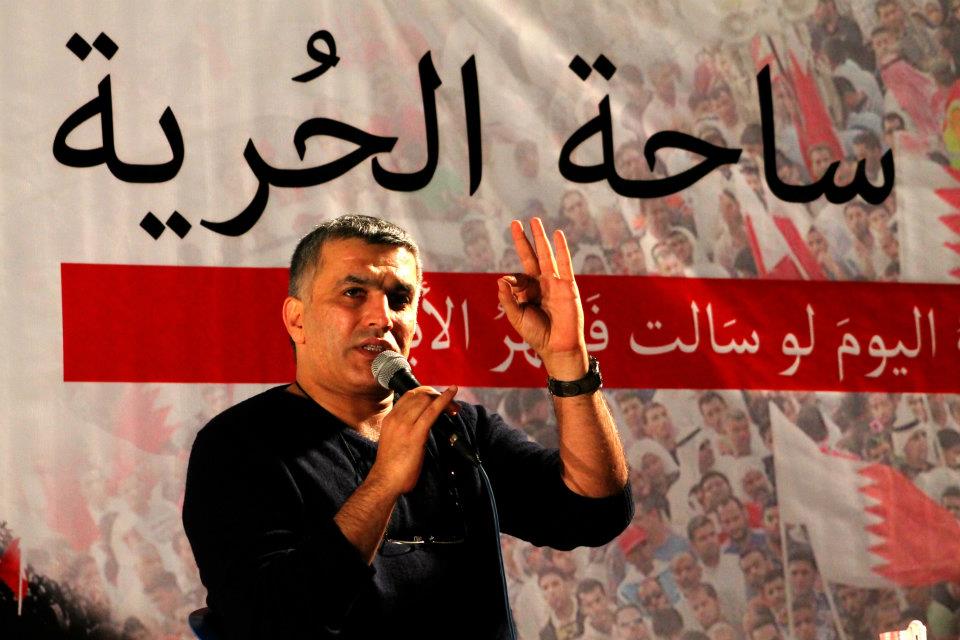
On 17 August 2014 Nabeel Rajab, who heads the Bahrain Center for Human Rights (the MEA Final Nominee of 2012), posted a strong piece in the Huffington Post which contains an impressive stand on why he takes the risks he does as well as a scathing attack on the western governments, especially those of the UK, for putting (arms) business before human rights consideration.
My reference last week to an interview with the new Special Rapporteur on Human Rights Defenders [https://thoolen.wordpress.com/2014/08/05/michel-forst-new-special-rapporteur-on-human-rights-defenders-gives-indication-of-his-priorities/] seemed well appreciated judging from the number of views. Therefore I now refer you to a piece by the Director of the ISHR, Phil Lynch, of 16 July, who addresses the incoming UN High Commissioner for Human Rights, Zeid Ra’ad Zeid al-Hussein as the “human rights defender-in-chief“, saying that he has a particular responsibility to protect human rights defenders, especially so when they face intimidation and reprisals for their efforts to seek accountability at the UN for human rights violations. Read the rest of this entry »
After a long holiday break there is probably no better way to start again covering developments relevant to human rights defenders than by referring to the views of the new Special Rapporteur on Human Rights Defenders, Michel Forst, who shared his vision with the International Service on Human Rights on 16 July 2014. Michel Forst – appointed in June 2014 – is an experienced human rights lawyer. He was Secretary-General of France’s national human rights commission, and was a Board member of several international human rights NGOs. In an interview with ISHR, he sets out his vision and priorities in the post of Special Rapporteur on HRDs. Read the rest of this entry »


 Hans Thoolen on Human Rights Defenders and their awards