The problem of reprisals against human rights defenders has been the subject of quite a few posts in this blog [see my earlier posts: https://thoolen.wordpress.com/tag/reprisals/]. On 3 October 2016 the SG of the United Nations, Ban Ki-moon, finally unveiled details about the long-awaited focal point against reprisals. This is a much-needed element to help combat the growing problem of governments preventing human rights defenders from engaging with the UN or punishing and even imprisoning them when they do so.
Assistant Secretary General, Andrew Gilmour, will be given a special mandate to receive, consider and respond to allegations of intimidation and reprisals against human rights defenders and other civil society actors engaging with the UN. In announcing the appointment Mr Ban said ‘These courageous individuals are often our only eyes and ears in extremely tough environments – and we owe them our best possible support’. ‘I have decided, in consultation with the High Commissioner for Human Rights, to designate my new Assistant Secretary-General for Human Rights, Mr. Andrew Gilmour, to lead our efforts within the UN system to put a stop to all intimidation and reprisals against those cooperating with the United Nations on human rights,’.
A recent report by the SG shows that reprisals take many forms, including travel bans, the issuance of arrest warrants on terrorism charges, detention and torture, surveillance, death threats, attempts to frame activists for criminal acts, defamation, and intimidation. In several cases defenders are tarnished as ‘terrorists’ or ‘traitors’, contributing to perceptions that engagement with the UN is an act of betrayal. In some cases reprisals have led to individuals fleeing their country, in others, to death.
This is an extremely welcome development. The ability of people or organisations to provide evidence or submit information or complaints to the UN is not a privilege – it is a fundamental right enshrined in the UN Declaration on Human Rights Defenders and it must be protected,’ said Ms Sinclair, ISHR’s legal counsel.
please pass this on to those who you think are deserving candidates:
Call For Nominations – 2017
MARTIN ENNALS AWARD
FOR HUMAN RIGHTS DEFENDERS
Deadline: 9 November 2016
Nominations can be submitted electronically at www.martinennalsaward.org (for the PDF version see below)
The Award is granted annually to an individual, or exceptionally an organisation, in recognition of their commitment and ongoing efforts in the defence and promotion of human rights.
The MEA aims to encourage individuals or organisations, particularly those who are working in conditions hostile to fundamental human rights and who are at risk and in need of protection. Special account is taken of those who combat human rights violations by courageous and innovative means.
Nominations are welcome from all regions, genders, and human rights related themes.
Three Finalists are selected and announced early in the year and the Laureate is selected from among them. All three are invited to participate in the ceremony in Geneva.
The following 10 international human rights NGOs form the Jury:
OMCT
ISHR
International Commission of Jurists
HURIDOCS
Human Rights Watch
Human Rights First
Front Line Defenders
FIDH
EWDE Germany
Amnesty International
The present value of the annual Award is a minimum of 20’000 Swiss Francs, to be used for further work in the field of human rights. The ceremony is hosted by the City of Geneva which provides each of the final three Finalists with project funds of 11’650 CHF and a 5’000 CHF travel grant.
The Award is named after Martin Ennals (1927-1991), an activist who was instrumental to the modern human rights movement and a driving force behind several organisations. His deep desire was to see more cooperation among NGOs.
Reporters Without Borders (RSF), Amnesty International, OMCT and FIDH and many others condemned a decision by an Iranian appeals court to uphold a 16-year jail sentence against journalist and human rights activist Narges Mohammadi. Under a law passed last year, she will ‘only’ serve the sentence linked to the most important charge – in this case 10 years for “forming and managing an illegal group” which pressed for an end to capital punishment. Mohammadi, 44, was the spokesperson of the Centre for Human Rights Defenders and campaigned for an end to the death penalty in Iran. 2003 Nobel peace laureate Shirin Ebadi who founded the Centre for Human Rights Defenders, said: “I condemn this sentence imposed by the Iranian judicial system as Narges’s only crime is to be a human rights defender in a country that flouts these rights“.
The Diplomat wrote under the title “OSCE Manages to Irritate Tajikistan, Kyrgyzstan and Human Rights Advocates, Too” a good piece summarizing the situation at the latest annual human rights conference (officially the Human Dimension Implementation Meeting), taking place from 19-30 September 2016, in Warsaw.
Most attention should go to the recurring reprisals against HRDs and in particular (when they are out of reach through exile) against their family: Read the rest of this entry »
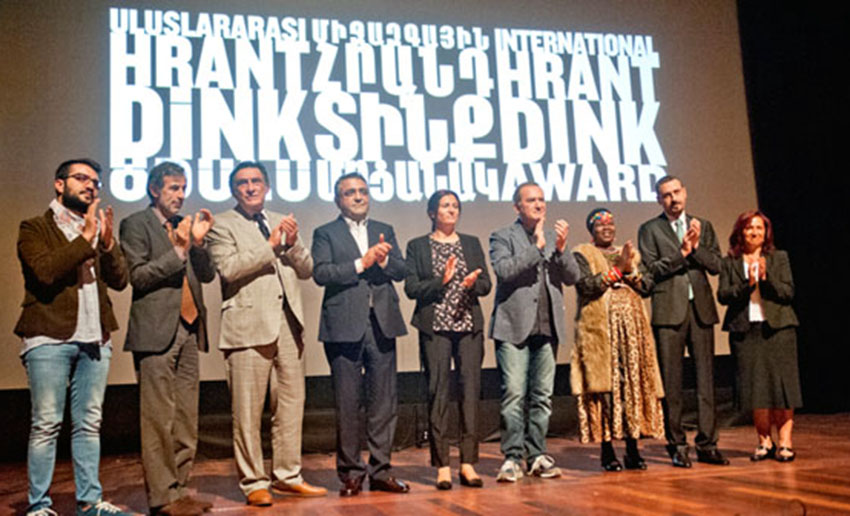
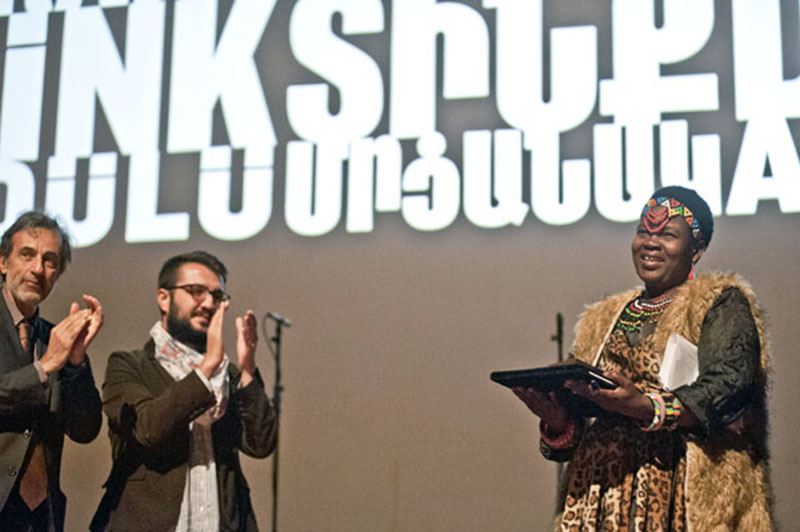
On 22 September 2016 a ceremony took place for the 8th annual ceremony of the Hrant Dink Award Granted. The laureates of the International Hrant Dink Award are the Diyarbakir Bar Association and Malawian human rights defender Theresa Kachindamoto, who works for children’s right.
Ahmet Insel, Head of the Selection Committee, made the opening speech: “It’s been almost 10 years since Hrant Dink was murdered. Nowadays, we are going through much darker times compared to 2007. The abominable coup attempt was foiled, but the state of law is completely suspended. Tens of thousands innocent people are detained without any legal procedure. Hundreds of journalists, academics, lawyers, teachers, artist and human rights defenders, meaning the usual suspects of the authoritarian regime are arrested, suspended and denied right to travel. We witnessed the arrest of Sebnem Korur Fincanci and Ahmet Altan, whose struggles were granted with Hrant Dink Award. Granted with Hrant Dink Award in 2013, Saturday Mothers (Cumartesi Anneleri) have been staging the longest civil obedience action in Turkish history; its their 600th week of protest. In times like these, the significance of the award increases. We greet the ones who struggle for creating a just and free world without violence.”
Diyarbakir Bar Association Chair Tahir Elçi was murdered on 28 November 2015 in Diyarbakir, while he was making a press statement. Deputy Chair Ahmet Özmen received the award on behalf of the association. Ahmet Özmen said inter alia: “I gratefully commemorate our dear chair Tahir Elçi, who devoted his life to the struggle for peace and freedom and sacrificed his life for this struggle….Tahir Elçi and Hrant Dink are two heroes, two human rights defenders who made history. People will remember them as intellectuals who made efforts for establishing a democratic order for the peoples of Turkey. Their only measure was rightfulness and justice. The ones who ordered their murder thought that their strong legacy will vanish and we won’t be able to follow their lead, but they are wrong.”…“Today, our most important duty and historical responsibility is to preserve and improve the legacies of Tahir Elçi and Hrant Dink. Demanding peace and speaking up for building peace is the only way.” During the ceremony, a video titled “Inspirations” was shown. People and institutions from Turkey and all around the world, who gave people hope about the future with their actions, were featured in the video. There were also people who objected to the coup and defended democracy on July 15.
Theresa Kachindamoto is the paramount chief, or Inkosi, of the Dedza District in the central region of Malawi, one of the poorest counties of Africa. For years, she has been working for preventing child marriages and defending their right to education. Becoming the chief of a tribe with 900,000 people, Kachindamoto started to struggle against child marriages, when she saw that half of the girls in the tribe are forced to marry at the ages of 12 or 13. She banned “marriage camps”, where children are abused under the name of sexual education. She managed to convince 50 tribe chiefs to abandon the traditions encouraging child marriage and to annul 850 marriages. Receiving the award from Yildiz Tar on behalf of last year’s laureate KAOS GL and Michèle Marian, Kachindamoto told the story of her struggle: “It wasn’t easy to fight against this problem. For majority of people, this practice was one of the most fundamental traditions of Malawi and encouraged by the society. We had to inform all people about the dangers and consequences of child marriage and abolish the accepted opinion which deems this practice as normal. There is no doubt that I need to push against more of the old ways of thinking to achieve my ultimate goal of removing child marriage from Malawi, and giving all girls and boys the opportunity to complete their education. I am proud of what we have achieved so far, but I am aware that there is still a long way ahead of us. I am grateful to every one who walked this way with me. I hope more people will join us and fight for the rights of Malawian girls. God bless you all.”
Human right defender, Iftikhar Mubarik, discusses his work addressing child exploitation in Pakistan and how he seeks to utilise the UN Human Rights system.
Michel Forst (right), the UN special rapporteur on the situation of human rights defenders (right), addressing reporters in Baku on 22 September 2016.
Michel Forst, the UN’s special rapporteur on the situation of human rights defenders, said on 22 September 2016 that Azerbaijani authorities have applied crippling pressure to journalists and rights activists critical of the government, and made it virtually impossible for nongovernmental organizations to operate. “Civil society has been paralyzed as a result of such intense pressure,” Forst saidas he wrapped up a nine-day visit to the South Caucasus nation to assess the situation. Observing that most of the recommendations by the international and regional human rights mechanisms have yet to be implemented by the Government of Azerbaijan, Mr Forst strongly called for establishing a mechanism that would result in a plan of action to implement those outstanding recommendations. He urged the Government to “to build bridges with civil society organizations, and to establish a regular and meaningful dialogue with human rights defenders, ensuring broad and inclusive participation. I believe such dialogue and partnership is ultimately in the interest of the Azerbaijani State”. [for the full end of mission statement see: http://www.ohchr.org/EN/NewsEvents/Pages/DisplayNews.aspx?NewsID=20544&LangID=E
“Human rights defenders have been accused by public officials to be a fifth column of the Western governments, or foreign agents, which has led to misperception in the population of the truly valuable role played by civil society,” Forst added.
He was served immediately by Azerbaijani MP and editor-in-chief of the New Azerbaijan newspaper, Hikmat Babaoghlu, who told APA that “the Western imperialism has launched an attack on Azerbaijan with its entire network, which includes radical opposition groups, numerous local and international “civil society instructions” and “human rights defenders”. All these are taking place before the eyes of the Azerbaijani people, who are well aware of what is happening. Therefore, the destructive plan of imperialist centers will never succeed in Azerbaijan” The main goal of the upcoming referendum is to better ensure the national security and the transition of development to a qualitatively new stage, he added. (Even more scathing is a piece written by Elmira Tariverdiyeva, the head of Trend Agency’s Russian news service – see link below.)
Forst’s report indeed comes just days ahead of a referendum (26 September) on changes to Azerbaijan’s constitution that critics say will tighten Aliyev’s grip on power, which he has held since 2003. The proposed amendments to the Constitution would further strengthen the already powerful president, including a longer presidential term, the authority to declare early presidential elections at will and dissolve parliament. The amendments will also lead to violations of the right to freedom of association. While in practice, public assemblies have already been prohibited in central Baku, the proposed amendments will grant the government even more power to interfere with the freedom of assembly in violation of international standards. The Council of Europe experts said on September 20 that the proposed changes would severely upset the balance of power and give “unprecedented” control to the president. (The head of the legal department in Aliyev’s administration called that assessment “hasty” and “politically driven.”)
The detention of a Kashmiri human rights defender on Wednesday, the day after a court had ordered his release from a previous arrest, has prompted concerns that Indian authorities have stepped up their use of laws that allow detention without trial. Khurram Parvez was due to be released after being arrested a week earlier but has instead been moved to prison after the Jammu and Kashmir state government approved a Public Safety Act (PSA) order, which allows administrative detention without trial for up to six months.




 Hans Thoolen on Human Rights Defenders and their awards