Archive for the 'human rights' Category

“RightDocs” the information gateway for official documentation of HRC35

June 7, 2017


HURIDOCS developed RightDocs to improve the accessibility and effectiveness of these resources for human rights advocates and others around the world, as well as to support the transparency and accountability of the Human Rights Council. With the 35th Regular Session of the UN Human Rights Council, it has updated the information on RightDocs with the most recent final Council resolutions and reports – now including all past sessions other than HRC34. [see also: https://humanrightsdefenders.blog/2016/03/07/human-rights-resolutions-count-at-rightdocs/]

RightDocs is the complete, searchable, and filterable collection of official Human Rights Council resolutions, amendments, presidential statements, decisions and reports. This platform allows users to:

  • Search full-text resolutions, amendments and reports
  • Filter by topic, agenda item, session, (co)sponsor States, voting results and dates
  • Discover voting patterns on topics over time, and compare those patterns
  • Identify prospective co-sponsors or supporters to approach

To access the RightDocs site, go to: www.right-docs.org 

Developed by HURIDOCS and Ketse with generous support from Permanent Mission of Denmark to the UN in Geneva.

Source: [RightDocs] Your information gateway for HRC35

Gil Loescher, life long defender of rights of refugees, honored

June 7, 2017

Lawrence University will recognize Gil Loescher, a visiting professor at the Refugee Studies Centre at the University of Oxford, with an honorary Doctor of Humane Letters degree during commencement ceremonies coming Sunday. Loesher’s also received an honorary doctorate of law in 2006 from the University of Notre Dame.

In a career spanning more than 40 years, Loescher has established himself as an authority on refugee policy. Prior to joining Oxford’s Refugee Studies Centre in 2008, Loescher held appointments as Senior Fellow for Forced Migration and International Security at the International Institute for Strategic Studies in London and as senior researcher at the European Council on Refugees and Exiles. According to Loescher, containing refugees in camps prevents them from contributing to regional development and state-building. In August 2003, Loescher was in the office of Sérgio Vieira de Mello, then the UN High Commissioner for Human Rights, at the Canal Hotel in Baghdad when a suicide bomber detonated a truck bomb outside the building. The blast killed more than 20 people and injured more than 100. Loescher was among nine people in the office at the time of the explosion, seven of whom were killed instantly. Loescher and Vieria de Mello were trapped in the debris of the collapsed building as American soldiers spent more than three hours trying to rescue them. Vieria de Mello died before he could be extricated. Loescher survived, although his legs were crushed and had to be amputated by the soldiers.  A moving film, “Pulled from the Rubble,” was directed by Loescher’s daughter, Margaret, about this episode. [Beguiled Eye Productions [gb]]

He has been recognized with numerous honors and research grants from organizations ranging from the Ford Foundation and the MacArthur Foundation to the Fulbright Program and the British Academy.

Source: Lawrence University honors refugee expert at 168th commencement

https://al.nd.edu/news/latest-news/daughters-film-on-bomb-survivor-nd-professor-gil-loescher-to-be-shown/

Side event on civil society and the promotion of economic, social and cultural rights – 9 June 2017

June 2, 2017

Among the many side events expected to be organized in the margin of the next session of the UN Human Rights Council will be “The role of civil society participation in the promotion of economic, social and cultural rights and poverty alleviation“, on Friday 9 June 2017, from 13.00-14.30 PM in Room IX, Palais des Nations, Geneva.
Respect for economic, social and cultural (ESC) rights is a fundamental element of effective and sustainable poverty alleviation; it is also intimately linked with respect for civil and political rights, progress in sustainable development and the construction of peaceful, cohesive and stable communities. The goal of this panel is to discuss among different stakeholders the crucial principle of participation by NGOs, human rights defenders, and other civil society actors in rights-based approaches to poverty alleviation at the national level. In particular, UN experts on economic, social and cultural rights will reflect on how the experiences and resources of civil society assist them in their work to promote and protect ESC rights, including the development and monitoring of recommendations arising from both reports and country visits. [see also: https://humanrightsdefenders.blog/2016/03/25/human-rights-council-adoption-landmark-resolution-protection-defenders-economic-social-cultural-rights/]
Opening remarks by Marta Maurás Perez, Ambassador of Chile to the UN in Geneva
Panelists:
  • Prof Philip Alston, UN Special Rapporteur on extreme poverty and human rights
  • Prof Sandra Liebenberg, Member of UN Committee on Economic, Social and Cultural Rights
  • Stefan Luca, lawyer and Roma rights advocate
  • Sophie Richardson, Human Rights Watch
Moderator: Lucy McKernan, Global Initiative for Economic, Social and Cultural Rights
The side event is co-sponsored by Global Initiative for Economic, Social and Cultural Rights, OHCHR and the International Service for Human Rights. You can follow the event on Twitter: @ISHRglobal #HRDs

Source: The role of civil society participation in the promotion of economic, social and cultural rights and poverty alleviation | ISHR

Qatar extradited human rights defender Otaibi to Saudi Arabia ignoring Norway’s grant of asylum

June 1, 2017
IMG_1127
On 31 May 2017 ALQST reported that Qatar has extradited the prominent Saudi human rights defender Mohammed bin Abdullah al-Otaibi to Saudi Arabia, even after Norway accepted his application for political asylum.  Otaibi was arrested at Doha International Airport on Wednesday 24 May, 2017 as he was about to travel with his wife to Norway, on travel documents provided by the Norwegians.  Days later, on Sunday, 28 May 28 3 a.m., Otaibi was deported overland to Saudi Arabia via the Salwa border crossing and delivered to the Saudi authorities, who sent him with an escort of Saudi security vehicles to the Dammam Prisons Department.
For more details see the piece referred to below:

Read the rest of this entry »

Human Rights Defenders issues on the agenda of the next 35th Human Rights Council

June 1, 2017

The International Service for Human Rights (ISHR) in Geneva has published again its timely alert to the next Session of the UN Human Rights Council, from 6 to 23 June 2017. 

It is a rich document [https://www.ishr.ch/news/human-rights-council-key-issues-agenda-35th-session-june] and I list here only the items most directly related to Human Rights Defenders:

Thematic areas of interest:

Sexual orientation and gender identity

The first annual report of the Independent Expert on protection against violence and discrimination based on sexual orientation and gender identity will be presented between 9:00 and 12:00am on Tuesday 6 June. Argentina, Brazil, Chile, Colombia, Costa Rica, Mexico and Uruguay will organise an event on Advancing human rights protection and ending violence and discrimination based on sexual orientation and gender identity on 9 June from 11:30-13:00 in Room IX.

Reprisals

In a recent letter to the President of the Human Rights Council, ISHR called for urgent attention to be given to cases of reprisals which have not been followed up by the Human Rights Council. One of the most serious instances of reprisal is against Chinese human rights defender Cao Shunli, who died in detention on 14 March 2014 after being detained for her engagement in UN human rights mechanisms. Despite her case being communicated with the Bureau during the three years following her death, there has been no independent investigation or adequate response. ISHR looks forward to consolidating the advances made by the recent appointment of Assistant Secretary General Andrew Gilmour to receive, consider and respond to allegations of reprisals. Acts of intimidation and reprisal against human rights defenders seeking to cooperate with the UN constitute violations of international human rights law and undermine the human rights system. The Human Rights Council should respond with appropriate gravity to reprisals and follow-up past cases during its 35th session. [for my many posts on reprisals see: https://humanrightsdefenders.blog/tag/reprisals/]

Business and human rights

The mandate of the Working Group on human rights and transnational corporations and other business enterprises will be up for renewal during the session. The report of the Working Group will be considered by the Council, in addition to reports of country missions to Mexico and the Republic of Korea.

The Working Group will also present a study on best practices and how to improve the effectiveness of cross-border cooperation between States with respect to law enforcement on the issue of business and human rights, and a report on public procurement (not yet available at time of writing). Over the past three years, the Working Group has increasingly recognised the role of human rights defenders in ensuring business respect for human rights, and the specific challenges faced by defenders working on business and human rights issues, as exemplified by a dedicated workshop on this topic during its last session in May 2017. Since the last renewal of the mandate in 2014, the Working Group has also made increasing use of its ability to confront States and companies with allegations of human rights violations. From just 16 such communications in 2014 the Working Group has increased to 21 in 2015 and 42 in 2016. Both of these trends should be recognised and encouraged by the resolution renewing the mandate of the Working Group.

Women human rights defenders and women’s rights

The annual full day discussion on the human rights of women will take place on Tuesday 13 June from 9:00 to 12:00 and from 15:00 to 18:00. It will focus on engaging men and boys in responding to and preventing violence against women and girls. Engaging with men and boys to combat violence and discrimination against women and girls is essential to efforts to prevent and eliminate all forms of discrimination and violence against them. This should include challenging the harmful gender stereotypes and negative social norms, attitudes and behaviours that underlie and perpetuate such violence.  Equally, it is important that the Council’s discussions and resolutions in this area  recognise the critical role of women human rights defenders (WHRDs) and organisations led by women and girls as rights holders and agents of change. They should be involved and consulted in the planning, design, implementation and monitoring of legislation, policies and programmes, including programs aimed at engaging men and boys.

ISHR will support joint advocacy on the resolutions on violence against women and discrimination against women, and on the ‘protection of the family’. The latter resolution will focus on ‘the rights of older persons in the context of family.’ States must ensure that this resolution upholds universal principles of human rights based on equality and non-discrimination. Many household structures and family forms exist across the world, facing particular situations and challenges that require tailored policy responses…

Cooperation of States with Special Procedures

There remains a consistent lack of State cooperation with Special Procedures, as demonstrated by the number of communications sent by the experts that have not received a State response, recorded in the Joint Communications Report published at every session of the Human Rights Council. ISHR welcomes recent developments in making communications more accessible, including the searchable database of communications, but continues to express concern that access to information regarding specific cases and State replies is still hard to find for victims and authors. [see my post from many years ago: https://www.linkedin.com/pulse/20140603192912-22083774–crime-should-not-pay-in-the-area-of-international-human-rights]

Country specific developments

China: The Special Rapporteur on extreme poverty and human rights, Prof Philip Alston, will present the report from his country visit to China. Prof Alston was tailed by State security and was prevented from meeting with civil society during his visit. As a result, the country report stresses the necessity of civil society in holding the Chinese Government accountable to human rights standards. The country visit was further undermined by reprisals. Following a meeting with Prof Alston, disbarred human rights lawyer Jiang Tianyong disappeared. His family was informed of his detention nearly one month later. Despite UN experts calling for an investigation into his disappearance, Jiang remains in ‘residential surveillance in a designated location’. Prof Alston’s report will be a key opportunity to discuss the ongoing crackdown on human rights defenders and concerns the Office of the High Commissioner for Human Rights for civil society in China.  [see also: https://humanrightsdefenders.blog/tag/jiang-tianyong/]

Burundi The commission of inquiry on Burundi will present an oral update on 14 and 15 June. ISHR remains concerned by consistent and deliberate lack of cooperation with human rights mechanisms in Burundi. The country continues to refuse to cooperate with UN Human Rights Council’s Independent Experts and despite the international community’s efforts to mitigate a human rights crisis, the situation continues to deteriorate. ISHR calls on the Burundian authorities to cease attacks against journalists and defenders and to cooperate with the UN commission of inquiry and implement the recommendations from both UN and African Commission reports.  [see inter alia: https://humanrightsdefenders.blog/2016/02/08/what-is-burundi-doing-in-the-un-human-rights-council/]

Other country situations where human rights defenders will surely come up: 

  • The interactive dialogue on the Democratic Republic of Congo (DRC), from 12:00 to 15:00 on Tuesday 20 June.
  • The interactive dialogue with the Independent Expert on Côte d’Ivoire will take place from 9:00 to 12:00 on Tuesday 20 June.
  • ISHR has joined a coalition of civil society organisations in urging State delegations to the Human Rights Council to express concern about the ongoing human rights crisis in Ethiopia.

Council programme, appointments and resolutions

Organisational meeting. The President of the Human Rights Council once again urged States to combat reprisals during the session. ‘As part of a constructive working atmosphere, it is in our common interest to have a climate of trust and security, whereby States ensure the appropriate protection against any acts of intimidation or reprisals against individuals and groups that cooperate or have cooperated with the United Nations, their representative and human rights mechanisms,’ he stated.

Appointment of mandate holders The President of the Human Rights Council has proposed candidates for the following four vacancies of mandate holders to be filled at this session:

  1. Independent Expert on human rights and international solidarity [HRC resolution 26/6]
  2. Special Rapporteur on minority issues [HRC resolutions 25/5 and 34/6]
  3. Special Rapporteur on the human rights of migrants [HRC resolution 26/19]
  4. Special Rapporteur on the promotion and protection of human rights and fundamental freedoms while countering terrorism [HRC resolution 31/3]

Panel discussions

During each Council session, panel discussions are held to provide member States and NGOs opportunities to hear from subject-matter experts and raise questions. Among the 4 panel discussions scheduled for this session:

Resolutions to be presented to the Council’s 35th session

At the organisational meeting on 22 May 2017 the following resolutions were announced (States sponsoring the resolution in brackets):

  • Resolution for the extension of the mandate on the Working Group on business and human rights (Norway and core group of Russia, Argentina and Ghana)
  • Resolution on accelerating efforts to eliminate all forms of violence against women (Canada)
  • Resolution on discrimination against women (Colombia, Mexico)
  • Resolution on the protection of the human rights of migrants (Mexico)
  • Resolution on the protection of human rights and fundamental freedoms while countering terrorism (Mexico)
  • Resolution on the human rights situation in the Syrian Arab Republic (France, Germany, Italy, Jordan, Kuwait, Morocco, Qatar, Saudi Arabia, Turkey, UK and USA )
  • Resolution on the independence and impartiality of the judiciary, jurors and assessors, and the independence of lawyers (Australia, Botswana, the Maldives, Mexico, Thailand, Hungary)
  • Resolution for renewal of the mandate of the Special Rapporteur on Independence and impartiality of the judiciary, jurors and assessors, and the independence of lawyers (Hungary)
  • Resolution for the renewal of the mandate of the Special Rapporteur on extrajudicial, summary or arbitrary executions (Sweden)
  • Resolution for the renewal of the mandate of the Special Rapporteur on the human rights situation in Belarus(EU)
  • Resolution for the renewal of the mandate of the Special Rapporteur on extreme poverty and human rights (France, Albania, Chile, Morocco, Senegal, Romania, Philippines, Peru)

For the the guide to the 34th session see: https://humanrightsdefenders.blog/2017/02/24/34th-human-rights-council-ishr-guide-to-key-issues-for-human-rights-defenders/


Assange’s persecution or prosecution? Marjory Cohen knows the answer

May 31, 2017
Marjorie Cohn – professor emerita at Thomas Jefferson School of Law, former president of the National Lawyers Guild, and deputy secretary general of the International Association of Democratic Lawyers – wrote a perhaps controversial but clear piece about the case of Assange under the title:  The Meaning of Assange’s Persecution. In Consortiumnews of 29 May 2017 you will find the full piece.  She concludes that the long legal ordeal of Julian Assange – and the continuing threats against the WikiLeaks founder – make a mockery of the West’s supposed commitment to press freedom and the public’s right to know. Here some excerpts:

WikiLeaks founder Julian Assange. (Photo credit: Espen Moe)

….Although the Swedish investigation has now been dropped, the threat of arrest persists. The London police have indicated they will arrest Assange for failure to appear in a London Magistrates Court if he leaves the embassy. Britain would then likely extradite Assange to the United States for possible prosecution.

Attorney General Jeff Sessions declared in April that arresting Assange is a “priority” for the Department of Justice, even though the New York Times indicated that federal prosecutors are “skeptical that they could pursue the most serious charges, of espionage.” The Justice Department is reportedly considering charging Assange with theft of government documents. A decision to prosecute Assange would mark a 180-degree change of direction for President Trump. During the 2016 presidential campaign Trump declared, “I love WikiLeaks” after it published confidential emails from the Democratic National Committee that some U.S. intelligence agencies claim were obtained by Russian hackers (although Assange denies getting the material from Russia).

In March, WikiLeaks published CIA documents containing software and methods to hack into electronics. This was the beginning of WikiLeaks’ “Vault 7” series, which, Assange wrote in an op-ed in The Washington Post, contained “evidence of remarkable CIA incompetence and other shortcomings.” The publication included “the agency’s creation, at a cost of billions of taxpayer dollars, of an entire arsenal of cyber viruses and hacking programs – over which it promptly lost control and then tried to cover up the loss,” Assange added. “These publications also revealed the CIA’s efforts to infect the public’s ubiquitous consumer products and automobiles with computer viruses.”

CIA Director Michael Pompeo called WikiLeaks “a non-state hostile intelligence service often abetted by state actors like Russia.” Pompeo said, “We have to recognize that we can no longer allow Assange and his colleagues the latitude to use free speech values against us.” Pompeo declared, “Julian Assange has no First Amendment privileges. He is not a U.S. citizen.” But, the Supreme Court has long held that the Constitution applies to non-Americans, not just U.S. citizens. And, when the Obama Justice Department considered prosecuting WikiLeaks, U.S. officials were unable to distinguish what Wikileaks did from what the Times and Guardian did since they also published documents that Manning leaked. WikiLeaks is not suspected of hacking or stealing them.

…….

As Elizabeth Goitein, co-director of the Brennan Center for Justice’s Liberty and National Security Program, wrote at Just Security, Comey was drawing the line “not between leaking classified information and publishing it, but between publishing it for ‘good’ reasons and publishing it for ‘bad’ ones.” And, “[a]llowing the FBI to determine who is allowed to publish leaked information based on the bureau’s assessment of their patriotism would cross a constitutional Rubicon,” Goitein wrote.

Other advocates for civil liberties also defended WikiLeaks as a news organization protected by the First Amendment. “The U.S. government has never shown that Assange did anything but publish leaked information,” Kenneth Roth, executive director of Human Rights Watch, told the Times. Ben Wizner, director of the ACLU’s Speech, Privacy and Technology Project, stated in an interview with the Times, “Never in the history of this country has a publisher been prosecuted for presenting truthful information to the public.”

Assange’s Detention Called Unlawful [see also: https://humanrightsdefenders.blog/2016/02/07/on-assange-there-is-more-to-the-decision-than-knee-jerk-reactions/]

In 2016, following a 16-month investigation, the United Nations Working Group on Arbitrary Detention concluded that Assange’s detention by Britain and Sweden was unlawful. It stated, “[A] deprivation of liberty exists where someone is forced to choose between either confinement, or forfeiting a fundamental right – such as asylum – and thereby facing a well-founded risk of persecution.”….Thus, the U.N. group concluded that Assange’s continued stay in the embassy “has become a state of an arbitrary deprivation of liberty,” in violation of the Universal Declaration of Human Rights, and the International Covenant on Civil and Political Rights

….Even some mainstream news organizations that have been critical of WikiLeaks for releasing classified U.S. information have objected to the idea of criminal prosecution. A Washington Post editorial in 2010 entitled “Don’t Charge Wikileaks” said: “Such prosecutions are a bad idea. The government has no business indicting someone who is not a spy and who is not legally bound to keep its secrets. Doing so would criminalize the exchange of information and put at risk responsible media organizations that vet and verify material and take seriously the protection of sources and methods when lives or national security are endangered.”

In the U.S. government’s continued legal pursuit of WikiLeaks, there is much more at stake than what happens to Julian Assange. There are principles of press freedoms and the public’s right to know. By publishing documents revealing evidence of U.S. war crimes, emails relevant to the U.S. presidential election and proof of CIA malfeasance, Assange did what journalists are supposed to do – inform the people about newsworthy topics and reveal abuses that powerful forces want concealed. Assange also has the right to freedom of expression under both U.S. and international law, which would further argue for Great Britain dropping the failure-to-appear warrant and allowing Assange to freely leave the embassy and to finally resume his life.

Marjorie Cohn is professor emerita at Thomas Jefferson School of Law, former president of the National Lawyers Guild, and deputy secretary general of the International Association of Democratic Lawyers. Her most recent book is Drones and Targeted Killing: Legal, Moral, and Geopolitical Issues. Visit her website at http://marjoriecohn.com/ and follow her on Twitter https://twitter.com/marjoriecohn.

Source: The Meaning of Assange’s Persecution – Consortiumnews

Five human rights defenders look towards the EU-China Summit

May 31, 2017

Lotte Leicht , director of Human Rights Watch’s Brussels office, wrote about “Five Names to Listen for at the EU-China Summit”. She writes that “under President Xi Jinping, whose senior officials arrive in Brussels this week for the European Union-China Summit, courageous human rights defenders, lawyers and academics in China have sustained an extraordinary body blow.”

Source: Five Names to Listen for at the EU-China Summit | Human Rights Watch

Jailed human rights lawyer in UAE awarded the 2017 Ludovic Trarieux Award

May 28, 2017

The Emirates lawyer was sentenced to 10 years in jail in 2013. Mohammed al-Roken was among 69 people jailed on charges of conspiring to overthrow the government following a mass trial criticised by rights groups. A former head of the UAE Jurists’ Association, Roken, 54, was arrested in July 2012, after taking on the defence of several government opponents, including seven islamists. According to Amnesty the trial “was marred by allegations of torture which were blatantly ignored, the rights of defence were flaunted, and independent observers were banned from the court room“.  For more on the Emirates and human rights: https://humanrightsdefenders.blog/tag/united-arab-emirates/

In awarding  the Jury said Roken had devoted two decades to defending fundamental freedoms. The jury lamented that Roken’s trial had gone ahead behind closed doors and demanded his immediate release.

Source: Jailed UAE lawyer awarded major human rights prize | Daily Mail Online

http://www.ludovictrarieux.org/uk-index.htm

Video report of the 2017 Oslo Freedom Forum now available

May 27, 2017

Watch this video (made by the Universidad Francisco Marroquín film crew) if you missed the 2017 Oslo Freedom Forum from 22-24 May. Over the course of five days, ‘Spikersuppa square’ was filled with art, film, and presentations; explored innovations and ideas at the Tech Lab and Interactive Expo; heard from keynote speaker Norwegian Prime Minister Erna Solberg; learned about human rights defenders and honored this year’s Havel Prize laureates. Next year’s forum (10-year anniversary) will take place on 28-30 May, 2018.  For reservations: alex@oslofreedomforum.com.

Lawyer wins Front Line’s 2017 human rights award for helping Crimean Tartars

May 26, 2017

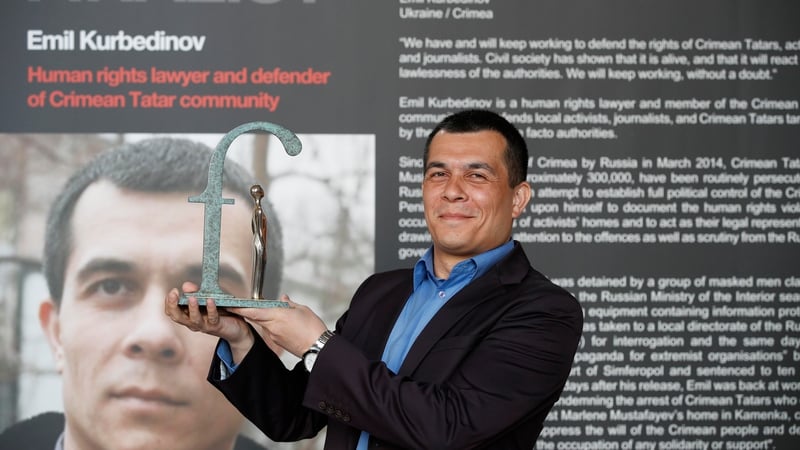
On 31 March this year  I announced the 5 nominees for Front Line’s human rights award [https://humanrightsdefenders.blog/2017/03/31/finalists-for-the-2017-front-line-defenders-award-come-from-ukraine-nicaragua-vietnam-south-africa-and-kuwait/] and today the organization announced that the winner is Emil Kurbedinov, a lawyer who is helping ethnic Tartars in Crimea.

Emil Kurbedinov said 'Winning an acquittal for my clients is almost impossible - but what I can do is show them that, despite the risks, I will not abandon them'

Emil Kurbedinov was at the ceremony in Dublin’s City Hall this morning to receive the Human Rights Defender At Risk award for 2017. According to Front Line Defenders, which has its global headquarters in Blackrock in Dublin, defending human rights activists and political prisoners in Crimea is some of the most dangerous work that any lawyer can undertake. Despite those risks, Mr Kurbedinov has spent years providing emergency legal response for the Crimean Tartar minority, which it maintains has been persecuted by Russian authorities.

In January of this year, Mr Kurbedinov was detained by representatives of Crimea’s Centre for Counteracting Extremism while on his way to represent a client whose house had been raided by police. A district court later sentenced him to ten days in detention on a charge of “propagandising for extremist organisations“.

The Executive Director, Andrew Anderson, said: “In the midst of a global crackdown on human rights defenders, the five finalists demonstrate the will to persist in the face of severe, often life-threatening risks.

Source: Lawyer wins human rights award for helping Tartars