Jacob Wolinsky blogged in Value Walk of 9 September 2019 about “Gaspar MatalaevFree After Three Years Of Unjust Imprisonment”. Gaspar Matalaev, a labor rights monitor from Turkmenistan,was released from prison on 6 September after three years’ imprisonment in retaliation for his reporting on forced labor. A court in Turkmenabat sentenced Matalaev on spurious charges of fraud in 2016 and Matalaev served the entire three-year sentence. “We are relieved that Gaspar is out of prison and home with his family where he belongs,” said Ruslan Myatiev, director of turkmen.news, a member of the Cotton Campaign. “But make no mistake, every day that Gaspar spent in prison was a travesty of justice to punish him for his human rights work and intimidate others from speaking out about abuses.”
Gaspar Matalaev, a reporter with turkmen.news who had monitored and reported on the systematic use of forced adult and child labor in Turkmenistan during cotton harvesting, was arrested in October 2016, just two days after turkmen.news published his extensive report on Turkmenistan’s labor practices. While in detention, Matalaev was tortured by electric shock and held incommunicado. Throughout the investigation and trial, he did not have access to effective legal representation or to key files, information, and documents. The United Nations Working Group on Arbitrary Detentions determined that Matalaev’s arrest and imprisonment was arbitrary.
“Matalaev and others take great personal risks when they document these abuses,” said Judy Gearhart, executive director at the International Labor Rights Forum, which hosts the Cotton Campaign. “Turkmenistan’s international partners, including in the U.S., EU, and the international development banks, should use their influence with the government of Turkmenistan to press for greater protections for human rights monitors and journalists.” International Labor Rights Forum honored Matalaev with its annual Labor Rights Defender award in 2019.
More than 100,000 people signed a petition calling on the government of Turkmenistan to release Matalaev. …….
The Cotton Campaign and investors called on companies to sign the Turkmen Cotton Pledge, and work to ensure that cotton from Turkmenistan produced with forced labor does not enter their supply chains. Thus far 70 major apparel and home goods brands and industry associations have signed the pledge.
“Thanks to the work of reporters and human rights defenders like Gaspar Matalaev, companies and consumers can make informed sourcing and purchasing decisions,” said Patricia Jurewicz, vice president of the Responsible Sourcing Network, Cotton Campaign co-founder, and host of the Turkmen Cotton Pledge. “Companies can take a stand to end the human rights abuses in Turkmenistan, and ensure that materials produced with forced labor do not enter their supply chains.”
Cotton Campaign is a global coalition of human rights, labor, responsible investor, and business organizations dedicated to eradicating child and forced labor in cotton production.
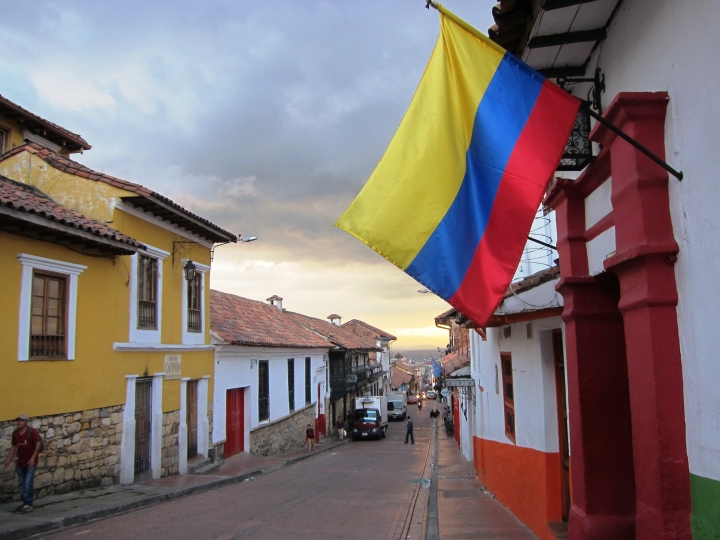
The Norwegian Human Rights Fund is looking for a country director in Colombia., which is a newly created post. Deadline for applications: September 17th, 2019.
Duration: 3 years with possibility of extension
Duty station: Bogota, Colombia. Travel inside the country and follow-up of grants/grantees will be an important part of the work. International travels will also be required.
The tasks include, but are not limited to
Lead the process of establishing a team in Colombia (initially 4-5 people) and set up an office.
Lead the strategy process for the NHRF for its Colombia work, including fundraising and communication work in line with the NHRF overall strategies.
Liaisons with and reporting to donors
Work dynamically with the grantees, and develop work, capacity building and follow-up based on needs and the situation on the ground.
Conduct risk assessments and risk reduction measures for the NHRF and its grantees.
Official qualifications (must have)
Master’s degree in social science, law, economics, or relevant field (can be compensated with long relevant leadership experience in funds mechanism).
Fluent in Spanish and Norwegian (might also be another Scandinavian language), good level of English needed.
Proven leadership experience, including leading a team/staff (min. 3-5 years)
Experience in working with civil society, grant making and funding mechanisms to civil society, including capacity building and networking.
Experience in handling donors and funds including from the Norwegian/Nordic governments.
Experience from Colombia, and possibly the region, when it comes to civil society and human rights defense/work.
Results-oriented and experience with Learning, monitoring and evaluation (LME) processes, previous work with Theories of Change is an advantage.
The aim of the Balzan prizesis to foster culture, the sciences and the most outstanding humanitarian initiatives of peace and brotherhood among peoples, regardless of nationality, race or creed. The four subject areas for the awards change every year. As stipulated in the Articles of the Balzan Foundation, they are selected from among “literature, the moral sciences and the arts” and “the physical, mathematical and natural sciences and medicine”. Rotating the subjects ensures that new or emerging research gets recognition, while at the same time it supports important fields of study that may have beenoverlooked by other great international awards. Since 2001, the rules of procedure of the Foundation’s General Prize Committee have stipulated that Prizewinners must destine half of the Prize to finance research projects that are preferably carried out by young scholars or scientists. The International Balzan Foundation, founded in 1957, operates through two separate institutions. The International Balzan Foundation “Prize” in Milan, chaired by Enrico Decleva, selects the subjects to be awarded and the candidates through its General Prize Committee. The Balzan Foundation “Fund” in Zurich, chaired by Gisèle Girgis-Musy,administers the estate left by Eugenio Balzan, so as to place at the disposal of the International Balzan Foundation”Prize,” the financial means necessary to realize its objective. The amount of each of the four 2020 Balzan Prizes will be CHF 750 000. Every year, the four Balzan Prizes are awarded to scholars and scientists who are distinguished in their fields on an international level.
At the conclusion of the announcement of the 2019 Balzan Prizewinners, the President of the General Prize Committee, Professor Luciano Maiani, informed the public that the 2020 Balzan Prizes will be awarded in the following fields:
Human Rights
Earth System Dynamics
As a further testimonial to the interdisciplinary mission of the Balzan Prize, for the first time in its history, the two general subject areas of the awards, the sciences and the humanities, will share a common theme that is fundamental and highly pertinent to today’s concern with the future of the planet: Environmental Challenges, which will in turn be divided into these two areas:
Responses from the Social Sciences and the humanities
“Illegitimate judicial proceedings are increasingly being used as a ‘rule-of-law-shield’ to fend off legitimate criticism,” says David Pressman, the Executive Director of the Clooney Foundation for Justice (CFJ). No overall system exists to monitor the fairness of trials around the world: some cases receive media attention and are well documented, whereas others are only followed by local activists. To bridge this gap, the CFJ, founded in June 2016, set up TrialWatch, an international monitoring program. Launched in April 2019, TrialWatch trains individuals in the basics of trial-monitoring, and equips them with the TrialWatch app, developed with Microsoft, to help them collect information about trials of interest in their areas. That information is then passed on to legal experts, such as international human rights lawyers, who assess it and write fairness reports. In time, this will contribute to a global justice index, ranking countries by the fairness of their legal system.
By early May 2019, TrialWatch was already monitoring 18 trials around the world, from Nigeria to Belarus, a number which the organisation wants to increase. “TrialWatch aims to solve the challenge of scaling trial-monitoring,” says Pressman. Trial-monitoring has been used by legal experts and lawyers for many years, because it increases transparency, creates a simplified record of the trial, and can facilitate reform. To make it easier to become a monitor, the CFJ developed a new set of guidelines accessible to non-experts, which were approved by the Office of the United Nations High Commissioner for Human Rights, the American Bar Association and Columbia Law School.
The TrialWatch smartphone app gives trial-monitors the tools to collect essential information, and store it securely in one place. The training that trial-monitors receive helps ensure that they record the right information, and straightforward yes/no questionnaires help them speed up collection. Within the app, trial-monitors can also take photos, shoot videos, and record audio – which is useful, given that many of the monitored trials happen in languages which aren’t widely spoken. Audio files are transcribed in the original language and then translated into English by Microsoft’s Azure Cognitive Services. All that is securely uploaded to the cloud, to be pored over by the CFJ’s legal experts.
“Our hope is that TrialWatch can help expose states when they fall short,” Pressman says . “It can demonstrate the ways that states are instrumentalising the courts in an effort to legitimise human rights abuses.”
Civil Rights Defenders, in partnership with Innovation Centre Kosovo (ICK) is hosting the first ever regional hackathon to tackle human rights issues – ‘EqualiTECH 2019’ – on 27-29 September 2019.
..there is a clear shortage in the interplay of technological investments around human rights issues, frequently materialising as a roadblock for its advocates. In an effort to reduce this gap, the organisers invite participants with various backgrounds, skill sets, and creative abilities to form multidisciplinary teams and invent unique digital products to hack Human Rights challenges pertaining to 3 thematic areas:
1). Justice and Equality; 2). Freedom of Expression; 3). Access to Information.
This signature event challenges participants to place humanity at the forefront of design thinking and innovation. It aims to fuse the power of technological innovation with the generative capacities of human rights defenders and activists, in building ICT solutions as part of diverse teams, to support human rights work in the Western Balkan countries. Under expert mentoring, the competitors of different backgrounds will have 40 hours to design innovative products that will elevate the work for human rights protection and advocacy. ‘EqualiTech 2019’ kicks off on the 27- 29 September, taking place at ICK’s event hub. All interested candidates can apply here. The deadline for application is 17 September, 11:59 pm.
The challenges
Justice and equality
Design a solution that helps increase justice and equality. Conceptualize and develop a digital product that will help increase justice and equality as well as promote inclusiveness for all. For example, think of tools (i.e. platform) that can connect state bodies responsible for providing free legal aid, private pro-bono lawyers/law firms, legal aid organizations and citizens in need of legal aid and advice; or tools that can help identify public and private places of interest and service providers (bars, restaurants, hotels, parks, etc) that are friendly, inclusive and non-discriminatory, particularly to vulnerable and marginalized communities in the Western Balkans.
Freedom of expression To complete this challenge, you should design a tool that will help facilitate and/or increase freedom of expression and reduce various forms of online harassment. The objective is to invent digital products (i.e. platforms) that can enable citizens, activists and journalists from the Western Balkans to connect with each other; identify and report violations of human rights; enable user-friendly reporting mechanisms that help increase their safety and security, etc.
Access to information is increasingly limited in the Western Balkans. Proliferation of unprofessional media, increasing number of fake and manipulative information, limits citizens abilities to make informed decisions. Conceptualize and design a digital product that will help increase access to reliable and useful information sources. This product (i.e. platform) should support citizens, progressive media outlets and independent journalists, fact-checking and other issues relating to ‘fake news’.
(Please note that this is not an exhaustive list.
Competition eligibility criteria?
To participate, you must meet the following eligibility criteria:
All individuals must be between 18-35 years of age.
Must work (HR activists or advocates) or have an interest (tech candidates) in combating discrimination, upholding human rights for minorities and underrepresented groups, and ensuring freedom of expression.
Tech candidates must be skilled in using programming language or tools and/or graphic design software.
All candidates must be able to collaborate within a team.
Must have a passion for problem-solving and analytical thinking.
Preference will be given to individuals with proven experience or passion in combating human rights violations.
Awards for the winning products
We will award three cash prizes, each in the amount of 1000 euros for the winning product prototypes in the respective challenge category.
Riot police break the main entrance of the İpek Media Group headquarters in İstanbul during the raid in 2015
The Nordic Monitor of 2 September 2019 carries an interesting and detailed piece on way the Turkish regime is using a court order – and judges sympathtic to it – to seize assets from its opponents:
In a new sign of the intimidation of regime opponents, an Islamist judge in Turkey ruled to seize the assets of exiled critics of Turkish President Recep Tayyip Erdoğan, new documents obtained by Nordic Monitor have revealed. The decision confirms how plunder has become part of the persecution pursued against these people, with the government unlawfully seizing the wealth of critics who live abroad.
In August 2016 Antalya 1st Criminal Court of Peace judge İbrahim Altınkaynak, a graduate of an imam-hatip (religious school) in the Kumluca district of southern Antalya province, ordered the seizure of all assets of US-based Turkish Muslim scholar Fethullah Gülen, a vocal critic of Erdoğan over pervasive corruption and the government’s aiding and abetting of armed jihadist groups in Syria and other countries.
Moreover, the court listed 102 Erdoğan critics who have been forced to live in exile or who remain at large in Turkey to escape the regime’s persecution. The judge ordered the transfer of their assets including real estate, chattel goods, bank accounts, intellectual property and other financial assets to the Treasury.
The Turkish government used a state of emergency to intervene and restrict all fundamental human rights after a coup attempt in July 2016. In order to impoverish exiled dissidents including writers, journalists, businessmen, doctors, academics and human rights defenders, the court confiscated all their assets in a blatant abuse of the state of emergency. In Altınkaynak’s decision, Articles 247 and 248 of the Code on Criminal Procedure (CMUK) were not applied in line with Article 3 (1) (b) of emergency decree no 668. In fact, Articles 247 and 248 of the code describe the seizure of property as a temporary measure.
Altınkaynak violated Articles 35 and 38 of the Turkish Constitution by ordering confiscation under an emergency decree that was not in force at the time. According to Article 35 of the constitution, Turkish nationals have “the right to own and inherit property, and these rights may be limited by law only in view of the public interest.” Furthermore, Article 38 underlines “penalties or security measures in lieu of penalties shall be prescribed only by law.” Article 38 also makes clear that “no one shall be punished for any act that does not constitute a criminal offense under the law in force at the time committed; no one shall be given a heavier penalty for an offense other than the penalty applicable at the time when the offense was committed.”
Moreover, the emergency degree itself and the decision of the Turkish court were in violation of Protocol No. 1 to the European Convention on Human Rights (ECHR), which guarantees the right to property. According to Article 1 of the protocol, “every natural or legal person is entitled to the peaceful enjoyment of his possessions. No one shall be deprived of his possessions except in the public interest and subject to the conditions provided for by law and by the general principles of international law.”
It is obvious that emergency decree 668 aimed at plundering the assets of Erdoğan critics does not comply with the necessities of democratic societies or the general principles of international law. The decisions were often taken by Islamist and ultranationalist judges and prosecutors who were transformed into tools of state-sanctioned plunder after the dismissal of more than 4,000 judges and prosecutors since 2016.
The documents revealed that people affiliated with the Gülen movement were not allowed to enjoy due process and fair trial protections and were treated as pariahs and outside the law in Turkey. The assets and wealth of individuals, corporations and organizations that were seen as affiliated with the movement were branded as war spoils open to plunder. Similar to Nazi Germany, their property was divided up among Erdoğan’s Islamists and their collaborators. The assets of Gülen-affiliated entities such as schools, universities, media outlets, companies and apartment buildings were confiscated or stolen by new owners.
Turkey’s Savings Deposit Insurance Fund (TMSF) has taken over 885 private companies including major conglomerates such as Boydak Holding, the Koza Ipek Group, Kaynak Holding and Naksan Holding, valued at close to TL 60 billion ($10.5 billion), since 2015. No figures were available verifying how much personal wealth and how many assets were seized through the Erdoğan government’s use of the partisan judiciary.
Instead of the Turkish Constitution and the principles of international law, a political Islamist approach with jihadist undertones has become the main source of motivation for Erdoğan’s judges and prosecutors. In an introductory video of the Kumluca Imam-Hatip school, Altınkaynak underlined the fact that the principles of imam-hatip schools have guided his professional life and judicial decisions. His social media posts are also embellished with Islamist and nationalist rhetoric.
Radical Turkish clerics who endorse Erdoğan help fuel a hostility in Turkey against the president’s critics and opponents, justifying torture and ill treatment of innocent people who are merely exercising their right to dissent. For example, at a rally held in front of Erdoğan’s house in Istanbul, a jihadist cleric named Abdülmetin Balkanlıoğlu publicly said that the assets seized from the Gülen movement were spoils of war for Muslims to enjoy. Balkanlıoğlu, who died in 2018, had links to jihadist groups in Syria and advocated the view that Muslims in Syria were battling the US, Russia and China and urged them to martyr themselves as part of the jihad.
Abdülmetin Balkanlıoğlu (L) and Nureddin Yıldız.
Another radical pro-Erdoğan cleric, Nureddin Yıldız, a man who has openly endorsed jihadist wars from Syria to China and is seen as very close to Erdoğan’s family, advocated the view that members of the Gülen movement must be executed — hanged and their arms and legs cut off.
The defendants in the sham case who were victims of asset seizure were listed by the Antalya 1st Criminal Court of Peace as Abdülkadir Koluçolak, Ahmet Çakmak, Alper İvecan, Burak Güller, Emrah Alagan, Feyyat İliman, Fikret Karyağdi, Hamza Göktaş, Hüseyin Girişken, İslam Ülker, Mehmet Uzun, Murat Doğan, Osman Direk, Ömer Akgün, Ridvan Demir, Sefa Öyke, Suphi Kiliç, Ufuk Atilgan, Yusuf Karabulut, Ahmet Yildirim, Nurettin Adigüzel, Erkan Kacir, Mustafa Akbulut, Emrah Abika, Murat Balaban, Muhammet Sertdemir, Zübeyir Selman Kahraman, Ender Vural, Abdülhalim Kökyay, Murat Değer, Celil Durmaz, Ahmet Sözgen, Ramazan Keskin, Ismail Şahin, Salih Karan, Yavuz Keskin, Turhan Negiz, Hüseyin Kaya, Hüseyin Bal, Mehmet Menderes Keskin, Cezmi Atan, Şeref Ünal, Tacittin Karataş, Mehmet Özdemir, Ramazan Altuntaş, Ibrahim Dolgun, Ramazan Örtülü, Cevdettin Serik, Halil Ersoy, Mustafa Ayanoğlu, Mustafa Karadağ, Eyyup Sabri Hamamcioğlu, Orhan Özkelle,Tuba Tüzemen, Abdi Durna, Elif Akkaya, Ayşenur Sezgin, Murat Sakartepe, Fetullah Gülen, Hasan Tarik Şen, Hasan Yilmaz, Saim Yuva, Arif Orhan, Hilmi Ünal, Mehmet Yaşa, Mustafa Yeşil, Ahmet Çiçek, Abdülkadir Yükselen, Abdullah Alniak, Ebu Ubeyde Seven, Mehmet Haş, Süleyman Çoban, Tacittin Akçakuş, Mehmet Ali Çoban, Ekrem Ünal Sevindik, Hasan Şahin, Hüseyin Tulpar, Kazim Sönmez, Mehmet Kafas, Mehmet Ihsan Öner, Nurullah Özbaş, Seyfullah Gürdal, Zekeriya Öner, Ismet Akil, Ahmet Güler, Ender Ileriye, Ergün Gürzal, Izzet Bayar, Ridvan Candemir, Serdar Gür, Salih Bayram Akinci, Ibrahim Şahin, Mehmet Ali Söyler, Mehmet Çelik, Halit Ünver, Kadir Sari, Sezai Ergün Ünal, Adil Baş, Osman Saritaş, Soner Taker, Oğuz Küçükzengin, Hüseyin Özçelik and Yahya Karadeniz.
None of the defendants had any criminal record, and they were all the subjects of prosecution because of their affiliation with the Gülen movement.
In a opinion piece in Foreign Policy of 6 September 2019 entitled “When Everything Is a Human Right, Nothing Is” Seth Kaplan– a Lecturer in the Paul H. Nitze School of Advanced International Studies at Johns Hopkins University, Senior Adviser for the Institute for Integrated Transitions – shows he belongs to the latter category albeit with a strong dose of return to basics (return to the UDHR) and a whiff of cultural relativism:
.. given the myriad challenges to human rights today, rethinking some widely accepted human rights assumptions seems timely. …
Some disagreements over human rights come from repressive regimes or communal leaders, and such complaints are easy to dismiss. But when critiques come from people who are sympathetic to the cause of human rights, they reflect something more fundamentally troubling. How did an idea once powerful enough to unify a vast range of people in struggles against totalitarianism and apartheid become so impotent? A major factor, ironically, was the overweening dual ambition born of those successes. Human rights advocates have broadened the scope of issues covered by human rights while narrowing the room for differences in bringing those rights to life. In so doing, they misconstrue the original goals of human rights, most clearly embodied in the Universal Declaration of Human Rights, the foundation for much of the post-1945 rights project. Even as their ambitions rise, human rights activists have failed to take into account how expansive new programs might aggravate suspicion of human rights in today’s multipolar world. And attempts to enforce a uniform conception of rights might reduce the space for local actors to formulate their own pathways, fueling skepticism about the rights themselves. For example, attempts by Western countries to promote gay rights in Africa triggered deep-rooted resentment about how the West treats Africa; the results are tougher laws, stronger rhetoric, more funding of anti-gay rights organizations, and even greater harassment of activists. As the New York Timesreported, “More Africans came to believe that gay rights were a Western imposition.”
Non-Western countries do not necessarily disagree with basic human rights goals. Rather, as the Brazilian academic Oliver Stuenkel argues in his book Post-Western World, they contest the “operationalization of liberal norms” and “the implicit and explicit hierarchies of international institutions” that privilege Western countries. U.S. retrenchment in the Middle East and the rise of authoritarian states like China reduce the effective reach of ideas that are stretched too thin or that are not credibly universal, in the sense of being deeply grounded in all the world’s major philosophical and religious systems. And curtailing overly expansionist and revisionist aspirations, as Jennifer Lind and William C. Wohlforth recently wrote in Foreign Affairs, is essential to preserving the post-World War II liberal international order.
If advocates for human rights wish to overcome the current challenges, they would do well to learn from the course of the human rights project from ideal to reality in the wake of World War II. The framers of the Universal Declaration learned that the best way to build a system of rights with a strong claim to legitimacy across different cultures and ideologies was to stick to basics. Today, only a modest and flexible approach can restore the moral authority that gave the universal human rights idea its greatest successes.
The 1948 Universal Declaration was a product of intense debate, negotiation, and compromise, all done with the understanding that its principles could be brought to life differently in dissimilar parts of the world. Today’s human rights discourse, however, is pervaded by Western normative assumptions that are controversial even in the West. Westerners play an extraordinarily large role as funders and conveners of human rights organizations and scholarly debates, directly and indirectly shaping agendas, frameworks of analysis, and evaluation methods in the process. As a result, human rights have become, as the New York University professor Sally Engle Merry writes in Human Rights and Gender Violence, “part of a distinctive modernist vision of the good and just society that emphasizes autonomy, choice, equality, secularism, and protection of the body,” converting cultural norms from one part of the world into universal rights.
Consequently, nonindividualistic values—such as those promoting communal duties or those tied to religious belief—have been de-emphasized. Arguments that there are other means of promoting and ensuring human dignity are dismissed as unrealistic or ignored. African, Asian, and other non-Western human rights institutions and laws are marginalized.
Meanwhile, the number of rights, and rights claims, has risen steeply as various well-meaning special interest groups have sought to harness the moral authority of the human rights idea to their causes. The international legal infrastructure has been enlarged, producing institutions such as the International Criminal Court (ICC) and doctrines such as the “Responsibility to Protect,” but these focus mainly on geopolitically weak or unimportant—10 of the 11 situations under investigation at the ICC are African—countries, while governments such as Syria’s commit atrocities with little fear of prosecution or intervention because Russia, one of its two main international backers, undermines any attempt to hold the country’s leaders accountable.
The human rights field’s ambitions not only have produced unnecessary clashes over human rights, but they have also diminished the core rights that were meant to, above all else, uphold human dignity.
In Europe, for example, advocates for abolishing circumcision have argued that a child’s bodily integrity is a human right while attempting to reduce religious freedom to a mere right to worship. This has led government ombudspersons to call for a ban, pediatric societies to call the practice “mutilation,” the Parliamentary Assembly of the Council of Europe to pass a resolution against the practice, political parties to lobby for legislation outlawing the practice, and a court in Germany to rule that the act of circumcision should be considered a prosecutable physical assault. For devout Jews and Muslims, these developments feel like direct attacks on a ritual integral to their faiths.
In Asia, instead of welcoming the 2012 Human Rights Declaration by the Association of Southeast Asian Nations (ASEAN) as representing some important steps forward, organizations such as Amnesty International, the International Commission of Jurists, the Office of the U.N. High Commissioner for Human Rights, and the U.S. State Department criticized the document for differing from their preferred emphases. Even though it included all the civil and political rights that similar documents elsewhere have—as well as innovative provisions related to those with AIDS, childbearing mothers, human trafficking, vulnerable groups, and children—these groups objected to the declaration’s emphasis that rights must be balanced with duties and that realization of rights has to take into account the local political and cultural context. But it is precisely the regional flavor that is most likely to increase the ASEAN declaration’s legitimacy—and thus the chance that it will be embraced locally.
In Africa, select issues that concern Western countries are often promoted in ways that pay little heed to local conditions, provoking a backlash. In Kenya, international attempts to prosecute Uhuru Kenyatta for fueling ethnic violence after the 2007 election ignored how this would boost his popularity among his supporters—helping him to eventual victory in the 2013 elections.
The mindset currently prevailing among many human rights actors thus makes it extremely difficult to realize the aim of the Universal Declaration’s framers to promote the implementation of fundamental human rights principles under a variety of circumstances and cultures. The result has been to reduce both the effectiveness and appeal of those principles. Human rights organizations are less able to embed themselves within local cultures and gain legitimacy in the eyes of local people. Greater flexibility in implementation would enable human rights supporters to focus on the importance of political dynamics and incentives to promoting change within countries. For example, the end of white rule in South Africa was brought about not by threatening apartheid leaders with international justice but by first sanctioning and then offering incentives for leaders to transfer power. Reconciliation and truth commissions played prominent roles; retribution was limited. The country crafted a new, inclusive national identity and developed a constitution around existing institutions, a stark contrast to efforts in Iraq and Libya that tried to replace institutions and exclude members of the previous regime.
The human rights movement should refocus on the principles of the Universal Declaration—a document more praised than understood. Its drafters developed a framework for human rights that was both universal and flexible. Their aim was to establish a “common standard of achievement,” based on the “inherent dignity” and “equal and inalienable rights of all members of the human family.”
This would entail recognizing that in a world of great cultural and political diversity, human rights cannot be universal unless kept to a small core of rights so fundamental that almost no country would openly oppose them.
In the original Universal Declaration, only a handful were drafted in such a way as to leave little room for flexibility in implementation. These include protections for religion and conscience, as well as prohibitions against genocide; slavery; torture; cruel, inhuman, or degrading treatment or punishment; retroactive penal measures; deportation or forcible transfer of population; and discrimination based on race, color, sex, language, religion, nationality, or social origin. Today, many human rights treaties make these rights nonderogable—i.e., there are no circumstances under which they can be lifted or suspended. Where other rights are concerned, the framers of the Universal Declaration were clear that universality does not mean homogeneity in implementation. They expected states to experiment with different modes of implementation—to allow “different kinds of music” to be “played on the same keyboard,” as the French philosopher Jacques Maritain, who supported the U.N. process, put it. Indeed, Eleanor Roosevelt made clear in 1948 during one of the debates over the Universal Declaration that methods for implementing many rights “would necessarily vary from one country to another and such variations should be considered not only inevitable but salutary.” For example, individuals everywhere have the right to be free of torture, but different countries may legitimately come to different conclusions about when private property may be taken for public use.
Moreover, in resolving tensions among rights, no fundamental right should be completely ignored. By specifying that all rights must be exercised with due respect for the rights of others, the framers intended that clashes should be occasions to figure out how to give each right as much protection as possible while never subordinating any right completely to another. Ultimately, a culture of human rights can only be built from the bottom up. Focusing on the gravest violations of human dignity while understanding that other rights can be protected in a legitimate variety of ways is the best way to achieve this.
As usual the International Service for Human Rights has come out with an excellent preview of key issues on the agenda of the 42nd session of the UN Human Rights Council, starting on Monday 9 September 2019. And – also as usual – I provide here an extract of the key elements affecting human rights defenders more directly. The 42nd session will consider issues such as reprisals, indigenous peoples, death penalty, arbitrary detention and enforced disappearances. To stay up-to-date on the whole session: follow @ISHRglobal and #HRC42 on Twitter. Side events will the subject of a separate post.
The Council will consider on 13 September two reports on the death penalty: the report of the UN Secretary General on capital punishment and the implementation of the safeguards guaranteeing protection of the rights of those facing the death penalty, and the summary report of OHCHR on the biennial high-level panel discussion on human rights violations related to the use of the death penalty, in particular with respect to the rights to non-discrimination and equality. The Council will also consider a resolution on the issue.
The Council will hold dedicated debates and consider the reports of several mandates relating to civil, political, economic, social and cultural rights, such as:
The Special Rapporteur on contemporary forms of slavery will present her report on current and emerging forms of slavery and country visit report to Italy on 9 September.
The Working Group on Enforced or Involuntary Disappearances will present a report on public policies for effective investigation of disappearances, as well as its annual report and country visit report to Ukraine, on 11 September.
The Special Rapporteur on the promotion of truth, justice, reparation and guarantees of non-recurrence will present his report and country visit report to Sri Lanka on 11 September.
The Working Group on Arbitrary Detention will present its annual report and country visit report to Bhutan on 13 September.
The Special Rapporteur on the rights of indigenous peoples will present her annual report and country visit reports to Ecuador and Timor-Leste on 18 September. The Council will also consider during the same debate three reports of the Expert Mechanism on the Rights of Indigenous Peoples.
Country-specific developments
China: The harassment, surveillance, and mass detention of more than one million Uyghurs and other Turkic Muslims in the People’s Republic of China continues to be the most pressing issue with regards to China for the international community to address.
Saudi Arabia: The September session provides an invaluable opportunity for the Council and States to follow up on the joint statement delivered on behalf of 36 States by Iceland [https://humanrightsdefenders.blog/2019/07/22/why-iceland-led-the-un-resolution-on-the-philippines/] During the June session, a broad range of cross-regional States called for accountability and guarantees of non-recurrence during the discussion of the Special Rapporteur on extrajudicial, summary or arbitrary executions’ report on the killing of Saudi journalist Jamal Khashoggi.
ISHR calls on States to advancing a HRC resolution establishing a monitoring mechanism over the human rights violations in the country and calling explicitly for the immediate and unconditional release of the detained Saudi women human rights defenders and to drop all charges against them.
Burundi: The Commission of Inquiry on Burundi will present its oral briefing on 17 September. Burundi continues to refuse to cooperate with the Council’s mechanisms. ISHR calls on States to renew the mandate of the Commission of Inquiry.
The Burundian Government suspended one of the last remaining independent civil society organisations (PARCEM), suspended the operating license of the Voice of America, revoked the license of the BBC, and forced at least 30 international non-governmental organisations to cease their activities. On 17 July 2019, the Ntahangwa Court of Appeal upheld the 32-year prison sentence against HRD Germain Rukuki. [see also: https://humanrightsdefenders.blog/2019/03/29/ngo-statement-condemns-new-irregularities-in-the-case-of-germain-rukuki-burundi/]
Interactive dialogue with the Special Rapporteur on Myanmar and the international fact-finding mission on the situation of human rights of Rohingya Muslims and other minorities in Myanmar on 17 September as well as the presentation of the report of the Independent Investigative Mechanism on Myanmar on 10 September. Among other things, the FFM sheds light on the economic interests of Myanmar’s military and the strong connections between the Tatmadaw and businesses and investors.
Enhanced interactive dialogue on the report of the High Commissioner on the human rights situation in Nicaragua on 10 September
Interactive dialogue on the oral update by the Commission on Human Rights in South Sudan on 16 September
Interactive dialogue on the updated written report of the Commission of Inquiry on Syria on 17 September
Interactive dialogue with the High Commissioner on the situation of human rights in Ukraine on 24 September
Interactive dialogue with the High Commissioner on the situation of human rights in Libya on 25 September
Adoption of Universal Periodic Review (UPR) reports: During this session, the Council will adopt the UPR working group reports on – inter alia – Albania, Côte d’Ivoire, the Democratic People’s Republic of Korea, the Democratic Republic of the Congo, Equatorial Guinea, Ethiopia, Nicaragua, and Qatar. ISHR supports human rights defenders in their interaction with the UPR. It publishes briefing papers regarding the situation facing human rights defenders in some States under review. This session of the Council will provide an opportunity for the Democratic Republic of the Congo and Côte d’Ivoire to accept recommendations made in relation to human rights defenders, as proposed in ISHR’s briefing papers.
Council programme, appointments and resolutions
The President of the Human Rights Council has proposed a candidate for the mandate of the Independent Expert on the situation of human rights in the Central African Republic.
At the organisational meeting the following resolutions were already announced (States sponsoring the resolution in brackets) which are especially relevant to HRDs :
Arbitrary detention (mandate renewal, France)
Technical assistance and capacity-building for Yemen in the field of human rights (Arab Group)
Contemporary forms of slavery (mandate renewal, United Kingdom)
Cooperation with the United Nations, its representatives and mechanisms in the field of human rights – ‘the reprisals resolution’ (Fiji, Ghana, Hungary, Ireland, Uruguay).
Human rights and indigenous peoples (mandate renewal of the SR, Guatemala, Mexico).
Human rights and indigenous peoples (Guatemala, Mexico).
Promoting international cooperation to support national human rights follow-up systems, processes and related mechanisms (Brazil, Paraguay).
The question of the death penalty (Belgium, Benin, Costa Rica, France, Mexico, Mongolia, Republic of Moldova, Switzerland).
World program on human rights education and training (Slovenia)
Technical cooperation and capacity building in the field of human rights (Brazil, Honduras, Indonesia, Morocco, Norway, Qatar, Singapore, Thailand, Turkey).
Human rights situation in Yemen (Belgium, Canada, Ireland, Luxembourg, Netherlands)
The human rights situation in the Syrian Arab Republic (France, Germany, Italy, Jordan, Kuwait, Morocco, Netherlands, Qatar, Turkey, United Kingdom of Great Britain and Northern Ireland)
Situation of human rights in Burundi (European Union)
Advisory services and technical assistance for Cambodia (Japan)
The right to privacy in the digital age (Brazil, Austria, Germany, Lichtenstein, Mexico)
Assistance to Somalia in the field of human rights (Somalia, United Kingdom)
Technical assistance and capacity-building to improve human rights in the Sudan (African Group)
The human rights situation in Venezuela (Argentina, Canada, Chile, Colombia, Costa Rica, Guatemala, Guyana, Honduras, Mexico, Paraguay, Peru)
Situation of human rights of Rohingya Muslims and other minorities in Myanmar (the Organization of Islamic Cooperation)
.. The groups welcome Canada’s acknowledgement that human rights defenders put themselves at great risk—along with their families, communities and the movements they represent—as they work to promote human rights and strengthen the rule of law. Women and LGBTI human rights defenders, for example, face high-levels of sexual and other forms of gender-based violence because of their gender and the rights they are advocating for. “In many parts of the world, human rights defenders are at risk as a result of their courageous work and their willingness to speak truth to power. Canada and the international community need to be strong supporters of these brave individuals. Human rights defenders must be able to act freely and without any interference, intimidation, abuse, threats, violence or reprisal. We are committed to speaking out against violations, standing up for human rights defenders and striving for a world where the rights and freedoms of all people are respected,” said Foreign Affairs Minister Chrystia Freeland on 17 June in Ottawa at a human rights event where the guidelines were announced.
For Canada’s new guidelines to be effective in helping to protect and support human rights defenders, they will need to be accompanied by a comprehensive implementation plan and increased Canadian funding going directly to human rights defenders and the movements they represent. Canada also needs to take a stronger approach to support human rights defenders advocating for corporate accountability, for instance, by enabling robust investigations when defenders face heightened risks linked to private sector investments. It will also be critically important that Canada create an advisory body that includes the participation of human rights defenders with experience and first-hand knowledge of the threats facing human rights defenders….
Importantly, the new guidelines call for Canadian diplomats working abroad at overseas missions or at Global Affairs Canada headquarters in Ottawa to take a more feminist and intersectional approach to promoting the rights of defenders. The document notes that many human rights defenders have multiple and “overlapping” identities, and often work on multiple issues. Human rights defenders may belong to one or more groups facing discrimination, including women, LGBTI people, Indigenous people, land and environment defenders, people with disabilities, journalists, and those seeking greater freedom of religion or beliefs. Human rights defenders in conflict and post-conflict countries face unique risks posed by high levels of militarization.
Quotes from Canada’s Voices at Risk: Canada’s Guidelines on Supporting Human Rights Defenders
“Canada recognizes the key role played by human right defenders in protecting and promoting human rights and strengthening the rule of law, often at great risk to themselves, their families and communities, and to the organizations and movements they often represent.”
“Canada’s guidelines on supporting human rights defenders is a clear statement of Canada’s commitment to supporting the vital work of HRDs.”
Many NGOs pay today attention to the International Day of the Victims of Enforced Disappearances. Here the example of AfricanDefenders (Pan-African Human Rights Defenders Network) which published the following on 27 August:
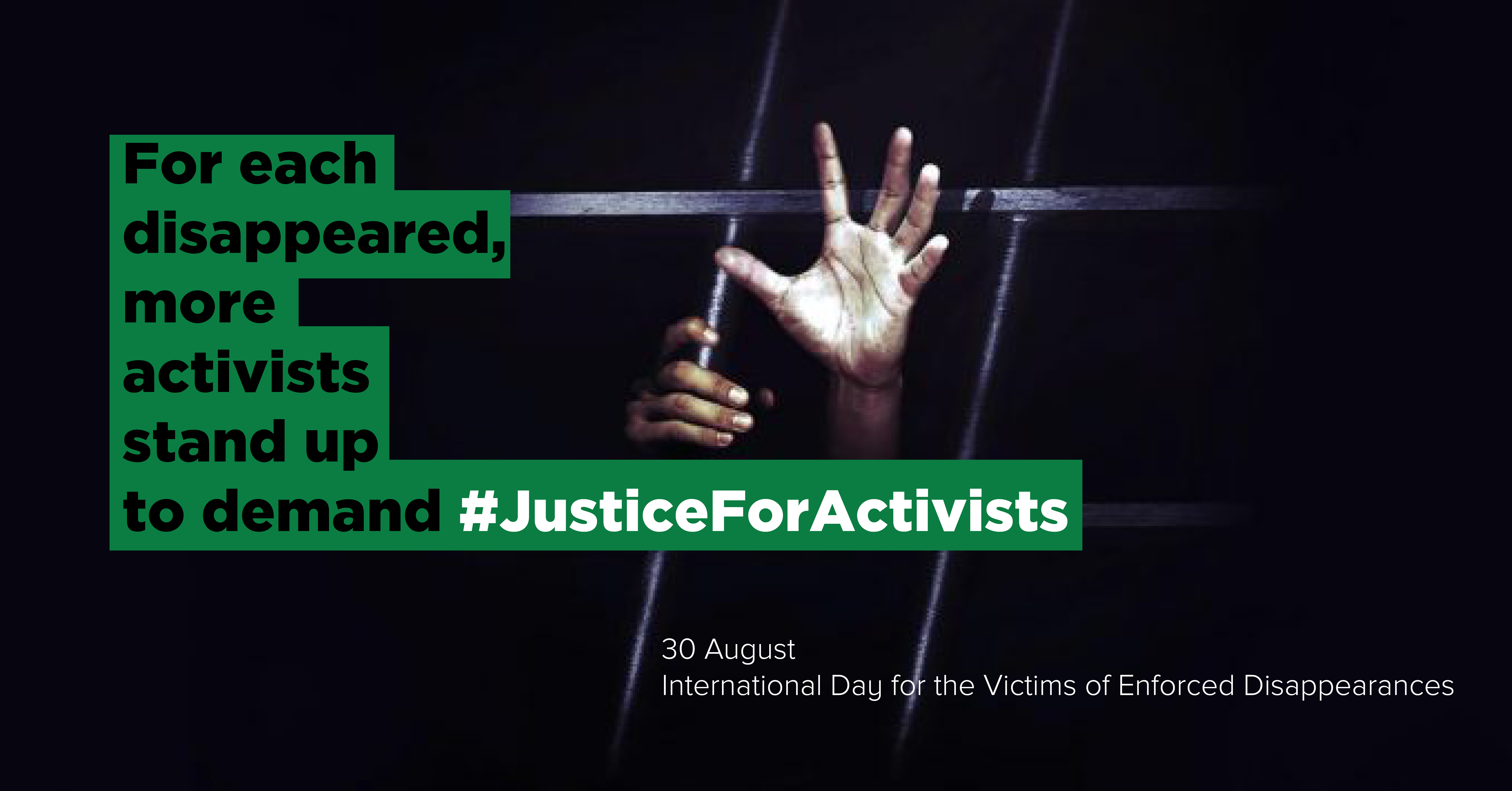
For each disappeared, more activists stand up! Stop enforced disappearances against human rights defenders
Some months later, on 10 December 2015, Burundian HRD Marie Claudette Kwizera was abducted in Bujumbura, Burundi by individuals believed to be members of the Burundian National Intelligence Service (SNR). Marie is still missing.
The cases of Sandra and Marie are not unique – it was just one of the few cases of enforced disappearance of African HRDs that made the headlines. Every year, African activists disappear without a trace, and without any media coverage. More importantly, no investigation is carried out, and no accountability is ensured. The alleged perpetrators continue to walk the streets, or, in most cases, rule the country, without any repercussions. Meanwhile, the victims are often tortured and many are killed, or live in constant fear of being killed, and the family and friends of the victim are left in the agony of not knowing the fate of their beloved.
In international human rights law, an enforced disappearance occurs when a person is abducted or imprisoned by state agents or by a third party with the authorisation, support or acquiescence of the state, followed by a refusal to acknowledge the person’s fate and whereabouts, which place the victim outside the protection of the law. When used systematically, it constitutes a crime against humanity according to the International Convention on the Protection of All Persons Against Enforced Disappearances (ICPPED).
Yet, it is a longstanding, systematic, and widespread tactic, often used by governments to silence HRDs, and as a strategy to spread terror within society. During the 1990s in Algeria, it is estimated that at least 7000 critical voices were abducted by government forces alone during the civil war. In Egypt, the Egyptian Commission for Rights and Freedoms’ campaign, “Stop Enforced Disappearances”, has documented more than 1000 cases of enforced disappearances of HRDs under Al-Sisi’s regime. During the current revolution in Sudan, hundreds of peaceful protests were abducted, disappeared, allegedly by the security forces. The fate and whereabouts of most of the victims remains unknown.
Despite threats and reprisals, the families and the communities of the victim continue to stand up and call for justice. For instance, every year, Burkinabe students commemorate Dabo Boukary, a student activist who disappeared during student protests in 1990. In Burundi, the impactful campaign “Ndondeza” (where are they?) continues to put pressure on the government and to call for justice. For each person that disappears, more activists stand up.
On 30 August, we commemorate the International Day of the Victims of Enforced Disappearance. We call on states to investigate cases of enforced disappearance and to ensure accountability; to ratify and implement the International Convention for the Protection of all Persons from Enforced Disappearances; and to ensure adequate reparations to the survivors, and their families.
We continue to stand in solidarity with HRDs that have disappeared, been tortured, and/or killed. We continue to demand #JusticeForActivists.



 Hans Thoolen on Human Rights Defenders and their awards
