The UN Human Rights Council will hold its 56th regular session at Palais des Nations in Geneva from 18 June and 12 July 2024. And as always the excellent Alert of the International Service for Human Rights permits me to hightlight what concerns HRDs most. To stay up-to-date you can follow @ISHRglobal and #HRC56 on X, and look out for the Human Rights Council Monitor.
Civil Society Access and Participation The UN is facing a severe liquidity crisis due to member states not paying their membership dues in full and on time. This shortfall is impacting victims and survivors of human rights violations. The crisis risks being used to impose restrictions on civil society participation, although online and hybrid modalities offer cost-effective and environmentally friendly solutions. Over 100 human rights organisations have called on all states to promptly pay their dues to address the liquidity crisis. Additionally, this session States have the opportunity to continue to build on the good practices adopted in the past years and allow for a broader, more inclusive, effective and climate-friendly human rights system, including by providing remote access to informal consultations on HRC resolutions that can greatly benefit from the analysis and lived experiences of human rights defenders.
Thematic issues Issues on the agenda At this 56th session, the Council will discuss a range of civil, political, economic, social and cultural rights through dedicated debates with the mandate holders and the High Commissioner, including with the Special Rapporteur on extrajudicial, summary or arbitrary executions, the Special Rapporteur on the right to freedom of expression, the Special Rapporteur on the rights to freedom of peaceful assembly and of association, the Special Rapporteur on promotion and protection of human rights in the context of climate change, the Special Rapporteur on contemporary forms of racism, racial discrimination, xenophobia and related intolerance In addition, the Council will hold dedicated debates on the rights of specific groups including with: The Independent Expert on protection against violence and discrimination based on sexual orientation and gender identity, the Special Rapporteur on the rights of Internally Displaced Persons, the Special Rapporteur on violence against women and girls, the Special Rapporteur on independence of judges and lawyers
The Council will also hold debates on interrelation of human rights and thematic issues including with: The High Commissioner on new and emerging technologies.
The new incoming Independent Expert on violence and discrimination on the basis of sexual orientation and gender identity, Graeme Reid, will present his first report focusing on freedom of expression, assembly and association.
Environment and Climate Justice The Special Rapporteur on Internally Displaced Persons will present her report on planned relocations of people in the context of the adverse effects of climate change and disasters. This report is building up on previous reports by other mandates and will also look at laws and policies at the national, regional, and international levels. The newly appointed Special Rapporteur on Climate Change will also present her first report looking at the upcoming priorities and some reflections of the progress achieved on some issues in the last 5 years. The report will also provide a snapshot of some other key topics and the impacts on some particular groups. The Special Rapporteur will also present two country visits reports: Honduras and the Philippines. There is currently a call for inputs for her upcoming General Assembly report on access to information on climate change and human rights. The Working Group on Business and Human Rights will present its report on investors, Environmental, Social, and Governance (ESG) approaches and human rights. The report will raise awareness of the responsibilities of investors and will clarify responsibilities on how to align their ESG approaches to human rights. On Thursday 20 June, the President of the Human Rights Council is organising a high-level informal Presidential discussion on ‘The important link between climate change, food security and health security’. The discussion should address the important role of environmental human right defenders in promoting and securing the full realisation of the right to a clean, healthy and sustainable environment; and recognition of the obligation of States to prevent, protect and promote their work in an enabling environment.
International Solidarity Civil society and international experts have continued to raise grave concern at the attacks on fundamental freedoms when advocating for the human rights of Palestinians by authorities in Western countries, including in universities. The High Commissioner deplored the ‘sharp rise in hatred globally – including anti-Semitism and Islamophobia’. In her report to the Council, the Independent Expert on International Solidarity called on States to ‘eliminate the criminalization of international solidarity expressions and symbols and calls for accountability for violations of public international law norms, such as calls for peace, self-determination or decolonization and the ending of apartheid or genocide […] stressing that States ‘should not conflate them with ‘manifest support of terrorism’ or antisemitism in relevant legislation or regulations’. The Special Rapporteur on racism also raised concern at ‘accusations of antisemitism on the basis of legitimate criticism of treatment of Palestinians by Israel’ in her report following her visit to the United States.
The Special Rapporteur on Education, following her visit to the United States, stressed that the International Holocaust Remembrance Alliance (IHRA) definition conflating criticism of Israel with antisemitism is being used to crackdown against pro-Palestinian protesters, including individuals who ‘self-identify as belonging to the Jewish community or represent Jewish student associations’. The Rapporteur addressed violations against students following the organisation of ‘mass encampments at nearly 40 universities in more than 25 states across the country’, including the detention of more than 2000 individuals, raids by fully armed police on university campuses requested by educational institutions to ‘disperse demonstrators and dismantle encampments’. During the session, and especially in the ID with the experts on International Solidarity, Education, Freedom of Expression, Freedom of Assembly and Association, we urge States to call for an end to the repression and criminalisation of groups and individuals advocating for the human rights of the Palestinian people, including through the instrumentalization of anti-Semitism (IHRA definition) and anti-terrorism policies, including in universities, and especially in the West (including in Austria, France, Germany, Italy, United States, United Kingdom).
Reprisals
HRC56 is a key opportunity for States to raise concerns about specific cases of reprisals and demand that governments provide an update on any investigation or action taken toward accountability. This month ISHR launched a new campaign regarding cases. ISHR urges States to raise these cases in their statements:
Cao Shunli was a prominent Chinese human rights defender, who sought to share information on the human rights situation in China with the United Nations in Geneva. Cao was arbitrarily detained and died in prison 10 years ago. [for more saee: https://humanrightsdefenders.blog/tag/cao-shunli/]
Abdulhadi Al-Khawaja is a Bahraini-Danish advocate known for his unwavering commitment to freedom and democracy. In April 2011 during the Bahrain chapter of what is known as the ‘Arab Spring’ uprisings, while he was leading peaceful demonstrations, Abdulhadi was violently arrested. He went missing for two months and, in June 2011, after a military trial, he was condemned to life-imprisonment on terrorism-related charges, despite grave concerns from the international community about unfair trials. [s`eae also: https://humanrightsdefenders.blog/2022/11/29/mea-laureate-abdulhadi-al-khawaja-facing-new-charges-for-protesting-injustice-in-jau-prison/ and https://www.trueheroesfilms.org/thedigest/laureates/4d45e316-c636-4d02-852d-7bfc2b08b78d]
Pham Doan Trang is an author, blogger, journalist and pro-democracy activist from Viet Nam. Trang was prosecuted for her articles and reports on the human rights situation in Viet Nam, including an analysis of a 2016 report on the Formosa Ha Tinh Steel Plant environmental disaster that was shared with the United Nations. See also: https://www.trueheroesfilms.org/thedigest/laureates/fe8bf320-1d78-11e8-aacf-35c4dd34b7ba and https://humanrightsdefenders.blog/tag/pham-doan-trang/].
Khurram Parvez and Irfan Mehraj are two Kashmiri human rights defenders. They have conducted ground-breaking and extensive human rights documentation in the Indian-administered Jammu and Kashmir, including through their work within the Jammu Kashmir Coalition of Civil Society (JKCCS). In 2016, Indian authorities arrested Khurram a day after he was barred from traveling to Geneva to attend the 33rd session of the Human Rights Council. See also: https://www.trueheroesfilms.org/thedigest/laureates/81468931-79AA-24FF-58F7-10351638AFE3 and https://humanrightsdefenders.blog/tag/khurram-parvez/. Meanwhile, on 20 March 2023, Irfan was summoned for questioning and arbitrarily detained by the NIA in Srinagar also under provisions of the UAPA and other laws. The NIA targeted Irfan for being ‘a close associate of Khurram Parvez.’ Both Khurram and Irfan are presently in pre-trial detention in the maximum-security Rohini prison in New Delhi, India.
See also: https://menarights.org/en/articles/egypt-un-experts-call-government-stop-targeting-and-retaliating-against-human-rights
Country-specific issues on the agenda
The Council will consider updates, reports on and is expected to consider resolutions addressing a range of country situations, in some instances involving the renewal of the relevant expert mandates. These include: Interactive Dialogues with the High Commissioner and the Special Rapporteur on Myanmar Enhanced Interactive Dialogue with the Special Rapporteur on Afghanistan Interactive Dialogue with the Independent international fact-finding mission for the Sudan Interactive Dialogue with the Commission of Inquiry on the Occupied Palestinian Territory and Israel Interactive Dialogue with the Special Rapporteur on Eritrea Interactive Dialogue with the Special Rapporteur on Belarus Interactive Dialogue with the Commission of Inquiry on Syria Interactive Dialogue with the Special Rapporteur on Burundi Interactive Dialogue with the High Commissioner on Venezuela Interactive Dialogue with the High Commissioner on Libya Interactive Dialogue with the Independent Expert on Central African Republic Interactive Dialogue with the High Commissioner on Ukraine and interim report of SG on Crimea Interactive Dialogue with the High Commissioner on Colombia
Afghanistan On 18 June, Richard Bennett, Special Rapporteur on Afghanistan will present his most recent report on the ‘phenomenon of an institutionalized system of discrimination, segregation, disrespect for human dignity and exclusion of women and girls’ (HRC res. 54/1). The report provides a multidimensional understanding of the design, commission and impact of the harms resulting from the Taliban’s institutionalized system of gender-based oppression. We welcome the Special Rapporteur’s view expressed in the report that the framing of gender apartheid most fully encapsulates the institutionalized and ideological nature of the abuses in the country. We note that the report of the Working Group on Discrimination Against Women to be presented at this session also noted the pattern of large-scale systematic violations of women’s and girls’ fundamental rights in Afghanistan ‘constitutes an institutionalized framework of apartheid based on gender and merits an unequivocal response.’ ISHR considers that the pursuit of justice for Afghan women and girls demands a multifaceted approach harnessing the strengths of various accountability mechanisms, including the establishment of an accountability mechanism for crimes against humanity; with strategic coordination exerting heightened pressure on the Taliban. See also: https://www.afintl.com/en/202406121393
Sudan On 18 June, the Fact-Finding Mission on Sudan will provide its first oral update to the HRC. Since the conflict erupted between the Sudanese Armed Forces and the Rapid Support Forces (RSF) on 15 April 2023, more than 30 thousand people have been killed while 10 million and a half have been displaced, a majority of which are women and children. Half of the population is now on the verge of famine, and 2.5 million could die of starvation by September. The continued fighting in El Fashir portends a repeated massacre and ethnic cleansing of the Masalit in El Geneina last year. In Aljazeera at least one hundred people were killed by RSF on 5 June, the area is facing grave human rights violations since last December. Meanwhile, the attacks on women’s rights groups and local response initiatives continue unabated.bHumanitarian responders get arbitrarily arrested, and smeared as traitors by the warring parties, some sentenced for up to 2 years and even killed. States should call for an immediate ceasefire, protection of civilians and adherence to international law by all parties in the conflict.
Occupied Palestinian Territory and Israel On 19 June, the Independent International Commission of Inquiry on the Occupied Palestinian Territory, including East Jerusalem, and Israel will present its report addressing the 7 October attacks by Palestinian armed groups and the commencement of Israel’s war on Gaza.
Venezuela The High Commissioner will present his report on 3 July with his Office staff still operating from Panama. The Maduro government has still not permitted the return of the Office on the terms of its original mandate. With Presidential elections to be held on 28 July, concerns increase about the safety of human rights defenders and opposition figures. Uncertainty has recently been increased by the re-introduction (and then rapid postponement of adoption) of the NGO Law. HRDs Javier Tarazona and Rocío San Miguel remain wholly unjustifiably detained. States must engage actively in the dialogue with the High Commissioner to make clear their support of the essential work of human rights defenders and of the UN’s essential, multifaceted regime scrutinising the human rights situation in the country. Situations of concern that are not on the Council’s agenda
Algeria The sustained repression against the pro-democracy movement and human rights defenders in Algeria was addressed in the end-of-session statements of the Special Rapporteur on freedom of association and assembly as well as the Special Rapporteur on human rights defenders who conducted official visits to Algeria in 2023. These were the first visits since 2016 by UN mandate holders to the country. The Special Rapporteur on Freedom of Assembly and Association addressed the ‘criminalisation of civil society work‘, and the ‘suspension or dissolution of political parties and associations, including prominent human rights advocacy organisations’ (including RAJ and LADDH), as well as ‘overly restrictive laws and regulations’ hindering their work.
Bahrain Thirty-three civil society organisations reiterated that thirteen years since Bahrain’s popular uprising, systemic injustice has intensified and political repression targeting dissidents, human rights defenders, clerics and independent civil society has effectively shut any space for the peaceful exercise of the right to freedom of expression or peaceful activism in the country. Despite the recent royal pardon issued on 8 April 2024, which included the release of more than 650 political prisoners, marking a change in State policy from previous royal pardons, the pardon excluded many individuals who played significant roles in the 2011 pro-democracy uprising, with an estimated 550 political prisoners remaining behind bars. HRC56 provides an important opportunity to address these developments in States’ national and joint statements, including during the Interactive Dialogues with the Special Rapporteurs and Independent Expert on Health, Freedom of Expression, Peaceful Assembly and Association, Independence of Judges and Lawyers and International Solidarity. We urge States to call for the release of all those arbitrarily, including human rights defenders and opposition activists Abdulhadi Al-Khawaja, Abduljalil Al-Singace, Hassan Mushaima and Sheikh Ali Salman as well as death row inmates Mohammed Ramadhan and Husain Moosa, who have now spent over a decade unlawfully detained following torture and unfair trials and remain at immanent risk of execution.
China The adoption on 4 July of the outcome of China’s fourth UPR review, which exposed strong international condemnation over grave abuses in January, is a key opportunity for States to urge China to fully implement recommendations emanating from existing findings by UN bodies. Any rejection by the Chinese government of UPR recommendations referring to UN expert mechanisms or to constructive cooperation with the UN system should be promptly condemned. Ahead of the second anniversary of the publication of the damning OHCHR Xinjiang report, and its authoritative findings of possible crimes against humanity in the Uyghur region, States should request updates on the implementation of the report’s recommendations. To uphold the integrity of its mandate and put an end to China’s exceptionalism, the HRC must also establish a monitoring and reporting mechanism on the country, as repeatedly called for by over 40 UN experts and hundreds of human rights groups globally. States should further urge the UN High Commissioner to strengthen follow-up action on his Office’s Xinjiang report, including through public calls for implementation, through translation of the report, and through an assessment of its implementation. States should raise serious concerns at the repression of peaceful protests by over 100 Tibetans who opposed a hydropower project in Derge County, affecting villages and monasteries. States should unequivocally call out the adoption of yet-another national security law further criminalising dissent and human rights promotion in Hong Kong, considered a ‘regressive step’ by High Commissioner Türk. States should echo the latter’s call to ‘release immediately and unconditionally all those arbitrarily arrested and detained under these laws.’ States should further ask for the prompt release of human rights defenders arbitrarily detained or disappeared, including feminist activist Huang Xueqin, human rights lawyers Ding Jiaxi, Yu Wensheng and his wife Xu Yan, legal scholar Xu Zhiyong, Uyghur doctor Gulshan Abbas, Hong Kong lawyer Chow Hang-tung, and Tibetan climate activist A-nya Sengdra.
Occupied Western Sahara ISHR is concerned over the situation of Saharawi human rights defenders, including lawyer M`hamed Hali, who has been arbitrarily deprived of his right to practice in the Moroccan judicial system due to opinions expressed in support of the right to self-determination for the people of Western Sahara. His hearing is scheduled on 27 June in front of Morocco´s highest court. We urge States to address the crackdown on Sahrawi civil society including: during the Interactive Dialogues with the Special Rapporteurs on Freedom of Expression, Peaceful Assembly and Association, to call on Morocco to immediately put an end to ‘the systematic and relentless targeting of human rights defenders in retaliation for exercising their rights to freedom of association and expression to promote human rights in Western Sahara’; during the Interactive Dialogue with the Special Rapporteur on the Independence of Judges and Lawyers to call on Morocco to reinstate M’hamed Hali’s right to practice as a lawyer, stressing that this case sets a dangerous precedent for the independence of lawyers; and during the Interactive Dialogue with the Independent Expert on International Solidarity to reiterate the recommendation of the expert that ‘States should eliminate the criminalization of international solidarity expressions and symbols and calls for accountability for violations of public international law norms, such as calls for peace, self-determination or decolonization […]’ in the case of Western Sahara.
Saudi Arabia On 4 July, the Council will consider Saudi Arabia’s fourth UPR outcome, as the authorities announce whether they have accepted or rejected recommendations issued by States in January. The recommendations address widespread and systematic rights violations in the Kingdom, and have the potential to bring about significant change. They include, but are not limited to: calls for the release of prisoners of conscience, many of whom are serving decades-long prison sentences for peacefully exercising their basic rights, and the repealing of travel bans imposed on human rights defenders following their release; the abolition of the death penalty for child defendants, with several young men at imminent risk of execution for alleged crimes committed as minors; and a raft of legislative measures, including ratifying key international human rights treaties and revising repressive laws. States should use this key opportunity to urge Saudi Arabia to accept them in good faith, and crucially implement them.
Tunisia In May 2024, Tunisian authorities waged an unprecedented crackdown against Black migrants and refugees, and civil society organisations defending their rights. On 6 May, in the opening address to a National Security Council meeting, Tunisian President Kais Saied reiterated discriminatory and hateful remarks against Sub-Saharan migrants and refugees while inciting against civil society organisations, describing them as ‘traitors and [foreign] agents’ and ‘rabid trumpets driven by foreign wages’, because of their receipt of foreign funding and their ‘insulting’ of the state. The president questioned the sheltering of asylum seekers and refugees by the Tunisian Council for Refugees (CTR) – a nongovernmental organization, partner of the UNHCR, which supports the registration of asylum claims – and described asylum seekers and refugees residing in Tunisia as illegal. President Saied suggested that CSOs should only work with the state and under its instructions. Since 3 May, Tunisian authorities have arrested and opened investigations against the heads or members of at least six organisations working on migrant and refugee rights and against racial discrimination, including the CTR. Five people, including WHRD Saadia Mosbah, President of Mnemty, have remained in pre-trial detention, under unfounded accusations of financial crimes. On 14 May, the Prime Minister announced that a new association law is being finalized, which would replace Decree-Law 88, an internationally lauded legislation that that safeguards Tunisia’s right to the freedom of association. During the interactive dialogues with the Special Rapporteurs on Freedom of Assembly and Association, and Freedom of Expression, we urge States to call on Tunisia to put an end to the crackdown on civil society, immediately release all those arbitrarily detained, including individuals providing support or advocating for the rights of migrants and refugees, and to firmly condemn the escalating smear campaign and stigmatisation of human rights and humanitarian organisations receiving foreign funding and working with migrants and refugees, supported by the president’s speeches, often making use of discriminatory and racist language against Black migrants and Black people.
Adoption of Universal Periodic Review (UPR) reports During this session, the Council will adopt the UPR working group reports on Belize, Central African Republic, Chad, China, Congo, Jordan, Malaysia, Malta, Mauritius, Mexico, Monaco, Nigeria, Saudi Arabia, Senegal. ISHR supports human rights defenders in their interaction with the UPR. This session of the Council will provide an opportunity for Chad, China, Congo, Mauritius, Nigeria to accept recommendations made in relation to human rights defenders, as proposed in ISHR’s briefing papers.
Side events
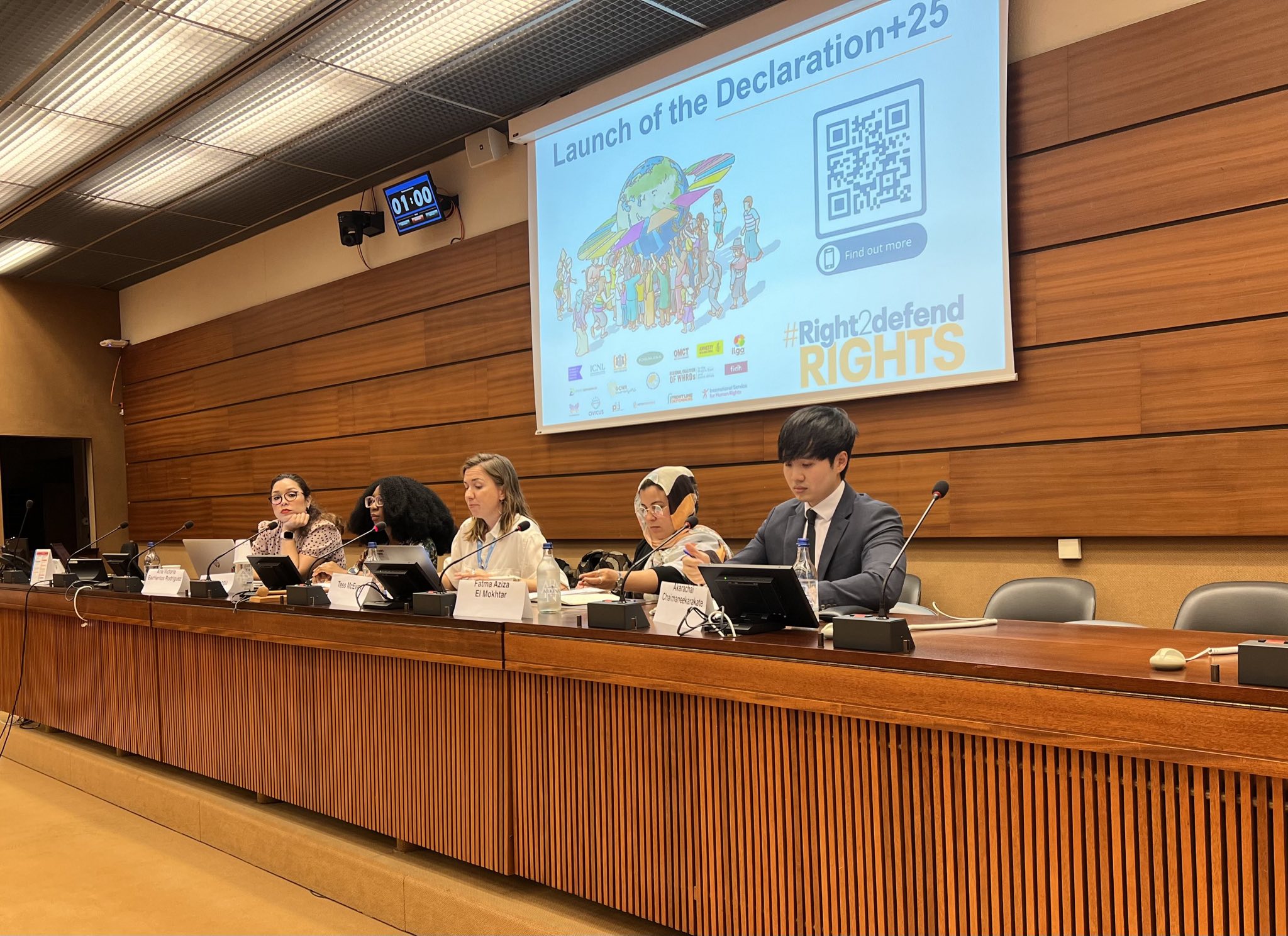
19 June at 13:00 (room XXV): ISHR will hold a side event to launch the Declaration +25: A supplement to the UN Declaration on human rights defenders. See https://humanrightsdefenders.blog/2024/06/08/launch-of-the-hrd-declaration25/.
Open Society Institute will hold a side event on human rights in Afghanistan 19 June at 15:00:
American Civil Liberties Union will hold a side event on human rights in the United States of America
On 25 June at 16:00: Center for Justice and International Law will hold a side event on human rights in Guatemala
26 June at 14:00: Amnesty International will hold a side event on the protection of freedom of expression and assembly
On 27 June at 14:00: International Bar Association will hold a side event on gender apartheid: Case studies
On 3 July at 12:00: Friedrich Ebert Stiftung will hold a side event on climate change and human mobility
On 3 July at 17:00: Third World Network will hold a side event on business accountability in the context of armed conflict
On 4 July at 15:00: Earthjustice will hold a side event on Protection of Environmental Human Rights Defenders #HRC55:
Alert to the Human Rights Council’s 56th session