Angélique is a Malagasy environmental and community rights defender who founded the Razany Vohibola Association in 2016. She represents over 3,000 villagers from four communities near the Vohibola Forest and leads efforts to preserve one of Madagascar’s last remaining primary forests.
Under her leadership, and in collaboration with the Ministry of the Environment, villagers have formed patrols to monitor and protect the forest against illegal logging, poaching, and the growing impacts of climate change. Angélique and her community face ongoing threats, including direct intimidation and violence from the authorities. One of her colleagues, patrol officer Mick, was killed for speaking out against illegal land grabbing, yet his death remains unpunished by local authorities.
Despite these grave risks, Angélique continues to advocate for justice and environmental protection. She also calls for structural change, urging the Malagasy government to pass a law that protects human rights defenders and holds public officials accountable.
There is currently no law to protect human rights defenders in Madagascar. We need this law to pass. The army and the gendarmes must be trained to understand who we are so they can become our allies.
‘What we need first is peace. (…) The international community, the UN, has the ability to end what’s happening in eastern RDC – what is happening today in the East is truly alarming.’
Judith Maroy is a Congolese journalist and human rights defender from Bukavu, in the South Kivu province of the Democratic Republic of the Congo.
Judith began her advocacy work through LUCHA, a youth-led citizen movement demanding social justice, democratic governance, and equality. She later became a journalist with La Prunelle RDC and co-founded a local organisation advocating for the rights of women, youth, and Indigenous communities.
She is calling for a just, peaceful Congo where young people have opportunities, women’s voices are heard, and no one is displaced in their own country.
Mirage news of 14 June 2025 comes with an interesting assessment of eyeWitness to Atrocities (eyeWitness) which marks its tenth anniversary. The International Bar Association (IBA) applauds the work of the pioneering initiative it founded in 2015. The launch of the eyeWitness to Atrocities app for Android phones has harnessed the power of technology in the global fight for justice. The tamper-proof photo, video and audio footage captured using the eyeWitness app, and securely stored by IBA partner LexisNexis , meets the strict evidentiary criteria required to be admissible as evidence in legal proceedings.
Jaime Carey, President of the International Bar Association, stated: ‘As we mark a decade of eyeWitness to Atrocities, we celebrate ten years at the intersection of technology, law, and human rights. .. As President of the IBA, I am proud of our member organisations that have dedicated vast amounts of pro bono work analysing footage captured using the app and I reaffirm IBA support for this vital work and its enduring impact on the global pursuit of justice.’
Mark Ellis, Executive Director of the IBA, added: ‘Footage captured with the eyeWitness to Atrocities app is invaluable in securing justice and bridging the gap between activists and the law. By ensuring that visual evidence is authenticated, the app transforms raw documentation into legally admissible proof. In a world where impunity often thrives in the absence of credible evidence, eyeWitness plays a critical role in bringing truth to light and ensuring that justice is not just a distant ideal, but a real possibility.’
Over the past decade, the eyeWitness app has become an essential tool for human rights defenders, journalists and civil society organisations documenting grave human rights violations and atrocity crimes around the world. Key achievements include:
more than 85,000 photos, videos and audio recordings captured using the app;
more than 900 training sessions delivered globally, including in active conflict zones;
more than 55,000 hours spent reviewing visual evidence;
The impact of eyeWitness has been extensive. The content captured has contributed to numerous cases and reports globally, including:
in 2018, when two commanders in the Democratic Republic of Congo were convicted of historical crimes against humanity including murder and torture;
in Ukraine, where the Kharkiv Commercial and District Administrative Courts heard four cases in 2022 relating to compensation claims for damage to non-residential property and the destruction of vital financial documents;
a case in the UK involving UK National Contact Point , where the construction company JCB’s equipment was used in the demolition of Palestinian communities and construction of Israeli settlements in the West Bank;
Carrie Bowker, Director of eyeWitness to Atrocities, commented: ‘The path from documentation to justice is not always straightforward, and as we mark this milestone, we are deeply grateful to the courageous documenters capturing critical evidence of atrocity crimes, to the law firms that provide invaluable pro bono support and to LexisNexis for securely storing footage captured with the app. We aim to continue connecting frontline documenters with legal and investigative bodies that can act on the evidence they collect.’
In a 2023 outcome report the eyeWitness organisation highlighted areas of work including significant footage collection; increased and strengthened partnerships with global human rights organisations dedicated to active documentation for accountability; and expanded pro bono assistance in reviewing and analysing collected footage.
Now finally there is some closure as reported by ANP on 4 June 2025:
In El Salvador, three suspects have been found guilty of murdering four Dutch journalists that were working for IKON in 1982. All three were handed a prison sentence of 15 years, several Salvadorian media outlets reported, including the newspaper Diario El Salvador.
After a hearing that took longer than 11 hours, the jury ruled that all the suspects were involved in the death of the journalists. The suspects are the former Minister of Defense, Guillermo Garcia (91), former director of a special police service, Francisco Antonio Moran (93), and former colonel Mario Reyes Mena (85).
Koos Koster, Jan Kuiper, Hans ter Laag, and Joop Willemsen, four journalists who worked for the now defunct broadcaster IKON, were reporting on the civil war in the country in 1982. They walked into an ambush at Chalatenango and were killed. A now-repealed amnesty law prevented the prosecution of the perpetrators for years.
Sonja ter Laag (70), the sister of Hans ter Laag, responded to the verdict. “I am very happy that the people who murdered my brother have been convicted. And that they will go to their graves as murderers. We can finally close this after 43 years.”
She added that the victim’s relatives have been living in a state of hope and desperation for the convictions for 43 years. “That costs a lot of energy, you don’t want to know. And now it is over. The people who gave the order to murder my brother, an innocent 25-year-old boy, will be punished.” Ter Laag did not mind that the elderly men would not have long to live anymore. “In any case, they will not go to their grave decorated.”
The judges imposed a lower sentence than the maximum set by the law. Instead of a prison sentence of 30 years, they imposed 15 years because of the defendants’ age and poor health.
García and Morán are being treated in a private hospital. El Salvador has requested the extradition of Reyes Mena. He currently lives in the U.S.
On 23 April, 2025 OMCT made public this interview with Armel Niyongere, exiled Burundian lawyer and Secretary General of SOS-Torture Burundi, a member of the World Organization Against Torture (OMCT) SOS-Torture network. He continues to denounce human rights violations in his home country. Despite 10 years of threats and intimidation from the authorities, Mr. Niyongere continues his fight to promote and protect human rights. In this interview he talks about the difficulties of exile, the challenges facing those who defend human rights, and the role of the international community.
Born in Damascus, Syria, Lina is a filmmaker, journalist, and human rights defender, who in 2011 decided to pick up her camera and start filming, without a plan, but with the knowledge that she has a story to tell. What ensued are five years of conflict, arbitrary arrests, as well as torture and ill-treatment in detention, but also of hope that things would get better, despite a veto. Five Seasons of Revolution was recently screened at the International Film Festival and Forum on Human Rights in Geneva, in an event co-hosted by OMCT, partner of the festival. In this interview, Lina tells us more about her process and the challenges she encountered in the making of the film, as well as her hopes for the future of Syria.
What made you decide to start filming?
We started shooting in the summer of 2011, and a lot was already happening in Syria, but it was not clear how things were going to go. I was optimistic, thinking it would be over in six months, maybe a year, with a release within two years. It took 12 years.
It took more than five years of filming, and then many more to edit, because the country hadn’t stabilised, and the characters’ decision to participate in the film shifted with every new development, for their own safety. We had to go back, take characters out, then put them back in, and make amendments to the storyline. But it wasn’t all negative. During this time, deepfake technology improved and gave us a solution for the anonymity issue of some of the characters who chose to stay in Syria in a way that is safe and does not interfere with the visual narrative.
What was the most challenging part about the filming process?
Not knowing where it’s heading. As a filmmaker, you have, even in documentaries, a rough script, or an idea of where you are heading, but we couldn’t. It was like surfing, we just had to keep up with weird twists and turns. At some point, there were so many arrests in the group that I was filming, the characters just kept going in and out of jail, and at any given moment, we would lose one of them. I was arrested several times and the rest of the film crew had to come up with plan Bs for ‘what if we lose the director, who also happens to be the camera person and the sole contact to all the other characters, how do we finish the film?’ There was even one editing session that was held in my absence because I was detained, and they didn’t know when I would be released. It was really challenging.
What was the most challenging part about having to change your identity several times throughout filming?
It was very confusing, but it was also very necessary. In order to make it work, you have to internalise it to a certain extent, which was challenging. This confuses your relationships with the people you’re working with, with the people you’re socialising with, with the people that trust you, despite only knowing your fake name. Very strong bonds are formed under extremely difficult conditions and something always felt wrong about not being able to be fully honest with people. it also created these compartments of who I am because different parts of me had different names in different places… and they didn’t always get along. Walking out of it was also a challenge. Normalising being one person and only using one name, only answering to one name. It was quite a journey.
Towards the end of the documentary, you talk about your experience with your arrest. Did what you experienced in custody change your approach to the film, or your activism?
I did not encounter anything during my arrest that I did not previously know exists and happens. What was detrimental was the repetition of detentions because you know you might get away with it once, maybe twice, if you’re lucky three times. But when I was released for the third time, I realised I did not know anybody that survived a fourth arrest. I felt like a cat with seven lives and I was really running out of them. I think this affected not only my decision-making in the film, but decision-making in my life in general, which obviously had consequences.
What are three things you hope people remember after watching your film?
Number one is that simplistic reductionist scenarios of war into black and white, good and bad are never true. Number two is that nobody has a blueprint for what to do in these cases. People improvise, people try to find solutions on the spot under pressure, and these are not always ideal. But also, people can be much braver than they think, because at the end of the day we are survivors, all of us, and there is a lot more to us than we sometimes give ourselves credit for. And number three, friendship is really important.
You are a filmmaker, but also a human rights defender. What are your hopes now for Syria and its people?
I hope people will be able to recover. I hope people will be given a break, given a chance to process everything they went through, given a bit of time to find a way out of this gigantic mess. It will take generations to rebuild the country. I understand that people have endured so much for so long that they cannot take one more day of it, so there is understandably also a lot of emotions. I just hope that we have the ability to open our hearts a bit more, understand each other a bit more and that people will in return give us the chance to process everything….
Comedian Noam Shuster-Eliassi speaks at the Thessaloniki International Documentary Festival awards. Looking on (in striped sweater) is ‘Coexistence, My Ass!’ director Amber Fares. Matthew Carey
Shuster-Eliassi attended the awards ceremony in the Greek port city, along with director Amber Fares and fellow members of the production. The comedian, whose one-woman show became the basis for the documentary, acknowledged her parents who were on hand for the event.
“My first political teacher, my father, is up there [in the balcony]. The first memory I have of my father is him going in and out of Israeli military prison for refusing to serve in the occupied Palestinian Territories,” Shuster-Eliassi noted. “Our activism and how we demonstrate equality, and freedom, and liberation is not just in one protest or one activity or one thing or one joke. It’s demonstrating what we envision the alternative is with your body, with your languages… using our privilege to make sure that my Palestinian friends will be free.”
“Two weeks ago, a Palestinian comedian, a colleague of mine, made jokes in Israel and the police showed up in at his home and took him and arrested him for telling jokes,” Shuster-Eliassi said. “And I’m here because there is still a little crack of freedom of speech that I get because of my privilege as an Israeli Jew.”
On a more humorous note, Shuster-Eliassi also brought up the president of Ukraine, Volodymyr Zelenskyy. “When I changed from political activism into comedy, it was because I heard that in The Ukraine, a Jewish comedian wrote a sitcom about becoming the president and he became the president!” she said. “So, I thought if I want to take my political career seriously, I need to start writing jokes because I know that when you’re laughing, you’re listening.”
Winning the Golden Alexander automatically qualifies Coexistence, My Ass! for consideration as Best Documentary Feature at the Academy Awards. In addition to the Golden Alexander, Fares’s film also won the Human Rights in Motion Award, presented by the Council of Europe.
While in Geneva the 23rd FIFDH announced its winners:
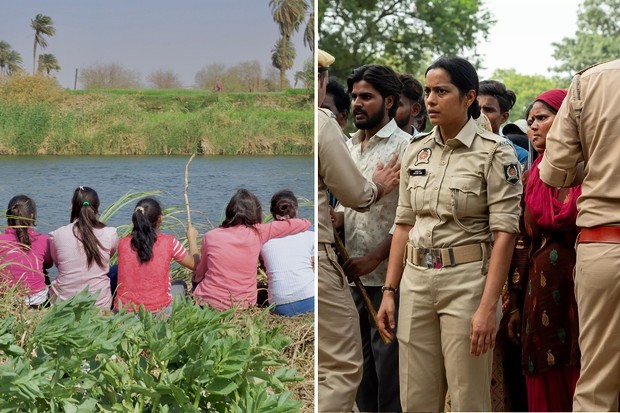
The documentary The Brink of Dreams by Nada Riyadh and Ayman El Amir and the crime-drama Santosh by Sandhya Suri have received the Grand Prizes at the Geneva-based human rights gathering
The Brink of Dreams by Nada Riyadh and Ayman El Amir (left) and Santosh by Sandhya Suri
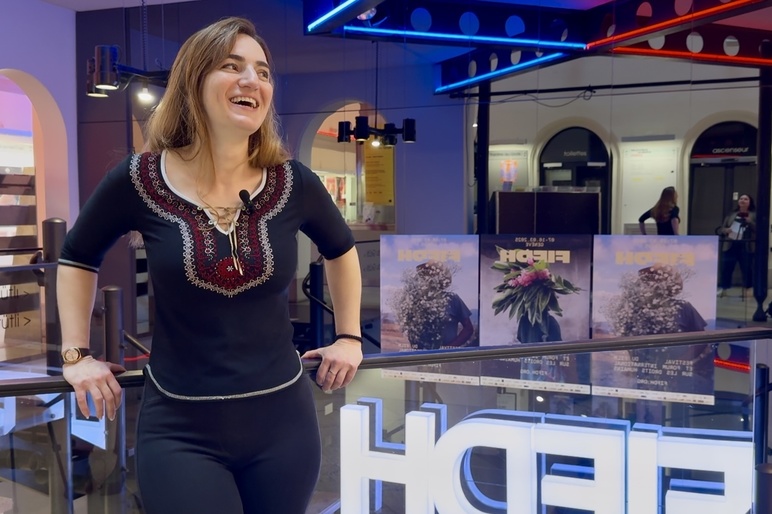
The 23rd Geneva International Film Festival and Forum on Human Rights (FIFDH) has concluded its 7-16 March run, drawing in over 31,000 attendees and hosting experts to dissect current affairs, move beyond shock and inspire collective action. Showcasing global films that highlight human rights, the festival reaffirmed its status as a key event for audiences and professionals alike, fostering dialogue on pressing geopolitical and social challenges.
At the closing ceremony, Laila Alonso Huarte and Laura Longobardi, the festival’s co-editorial directors, mentioned: “We’re proud to see that the winning films are not only powerful and innovative in cinematic terms, but also warrant international support given the filmmakers’ commitment to and courage in confronting the many social, political and economic challenges in their countries.”
In the International Documentary Competition, the jury awarded the Geneva Grand Prix, valued at CHF 10,000 (€10,300) and sponsored by the city of Geneva, to The Brink of Dreams [+] by Nada Riyadh and Ayman El Amir. Highlighting their decision, the jury stated, “This poignant film follows the aspirations of five young Egyptian women seeking freedom – a freedom threatened by traditions and restrictions imposed in their village. Rich in cinematic creativity, it tackles sensitive issues such as forced marriage and sexual harassment, exposing how women’s rights remain precarious in the region.”
Here is the full list of award winners at the 23rd FIFDH:
International Documentary Competition
Geneva Grand Prix The Brink of Dreams [+] – Nada Riyadh, Ayman El Amir (Egypt/France/Denmark/Qatar/Saudi Arabia)
FIFDH Gilda Vieira de Mello Prize Khartoum [+] – Anas Saeed, Rawia Alhag, Ibrahim Snoopy Ahmad, Timeea Mohamed Ahmed, Phil Cox (Sudan/UK/Germany/Qatar)
Fiction Grand Award Santosh [+] – Sandhya Suri (UK/Germany/France/India) Special Mentions Cosmos – Germinal Roaux (Switzerland/France/Mexico) Sugar Island [+] – Johanné Gómez Terrero (Dominican Republic/Spain)
Youth Jury Prize – Fiction In the Land of Brothers [+] – Raha Amirfazli, Alireza Ghasemi (Iran/France/Netherlands)
Focus Competition
Vision for Human Rights Award There Is Another Way – Stephen Apkon (USA/Palestine/Israel)
Special Jury – In Hospitals/Convergences Award Flying Hands [+] – Paula Iglesias, Marta Gómez (Spain)
Special Jury – In Correctional Facilities/La Brenaz Jury Award Life Is Beautiful [+] – Mohamed Jabaly (Norway/Palestine)
Champ-Dollon Jury Award Riverboom – Claude Baechtold (Switzerland)
A screening of the feature documentary “Dissidents” will take place on Sunday, Feb. 2, 2025, at 2:00 p.m. EST. The event location is Firehouse Cinema, 87 Lafayette Street, New York. “Dissidents” tells the story of three Chinese dissidents who continue to fight for democracy against the Chinese Communist Party (CCP) through art, protest, and grassroots organizing despite being exiled from their own home and despite the CCP’s transnational attempts to threaten them with violence, criminal charges, and arson. The film features Juntao Wang, a primary organizer of the 1989 Tiananmen Square protests; Weiming Chen, a human rights artist whose sculpture criticizing Xi Jinping was burnt down; and asylum seeker Chunyan Wang, who was arrested for attempting to deliver a petition letter to Chinese vice premiers during the US-China trade talks.
After the film, there will be a panel discussion featuring: Yaqiu Wang, research director for China, Hong Kong, and Taiwan at Freedom House Joey Siu, Hong Kong activist and executive council member at the World Liberty Congress Weiming Chen, human rights artist known for the Liberty Sculpture Park in CaliforniaYi Chen, director of “Dissidents” at C35 FilmsPema Doma, Executive Director, Students For a Free Tibet The event is free and open to the public, but registration is required. Please be sure to RSVP on Eventbrite as soon as possible, as reservations are granted on a first come, first serve basis.
on 31 December 2024 the UN Human Rights Podcast showcases the stories of five of the members of the Youth Advisory Board. The board is made up of young people who work on issues that mobilize and empower others to stand up for human rights. The Board is in partnership with Education Above All and Silatech, to empower young people, especially those in conflict and vulnerable situations.


 Hans Thoolen on Human Rights Defenders and their awards