Archive for the 'awards' Category

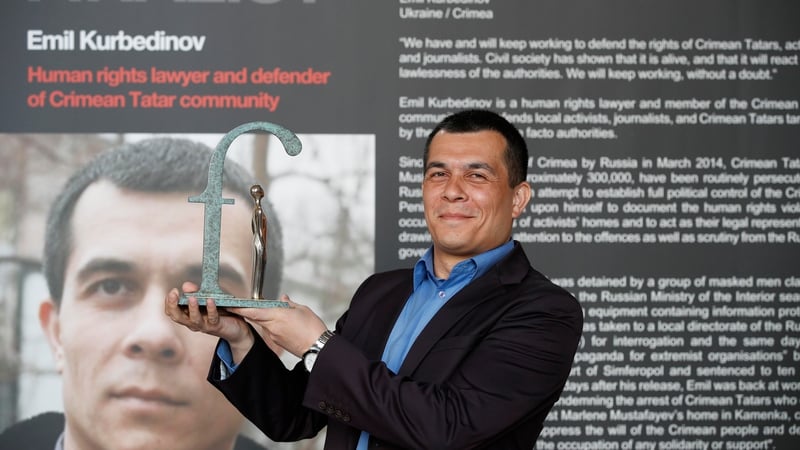
Lawyer wins Front Line’s 2017 human rights award for helping Crimean Tartars

May 26, 2017

On 31 March this year  I announced the 5 nominees for Front Line’s human rights award [https://humanrightsdefenders.blog/2017/03/31/finalists-for-the-2017-front-line-defenders-award-come-from-ukraine-nicaragua-vietnam-south-africa-and-kuwait/] and today the organization announced that the winner is Emil Kurbedinov, a lawyer who is helping ethnic Tartars in Crimea.

Emil Kurbedinov said 'Winning an acquittal for my clients is almost impossible - but what I can do is show them that, despite the risks, I will not abandon them'

Emil Kurbedinov was at the ceremony in Dublin’s City Hall this morning to receive the Human Rights Defender At Risk award for 2017. According to Front Line Defenders, which has its global headquarters in Blackrock in Dublin, defending human rights activists and political prisoners in Crimea is some of the most dangerous work that any lawyer can undertake. Despite those risks, Mr Kurbedinov has spent years providing emergency legal response for the Crimean Tartar minority, which it maintains has been persecuted by Russian authorities.

In January of this year, Mr Kurbedinov was detained by representatives of Crimea’s Centre for Counteracting Extremism while on his way to represent a client whose house had been raided by police. A district court later sentenced him to ten days in detention on a charge of “propagandising for extremist organisations“.

The Executive Director, Andrew Anderson, said: “In the midst of a global crackdown on human rights defenders, the five finalists demonstrate the will to persist in the face of severe, often life-threatening risks.

Source: Lawyer wins human rights award for helping Tartars

Women Nobel Laureates ask to fight fundamentalism in all its guises

May 18, 2017
On 16 May 2017 Jennifer Allsopp reported for 50.50 from the second day of the Nobel Women’s Initiative conference at the historic Kaiser-Friedrich-Halle in Mönchengladbach, Germany. [see also: https://humanrightsdefenders.blog/2015/04/20/nobel-womens-initiative-defending-the-defenders-24-26-april-2015/]

Women human rights defenders meet at the 2017 Nobel Women's Initiative Conference. Credit: author.

Women human rights defenders meet at the 2017 Nobel Women’s Initiative Conference. Credit: author.

Jody Williams, Mairead Maguire, Rigoberta Menchu Tum, Shirini Ebadi and Tawakkol Karman have come to address the 900 attendees about their work fighting totalitarianism and fundamentalism in its many global guises in order to build a more peaceful just and equal world. The public event took place on the final evening of the sixth international conference of the Nobel Women’s Initiative. Over the last three days, more than 50 women human rights defenders have been in Mönchengladbach to discuss the future of the feminist movement in collaboration with Initiativikreis Mönchengladbach.

….

The global response to refugees has been a key theme of the conference over the past three days and is a concern of all the laureates. One of the reasons the delegates decided to hold the conference in Germany was to come and congratulate Germany for its policies, explained Tawakko Karman, Yemeni human rights activist and 2011 Nobel Peace laureate. Since the beginning of the so-called ‘refugee crisis’ in Europe, Germany has welcomed more than one million refugees, more than any other country in Europe. For 2016 and 2017 alone, the government has set aside 28.7 billioneuros of funding for their accommodation and integration.

….Many of the young people here have been politicised to defend human rights more broadly because of personal experiences of getting to know refugees in Germany. It heartens me because I know this experience will stay with them for life. I saw the same transformation time and time again myself as a national coordinator with the UK NGO Student Action for Refugees which supports students to set up volunteering and campaigning projects in their local communities. But unlike Germany, the UK – and other countries who are now turning their backs on refugees – are training the next generation to look inwards rather than out. They’re turning away from fostering international consciousness among citizens. This Jody Williams, who won the 1997 Nobel Peace prize for her work to ban antipersonnel landmines, has repeated over the last three days, is “the real fake news”.

Germany’s decision to welcome refugees has nevertheless not come without challenges, especially in terms of the far right explains Brigitte Schuster, a German teacher who has come along to hear the Nobel laureates speak. She teaches as part of a network of state funded programmes run by BAMF (the Federal for Migration and Refugees). Despite some “teething problems” in the provision of services, Bridgette insists, people are nevertheless now moving forward with their lives. They are contributing a lot to the community, she explains, including through sharing their stories and fostering consciousness of totalitarianism in other parts of the world.

After the event in the foyer the laureates message appears to have got through. Attendees have been issued a call to action. The laureates have thanked the German people for welcoming refugees but also asked them to keep up the pressure on the totalitarian regimes that they have fled and to fix the gaps in their own democracies. Tawakkol Karman, Yemeni human rights activist has called on those present not to victimise people but to “be close to people’s dreams, their aspirations and their suffering.” And she’s issued an order. “You will fight for a society of equal citizenship for men and women.

Five boys, all aged 15, jump over one another to tell me what they found most inspiring when I ask them in the foyer after the event. They’ve been brought along by their English teacher Meike Barth from the Gymnasium an der Gartenstraße which has around 900 students. They are also curious to learn about human rights struggles other parts of the world and how they can support them, in part because of the new refugee friends they have made at their school.

Ahmet says he was especially touched when Shirin Ebadi, who received the Nobel Peace Prize in 2003 for her efforts to promote human rights in Iran, mentioned the Berlin wall: “She said that that physical wall and the wall Trump wants to build is like the Berlin wall and we can bring it down,” he recounts. But Ahmet’s also struck by her message about breaking down the walls between people ideologically. “It’s not just physical walls but walls in our hearts. People can always find ways to talk across physical walls, but what’s more hard is what she said about solidarity and people, the politicians trying to stop that connection. Actually,” he reflects, “I was thinking of this different metaphor of a different kind of wall we all build together with that hope, like bricks but you also need cement….It’s a metaphor in progress!”

Ahmet is also inspired by Jody William’s work to erase landmines. “There are still landmines in Vietman”, he tells me, “actually I read about that just last week and I was sat there thinking we need to do something about that.” I ask him what he’s going to do: he’s going to organise a local event and write to politicians.

Sebastian meanwhile tells me what stuck with him was the message advanced by Northern Irish peace activist and 1976 Nobel Peace Prize laurate Mairead Maguire to use academic studies to advance the cause of peace, whatever the discipline. He enjoys chemistry, biology and maths and wants to help tackle climate change. “People thing human rights is just a subject but it’s actually about everything, the whole environment. It’s not just politicians saying this and that.” He’s been inspired by the public meeting tonight to organise his own event. Benjamin, another student, wants to get active on social media and says he is going to help him.


Source: Fight fundamentalism in all its guises: a call to action from Yemen to Germany | openDemocracy

Gwangju award for human rights defender Pai Dao Din upsets Thai government

May 10, 2017
The Thai Ministry of Foreign Affairs gets upset easily as shown by the reaction to the granting of the 2017 Gwangju Prize for Human Rights (South Korea) to detained student activist Jatupat Boonpattararaksa, better known as Pai Dao Din. He has been in prison in Khon Kaen on lese majeste and computer crime charges since 22 December 2015, when 10 Khon Kaen University’s students from “Dao Din” group were arrested at the Khon Kaen Democracy Monument.

Pai Dao Din a day after the Khon Kaen court denied him bail again (FB/Jom Petchpradab)
Now the Thai ambassador to Seoul has written to the human rights award giver in South Korea asking it to ‘reconsider ‘ honouring jailed activist Jatupat Boonpattararaksa.

In a copy of the letter was acquired by the Bangkok Post (copy below):

The detained defender had been hoping to make bail so he could attend the award presentation ceremony in person, but his request was denied. In refusing Mr Jatupat’s bail requests, the Region 4 court and Khon Kaen Provincial Court described him as a flight risk who could tamper with evidence. The laureate is thus unlikely to be abel to travel on 18 May to the award ceremony in Gwangju and Mr Jatupat’s mother Prim Boonpattararaksa and her husband Viboon will represent their son and receive the award on his behalf.

National Human Rights commissioner Angkhana Neelapaijit, who won the Gwangju Award for Human Rights in 2006, described it as a prestigious accolade.

Source: Envoy queries Korea award for Jatupat | Bangkok Post: news

Relief for threatened scholars: the Philipp Schwartz Initiative of the Alexander von Humboldt Foundation

May 10, 2017
Some support structures suffer from a lack of general knowledge. Here is one that I came across recently.

The Alexander von Humboldt Foundation (AvH), in conjunction with the Scholars at Risk (SAR) Germany Section, convened the 3rd Workshop on the Philipp Schwartz Initiative (PSI) in Berlin, bringing together SAR staff, Philipp Schwartz Fellows, representatives of universities and research institutions in Germany supporting threatened scholars, and representatives from partner organizations.

As a part of AvH and supported by the German Federal Foreign Office and other private funders, the PSI provides universities and research institutions in Germany with the means to host at-risk foreign researchers with two-year, fully funded fellowships. Since the summer of 2016, the Alexander von Humboldt Foundation has invited applications to the PSI on behalf of scholars regardless of country of origin, current location, or academic field, as long as a demonstrable threat can be confirmed. The PSI is currently sponsoring more than 60 researchers, 34 of whom are SAR scholars. This number will undoubtedly grow, as the PSI has recently confirmed funding for an additional 30 grants.  Applications in the context of the Philipp Schwartz Initiative cannot be submitted at this time. Applicants in the 3rd round will be informed of the outcome by 30 June 2017.

For more information about the important work being done, visit the Philipp Schwartz Initiative’s homepage and consult the most recent issue of AvH’s magazine, Humboldt Kosmos.

Who can apply?  Please note that researchers cannot apply on an individual basis only through host institutions in Germany.

Research-performing institutions in Germany in the following categories may apply:

  • public and state-recognised universities, including universities of applied sciences (“Fachhochschulen”)
  • Max Planck Institutes, Helmholtz Institutes, Leibniz Institutes, Fraunhofer Institutes
  • Federal and State Research Institutes
  • other research-performing institutions that can convincingly demonstrate their research focus and infrastructures

Successful applicants will be able to grant a Philipp Schwartz Fellowship to a threatened researcher. In detail:

  • institutions that were successful in the 1st or 2nd call for applications (no submission of support concepts in 3rd call; only nomination of researcher)
  • institutions that applied but were not successful in the 1st or 2nd call for applications
  • institutions that have not applied for Philipp Schwartz funding before

Who is eligible for a Philipp Schwartz fellowship?

Threatened researchers from any academic field and any country of origin who

  • have completed their doctorate or a comparable academic degree (PhD, CSc or equivalent)
  • have not been resident outside their own country for more than three years; researchers who hold German university entrance qualifications (“Bildungsinländer”) are not eligible
  • possess the language skills required to successfully conduct their research projects
  • possess academic qualifications (e.g. publications)
  • possess potential to be integrated into the (research-related) job market
  • who have not yet been funded in the context of the Philipp Schwartz Initiative
  • persons that have access to residence in safe countries due to multiple citizenship and German citizens are not eligible for nomination
  • multiple nominations of one person by several institutions are not permitted

The Humboldt Foundation imposes no restrictions with regard to country of origin or current location if the threat can be confirmed in accordance with the programme guidelines.

What does the funding include?

  • fellowship funds including subsidies of 3,500 EUR/month for up to 24 months
  • a one-off lump sum of 12,000 EUR for the host institution

How can a threat to a researcher be confirmed in the context of the Philipp Schwartz Initiative?

In the context of the Philipp Schwartz Initiative, a pertinent threat of researchers who are demonstrably threatened in their countries can be confirmed in two ways:

  • by way of a residence status in the context of an asylum-granting procedure that confirms a recognised threat
  • by way of a credible threat assessment from a third party, such as the Scholars at Risk Network, the Scholar Rescue Fund, or the Council for At-Risk Academics


Source: Alexander von Humboldt-Foundation – The Philipp Schwartz Initiative of the Alexander von Humboldt Foundation supported by the Federal Foreign Office

Havel Prize for Creative Dissent recognizes Human Rights Defenders in Bahrain, Venezuela and Zimbabwe

May 7, 2017

On 5 May 2017 the Human Rights Foundation in New York announced as the recipients of the 2017 Václav Havel International Prize for Creative Dissent the Zimbabwean activist and playwright Silvanos Mudzvova, Venezuelan satirical media project El Chigüire Bipolar, and Bahraini poet and activist Aayat Alqormozi.

the “Goddess of Democracy,” the iconic statue erected by Chinese students during the Tiananmen Square protests of June 1989.

Silvanos Mudzvova is a Zimbabwean actor, playwright, and activist known for challenging the country’s dictator, Robert Mugabe, in daring theatrical productions. Silvanos works with the protest group Tajamuka (“We are rising up”) and serves as the director of Vhitori Entertainment Trust, a theater group created to protest Zimbabwe’s democracy crisis, human rights abuses, and poor governance. Silvanos has directed several controversial performances including “The Final Push,” a political satire; “Missing Diamonds, I Need My Share;” a play on corruption in the diamond industry; and “Protest Revolutionaries,” a play that encourages Zimbabweans to plan their own Arab Spring. Silvanos has been detained and arrested several times. To avoid government persecution, Silvanos now performs what he calls “hit-and-run” performances in public spaces. Silvanos has been awarded an Artist Protection Fund (APF) Fellowship and is currently in-residence for this at The University of Manchester. “Silvanos Mudzvova’s persistence in using art and performance to challenge dictatorship is an inspiration. The persecution of Silvanos illustrates Robert Mugabe’s cruelty, intolerance, and cowardice,” said Havel Prize Committee Chairman Thor Halvorssen.

El Chigüire Bipolar is a Venezuelan satirical media project created in 2008 by Elio Casale, Oswaldo Graziani, and Juan Andrés Ravell. The website, most famous for mocking former Venezuelan president Hugo Chávez, is often described as a mix of the Onion and John Oliver’s Last Week Tonight. El Chigüire Bipolar’s popularity in Venezuela grows as the government increases pressure on independent news outlets. “El Chigüire Bipolar is playing an increasingly crucial role in resisting Maduro’s campaign to stifle free speech. Its raw humor and exacting analysis demonstrates the great power that satire has in criticizing authoritarian regimes,” said Havel Prize Committee member Garry Kasparov.

 Aayat Alqormozi is a Bahraini poet who uses her craft to advocate for the equal rights of Shi’ite and Sunni Muslims, and to express her opposition to Bahrain’s monarchy. In 2011, Aayat recited poetry during a protest at Pearl Square as a part of the Bahraini uprising. In response, she was expelled from university and imprisoned for “insulting the King and encouraging hatred of the ruling regime.” Nevertheless, Aayat’s poetry and peaceful defiance have made her a symbol of resistance against the al-Khalifa regime. “Aayat’s methods for peaceful resistance are motivating the next generation of artists and political dissidents in Bahrain. Her commitment to poetry as a vehicle for social and political change is worthy of recognition and encouragement,” said Havel Prize Committee member Amir Ahmad Nasr.

Past laureates include Chinese artist Ai Weiwei, Russian punk protest group Pussy Riot, North Korean democracy activist Park Sang Hak, Saudi women’s rights advocate Manal al-Sharif, and Cuban graffiti artist El Sexto. [https://humanrightsdefenders.blog/2014/05/05/2014-havel-prize-for-creative-dissent-awarded-to-erdem-gunduz-pussy-riot-and-dhondup-wangchen/]The Havel Prize ceremony will be broadcast live at oslofreedomforum.com beginning at10:00 a.m. Central European Time on Wednesday, May 24. The event will take place at the Oslo Nye Theater. Contact: Prachi Vidwans, (212) 246-8486, prachi@hrf.org.

Source: Havel Prize for Creative Dissent Recognizes Efforts in Bahrain, Venezuela, and Zimbabwe | Human Rights Foundation Home Page

Video portrait of Johan Galtung, ‘father of peace studies’

May 5, 2017

Short but informative film portrait of Norwegian peace specialist Johan Galtung, winner of the 1987 Right Livelihood Award.

Call for nominations for the North-South Prize 2017

May 4, 2017

Prix Nord Sud

Call for nominations for the North-South Prize 2017 is now open. The North-South Prize distinguishes each year two personalities, one from the north, the other from the south, who have excelled in their commitment to human rights, democracy and rule of law, contributing to the north-south dialogue and interdependence.   Deadline 15 September 2017.

see also: https://humanrightsdefenders.blog/2016/07/05/north-south-prize-2015-of-the-council-of-europe-goes-to-greek-and-mozambique-organizations/

Source: Centre Nord-Sud – Prix Nord-Sud

Eritrean-born journalist Dawit Isaak awarded 2017 UNESCO’s Guillermo Cano World Press Freedom Prize

May 4, 2017

Dawit Isaak in Sweden circa 1987-88 © Kalle Ahlsén
Dawit Isaak, an imprisoned Eritrean-Swedish journalist, has been chosen to receive the 2017 UNESCO/Guillermo Cano World Press Freedom Prize. Mr. Isaak was arrested in a crackdown on the media that occurred in September 2001. The last time he was heard from was in 2005. His present location is unknown.  An independent international jury of media professionals recommended unanimously Mr. Isaak in recognition of his courage, resistance and commitment to freedom of expression, and the recommendation was endorsed by the UNESCO Director-General Irina Bokova.

Defending fundamental freedoms calls for determination and courage – it calls for fearless advocates,” said Irina Bokova. “This is the legacy of Guillermo Cano, and the message we send today with this decision to highlight the work of Dawit Isaak.” Dawit Isaak joins a long list of courageous journalists who have persevered to shed light in the dark spaces; keeping their communities informed against all odds,” said Cilla Benkö, President of the UNESCO/Guillermo Cano World Press Freedom Prize 2017 Jury. “Some have given their lives in the pursuit of truth. Many have been imprisoned. Dawit Isaak has spent nearly 16 years in jail, without charge or trial. I sincerely hope that with this award the world will say, ‘Free Dawit Isaak Now.’”

Dawit Isaak, a playwright, journalist and writer, moved to Sweden in 1987, where he later became a citizen. After the independence of Eritrea, he returned to his homeland to become one of the founders and reporters of Setit, the first independent newspaper in the country. He was known for his critical and insightful reporting. Mr. Isaak was arrested in September 2001 during a political crackdown on the so-called G-15, a group of politicians, and journalists critical of Government policies. Some were detained and tortured, others disappeared. The last known sighting of Mr. Isaak was in 2005. His whereabouts now are unknown.

The UN Special Rapporteur on the situation of human rights in Eritrea, Sheila B. Keetharuth, said: “The Eritrean authorities should stop the practice of arrests and detention carried out without legal basis instantly,” welcoming the award of the UNESCO/Guillermo Cano World Press Freedom Prize 2017 to Mr. Isaak.

The Prize was awarded during the celebration of World Press Freedom Day, 3 May, hosted in Jakarta, Indonesia this year in the presence of the Director General of UNESCO, Irina Bokova, and the President of Indonesia, Joko Widodo.

Created by UNESCO’s Executive Board in 1997, the annual UNESCO/Guillermo Cano World Press Freedom Prize honours a person, organization or institution that has made an outstanding contribution to the defence and, or promotion of press freedom anywhere in the world, and especially when this has been achieved in the face of danger.

The $25,000 Prize is named in honour of Guillermo Cano Isaza, a Colombian journalist who was assassinated in front of the offices of his newspaper, El Espectador, in Bogotá, on 17 December 1986. It is funded by the Cano Foundation (Colombia) and the Helsingin Sanomat Foundation (Finland).

see also: https://humanrightsdefenders.blog/2015/02/14/reporters-without-borders-published-its-2014-world-press-freedom-index/

Sources:

Eritrean-born journalist Dawit Isaak awarded UNESCO/Guillermo Cano World Press Freedom Prize 2017

http://mareeg.com/eritrea-must-free-prize-winning-journalist-says-un-human-rights-expert/

The ADHOC FIVE in Cambodia continue to linger in shameful pre-trial detention for more than a year!

April 29, 2017

From left to right: Ny Chakrya, Yi Soksan, Ny Sokha, Lim Mony and Nay Vanda.

From left to right: Ny Chakrya, Yi Soksan, Ny Sokha, Lim Mony and Nay Vanda. RFA

On 27 April 2017, the Phnom Penh Municipal Court extended the pre-trial detention of senior ADHOC staff and human rights defenders, Lim Mony, Ny Sokha, Nay Vanda, Yi Soksan and Ny Chakrya by an additional six months, purportedly to further investigate their case. The five human rights defenders have already spent a year in pre-trial detention!  The Cambodian Human Rights and Development Association (ADHOC) [https://www.frontlinedefenders.org/en/profile/adhoc]  is a human rights organisation founded in December 1991 by a group of former political prisoners aiming to address the absence of basic rights and freedoms in Cambodia. The organisation assists human rights victims and disseminates information on human rights, law and democracy to the Cambodian public.

On April 26, 2017, the detainees, listed as “FreeThe5KH” (Free the Khmer Five), were named as a finalist for the Martin Ennals Award for Human Rights Defenders [https://humanrightsdefenders.blog/2017/04/26/breaking-news-three-human-rights-defenders-selected-as-finalists-for-the-2017-martin-ennals-award/].

Many NGOs and the UN (including an opinion by the UN Working Group on Arbitrary Detention last November) have called on he Cambodian government to immediately release five the human rights defenders and urge all to participate in the #FreeThe5KH campaign at https://freethe5kh.net/. “Cambodia’s donors should publicly call for the release and dropping of bogus charges against the ‘ADHOC Five,’ which were instigated by Prime Minister Hun Sen to intimidate and suppress human rights work,” said Brad Adams, Asia director of HRW. “These human rights defenders are in jail as part of a campaign to destroy the opposition and scare Cambodian human rights workers into silence.”

Radio Free Asia reported on 28 April that the children of two of the human rights defenders said that their families faced serious hardship during the year their parents have spent in prison and expressed hope they might be freed.

Sources:

OHCHR BRIEFING NOTES – Arkansas executions, Cambodia | Scoop News

http://www.rfa.org/english/news/cambodia/children-04282017171322.html

https://www.hrw.org/news/2017/04/26/cambodia-use-anniversary-freethe5kh

Breaking news: three Human Rights Defenders selected as Finalists for the 2017 Martin Ennals Award.

https://www.ifex.org/cambodia/2017/04/28/free-khmer-five/

Breaking news: three Human Rights Defenders selected as Finalists for the 2017 Martin Ennals Award.

April 26, 2017

Today, 26 April 2017, the Martin Ennals Foundation announced that the following 3 human rights defenders have been selected as the Finalists for the  2017 Martin Ennals Award. This award is considered to be the main of award of the whole international human rights movement as the Jury (see below) is composed of leading human rights NGOs.

FreeThe5KH (Cambodia)

FreeThe5KH are five Human Rights Defenders who have been in pre-trial detention for almost one year. This is linked to their work with the Cambodian Human Rights and Development Association (ADHOC). International bodies like the UN Working Group on Arbitrary Detention and UN Special Rapporteurs have repeatedly called for their immediate and unconditional release, and a stop to judicial harassment of human rights defenders in Cambodia based on their legitimate human rights work. This comes in the context of an increasingly severe crackdown on civil society and the political opposition in Cambodia.

On behalf of the Khmer Five, Thun Saray, President of (ADHOC) comments: “It is an immense honour for the five HRDs to be selected as finalists. 28 April will mark their one year in arbitrary detention on the basis of their legitimate human rights work. The increased attacks against HRDs and activists has had a tremendous impact on those working to promote and protect human rights in Cambodia. This Award is symbol of encouragement for every courageous Cambodian, who continues to speak out against injustices and human rights violations. I would like to express my deepest gratitude to everyone that has supported the nomination.

Karla Avelar (El Salvador)

Karla Avelar, a transgender woman in El Salvador, grew up on the streets of San Salvador, suffering discrimination, violence, exploitation, and rape. She was imprisoned when she defended herself, and then regularly abused by fellow prisoners with the knowledge and even participation of the prison authorities. These terrible experiences have forged her into a powerful advocate. With three others, she founded COMCAVIS TRANS, which was created to represent, defend, and promote the human rights of LGBTI persons, with a focus on those living with HIV, as she does. She works to change legislation and the authorities’ practices, by holding them publicly to account. Notably her advocacy helped prompt the authorities to segregate LGBTI prisoners for their own safety, and allow for the standard HIV treatments provided by the Ministry of Health.

She said,” I want to thank Martin Ennals, the jury, and those who nominated me for this important award. Although today I am in danger, and sure that my struggle is risky, my eagerness for justice and equity motivates me. I will continue to push the State to accept reforms and legislation proposed by civil society to allow the LGBTI community to fully enjoy their human rights.”

Mohamed Zaree (Egypt)

Mohamed Zaree is the Egypt Country Director for the Cairo Institute for Human Rights Studies (CIHRS), responsible for CIHRS’s legal research, media outreach and national advocacy. CIHRS’s work was influential in the Arab world particularly Egypt, which resulted in death threats to its director. This forced the CIHRS executive director and regional staff to move abroad to continue their work. Mohamed chose to stay and is now banned from travel. He is a legal scholar coordinating research to challenge laws designed to limit NGOs activities working on human rights, such as freedom of expression and assembly. He is widely seen a unifying figure bringing together the human rights community in Egypt to advocate with a common approach.

He stated “Our hopes were high following the Egyptian revolution in 2011; we don’t know how the situation has instead deteriorated to such an extent. Today, we are battling human rights violations that are worse than before 2011, and challenging the normalization and acceptance of these atrocities. Killing almost 1000 citizens in few hours, arresting almost 40,000 others, innocents dying in Egyptian prisons; is not the norm and we will not allow it to become so. We human rights defenders are fighting these abuses at risk of indefinite imprisonment. 

The Martin Ennals Award for Human Rights Defenders (MEA) is a unique collaboration among ten of the world’s leading human rights organizations to give protection to human rights defenders worldwide. The Jury is composed of the following NGOs:

  • Amnesty International,
  • Human Rights Watch,
  • Human Rights First,
  • FIDH – Int’l Federation for Human Rights,
  • World Organisation Against Torture,
  • Front Line Defenders,
  • International Commission of Jurists,
  • EWDE Germany,
  • International Service for Human Rights,
  • HURIDOCS

The Award will be presented on October 10th 2017 at a ceremony hosted by the City of Geneva.

For further information, please contact: Michael Khambatta +41 79 474 8208 khambatta[at]martinennalsaward.org or visit www.martinennalsaward.org