Posts Tagged ‘lese majeste’

NGOS call on authorities of Thailand to end the judicial harassment of lawyer Arnon Nampa

November 12, 2026

Lawyers for Lawyers (L4L), the International Bar Association Human Rights Institute (IBAHRI), The Law Society of England and Wales (LSEW) and the International Observatory for Lawyers at Risk (OIAD) condemn the latest conviction of Thai human rights lawyer Arnon Nampa under Section 112 (lèse-majesté) of the Thai Criminal Code. On 30 October 2026, Mr. Nampa was sentenced to four years in prison, subsequently reduced to two years and eight months, for speeches delivered during a peaceful assembly. This marks his twelfth conviction under the controversial lèse-majesté law, bringing his cumulative prison sentence to 34 years, five months and 20 days. Mr. Nampa has been detained since 26 September 2023.

Background: Arnon Nampa and the prosecutions against him

Arnon Nampa is a prominent Thai human rights lawyer and a founding member of Thai Lawyers for Human Rights (TLHR) who has dedicated himself to defending individuals charged under the lèse-majesté law, despite facing sustained harassment by state authorities as a result of his work. In addition to his legal practice, Mr. Nampa has participated in public discussions concerning constitutional reform, democracy, and the role of the monarchy. He received the Front Line Defenders Award for Human Rights Defenders at Risk in 2025, and the Gwangju Prize for Human Rights in 2021 in recognition of his efforts to challenge the violent crackdown on protesters during Thailand’s political unrest. His public advocacy during Thailand’s 2020–2021 pro-democracy movement has resulted in numerous criminal proceedings, primarily under the controversial lèse-majesté law, which makes criticism of the monarchy punishable by up to 15 years in prison, equivalent to the penalty for manslaughter.

https://www.frontlinedefenders.org/en/profile/arnon-nampa

Between 2020 and 2022, authorities arrested and detained Mr. Nampa several times in different cases. He has faced 14 separate lèse-majesté cases and has been convicted in 12 of them. In addition to the criminal proceedings, Mr. Nampa has also been subjected to disbarment proceedings before the Lawyer Council of Thailand under the Royal Patronage, which seek the revocation of his license to practice law in connection with a speech delivered during the protest on 3 August 2020. The proceedings, arising from Mr. Nampa’s exercise of freedom of expression and peaceful assembly, have remained pending for more than five years and are currently under consideration by the Lawyer Council’s Professional Etiquette Committee.

Judicial harassment and misuse of Section 112

Mr. Nampa’s prosecution forms part of a broader pattern of judicial harassment and criminal proceedings against lawyers, human rights defenders, journalists and pro-democracy activists under Section 112 of the Thai Criminal Code. The broad interpretation and application of this provision have enabled the criminalisation of peaceful expression concerning the monarchy, severely restricting freedom of expression and public debate while exposing individuals to lengthy prison sentences for exercising their fundamental rights. UN human rights experts have repeatedly called on Thailand to repeal its lèse-majesté laws, raising serious concerns about their incompatibility with international human rights standards.

The repeated prosecutions of Mr. Nampa, the accumulation of lengthy prison sentences and the persistent denial of bail raise serious concerns that criminal proceedings are being used to punish and deter legitimate human rights advocacy and peaceful political expression. The prosecution and imprisonment of a human rights lawyer for participating in public debate not only violate his fundamental rights but also undermine the independence of the legal profession. Such measures risk creating a chilling effect on other lawyers, discouraging them from engaging in human rights advocacy, representing individuals in politically sensitive cases or speaking out on matters of public interest.

These concerns are further reinforced by the findings of the United Nations Working Group on Arbitrary Detention (WGAD). In its Opinion No. 28/2024 concerning Arnon Nampa, adopted during its 100th session in August 2024, the Working Group concluded that his deprivation of liberty was arbitrary and in violation of Thailand’s obligations under international human rights law. Notably, the Working Group found that Mr. Nampa had been “deprived of his liberty on discriminatory grounds on the basis of his political or other opinion regarding the lèse-majesté law”. It therefore called on the Thai authorities to release him immediately and grant him an enforceable right to compensation and other reparations, in accordance with international law. Despite these findings and recommendations, Mr. Nampa remains imprisoned and continues to face further convictions under Section 112.

Exclusion of Section 112 in Thailand’s recently enacted amnesty law

In August 2026, Thailand enacted a law that provides amnesty to individuals charged, prosecuted, and convicted in connection with political expression and/or public assemblies between 2005 and 2025. However, the law explicitly excludes offenses under Section 112. Since November 2020, close to 300 people have been charged and/or prosecuted under Section 112, including 20 children. Among them are Mr. Nampa and at least 32 other political prisoners who are currently detained in prison.

The undersigned organisations call on the authorities of Thailand to

  1. Immediately and unconditionally release Mr. Nampa, in accordance with the findings and recommendations of the UN Working Group on Arbitrary Detention in Opinion No. 28/2024, and ensure his right to adequate compensation and other reparations;
  2. Put an end to all forms of judicial harassment against Mr. Nampa, including criminal and disciplinary proceedings arising from the legitimate exercise of his rights to freedom of expression and peaceful assembly, and ensure that he is not subjected to further reprisals for his work as a lawyer;
  3. Guarantee Mr. Nampa’s physical and psychological integrity, as well as his access to adequate medical care and legal counsel, for as long as he remains in detention;
  4. Repeal or amend Section 112 of the Thai Criminal Code to bring Thailand’s legal framework into full compliance with its international human rights obligations, particularly the rights to freedom of expression and peaceful assembly under the ICCPR, and ensure that criminal legislation is not used to suppress peaceful dissent or legitimate human rights advocacy;
  5. Amend the amnesty law to include offenses under Section 112 of the Criminal Code in the amnesty;
  6. Ensure that all lawyers in Thailand can carry out their professional activities freely, independently and without fear of intimidation, harassment or reprisals, including when representing clients in politically sensitive cases or participating in public debate, in accordance with the UN Basic Principles on the Role of Lawyers.

Signatories

Lawyers for Lawyers (L4L)
International Bar Association Human Rights Institute (IBAHRI)
The Law Society of England and Wales (LSEW)
International Observatory for Lawyers at Risk (OIAD)

New Year, New Charges against Thai Protesters – the Lese-majesty law in Thailand

January 4, 2021

Thai authorities on 1 January 2021 made their 38th arrest of a pro-democracy activist in recent weeks under the country’s tough lèse majesté law as authorities crack down on the country’s unprecedented protest movement. That law, Section 112 of the Thai criminal code, forbids defamation of the king and provides for three to 15 years’ imprisonment for violations.The law had been dormant since King Maha Vajiralongkorn succeeded his father, King  Bhumibol Adulyadej, who died in 2016. The Thai government, though, is now using it to try to stamp out continuing protests calling for the government to resign, a new constitution and reform of the monarchy

Thailand’s authorities must stop targeting pro-democracy protesters with draconian legal action and instead enter into dialogue, according to the UN’s special rapporteur for freedom of assembly, who warned the country risks sliding into violence. Clément Voule said he had written to the Thai government to express alarm at the use of the fierce lese-majesty law against dozens of protesters, including students as young as 16.

“It is legitimate for people to start discussing where their country is going and what kind of future they want,” Voule said of the protests. “Stopping people from raising their legitimate concerns is not acceptable.”

So far, 37 people face charges of insulting the monarchy for alleged offences ranging from wearing traditional dress deemed to be a parody of the royals to giving speeches arguing that the power and wealth of the king should be curbed.

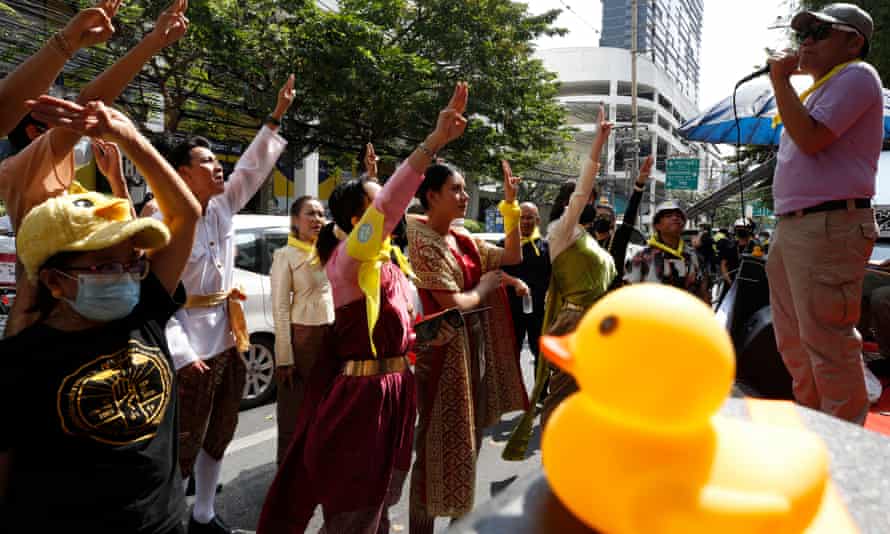
Anti-government protesters flash a three-finger salute – a gesture used adopted by protesters from the Hunger Games films – as they gather in support of people detained under the lese-majesty law at a police station in Bangkok.
Anti-government protesters flash a three-finger salute – a gesture used adopted by protesters from the Hunger Games films – as they gather in support of people detained under the lese-majesty law at a police station in Bangkok. Photograph: Narong Sangnak/EPA

Prominent protest leaders face an unusually high number of charges. This includes the student activists Parit Chiwarak, also known as Penguin, (12 charges) and Panusaya Sithijirawattanakul (six charges) and the human rights lawyer Anon Nampa (eight charges), who have given speeches calling for the power of the royals to be curbed.

The pro-democracy protest fundraiser Inthira Charoenpura
The pro-democracy protest fundraiser Inthira Charoenpura speaks from a stage outside Bang Khen police station in Bangkok. Photograph: Gemunu Amarasinghe/AP

Protesters – who have faced various other charges over recent months, including sedition – declined to participate in a government reconciliation panel in November, rejecting it as an attempt to buy time. The recent cases come after months of demonstrations in which protesters have made unusually frank and public calls for reform to the monarchy.

Benja Apan, 21, one of 13 people facing charges over a demonstration outside the German embassy in Bangkok, said legal action was unlikely to deter protesters from coming out in the new year. “I actually think it will bring more people out, because it is not fair,” she said.

The human rights group Amnesty International has launched a campaign calling on PM Prayut Chan-o-cha to drop charges pressed on a number of activists for their role in the pro-democracy movement and to repeal, or at least amend, Thailand’s draconian lèse majesté law. According to the campaign, at least 220 people, including minors, face criminal charges for relating to their actions in the pro-democracy movement. Activists are calling on government and monarchy reform, raising issues considered taboo and unprecedented in Thai society. Thailand must amend or repeal the repressive laws it is using to suppress peaceful assembly and the expression of critical and dissenting opinions.

Amnesty International is calling on people to take action and send a letter to the prime minister, calling on the Thai government to change their approach when handing the ongoing protests to protect human rights. Sample letter by AI’s campaign calls on Prayut to:

  • Immediately and unconditionally drop all criminal proceedings against protesters and others charged solely for exercising their rights to freedom of peaceful assembly and expression
  • Cease all other measures, including harassment, aimed at dissuading public participation in peaceful gatherings or silencing voices critical of the government and social issues
  • Amend or repeal legislation in order to ensure it conforms with Thailand’s international human rights obligations on freedom of peaceful assembly and expression, and to train state officials to carry out their duties confirming to Thailand’s obligation to respect, protect and fulfil the peaceful exercise of the rights to freedom of peaceful assembly and expression.

On Saturday 19 December 2020 Maya Taylor in The Thaiger had already reported that the United Nations High Commission for Human Rights has expressed shock and dismay at Thailand’s use of its strict lèse majesté law against a 16 year old pro-democracy activist. The UN High Commissioner for Human Rights’ spokesperson Ravina Shamdasani has called on Thailand to refrain from using the law against those exercising their right to freedom of speech, as she expressed alarm that a minor was being charged under the law. “It is extremely disappointing that after a period of 2 years without any cases, we are suddenly witnessing a large number of cases, and – shockingly – now also against a minor. We also remain concerned that other serious criminal charges are being filed against protesters engaged in peaceful protests in recent months, including charges of sedition and offences under the Computer Crime Act. Again, such charges have been filed against a minor, among others.”

“The UN Human Rights Committee has found that detention of individuals solely for exercising the right to freedom of expression or other human rights constitutes arbitrary arrest or detention. We also urge the government to amend the lèse majesté law and bring it into line with Article 19 of the ICCPR on the right to freedom of expression.”

Thailand’s Foreign Ministry spokesman has played down the UN High Commissioner for Human Rights’ criticisms over the kingdom’s enforcement of the Lese Majeste law.

See also in 2019: https://humanrightsdefenders.blog/2019/12/23/thailand-amnesty-and-un-rapporteur-agree-on-misuse-of-lese-majeste/

https://thethaiger.com/news/national/pro-democracy-movement-making-little-headway-monarchys-powers-remain-untouched

https://www.theguardian.com/world/2020/dec/27/un-thailand-protesters-royal-insult-law-lese-majesty

https://www.voanews.com/east-asia-pacific/new-year-new-charges-thai-protesters-slapped-royal-defamation-charges

Thailand: Amnesty and UN Rapporteur agree on misuse of lese-majeste

December 23, 2019

Thailand: Amnesty International published a special 30-page report “They Cannot Keep Us Quiet” on Wednesday 11 December 2019. It is sub-titled “The criminalization of activists, human rights defenders and others in Thailand.” It was released hours after David Kaye, the UN Special Rapporteur on freedom of opinion and expression, after meetings on Tuesday launched a scathing attack on what he called misuse of laws prohibiting defamation of the monarchy. “Thai authorities are waging a campaign to criminalise and punish dissent by targeting civil society and political activists who peacefully exercise their rights to freedom of expression and assembly,” the Amnesty report said.

Mr Kaye said at a media briefing: “Lese-majeste provisions have no place in a democratic country. I urge the authorities of Thailand to take steps to revise the country’s Criminal Code and to repeal the law that establishes a justification for criminal prosecution.”

And both singled out the refusal of the regime to back bail for dissident Jatupat Boonpatararaksa, better known as Pai Daodin.

https://wellstonjournal.com/un-envoy-amnesty-denounce-regime-ways.html

https://wellstonjournal.com/un-envoy-amnesty-denounce-regime-ways.html

Thai Human Rights Defender ‘Pai Dao Din’ jailed for 2-and-a-half years on lese majeste charge

August 16, 2017
On 15 August 2017, Jatupat Boonpattararaksa received a two and a half years jail sentence after pleading guilty to violating the lèse majesté law. The human rights defender – also known as Pai Dao Din – has been detained since 3 December 2016 in connection with his sharing of a BBC article on the life of King Vajiralongkorn on social media. Pai Dao Din, is leader of a student activist group called Dao Din based in Khon Kaen University. (https://www.frontlinedefenders.org/en/profile/jatupat-boonpattararaksa). The group advocates for community rights, social justice and democracy. He is also a member of New Democracy Movement (NDM), which opposes the military dictatorship in Thailand, a regime in place since the coup d’etat in May 2014. In May 2017, Jatupat Boonpattararaksa  was awarded the Gwangju Prize for Human Rights [https://humanrightsdefenders.blog/2017/05/10/gwangju-award-for-human-rights-defender-pai-dao-din-upsets-thai-government/]The defender was originally sentenced to five years in jail, however this sentence was reduced after he pleaded guilty to sharing material deemed insulting towards the country’s monarchy.

{While authorities did not file charges or even a complaint against the London-based BBC for publishing the article, only Jatupat was arrested. His bail requests were consistently rejected as authorities regarded lèse majesté as a serious charge possibly entailing severe punishment. Domestic and international campaigns over recent months have failed to free him on bail. Prior to the court judgment, Jatupat, who had maintained his innocence for months, agreed to plead guilty after consulting with his family and legal team to get a more lenient sentence.}

 “It appears that Jatupat was singled out, from thousands of people who shared the BBC article, and prosecuted for his strong opposition to military rule rather than any harm incurred by the monarchy,” said Brad Adams, Asia Director at Human Rights Watch. “His guilty verdict and jail sentence show yet again how Thailand’s draconian ‘insulting the monarchy’ law has been misused to punish dissenters.”

Source: Activist ‘Pai Dao Din’ jailed for 2-and-a-half years on BBC Thai article lese majeste charge

Gwangju award for human rights defender Pai Dao Din upsets Thai government

May 10, 2017
The Thai Ministry of Foreign Affairs gets upset easily as shown by the reaction to the granting of the 2017 Gwangju Prize for Human Rights (South Korea) to detained student activist Jatupat Boonpattararaksa, better known as Pai Dao Din. He has been in prison in Khon Kaen on lese majeste and computer crime charges since 22 December 2015, when 10 Khon Kaen University’s students from “Dao Din” group were arrested at the Khon Kaen Democracy Monument.

Pai Dao Din a day after the Khon Kaen court denied him bail again (FB/Jom Petchpradab)
Now the Thai ambassador to Seoul has written to the human rights award giver in South Korea asking it to ‘reconsider ‘ honouring jailed activist Jatupat Boonpattararaksa.

In a copy of the letter was acquired by the Bangkok Post (copy below):

The detained defender had been hoping to make bail so he could attend the award presentation ceremony in person, but his request was denied. In refusing Mr Jatupat’s bail requests, the Region 4 court and Khon Kaen Provincial Court described him as a flight risk who could tamper with evidence. The laureate is thus unlikely to be abel to travel on 18 May to the award ceremony in Gwangju and Mr Jatupat’s mother Prim Boonpattararaksa and her husband Viboon will represent their son and receive the award on his behalf.

National Human Rights commissioner Angkhana Neelapaijit, who won the Gwangju Award for Human Rights in 2006, described it as a prestigious accolade.

Source: Envoy queries Korea award for Jatupat | Bangkok Post: news

Thailand’s Supreme Court confirms sentence against human rights defender Chiranuch Premchaiporn

January 11, 2016


Frontline NEWlogo-2 full version - cropped

reports that on 23 December 2015, the Supreme Court confirmed the 2012 sentencing of human rights defender Ms Chiranuch Premchaiporn to eight months’ imprisonment, suspended for one year, and a fine of 20,000 baht, for failing to delete allegedly offensive comments about the Thai monarchy, which had been posted on the now-defunct Prachatai web forum.

Chiranuch Premchaiporn [https://frontlinedefenders.org/ChiranuchPremchaiporn] is executive director of Prachatai, an independent news website that reports on human rights, social and political issues in Thailand and Southeast Asia. She was the webmaster of the now defunct Prachatai web board which was set up to promote the exchange of information and opinion on Thai political and social issues. Chiranuch Premchaiporn was the recipient of the International Women’s Media Foundation Courage in Journalism Award in May 2011 and the Human Rights Watch Hellman/Hammet Award in September 2011.

The Supreme Court ruling confirmed the verdicts of the Court of Appeals and the Court of First Instance, which were made against the human rights defender in November 2013 and May 2012 respectively. Chiranuch Premchaiporn was convicted under Article 15 of the 2007 Computer Crime Act (CCA) for allowing the alleged offensive comments to remain on the Prachatai web forum for 20 days. Article 15 of the CCA states that any service provider intentionally supporting or consenting to the importation of illegal computer content, as provided for in Article 14 of the CCA, shall be subjected to the same penalty as that imposed upon a person committing an offence under Article 14.

Front Line Defenders expresses concern at the decision of the Supreme Court to confirm the sentence against Chiranuch Premchaiporn, and thus to continue the use of the Computer Crime Act to silence and intimidate human rights defenders in Thailand. Front Line Defenders fears for the potential chilling effect of the decision on the exercise of freedom of expression in Thailand, and the restrictive effect of this on the work of human rights defenders.


Thai government concedes there are problems as raised by the UN special rapporteur

May 24, 2013

The Bangkok Post of 24 May 2013 contains a nice little item that should give heart to those who work on UN special procedures and of wonder about the impact of all this advocacy work: It seems that Thailand has conceded a bit on issues raised by a UN special rapporteurs regarding freedom of expression and migrant labour, and to the fatal harassment of human rights defenders.The ‘admission’ is in a document included in 108 pages of communications involving special rapporteurs of the United Nations recently made available ahead of the 23rd session of the UN Human Rights Council.

via Thai government concedes abuses raised by a UN special rapporteur as abuses of human rights | Bangkok Post: news.