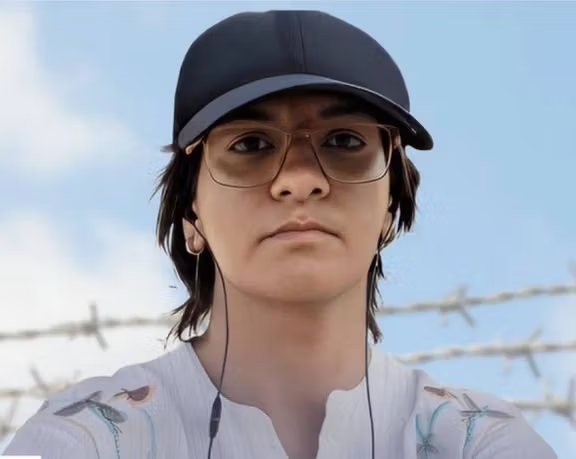
Members of the Foreign Affairs and Development Committees of the European Parliament voted on Thursday for the three finalists for the 2025 Sakharov Prize for Freedom of Thought (in alphabetical order):
-Imprisoned journalists fighting for your freedom and ours, Andrzej Poczobut from Belarus and Mzia Amaglobeli from Georgia
-Journalists and Humanitarian Aid Workers in Palestine and all conflict zones, represented by the Palestinian Journalists Syndicate, the Red Crescent, and UNRWA ;
-Serbian students
Find the biographies of the candidates and finalists by following this link.
The Conference of Presidents, comprising European Parliament President Roberta Metsola and the leaders of the political groups, will choose the 2025 laureate from this shortlist. Their decision will be announced in the Strasbourg Hemicycle during the plenary session on 22 October 2025.
After persistent speculation about the possibility of the prize going to Donald Trump [see e.g.: https://humanrightsdefenders.blog/2025/07/24/nobel-peace-prize-choice-between-trump-and-albanese/], it was announced today 10 October that the Venezuelan opposition leader María Corina Machado has won the 2025 Nobel Peace Prize, winning more recognition as a woman “who keeps the flame of democracy burning amid a growing darkness.”
The former opposition presidential candidate was lauded for being a “key, unifying figure” in the once deeply divided opposition to President Nicolás Maduro’s government, said Jørgen Watne Frydnes, chair of the Norwegian Nobel committee. “In the past year, Ms. Machado has been forced to live in hiding,” Watne Frydnes said. Despite serious threats against her life, she has remained in the country, a choice that has inspired millions. When authoritarians seize power, it is crucial to recognize courageous defenders of freedom who rise and resist.”
The Nobel Prize Committee clarified that “Maria Corina Machado meets all three criteria stated in Alfred Nobel’s will for the selection of a Peace Prize laureate. She has brought her country’s opposition together. She has never wavered in resisting the militarisation of Venezuelan society. She has been steadfast in her support for a peaceful transition to democracy.
Maria Corina Machado has shown that the tools of democracy are also the tools of peace. She embodies the hope of a different future, one where the fundamental rights of citizens are protected, and their voices are heard. In this future, people will finally be free to live in peace.”
Each year the European Parliament awards the Sakharov Prize to honour exceptional individuals and organisations defending human rights and fundamental freedoms, safeguarding the rights of minorities, and fighting for respect of international law, democracy and rule of law. Nominations are made by political groups or by at least 40 MEPs. This year’s nominations were presented during a joint meeting of the foreign affairs and development committees, and the human rights subcommittee on 23 September 2025:
Andrzej Poczobut
Andrzej Poczobut is nominated by the groups of theEuropean People’s Party and the European Conservatives and Reformists. He is a journalist, essayist and blogger from the Polish minority in Belarus, known for his criticism of Alexander Lukashenko’s regime and has become a symbolic figure in the struggle for freedom and democracy in the country.
Poczobut has been repeatedly arrested by the authorities. Detained in 2021, he was sentenced to eight years in a penal colony. He has at times been held in solitary confinement without adequate medical treatment. His current condition is unknown and his family is denied any visits. Parliament has called for his immediate and unconditional release.
The Socialists and Democratsgroup has nominated journalists and humanitarian aid workers in conflict zones represented by the Palestinian Press Association, the Palestine Red Crescent Society (PRCS), and the United Nations Relief and Works Agency (UNRWA). Gaza is identified as the world’s deadliest region for journalism, with a high number of Palestinian journalists killed. Humanitarian workers have also endured significant losses during the conflict, with deadly attacks affecting organisations such as World Central Kitchen, the PRCS and UNRWA. These individuals, through their work and sacrifices, ensure international awareness of the critical human rights situation in Gaza.
The Left group has also nominated journalists in Palestine, with a specific mention of Hamza and Wael Al-Dahdouh, Plestia Alaqad, Shireen Abu Akleh, Ain Media (in honour of Yasser Murtaja & Roshdi Sarraj), representing all the journalists active in Palestine.
Franco-Algerian writer Boualem Sansal is nominated by the Patriots for Europe group. A former senior official in Algeria’s Ministry of Industry, he began writing novels after retiring. He has received several literary awards and is known for his criticism of Islamism and the Algerian government.
In November 2024, Sansal was arrested in Algeria for “undermining national unity” following an interview with French media. In March 2025, he was sentenced to five years in prison, despite health concerns and without his French lawyer present. The sentence was later upheld on appeal. The European Parliament and French National Assembly have both called for his immediate release.
The Renew Europe group has nominated the Serbian students who initiated nationwide protests after the collapse of a railway station canopy in Novi Sad, Serbia, on 1 November 2024. This tragedy, which killed 16 people, was linked to alleged systemic corruption and infrastructural neglect. It triggered silent nationwide protests demanding accountability. The movement has transcended ideological and political divisions and now includes academic staff and students, farmers, artists, journalists, taxi drivers, engineers, and others. It culminated on 15 March 2025, when over 350,000 people gathered in Belgrade for the largest demonstration in Serbia’s post-Yugoslav history.
Budapest Pride
Budapest Pride has been nominated by the Greens/European Free Alliance group as well as by Marc Angel (S&D, Luxembourg), Kim van Sparrentak (Greens/EFA, Netherlands) and 43 other MEPs. Taking place despite a government-announced ban, 2025 Budapest Pride drew the largest attendance in the event’s history and became the seventh-largest Pride march in Europe. Despite the risks of potential police intervention, fines, and imprisonment, the march emphasised freedom of assembly and expression. By combining grassroots LGBTQ activism with support from established NGOs amid increasing government restrictions, the event has played a role in advocating for democratic values and civil liberties in Hungary.
Charlie Kirk, nominated by the Europe of Sovereign Nations group, was an American civic activist and public speaker, co-founder and CEO of Turning Point USA (TPUSA), founded in 2012 to engage students and young voters. Under his leadership, TPUSA played a significant role in youth political participation and debates on free speech on university campuses. On 10 September 2025, Charlie Kirk was shot dead during an outdoor event at Utah Valley University. The assassination has been widely condemned and highlights concerns over threats to freedom of expression.
Mzia Amaglobeli and Georgia’s pro-democracy protest movement have been nominated by Rasa Juknevičienė (EPP, Lithuania) and 60 other MEPs. Mzia Amaglobeli, a Georgian journalist and director of online media outlets, was detained in 2025 for participating in an anti-government protest and imprisoned for two years on politically motivated charges. The first female political prisoner in Georgia since its independence and a fighter for freedom of expression, she has become the symbol of Georgia’s pro-democracy protest movement that opposes the Georgian Dream regime after the October 2024 elections.
The death of a female Iranian political prisoner in hospital following a series of seizures has sparked outrage from Iran’s two Nobel laureates and right groups who have labeled her death a state-sponsored murder. Somayeh Rashididied after several days in hospital following her transfer from Qarchak Prison near Tehran, Iran’s judiciary-affiliated Mizan news agency reported on Thursday.
Rashidi, born in 1983, was detained in April for allegedly writing anti-government graffiti slogans in Tehran’s Javadieh district.
Nobel Peace laureates Narges Mohammadi condemned her death in custody, describing it as part of a pattern of abuse in detention. “This devastating loss of Somayeh Rashidi is not an accident but the result of a systematic policy of neglect and cruelty inside Iranian prisons,” Mohammadi said in a post on X.
Rights groups and activists including Nobel laureate Shirin Ebadi had previously raised alarm about Rashidi’s deteriorating condition, highlighting her urgent need for medical attention.
Iran International reported earlier this month that Rashidi’s condition had severely declined, with doctors holding little hope for her recovery.
Human rights groups including the Norway-based Iran Human Rights (IHR) have publicly called for the closure of Qarchak, describing it as “one of the darkest symbols of systematic human rights violations in the Islamic Republic.” Rashidi death comes less than a week after another prisoner, Maryam Shahraki, died in Qarchak last Friday. According to Norway-based rights group Hengaw Organizattion, three women have already died in this facility this year due to lack of adequate medical care — Jamileh Azizi on September 19, Shahraki on September 13, and Farzaneh Bijanipour on Januar
The thirteenth Václav Havel Human Rights Prize – which honours outstanding civil society action in defence of human rights – has been awarded to Ukrainian journalist and human rights defender Maksym Butkevych. The prize was presented at a special ceremony on the opening day of the autumn plenary session of the Parliamentary Assembly of the Council of Europe (PACE) in Strasbourg on 29 September 2025
Mr Butkevych is a co-founder of the Zmina Human Rights Centre and of Hromadske Radio. Despite his lifelong pacifism, he volunteered for the Ukrainian Armed Forces at the start of the 2022 Russian invasion and became a platoon commander. Captured and sentenced to 13 years in prison by Russian forces, he endured over two years of harsh imprisonment before being released in a prisoner exchange in October 2024. He remains a powerful symbol of courage and resilience in defence of justice and freedom.
The two runners-up for the 2025 Prize are Georgian journalist Mzia Amaghlobeli and Azerbaijani journalist Ulvi Hasanli. Both of them are currently detained in their home countries.
Opening the ceremony, PACE President Theodoros Rousopoulos said it was no coincidence that all three shortlisted candidates this year were journalists. Urging the immediate release of Ms Amaghlobeli and Mr Hasanli, he said: “Your voice may be silenced, but your testimony is heard loud and clear.” The President – himself a former journalist – also thanked all three candidates for their courage in opposing authoritarianism and for acting as role-models for a whole generation of journalists and human rights defenders: “Governments should not be afraid of the truth,” he declared.
IPS at this occasion published a post critical of the lack of follow up to free the laureates:
The Václav Havel Prize is an important international recognition for those who stand up for human rights and against autocracy, but while recognition through such awards and solidarity matters deeply, it is not enough. The Council of Europe must match its willingness to recognise the courage of human rights defenders with efforts to stand courageously up to autocrats and dictators, even and especially those within its own membership ranks.
For PACE leadership and members, the recognition given to human rights defenders through the Václav Havel Prize must be matched with tireless, persistent and coordinated action to put pressure on the other political bodies of the Council of Europe. This includes adopting resolutions demanding the release of imprisoned laureates; organising visibility campaigns within PACE through side events, exhibitions and public initiatives; building stronger connections and networks with families of prisoners; and consistently deploying all available diplomatic tools to keep political prisoners at the forefront of European media and diplomacy.
At the same time, CoE leaders, including the Secretary General and Commissioner for Human Rights (currently Alain Berset and Michael O’Flaherty, respectively), must put the release of political prisoners at the top of the organisation’s priority list. These leaders have important public platforms that must consistently and relentlessly raise the profile of human rights defenders at risk. Leaders must work to mobilise member states to apply pressure for the release of political prisoners.
Finally, Council of Europe member states – signatories to the European Convention on Human Rights – need to recognise that the continued detention of human rights defenders poses a great risk to the long-term credibility of the institutions. Member states – on their own and through the organisation’s powerful Committee of Ministers – have to use all tools at their disposal to address the rising cases of political prisoners and crackdowns against civil society across the broader region. The Committee of Ministers needs to put enhanced enforcement pressure on member states regarding the judgments of the European Court of Human Rights on fundamental freedoms. These judgements, after all, often affect the fate of political prisoners.[https://www.ips-journal.eu/topics/democracy-and-society/prizes-without-freedom-risk-becoming-trophies-of-hypocrisy-8573/]
The Rafto Prize 2025 has been awarded to The Emergency Response Rooms of Sudan (ERRs) for their courageous work to preserve the most fundamental human right – the right to life.
The Emergency Response Rooms of Sudan are grassroot networks that emerged in the wake of the war in Sudan in 2023. They consist of thousands of volunteers who engage in collaborative, community driven efforts to meet urgent humanitarian needs of others, at great personal risk. The ERRs save lives and maintain human dignity in a place of misery and despair.
After the brutal war between the Sudanese Armed Forces (SAF) and the Rapid Support Forces (RSF) broke out in April 2023, the Sudanese state collapsed. As a consequence, civilians have an enormous need for humanitarian assistance.In a desperate attempt to save lives, ordinary Sudanese took matters in their own hands and formed self-help groups to offer services supporting basic life, welfare, and human dignity through Emergency Response Rooms (ERRs).
The ERRs originated in Khartoum and has spread to other conflict areas of Sudan. To mitigate excessive loss of life and human suffering, ERRs provide key services such as health, food, water, body retrieval and burial. They also work on monitoring, documenting, and responding to cases of sexual violence.
The Rafto Prize 2025 honours the Emergency Response Rooms and the thousands of individuals protecting the right to life and health, who are building hope in Sudan, at tremendous risk to their own lives. The prize is also a recognition of the significance of grassroot mobilization and collective effort in ensuring basic human rights in times of conflict. The need for protection of human rights and humanitarian assistance is becoming greater by the day. In these trying times, we must all stand in solidarity with the people of Sudan.
Brian J. Dooley is an Irish human rights activist and author. He is Senior Advisor at Washington DC–based NGO Human Rights First. In October 2023 he was made an Honorary Professor of Practice at the Mitchell Institute, Queen’s University Belfast. He is a visiting scholar at University College, London (UCL). He is a prominent human rights voice on Twitter (@dooley_dooley).
From April 2020 to March 2023 he was Senior Advisor to Mary Lawlor, the United Nations Special Rapporteur on the situation of human rights defenders. He is as an advisory board member of the Gulf Centre for Human Rights, and was a visiting scholar at John Jay College, City University of New York from 2022 to 2023, and at Fordham University Law School in New York from 2019 to 2020.
He receives the award for having dedicated his career to advocating human rights and bringing greater global attention to less visible issues. Congratulations with a big DISCLAIMER : I am a good friend and admirer of Brian [see posts: https://humanrightsdefenders.blog/tag/brian-dooley/] and he has represented Human Rights First on the MEA Jury for years.
Dooley has written numerous reports on human rights defenders and human rights issues based on research in countries including Bahrain, Egypt, China (Hong Kong), Hungary, Kenya, Lebanon, Northern Ireland, Palestine, Ukraine, the USA (Guantanamo), and the United Arab Emirates. His efforts have played a crucial role in exposing human rights violations, and he has actively supported justice in conflict areas, including Ukraine and Northern Ireland.
Commenting on the Award, Brian Dooley said: “This is such a great honour for me, and I’m very grateful to the University of Oslo for recognising my work. I’ve been very lucky over decades that my work with Amnesty International, with The Gulf Centre for Human Rights, with Mary Lawlor – the Special Rapporteur on Human Rights Defenders – and with Human Rights First has enabled me to meet and work with Human Rights Defenders working in some of the most difficult places in the world. Too often great work by local activists in wars or revolutions, or those living under oppression, goes unseen and unreported. This award helps bring attention to this work, and to those who do it.”
Brian will receive his Award during the Oslo Peace Days this coming December.
This year’s theme is Exploitation and trafficking of children Applications are open to individuals or non-governmental organisations involved in one or more field projects based on a human rights approach and aimed at preventing and combating child trafficking and exploitation. Preference will be given to applications that, in accordance with children’s rights, aim to:
provide comprehensive support for young people;
implement transformative and restorative actions;
ensure the active participation of the children themselves in the project.
The projects submitted will focus on defending and protecting children against trafficking and exploitation through programmes such as:
raising awareness among the general public and the authorities;
identifying and referring victims;
receiving, supporting and rehabilitating child victims;
training for stakeholders (police, justice, medical and social services, education, etc.);
advocacy for the implementation of legal tools or the development of public policies to combat and prevent trafficking;
access to justice and reparations.
Award
The five prize winners will be invited to Paris for the official ceremony. They will receive a medal and share a total sum of 70.000 €, awarded by the CNCDH, to be used to implement their projects. They may introduce themselves as 2025 laureates of the Human Rights Prize of the French Republic.
Five runners-up will be awarded a “special mention” medal by the French ambassador in their country of origin. Runners-up will not receive any financial endowment.
The application must be written in French and include:
a) A letter of application presented and signed by the president or legal representative of the NGO concerned, or by the individual candidate;
b) The application form, which is attached to this call for applications and can be
c) A presentation of the NGO (statutes, operations, etc.), where appropriate.
d) The postal address and bank details (included IBAN and SWIFT Code) of the NGO or individual candidate.
Candidates must send their complete application by the deadline of 14 September 2025 to the Secretariat-General of the CNCDH:CNCDH – for the attention of Cécile RIOU-BATISTA, TSA 40 720 – 20 avenue de Ségur, 75 007 PARIS – France or by email to: prixdesdroitsdelhomme@cncdh.fr
Once the panel has announced the results, the 2025 Prize will be awarded in Paris by the Prime Minister, or another French minister, around 10 December 2025.
The prize honours the memory of Swedish diplomat Raoul Wallenberg. The deadline for applications is 31 October 2025. The award ceremony will take place in Strasbourg around 17 January – the date of Raoul Wallenberg’s arrest by Soviet forces in 1945 and subsequent disappearance. The call for nominations is available on the Council of Europe’s website. The winner of the 2024 edition was Croatian Neva Tölle, who has spent her life working to protect women from domestic violence.
No-one will have missed the recent media hype surrounding the opposite candidacies of US President Trump and UN rapporteur Francesca Albanese for this year’s Nobel Peace Prize. This blog with its focus on human rights defenders and their awards would be amiss in not taking note, even if the Nobel Prize is foremost a peace prize not necessarly a human rights award. [see also my piece of 2012 https://global.comminit.com/content/nobel-prize-peace-not-necessarily-human-rights]
So, it is not excluded that the ‘making peace at any cost’ considerations will prevail, but my bet is that the Peace Prize Committee will be careful in ignoring the massive support from the world’s human rights community who have massively come out against the Trump administration’s sanctions against Albanese. Human rights should trump ‘peace’ on this occasion.
Nominations for a Nobel Peace Prize for Francesca Albanese are gathering steam. See the links below: