Author Archive

Satire as a weapon: Malaysian cartoonists showed the way

April 4, 2019
Having blogged about cartoonists as human rights defenders (se e.g.https://humanrightsdefenders.blog/2016/05/19/urgent-award-winning-cartoonist-zunar-threats-malaysia-support/), it is a pleasure to refer to a long piece in CNN  written by James Griffiths on 29th March 2019: “The cartoonists who helped take down a Malaysian prime minister”. The story is enriched by many of the cartoons that landed the cartoonists in trouble.
For Malaysians, the figure pictured (below) is instantly recognizable as Rosmah Mansor, wife of disgraced former Prime Minister Najib Razak and — according to prosecutors in the US and Malaysia — a modern day Imelda Marcos who accrued luxury goods worth millions of dollars using money embezzled from the state investment fund, 1MDB.
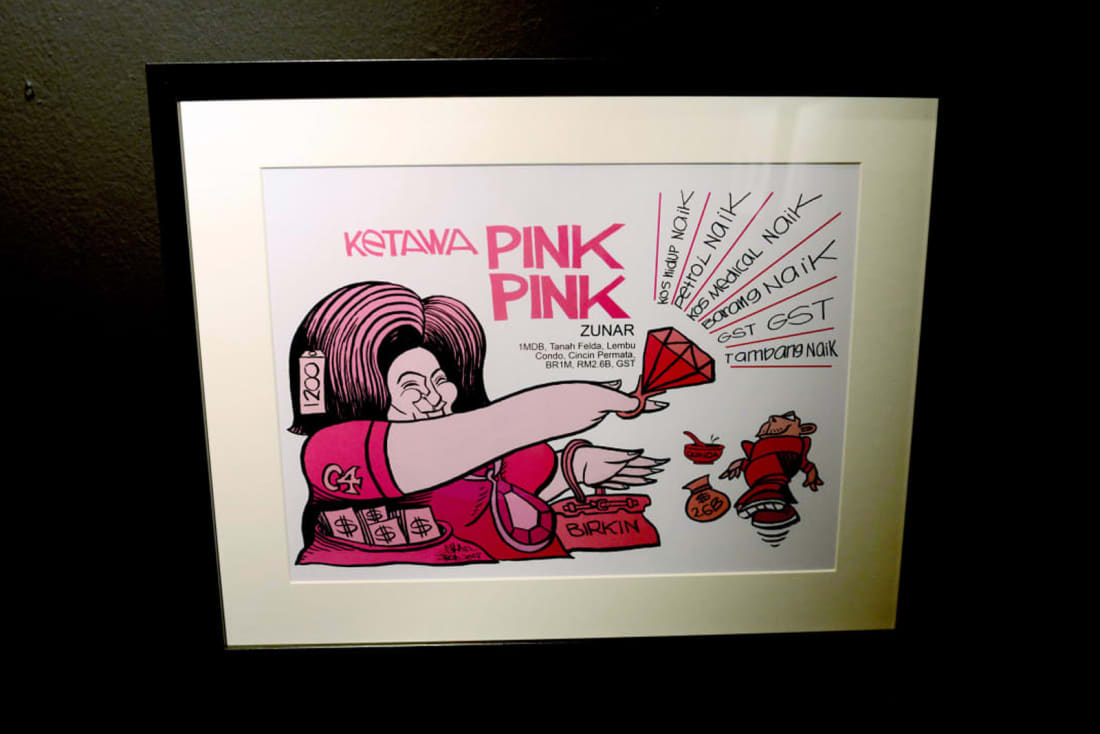
A cartoon of former Malaysian first lady Rosmah Mansor by Zunar is seen in a gallery in Kuala Lumpur.

A cartoon of former Malaysian first lady Rosmah Mansor by Zunar is seen in a gallery in Kuala Lumpur. Credit: James Griffiths/CNN
Zunar‘s work welcomes visitors to “Democracy in Action,” a recent exhibition that would have been impossible to stage only a year ago.
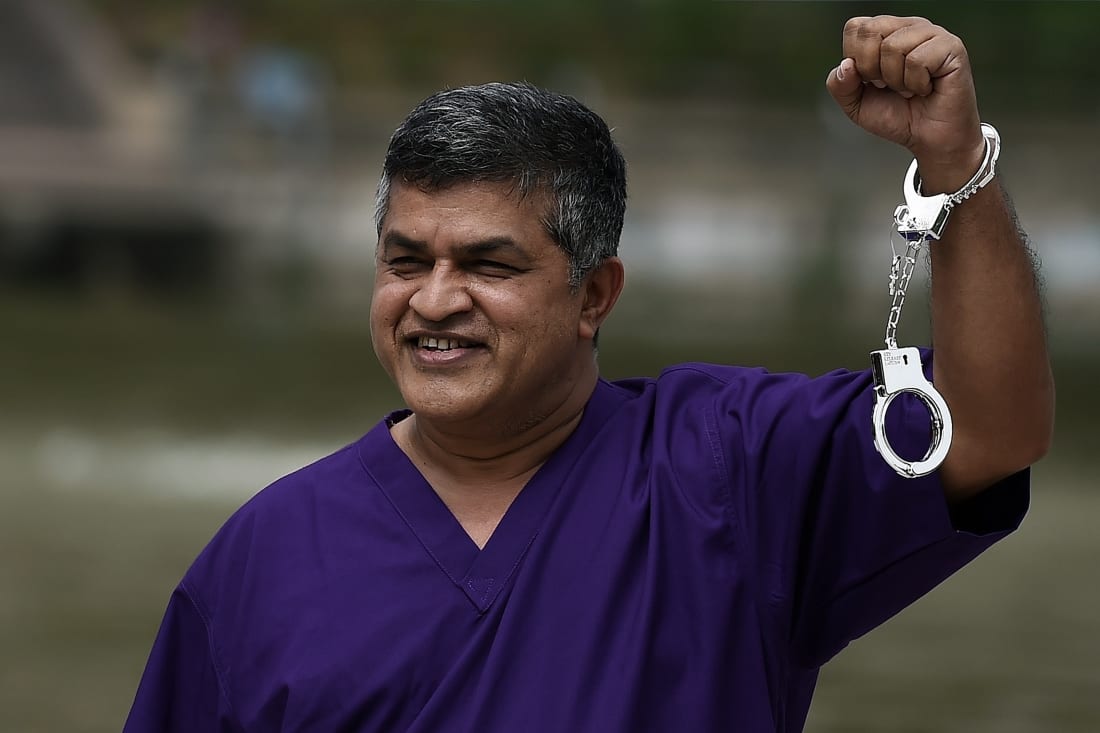
Malaysian cartoonist Zulkifli Anwar Ulhaque, popularly known as Zunar, poses with handcuffs prior to a book-launch event in Kuala Lumpur on February 14, 2015.
Malaysian cartoonist Zunar, poses with handcuffs prior to a book-launch event in Kuala Lumpur on February 14, 2015. Credit: MANAN VATSYAYANA/AFP/AFP/Getty Images
..Just last year, it seemed almost certain that Zunar would end up in prison. A number of his books had been banned, and while his work was still widely shared online, the artist faced multiple charges of sedition and committing acts deemed “detrimental to parliamentary democracy.” Unknown assailants attacked him at a gallery show, police seized his works and he was banned from leaving the country. Then, in a shock election result, a coalition of opposition parties turfed Najib out of office, promising to clamp down on corruption and reverse the country’s turn toward authoritarianism. Now Zunar is watching as his the political figures who were once his nemeses and muses face decades behind bars themselves — in part because artists like him helped bring attention to their alleged corruption and disdain for the rule of law. “The medium of cartooning is (a) very powerful medium,” Zunar told CNN at his small studio in a Kuala Lumpur suburb. “Everywhere, in any country you go, (cartoonists) get killed. Cartoonists, get arrested, put in jail everywhere because of the medium.
Fellow artist Fahmi Reza, who also faced prosecution under Najib, said this is partly because of cartoons’ unique ability to poke fun at those in power. “Using satire and humor is effective because it breaks the fear barrier,” he said in a phone interview. “People had always been afraid to speak out. The culture of fear is always there; the culture of self-censorship is always there. That’s where satire and humor can be the most effective tool, it makes people less afraid.
In June 2016, Fahmi Reza was charged with two counts of violating section 233(1) of the Communications and Multimedia Act, which forbids disseminating online content deemed to annoy, abuse, threaten or harass others. Fahmi had depicted Najib as a clown with big red lips and arched, thick eyebrows. The image quickly caught on with Malaysians sick of the widespread allegations of corruption, and it soon became a common sight at anti-government protests.
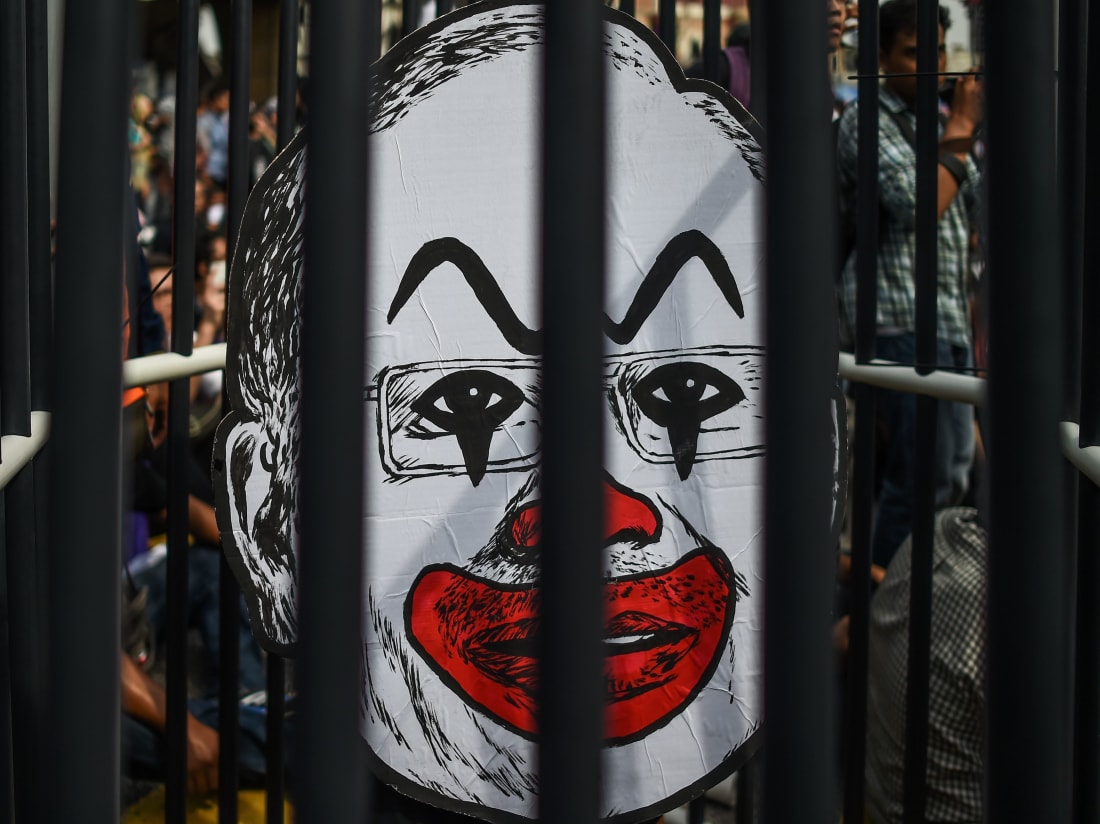
A caricature of Malaysian Prime Minister by artist Fahmi Reza. The artwork almost landed Fahmi in prison.
A caricature of Malaysian Prime Minister by artist Fahmi Reza. The artwork almost landed Fahmi in prison. Credit: MOHD RASFAN/AFP/AFP/Getty Images
Like Zunar, Fahmi had a record of trouble with the authorities. ….. “One sign that whatever you’re doing is effective is when the authorities and people in power react,” he added. “If they ignore it, then there’s no impact. That’s how the whole clown thing became a symbol of protest — because of the overreaction by the authorities.
Both cartoonists’ arrests made international headlines, helping to highlight Najib’s growing authoritarianism to the outside world. Protesters also delighted in using the caricatures of Najib and Rosmah on posters and placards after it was revealed how much the artists had irritated them. As Malaysia’s opposition grew ever more determined to oust Najib — with many observers warning that 2016’s general election might be their last chance to do so — the government passed new legislation to control what people could say about it.
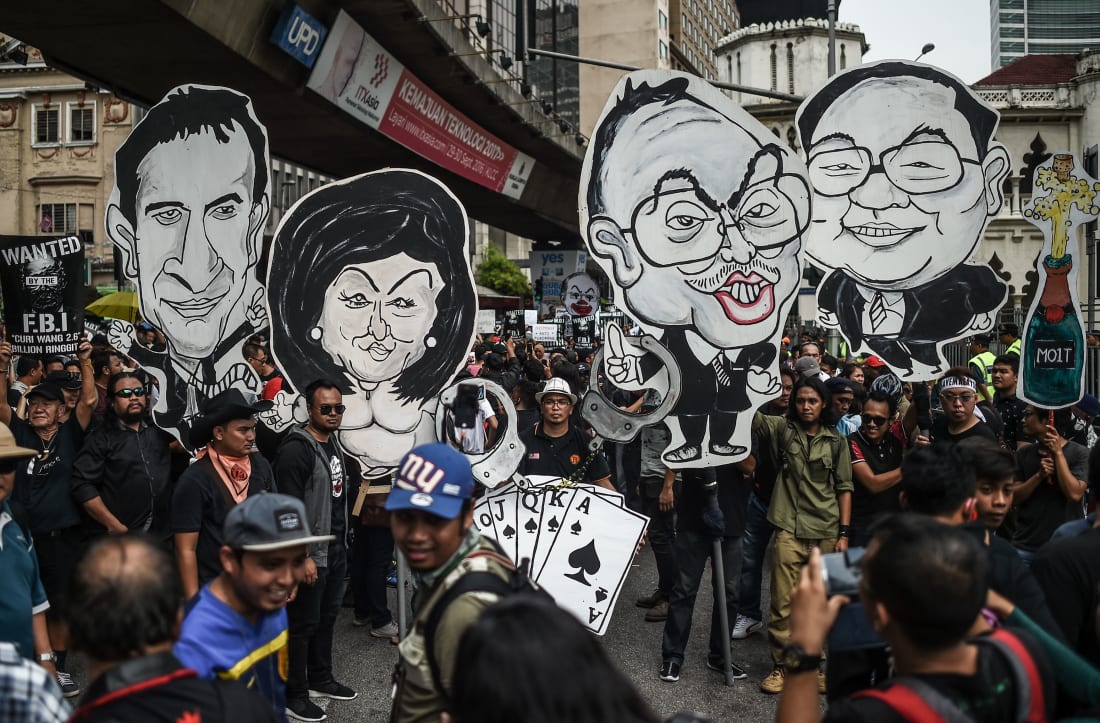
Activists hold up caricatures of Najib Razak and Rosmah Mansor (center). Political art became a key tool of protest in Malaysia during Najib's rule.

Activists hold up caricatures of Najib Razak and Rosmah Mansor (center). Political art became a key tool of protest in Malaysia during Najib’s rule. Credit: MOHD RASFAN/AFP/AFP/Getty Images
In early 2018, it introduced a new law to crack down on “fake news” that critics said was so broadly defined that it could easily be used to shut down and criminalize criticism of Najib.
Eventually however, the wave of dissent was too great for Najib to overcome. ….Since Najib’s downfall, charges against Zunar and Fahmi have been dropped, though the latter is still fighting to have an earlier conviction overturned. Both men said that, while they felt considerably freer under the new government, true reform has yet to be delivered.
For some other posts on cartoons, see: https://humanrightsdefenders.blog/tag/cartoons/
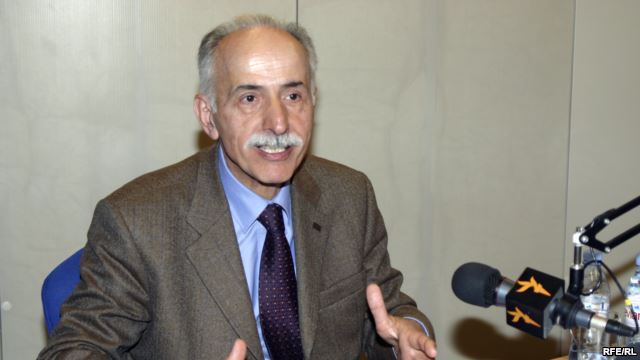
Iran: just when you think that it cannot get worse….Ebrahim Raisi get appointed

April 4, 2019

It’s an Insult:” says human right defender Karim Lahiji about Iran’s new Chief Justice Ebrahim Raisi. His predecessor Sadegh Larijani was already a serious problem but this seems worse. [see e.g.: https://humanrightsdefenders.blog/2014/02/02/larijani-brothers-iran-attack-un-rapporteur-and-human-rights-defenders/].

Abdolkarim Lahiji worked for decades as a defense attorney in Iran taking on politically sensitive cases involving activists, religious minorities and dissidents.

The appointment by Iran’s Supreme Leader Ali Khamenei of a known human rights violator to head the country’s judiciary is a prelude to dark days ahead for human and civil rights defenders, Iranian attorney Abdolkarim Lahiji told the Center for Human Rights in Iran (CHRI).

In a wide-ranging interview, Lahiji, who for decades worked as a prominent attorney and human rights activist in Iran until going into exile in France, discussed the events leading up to Raisi’s appointment to chief justice in early March 2019. Before his appointment, Raisi, 58, held top positions in the country’s judiciary, including Tehran prosecutor and chief prosecutor for the clergy, as well as membership in the Assembly of Experts and the Expediency Council. In 1988, Raisi served on Iran’s so-called “death commissions,” which were set up shortly after the end of the Iran-Iraq war (1980-1988) by order of then-Supreme Leader Ayatollah Ruhollah Khomeini, who wanted to crush opposition to the state.

Many of the prisoners executed after being interviewed by the inquisition-like commissions set up around the country were supporters of the Mojahedin-e Khalgh (MEK), but communists, members of the Fadaian-e Khalgh and other opposition groups were targeted as well. The estimated 4,000-5,000 prisoners—actual numbers could be higher—who were secretly killed in prisons throughout the country and dumped in mass graves had already been issued prison sentences before they were suddenly sent to the gallows.

Raisi now takes the reigns of the judiciary from Sadegh Larijani, who was chief justice of Iran from August 2009 until March 2019. At least 15 political prisoners died in state custody under Larijani’s watch. All of the cases were closed without fair and unbiased investigations and no one in the judiciary was ever held accountable for these deaths.

Lahiji, who defended political prisoners during Larijani’s rule, discussed what lies ahead for human rights defenders under Raisi. For excerpts of the interview follow the link below:

https://www.iranhumanrights.org/2019/04/its-an-insult-human-rights-attorney-condemns-irans-new-judiciary-chief-ebrahim-raisi/

Martin Ennals Foundation in Geneva seeks part-time Coordinator – deadline 29 April

April 4, 2019

With the departure of Michael Khambatta – planned for June 2019 –  the Martin Ennals Foundation (MEF) seeks a part-time Coordinator to lead a new, restructured team of (part-time) posts in Geneva.

Part-time 60 % (3 days per week, flexible). Languages: Fluent French and English. Start date: June/July 2019

The MEF has a Board of up to 12 members, led by a Chairperson elected by the Board. It includes a Vice-Chairperson, a Secretary and a Treasurer who together make up the Governance Committee that is entrusted with overseeing the routine business of the Foundation. The Coordinator is the executive arm of the MEF working on a part-time basis until additional resources can be found to strengthen staff capacity. Other staff include (as at June 2019) a Communications Manager and a Programme Officer (also part-time positions).

To apply please send:

1) a current CV and

2) a motivational cover letter of 500 words

to hr@martinennalsaward.org by 26 April 2019. Interviews will take place between 7-10 May 2019 in Geneva, Switzerland. Only shortlisted candidates will be contacted.

——- Read the rest of this entry »

In memoriam human rights defender Tejshree Thapa of Human Rights Watch

April 3, 2019

Flash mob in support of Sotoudeh in Hong Kong concert

April 2, 2019


Activists ‘flash mob’ Iranian concert to protest jailing of rights lawyer Nasrin Sotoudeh

A Hong Kong concert organised by the Iranian Consulate on 25 March 2019 was met with protesters who decried the jailing of human rights lawyer Nasrin Sotoudeh. [See: https://humanrightsdefenders.blog/2019/03/12/iran-cracks-down-on-nasrin-sotoudeh-and-other-human-rights-defenders/]

Around 20 activists staged a silent protest at the City Hall foyer, just before the start of a concert titled “Songs of Persia.” Venue staff did not intervene, as the protesters revealed black t-shirts stating “Free Nasrin Sotoudeh” The event was presented by the Iranian Consulate as part of a week-long cultural celebration.

We revealed our t-shirts in a quiet, dignified way, in the lobby… I would say everyone who went into the concert saw our protest,” one of the organisers – who did not wish to be named – told HKFP. She added that concertgoers took photos, and many already were familiar with Sotoudeh’s plight. One attendee told the group that Sotoudeh was his lawyer.

https://www.hongkongfp.com/2019/03/25/just-pictures-protesters-decry-jailing-iranian-rights-lawyer-nasrin-sotoudeh-hong-kong-concert/

Launch of the Fragile States Index 2019 on 10 April in Geneva

April 1, 2019

The Fund for Peace and the The New Humanitarian (see: https://humanrightsdefenders.blog/tag/the-new-humanitarian/) will launch on Wednesday 10 April 2019, 18:15 – 20:00 CET their  FRAGILE STATES INDEX 2019 in the Maison de la Paix, Geneva.

Following a tumultuous year around the globe, Cameroon, Brazil, the United Kingdom, and Venezuela are among the countries that have fallen furthest down the Fragile States Index (FSI).

The event is to discuss the findings of the 15th FSI and its relevance to the humanitarian sector at the Graduate Institute’s Centre on Conflict, Development and Peacebuilding (CCDP). The event, jointly convened between the Graduate Institute, The New Humanitarian, and Fund for Peace, will feature a briefing on the FSI and its findings for 2019 and a panel discussion on the changing humanitarian focus on fragile states and the role of the media in chronicling the immediate and long-term impact of social, political, and economic pressures on lives and livelihoods around the world.

The FSI annually highlights the current trends in social, economic and political pressures that affect all states, but can strain some beyond their capacity to cope. Linking robust social science with modern technology, the FSI is unique in its integration of quantitative data with data produced using content-analysis software, processing information from millions of publicly available documents. The result is an empirically-based, comprehensive ranking of the pressures experienced by 178 nations. The Index is used by policy makers, civil society, academics, journalists, investors, and businesses around the world.

For those not in Geneva: the live stream of the event on website.


Profile of Nayaali Ramirez Espinosa, indigenous rights defender of the Maya

March 31, 2019

Last year ISHR interviewed Nayaali Ramirez Espinosa, a lawyer providing legal assistance to Mayan communities in the region of Holpelchén, in the State of Campeche in Mexico. She expresses her satisfaction with some legal achievements such as the indigenous consultation in the region. It was published on 13 December, 2018.

Seven persons charged in South Sudan, including Peter Biar Ajak

March 30, 2019

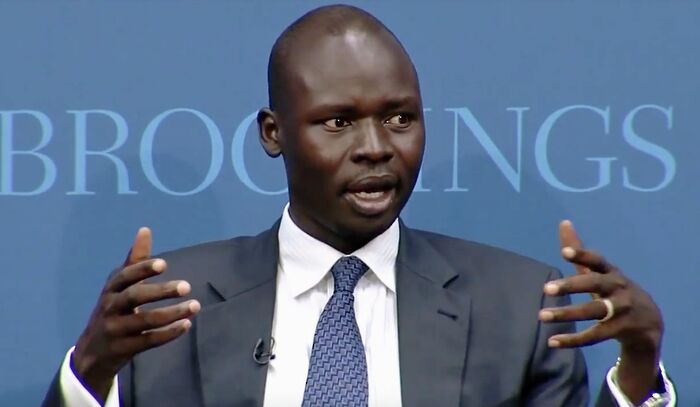
It clearly helps to get attention for a human rights defender in trouble if there is a connection to a western country as shown in the case of Cambridge PhD student Peter Biar Ajak who was with charged with sabotage and insurgency in South Sudan.

Jared Genser, an international human rights lawyer who took on Ajak’s case, called the recent charges “unequivocally false”, telling Newsweek that his client “was not involved in any way in the planning or execution of the protest.”

Ajak was originally detained by the NSS at Juba International Airport on 28th July 2018, and has still not been formally charged for anything relating to this initial arrest eight months ago.

Ajak had been an outspoken critic of the South Sudanese government’s response to the country’s ongoing civil war. He is a chairperson of the South Sudan Young Leaders Forum, and was arrested while on the way to an event held by the Red Army Foundation, an organisation created by former child soldiers to advocate for peace and address social issues in the country.

Shortly before his arrest Ajak had tweeted that: “We must stop thinking that the so-called leaders will bring peace #SouthSudan. We, the great people of #southsudan, must organize ourselves to bring about the peace we deserve!”

Over the past few months there has been mounting international pressure on the South Sudanese government to release Ajak and others who have been similarly detained. Detaining a person without charge for more than 24 hours is illegal under the South Sudanese constitution.

The United Nations condemned Ajak’s continued detention earlier this month, citing a “clear trend in the use of national security and counter-terrorism legislation by states to criminalize free expression and the legitimate work of human rights defenders.”

Mountain View

In September 2018, Vice-Chancellor Stephen Toope wrote a letter to the President of the Republic of South Sudan. Ajak’s cause has also been championed by international human rights organisation Amnesty International.

https://www.varsity.co.uk/news/17369

https://www.sfgate.com/news/crime/article/7-in-South-Sudan-charged-with-sabotage-and-13714433.php

NGO statement condemns new irregularities in the case of Germain Rukuki, Burundi

March 29, 2019
On 27 March 2019, 21 international and Burundian human rights organisations condemn new irregularities in the case of Germain Rukuki in a Joint statement:

Almost four months after his appeal hearing at the Bujumbura Court of Appeal on 26 November 2018, the judicial case file of Burundian human rights defender, Germain Rukuki, has gone missing. In December 2018, the Government of Burundi decided to divide the Bujumbura Court of Appeal into three separate appeal courts, and the file apparently went missing during the reorganization.

Germain is appealing against his wrongful conviction by the Ntahangwa High Court and 32-year prison sentence, the longest prison sentence imposed on a human rights defender in Burundi. He is still awaiting the Court’s decision, which was initially expected within 30-days of the appeal hearing.

The loss of his case file further violates Germain Rukuki’s right to a fair trial, in addition to the multiple irregularities and undue delays that have characterized the legal proceedings since his arrest in July 2017.

We, the undersigned non-governmental organisations, strongly condemn this blatant miscarriage of justice and insist that Germain’s conviction is unlawful and part of a pattern of systematic attacks against human rights defenders and dissent voices since 2015, as echoed by the international human rights community, international and national civil society, as well as the United Nations and the Commission of Inquiry on Burundi in its reportreleased in September 2018.

We, the undersigned organisations, call on Burundian authorities to:

  • Release Germain Rukuki immediately and unconditionally, and quash his conviction and sentence;
  • Comply with international and regional human rights standards, notably the rights to freedom of expression, association and peaceful assembly, and the right to a fair trial;
  • Until he is released, ensure Germain Rukuki and his lawyer have timely and adequate access to his case file;
  • Launch an immediate, effective, impartial and transparent investigation into the circumstances of and responsibility for the loss of Germain Rukuki’s file;
  • Recognise the legitimacy of human rights work in Burundi and ensure a safe and enabling environment in which it is possible to defend and promote human rights without fear of punishment, reprisal or intimidation…..

For the list of Signatories, see link below: https://www.defenddefenders.org/statement/burundi-21-international-and-burundian-human-rights-organisations-condemn-new-irregularities-in-the-case-of-germain-rukuki/

3 Saudi women human rights defenders released but for how long? And what about the others?

March 28, 2019
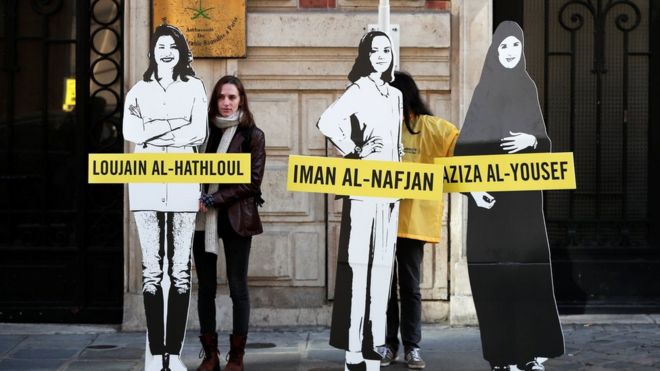
Amnesty International urges Saudi authorities to release activists Loujain al-Hathloul, Eman al-Nafjan and Aziza al-Yousef, outside the Saudi Arabian embassy in Paris, March 8, 2019
Protesters called for the female activists’ release at the Saudi embassy in Paris last month – copyright REUTERS

Media just reported that Saudi Arabia has temporarily released three female human rights defenders facing charges related to human rights work and contacting foreigners. Two sources told Reuters that three women had been released, and more would be freed on Sunday.[see: https://humanrightsdefenders.blog/2019/03/13/saudi-arabia-persist-with-trial-for-women-human-rights-defenders/]

Amnesty International and UK-based Saudi rights organisation, ALQST, named the women as Eman al-Nafjan, Aziza al-Yousef and Roqaya al-Mohareb. Saudi state media said the releases were only provisional. Lynn Maalouf from Amnesty welcomed the releases but said it should not be on a temporary basis. “They have been locked up, separated from their loved ones, subjected to torture and threats for simply peacefully calling for women’s rights and expressing their views,” she said.

https://www.bbc.co.uk/news/world-middle-east-47731946