Posts Tagged ‘Violence against women’

New study shows that on-line attacks against women human rights defenders doubled

December 16, 2025
Stressed businesswoman working on laptop at home, tired freelancer

On 15 December 2025 Emma Woollacott, in Forbes, referred to a new study that shows that 7 in 10 women human rights defenders, activists and journalists have experienced online violence in the course of their work. Produced through the UN Women’s ACT to End Violence against Women program and supported by the European Commission, “Tipping point: The chilling escalation of violence against women in the public sphere” draws on a global survey of women from 119 countries.

Along with online threats and harassment, more than 4 in 10 have experienced offline harm linked to online abuse — more than twice as many as in 2020, the researchers found. This can range from verbal harassment right up to physical assault, stalking and swatting.

“These figures confirm that digital violence is not virtual — it’s real violence with real-world consequences,” said Sarah Hendricks, director of policy, programme and intergovernmental division at UN Women.

“Women who speak up for our human rights, report the news or lead social movements are being targeted with abuse designed to shame, silence and push them out of public debate. Increasingly, those attacks do not stop at the screen — they end at women’s front doors. We cannot allow online spaces to become platforms for intimidation that silence women and undermine democracy.”

And AI is only making things worse, with almost 1 in 4 women human rights defenders, activists and journalists having experienced AI-assisted online violence, such as deepfake imagery and manipulated content. This is most often the case for writers and public communicators who focus on human rights issues, such as social media content creators and influencers, for whom the figure reaches 30%.

“Gender-based online violence is not a new phenomenon, but its scale certainly is,” said report co-author Lea Hellmueller, associate professor in journalism at City St George’s and associate dean for research in the School of Communication and Creativity.

“AI tools enable the production of cheaper and faster abusive content, which is detrimental to women in public life — and beyond,” Hellmueller added.

Tech firms are partly responsible, the researchers said, with the report calling for better tools to identify, monitor, report and fend off AI-assisted online violence. The researchers also want to see more legal and regulatory mechanisms to force tech firms to prevent their technologies being deployed against women in the public sphere.

“Our next steps include publishing data from the survey about the opportunities for, and barriers to, law enforcement and legal redress for survivors of online violence,” said Julie Posetti, chair of the Centre for Journalism and Democracy at City St George’s, University of London, one of the authors of the report. “We will also focus on creative efforts to counter gender-based online violence and policy recommendations to help hold the Big Tech facilitators of this dangerous phenomenon accountable.”

https://www.forbes.com/sites/emmawoollacott/2025/12/15/online-attacks-against-women-human-rights-workers-double-in-five-years/

https://www.globalissues.org/news/2025/12/15/41907

https://theconversation.com/ai-tools-are-being-used-to-subject-women-in-public-life-to-online-violence-271703

Defamation Campaign against Syrian woman rights defender Hiba Ezzideen Al- Hajji

April 25, 2025

On 23 April 2025 Front Line Defenders expressed its serious concern for Syrian woman human right defender Hiba Ezzideen Al-Hajji, as well as her family and the ‘Equity and Empowerment’ organisation, who are being targeted by a defamation campaign on Facebook which seeks to incite violence against them. The online campaign, initiated both by individuals known to support the new government and unknown users, has targeted Hiba Ezzideen Al-Hajii for a Facebook post she made on 20 April 2025, in which she advocated against forced marriages. This bombardment of defamatory messages has included calls for violence, including death threats, constituting a clear case of harassment.

Hiba Ezzideen Al-Hajji is a Syrian feminist and woman human rights defender. She is the CEO of the Equity and Empowerment organisation and the Chairperson of the Board of Directors in Shan network for peace building. Equity and Empowerment is a women-led organisation which works on gender equality, focusing on digital security, economic and political empowerment. [see also: https://humanrightsdefenders.blog/2023/08/10/syrian-woman-human-rights-defender-hiba-ezzideen-al-hajji-threatened/]

Since 20 April 2025, Hiba Ezzideen Al-Hajii’s Facebook account, through which she posted about women’s rights, has been used to start a defamation campaign and incite violence against her, as well as her family and the Equity and Empowerment organisation, both based in Idlib, Syria. The online campaign has led to Hiba Ezzideen Al-Hajii receiving numerous death threats on the social media platform, both through private messages and through a flood of posts on her own account, as well as on Equity and Empowerment’s page. The online mob, formed by unknown users, have urged followers to post defamatory content against her online and called for physical violence, inciting people to burn down the center of Equity and Empowerment in Idlib, with the objective of killing Hiba Ezzideen Al-Hajii and harming her family. They have distorted the meaning of an old video, in which she stated that it is unnecessary to use the veil in the centers of Equity and Empowerment where there are only women, to falsely accuse her of insulting the Hijab and Islam. The online mob have also attempted to distort her Facebook post in which she urged authorities to investigate cases of women’s abduction, in order to allow for accountability.

Several public figures have taken advantage of this defamation campaign in order to falsely accuse the woman rights defender of being an agent to Assad security branches, despite her clear stands against the Assad regime and extensive record of human rights activism against it. Subsequently, on 22 April, the police in Idlib closed down the center of Equity and Empowerment. Furthermore, the governor of Idlib announced via Facebook that he has requested the public prosecutor to file a lawsuit against Hiba Ezzideen Al-Hajii for insulting the hijab. The woman human rights defender has expressed a profound concern for her personal safety and well-being. She has reported fearing for her life, as well as the lives of her family and team at Equity and Empowerment.

Front Line Defenders condemns the defamation and online campaign seeking to incite violence, as well as subsequent acts of intimidation against woman human rights defender Hiba Ezzideen Al-Hajii, her family and her organisation Equity and Empowerment. Front Line Defenders believes that the defamation campaign and online harassment is directly related to Hiba Ezzideen Al-Hajji’s work in the defence of human rights, particularly her work towards the promotion of women’s rights in Syria.

Front Line Defenders also expresses concern with the recurrent use of Facebook as a tool to incite violence against woman human rights defenders in Syria. The organisation urges Meta to immediately take down all Facebook posts against woman human rights defender Hiba Ezzideen Al-Hajii and her organisation Equity and Empowerment, suspend any groups, pages and profiles used to defame her or organise attacks and incite violence against her and her organisation, while also storing data that is relevant for future investigations and accountability. Meta must fulfill their responsibility to protect human rights, in accordance with international human rights standards. They must take the necessary steps to guarantee the safety of human rights defenders online, ensuring their platforms do not contribute to violent and dangerous campaigns, or allow users to incite targeted violence against defenders, particularly woman human rights defenders, which puts their lives at serious risk. Front Line Defenders stands ready to assist Meta with identifying the defamatory and violent content in question and the accounts on which they are hosted or shared.

https://www.frontlinedefenders.org/en/statement-report/syria-defamation-campaign-against-woman-rights-defender-hiba-ezzideen-al-hajji

Documentary “Silence of Reason” wins human rights award at Sarajevo Film Festival 2023

August 29, 2023

For the Hollywood Reporter, Eliza Whitfield on 19 August 2023 gives the result of the Sarajevo Film Festival 2023:

……Macedonian filmmaker Kumjana Novakova won the human rights award, given to the film in the Sarajevo competition that best addresses human rights issues, for her documentary Silence of Reason, which used the archives of the international court of human rights in the Hague to explore how violence against women was used as a weapon of war in the Bosnian War.

Nvoakova took part in the public discussion held in Sarajevo on Thursday into the artistic and media representations of violence against women. The discussion was held on a day of national mourning across Bosnia and Herzegovina called in response to a shocking triple-murder suicide in the northeastern Bosnian town of Gradacac last week, in which a man live-streamed the murder of his ex-wife. The Sarajevo festival suspended its regular programming, with the public discussion as the only event of the day.

As part of the festival, a public discussion was held in Sarajevo to examine the artistic and media representations of violence against women. The discussion took place on a day of national mourning in response to a tragic triple-murder suicide in the town of Gradacac. The Sarajevo festival suspended its regular programming to prioritize this important conversation.

TODAY: International Day for the Elimination of Violence against Women,

November 25, 2021

Women and girls everywhere continue to be subjected to multiple forms of gender-based violence, including femicide, online violence and domestic violence, UN and regional experts (for impressive list see below) said today. They call on States to exercise due diligence and to fight pushbacks on gender equality.

On the International Day for the Elimination of Violence against Women, they issue the following statement: [see also: https://humanrightsdefenders.blog/2019/11/19/16-days-of-activism-against-gender-based-violence-start-on-25-november-2019/]

“Although they represent more than half the world’s population, women and girls the world over are still at risk of being killed and subject to violence, intimidation and harassment when they speak out – for the simple fact of being women and girls. Violence against women and girls is the result of intersectional forms of social, political, economic, racial, caste and cultural discrimination perpetrated daily against women and girls in all of their diversity, including in the context of armed conflict, and States and the international community have the obligation mandated by international human rights law and standards to address this violence. Together, these forms of discrimination not only aggravate the intensity and frequency of violence but also sharpen the impunity that exists against it and increase societal and individual readiness to allow it.

Of particular concern is the fact that not only women and girls continue to be subjected to multiple manifestations of violence but that the spaces where this violence takes place have also multiplied. Nowhere is this more apparent than within online spaces, including social media. Governments, private companies and others may seek to hide their responsibilities behind the seemingly “borderless” nature of the internet. But human rights are universal and, as such, there is one human rights regime that protects the rights of women and girls offline as well as online, and that demands zero tolerance for violence against women and girls in the digital space. Violence against women and girls flourishes because those who seek to silence women and girls and facilitate their exploitation, abuse, maiming and killing are not firmly prevented from and held accountable for their actions.

It is unacceptable that in today’s world where humanity and life on this planet faces the existential threats of climate change and toxic pollution amidst a proliferation of conflict; the COVID-19 pandemic has killed at least 5 million people and infected at least 250 million worldwide in less than two years, also causing an increase in domestic violence against women, that women and girls are unable to participate fully in responding to these threats or in the search for solutions because they are discriminated, abused and continue to suffer violence, including sexual violence, exploitation and death on the basis of their sex, gender, sexual orientation and gender identity. These global crises interact with and further deepen pre-existing inequalities as well as legal, institutional and policy gaps to eliminate gender-based violence against women and girls, which in many cases, worsen them. Indigenous women, internally displaced women, women with disabilities, lesbian and transgender women and women belonging to other vulnerable or marginalized groups are particularly affected by the failure of these policies to prevent such violence, as well as protect and assist survivors.

While a number of States, non-state actors and other stakeholders have stepped up their interventions and resource allocations to prevent and respond to gender-based violence against women and girls, more effort in terms of both financial and non-financial interventions is needed to make these approaches truly transformative, particularly with regards to prevention, to avoid that policies remain ‘gender blind’, ‘gender exploitative’ or ‘race neutral’. Many of these policies do not disaggregate data based on social and racial constructs which discriminate, marginalize, exclude, and violate women and girls. These policies need to transform the prevailing social, economic and political systems that produce, nurture, and maintain gender inequality and drive violence against women and girls everywhere, through increased investment in their education and skills development, access to information, social services and financial resources, and support for positive representation and images in public discourse and social media. Collectively, they need to do more to challenge the patriarchal social norms and constructs of masculinity, femininity, racism and casteism that are based on extremely harmful stereotypes and which can cause psychological, physical, emotional and economical harm, including for women of colour, including those of African descent. These stereotypes pervade state institutions as evidenced by the lack of accountability for many cases before law enforcement and justice systems. States must also ensure access to comprehensive physical and mental care for survivors of gender-based violence, as part of the full range of quality sexual and reproductive health care that must be available for all.

Collective effort is required to stop the reversal of progress made in ending violence against women across the world and to counter the backlash against gender equality and the tenets of human rights-based legislation and governance. Those responsible for these regressive steps often begin by attempts to co-opt the justice system, change or issue new legislation and curtail fundamental rights and freedoms for women and girls, such as their freedom of thought, expression and association, their right to peaceful assembly, freedom of association, freedom of thought and, in particular, their sexual and reproductive rights. All human rights are inalienable, interdependent and exist without a hierarchy, despite the efforts of some actors to sacrifice some of these rights at the expense of others, often in the name of their own cultural or religious norms and their particular perception of societal harmony.

Women and girls around the world need to be heard; their voices should not be silenced nor their experiences go unnoticed. Women will never gain their dignity until their human rights are protected. Women’s rights are human rights. Women and girls’ agency and participation in all processes that affect their rights and lives need to be promoted and protected at all costs. States should ensure and create an enabling environment for women to exercise their fundamental freedoms of expression, association, peaceful assembly and public participation free from intimidation and attacks. States must exercise their due diligence obligation and protect women human rights defenders, activists and women’s organizations who are regularly harassed, intimidated and subjected to violence for defending their rights and promoting equality. The level and frequency of violence against them should raise alarm bells everywhere. It is, and should be, a public policy and a human rights priority.

If we want to gauge the underlying health, security and prosperity of a society, we all need to address our duty to play a part in the respect and furtherance of women and girls’ rights. There will be no prosperity without ending violence against women and girls in the public as well as in the private sphere.

There will be no ending of violence against women and girls if we don’t recognize and protect the dignity, rights and security of women and girls everywhere and at all times.” ENDS

*The experts:

Platform of independent expert mechanisms on the elimination of discrimination and violence against women (EDVAW Platform): Reem Alsalem*, Special Rapporteur on violence against women, its causes and consequences; ****Melissa Upreti ****(Chair), **Dorothy Estrada Tanck **(Vice-Chair), Elizabeth Broderick, Ivana Radačić, and **Meskerem Geset Techane, ***Working Group on discrimination against women and girls*; ****Gladys Acosta Vargas, ***Chairperson of the UN Committee on the Elimination of Discrimination against Women;* Margarette May Macaulay******, ****Rapporteur on the Rights of Women of the Inter-American Commission on Human Rights**; Iris Luarasi, President of the Group of Experts on Action against Violence against Women and Domestic Violence of the Council of Europe; Tatiana Rein Venegas**, President of the* Committee of Experts of the Follow-up Mechanism to the Belém do Pará Convention*; Maria Teresa Manuela, Special Rapporteur on the Rights of Women in Africa.*

Obiora Okafor*, Independent Expert on human rights and international solidarity; Javaid Rehman, Special Rapporteur on the situation of human rights in the Islamic Republic of Iran; Fabian Salvioli, Special Rapporteur on the promotion of truth, justice, reparation and guarantees of non-recurrence; Marcos A. Orellana, Special Rapporteur on the implications for human rights of the environmentally sound management and disposal of hazardous substances and wastes; Francisco Cali Tzay, Special Rapporteur on the rights of indigenous peoples; Vitit Muntarbhorn,*Special Rapporteur on the situation of human rights in Cambodia*; Mama Fatima Singhateh, Special Rapporteur on the sale and sexual exploitation of children; Mary Lawlor, Special Rapporteur on the situation of human rights defenders; **Victor Madrigal-Borloz, ***Independent Expert on Protection against violence and discrimination based on sexual orientation and gender identity*; ****Alioune Tine****, Independent Expert on the situation of human rights in Mali; **Sorcha MacLeod (Chair-Rapporteur), Jelena Aparac, Ravindran Daniel, Chris Kwaja, ***Working Group on the use of mercenaries*; Gerard Quinn****, ****Special Rapporteur on the rights of persons with disabilities*; Livingstone Sewanyana*, Independent Expert on the promotion of a democratic and equitable international order; ****Fionnuala Ní Aoláin****, Special Rapporteur on the promotion and protection of human rights while countering terrorism; Cecilia Jimenez-Damary, Special Rapporteur on the human rights of internally displaced persons;** Saad Alfarargi, Special Rapporteur on the right to development; **Tomoya Obokata, Special Rapporteur on contemporary forms of slavery, including its causes and consequences; Fernand de Varennes****, Special Rapporteur on minority issues; Yao Agbetse, Independent Expert on the situation of Human Rights in the Central African Republic; **Nils Melzer, ***Special Rapporteur on torture and other cruel, inhuman or degrading treatment or punishment*; Felipe González Morales, Special Rapporteur on the human rights of migrants; Balakrishnan Rajagopal, Special Rapporteur on the right to adequate housing; Tlaleng Mofokeng, Special Rapporteur on the right to health; Attiya Waris, Independent Expert on debt, other international financial obligations and human rights; Pedro Arrojo Agudo, Special Rapporteur on the human rights to safe drinking water and sanitation;****Elina Steinerte**** (Chair-Rapporteur), ****Ms. Miriam Estrada-Castillo**** (Vice-Chair), ****Ms. Leigh Toomey****, ****Mr. Mumba Malila****, ****Ms. Priya Gopalan****, Working Group on arbitrary detention;** Michael Fakhri, Special Rapporteur on the right to food; Ahmed Shaheed, Special Rapporteur on freedom of religion or belief; Muluka Anne Miti-Drummond,Independent Expert on the enjoyment of human rights by persons with albinism; Siobhán Mullally, Special Rapporteur on trafficking in persons, especially women and children; Clément Nyaletsossi Voule, Special Rapporteur on the rights to freedom of peaceful assembly and of association**; **Isha Dyfan, ***Independent Expert on the situation of human rights in Somalia* ; ****Luciano Hazan (****Chair-Rapporteur),**** Aua Balde ****(Vice-Chair),**** Gabriella Citroni, Henrikas Mickevicius**** and ****Tae-Ung Baik, ***Working Group on Enforced or Involuntary Disappearances*; ****Alexandra Xanthaki, ***Special Rapporteur in the field of cultural rights;* **Morris Tidball-Binz ***Special Rapporteur on extrajudicial, summary or arbitrary executions*; Anais Marin, Special rapporteur on the situation of human rights in Belarus; Surya Deva (Chairperson), Elżbieta Karska (Vice-Chairperson), Githu Muigai, Fernanda Hopenhaym, and Anita Ramasastry, Working Group on Business and Human Rights; David Boyd, Special Rapporteur on human rights and the environment; Ms. Dominique Day (Chair), Ms. **Catherine S. Namakula (Vice-Chair), Ms. Miriam Ekiudoko,** Mr. Sushil Raj, Ms. Barbara G. Reynolds Working Group of Experts on People of African Descent; **Irene Khan, ***Special Rapporteur on the right to freedom of opinion and expression.

See also:

https://www.coe.int/en/web/commissioner/-/combating-violence-against-women-in-a-digital-age-utilising-the-istanbul-convention-grevio-general-recommendation-no-1-on-the-digital-dimension-of-vio

https://www.unhcr.org/news/stories/2021/11/619e0ae14/refugee-women-lead-combating-gender-based-violence.html

https://reliefweb.int/report/world/violence-targeting-women-politics-trends-targets-types-and-perpetrators-political

“We Will Stop Femicide” winner of gender equality award 2021

November 23, 2021

On 23 November, 2021 urdupoint.com reported that the Turkish human rights Platform “We Will Stop Femicide” has received the international prize for gender equality (IGEP), the Finnish Cabinet said on Monday. For more on this and similar awards, see: https://www.trueheroesfilms.org/thedigest/awards/ef066ac0-e59c-11e7-8845-81361f38ae62

We Will Stop Femicide was founded in 2010 to provide legal help to Turkish women facing abuse at home. It has been chosen as the winner out of about 400 applicants.

We are proud to announce the winner of the #IGEP 2021, WE WILL STOP FEMICIDE PLATFORM, a non-governmental organization that does groundbreaking work combating violence against women in Turkey and whose work has a global relevance. Congratulations!” the award’s organizers posted on Twitter.

The prize was awarded in the Finnish city of Tampere to the founder of the organization, Gulsum Onal, by Finnish Prime Minister Sanna Marin.

“The work of the We Will Stop Femicide Platform includes decision meetings, educational activities, informative seminars, mass protests, and a variety of correspondence meetings. The association seeks to work with provincial and district assemblies to ensure gender equality nationwide in Turkey,” Marin said.

She further stressed the importance of a global effort to end violence against women and called on the international community to ensure protection of women‘s rights in all countries.

Nobel Peace Laureate Nadia Murad also attended the ceremony.

https://www.urdupoint.com/en/world/turkish-human-rights-activists-awarded-finnis-1407890.html

16 Days of Activism for the Elimination of Gender-Based Violence start on 25 November 2020

November 6, 2020

On 5 November 2020 this journal reminded us that from 25 November to 10 December many organizations and groups will highlight the 16 Days of Activism for the Elimination of Gender-Based Violence. [for 2019 see: https://humanrightsdefenders.blog/2019/11/19/16-days-of-activism-against-gender-based-violence-start-on-25-november-2019/]

This international advocacy campaign highlights days like the International Day for the Elimination of Gender-Based Violence (November 25); the International Day of Women Human Rights Defenders (November 29); the National Day of Remembrance and Action on Violence against Women (December 6); and International Human Rights Day (December 10).

The UN System’s 16 Days of Activism against Gender-Based Violence activities will take place under the 2020 global theme: “Orange the World: Fund, Respond, Prevent, Collect!”

UNITE To end violence against women

As the world retreated inside homes due to the lockdown measures introduced to curb the COVID-19 pandemic, reports showed an alarming increase in the already existing pandemic of violence against women.

You can make a difference during the ongoing COVID-19 pandemic and protracted state of crisis it has generated across the world. You can support women and girl survivors of violence to stay safe and free of violence. Take action during this year’s 16 Days of Activism to End Gender-Based Violence. For more information about “Orange the World: Fund, Respond, Prevent, Collect!” and action ideas, see this year’s concept note.

This year, organizations are joining forces to gather positive words and messages of strength, hope and resiliency. Until 18 November, organizers are asking their partners, clients and the general public to submit positive written messages. These words will be used to design a piece of artwork, which will be unveiled on 10 December on social media.

https://www.unwomen.org/en/what-we-do/ending-violence-against-women/take-action/16-days-of-activism

https://www.ohchr.org/EN/Issues/Women/WRGS/Pages/16DaysOfActivism.aspx

Women human rights defenders in focus at 43rd Human Rights Council

February 27, 2020

UN High Commissioner for Human Rights, Bachelet, taking part in a panel discussion, held at the UN Human Rights Council on Tuesday 25 February 2020, said that the Beijing Declaration should be celebrated but noted that the Plan of Action agreed at the event is still unfinished. According to Ms. Bachelet, the risks of setbacks to women’s rights are real, and growing. ….”Women’s rights are threatened and attacked” on many fronts, she warned, adding that there over this period there has been “a backlash and the resurgence of gender inequality narratives based on age-old discrimination”. Ms. Bachelet also welcomed the speech delivered to the Human Rights Council by UN Secretary-General António Guterres on Monday. As part of his Call to Action for human rights [see https://humanrightsdefenders.blog/2020/02/25/43rd-session-hrc-un-secretary-general-launches-call-to-action-on-human-rights/], He called on every country to “support policies and legislation that promote gender equality, to repeal discriminatory laws, to end violence against women and girls and to strive for equal representation and participation of women in all areas”.

Against this backdrop the NGO side eventWomen human rights defenders radically transforming a world in crisis” is most timely.

Wednesday 4 March 2020, 11:00 – 12:00, Room XXVII Palais des Nations, Geneva. This event is co-hosted by ISHR, Amnesty International, Global Fund for Women, Urgent Action Fund, Mesoamerican Initiative of women human rights defenders, and Just Associates (JASS).

Panellists:

  • Michel Forst, UN Special Rapporteur on the situation of Human Rights Defenders
  • Nazik Awad, Sudan
  • Aurelia Martin Arzu Rochez, Honduras
  • Luz Mary Rosero Garces, Colombia
  • Fatima Bentaleb, France
  • Hasmida Karim, Indonesia

Moderator:

  • Zephanie Repollo, Just Associates (JASS)

THE THREE WOMEN: audio from AfricanDefenders

December 1, 2019

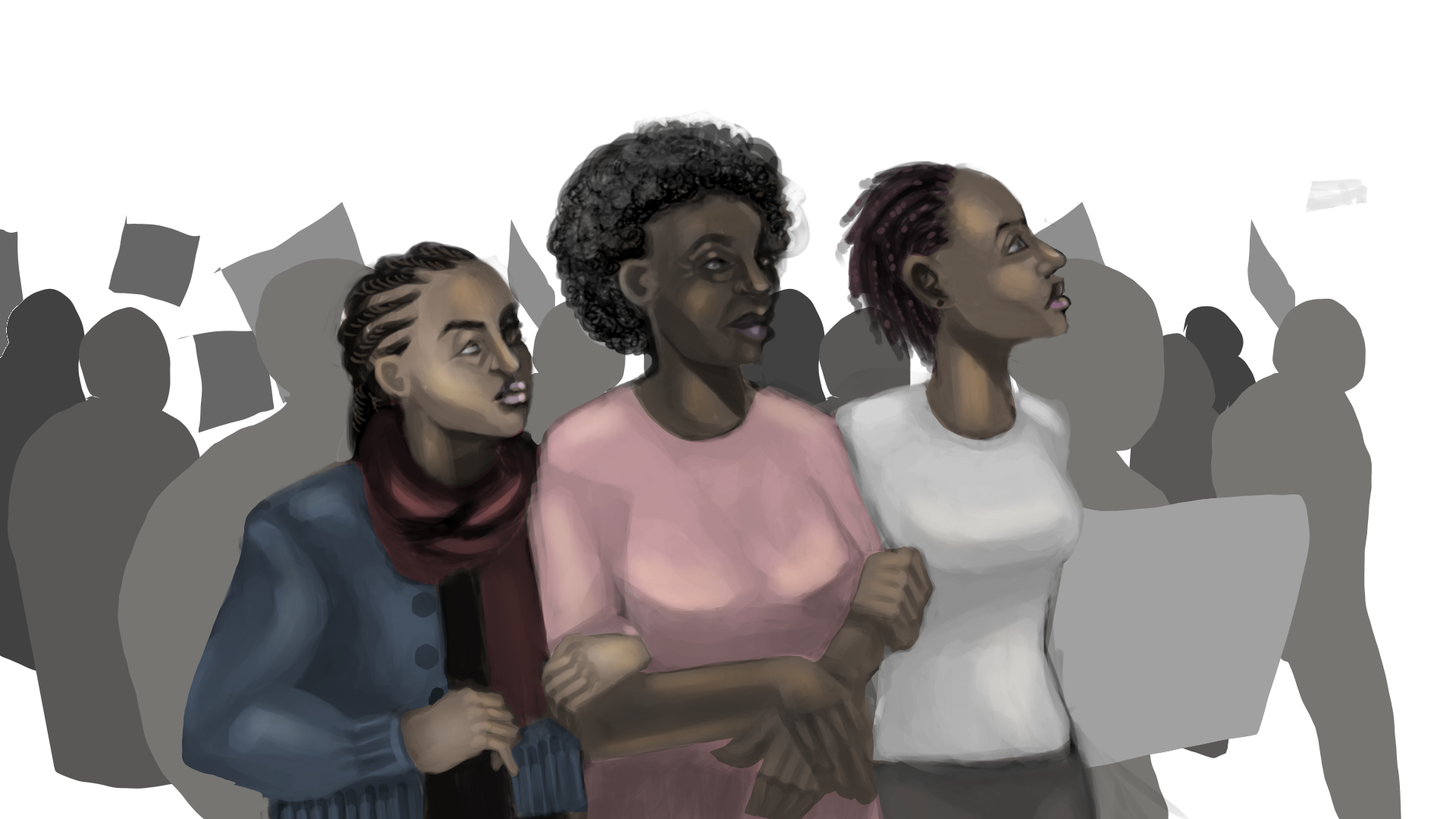
AfricanDefenders & DefendDefenders launched on 29 November 2019 their audio campaign about African women human rights defenders and courage, simply called THE THREE WOMEN”. The story by Gentrix Barasa and beautiful Illustrations by Primordial M. Here is the first episode (https://twitter.com/hashtag/IAmTheThreeWomen) in the context of the 16 Days Campaign Against Gender Based Violence:

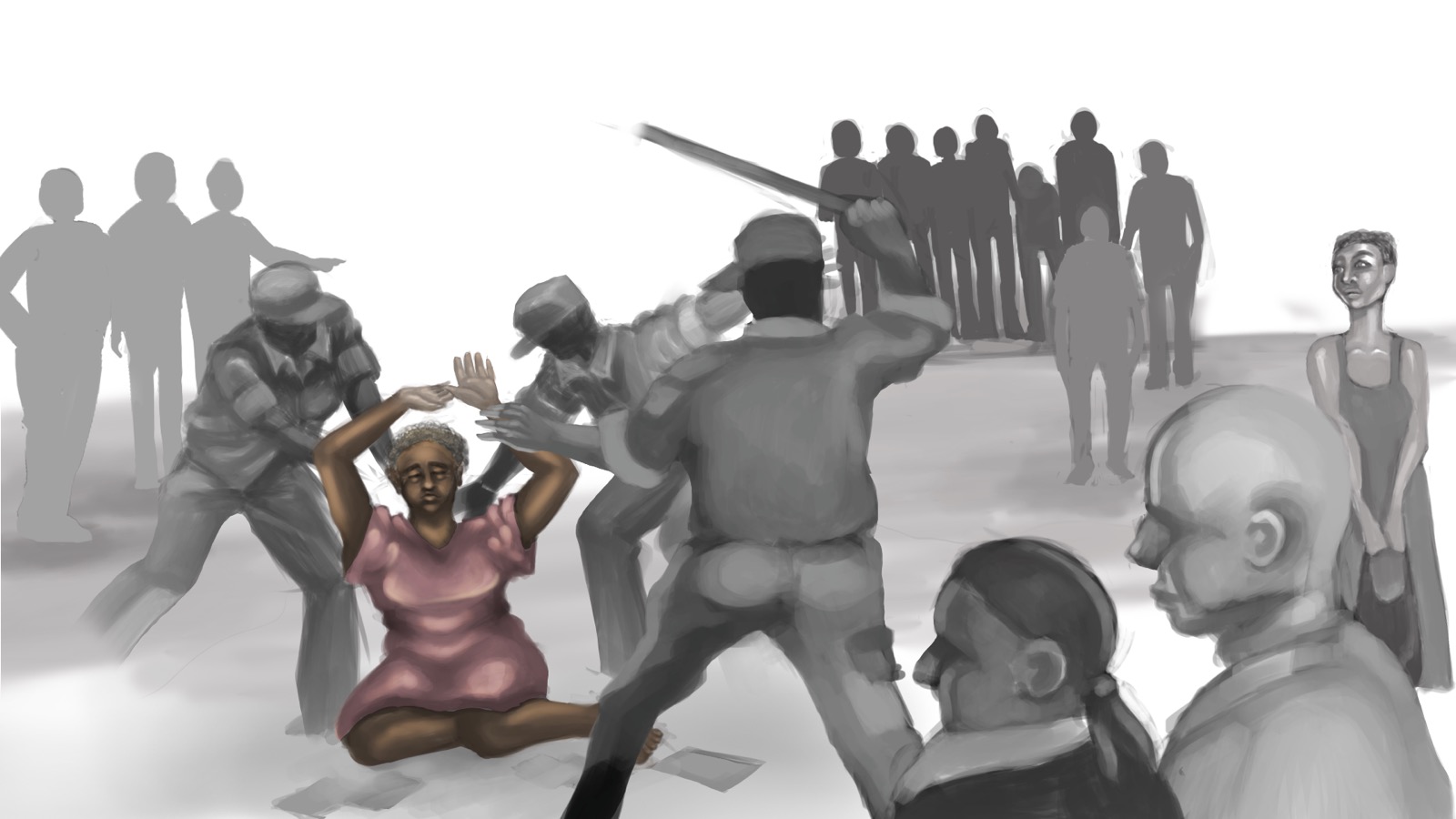
THE STORY OF MARTHA. A woman could be heard screaming from a distance in the town square. The distinct sound of a whip hitting her body could be heard reverberating throughout the town. A small crowd of onlookers were gathering around quietly, curious to see what was going on and to find out why this woman was being beaten. Nuru was rushing home so she could prepare lunch when she spotted the crowd of onlookers. Despite being aware that she would get in trouble with her father if she was late, she was drawn towards the woman.

“What is going on?” she asked the man standing beside her.

“Oh, Martha started with her nonsense again. They should beat that devil out of her.”

The men in the town, especially the elders, did not appreciate when women challenged societal norms. In their mind, Martha was turning their wives and daughters against them with all this talk of women’s rights and liberation. They had complained to the mayor of the town, Mr. Tapiwa, when they caught wind of the women’s march that Martha was organising.

“This one is from Tapiwa,” one of the policemen said before hitting Martha.

“I heard she is secretly a man,” Nuru heard a woman whisper, “why else would she behave like this? This is not how women are supposed to behave.”

“I heard she is just trying to break our marriages, so we are miserable and alone like her,” another whispered.

“She is a witch. She does not even have children and she is trying to tell us how to bring up our daughters.”

“I heard she is a prostitute. She is just trying to corrupt us,” the whispers continued.

“I feel bad for her, but she should know that activism is not the work of a woman,” a man chimed in.

The police eventually stopped harassing and beating Martha, before taking off. The crowd slowly dispersed, without offering her any help. Eventually, Nuru was the only one left.

She looked around nervously as if trying to make sure no one was looking. As much as she felt sorry for her, she was scared to go against the people of the town. She did not want to be an outcast like Martha. When she was sure no one was looking, she reached out for Martha’s hand helping her to her feet.

“Why did they do this to you?” Nuru asked, while watching the older woman wince in pain as she started walking.

“I was fighting for your rights.”

“What do you mean my rights?”

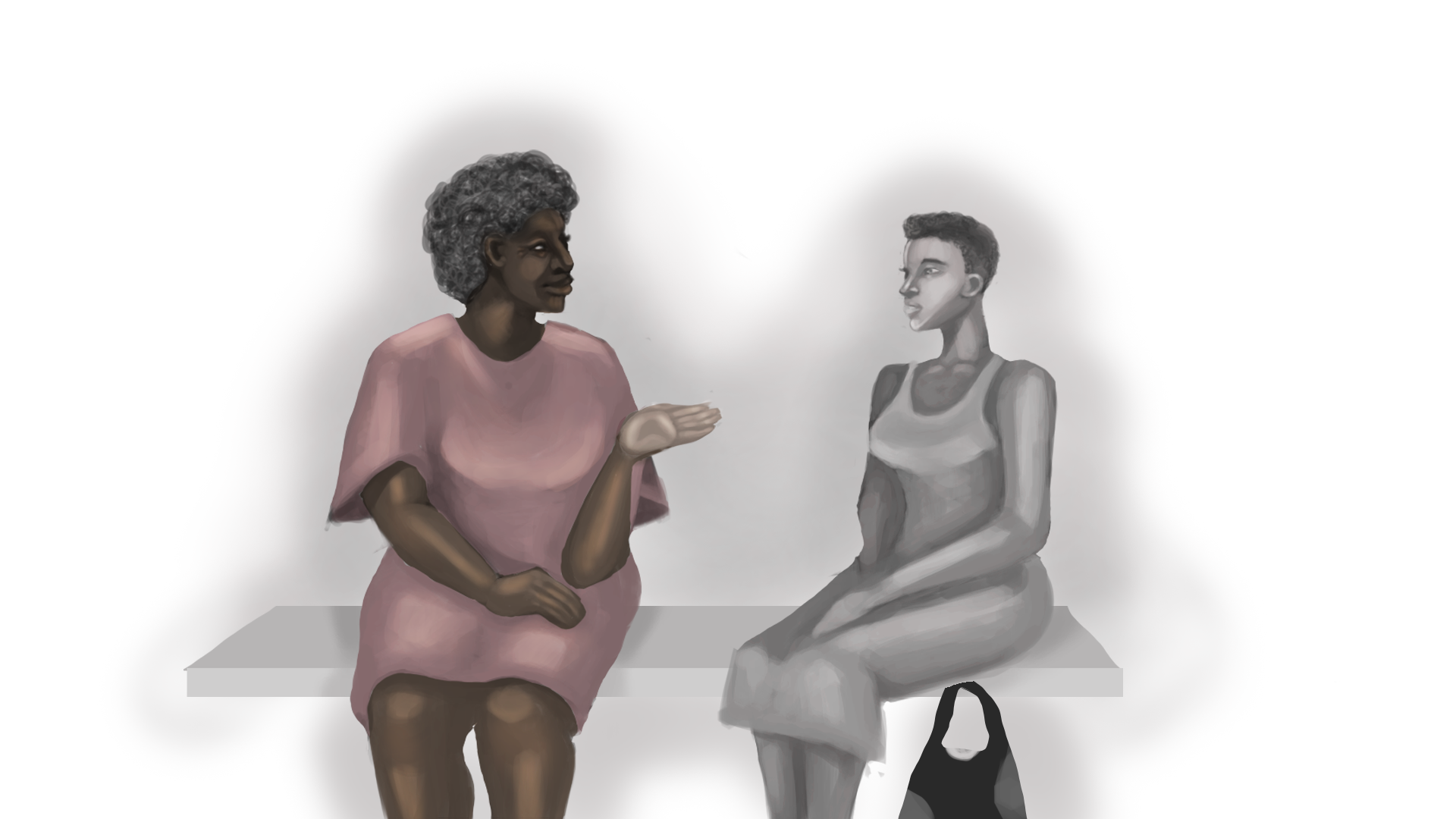
Martha gestured at a nearby bench for them to sit on.

“Don’t you want to live in a world where you have choices?” Martha asked.

“I do have choices. I make choices every day,” Nuru said defensively.

Martha looked at Nuru, slightly raising an eyebrow. “Did you know you could own property, get an education, be equal to your father and brothers?” Martha continued.

Nuru stared into the distance with a look of longing. She had always wanted more for herself, but she had come to accept her life. Also, she was too scared to go against her father. “My father would never allow it, “she finally said.

Martha reached into her bag and retrieved a card. “This organisation can help you to learn more about your rights and can find you a good school. It is not his place to allow it. It is your right.”

Nuru hesitantly took the card and quickly pocketed it, afraid someone would see.

“I heard you are organising a march tomorrow.”

Martha nodded and handed her a flier with all the information about the march. “You don’t have to come to this if you don’t want to, but at least think about what I told you.”

Nuru nodded while gathering her things. She was still not quite sure if she would dare to go against her father, after all, who would take care of the house? “You are really nice,” Nuru said. She felt like Martha needed to hear some kind words. Then, Nuru took off.

Despite a restless night and the pain from the beating, Martha got up early the next morning to get ready for the march. The beating was the worst she had gotten since she started being outspoken about women’s rights. She had received calls and text messages all morning from people backing out of her march. It had worked – the beating had served as a warning to anyone planning to participate. Martha felt ashamed to admit it to herself, but they were really close to breaking her. She had tried so hard to not let them win, but that beating might have been the straw that broke the camel’s back.

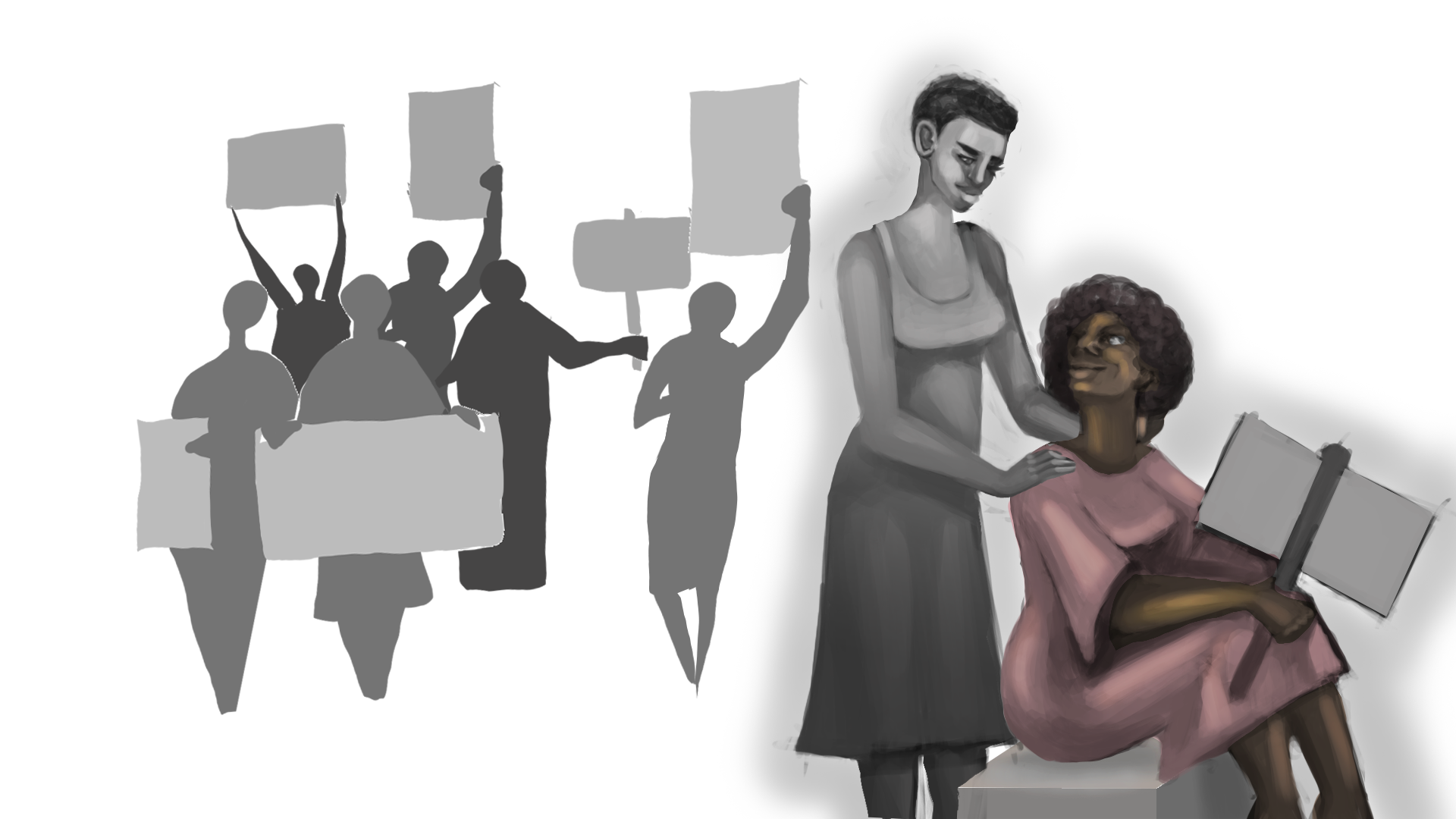
She held out hope that at least one other person would show up, but she had been standing there for an hour. At that point, it was apparent that the march was a complete failure. In that moment, it was hard to remember why she was fighting so hard for this. As she sat down on the side of the road, with the sign Don’t tell me how to dress – tell them not to rape, next to her, a single teardrop ran down her face. With a sigh she reached out for the sign, resigning to go home. Instead of feeling the wooden base of the sign, she felt a hand touching hers. She looked up in panic, expecting to see the policemen from the previous day. Instead, it was Nuru.

“What are you doing here?” Martha asked in a confused tone, quickly drying her tears.

“We want to fight for our rights.”

“We?” asked Martha, even more confused. She then saw a group of women behind Nuru.

“We came to stand with you and all the women and girls in town,” Nuru said.

Martha smiled. She stood up grabbing the rest of the signs and handing them out to the group. They started chanting the slogans on the signs, marching towards Mr. Tapiwa’s office.


THE THREE WOMEN

Media have critical role in breaking silence on violence against women

November 23, 2019

Swapna Majumdar wrote in the Daily Pioneer of 22 November 2019 “Don’t muzzle their voices”  about what role the media can play in the discourse on violence against women, human rights and empowerment?  Can it help survivors? How can the media be leveraged to change perceptions and end gender-based violence?

These are some of the questions that came up at the International Conference on Population and Development (ICPD+25) Summit held in Nairobi recently. A session focussed on the importance of the media in either shifting or perpetuating attitudes toward  gender-based violence in the context of the ICPD. [see also: https://humanrightsdefenders.blog/2019/11/19/16-days-of-activism-against-gender-based-violence-start-on-25-november-2019/]

“Violence against women is a human rights violation. Violence is about silencing us and the media is about breaking the silence. The media has a critical role to see that this silence is broken and women’s voices are amplified,” said Ing Kantha Phavi, Minister of Women’s Affairs of Cambodia. … However, the persistence of social stereotyping and social attitudes towards women prevented them from seeking help and services. This is where the media can help as it continues to play a crucial role globally in key conversations. The way gender-based violence (GBV) is covered and reported in the news media can influence the way our communities perceive the issue,” she said.

Lagipoiva Cherelle Jackson, an award-winning journalist from Samoa, agreed. “The media is a powerful tool in fighting GBV because they not only report on society but help shape public opinion and perceptions,” she contended. The Chief Editor of JiG, Jackson said that the language used by the media was critical and it had to be careful not to normalise sexual harassment, objectify women or blame survivors. Studies have shown that gender inequalities tend to get reinforced by media content that contributes to the normalisation of sexual assault and other forms of sexual violence. There is a tendency to reproduce stereotypes that associate violence by men as a symbol of their masculinity and power. Many news reports of violence against women tend to represent women as victims and as responsible for the violence.

Unfortunately, this is what has happened in Syria, according to Jafar Irshaidat, communications specialist, UNFPA, Syria. “We found that the media could play a harmful role in generating stereotyping and perpetuating certain myths about GBV. Their news reports also harmed survivors directly by disclosing their identities and shifting the blame away from the perpetrators. So we are working with the media on how they can change the narrative,” he said. This is where women journalists are making the difference.  In India, one of the important examples of how the media used its influence to impact positive change was seen by the reportage, by women journalists in particular, around the Delhi gang-rape in December 2012. This led to public mobilisation and the enactment of the Criminal Law (Amendment) Act 2013. This mandated the compulsory filing of First Information Reports (FIRs) in police stations, something that was neglected earlier. It also criminalised various kinds of attacks on women, including stalking, acid attacks and stripping.

“Women journalists have made significant contribution to changing the narrative and defending human rights through their reporting on gender-based violence,” stated Krishanti Dharmaraj, Executive Director, Centre for Women in Global Leadership (CWGL).  The CWGL, a global women’s rights organisation based out of Rutgers University is the founder and coordinator of the ‘16 Days of Activism Against Gender-Based Violence’, an international campaign used by activists around the world to eliminate of all forms of GBV.

“Women journalists who cover stories about gender-based violence are human rights defenders in their own right. They often face challenges, including misogynistic attacks online and offline, as a result of their work. “They also face the challenge of dealing with their own trauma as they help another girl or woman secure justice,” says Sarah Macharia, Global Media Monitoring Project (GMMP). The GMMP is the largest and longest-running research and advocacy initiative on gender equality in the world’s news media.

Implemented collaboratively with grassroots and national-level women’s rights groups, other civil society organisations, associations and unions of media professionals, university students and researchers around the world, the GMMP aims to advance gender equality in and through the media by gathering evidence on disparities in portrayal, representation and voice of women compared to men.

The latest GMMP study showed a decline in stories that focussed on gender violence, including issues such as rape, sexual assault, family violence, female genital mutilation and trafficking. At the same time, there were progressively higher proportions of women as sources in GBV stories.

“In 2005, women were 38 per cent of the people seen, heard or spoken about in the stories, compared to 46 per cent in 2015, a rise of almost 10 points in 10 years. At least three quarters of those who experience gender-based violence are women and yet, they constitute less than one half of people interviewed or are the subject of these stories,” said Sarah Macharia, GMMP coordinator. However,  even women journalists are reporting fewer of the stories. Macharia pointed out that in 2010, women journalists reported 41 per cent of the stories, compared to 30 per cent in 2015, a fall of 11 per cent in five years.

Last year, a survey conducted by the International Women’s Foundation and Troll Busters found women journalists, who experienced online abuse, reported short-term and long-term emotional and psychological effects. About 40 per cent had avoided reporting certain stories as a result of these incidents.

In India, the #MeToo movement has been a catalyst to tackle GBV violence in the media with many women journalists coming out to share their stories of sexual assault and harassment. However, hardly any media organisation has provided physical security, legal advice and psychological support to women journalists affected by sexual violence and sexual harassment.

Women journalists face a triple risk:  Risk as every other woman; the same risks as their male colleagues and risks that impact them specifically because they are women journalists. Unless impunity for attacks on women journalists ends, these risks will continue to impact their work.

https://www.dailypioneer.com/2019/columnists/don—t-muzzle-their-voices.html

16 Days of Activism against Gender-Based Violence start on 25 November 2019

November 19, 2019

The 16 Days of Activism against Gender-Based Violence is an annual international campaign that kicks off on 25 November, the International Day for the Elimination of Violence against Women, and runs until 10 December, Human Rights Day. It was started by activists at the inaugural Women’s Global Leadership Institute in 1991 and continues to be coordinated each year by the Center for Women’s Global Leadership. It is used as an organizing strategy by individuals and organizations around the world to call for the prevention and elimination of violence against women and girls.

In support of this civil society initiative, the UNiTE campaign [United Nations Secretary-General’s UNiTE by 2030 to End Violence against Women campaign] calls for global actions to increase awareness, galvanize advocacy efforts, and share knowledge and innovations.

2019

16 Days of Activism against Gender-Based Violence 2019 - Generation Equality stands against rape

In 2019, the UNiTE campaign will mark the 16 Days of Activism against Gender-Based Violence, from 25 November to 10 December, under the theme, “Orange the World: Generation Equality Stands against Rape!”

While the names, times and contexts may differ, women and girls universally experience rape, sexual violence, and abuse, in times of peace or war. Rape is rooted in a complex set of patriarchal beliefs, power, and control that continue to create a social environment in which sexual violence is pervasive and normalized. Exact numbers of rape and sexual assaults are notoriously difficult to confirm due to frequent latitude and impunity for perpetrators, stigma towards survivors, and their subsequent silence. In recent years, the voices of survivors and activists, through campaigns such as #MeToo, #TimesUp, #Niunamenos, #NotOneMore, #BalanceTonPorc, and others, have put the spotlight on the issue of sexual violence and have reached a crescendo that cannot be silenced or ignored anymore.

As an example see my anthology of 2017: https://humanrightsdefenders.blog/2017/12/07/women-human-rights-defenders-day-2017-an-anthology/

That is why, under the umbrella of UN Women’s Generation Equality campaign that marks the 25th anniversary of the Beijing Declaration and Platform for Action, the UNiTE Campaign is calling on people from all walks of life to learn more and take a stand against the pervasive rape culture that surrounds us. You can share your photos, messages and videos showing how you are participating in the campaign on Facebook, Instagram, and Twitter using #OrangeTheWorld and #GenerationEquality. You can also join the conversation on social media by sharing the campaign materials that you can download here.

For more information about “Orange the World: Generation Equality Stands against Rape” and action ideas, see this year’s concept note.

Subscribe to the mailing list for updates.

https://www.unwomen.org/en/what-we-do/ending-violence-against-women/take-action/16-days-of-activism