Posts Tagged ‘USA’

First assessment of Human Rights under the Trump Administration by HRW

March 5, 2025

Amy Braunschweiger speaks with Human Rights Watch’s US Program Director Tanya Greene, who leads research within the United States, as well as Washington Director Sarah Yager, who advocates with the US government on global issues, about the slew of executive orders President Trump has issued, the damage to human rights his administration’s policies have already done, and where we go from here.The text – reproduced in full below, was published on 3 March 2025.

See also: https://youtu.be/N_hCOCVuJsA?si=t2lUEb3Fw8XWH7Vo where UN human rights chief Volker Türk has voiced deep concerns for hostilities happening across the globe, including a “fundamental shift in direction” of the US. He expressed concern over a peace deal in the Russia-Ukraine war that did not involve Kyiv.

President Trump has been governing by executive orders. Could you give us some quick background on executive orders and what they do?

TG: An executive order is a presidential directive regarding federal government operations and policies. Their reach and power can be extraordinary, including because they often impact federally funded non-governmental entities, like universities and housing providers. Executive orders should be based on existing law, and are often operationalized through agency action, such as the departments of labor, homeland security, or education.

Many of Trump’s executive orders are facing court challenges arguing that they are unconstitutional or otherwise illegal. For example, his executive order denying citizenship to children of undocumented people born in the United States has been stayed by the courts pending a legal challenge. It is widely seen as a clear violation of the 14th amendment to the Constitution.

Although the implementation of executive orders is not always automatic, widespread responses have been preemptive, anticipatory, and fearful, which is likely what Trump intended in this blitz of actions.

SY: These executive orders show how split the United States is. In 2016, Trump’s executive orders reversed former President Barack Obama’s. Then Joe Biden reversed Trump’s orders. And today, Trump reverses Biden’s. But this isn’t typical. It shows the divisive nature of US politics.

It’s also not typical that so many of these current orders are harmful to human rights.

Many of Trump’s executive orders harm human rights, both in the United States and around the world. Meanwhile, billionaire Elon Musk’s “Department of Government Efficiency,” or DOGE, is laying off masses of federal employees at various agencies. What are we most concerned about inside the US?

TG:  Whatever its supposed intentions, DOGE is slashing and burning to the point that a growing number of federal agencies are crippled by lack of resources, staff, and competent leadership. DOGE is also taking down websites and data that we rely on, both as human rights defenders and as the general public seeks information. For instance, hospitals across the country can no longer obtain important public health data from the Centers for Disease Control and Prevention.

Human Rights Watch is investigating the treatment of immigrant children, racial justice impacts, environmental concerns, healthcare access, rights of lesbian, gay, bi-sexual, and transgender people, and reproductive freedoms. You have a president that says diversity, equity and inclusion (DEI) is “dangerous, demeaning and immoral” but offers no ways to fight racial injustice, and yet one of his executive orders allows for resettling certain supposedly-persecuted white South Africans in the US, just after an earlier order closed the refugee admissions door on all other refugees worldwide.

Immigration enforcement raids and other enforcement activities in the last month have targeted all immigrant communities, disproportionately those of color. Enforcement has targeted immigrants regardless of how long they have been in the United States and without considering their contributions to their communities, as well as people in the process of an immigration proceeding, where a judge decides if they can stay in the US.  As a result, there are communities in which many people are terrified and some avoid going to church or the hospital, and many children don’t go to school.

There is also an order now in place defunding reproductive justice and abortion access both in the US and around the world.

The stock value of GEO Group, a company the US government has long contracted with to run private immigration detention facilities, went up immediately after Trump’s election, presumably in anticipation of ramped-up immigration detention in private facilities. Human Rights Watch has long called for investment in community-based public safety solutions rather than more prisons.

What are we worried about in terms of US foreign policy?

SY: The foreign aid freeze and termination of thousands of State Department grants is a key focus for us right now, though of course there are new concerns that rise up every day. The aid being stopped has had awful consequences around the world. People will die needlessly because of this one policy decision.

There is also an impact on civil and political rights abroad. Russian independent media outlets, which have been doing an amazing job exposing the Kremlin’s repression and debunking the official propaganda, received significant US-funding. Terminating aid will severely undercut that work. The same thing with Belarusian independent media.

Many human rights defenders targeted by their governments lived in US-funded safe houses, which are now closed.

Small human rights groups, some the only ones in their country, are on the verge of closing. We’re going to see the ripple effects and deaths in populations unable to stand up for their freedoms without this funding and the political support the United States gave.

Aside from the aid freeze, Trump and Secretary of Defense Pete Hegseth fired the military’s top lawyers. Military lawyers are supposed to ensure US military operations abide by international law, the laws of war.  This could mean far more harm to civilians, who are supposed to be protected, when the US military is in an armed conflict. In fact, Trump also just lifted limits on US commanders authorizing airstrikes and special operations raids outside of war zones, which rolls back 20 years of work to ensure only combatants are targeted and only in recognized armed conflicts.

These kinds of actions will have long-term ramifications on how people around the world view the United States.

When there’s so much happening in a short period of time, how does Human Rights Watch approach its work?

TG: We remember our priorities and how we can make a difference. There’s a lot of noise and distraction so we have to be thoughtful about putting limited resources into efforts that have impact. Our research on immigration raids or deportation flights might be used in partner litigation; our interviews with witnesses to abuses help support policymakers advocating in support of human rights.

As an organization with colleagues who deal with repressive states and authoritarian regimes globally, those of us working in the US are informed of effective strategies and lessons learned as we encounter them here. And we can share this information with partners on the ground and policymakers, too.

SY: We were not caught off guard by this. We were able to plan. I do think the speed, the apparent vindictiveness, and the level of chaos of Trump’s first month in office shocked many people. But we planned for this. We had a strategy that we are now implementing. We are going to engage with every policymaker that we can. We know for a fact many on both sides of the aisle don’t agree with what is happening. We are going to document the Trump administration’s impact on human rights around the world, and we’re going to try and block or end those policies. We are working together with our partners, some of whom focus on strategic litigation – litigation designed to advance respect for and protection of rights.

How is Human Rights Watch responding to this? What is our work inside the US focusing on?

TG: All the areas of work I mentioned are under attack by the new administration.

The immigration space is fraught with misinformation that stokes fears and prejudices, but we counter that with fact-finding and with the stories of the real people who are harmed by dehumanizing rhetoric and policies.  We will build on our track record of careful research on problematic immigration policies from previous administrations, including the first Trump administration, exposing harmful policies such as inhuman and degrading immigration detention and the separation of migrant children from their parents. We are continuing this work, documenting what’s happening to people and using it to advocate for change.

We’ve seen US Immigration and Customs Enforcement (ICE) deporting Iranian families with children to Panama with an agreement that the US will pay for Panama to deport them to Iran. A country cannot lawfully send Iranian asylum seekers to Panama without hearing their claims and just be done with it – sending them back to a country to face persecution violates international refugee law. The administration is also preparing to deport unaccompanied immigrant children – not just cruel and terrifyingly dangerous, but a human rights violation.

In the democracy space, some US voters seem ready to trade freedoms away for supposed gains that are ultimately long-term losses, like increased surveillance, that will embolden and enable bad actors in government.

In the racial equality space, we’ve been working on education, and that is a battle zone. We are doing research to expose state-level policies that censor and distort school curricula in ways that are inconsistent with human rights norms—measures that target the histories and experiences of Black, Indigenous and LGBT people in particular. If those efforts succeed they will be exported to other states.

How is our work responding to changes in the foreign policy space?

SY: The Trump executive order putting in place a sanctions program targeting the International Criminal Court has already done damage. We are working to convince the Senate not to legislate more sanctions, and to make sure other governments step up to defend the court from US pressure.

We continue to focus on some of the conflicts where we think the Trump administration could play a valuable role. When it comes to Sudan, where the US government itself said a genocide took place, the US could pressure allies like the United Arab Emirates to stop supplying weapons to the Rapid Support Forces, one of the abusive warring parties there.

President Trump says he wants to be a peacemaker. There are ways he could do that, but so far we are seeing very worrying foreign policy proposals. For example, Ukraine’s future is being discussed by the United States and Russia without Ukraine, and in Gaza, Trump has proposed permanently and forcibly displacing the Palestinian population, which would amount to crimes against humanity and ethnic cleansing.

Some people would say there is no way to engage with this administration on human rights.

SY: Engaging is certainly more challenging. But we don’t want to just walk away from our advocacy with US officials. Then you give up the power of the human rights movement, and any opportunity to change the minds of policymakers. There are still people in this administration who care about human rights. They may talk about it differently, they may be focused on particular places or issues. We’ll start there and make our case for the US role in lessening suffering and protecting rights around the world, not only because it’s good but because it’s smart and it’s in the US interest.

And there’s Congress, which needs to step up as a check on the power of the White House. We will continue to work with House representatives and Senators on both sides of the aisle.

TG:  The fear that the administration is cultivating among the public is dangerous, and information is so critical in response. That’s why we respond with research, arming people with facts. We know there are members of congress and state leadership like governors that support human rights. They are also empowered by our work.

What can people in the US do in this situation?

SY: If we want to see rights on the agenda, we need to see people in the United States reaching out to their representatives in Congress. They were elected to bring to Washington the needs and desires of their people.

Also, if you see a person acting with courage in these difficult times, thank them. We’re going so fast, and we push and yell and scream, and then when a policymaker, a celebrity, or the head of a local food bank steps out and does the right thing, we move on. Stop for a minute and recognize the people doing the right thing. Make the space for them to keep doing that important work of holding the line.

TG: Also, you too can be that person. Share the information. Have the conversations with your friends and family, provide what you know, encourage exchange of real information. It’s about building community. One of the strongest weapons we have is our unity, and we can each do something to build that.

Religious communities and school groups and community centers, there are many places we can plug in to make a difference. Support your local homeless shelter or food pantry. Sponsor or reach out to refugees and immigrants living in your localities. I think the big risk is feeling powerless and unplugging. I know the temptation is great. We each don’t have to do everything. But if we all do something, that’s more than nothing. And don’t be afraid to hear “no” or lose on your first try. No is the first step to yes.

And remember that there have been people in this country who have been targeted for abuse and destruction by the government their entire time in this country. Us as Black people, Indigenous people. And we’ve not only survived but thrived, and there are lessons to be learned from those struggles. And for the rest of the US population, we are a nation of mostly immigrants who came here to escape ills like human rights abuses or poverty. So gain strength from that.

We’re doing this work for the next generation as well as the present. Not only are we trying to protect rights for them, we are also modeling what to do when you have problems and face difficulties.

https://www.hrw.org/news/2025/03/03/interview-snapshot-rights-under-trump-administration

Vietnamese Human Rights Defender Bach Wins 2024 Baldwin Medal of Liberty

January 28, 2025

Human Rights First announced on 24 January 2025 that climate rights activist and lawyer Dang Dinh Bach, jailed in Vietnam since June 2021, is the winner of the 2024  Roger N. Baldwin Medal of Liberty. The Baldwin Medal will be presented at an event in the United States later this year to someone on Bach’s behalf, unless he is freed from prison and able to travel to receive the award in person.

For more on the Baldwin Medal and its laureates, see: https://www.trueheroesfilms.org/thedigest/awards/F23B5465-6A15-4463-9A91-14B2977D9FCE

Bach is the co-founder and former Executive Director of the Law and Policy of Sustainable Development Research Center (LPSD), a public interest law firm advising communities on cases of environmental harm, including industrial pollution, involuntary displacement due to hydropower construction, and pollution from coal plants.

Taken from his home in June 2021, he was held in pretrial detention for seven months, with limited contact with his family or his lawyers, and the LPSD was shut down by authorities following his arrest. The UN Human Rights Council’s Working Group on Arbitrary Detention has found Bach’s imprisonment to be arbitrary and in “violation of international law,” and called for his immediate release. United Nations Special Procedures experts have noted reports of his being attacked and beaten in prison.

I’d like to express honor and gratitude for this recognition of Bach’s life and work,” said Tran Phuong Thao, his wife. “The Baldwin Award represents the critical importance of human rights and rule of law in building a just and sustainable world – values my husband has fought for both outside and inside of prison. It is through solidarity and support from the international community that the movement he has helped to build continues to grow and inspire others.”Press

The dangers confronting human rights defenders in the United States

December 2, 2024

On 27 November, 2024 Amelia Shindelar (managing director of the Human Rights Initiative at the University of Minnesota) published in Open Global Rights an assessment of the situation of n HRDs in the USA: From grief to activism: The dangers confronting human rights defenders in the United States

Human rights defenders who have lost loved ones to law enforcement violence face additional traumas and risks. These activists need safety and support for their mental and physical well-being.

…HRDs are at high risk of adverse health and safety outcomes. They face significant mental health challenges, particularly when the defenders are from a marginalized community and work on issues related to their identities and their communities. Through a series of interviews with HRDs involved in the anti-law enforcement violence movement, my research team learned about the particular risks faced by HRDs in the United States who have lost a loved one to law enforcement violence. 

The most recognised risk to HRDs is the threat to their physical safety. This danger can take various forms, including direct violence and assault, ranging from beatings to torture and abduction at the hands of both state and non-state actors. Tragically, hundreds of HRDs are killed each year. Front Line Defenders reported over 300 killings in 2023 alone, and this figure likely underestimates the true toll.

While not as often discussed, other risks are just as severe. These include the criminalization of protest and activism, spurious lawsuits, or legal proceedings designed to hinder their work and drain their resources. Ostracization and or stigmatization within their communities leads to social isolation. The chronic stress and trauma associated with human rights work can have severe mental health consequences. 

The unique struggles of defenders who have lost loved ones to law enforcement violence

In the United States, HRDs who have lost family members or loved ones to law enforcement violence face an exceptional set of traumatizing experiences that go beyond the already significant challenges associated with the loss of a loved one to violence. We identified four common risk factors that contribute to this:

1. Dehumanization and criminalization by the media

Traditional media often relies on official statements from law enforcement, which emphasize perceived threats and reinforce that the officer is justified in their use of force. Victims of law enforcement violence are regularly portrayed as criminals in an effort to justify their deaths and shift the focus elsewhere.

Shortly after the death of her son in 2022, Monique Johnson shared with us her experience of how the media portrayed the situation, saying, “They always put their own narrative out there so that people think that he’s the bad guy.” Monique’s experience mirrors that of all the other activists that we interviewed. This negative portrayal can have severe consequences, including exacerbating grief, traumatization, and a loss of social support, as community members withdraw their assistance based on these representations. 

2. Recurring exposure to law enforcement violence

Each new incident of violence reopens the wounds. With over 1,000 people killed by law enforcement in the United States each year, the reminders are frequent and painful. Cindy Sundberg, whose son Tekle was killed in 2022, vividly described her experience: “Each event and each killing is like you just open up the wound, and they take a knife and stir it up. And you are just oozing pain.”

In the cases that receive substantial media attention, there’s an added layer of daily trauma. Courteney Ross, George Floyd’s fiance, described this experience: “It never stops. I know loss and grief don’t stop, but when you are faced with literally a symbol of your loved one’s murder every single day, it’s exhausting. It’s just—it’s fearful; it’s anxiety ridden.”

This recurring exposure leads to chronic stress, keeping defenders in a state of heightened alertness that can have severe physical and mental health consequences and affect their ability to process their grief and trauma.

3. Surveillance and harassment by law enforcement

Many HRDs report surveillance or harassment by law enforcement following the death of their loved ones, ranging from increased police presence in their neighborhoods to overt acts of intimidation. Such experiences contribute to a pervasive sense of fear and insecurity.

Matilda Smith shared her experience of constant fear after the officer who killed her son moved into her apartment building: “I was afraid for my life, and my daughter was, and my son as well.” This anxiety led her to move to a different part of town, but the feeling of being watched persisted. The psychological impact of surveillance can be severe, leading to a constant state of alertness and paranoid thoughts and behaviors.

4. Negative consequences of activism

All of the affected individuals with whom we spoke turned to activism to find purpose and healing after the death of their loved ones. As demonstrated by the examples above, among others, activists face multifaceted risks. “I’ve known people in this work that have died of a broken heart,” said Jeralynn Brown-Blueford, co-founder of the Alan Blueford Foundation. Other interviewees also described the emotional, physical, financial, and social toll of their work. 

Activism can involve difficult physical labor; carrying protest materials for long distances, building temporary blockades, setting up and taking down sound systems and event spaces, and distributing supplies and resources are just a few examples. Marilyn Hill, whose son was killed in 1997 and has since been active in the anti-law enforcement violence movement, talked about the physical toll the work takes: “I had to load and unload and pick up heavy things…I ended up with a hole in my stomach, and it got bigger and bigger. I ended up having the most excruciating surgery that left me in a nursing home for a month after the surgery.” 

The intense focus on activism can strain family relationships. According to Colette Flanagan, founder of Mothers Against Police Brutality, “People get confused; they don’t know what to do when you fight against the policeman. It has damaged our family. I basically lost my daughter. We’re estranged—we haven’t spoken in ten years.” Family estrangement can lead to a loss of crucial support systems, leaving defenders more vulnerable to burnout and emotional exhaustion.

Conclusion

Understanding the risks faced by HRDs in the United States is crucial not only for supporting individual defenders but also for ensuring the sustainability of human rights movements. As the rights community continues to grapple with issues of systemic injustice and human rights violations, we must recognize the human cost borne by those on the front lines of these battles and work towards creating safer, more supportive environments.

Her research focuses on the protection, security, and well-being of human rights defenders.

https://www.openglobalrights.org/from-grief-to-activism-the-dangers-confronting-human-rights-defenders-in-the-united-states/

US State Department 2023 country reports

May 4, 2024

US State Department highlights human rights concerns globally in 2023 country reports

On 2 May 2023 Angelica Dino in the Canadian Lawyer summarizes the latest annual Country Reports on Human Rights Practices, released by the U.S. Department of State on the 75th anniversary of the UN Universal Declaration of Human Rights (UDHR).

The Human Rights Report evaluated the status of internationally recognized individual, civil, political, and worker rights in nearly 200 countries and territories, leveraging insights from various sources, including government agencies, NGOs, and media. According to the State Department, this documentation serves as a critical tool in connecting U.S. diplomatic and foreign aid efforts to the foundational American values of human rights protection and promotion.

The release coincides with the third Summit for Democracy, led this year by the Republic of Korea. The summit emphasizes a collective international effort to strengthen democratic governance and address human rights abuses. Its goals include expanding media freedom, enhancing women’s rights, combating corruption, and ensuring that technology supports democratic processes rather than acting as a tool of repression.

This year’s report detailed significant human rights violations across several countries, with stark abuses noted in Russia’s ongoing conflict in Ukraine. Russian military actions have been characterized by violent assaults on civilians, with extensive documentation of crimes potentially amounting to crimes against humanity. The report also highlighted the forced transfer and assimilation of Ukrainian children into Russian territories, marking a severe violation of international law.

Further, the report raised concerns about the human rights situations in Sudan, where both government and paramilitary forces have committed war crimes, and in Uganda, which has enacted severe anti-LGBTQI+ legislation. The ongoing conflict between Israel and Hamas also drew attention, with the report calling for adherence to international law and protection of civilians amidst military actions.

In Iran, the regime’s crackdown on dissent extended beyond its borders, posing grave risks to its citizens both domestically and internationally. Similarly, the report condemned the Taliban’s discriminatory actions against women and girls in Afghanistan, which starkly undermined their societal roles and freedoms.

Conversely, the report identified positive strides in several nations. Notably, Kenya has upheld freedom of expression for LGBTQI+ individuals, and Estonia and Slovenia have recognized marriage equality. Additionally, labour reforms in Mexico have empowered workers to improve conditions and assert their rights more effectively.

Secretary of State Anthony Blinken emphasized the report’s role and expressed hope that the findings will support and inspire human rights defenders globally. “I hope that the honest and public assessments of human rights abuses, as well as the reports of progress, reflected in these pages give strength to these brave individuals across the globe who often put their lives at risk to improve conditions in their own countries, and, ultimately, make the world a freer, safer place for us all,” Blinken said.

see also: https://humanrightsdefenders.blog/2022/04/14/us-state-departments-report-2021-is-out/

https://www.canadianlawyermag.com/news/international/us-state-department-highlights-human-rights-concerns-globally-in-2023-country-reports/385900

UN Human Rights Office alarmed over repression of student protests in USA

May 2, 2024

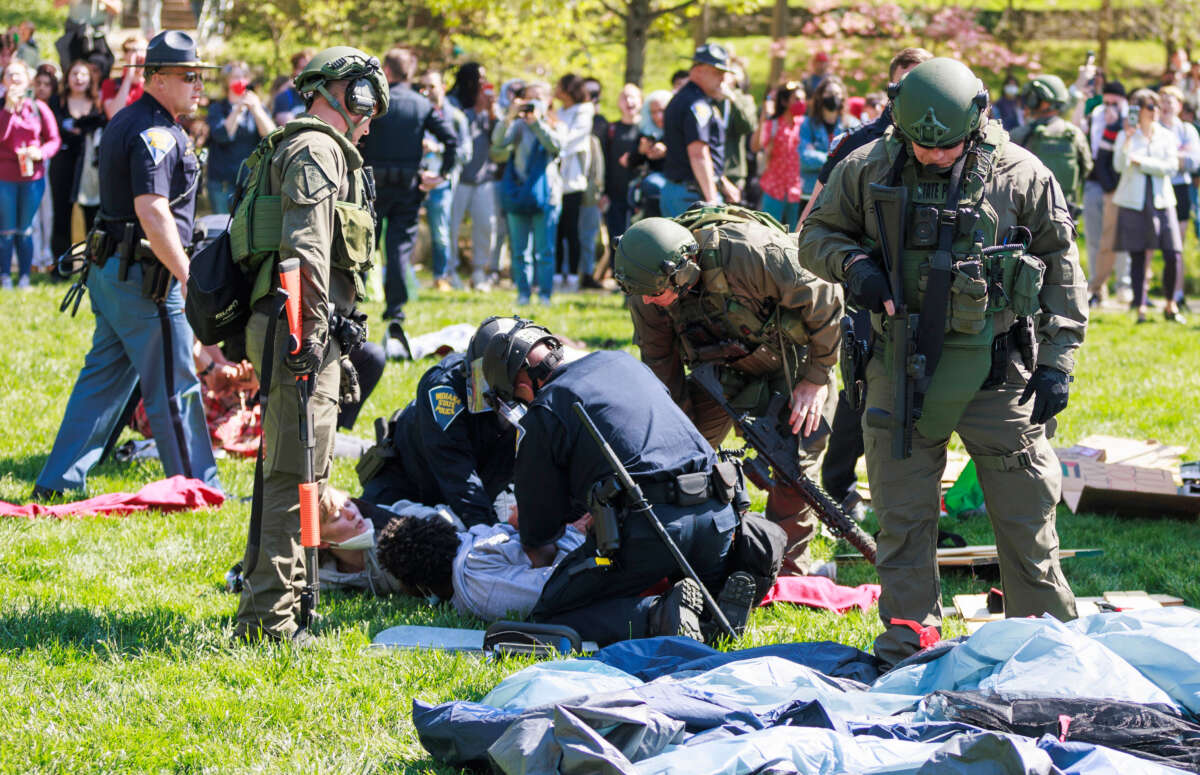
Dozens of people are arrested by the Indiana State Police riot squad during a pro-Palestinian protest on campus in Bloomington, Indiana, on April 25, 2024.

UN human rights officials are expressing alarm over the recent wave of violent repression by university administrators against the student protests for Palestinian liberation that have swept the U.S., raising concerns that protesters’ rights to free speech and assembly are being violated.

A statement on Tuesday said that UN High Commissioner for Human Rights Volker Türk, the UN’s top human rights officer, is “troubled” over a “series of heavy-handed steps taken to disperse and dismantle protests” across U.S. college campuses.

Freedom of expression and the right to peaceful assembly are fundamental to society — particularly when there is sharp disagreement on major issues, as there are in relation to the conflict in the Occupied Palestinian Territory and Israel,” said Türk. “I am concerned that some of the law enforcement actions across a series of universities appear disproportionate in their impacts.

Over the last two weeks, over 1,200 protesters have been arrested across dozens of campuses after university administrators enlisted police to crack down on encampments and other demonstrations set up by students calling for their schools to divest from Israel and supporting corporations, among other demands. At some universities, administrators even allowed law enforcement officers to aim sniper rifles at their students for their peaceful acts of protest.

UN Special Rapporteur on Human Rights Defenders Mary Lawlor said that universities’ crackdowns are an obvious violation of students’ rights.

https://www.ohchr.org/en/statements/2024/02/israelopt-enabling-human-rights-defenders-and-peaceful-protests-vital-achieving

https://www.ohchr.org/en/press-releases/2024/04/united-states-america-un-human-rights-chief-troubled-law-enforcement-actions

see also: the Economist of 30 April: Escalating protests expose three fault lines on American campuses

18th edition of the International Women of Courage Awards

March 5, 2024

On Monday, 4 March 2024, Secretary of State Antony J. Blinken and First Lady Jill Biden hosted the annual International Women of Courage (IWOC) Awards ceremony at the White House. See: https://www.trueheroesfilms.org/thedigest/awards/A386E593-5BB7-12E8-0528-AAF11BE46695

Now in its 18th year, the Secretary of State’s IWOC Award recognizes women from around the globe who have demonstrated exceptional courage, strength, and leadership in advocating for peace, justice, human rights, gender equity and equality, and the empowerment of women and girls, in all their diversity – often at great personal risk and sacrifice.  The 2024 awardees and many earlier laureates can be found via the Digest link above.

USAID Administrator Samantha Power had the following to say: It has always taken bravery and stubbornness to stand up for human rights. But today the threats that human rights activists and defenders face – from threats to their families to legal retribution to imprisonment and outright violence at the hands of those who would prefer to see them silenced – those threats are grave, and sadly they are growing. In 2022, more than 400 human rights defenders were murdered, the highest number ever recorded in a single year. I am in awe of the women we are honouring today for their courage. 

They refuse to back down because of a shared conviction captured by Fatima Corazon, one of the women we are recognizing today. As she puts it, courage, even in the face of danger and fear is the driving force to achieve positive change. The women we are honoring live this conviction every minute of every day. They have been unjustly imprisoned, they have been driven from their homes or trapped inside their homes, they have seen their families and their colleagues attacked, or they have received death threats and been assaulted themselves. 

But they do not relent. They go on fighting, they fight for the rights of political prisoners, they organize movements to bring services to marginalized communities, they publish articles, they host rallies, and they call out injustice wherever they can. Even in the most dangerous places against all odds, they are continuing their work demonstrating incredible, inspiring courage and putting their lives on the line to defend human rights. 

Benafsha Yaqoobi has dedicated her life to defending the rights of women and girls in Afghanistan. A former attorney and member of the Afghanistan Independent Human Rights Commission, she has helped women escape violence and visually impaired children attend school. Today, she continues to fight for the future of Afghanistan – one that respects human rights and human dignity.

Born in Isla Luis Vargas Torres, one of the most violent enclaves within Esmeraldas, Ecuador, Fátima Corozo has put her life on the line to draw hundreds of young people away from rising gang violence and help them get the education and job opportunities they need to build the futures they want for themselves.

Martha Beatriz Roque Cabello was the only woman amongst 75 people imprisoned during the black spring, Cuba’s crackdown on dissidents two decades ago, Martha was jailed for her activism. After her release, she continued to fight for the rights of political prisoners documenting fraudulent court hearings and supporting activists and their families. Unfortunately, as the Secretary relayed, the Cuban government is preventing Ms. Roque Cabello from leaving the country. So she is not here to accept the award, but let us give her a heartfelt round of applause.

As a result of Fariba Balouch’s outspoken activism for the rights of women and systematically oppressed ethnic minorities in Iran’s poorest province of Sistan and Baluchestan, Iranian authorities have threatened her life. And after she escaped to London, they detained her son and brother in a further attempt to intimidate her. Yet, Ms. Balouch believes the only way forward is resistance, and she continues to advocate for marginalized communities in Iran refusing to be silenced.

https://www.miragenews.com/2024-intl-women-of-courage-awardees-unveiled-1185728

https://www.usaid.gov/news-information/speeches/mar-04-2024-administrator-samantha-powers-remarks-international-women-courage-awards-ceremony

Meet Joey Siu, a Hong Kong activist

January 21, 2024

Meet Joey Siu, a Human Rights Foundation (HRF) Freedom Fellow and Hong Kong activist based in Washington, D.C.  Siu played a vital role in Hong Kong’s 2019 pro-democracy protests, co-founding a student advocacy coalition and organizing city-wide demonstrations. After fleeing Hong Kong in 2020, Siu served as an advisor to the Inter-Parliamentary Alliance on China and a policy advisor to Hong Kong Watch. Siu is currently an Asia Pacific coordinator for the World Liberty Congress, an advisor to the Athenai Institute, and oversees the Hong Kong program at the National Democratic Institute.

In exile, Siu remains a dedicated advocate for Hong Kongers, Tibetans, Uyghurs, and other communities oppressed by the Chinese Communist Party (CCP). Learn more about her activism in the exclusive interview below.

Q: Tell us a little bit about yourself and your current projects. 

A: I am a human rights activist from Hong Kong (HK). Back in 2019, when the pro-democracy movement in Hong Kong first started, I was one of the student leaders who led many of the on-campus activities and city-wide protests and demonstrations. In 2019, I also co-founded a student coalition with other student activists in HK to solidify international advocacy efforts for HK. I was forced to flee HK in late 2020 and settled in Washington, D.C. Since then, my efforts have been focused on international advocacy for HK’s democratic freedoms overseas.

I am establishing a regional activist network for women advocates to connect, amplify, and empower one another and to elevate women leaders in this space. Beyond that, I am very active in the HK diaspora community and working to foster cross-movement solidarity with other communities under the repression of the Chinese Communist Party (CCP).

Q: How do you feel about the bounty HK authorities placed on your head?

A: On Dec. 13, I woke up to the news that HK authorities issued an arrest warrant and a $1 million HK bounty on me. Ever since I fled, I knew this could happen given the Chinese and HK authorities’ efforts to silence dissent, not just from those in HK but from those in exile. But this bounty is like a death certification — I can really never go back. I was overwhelmed by the news and the actions I’ve had to take to step up my personal security. 

I — and the 12 others with bounties on their heads — saw this coming. They issued the bounty to threaten us, to deter us from continuing our advocacy, to scare us, and to really intimidate us. But that will not work on me. I will not stop; I will continue my advocacy until I can return to HK.

Q: What tactics does the Chinese regime employ to suppress activists like yourself?

A: The overseas communities have lobbied for international attention on China and HK and all of the human rights atrocities committed by the CCP. That is why the CCP is trying so hard to silence us. 

Over the past few years, the CCP and the HK authorities have stepped up their transnational repression. We’ve witnessed a wide variety of tactics employed by the CCP, from holding our loved ones back home as hostages to infiltrating our communities, setting up secret police stations all across the world, including in the United States, to coercing different stakeholders and industries to spy on their behalf. 

These tactics have not been used just against Chinese and Hong Kongers but also against Uyghurs and Tibetans. And we’ve seen other authoritarian regimes copying the CCP’s tactics, including Russia, Iran, and Belarus. In fact, these regimes are working hand-in-hand to silence dissent overseas.

Q: Should democracies be paying more attention?

A: I want to stress that the impact of transnational repression extends beyond the activists. Beyond spying on dissidents overseas, tactics include economic coercion, brainwashing, and education through Confucius institutes in American universities and colleges. Those tactics impact every individual living in a democracy.

Democracies all across the world should pay attention to this and take concrete steps to combat transnational repression on their soil and in other democracies. Securing the safety and security of dissidents like me is an essential step to allowing us to have the freedom to continue speaking up and to continue confronting authoritarianism. 

Q: How has the Freedom Fellowship supported you in your work?

A: The Fellowship allowed me to meet activists from communities I otherwise would not have been in touch with as actively or frequently. In my cohort, I met activists from Bolivia, Cuba, Myanmar, Morocco, Egypt, and more. I got to talk with them and learn the tactics they’ve used to overcome challenges and unite their communities. Fostering relationships and strategizing on campaigns together was the most valuable experience for me. 

Building that cross-community solidarity is essential. We see dictators working together and it is of the utmost importance that we, human rights activists, are working together. Democratic backsliding is not an issue faced by one community alone; it is an issue faced by all communities under oppression.

Q: What have you recently been doing? What do you hope to achieve in 2024?

A: After the news about the HK bounty broke, I had several meetings with US congressional offices. I met with the House Foreign Affairs Committee, Chairman Mike Gallagher of the House Select Committee on the Chinese Communist Party, and Sen. Jennifer Sullivan. Hopefully, these meetings will lead to legislation to combat transnational repression, but we require a coordinated and bipartisan effort in Congress. I hope to see something like the Transnational Repression Policy Act advanced and adopted in this Congress. 

With the ongoing reports of the bounty on me and other activists, Jimmy Lai’s case, and the upcoming sentencing of the 47 activists in HK, we can hopefully take advantage of the momentum. We can push the US government and other democracies to take action. 

Additionally, during the 2023 Freedom Fellowship retreat, I came up with the idea of the regional women’s network. In the upcoming months, I want to turn this idea into something concrete—start inviting people to be founding members and board members, start the registration process, and establish a financial foundation and fundraising plan.

https://mailchi.mp/hrf.org/meet-hrf-freedom-fellow-joey-siu?e=f80cec329e

5 Podcasts by Human Rights Defenders

January 16, 2024

On 15 January 2024, Amnesty International announced that five courageous human rights defenders from around the world have shared their hard-hitting stories on its new podcast: ‘On the Side of Humanity. How human rights defenders fight for our present and future’.

The three-part series was released to mark the 25th anniversary of the UN Declaration on Human Rights Defenders. The documentary explores how the human rights movement has evolved since the adoption of the watershed declaration.

In the podcast, Amnesty International’s Tatyana Movshevich discovers the story behind the declaration and meets brave activists from Chile, the USA, Nepal, Ireland and Ghana, all of whom have been fighting for the rights of marginalized people — and risking their lives in the process.

“Every day, human rights defenders are risking their lives, sometimes at a significant personal cost. They experience violence and discrimination simply for defending the rights of others,” said Tatyana Movshevich, Amnesty International’s Campaigner.

“For this podcast I have interviewed five incredible human rights defenders and it was inspiring to hear about their work, but also distressing to realise the enormous dangers they are facing. During our interview, Anas Aremeyaw Anas, a journalist from Ghana, told me a chilling story of how his investigation into killings linked to ritual magic in Malawi had gone terribly wrong. And it was not the only time when Anas found himself in mortal danger because of his human rights work. Far from it.”

Every day, human rights defenders are risking their lives, sometimes at a significant personal cost.Tatyana Movshevich, Amnesty International’s Campaigner

Others featured in the podcast include Lorena Donaire, a water defender from Chile whose life was turned upside down as she was tackling the catastrophic results of a mega-drought; Monica Simpson, a queer activist and artist from the USA and Durga Sob, a Dalit woman and Nepalese feminist activist, who have both been confronting long-ignored issues of racism and caste-based discrimination; and Sean Binder, a migrant rights defender from Ireland whose freedom was compromised while he was volunteering on an idyllic Greek island. [see lso: https://humanrightsdefenders.blog/2021/11/17/greeces-mistaken-deterrence-migrants-and-aid-workers-facing-heavy-prison-sentences/]

International experts that took part in the series include Mary Lawlor, the UN Special Rapporteur on the situation of Human Rights Defenders, and Hina Jilani, women rights activist and co-founder of Pakistan’s first all-women law firm.

The podcast is out now and available to stream on Spotify, Apple, Google and Deezer.

https://www.amnesty.org/en/latest/news/

UDHR@75: occasion for US, UK and Canada to put sanctions on human rights abusers

December 9, 2023

The UK, US and Canada are announcing a sweeping package of sanctions targeting individuals linked to human rights abuses around the world, ahead of the 75th anniversary of the Universal Declaration of Human Rights on 10 December. 

UK targets forced labour operations in Southeast Asia, and government-linked officials in Belarus, Haiti, Iran, and Syria complicit in repressing individual freedoms.

The first set targets 9 individuals and 5 entities for their involvement in trafficking people in Cambodia, Laos and Myanmar, forcing them to work for online ‘scam farms’ which enable large-scale fraud. Victims are promised well-paid jobs but are subject to torture or other cruel, inhuman, or degrading treatment…

The second is aimed at a number of individuals linked to the governments, judiciaries and prosecuting authorities of Belarus, Haiti, Iran, and Syria, for their involvement in the repression of citizens solely for exercising fundamental freedoms in those countries.

Included in the USA sanctions are two Afghanistan government ministers accused of repressing women and girls, by restricting access to secondary education; two Iranian intelligence officers who the Treasury says plot violence against Iranian regime opponents beyond the nation’s borders and two Chinese officials accused of torturing Uyghur ethnic minorities in the Xinjiang region of China.

https://www.gov.uk/government/news/uk-and-allies-sanction-human-rights-abusers

https://thehill.com/homenews/ap/ap-u-s-news/ap-u-s-sanctions-officials-from-afghanistan-to-china-on-declaration-of-human-rights-anniversary/

https://www.france24.com/en/live-news/20231208-us-uk-canada-sanction-dozens-on-human-rights-anniversary

Front Line Defenders Award winners go on US advocacy trip

September 29, 2023

Three human rights defenders (from Democratic Republic of the Congo (DRC), the Philippines and Ukraine) will visit New York and Washington, D.C. as part of an advocacy tour after being awarded the prestigious Front Line Defenders Award for Human Rights Defenders at Risk. [see: https://www.trueheroesfilms.org/thedigest/awards/2E90A0F4-6DFE-497B-8C08-56F4E831B47D]

Apart from engaging in high-level advocacy meetings with U.S. lawmakers and the State Department, the human rights defenders will speak at the Columbia Law School Human Rights Institute, participate in Climate Week NYC and take part in the Global Citizen Festival in New York, among other events.

From defending environmental rights to supporting civil society during armed conflict, to fighting for the right to education, these courageous human rights defenders represent some of the most at-risk communities of activists around the world today,” said Ana Cutter Patel, U.S. Representative at Front Line Defenders. “We hope this advocacy tour will bring them much-needed additional support and recognition, to energize them in their struggle to ensure human rights are respected in their respective countries.

Those taking part in the advocacy tour are:

Africa laureate: Olivier Bahemuke Ndoole (Democratic Republic of the Congo) is a leader among environmental and land defenders in DRC [https://www.trueheroesfilms.org/thedigest/laureates/4bdd9da9-740f-41b6-b6a1-bcad15e2e0a0]

Asia and the Pacific laureate, Jeany ‘Rose’ Hayahay (Philippines) is a woman human rights defender based in Mindanao, the Philippines. [https://www.trueheroesfilms.org/thedigest/laureates/ab448b53-297d-4ebc-8608-4baa29c1c161]

Europe and Central Asia laureate, Digital Security Lab Ukraine (Ukraine) – represented by Executive Director Vita Volodovska – is a team of specialists in the field of digital security and internet freedom. [https://www.trueheroesfilms.org/thedigest/laureates/70e5e379-d671-42c8-9d56-40b9a879cac2]

https://www.frontlinedefenders.org/en/statement-report/front-line-defenders-award-winners-launch-us-advocacy-trip