Posts Tagged ‘Turkey’

Turkey defies European Court on Kavala and undergoes UPR review

January 29, 2020
FILE - A journalist stands in front of a poster featuring jailed philanthropist Osman Kavala, during a press conference given by his lawyers, in Istanbul, Turkey, Oct. 31, 2018.
A journalist stands in front of a poster featuring jailed philanthropist Osman Kavala, during a press conference given by his lawyers, in Istanbul, Turkey, Oct. 31, 2018.

Kavala and 15 other civil society activists are accused of supporting anti-government protests in 2013 against then-Prime Minister Recep Tayyip Erdogan, who is now president. The protest action came to be known as the Gezi movement, named after an Istanbul park where the unrest started. Prosecutors are calling for life imprisonment without parole. The ECHR condemned the case, calling for an end to Kavala’s more than two years in prison and describing it as “arbitrary” and “politically motivated.”

The Istanbul court ruled Tuesday the ECHR decision was provisional because Ankara was appealing the verdict and that Kavala should remain in jail. The court’s decision is flawed because the European Court ruling was clear in its call for Kavala’s immediate release,” said Emma Sinclair Webb, Turkey researcher for New York-based Human Rights Watch.

We saw multiple signs of how unfair this trial is,” said Webb, speaking after attending Tuesday’s court hearing. “The lawyers for Kavala raised many objections to the way witness evidence is used in this case. The court turns a deaf ear to all objections. It’s a shocking indication that once again, Turkey’s judiciary seems to be under heavy pressure of the executive.”

Tuesday’s court hearing was marred by chaos, with Kavala’s lawyers challenging the judge’s decision to hear some witnesses without their presence, prompting the lawyers to walk out of the room. Ankara strongly rejects the ECHR verdict, maintaining that the judiciary is independent. But observers note the case has strong political undertones. Three months ahead of Kavala’s prosecution, Erdogan accused him of “financing terrorists” and that Kavala was a representative for “that famous Jew [George Soros,] who tries to divide and tear up nations.” Erdogan did not elaborate on the comments about George Soros, who is an international philanthropist. Erdogan’s allegations against Kavala resemble the prosecution case against the jailed activist. Kavala is a pivotal figure in Turkey, using his wealth to help develop the country’s fledgling civil society after a 1980 military coup.

“Osman Kavala is very prominent within the civil society in this country,” said Sinan Gokcen, Turkey representative of Swedish-based Civil Rights Defenders. “He is not a man of antagonism; he is a man of preaching dialogue, a man of building bridges.”….

With the U.N. having few tools to sanction Turkey, the European Union is seen as offering the best hope by human rights advocates of applying pressure on Ankara. Turkey’s EU membership bid is already frozen, in part due to human rights concerns. But Ankara is seeking to extend a customs union, along with visa-free travel for its citizens with the EU. “It’s time all European countries should be speaking out very loud and clear on cases like this [Kavala],” said Sinclair-Webb. But even high-profile cases like Kavala’s have seen Brussels offer only muted criticism of Ankara. German Chancellor Angela Merkel’s visit to Istanbul Friday for talks with Erdogan saw little criticism of Turkey’s human rights record. Instead, discussions focused on Ankara’s recent deployment of soldiers to Libya and the upholding of an EU-Turkish agreement controlling migrants entering Europe. “There are many issues to talk about with Turkey,” said Sinclair Webb. “Syria, Libya, Turkey, hosting so many refugees from Syria, and this often takes priority over Turkey’s domestic human rights crisis. This means there isn’t sufficient clarity on cases like this. What we are seeing is Turkey defying Europe’s human rights court.” Some analysts suggest Brussels could yet be lobbying behind the scenes for Kavala’s release, tying Ankara’s calls for extra financial assistance for refugees to gestures on human rights.

https://www.forum-asia.org/?p=30836

HRW urges UN to address human rights violations in Turkey

https://www.voanews.com/europe/turkish-court-defies-europe-leaves-philanthropist-behind-bars
Side event preparing the UPR process on Turkey

January 22, 2020

In the framework of the 35th session of the Universal Periodic Review, Press Emblem campaign (PEC) and International Observatory for Human Rights (IOHR) are organising a side event entitled ‘Information meeting on the UPR process in Turkey‘ within the Palais des Nations on Monday, 27 of January, Room XXV from 1 to 2.30 pm.

Key Note Speaker:
Ambassador Stephen Rapp Former United States Ambassador-at-Large for War Crimes Issues in the Office of Global Criminal Justice

Panel 1: Press Freedom
Guest Speakers
Mr Yavuz Baydar: Editor-in-Chief of Ahval
Ms Evin Barış Altıntaş: Journalist & Blogger
Mr Massimo Frigo: Senior Legal Advisor for International Commission for Jurists

Panel 2: Human Rights Defenders
Guest Speakers
Şebnem Korur Fincancı – President of the Human Rights Foundation of Turkey
Nurcan Baysal – Award-winning Turkish Human Rights Defender & Journalist [see: https://humanrightsdefenders.blog/2018/05/18/breaking-news-five-front-line-award-winners-2018-announced/]
Anne van Wezel – Former Co-Chair, EESC EU-Turkey Joint Consultative Committee

Moderator: Louise Pyne Jones, Head of Research, IOHR

See also: https://humanrightsdefenders.blog/2019/03/13/press-emblem-campaign-pec-reports-to-human-rights-council-on-media-casualties/

https://www.pressemblem.ch/

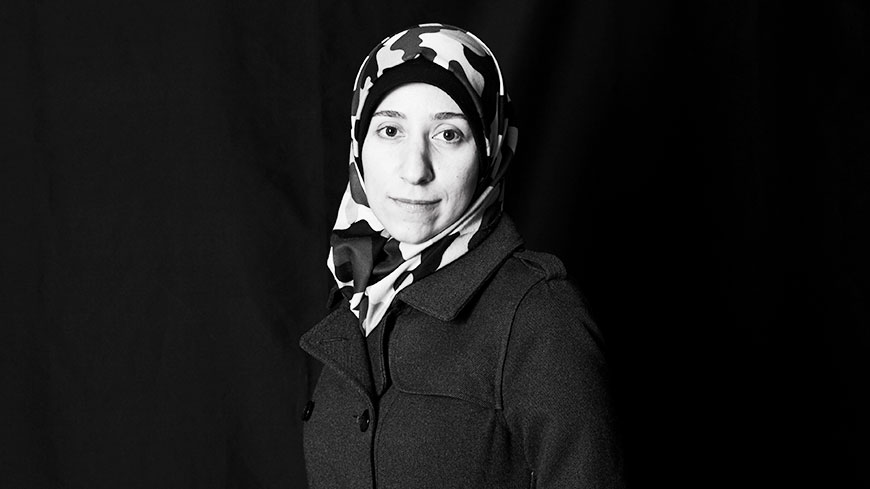
Amani Ballour, Syrian paediatrician, awarded the Council of Europe’s Raoul Wallenberg Prize

January 16, 2020

© Stine Heilmann

Amani Ballour © Stine Heilmann

Dr. Amani Ballour, a paediatrician from Syria who ran an underground hospital in Eastern Ghouta in 2012-2018 and is now a refugee in Turkey, has been awarded the Council of Europe’s Raoul Wallenberg Prize for her personal courage, bravery and commitment in saving hundreds of lives during the Syrian war. For more on this and two other awards with Wallenberg in their name, see: http://www.trueheroesfilms.org/thedigest/awards/raoul-wallenberg-prize-council-of-europe]

Human rights and personal dignity are not a peacetime luxury. Dr. Amani Ballour is a shining example of the empathy, virtue and honour that can flourish even in the worst circumstances: in the midst of war and suffering,” said Marija Pejčinović Burić, the Secretary General of the Council of Europe On 15 January 2020

A young paediatrician just out of university, Dr Ballour started as a volunteer helping the wounded and ended up, several years later, managing a team of some 100 staff members at the subterranean hospital, the ‘Cave’, in her hometown near the Syrian capital. “The Cave became a beacon of hope and safety for many besieged civilians. There, Dr Ballour risked her own safety and security to help those in the greatest need. She and others acted day after day to save the lives of so many people, including children suffering the effects of chemical weapons,” the Secretary General added.

https://www.coe.int/en/web/portal/-/syrian-doctor-who-ran-underground-children-s-hospital-receives-wallenberg-prize

USA’s International Women of Courage Awards for 2019

December 18, 2019

Stock Daily Dish on 16 December 2019 reports that Melania Trump made a rare public appearance to present 13 women with the 2017 Secretary of State’s International Women of Courage Award. The prize honors those who fight for women’s empowerment, often at great personal risk. “Together, we must declare that the era of allowing the brutality against women and children is over while affirming that the time for empowering women around the world is now,” Mrs. Trump said. She called on leaders to “continue to work towards gender empowerment and respect for people from all backgrounds and ethnicities,” and on the international community to fight all forms of injustice. For more on this award – and 7 more that have ‘courage’ in the title – see: http://www.trueheroesfilms.org/thedigest/awards/international-women-of-courage-award.

Each US embassy can nominate one woman for the award. The 13 women honored this year are:

Malebogo Molefhe (Botswana), who used to play for the Botswana national basketball team, has served as an advocate for survivors of gender-based violence after she was attacked and shot eight times by her ex-boyfriend in 2009 and confined to a wheelchair,

Rebecca Kabugho (Democratic Republic of the Congo), has led peaceful anti-government protests calling for credible elections in the DRC, and spent six months in prison for her role as an activist

Major Aichatou Ousmane Issaka (Niger), currently the deputy director of social work at the Military Hospital of Niamey, was one of the first women to join the Nigerien army in 1996, and was one of the first to attend a military academy. She has served throughout Niger, including in the Diffa Region, a stronghold of the Boko Haram terrorist group.

Veronica Simogun (Papua New Guinea), the founder and director of the Family for Change Association, who works to help shelter and relocate women affected by violence,

Nguyen Ngoc Nhu Quynh (Vietnam), a blogger and activist who promotes environmental and human rights issues under the nom de plum Me Nam or Mother Mushroom. [see: https://humanrightsdefenders.blog/2018/10/18/vietnamese-blogger-mother-mushroom-released/]

Saadet Ozkan (Turkey) was a primary school teacher, who uncovered a “decades-long pattern of sexual abuse” and forced a criminal investigation of the principal; she still supports the victims and their case as a private consultant.

Jannat Al Ghezi (Iraq), helps Iraqi women escape violence, rape and domestic abuse, as well as Islamic State terrorism and occupation, and offers them shelter, training, protection and legal services through the Organization of Women‘s Freedom in Iraq

Sister Carolin Tahhan Fachakh (Syria), known as Sister Carol, runs a nursery school in war-torn Damascus for more than 200 Muslim and Christian children, as well as a tailoring workshop for internally displaced women.

Fadia Najib Thabet (Yemen) is a child protection officer who has dissuaded young boys from joining Al-Qaeda, exposed its Yemeni branch Ansar al-Sharia as a recruiter of child soldiers and reported on human rights violations for the UN Security Council.

Sharmin Akter (Bangladesh), a student who refused an arranged marriage at age 15, which resulted in the prosecution of her mother and her much-older prospective husband,

Sandya Eknelygoda (Sri Lanka), who fought for justice after the disappearance of her journalist husband in 2010 and who has served as a voice for the families of others who have disappeared during the country‘s civil war.

Natalia Ponce de Leon (Colombia), who has become a human rights activist for the victims of acid attacks after a stalker threw a liter of sulfuric acid on her in 2014,

Arlette Contreras Bautista (Peru), a domestic violence survivor and activist, who helped launch the Not One Woman Less movement, which aims to increase the social and political awareness of women‘s rights and gender-based violence in Peru.

The newspaper noticed that Mrs Trump did not mention her husband or his presidential administration during her 10-minute remarks.

China, Arsenal, Ozil and freedom of expression…

December 16, 2019

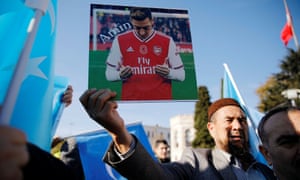
On 16 December 2019 wrote in the Guardian “Craven Arsenal abandon Mesut Özil over his stance on China’s Uighur persecution“.  He argued that the midfielder is in tune with human rights groups over the imprisonment of millions of Uighurs but the club chose to raise a white flag. The incident touches on more than the freedom of expression of an individual player. ‘Sports washing’ (see earlier posts:  https://humanrightsdefenders.blog/tag/sports-washing/) is a widespread phenomenon to which Arsenal itself in no stranger. It plays in the Emirates Stadium and in Emirates T-shirts (in a 280 million $ deal) without ever mentioning Ahmed Mansoor the UAE’s most prominent political prisoner [see also: https://humanrightsdefenders.blog/2018/06/07/ahmed-mansoor-ten-years-jail-for-tweeting-and-a-street-named-after-you/]

A demonstrator in Istanbul holds up a picture of Arsenal’s Mesut Özil who expressed his horror at China’s treatment of the Uighurs.

On the Chinese social media site Weibo Arsenal quicly posted that Özil’s comments were merely his “personal opinion” and reminding that “Arsenal has always adhered to the principle of not involving itself in politics”. The article nicely quotes Simon Chadwick, a professor of sports enterprise at Salford University who specialises in China: “The world is in the midst of an ideological battle: western liberalism versus eastern authoritarianism. And sport is one of the front lines.”

Also saying it is just a personal opinion, seems a bit much:  Özil was entirely in tune with a United Nations panel and multiple human rights groups who have spoken out about the imprisonment of millions of Uighur people in internment camps without trial for “re-education” in what has been described as the largest incarceration of one ethnic group since the Holocaust, with multiple accounts of torture, rape and abuse from eyewitnesses who have passed through.

Celebrities have been criticised for NOT speaking out when they insist on touring human rights violating regimes (e.g. only last week Anthony Joshua was widely criticised for not speaking out about human rights in Saudi Arabia and Mariah Carey in July this year [https://humanrightsdefenders.blog/2019/07/10/nicki-minaj-did-the-right-thing-and-cancelled-her-performance-in-saudi-arabia/]. states” Yet can you blame sportspeople for staying quiet when they see Özil bravely raising his head above the parapet only to be shot down by his own club? As for Arsenal not involving themselves in politics, what did the club think they were doing when they agreed a £30m deal with the Rwandan government to promote tourism?

It would seem that what is ‘political’ is mostly determined by the sensitivity and power of the country being targeted. And in the case of China there is very little margin. Whether it is the according of awards to dissidents or accepting statements on Hong Kong by NBA officials [see more generally: https://humanrightsdefenders.blog/2012/12/06/china-and-its-amazing-sensitivity-on-human-rights-defenders/]. As stated: The decision by CCTV not to show Arsenal’s match against Manchester City is another reminder that there is no middle ground here. No way to stick up for human rights and free speech without angering China. You are either for such values or against them.

https://www.theguardian.com/football/2019/dec/16/arsenal-mesut-ozil-uighurs-china

Human Rights Day 10 December 2019: an anthology

December 11, 2019

International Human Rights Day, 10 December 2019, was celebrated or observed all around the world and there is no way to report on every event. Stil to add flavour here a selection of some 14 smaller and bigger events – for more details follow the links provided (and for last year’s anthology see references at the end):

There was of course the annual statement by UN High Commissioner for Human Rights Michelle Bachelet Rightly, these young people are pointing out that it is their future which is at stake, and the future of all those who have not yet even been born. It is they who will have to bear the full consequences of the actions, or lack of action, by the older generations who currently run governments and businesses, the decision-makers on whom the future of individual countries, regions and the planet as whole depends…We have a duty to ensure young people’s voices are heard. The Universal Declaration of Human Rights, adopted by the UN General Assembly on 10 December 1948, was a firm commitment by States to protect the rights of everyone – and that includes making it possible for future generations to uphold human dignity, equality and rights…..Climate harms will not be halted by national borders – and reactions based on hostile nationalism, or short-term financial considerations, will not only fail: they will tear our world apart. The struggles for climate justice and human rights are not a political quarrel. This is not about left or right: it is about rights – and wrongs… We need to mobilise across the world – peacefully and powerfully – to advance a world of rights, dignity and choice for everyone. The decision-makers understood that vision very clearly in 1948. Do they understand it now? I urge world leaders to show true leadership and long-term vision and set aside narrow national political interests for the sake of everyone, including themselves and all their descendants.

Pakistan: Human Rights Defenders asked the government to make serious efforts to provide fundamental rights. Human rights, labour rights and civil society activists called upon the government to make serious efforts for the provision of fundamental human rights and freedoms, especially the freedoms of association and expression, enshrined in the Constitution of Pakistan and the Universal Declaration of Human Rights. Addressing a joint press conference at the Karachi Press Club to mark International Human Rights Day, PILER joint director Zulfiqar Shah, human rights activists Naghma Shaikh and Saeed Baloch representing the Sindh Human Rights Defenders Network said the government should ensure the restoration of the freedom of expression and the freedom to association. They demanded that the government should bring in a law to protect the rights of human rights defenders as they stood up for the voiceless people…. They also demand fully restoring the freedom of expression, as it was a constitutional right of the people to express their thought. Access to the information right must be ensured, they said.

India: Activists say NHRC urgently needs to protect human rights defenders. The National Human Rights Commission should proactively protect the rights of ‘human rights defenders’, said activists at the national convention on rights of Dalit and Adivasi rights defenders in the capital on Tuesday. Human Rights Defenders appealed to the commission to proactively intervene in cases where the works of Dalit and Adivasi organisations were being obstructed. Activists said there were a growing attack on human rights defenders in India and said the need of the hour was collective action….On Human Rights Day, the convention highlighted the importance of the work of human rights defenders. Despite the country having national human rights institutions and over 160 state human rights institutions dealing with human rights, women, children, minorities, SCs, STs, right to information, persons with disabilities, and safai-karamcharis, these institutions have often failed to protect the human rights defenders, activists said. In addition to the usual challenges, women human rights defenders face gender-specific violations, such as rape and sexual violence which are used as tools for harassment, said activists. Caste discrimination has also presented a greater danger for women rights defenders belonging to the Dalit and Adivasi communities.

Cambodia: The Khmer Times reported that very differing opinions on the status of human rights in the Kingdom became apparent as various groups marked Human Rights Day at two venues in the capital. About 400 government officials and youth group members marked the day’s 71st anniversary at the Cambodia-Korea Cooperation Centre, while about 2,000 unionists and members of the public marked the day at Freedom Park.

Keo Remy, president of the Cambodian Human Rights Committee, at the CKCC said the government has always paid attention to the rights of citizens. “Our leaders prioritise peace and stability,” Mr Remy said. “Youths can make the country chaotic because of the words democracy and human rights. That is why we focus on youths and stability.” while..

Ath Thorn, president of the Coalition of Cambodian Apparel Workers’ Democratic Union, at Freedom Park said respecting the rights of workers has decreased over the years and it is a source of concern for many. “We see that respecting workers’ rights has decreased – investors do not pay attention to workers,” Mr Thorn said. “Investors need to consider the rights of workers.” He said garment factory workers are faced with decreasing salaries, overtime work, discrimination, short-term contracts, violence and imprisonment. The Cambodian Centre for Human Rights in a statement said the government has taken action to curb issues surrounding human rights, but it has not done enough. “We call on the government to encourage the celebration of Human Rights Day in Cambodia and acknowledge the benefit human rights have on society as a whole,” it said. “We implore the government to cease all arbitrary action and targetting of human rights defenders.” The CCHR also called for the charges against two former Radio Free Asia journalists and Kem Sokha to be dropped.

Palestine: the Addameer Prisoner Support and Human Rights Association reported that Palestinians marked International Human Rights Day following a year of nonstop violence and widespread human rights violations by Israeli Occupation Forces (IOF), against the Palestinian population used, as a form of collective punishment and a method to control Palestinian society. These consistent and systematic policies by the occupation include, extrajudicial executions and issuance of discriminatory legislations, mass arrests campaigns, torture, administrative detention, and medical negligence against Palestinian political prisoners…..In 2019, the (IOF) continued its crackdown and repression of human rights defenders. Currently, Addameer faces gag orders against around 40 of the cases they represent, who are in interrogation. The gag order prohibits us from releasing any information to the public regarding their detention status, or face grave consequences.

Philippines: Groups under the Ecumenical Voice for Human Rights and Peace in the Philippines (Ecuvoice) has submitted its first wave of reports on the human rights situation in the Philippines to United Nations Commissioner on Human Rights Michelle Bachelet on Monday, Dec. 9. This is in line with Resolution 41/2 which was adopted by the UN Human Rights Council (UNHRC) in July this year. “With the intensifying transgressions on the Filipinos people’s political rights and civil liberties, we are participating in this report-making process of the UN High Commissioner for Human Rights to pursue justice and accountability,” the convenor of Ecuvoice, Edita Burgos, said.

while

the international trade union movement was using international human rights day to call attention to the alarming attacks on human and labour rights defenders in the Philippines. The government’s targeting of trade unionists has been ramped up recently with fresh waves of arrests and violence. The international trade union movement is united in calling on the government to stop the attacks. The government is targeting labour activists through a practice known as red-tagging. By falsely identifying people who speak out against the government as associated to armed militia groups, the government purposely targets them with harassment and arrests and exposes them to violence and even murder….The International Labour Organization (ILO) has resolved to send a High-Level Tripartite Mission to the Philippines to investigate the human rights situation, but despite the urgency, the government has yet to receive the Mission. The international labour movement is undertaking solidarity events across the world to demand an end to the human rights abuses and the targeting of trade unionists. The ITUC has requested to meet with the representative of the Philippines to the EU on Human Rights Day and has outlined three key demands.

Turkey. Amnesty International Turkey and MetroPOLL Strategic and Social Research Center have jointly conducted a Survey on Perception of Human Rights. The results of the survey have shown that when they hear the expression of “human rights”, 65.2 percent of the participants think of “right to life” first. While “freedom of expression” comes to the minds of 33.5 percent, the right to a fair trial ranks third with 22.1 percent. According to the survey participated by 2,651 people from 28 cities and conducted in a face-to-face manner, 82.1 percent of the society think that fundamental rights and freedoms are violated in Turkey. Of these people, 58 percent say that fundamental rights are occasionally violated and 42 percent say that they are frequently violated. 62.6 percent of the participants are of the opinion that fundamental rights and freedoms are restricted in Turkey. While 72 percent of the young participants think that fundamental rights and freedoms are restricted, this rate falls as the age of the participant gets older. For more detials see the full report.

China:  posted an interesting piece in China Digital Times on how the Chinese government defends if record on human rights and how others see this. Here one excerpt out of manY:

On Tuesday, International Human Rights Day, spokesperson Hua Chunying mounted a familiar defense of China’s rights record at the Ministry of Foreign Affairs’ regular press conference …and went on to note that the MoFA and State Council Information Office would host the “2019 South-South Human Rights Forum” this week “with a view to adding new dimensions and injecting impetus into exchange and cooperation in the field of human rights.” ….. At Hong Kong Free Press, the Uyghur Human Rights Project’s Omer Kanat commented on the ‘South-South Human Rights Forum’ hailed by Hua Chunying,…… Among the enablers of Xi Jinping’s repression are states with disreputable recor[ds attracted to a possible exemption from universal standards that ‘human rights with Chinese characteristics’ affords. And again, if we could freely ask the populations who reside in these states how they feel about such a concept, there would be few advocates. Therefore, on Human Rights Day, we have a responsibility to defend those who defend universal values and be clear ‘never again’ has meaning. There is injustice everywhere and we must fight it. Uyghurs are among them, for example, the imprisoned Ilham Tohti, and in exile , Nury Turkel, Rushan Abbas, and Gulchehra Hoja, whose families have been detained and disappeared in East Turkestan because of their advocacy. The second ‘South-South Human Rights Forum’ is opening in Shanghai for this year’s Human Rights Day. The dangerous fiction of the ‘Beijing Declaration’ that there are exceptions to the universality of rights should be firmly resisted.

Afghanistan ‘Human Rights’ should be more focused during peace talks. MENAFN (Afghanistan Times) reported that UN Special Representative for Afghanistan and head of UNAMA, Tadamichi Yamamoto, in a gathering has expressed concerns regarding the human rights achievements, saying that these gains should be saved in the ongoing negotiation with the Taliban. He called on the National Security Council to consider perseverance of human and civil rights in talks with the Taliban, adding ‘Afghanistan Independent Human Rights Commission’s role is very important in the peace process, every voice that raise should be heard and rights of the victims should be observed.‘.. Moreover, head of AIHRC, Shaharzad Akbar has called on the Taliban to legislatively recognize the values of human rights. …There are massive concerns about the violation of achievements of human rights and freedom of speech in the peace negotiation with the Taliban militants. The Taliban has back in 1990 ruled Afghanistan with the sever restriction on girls and school students. The cultural Taboos and less freedom of women are one of the other key issues that have brought sever concerns from Afghan and foreign officials.

The NGO WITNESS used the occasion to publish its ANNUAL REPORT which looks at key successes from July 2018-June 2019 (fiscal year 2019). See the video clip:

Malaysia. “What happened to Harapan’s vow to improve human rights?” asks Jasmine Cho in an open letter:…’When Pakatan Harapan won a dramatic victory in the GE14 elections, they vowed to steer the country forward with human rights as one of their top priorities. However, since their win, we have seen a heavy regression in the area. The kind of regression that has gotten us worried about our present and our future as a modern, fair, and humane nation. From the Suaram 2019 report, several areas of abuse were glaring. One was the treatment of prisoners. The government has yet to abolish the Security Offences (Special Measures) Act 2012, the Prevention of Crime Act 2015 and the Dangerous Drugs (Special Preventive Measures) Act 1985……….The list of human rights abuse is getting longer and the frustration we feel with our government is reaching boiling point. Malaysia is considered a modern and democratic country, so why are we so far behind when it comes to human rights? The government should stop pandering to the religious majority and stop focusing on external matters. The rights of the rakyat are being abused.

Netherlands/Sri Lanka. The Dutch Ambassador Gonggrijp spoke at an event for Human Rights Day 2019 organized by Equal Grounds Sri Lanka saying inter alia:

Sri Lanka has recently known a long period of conflict, during which human rights were under pressure. The reconciliation process after the end of the war has been slow. And I hear people say: what is the point of looking back, let’s move forward. To my opinion it is about recognition and human dignity. To that respect we should also recognize the progress that has been made: the Office on Missing Persons has been mandated to restore the rights of every Sri Lankan of any background, language or religion, to know what happened to their loved ones. And the work of the Sri Lanka Human Rights Commission, as an independent entity, mirrors the country’s commitment to uphold human rights and civil freedoms. The Netherlands supports this and stands ready to help Sri Lankan institutions like these with capacity building and technical expertise…..

The policy of Netherlands is aimed at 1) abolishing the criminalization of homosexuality, 2) opposing discrimination on the basis of sexual orientation and gender identity and 3) achieving wider social acceptance of gay people. In the Netherlands we have taken the first step of decriminalization a long time ago, but we are also still working on stopping discrimination and promoting acceptance. As I hope Sri Lanka will also take this first step in the near future, I also recognize that this will not solve all issues the LGBTI community is facing. It is key to inform people about the rights they have, regardless of their sexual orientation. To empower them to take responsibility, stand up or seek justice. It is also key to educate and make people from outside the community aware of the harassment and discrimination that people from the LGBTI community face. In order to also empower them to show solidarity and to take action if necessary. Every form of emancipation has been and still is a struggle. It starts with a ‘fight for your rights’. This is why this initiative of Equal Ground is so important, because – and allow me to quote again:

Mongolia / EU: Montsame reported that on the occasion of International Human Rights Day the Delegation of the European Union to Mongolia together with the Embassies of France and Italy presented European Union Human Rights Defenders’ Award (a national award!) to nine people, who are making their efforts to human rights protection…..Unfortunately, we are still observing human rights violations in many countries, especially gender and racial discrimination and discrimination in sexual orientation. Therefore, the EU Delegation to Mongolia, the Embassies of France and Italy and the Embassies of other countries are showing respect to human rights activists in Mongolia. Protection of human rights is one of main principles of the European Union, which defines its internal, and foreign policies and it is belonged to everyone. We will ever protect and encourage the people who endeavor for human rights, “ Ambassador of the European Union to Mongolia Traian Laurentiu Hristea said at the opening of the award presenting ceremony. The Ambassador also highlighted that the event will be traditionally held in the future.

MEXICO An indigenous activist who documented and denounced abuse committed by the military in Guerrero is this year’s winner of the National Human Rights Prize. Obtilia Eugenio Manuel was awarded the prize at Tuesday’s presidential press conference by National Human Rights Commission (CNDH) president Rosario Piedra Ibarra. The human rights chief said that among the military abuses that have been documented by Eugenio are the forced sterilization, sexual assault and sexual torture of indigenous women. Piedra also said the activist has received numerous threats and noted that she was abducted for four days earlier this year. ..“We don’t want one more rapist in our way,” Eugenio said, making a reference to the Chilean feminist anthem that has been performed around the world in recent weeks. Also at Tuesday’s press conference, Piedra recognized the human rights work of Margarito Díaz González and presented an award to his widow, Modesta Chávez de la Rosa. A former member of the Wirikuta security council and an advocate for environmental and indigenous rights, Díaz was murdered in Nayarit last year. Piedra recalled that the activist opposed the construction of a dam and other projects in San Luis Potosí and the development of Canadian-owned mines on sacred sites of the Huichol people.


If you are interested to compare with last year, see:

https://humanrightsdefenders.blog/2018/12/10/human-rights-day-2018-just-an-anthology/

https://humanrightsdefenders.blog/2018/12/11/human-rights-day-2018-anthology-part-ii/

—————

http://bianet.org/english/human-rights/216920-82-1-percent-of-society-think-that-fundamental-rights-and-freedoms-are-violated
https://chinadigitaltimes.net/2019/12/china-defends-record-on-international-human-rights-day/
https://menafn.com/1099401711/Afghanistan-Human-Rights-should-be-more-focused-during-peace-talks
https://ar2019.witness.org/
https://www.malaysiakini.com/letters/503280
https://www.netherlandsandyou.nl/latest-news/news/2019/12/11/human-rights-day-2019
https://akipress.com/news:630675:EU_Human_Rights_Award_presented_to_nine_people_in_Mongolia/
https://mexiconewsdaily.com/news/human-rights-prize-winner-documented-abuse-by-military/

Winners of the 2020 Andrei Sakharov Prize (of the APS) announced:

October 23, 2019

The American Physical Society (APS) on 22 october 2019 announced the Society’s Spring 2020 prize and award recipients. This includes the 2020 Andrei Sakharov Prize [see: http://www.trueheroesfilms.org/thedigest/awards/andrei-sakharov-prize-aps] which goes to:

Ayşe Erzan, Istanbul Technical University
For her lifelong commitment to human rights, especially for her steadfast defense of the rights of citizens to criticize those in power, even at great personal cost.

Xiaoxing Xi, Temple University
For his articulate and steadfast advocacy in support of the US scientific community and open scientific exchange, and especially his efforts to clarify the nature of international scientific collaboration in cases involving allegations of scientific espionage.

https://www.aps.org/publications/apsnews/updates/spring-prizes20.cfm

Extra funds from ProtectDefenders.eu for human rights defenders in Turkey

October 21, 2019

In consideration of the latest developments in Turkey creating an ever less enabling environment for human rights defenders, with the support of ProtectDefenders.eu Secretariat, five international organizations working in the human rights field established a new grant-making program to provide support to human rights defenders in Turkey. The Comprehensive Support to Human Rights Defenders in Turkey program is funded by the European Union. The project aims to protect human rights defenders at risk, support human rights defender organizations in continuing to carry out their work while strengthening their domestic and international networks and increase their capacities in documenting human rights abuses, access to justice mechanisms and advocating for a more enabling environment for their work in Turkey.

Image result for protectdefenders.eu

The project is offering two types of grants in order to meet its objectives and address comprehensively human rights defenders’ needs in the country. Protection grants pay for provisions to improve the security and protection of human rights defenders and their organizations at risk through rapid response measures. Institutional support grants are designed to support human rights defender organizations in their work with two components . Core funding aims to ensure that human rights defenders can continue their daily human rights work. Grants for projects and/or activities aim to increase the capacity of human rights defenders in a broad range of areas. Human rights defenders who can benefit from the grant-making program can be individual human rights defenders, registered civil society organizations and unregistered groups, initiatives or networks who can use financial support for their human rights work. The project will give priority to those who are working in the most difficult situations such as remote areas and small cities, those who are specifically targeted for their area of human rights work and those who face obstacles to access funding to maintain their work including women HRDs, LGBTI HRDs, journalists and bloggers, and those denouncing the use of torture or working with survivors of torture. Human rights defenders are invited to submit their proposals starting from today on our website. The call for applications will remain open and ProtectDefenders.eu will welcome applications on a rolling basis. For more information about our grant-making programme, please visit ProtectDefenders.eu Turkey website

https://protectdefenders.eu/en/turkey.html


Human Rights Watch takes populist leaders in UN to task

September 25, 2019
World leaders gathering for the United Nations General Assembly should reject the abusive policies of autocratic populists and promote greater respect for human rights worldwide, Human Rights Watch said ton 23 September 2019. Four leaders who have spearheaded aggressive attacks on human rights at home and at times abroad – Brazilian President Jair Bolsonaro, US President Donald Trump, Egyptian President Abdel Fattah al-Sisi, and Turkish President Recep Tayyip Erdogan – will open the annual General Debate at UN headquarters on September 24, 2019.

Assets belonging to Erdoğan critics abroad are being seized

September 8, 2019
Riot police break the main entrance of the İpek Media Group headquarters in İstanbul during the raid in 2015

The Nordic Monitor of 2

In a new sign of the intimidation of regime opponents, an Islamist judge in Turkey ruled to seize the assets of exiled critics of Turkish President Recep Tayyip Erdoğan, new documents obtained by Nordic Monitor have revealed. The decision confirms how plunder has become part of the persecution pursued against these people, with the government unlawfully seizing the wealth of critics who live abroad.

In August 2016 Antalya 1st Criminal Court of Peace judge İbrahim Altınkaynak, a graduate of an imam-hatip (religious school) in the Kumluca district of southern Antalya province, ordered the seizure of all assets of US-based Turkish Muslim scholar Fethullah Gülen, a vocal critic of Erdoğan over pervasive corruption and the government’s aiding and abetting of armed jihadist groups in Syria and other countries.

Moreover, the court listed 102 Erdoğan critics who have been forced to live in exile or who remain at large in Turkey to escape the regime’s persecution. The judge ordered the transfer of their assets including real estate, chattel goods, bank accounts, intellectual property and other financial assets to the Treasury.

The Turkish government used a state of emergency to intervene and restrict all fundamental human rights after a coup attempt in July 2016. In order to impoverish exiled dissidents including writers, journalists, businessmen, doctors, academics and human rights defenders, the court confiscated all their assets in a blatant abuse of the state of emergency. In Altınkaynak’s decision, Articles 247 and 248 of the Code on Criminal Procedure (CMUK) were not applied in line with Article 3 (1) (b) of emergency decree no 668. In fact, Articles 247 and 248 of the code describe the seizure of property as a temporary measure.

Altınkaynak violated Articles 35 and 38 of the Turkish Constitution by ordering confiscation under an emergency decree that was not in force at the time. According to Article 35 of the constitution, Turkish nationals have “the right to own and inherit property, and these rights may be limited by law only in view of the public interest.” Furthermore, Article 38 underlines “penalties or security measures in lieu of penalties shall be prescribed only by law.” Article 38 also makes clear that “no one shall be punished for any act that does not constitute a criminal offense under the law in force at the time committed; no one shall be given a heavier penalty for an offense other than the penalty applicable at the time when the offense was committed.”

Moreover, the emergency degree itself and the decision of the Turkish court were in violation of Protocol No. 1 to the European Convention on Human Rights (ECHR), which guarantees the right to property. According to Article 1 of the protocol, “every natural or legal person is entitled to the peaceful enjoyment of his possessions. No one shall be deprived of his possessions except in the public interest and subject to the conditions provided for by law and by the general principles of international law.”

It is obvious that emergency decree 668 aimed at plundering the assets of Erdoğan critics does not comply with the necessities of democratic societies or the general principles of international law. The decisions were often taken by Islamist and ultranationalist judges and prosecutors who were transformed into tools of state-sanctioned plunder after the dismissal of more than 4,000 judges and prosecutors since 2016.


Kumluca Imam-Hatip school introduces alumnus Ibrahim Altınkaynak in a video (https://www.youtube.com/watch?reload=9&v=w8zrGJMKYLM&feature=youtu.be).

The documents revealed that people affiliated with the Gülen movement were not allowed to enjoy due process and fair trial protections and were treated as pariahs and outside the law in Turkey. The assets and wealth of individuals, corporations and organizations that were seen as affiliated with the movement were branded as war spoils open to plunder. Similar to Nazi Germany, their property was divided up among Erdoğan’s Islamists and their collaborators. The assets of Gülen-affiliated entities such as schools, universities, media outlets, companies and apartment buildings were confiscated or stolen by new owners.

Turkey’s Savings Deposit Insurance Fund (TMSF) has taken over 885 private companies including major conglomerates such as Boydak Holding, the Koza Ipek Group, Kaynak Holding and Naksan Holding, valued at close to TL 60 billion ($10.5 billion), since 2015. No figures were available verifying how much personal wealth and how many assets were seized through the Erdoğan government’s use of the partisan judiciary.

Instead of the Turkish Constitution and the principles of international law, a political Islamist approach with jihadist undertones has become the main source of motivation for Erdoğan’s judges and prosecutors. In an introductory video of the Kumluca Imam-Hatip school, Altınkaynak underlined the fact that the principles of imam-hatip schools have guided his professional life and judicial decisions. His social media posts are also embellished with Islamist and nationalist rhetoric.

Radical Turkish clerics who endorse Erdoğan help fuel a hostility in Turkey against the president’s critics and opponents, justifying torture and ill treatment of innocent people who are merely exercising their right to dissent. For example, at a rally held in front of Erdoğan’s house in Istanbul, a jihadist cleric named Abdülmetin Balkanlıoğlu publicly said that the assets seized from the Gülen movement were spoils of war for Muslims to enjoy. Balkanlıoğlu, who died in 2018, had links to jihadist groups in Syria and advocated the view that Muslims in Syria were battling the US, Russia and China and urged them to martyr themselves as part of the jihad.

Abdülmetin Balkanlıoğlu (L) and Nureddin Yıldız.

Another radical pro-Erdoğan cleric, Nureddin Yıldız, a man who has openly endorsed jihadist wars from Syria to China and is seen as very close to Erdoğan’s family, advocated the view that members of the Gülen movement must be executed — hanged and their arms and legs cut off.

The defendants in the sham case who were victims of asset seizure were listed by the Antalya 1st Criminal Court of Peace as Abdülkadir Koluçolak, Ahmet Çakmak, Alper İvecan, Burak Güller, Emrah Alagan, Feyyat İliman, Fikret Karyağdi, Hamza Göktaş, Hüseyin Girişken, İslam Ülker, Mehmet Uzun, Murat Doğan, Osman Direk, Ömer Akgün, Ridvan Demir, Sefa Öyke, Suphi Kiliç, Ufuk Atilgan, Yusuf Karabulut, Ahmet Yildirim, Nurettin Adigüzel, Erkan Kacir, Mustafa Akbulut, Emrah Abika, Murat Balaban, Muhammet Sertdemir, Zübeyir Selman Kahraman, Ender Vural, Abdülhalim Kökyay, Murat Değer, Celil Durmaz, Ahmet Sözgen, Ramazan Keskin, Ismail Şahin, Salih Karan, Yavuz Keskin, Turhan Negiz, Hüseyin Kaya, Hüseyin Bal, Mehmet Menderes Keskin, Cezmi Atan, Şeref Ünal, Tacittin Karataş, Mehmet Özdemir, Ramazan Altuntaş, Ibrahim Dolgun, Ramazan Örtülü, Cevdettin Serik, Halil Ersoy, Mustafa Ayanoğlu, Mustafa Karadağ, Eyyup Sabri Hamamcioğlu, Orhan Özkelle,Tuba Tüzemen, Abdi Durna, Elif Akkaya, Ayşenur Sezgin, Murat Sakartepe, Fetullah Gülen, Hasan Tarik Şen, Hasan Yilmaz, Saim Yuva, Arif Orhan, Hilmi Ünal, Mehmet Yaşa, Mustafa Yeşil, Ahmet Çiçek, Abdülkadir Yükselen, Abdullah Alniak, Ebu Ubeyde Seven, Mehmet Haş, Süleyman Çoban, Tacittin Akçakuş, Mehmet Ali Çoban, Ekrem Ünal Sevindik, Hasan Şahin, Hüseyin Tulpar, Kazim Sönmez, Mehmet Kafas, Mehmet Ihsan Öner, Nurullah Özbaş, Seyfullah Gürdal, Zekeriya Öner, Ismet Akil, Ahmet Güler, Ender Ileriye, Ergün Gürzal, Izzet Bayar, Ridvan Candemir, Serdar Gür, Salih Bayram Akinci, Ibrahim Şahin, Mehmet Ali Söyler,  Mehmet Çelik, Halit Ünver, Kadir Sari, Sezai Ergün Ünal, Adil Baş, Osman Saritaş, Soner Taker, Oğuz Küçükzengin, Hüseyin Özçelik and Yahya Karadeniz.

None of the defendants had any criminal record, and they were all the subjects of prosecution because of their affiliation with the Gülen movement.


Islamist judge ruled for plunder of assets belonging to Erdoğan critics abroad