Posts Tagged ‘Trump’

Incredible number of NGOs (3700!!) condemn attacks on civil society in USA

October 9, 2025

Human Rights Watch stands with civil society and signed this letter, alongside more than 3700 other organizations, condemning the Trump administration’s attacks. It is a testament to our community’s solidarity.

“We are a coalition of nonprofit and nonpartisan organizations formed to champion causes dear to all Americans. We work in communities across the country to protect our air and water, our right to vote, to worship, and to organize; we fight for consumers, workers, and our children; we advocate for civil and human rights at home and abroad; we have made it safer to drive on our roads, easier to start a business, and healthier to live in our cities. We span the full ideological spectrum. And today, we stand together for our democracy and in solidarity with the nonprofit groups unjustly and illegally targeted by the Trump administration, including in a new September 25 presidential memorandum. 

We of course unequivocally reject political violence. But we won’t mince words. No president–Democrat or Republican–should have the power to punish nonprofit organizations simply because he disagrees with them. That is not about protecting Americans or defending the public interest. It is about using unchecked power to silence opposition and voices he disagrees with. That is un-American and flies in the face of the Constitution, including the First Amendment bar on targeting organizations for their advocacy. 

Charities perform crucial functions in every community across our country, including providing healthcare, housing, education, religious services, food and water, and so much more. Like other nonprofits, the organizations threatened by President Trump have a mission to serve the public good and are composed of everyday people fighting for dignity, safety, and opportunity. 

This attack on nonprofits is not happening in a vacuum, but as a part of a wholesale offensive against organizations and individuals that advocate for ideas or serve communities that the president finds objectionable, and that seek to enforce the rule of law against the federal government. Whether the target is a church, an environmental or good government group, a refugee assistance organization, university, a law firm, or a former or current government official, weaponizing the executive branch to punish their speech or their views is illegal and wrong. It is also an attack on the very notion that government power must serve the people, not those in office. 

Charitable organizations serve our communities in various ways, playing a central role in public protection, health, accountability, anti-discrimination, and in creating the moral fabric of our nation. That is, of course, precisely why this administration is targeting them. They know that the organizations they are attacking exist to lift up the voices of everyday Americans and shine the spotlight of accountability on those who seek to abuse power. 

Political violence is unacceptable. But efforts by the president of the United States to defund, discredit, and dismantle nonprofit groups he simply disagrees with are reprehensible and dangerous—a violation of a fundamental freedom in America. This Administration is trying to bully people into silence but speaking out is, and has always been, our collective mission. We stand with those wrongly targeted and with each other. No exceptions.”

https://www.hrw.org/news/2025/10/08/an-open-letter-rejecting-presidential-attacks-on-nonprofit-organizations

https://www.commondreams.org/news/letitia-james-indicted

Nobel Peace Prize: choice between Trump and Albanese?

July 24, 2025

No-one will have missed the recent media hype surrounding the opposite candidacies of US President Trump and UN rapporteur Francesca Albanese for this year’s Nobel Peace Prize. This blog with its focus on human rights defenders and their awards would be amiss in not taking note, even if the Nobel Prize is foremost a peace prize not necessarly a human rights award. [see also my piece of 2012 https://global.comminit.com/content/nobel-prize-peace-not-necessarily-human-rights]

So, it is not excluded that the ‘making peace at any cost’ considerations will prevail, but my bet is that the Peace Prize Committee will be careful in ignoring the massive support from the world’s human rights community who have massively come out against the Trump administration’s sanctions against Albanese. Human rights should trump ‘peace’ on this occasion.

Nominations for a Nobel Peace Prize for Francesca Albanese are gathering steam. See the links below:

https://www.frontlinedefenders.org/en/statement-report/united-states-america-sanctions-united-nations-special-rapporteur-assault-human

https://www.scmp.com/news/us/diplomacy/article/3318822/trump-says-he-deserves-nobel-peace-prize-not-everyone-agrees

https://english.pnn.ps/news/47558

https://www.business-humanrights.org/en/latest-news/un-experts-condemn-us-sanctions-on-special-rapporteur-francesca-albanese-amid-report-on-corporate-complicity-in-israels-occupation-genocide/

https://www.thearabweekly.com/eu-gingerly-criticises-washingtons-unprecedented-sanctions-un-rapporteur

https://www.ynetnews.com/article/bku2skjbgl

https://www.hrw.org/news/2025/07/10/us-imposes-sanctions-on-un-special-rapporteur

https://eu.fayobserver.com/story/opinion/2025/08/22/trump-wants-nobel-peace-prize-but-cut-food-abuses-immigrants-has-not-resolved-gaza-or-ukraine/85765058007/

https://www.ynetnews.com/article/sk429uepgg

https://economictimes.indiatimes.com/news/international/global-trends/donalds-dream-dumped-trump-overlooked-for-2025-nobel-peace-prize-but-why/articleshow/124450001.cms?from=mdr#google_vignette

First assessment of Human Rights under the Trump Administration by HRW

March 5, 2025

Amy Braunschweiger speaks with Human Rights Watch’s US Program Director Tanya Greene, who leads research within the United States, as well as Washington Director Sarah Yager, who advocates with the US government on global issues, about the slew of executive orders President Trump has issued, the damage to human rights his administration’s policies have already done, and where we go from here.The text – reproduced in full below, was published on 3 March 2025.

See also: https://youtu.be/N_hCOCVuJsA?si=t2lUEb3Fw8XWH7Vo where UN human rights chief Volker Türk has voiced deep concerns for hostilities happening across the globe, including a “fundamental shift in direction” of the US. He expressed concern over a peace deal in the Russia-Ukraine war that did not involve Kyiv.

President Trump has been governing by executive orders. Could you give us some quick background on executive orders and what they do?

TG: An executive order is a presidential directive regarding federal government operations and policies. Their reach and power can be extraordinary, including because they often impact federally funded non-governmental entities, like universities and housing providers. Executive orders should be based on existing law, and are often operationalized through agency action, such as the departments of labor, homeland security, or education.

Many of Trump’s executive orders are facing court challenges arguing that they are unconstitutional or otherwise illegal. For example, his executive order denying citizenship to children of undocumented people born in the United States has been stayed by the courts pending a legal challenge. It is widely seen as a clear violation of the 14th amendment to the Constitution.

Although the implementation of executive orders is not always automatic, widespread responses have been preemptive, anticipatory, and fearful, which is likely what Trump intended in this blitz of actions.

SY: These executive orders show how split the United States is. In 2016, Trump’s executive orders reversed former President Barack Obama’s. Then Joe Biden reversed Trump’s orders. And today, Trump reverses Biden’s. But this isn’t typical. It shows the divisive nature of US politics.

It’s also not typical that so many of these current orders are harmful to human rights.

Many of Trump’s executive orders harm human rights, both in the United States and around the world. Meanwhile, billionaire Elon Musk’s “Department of Government Efficiency,” or DOGE, is laying off masses of federal employees at various agencies. What are we most concerned about inside the US?

TG:  Whatever its supposed intentions, DOGE is slashing and burning to the point that a growing number of federal agencies are crippled by lack of resources, staff, and competent leadership. DOGE is also taking down websites and data that we rely on, both as human rights defenders and as the general public seeks information. For instance, hospitals across the country can no longer obtain important public health data from the Centers for Disease Control and Prevention.

Human Rights Watch is investigating the treatment of immigrant children, racial justice impacts, environmental concerns, healthcare access, rights of lesbian, gay, bi-sexual, and transgender people, and reproductive freedoms. You have a president that says diversity, equity and inclusion (DEI) is “dangerous, demeaning and immoral” but offers no ways to fight racial injustice, and yet one of his executive orders allows for resettling certain supposedly-persecuted white South Africans in the US, just after an earlier order closed the refugee admissions door on all other refugees worldwide.

Immigration enforcement raids and other enforcement activities in the last month have targeted all immigrant communities, disproportionately those of color. Enforcement has targeted immigrants regardless of how long they have been in the United States and without considering their contributions to their communities, as well as people in the process of an immigration proceeding, where a judge decides if they can stay in the US.  As a result, there are communities in which many people are terrified and some avoid going to church or the hospital, and many children don’t go to school.

There is also an order now in place defunding reproductive justice and abortion access both in the US and around the world.

The stock value of GEO Group, a company the US government has long contracted with to run private immigration detention facilities, went up immediately after Trump’s election, presumably in anticipation of ramped-up immigration detention in private facilities. Human Rights Watch has long called for investment in community-based public safety solutions rather than more prisons.

What are we worried about in terms of US foreign policy?

SY: The foreign aid freeze and termination of thousands of State Department grants is a key focus for us right now, though of course there are new concerns that rise up every day. The aid being stopped has had awful consequences around the world. People will die needlessly because of this one policy decision.

There is also an impact on civil and political rights abroad. Russian independent media outlets, which have been doing an amazing job exposing the Kremlin’s repression and debunking the official propaganda, received significant US-funding. Terminating aid will severely undercut that work. The same thing with Belarusian independent media.

Many human rights defenders targeted by their governments lived in US-funded safe houses, which are now closed.

Small human rights groups, some the only ones in their country, are on the verge of closing. We’re going to see the ripple effects and deaths in populations unable to stand up for their freedoms without this funding and the political support the United States gave.

Aside from the aid freeze, Trump and Secretary of Defense Pete Hegseth fired the military’s top lawyers. Military lawyers are supposed to ensure US military operations abide by international law, the laws of war.  This could mean far more harm to civilians, who are supposed to be protected, when the US military is in an armed conflict. In fact, Trump also just lifted limits on US commanders authorizing airstrikes and special operations raids outside of war zones, which rolls back 20 years of work to ensure only combatants are targeted and only in recognized armed conflicts.

These kinds of actions will have long-term ramifications on how people around the world view the United States.

When there’s so much happening in a short period of time, how does Human Rights Watch approach its work?

TG: We remember our priorities and how we can make a difference. There’s a lot of noise and distraction so we have to be thoughtful about putting limited resources into efforts that have impact. Our research on immigration raids or deportation flights might be used in partner litigation; our interviews with witnesses to abuses help support policymakers advocating in support of human rights.

As an organization with colleagues who deal with repressive states and authoritarian regimes globally, those of us working in the US are informed of effective strategies and lessons learned as we encounter them here. And we can share this information with partners on the ground and policymakers, too.

SY: We were not caught off guard by this. We were able to plan. I do think the speed, the apparent vindictiveness, and the level of chaos of Trump’s first month in office shocked many people. But we planned for this. We had a strategy that we are now implementing. We are going to engage with every policymaker that we can. We know for a fact many on both sides of the aisle don’t agree with what is happening. We are going to document the Trump administration’s impact on human rights around the world, and we’re going to try and block or end those policies. We are working together with our partners, some of whom focus on strategic litigation – litigation designed to advance respect for and protection of rights.

How is Human Rights Watch responding to this? What is our work inside the US focusing on?

TG: All the areas of work I mentioned are under attack by the new administration.

The immigration space is fraught with misinformation that stokes fears and prejudices, but we counter that with fact-finding and with the stories of the real people who are harmed by dehumanizing rhetoric and policies.  We will build on our track record of careful research on problematic immigration policies from previous administrations, including the first Trump administration, exposing harmful policies such as inhuman and degrading immigration detention and the separation of migrant children from their parents. We are continuing this work, documenting what’s happening to people and using it to advocate for change.

We’ve seen US Immigration and Customs Enforcement (ICE) deporting Iranian families with children to Panama with an agreement that the US will pay for Panama to deport them to Iran. A country cannot lawfully send Iranian asylum seekers to Panama without hearing their claims and just be done with it – sending them back to a country to face persecution violates international refugee law. The administration is also preparing to deport unaccompanied immigrant children – not just cruel and terrifyingly dangerous, but a human rights violation.

In the democracy space, some US voters seem ready to trade freedoms away for supposed gains that are ultimately long-term losses, like increased surveillance, that will embolden and enable bad actors in government.

In the racial equality space, we’ve been working on education, and that is a battle zone. We are doing research to expose state-level policies that censor and distort school curricula in ways that are inconsistent with human rights norms—measures that target the histories and experiences of Black, Indigenous and LGBT people in particular. If those efforts succeed they will be exported to other states.

How is our work responding to changes in the foreign policy space?

SY: The Trump executive order putting in place a sanctions program targeting the International Criminal Court has already done damage. We are working to convince the Senate not to legislate more sanctions, and to make sure other governments step up to defend the court from US pressure.

We continue to focus on some of the conflicts where we think the Trump administration could play a valuable role. When it comes to Sudan, where the US government itself said a genocide took place, the US could pressure allies like the United Arab Emirates to stop supplying weapons to the Rapid Support Forces, one of the abusive warring parties there.

President Trump says he wants to be a peacemaker. There are ways he could do that, but so far we are seeing very worrying foreign policy proposals. For example, Ukraine’s future is being discussed by the United States and Russia without Ukraine, and in Gaza, Trump has proposed permanently and forcibly displacing the Palestinian population, which would amount to crimes against humanity and ethnic cleansing.

Some people would say there is no way to engage with this administration on human rights.

SY: Engaging is certainly more challenging. But we don’t want to just walk away from our advocacy with US officials. Then you give up the power of the human rights movement, and any opportunity to change the minds of policymakers. There are still people in this administration who care about human rights. They may talk about it differently, they may be focused on particular places or issues. We’ll start there and make our case for the US role in lessening suffering and protecting rights around the world, not only because it’s good but because it’s smart and it’s in the US interest.

And there’s Congress, which needs to step up as a check on the power of the White House. We will continue to work with House representatives and Senators on both sides of the aisle.

TG:  The fear that the administration is cultivating among the public is dangerous, and information is so critical in response. That’s why we respond with research, arming people with facts. We know there are members of congress and state leadership like governors that support human rights. They are also empowered by our work.

What can people in the US do in this situation?

SY: If we want to see rights on the agenda, we need to see people in the United States reaching out to their representatives in Congress. They were elected to bring to Washington the needs and desires of their people.

Also, if you see a person acting with courage in these difficult times, thank them. We’re going so fast, and we push and yell and scream, and then when a policymaker, a celebrity, or the head of a local food bank steps out and does the right thing, we move on. Stop for a minute and recognize the people doing the right thing. Make the space for them to keep doing that important work of holding the line.

TG: Also, you too can be that person. Share the information. Have the conversations with your friends and family, provide what you know, encourage exchange of real information. It’s about building community. One of the strongest weapons we have is our unity, and we can each do something to build that.

Religious communities and school groups and community centers, there are many places we can plug in to make a difference. Support your local homeless shelter or food pantry. Sponsor or reach out to refugees and immigrants living in your localities. I think the big risk is feeling powerless and unplugging. I know the temptation is great. We each don’t have to do everything. But if we all do something, that’s more than nothing. And don’t be afraid to hear “no” or lose on your first try. No is the first step to yes.

And remember that there have been people in this country who have been targeted for abuse and destruction by the government their entire time in this country. Us as Black people, Indigenous people. And we’ve not only survived but thrived, and there are lessons to be learned from those struggles. And for the rest of the US population, we are a nation of mostly immigrants who came here to escape ills like human rights abuses or poverty. So gain strength from that.

We’re doing this work for the next generation as well as the present. Not only are we trying to protect rights for them, we are also modeling what to do when you have problems and face difficulties.

https://www.hrw.org/news/2025/03/03/interview-snapshot-rights-under-trump-administration

Impact of US funding freeze on human rights defenders

February 6, 2025

The suspension and, in some cases the termination, of US foreign aid is having profound and adverse human rights impacts, threatening the very existence says Phil Lynch of ISHR in his Director’s update: “Impact of US funding freeze on human rights defenders and ISHRe of many human rights defenders, organisations and institutions“.

ISHR is directly affected by the US funding freeze. The suspension of US government funds means we’ve already had to terminate, defer or reduce activities to support human rights defenders working in highly restrictive contexts.

Together with announced and anticipated reductions in support for human rights organisations from some other governments and institutional philanthropy, it has also required that we take a number of significant anticipatory cost-saving measures, reducing our capacity to support human rights defenders globally.

The US funding freeze is also very adversely affecting a number of our national NGO partners, including those supporting human rights defenders in countries such as Afghanistan, China and Venezuela, among others. If you are in any position to support these organisations we would be delighted to connect you.

As I have recently written together with incoming and outgoing ISHR Board Chairs Taaka Awori and Vrinda Grover, we simply can’t afford to give up hope in our shared work for freedom, equality and justice. But we will not win and cannot survive on starvation rations.

We need investors – governments, foundations, corporations and individuals – to join us and create the resources that enable us to be sustainable, innovative and impactful. We particularly need medium and small States to step up investment, not only because it is the right thing to do, but also because their interests are not served by the law of the jungle where might is right.

This investment needs to be made in civil society at the national, regional and international levels, as well as in the international human rights system to which frontline defenders increasingly turn when justice and accountability are denied at the national level. The realisation of human rights will provide an unmatched return on investment.

..

And we invite you to take action for a fairer future now, whether by sharing our training and information  material, amplifying our messages on social media, making a donation or in-kind contribution, or participating in our campaigns. Your every action makes a difference. 

https://ishr.ch/latest-updates/directors-update-impact-of-us-funding-freeze-on-human-rights-defenders-and-ishr

https://www.freiheit.org/sub-saharan-africa/are-trumps-policies-holding-human-rights-organisations-hostage

and later:
https://www.amnestyusa.org/reports/lives-at-risk-chaotic-and-abrupt-cuts-to-foreign-aid-put-millions-of-lives-at-risk/

Positioning China as THE threat, overlooks the bigger issues within democracies

August 7, 2021

Zack Beauchamp in VOX of 28 July 2021 makes a strong but perhaps controversial plea that “In the fight for democracy’s future, Indian and American politics is more important than anything China is doing“:

Donald Trump and Narendra Modi shaking hands while standing in front of US and Indian flags.
Donald Trump and Narendra Modi.

One of the emerging tenets of the Biden presidency is that the United States and China are locked in ideological conflict over the fate of democracy.

In March, during his first press conference as president, he declared that “this is a battle between the utility of democracies in the 21st century and autocracies.” In April, during his first address to a joint session of Congress, he labeled this struggle “the central challenge of the age” — and that China’s Xi Jinping is “deadly earnest about becoming the most significant, consequential nation in the world.”

More recently, in last week’s CNN town hall, he warned that Xi “truly believes that the 21st century will be determined by oligarchs, [that] democracies cannot function in the 21st century. The argument is, because things are moving so rapidly, so, so rapidly that you can’t pull together a nation that is divided to get a consensus on acting quickly.”

Inasmuch as there is a Biden doctrine, the notion that the US needs to protect democracy from China’s authoritarian model is at the center of it. “Biden’s administration [is] framing the contest as a confrontation of values, with America and its democratic allies standing against the model of authoritarian repression that China seeks to impose on the rest of the world,” Yaroslav Trofimov writes in the Wall Street Journal.

Biden’s thinking captures an important insight: that the struggle over democracy’s fate will be one of the defining conflicts of the 21st century. But his analysis is crucially flawed in one respect: China is not an especially important reason why democracy is currently under threat — and centering it is not only wrong, but potentially dangerous.

In countries where democracy is at real risk of collapse or even outright defeated — places like India, Brazil, Hungary, Israel, and, yes, the United States — the real drivers of democratic collapse are domestic. Far-right parties are taking advantage of ethno-religious divides and public distrust in the political establishment to win electorally — and then twist the rules to entrench their own hold on power. Leaders of these factions, like former US President Donald Trump and Indian Prime Minister Narendra Modi, aid and abet each other’s anti-democratic politics.

More traditional authoritarian states, even powerful ones like China or Russia, have thus far played at best marginal roles in this struggle.

“Much of the recent global democratic backsliding has little to do with China,” Thomas Carothers and Frances Brown, two leading experts on democracy, write in a recent Foreign Affairs essay. “An overriding focus on countering China and Russia risks crowding out policies to address the many other factors fueling democracy’s global decline.”

This misdiagnosis has real policy stakes. Leaning into competition with China could lead the US to excuse anti-democratic behavior by important partners, like Modi or the Philippines’ Rodrigo Duterte, in a manner reminiscent of US relations with anti-communist dictators during the Cold War. Moreover, too much emphasis on competition with China could distract from the place where Biden has the most power to affect democracy’s fate — the home front, an area in which voting rights advocates increasingly see him as indefensibly complacent.

There are real problems associated with China’s rise. Its increasing military belligerence, predatory economic practices, and horrific human rights abuses in places like Xinjiang are all very serious concerns. But the fact that China is the source of many real issues doesn’t mean it’s the source of democratic erosion worldwide — and positioning it as such will do little to advance the democratic cause.

Democracies are rotting from within, not without

In his public rhetoric, Biden often argues that the US needs to prove that democracy “works” — that it can “get something done,” as he said last week — in order to outcompete the Chinese model.

While he hasn’t spelled out the nature of this competition all that precisely, the concern seems to center on Chinese policy success: that its rapid economic growth and authoritarian ability to make swift policy changes will inspire political copycats unless democracies prove that they can also deliver real benefits for their citizens.

“I believe we are in the midst of an historic and fundamental debate about the future direction of our world,” the president wrote in a March letter outlining his national security strategy. “There are those who argue that, given all the challenges we face, autocracy is the best way forward. And there are those who understand that democracy is essential to meeting all the challenges of our changing world.”

But at this point, the fear of Chinese political competition is mostly hypothetical. While the Chinese government and state media frequently tout the superiority of its political model to American-style democracy, there’s little evidence that these efforts are all that influential globally — and certainly not in the countries where democracy is most at risk.

A look back at the Soviet Union, the last major challenge to the hegemony of liberal democracy, is telling. ln ideological terms, there’s no comparison: Soviet communism was a far more powerful model than Chinese authoritarian state capitalism is today.

CHINA-BEIJING-XI JINPING-JULY 1 MEDAL-AWARD CEREMONY (CN)
Xi Jinping.

Marxist ideals inspired revolutionary Communist movements and governments around the globe, successfully toppling Western-backed governments in countries ranging from Cuba to Vietnam to China itself. By contrast, there are vanishingly few foreign governments or even political parties today openly vowing to emulate modern China. While the Soviets had the Iron Curtain in Europe, modern China’s most notable client state is North Korea — perhaps the most isolated and mistrusted government on the planet.

In the countries that observers worry most about — established democratic states experiencing “backsliding” toward authoritarianism — Chinese influence is minimal at best.

In backsliding democracies, authoritarian-inclined leaders win and hold power through the electoral system for domestic reasons. Corruption scandals in India and Hungary, violent crime in the Philippines, a racist backlash against America’s first Black president: These are some of the key factors in the rise of authoritarian populists, and they weren’t created or even significantly promoted by China.

Elected authoritarians still bill themselves as defenders of democracy while in power — even after they start undermining the electoral system with tactics like extreme gerrymandering and takeovers of state election agencies. Their political appeal isn’t grounded in an overt rejection of democracy in favor of a Chinese model, but rather a claim to be taking democracy back from corrupt elites in the name of the “true” people, typically defined in ethno-nationalist terms.

The ideology driving modern democratic decline is vastly different from the sort that China promotes at home and through official state media. It represents a home-grown challenge inside the democratic world, rather than an externally stoked, Cold War-style threat.

That’s not to say China does nothing to undermine democracy outside its borders. It has, for example, exported surveillance technology and provided training in “cybersecurity” for foreign officials that amount to teaching them tools for controlling public opinion — underscoring its role as a global pioneer in using technology to repress dissent.

Yet even in this area, China’s influence can easily be overstated. Backsliding countries typically do not ban websites outright or arrest online dissidents in the way China does. Instead, they rely on spreading misinformation and other more subtle uses of state power. When they do use more traditional authoritarian tools, they often don’t need China’s help in doing so — as shown by recent reporting on Israel’s NSO Group, a company with close links to the Israeli state that sold spy software to India and Hungary (whose governments allegedly used it to surveil journalists and opposition figures).

In his recent book The Rise of Digital Repression, Carnegie Endowment scholar Steven Feldstein attempts to systematically document the use of digital tools and tactics for undermining democracy around the world. He found that while such practices were indeed becoming more widespread, this is largely due to domestic factors in authoritarian and backsliding countries rather than Chinese influence.

“China really wasn’t pushing this technology any more so than other countries were pushing advanced technology or censorship technologies,” he told me in an interview earlier this year. “What I saw — when I spoke on the ground to intelligence officials, government officials, and others — was that there were many other factors at play that were much more determinative in terms of whether they would choose to purchase a surveillance system or use it than just the fact that China was trying to market it.”

The problem with blaming China for democracy’s crisis

Biden and his team recognize that many of the challenges to democracy have domestic roots. But in casting the rise of anti-democratic populism as part of a grander ideological struggle against an authoritarian Chinese model, they conflate two distinct phenomena — and risk making some significant policy errors.

Again, an analogy to the Cold War is helpful here. One of the most grievous errors of America’s containment policy was its repeated willingness to align itself with anti-communist dictators. The perceived need to stop the expansion of Soviet influence consistently trumped America’s commitment to democracy — with horrific consequences for the people of Iran, Argentina, Indonesia, and Bangladesh (to name just a handful of examples from a very long list).

The more China is treated like the new Soviet Union — the principal ideological threat to democracy whose influence must be curtailed — the more likely the US is to repeat that mistake.

Take India, for example. In the past six months, Biden has courted Modi’s government as a potential counterweight to China. “There are few relationships in the world that are more vital than one between the U.S. and India. We are the world’s two leading democracies,” Secretary of State Antony Blinken said in a July 28 press conference in New Delhi.

Yet this is an Indian government that has assailed the rights of its Muslim citizens, strong-armed US social media companies into removing critical posts, and arrested a leading protest figure. Earlier this year, V-Dem — a research group behind the leading academic metric of democracy — announced that India under Modi was an “electoral autocracy,” rather than a true democracy. It’s easy to see how an emphasis on China could lead to these problems getting swept under the rug.

“There has long been a bipartisan consensus in Washington that India is a critical ally in its attempt to check Chinese influence in Asia,” the Indian intellectual Pankaj Mishra wrote in a June Bloomberg column. “In overlooking the Modi government’s excesses, Biden probably counts on support from a US foreign policy establishment invested more in realpolitik than human rights.”

If you take the notion that democracy’s crisis is emerging from within seriously, then it follows that very best thing that Biden could do for democracy’s global future has nothing to do with China or even foreign policy. It’s arresting creeping authoritarianism at home.

Black Voters Matter Protest
Cliff Albright, co-founder of Black Voters Matter, and Rep. Hank Johnson (D-GA) are arrested during a protest to support voting rights outside of Hart Senate Office Building on Thursday, July 22, 2021.

Biden has acknowledged this at times, writing in his March letter that his global strategy “begins with the revitalization of our most fundamental advantage: our democracy.” And yet that urgency hasn’t translated into action — legislation necessary to safeguard American democracy from the GOP’s increasingly anti-democratic politics appears stalled out. Biden, for his part, has refused to publicly endorse more aggressive action to break the logjam — like abolishing the filibuster for voting rights bills.

The New York Times recently reported that “in private calls with voting rights groups and civil rights leaders, White House officials and close allies of the president have expressed confidence that it is possible to ‘out-organize voter suppression’” — an implausible claim that reflects an administration that, according to activists, has “largely accepted the Republican restrictions as baked in and is now dedicating more of its effort to juicing Democratic turnout.”

Shoring up American democracy after the recent attacks it has suffered should be the top priority of any US government concerned with democracy’s global fate. But for all of Biden’s lofty language about out-competing China and winning the future for democracy, there’s a striking lack of urgency when it comes to the perhaps the most important backsliding country — his own.

In this sense, China has very little influence over the future of democracy globally. The key battles are happening not in the South China Sea or the Taiwan Strait, but in the legislatures of New Delhi and Washington. If there really is to be a grand struggle for democracy’s survival in the 21st century, it needs to start there.

https://www.vox.com/policy-and-politics/22590777/biden-china-democracy-voting-india-doctrine

Next logical step: US Rescinds ICC Sanctions

April 4, 2021
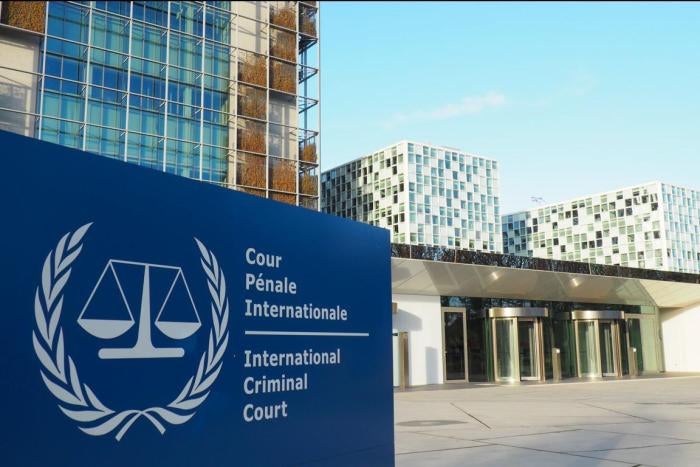
ICC permanent premises
Permanent premises of the International Criminal Court in The Hague, the Netherlands. © 2018 Marina Riera/Human Rights Watch

US President Joe Biden’s cancellation of punitive sanctions targeting the International Criminal Court (ICC) removes a serious obstacle to the court’s providing justice to the victims of the world’s worst crimes, Human Rights Watch said on 2 April 2, 2021. Biden revoked a June 2020 order by then-President Donald Trump authorizing asset freezes and entry bans to thwart the ICC’s work. This was expected after an appeal by many NGOs, see: https://humanrightsdefenders.blog/2021/02/19/large-group-of-ngos-call-on-biden-administration-to-repeal-icc-sanctions/

In announcing the repeal of the executive order, Secretary of State Antony Blinken said that “[t]hese decisions reflect our assessment that the measures adopted were inappropriate and ineffective.” The State Department also lifted existing visa restrictions.

“The Trump administration’s perversely punitive sanctions against the ICC showed stark contempt for the victims of grave international crimes and the prosecutors who seek to hold those responsible to account,” said Richard Dicker, international justice director at Human Rights Watch. “In removing this unprecedented threat to the global rule of law, President Biden has begun the long process of restoring US credibility on international justice through the ICC.”

https://www.hrw.org/news/2021/04/02/us-rescinds-icc-sanctions

Annual State Department report 2020: complete change of tone

March 31, 2021

On Tuesday, March 30, 2021, the 2020 edition of the Country Reports on Human Rights Practices was released by the U.S. Department of State’s Bureau of Democracy, Human Rights, and Labor. The Secretary of State is required by law to submit an annual report to the U.S. Congress on “the status of internationally recognized human rights” in all countries that are members of the United Nations. This annual report, called the Country Reports on Human Rights Practices but commonly known as the Human Rights Report (HRR), provides information that is used by Congress, the Executive Branch, and courts in making policies and/or decisions; thus accurate information on human rights conditions is critical. The HRR also informs the work at home and abroad of civil society, human rights defenders, lawmakers, scholars, immigration judges and asylum officers, multilateral institutions, and other governments.

The country reports are prepared by U.S. diplomatic missions around the world, which collect, analyze, and synthesize information from a variety of sources, including government agencies, non-governmental organizations, and the media. The reports do not attempt to catalogue every human rights-related incident, nor are they an effort by the U.S. government to judge others. Instead, they claim to be factual in nature and focus on a one-year period, but they may include illustrative cases from previous reporting years.

Conor Finnegan for ABC News on 30 March 2021 compared the report with those of the Trump administration:

Blinken launched the department’s 45th annual human rights report Tuesday which The report covers 2020 and found a further deterioration for human rights in many countries, particularly as governments used the coronavirus pandemic to curb their citizens’ rights.

The first report under the Biden administration also included changes that eliminated the conservative take of the Trump years, like ending former Secretary of State Mike Pompeo’s “hierarchy” of rights and re-introducing a section on women’s reproductive rights that will be published later this year.

When human rights defenders “come under attack, they often look to the United States to speak up on their behalf. Too often in recent years, these defenders heard only silence from us,” Blinken said. “We are back for those brave advocates as well. We will not be silent.

In particular, Blinken “decisively” repudiated Pompeo’s “Unalienable Rights Commission,” a panel of academics that said in a report last July that freedom of religion and right to property were the most important human rights. While Pompeo touted the report and said it would lay a foundation for future administrations, critics accused it of minimizing minority rights. Blinken essentially jettisoned the report, saying Tuesday, “There is no hierarchy that makes some rights more important than others. Past unbalanced statements that suggest such a hierarchy, including those offered by a recently disbanded State Department advisory committee, do not represent a guiding document for this administration.” [see also: https://humanrightsdefenders.blog/2019/07/11/trump-marches-on-with-commission-on-unalienable-rights/]

Human rights are increasingly under threat around the world, Blinken said, saying the trend lines “are in the wrong direction.”

In particular, he highlighted what he called the Chinese government’s genocide of Uighurs and other Muslim ethnic minorities in Xinjiang province, attacks on civil society and political opposition in Russia, Uganda and Venezuela and on pro-democracy protesters in Belarus, war crimes in Yemen, atrocities “credibly reported” in Ethiopia’s Tigray region, and abuses by the Syria’s Bashar al-Assad’s regime.

While the report doesn’t touch on Myanmar’s coup and the military’s bloody crackdown on protests, because they happened in 2021, Blinken took time to again condemn the events. But after weeks of steadily increasing U.S. sanctions that have not deterred the ruling junta, he had no specific answer on what else the U.S. could do to change the darkening trajectory there.

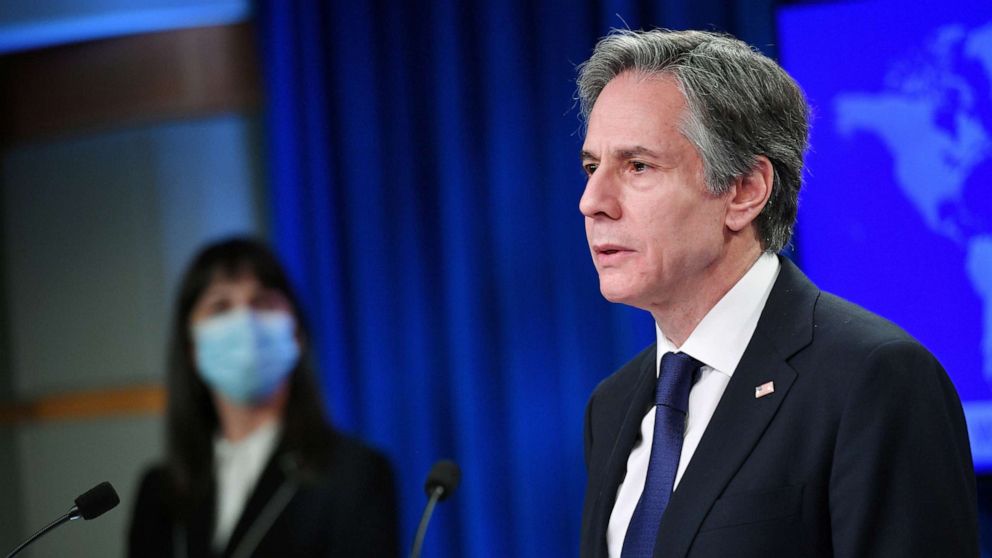
PHOTO: U.S. Secretary of State Antony Blinken speaks during the release of the "2020 Country Reports on Human Rights Practices" at the State Department in Washington on March 30, 2021.
Mandel Ngan/Pool/ReutersMandel Ngan/Pool/ReutersU.S. Secretary of State Antony Blinken speaks during the release of the “2020 Country…

Chinese officials and state-run outlets have increasingly raised U.S. race relations to say American officials are in no position to criticize Beijing — comparing Uighur slave labor in Xinjiang to Black slaves in the U.S. South.

We know we have work to do at home. That includes addressing profound inequities, including systemic racism. We don’t pretend these problems don’t exist. … We deal with them in the daylight with full transparency, and in fact, that’s exactly what separates our democracy and autocracies,” he said, adding that open reckoning gives the U.S. “greater legitimacy” to address other countries’ records, too.

The Biden administration will use all tools available to impose consequences on human rights abusers and encourage better behavior, Blinken said, including the new Khashoggi policy that imposes visa restrictions on officials that target or harass their countries’ dissidents.

Standing up for human rights everywhere is in America’s interests, and the Biden-Harris administration will stand against human rights abuses wherever they occur, regardless of whether the perpetrators are adversaries or partners,” he said.

https://abcnews.go.com/Politics/blinken-swipes-trump-administration-unveiling-human-rights-report/story?id=76770342

Large group of NGOs call on Biden administration to repeal ICC Sanctions

February 19, 2021

After the Trump administration attacks on the ICC [see https://humanrightsdefenders.blog/2020/06/12/trump-issues-new-sanctions-on-the-icc-and-human-rights-defenders/], the question is now how the Biden administration will change course:

On 17 February 2021, more than 70 Non-Governmental Organizations, Faith-Based Groups and Academic Institutions called for the Biden Administration to Repeal ICC Sanctions:

The undersigned organizations urge the Biden Administration to engage constructively with the International Criminal Court (ICC). The U.S. government’s support for the ICC could help secure justice for victims in situations from Myanmar to Darfur, just as it helped facilitate the February 4 historic conviction of a former leader of an armed rebel group for war crimes and crimes against humanity in northern Uganda.There is an immediate need to act to reset U.S. policy regarding the ICC. Most urgently, we are alarmed by recent calls for the U.S. government to maintain or even expand the sanctions put into place by the Trump administration in June 2020 currently targeting the court’s work.These actions were an unprecedented attack on the court’s mandate to deliver justice and the rule of law globally, an abuse of the U.S. government’s financial powers, and a betrayal of the U.S. legacy in establishing institutions of international justice. They were also an attack on those who engage with the court, including human rights defenders and victims. These extraordinary measures have put the U.S. at odds with many of its closest allies. They also have been challenged on constitutional grounds domestically. Keeping in place the executive order authorizing sanctions would be inconsistent with the new administration’s laudable commitments to respecting the rule of law and pursuing multilateral cooperation in support of U.S. interests. It would also transform a shameful but temporary action into a standing license for other governments to attack multilateral institutions when they disagreewith those bodies’ actions. We call upon the U.S. government to rescind Executive Order 13928 and all sanctions measures against ICC officials at the earliest possible opportunity. We appeal for constructive engagement with the ICC and we urge the Biden administration and members of Congress to support that approach.

This statement was coordinated by the Washington Working Group for the International Criminal Court (WICC), an informal and nonpartisan coalition of diverse NGOs, including human rights organizations, faith based groups, professional associations, and others.

The Advocates for Human Rights, Allard K. Lowenstein International Human Rights Clinic, Yale Law School, American Civil Liberties Union (ACLU), American Jewish World Service (AJWS), Amnesty International USA, Anti-Torture Initiative, American University Washington College of Law, Associazione Luca Coscioni, Center for Civilians in Conflict (CIVIC), Center for Constitutional Rights (CCR)Center for Justice and Accountability Center for the Study of Law & Genocide, Loyola Law School, Center for Victims of Torture (CVT) Congregation of Our Lady of Charity of the Good Shepherd, US, Provinces Darfur Women, Action Group Democracy for the Arab World Now (DAWN), Eumans European Center for Constitutional and Human Rights, Fortify Rights, Global Centre for the Responsibility to Protect, Global Justice Center, Global Justice Clinic, New York University School of Law, Guernica 37, Chambers and Centre for International Justice, Human Rights and Gender Justice Clinic, City University of New York School of Law, Human Rights FirstHuman Rights Institute, Georgetown University Law Center, Human Rights Watch, Institute for Policy Studies, Drug Policy Project, Institute for Policy Studies, New Internationalism Project, International Association of Democratic Lawyers, International Center for Transitional Justice (ICTJ). International Commission of Jurists (ICJ), International Criminal Court Alliance (ICCA), International Federation for Human Rights (FIDH), International Human Rights Clinic, Boston University School of Law, International Human Rights Clinic, Harvard Law School, InterReligious Task Force on Central AmericaJ . StreetJustice for Muslims Collective. Leitner Center for International Law and Justice, National Advocacy Center of the Sisters of the Good Shepherd. Never Again Coalition, No Peace Without Justice, Open Society Foundations, Operation Broken Silence, Parliamentarians for Global Action (PGA), Partners in Justice International, Pax Christi USA, Physicians for Human Rights, Presbyterian Church (USA), Office of Public Witness, Project Blueprint,The Promise Institute for Human Rights, UCLA School of Law REDRESS, The Rendition Project

Speculating on the Nobel Peace Prize 2021

February 4, 2021

Speculating about the Nobel Peace Prize is a sport that keeps some media busy most of the year.

Although thousands of people, from members of parliaments worldwide to former winners, are eligible to propose candidates (see list in link), it is the group of Norwegian parliamentarians that has nominated the eventual laureate every year since 2014 (with the exception of 2019), according to Henrik Urdal, Director of the Peace Research Institute Oslo. And for this year Russian dissident Alexei Navalny, the World Health Organization and climate campaigner Greta Thunberg are among those nominated by backed by Norwegian lawmakers.

The Norwegian Nobel Committee, which decides who wins the award, does not comment on nominations, keeping secret for 50 years the names of nominators and unsuccessful nominees. But the nominators themselves can choose to reveal their choice and often do.

On 31 January 2021 Gwladys Fouche and Nora Buli started off the guessing season by reporting that, according to a Reuters survey of Norwegian lawmakers, nominees include Thunberg, Navalny, the WHO and its COVAX programme to secure fair access to COVID-19 vaccines for poor countries.

Other names are Belarusian activists Sviatlana Tsikhanouskaya, Maria Kolesnikova and Veronika Tsepkalo for their “fight for a fair election and inspiration for peaceful resistance”, one nominator, Geir Sigbjoern Toskedal, said. Another, Jette Christensen, also named the Hungarian Helsinki Committee, a human rights group, and IUSTITIA, a group of Polish judges defending civil rights. “My nomination this year is … for the fight to preserve democracy as a form of government in Europe,” Christensen said.

Freedom of information is a recurring theme with nominees including the U.S.-based Committee to Protect Journalists; former Charlie Hebdo journalist Zineb el Rhazoui; news website Hong Kong Free Press, the U.S.-based International Fact-Checking Network and Paris-based Reporters without Borders (RSF). Also mentioned are: the Black Lives Matter movement and Stacey Abrams, the former Georgia gubernatorial candidate who has become a leading voting rights advocate.

Other nominees include former U.S. President Donald Trump (by Jaak Madison, a member of the right-wing populist EKRE party) as well as Kushner and Berkowitz for negotiating deals between Israel and the United Arab Emirates, Bahrain, Sudan and Morocco), .

Also on the list are NATO and again the U.N. refugee agency (UNHCR) as well as Aminatou Haidar, for her peaceful campaigning towards an independent Western Sahara, the International Space Station and the International Scout Movement.

https://www.nobelprize.org/nomination/peace/

https://www.kcrg.com/2021/02/02/explainer-how-nobel-peace-prize-nominations-come-about/

https://www.euronews.com/2021/02/01/donald-trump-estonian-mep-jaak-madison-nominates-ex-us-president-for-nobel-peace-prize

MEA 2019 laureate Abdul Aziz Muhamat wants refugees themselves to be heard

November 9, 2020

Geneva Solutions of 7 November 2020 published a call to give “a voice back to the voiceless: a call to empower refugees” written by Abdul Aziz Muhamat, who is a human rights advocate for migrants and refugees now based in Geneva. He is the 2019 Martin Ennals Award Laureate for Human Rights Defenders (see: https://humanrightsdefenders.blog/2019/09/30/flight-from-manus-the-inside-story-of-an-exceptional-case/),

He is currently a UN fellow at OHCHR, and the former recipient of the ISHR Human Rights Defenders Fellowship. He is involved in social work, advocacy, and is authoring in collaboration with other refugees offshore and inshore ( They Can’t Take The Sky):

I’m tired of hearing celebrities saying they are  “voices of the voiceless.” Unfortunately, I hear it often from celebrities with our pictures and stories, rather than from refugees themselves.

The so-called “voiceless” are individuals living in poverty and conflict zones, and were forced to leave their countries while they were muffled, hushed, pushed down and left out. But they are not voiceless. They do not need your voices but they do need you to put them behind the microphone, make room at the table, and give them a chance to speak up. If we want to find lasting and sustainable solutions for the refugee and migrant crisis, then stop speaking for the so-called voiceless, and start working alongside them to make sure their powerful voices are heard.

Media, the arts and celebrities often say they strive to “give voice to the voiceless”. While this can empower, it can also be a potentially harmful tool for them too. It makes me feel like an object, it discourages me from speaking for myself and most importantly, it is dehumanising because someone else is speaking on my behalf. Being a refugee means more than being an alien, no right, no voice; this can sound trite, clichéd, even patronising. Speaking on our behalf can take the real voices of the concerned people away and replace them with a slogan, “Voice of the Voiceless”. Are they really voiceless? If so, then who took their voices?

What refugees urgently need, besides food and water, medical care, and a roof over their heads, is hope! And prospects of a homeland, friends, and a sense of security. Unfortunately, reality presents a completely different picture to many of them. Here is a call for reflection.

Protests and public ceremonies at least remind us of the problem, even if they do not solve them. Anyone who has never been part of a refugee trek has little idea of everything that happens along the way. These people have just turned their backs on violence, persecution, and human rights violations only to walk into hopelessness, hunger, and cold! It is a vicious cycle of evil that has been set in motion. People with a permanent home and a roof over their heads can barely imagine this. There are millions of fates and stories that tell of violence, human abysses, but some also of hope and courage.

Why is it easy to listen to someone who speaks out on behalf of victims but not to the victims directly? Is it also time to question this invisibility? The fact is that no-one is listening and no-one is offering them a platform to express their concerns on their own, so it doubles their suffering. We hide them in detention centres or camps, away from us, making it harder for them to connect with reality. But it also prevents the truth from coming out as it is, and that’s part of the complexity. The majority of these refugees are coming from countries that are torn apart by wars, extreme poverty, lack of freedom of speech, human rights abuses etc.

The media are not interested in listening to the people concerned. Instead they listen to the rich and famous, and this makes them complicit. It is on journalists and the media’s shoulders to seek out the stories of those who would be left out of the public record, like refugees, asylum seekers and migrants. If we aim “to give voice to the voiceless,” it requires more than asking for sound-bite quotes, taking pictures in refugee camps or using them to sell newspapers. No, it is bigger than that, it means listening to their stories, offering them a safe platform to speak for themselves rather than to speak on their behalf, no-one was born without a voice.

No media so far asks the refugees about the impact of the US election or the EU migration policy, why? Because we don’t have a voice and our point of view is not considered as valuable. The Trump administration, but also the Democratic party, have largely dismantled the US asylum seekers and refugees resettlement programme. It became a model for the EU member States and Australia, and even questioned the refugees convention of 1951.

The actions of the US government over the last four years shaped the dichotomy of “Us-vs-Them”. It has also created social and economical inequality among the refugee communities: some were seen as vulnerable and others not, and this in turn has increased tensions within refugee communities. As an example, in 2017 when the US government made a deal with the Australians to take refugees from offshore detention centres on Manus Island and Nauru several countries were banned and it created big tensions between the refugees. These actions show a lack of compassion for the victims of armed violence and persecution and abdicates US leadership and support for countries struggling to cope with refugee crises. The Trump administration turned a cold shoulder to countries on the frontlines of conflict, many of which are close US allies and bear the burden of caring for and protecting the overwhelming majority of the world’s refugees. Even at its most robust, US refugee resettlement only directly benefits a small fraction of the world’s 26 million refugees. But when used strategically, and in combination with humanitarian assistance and technical support, it can have enormous benefits beyond helping the relatively few people rescued.

The US refugee resettlement program has traditionally aimed to identify the most vulnerable refugees, often those who are not only persecuted in their home country but also unwelcome in the country of first arrival, such as members of religious minorities or LGBT.  The American refugee policies have inspired many countries such as Australia, Europe, the UK, and especially after the domination of the right-wing in Europe. In Australia, refugees are forcibly sent to remote islands and detained for almost seven years, in Europe especially Greece became the EU warehouse for asylum seekers and migrants, and some were forcibly pushed back by some EU member States to Libya or left to drown off the coast of Libya.

Europe’s humanity is lost at sea when it comes to refugees and no-one knows when or how will the EU get it back.

————-

https://genevasolutions.news/peace-humanitarian/giving-a-voice-back-to-the-voiceless-a-call-to-empower-refugees