Travel bans on human rights defenders are popular with all kind of autocratic regimes but seem to enjoy special status in the Middle East. The video clip above (part of a joint campaign by AI and HRW) focuses on Egypt and so does the statement by 6 other NGOs issued on 9 November. They strongly condemn the travel ban against Malek Adly, prominent Egyptian human rights lawyer and director of the Lawyers Network of the Egyptian Center for Economic and Social Rights (ECESR). But there is more: Read the rest of this entry »
The detention of a Kashmiri human rights defender on Wednesday, the day after a court had ordered his release from a previous arrest, has prompted concerns that Indian authorities have stepped up their use of laws that allow detention without trial. Khurram Parvez was due to be released after being arrested a week earlier but has instead been moved to prison after the Jammu and Kashmir state government approved a Public Safety Act (PSA) order, which allows administrative detention without trial for up to six months.
Bahrain does everything it can to keep itself in the spotlight of human rights concern. A coalition of NGOs, as well as the UN and (reluctantly) the USA have recently come out with criticism over travel bans, reprisals, denationalization and other violations:
When the 32nd session of the United Nations Human Rights Council opened in Geneva on 13 June 2016, Nabeel Rajab, Bahrain’s best-known human rights defender, was arrested after dozens of police officers raided his home at around 5am and confiscated his electronic devices. The day before, Bahraini human rights defenders and victims of violations were prevented from flying to Geneva. On 16 June21 NGOs signed a statement of serious alarm by Bahrain’s restrictions civil society especially preventing them from engaging with the UN.
[Rajab, President of the Bahrain Center for Human Rights (BCHR – nominee of the MEA 2012), founding Director of the Gulf Centre for Human Rights (GCHR) and Deputy Secretary General of FIDH, was reportedly arrested under order from the Ministry of Interior’s Cybercrimes Unit. Bahraini officials had imposed a travel ban on Rajab a year ago, and since April 2015 have maintained charges against him for crimes related to freedom of expression online. Despite the submission of several appeals against the ban, authorities remained unresponsive. On 14 June 2016, Rajab was transferred to the public prosecution; and new charges were brought against him of allegedly ‘publishing and broadcasting false news that undermines the prestige of the state’. The public prosecution remanded him to seven days in detention pending investigation.]
In a new escalation of its crackdown against civil society, Bahraini authorities have now also banned other human rights defenders from leaving the country. The bans were imposed as the activists were attempting to travel to Geneva to participate in the Human Rights Council.
In light of this escalated attack on civil society in Bahrain, the 21 NGOs call for the immediate release of all human rights defenders in Bahrain, including Nabeel Rajab, and for the removal of the imposed travel bans which unfairly restrict activists’ freedom of movement. We also request that the President of the HRC, the UN High Commissioner for Human Rights, the Special Rapporteur on the Situation of Human Rights Defenders, the Special Rapporteur on Freedom of Opinion and Expression and the Special Rapporteur on the Rights to Freedom of Peaceful Assembly and Association call on the Bahraini authorities to immediately and unconditionally lift the travel ban imposed on Bahrain’s civil society activists and guarantee Bahraini human rights defenders are free from intimidation and restrictions on their work, including at the UN. We also call on the international community to hold the government of Bahrain to its commitments and obligations to foster a safe environment for the peaceful enjoyment of universal human rights. The government of Bahrain must immediately stop the ongoing reprisals against human rights defenders who are engaging with international mechanisms including the UN system. [21 signatories to be hound at the bottom of this post.]
On 21 June 2016, the Office of the UN High Commissioner for Human Rights stepped in with an expression of great concern over this intensification of a crackdown on free expression and association, and the right to a nationality: Read the rest of this entry »
reports on 13 May 2016 how Israel refused to give a travel document and could possibly revoke the permanent resident status of Omar Barghouti.
On 10 May 2016, human rights defender Mr Omar Barghouti received confirmation of the official refusal by Israeli authorities to renew his travel document. Moreover he was informed that the refusal to renew the travel document is a first step in the eventual revocation of his permanent resident status. Omar Barghouti is a Palestinian human rights defender and co-founder in 2005 of Boycott, Divestment and Sanctions [https://www.frontlinedefenders.org/en/profile/omar-barghouti]. Omar Barghouti has been living in Acre, Israel with his family since 1994, when he was granted permanent residency. His Israeli travel document allows him to travel back and forth to Palestine to carry out his advocacy work related to the promotion of Palestinian rights. The permit must be renewed every two years, and was renewed regularly without any difficulty.
On 10 May 2016, Omar Barghouti received official confirmation that renewal of his travel document and re-entry permit had been refused by Israeli authorities. In April 2016, he was informed by Israel’s Interior Ministry, who has responsibility for immigration, that his resident status was under review by the Attorney General. Officials have stated that the revocation of his resident permit is related to his work and international travel advocating “for the boycott of Israel”. Without travel document, Omar Barghouti will be unable to freely travel to and from Palestine; should the resident permit also be withdrawn, he will be unable to reside in Israel, where he has been living with his family for 22 years.
Prior to this incident, Omar Barghouti was prevented by Israeli authorities from traveling abroad on several occasions including to two conferences held by BDS in California, on nonviolent and strategic action against human rights violations.
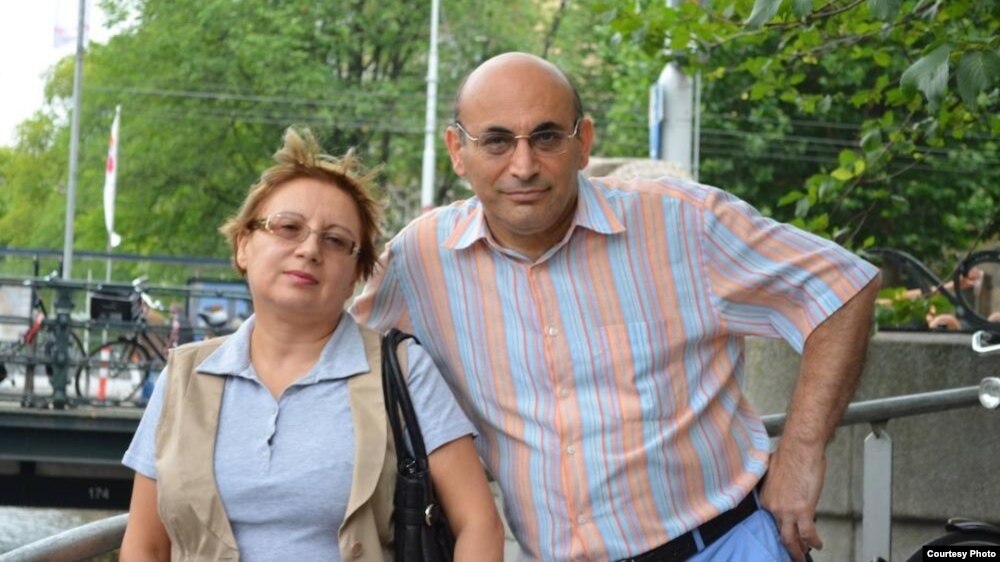
Two of Azerbaijan‘s most prominent human rights defenders have arrived in the Netherlands after the authorities in Baku suddenly granted them permission to leave.
Leyla and Arif Yunus
RFE/RL’s Azerbaijani Service reported on 19 April 2016 that Leyla Yunus and her husband, Arif, were greeted by their daughter, Dinara Yunus, who lives in the Netherlands, upon landing at Amsterdam’s Schiphol airport on April 19, according to Dutch media reports. Welcoming the two, Dutch Foreign Minister Bert Koenders said Leyla and Arif Yunus, who are seeking asylum in the Netherlands, “had put their own safety and happiness at stake in the struggle for democracy and human rights“.
While human rights organizations and the media around the world were remembering Egypt‘s Tahrir Square [https://thoolen.wordpress.com/2016/01/28/five-years-after-tahrir-square-there-is-stability-in-egypt-but-do-not-ask-at-what-price/] the space for demonstrations in Egypt itself was minimal. But a huge exception was made on 13 February 2016 when some 10.000 people gathered at noon in front of the Doctors Syndicate in Cairo. Heartening to see that the doctors have the courage to take up the case against police brutality. But you are unlikely to hear about this from an Egyptian human rights defender in person as they are systematically banned from traveling. Read the rest of this entry »
BREAKING NEWS: Ahmed Mansoor was just announced during the ceremony in Geneva as the 2015 MEA Laureate [6 October 2015]. Since 2006, Ahmed Mansoor (United Arab Emirates) has focussed on initiatives concerning freedom of expression, civil and political rights. He successfully campaigned in 2006-2007 to support two people jailed for critical social comments, who were released and the charges dropped. Shortly after, the Prime Minister of UAE issued an order not to jail journalists in relation to their work. Mr Mansoor is one of the few voices within the United Arab Emirates who provides a credible independent assessment of human rights developments. He regularly raises concerns on arbitrary detention, torture, international standards for fair trials, non-independence of the judiciary, and domestic laws that violate international law.
He has faced repeated intimidation and harassment, including imprisonment in 2011 after being convicted of “insulting officials” and sentenced to three years’ in prison, although he was released after eight months. Since being jailed in 2011, he has been denied a passport and banned from travelling. The Martin Ennals Jury has in vain urged the government of the UAE to lift this travel ban and allow him to travel. Martin Ennals Foundation Chair Micheline Calmy-Rey stated “ Ahmed Mansoor continues to pay the price for speaking out on human rights issues in his country, we urge his government to lift the travel ban.” [https://thoolen.wordpress.com/2015/09/15/fly-emirates-if-the-emirs-let-you/]
Ahmed Mansoor’s message (recorded on video before the ceremony):
The Martin Ennals Award for Human Rights Defenders (MEA) is a unique collaboration among ten of the world’s leading human rights organizations to give protection to human rights defenders worldwide. The Jury is composed of the following NGOs:
Martin Ennals Award for Human Rights Defenders
– Amnesty International,
– FIDH,
– Human Rights First,
– HURIDOCS,
– International Service for Human Rights,
– EWDE Germany,
– Front Line Defenders,
– Human Rights Watch,
– International Commission of Jurists,
– World Organisation Against Torture.
The two other finalists received Martin Ennals Prizes:
Robert Sann Aung (Myanmar)
Since 1974, Robert Sann Aung has courageously fought against human rights abuses. He has been repeatedly imprisoned in harsh conditions, physically attacked as well as regularly threatened. He was disbarred from 1993 – 2012. Currently, he represents students detained for peaceful protests.
Asmaou Diallo (Guinea)
Her human rights work started following the events of 28 September 2009 when the Guinean military attacked peaceful demonstrators. She founded l’Association des Parents et Amis des Victimes du 28 septembre 2009 (APIVA), which assists those affected, and supports them to testify in court proceedings.
The Emirates proudly sponsor major clubs such as AC Milan, Real Madrid, Benfica, Paris Saint-Germain and Arsenal, but when it comes to flying out of the country there is a problem for those who do not toe the line. A case in point is Ahmed Mansoor, one of 3 finalist for the 2015 Martin Ennals Award for Human Rights Defenders.
Today – 15 September 2015 – the 10 international NGOs on the Jury of the MEA (see list below) came out with an exceptional joint statement calling on the United Arab Emirates (UAE) authorities to lift the travel ban imposed on Ahmed Mansoor and to issue him a passport before the ceremony on 6 October in Geneva (in which the United Nations High Commissioner for Human Rights participates).
Widely respected as one of the few voices within the UAE to provide a credible independent assessment of human rights developments, Ahmed Mansoor regularly raises concerns regarding arbitrary detention, torture or degrading treatment, and failure to meet international standards of fair trial. He also draws attention to other human rights abuses, including against migrant workers. As a result, Ahmed Mansoor has faced repeated intimidation, harassment, and death threats from the UAE authorities or their supporters, including arrest and imprisonment in 2011 following an unfair trial. He and four other activists who called for democratic rights in the UAE were jailed in 2011 on the charge of “insulting officials”. Although pardoned and released later that year, Ahmed Mansoor has been banned from travel and had his passport confiscated.
Martin Ennals Award for Human Rights Defenders
The Martin Ennals Award Jury today said: “Ahmed Mansoor’s absence at the ceremony would mark a very disappointing position for the UAE, which is a country that prides itself as one of the hubs of international business and tourism in the Middle East, as well a safe haven in the region. As a member of the UN Human Rights Council, which is running for a second term, we expect the UAE authorities to honour their obligations to uphold human rights and protect human rights defenders. The UAE government must match its rhetoric on the international stage with meaningful actions at home, starting with immediately lifting the travel ban on Ahmed Mansoor, to returning and renewing his passport, and allowing him to travel to Geneva for the ceremony.”
He already was portrayed as an atheist, working for foreign agendas, receiving foreign funding, etc. Now, in one of the leaked WikiLeaks cables of the Saudi Foreign Ministry, the Ministry of Interior tries to justify its preventing Waleed AbuAlKhair from traveling to attend the Democratic Leaders Program sponsored by the US State Department. After the Saudi ambassador in Washington received a call from the US Ministry of Foreign Affairs, the Saudi Ministry of Interior fabricated a story that Waleed is facing a family suit because of his marriage and his conversion from Sunni to Shiite Islam. None of this was mentioned in court, when he was sentenced to 15 years in prison for demanding constitutional monarchy, and the establishment of two human rights organizations.



 Hans Thoolen on Human Rights Defenders and their awards