The event “Tackling the protection gap: Host States’ responsibility to prevent and respond to transnational repression” will bring together defenders and UN experts to discuss the international human rights law obligations of States in respect of transnational repression against individuals and groups within their territory, as well as the strengthening of international standards, and gaps arising from shortcomings in their implementation domestically.
Location: Geneva, Switzerland. Date: 09 March 2026. Palais des Nations, Room VIII. Time: 2:00PM – 3:00PM CET and livestreamed on ISHR’s YouTube channel.!
Research from international organisations, NGOs and academics shows that transnational repression (TNR) – acts by States and their proxies to deter, silence or punish dissent, criticism or advocacy outside their territory – is affecting a growing array of individuals and groups worldwide.[1] With the emergence of new surveillance and communication technologies, many actors have found new avenues to silence and punish critics and opponents. The most common targets have been exiled human rights defenders and political activists, but today broader groups such as journalists, lawyers, artists, academics and ordinary members of diaspora communities are frequently targeted. See e.g.
The immediate effect of TNR is the violation of, or constraint on the exercise of, fundamental human rights. States have obligations towards those subject to such violations taking effect within their territory. These obligations have long been recognised, but have not yet been the subject of focused discussion in relation to TNR, leaving the scope and nature of the duties of host States unclear.
This event will bring together defenders and UN experts to discuss the international human rights law obligations of States in respect of transnational repression against individuals and groups within their territory, as well as the strengthening of international standards, and gaps arising from shortcomings in their implementation domestically.
Speakers:
Sayed Ahmed al-Wadaei, Director of Advocacy, Bahrain Institute for Rights and Democracy (BIRD)
Birgit Kainz-Labbe, Coordinator of Civic Space Unit, Office of the UN High Commissioner for Human Rights
Ben Saul, UN Special Rapporteur on counter-terrorism and human rights
Hélène Tigroudja, Human Rights Committee, Vice-Chair
Moderator: Raphael Viana David, International Service for Human Rights
This event is organised by ISHR and co-hosted with Human Rights Watch, Human Rights House Foundation and the International Federation for Human Rights (FIDH).
Transnational repression (TNR), the cross-border targeting, intimidation, and harassment of journalists and human rights defenders, is increasingly undermining press freedom and human rights in Europe and beyond. Journalists in exile often remain subjects of sustained threats, surveillance, cyber-attacks, psychological pressure, and harassment long after reaching presumed safety. These tactics are used by authoritarian states to silence dissent, extend their reach beyond borders, and weaken the role of independent media globally. This is demonstrrated in the 18 December 2025 Position Paper written by Katrin Schatz, Journalists-in-Exile Programme Manager,
The European Centre for Press and Media Freedom (ECPMF) stands firmly against any form of repression that endangers journalists in exile and undermines fundamental freedoms. As a Europe-focused organisation, our mandate centres on strengthening press freedom across the continent. Much of our documented experience with transnational repression comes from our support work in Germany, particularly through the Journalists in Exile (JiE) programme, which gives us direct insight into how these threats continue even after relocation. Our analysis, monitoring and advocacy consistently show that current policy frameworks are insufficiently equipped to address the reality of transnational repression.
Transnational Repression targets journalists in exile
Many Journalists in exile remain at risk. ECPMF’s research on transnational repression in Germany from 2025 finds that journalists who fled authoritarian contexts continue to experience threats, intimidation, surveillance and psychological pressure in their host countries. These tactics are part of a broader strategy by autocratising states to control dissent.
ECPMF’s Mapping Media Freedom (MapMF) platform shows exactly this – through the recently initiated category documenting threats against journalists in exile, ongoing surveillance, digital harassment and family members being targeted are reported. However, cases of transnational repression are rarely documented, not because they don’t exist, but because of the extreme sensitivity of the issue: publicity can endanger journalists’ families at home, expose those in exile to additional targeting, and many affected journalists choose or are advised to remain discreet for safety reasons.
Transnational repression threatens press freedom and democratic space
Transnational repression is not only an attack on individual journalists, it is a direct assault on press freedom and democratic spaces globally. However, acknowledging the personal strains of those affected is essential: many journalists in exile face isolation, trauma, financial precarity, and the constant fear that reprisals could reach them or their families, friends, and colleagues.
TNR tactics take place across multiple contexts: through digital harassment, spyware, coordinated smear campaigns, threats to family members, diplomatic pressure, misuse of international legal instruments, or using diaspora networks to intimidate critics abroad. Together, they form a pattern: a systematic effort by authoritarian and autocratising states to suppress independent journalism far beyond their borders. Coupled with the EU’s lack of reaction, this perpetuates cycles of violence and silencing.
By creating a climate of fear among critical voices and disrupting professional and personal safety TNR systematically undermines freedom of expression, independent journalism and the safety of journalists. Journalists in exile play an indispensable role in informing the public through international reporting, providing independent coverage from authoritarian contexts where local journalism is heavily restricted or impossible.
Gaps in policy and protection in the EU
Increasingly restrictive migration and return policies
The EU’s use of “safe country of origin/ third country” frameworks and streamlined return mechanisms risk exposing journalists to environments where they continue facing repression. Recent decisions by the European Council, endorsed by 39 MEPs , including the designation of countries with documented human rights violations, including press freedom violations as “safe” contradicts the very essence of protection that asylum and refugee policies are meant to provide.
The EU-wide list of safe countries will include: Bangladesh, Colombia, Egypt, Kosovo, India, Morocco and Tunisia. ECPMF is highly concerned about the dangerous implications of this policy for journalists and human rights defenders.
Lack of comprehensive frameworks
Current EU instruments still do not provide a systemic approach to TNR. There is no binding definition, no integrated action plan, and no framework that aligns migration policies, human rights obligations, digital safety, and cross-border policing responses to transnational repression. Existing mechanisms remain fragmented, leaving journalists without coherent pathways to protection.
Fragmented national responses
At the EU member state level, responses to TNR are inconsistent. Few governments started to formally acknowledge the threat and explore legal or policy measures, while others lack official recognition and structured responses. Even when awareness exists, protection mechanisms remain fragmented, under-resourced, or inaccessible. Journalists, just as any other person seeking refuge, also face racial discrimination within domestic systems, which can influence how their cases are treated.
Civil society has often stepped in where states have not taken responsibility. In Germany, the Coalition Against Transnational Repression has emerged as a key actor, bringing together human rights and diaspora organisations to push for stronger national policies. At the same time, many institutions and law enforcement bodies lack sufficient knowledge or training to identify transnational repression patterns, assess cross-border threats, or understand the jurisdictional complexities involved. Limited cooperation between migration authorities, police, prosecutors, and security services further weakens effective responses. As a result, national responses remain predominantly reactive rather than preventive, leaving journalists in exile exposed to ongoing risks.
ECPMF’s position and demands
Transnational repression is pervasive and increasingly dangerous. Journalists who have fled oppression continue to face coordinated pressure, digital harassment, legal threats, and physical intimidation across borders. As seen through the experiences of fellows in ECPMF’s Journalists-in-Exile programme, exile does not guarantee safety. Threats often follow them into Europe, leaving them vulnerable even in countries that are supposed to offer protection.
Current human rights and migration policies fall short of addressing the lived realities of journalists in exile and, in some cases, may even increase the risks they face. EU migration policies could force journalists back into the very environments from which they fled, thereby further jeopardizing their safety. This reflects the wider gap in the protection of journalists, where national and EU responses to transnational repression remain inconsistent, under-resourced, and fragmented.
ECPMF calls on the European Union, its member states and international bodies to take the following actions to better protect journalists in exile and combat transnational repression:
Develop and implement comprehensive legal frameworks that recognise the specific cross-border threats faced by journalists in exile, including digital harassment, surveillance, physical attacks, and threats to family members.
Ensure the protection of journalists within migration systems, with clear safeguards against forced returns to countries where they face repression, in line with the international principles of non-refoulement.
Develop and support national and EU-level mechanisms to monitor and respond to transnational repression, including dedicated hotlines, coordinated support services, and legal aid for affected journalists.
Include transnational repression in the EU’s strategic documents and policies for safeguarding democracies and combating disinformation and malicious interference, including the European Democracy Shield and similar documents, to ensure that the protection of those fighting repression is part of a comprehensive approach to preserving our democracies.
Incorporate transnational repression explicitly into EU foreign policy, ensuring that the EU’s human rights policies hold countries accountable for using repressive tactics against journalists in exile, as well as creating a system of sanctions and diplomatic pressure to address perpetrators.
Strengthen cooperation between member states, creating a coherent and coordinated EU response to transnational repression, with particular attention to the intersectional risks faced by journalists, including race, gender, and migration status.
Engage civil society and human rights organisations in the design and implementation of policies related to journalists in exile, ensuring that those who are most affected have a direct role in shaping the response.
This position paper was written by Katrin Schatz, Journalists-in-Exile Programme Manager, with contributions by Basma Mostafa, Journalists-in-Exile Fellow, Edith Bohl, Journalists-in-Exile Programme Officer, and Ena Bavčić, Senior Advocacy and Policy Advisor.
The issuance of Interpol red notices against two Salvadoran human rights defenders currently in exile in Spain constitutes a grave misuse of the law enforcement mechanism, UN experts warned on 19 November 2025
“This move amounts to an act of transnational repression, as it extends the harassment of human rights defenders beyond borders, targeting them in a country where they are seeking safety,” the experts said.
Ivania Cruz and Rudy Joya have applied for asylum in Spain, fleeing legal harassment in El Salvador stemming from their legitimate human rights work. Both human rights defenders work for the non-governmental organisation UNIDEHC, which has been targeted by the Salvadoran authorities since February 2025 for its support to the La Floresta community, who have been facing attempts of forced eviction since 2024.
“The charges brought against Ivania Cruz and Rudy Joya in El Salvador and related arrest warrants issued by the authorities appear to be without basis and in direct connection with their legitimate human rights work for UNIDEHC to support communities under threat and denounce the actions of the Government under the state of emergency declared in 2022,” the experts said.
In May 2025, the court presiding over their case in El Salvador ordered the Interpol National Central Bureau to submit a request for the issuance of a red notice to the Interpol General Secretariat. Interpol confirmed the issuance in July 2025.
The experts pointed to Articles 2 and 3 of the Constitution of Interpol, which state that the organisation is “strictly forbidden” from undertaking “any intervention or activities of a political nature”, and that the organisation’s activities will be conducted “in the spirit of the Universal Declaration on Human Rights.”
In September 2025, Rudy Joya was summoned by police under the pretext of his asylum application in Spain. Upon presenting himself to the authorities, he was detained and presented before a Spanish specialised court. Ivania Cruz was also summoned and appeared before the same court, which ordered that both defenders sign-in at a local court every 15 days, not leave the country, surrender their passports and report any change of address.
“We call on Interpol to immediately revoke the red notices and judicial sanctions against Ivania Cruz and Rudy Joya, and on Spain to refuse to accede to the red notice and to ensure their safety by rejecting their forcible return to El Salvador,” the experts said.
The experts are in contact with Interpol and the governments of Spain and El Salvador on these concerns.
Ganna Yudkivska (Chair-Rapporteur), Matthew Gillett (Vice-Chair on Communications), Miriam Estrada Castillo (Vice-Chair on Follow-Up), Mumba Malila, and Ethan Hee-Seok Shin,Working Group on Arbitrary Detent
On 14 November 2025, Scilla Alecci of the International Consortium of Investigative Journalists, Inc. (ICIJ) wrote about a parliamentary report which identified China and other authoritarian regimes as harassing and attacking dissidents abroad, echoing findings from ICIJ’s China Targets.
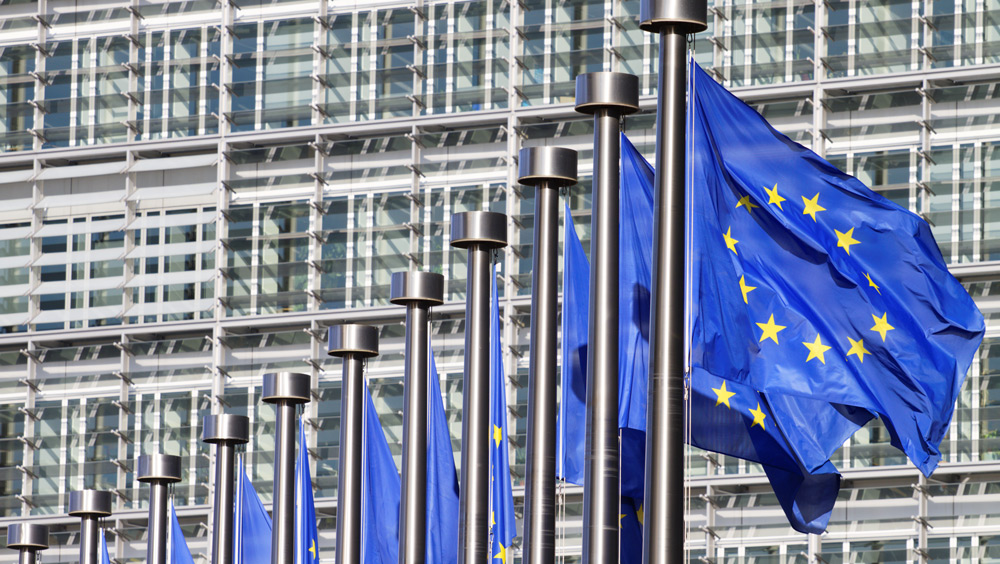
European Parliament in Brussels, Belgium.
The European Parliament has adopted a resolution urging member states to confront efforts by authoritarian regimes to coerce, control or silence political opponents and dissidents living in Europe. “Human rights defenders are a key pillar of democracy and the rule of law, and they are insufficiently protected,” a statement from the parliament said.
The resolution, adopted with a majority of 512 votes (to 76 against and 52 abstentions), called for targeted sanctions against perpetrators, market surveillance of spyware and better coordination among European authorities to counter what lawmakers labeled “transnational repression.”
The resolution is not legally binding but signals that European lawmakers want to take a clear position on the issue and draw attention to it, Elodie Laborie, a spokesperson for the Parliament’s Subcommittee on Human Rights, told the International Consortium of Investigative Journalists in an email.
It confirms findings by ICIJ’s China Targets investigation, which revealed how Beijing continues to use surveillance, hacking and threats against Chinese and Hong Kong dissidents, Uyghur and Tibetan advocates and their families to quash any criticism of the regime abroad.
Chinese authorities harassed several dozen Chinese film directors and producers, as well as their families in China, causing them to pull films from the inaugural IndieChina Film Festival in New York City. On November 6, 2025, the festival’s organizer, Zhu Riku, announced that the film festival, scheduled for November 8-15, had been “suspended.”
“The Chinese government reached around the globe to shut down a film festival in New York City,” said Yalkun Uluyol, China researcher at Human Rights Watch. “This latest act of transnational repression demonstrates the Chinese government’s aim to control what the world sees and learns about China.”
Chiang Seeta, a Chinese artist and activist, reported that nearly all participating directors in China faced intimidation. Even directors abroad, including those who are not Chinese nationals, reported that their relatives and friends in China were receiving threatening calls from police, said Chiang.
On November 1, the organizers issued an announcement on social media saying they had received messages from some film directors and producers and their families about Chinese government harassment: “We are deeply concerned about the situation. … [I]f you are under pressure not to attend the festival … we fully understand and respect it.” By November 4, more than two-thirds of participating films had cancelled their screenings.
After the festival was suspended, Zhu issued a statement that the decision was not out of fear, but rather to “stop harassment of … directors, guests, former staff, and volunteers associated with the festival, including my friends and family.”
Independent film festivals in China have faced intensifying crackdowns over the past decade, Human Rights Watch said. The Chinese authorities have shut down all three major independent film festivals in China: Yunfest, founded in 2003; the China Independent Film Festival, founded in 2003; and Beijing Independent Film Festival, founded in 2006.
When the authorities shut down the last screening of the Beijing Independent Film Festival in 2014, they cut off electricity from the venue, confiscated documents from the organizer’s office, and forced the organizers to sign a paper promising not to hold the festival. Many festival organizers have tried without success to adapt, for instance by changing their format to screenings at multiple venues.
The 14th China Independent Film Festival was shuttered in 2018, the last time such a festival took place in China.
A court in January 2025 sentenced Chen Pinlin, known as Plato, to three-and-a-half years in prison for allegedly “picking quarrels and provoking trouble” after he made a documentary about the “white paper protests” during Covid-19 lockdowns. Transnational repression can be defined as government efforts to silence or deter dissent by committing human rights abuses against their own nationals living abroad, their families at home, or members of the country’s diaspora. [see also: https://humanrightsdefenders.blog/2025/10/17/un-report-highlights-chinas-targeting-of-human-rights-defenders-abroad/]
The Chinese government’s transnational repression of the arts has not been limited to film. Chinese officials interfered with an exhibition in Bangkok and censored artwork by Uyghur, Tibetan, and Hongkonger artists in August.
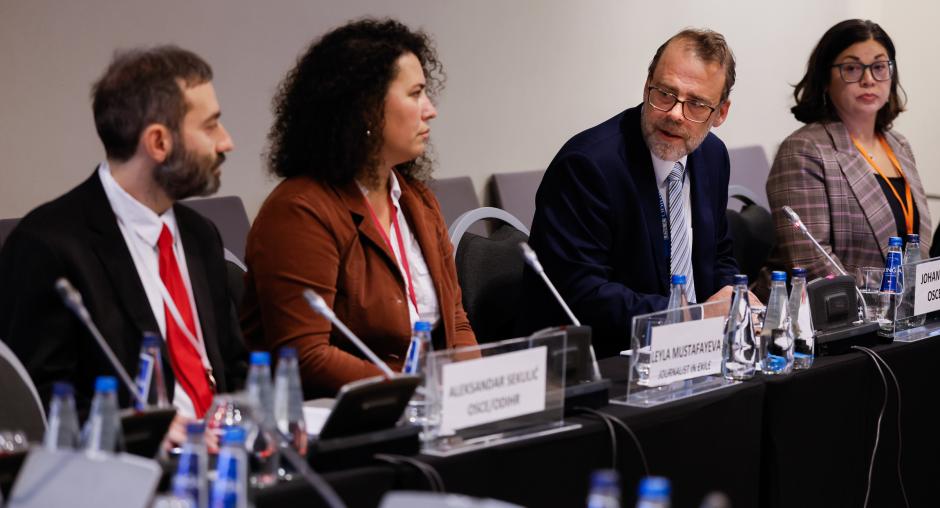
Panelists discussing the need for stronger protection for human rights defenders in exile. Warsaw, 16 October 2025 (OSCE/Piotr Dziubak) Photo details
As civil society space shrinks and attacks against activists increase in many places, a growing number of human rights defenders are being forced into exile as they seek a safe environment to continue their work freely and securely. This was the focus of an event organized by the OSCE Office for Democratic Institutions and Human Rights (ODIHR), Araminta, and the World Organisation Against Torture at the Warsaw Human Dimension Conference on 16 October 2025.
“Human rights defenders face inherent risks in their work, and relocating does not address all their needs. Adopting robust safeguarding mechanisms is essential to ensure minimum standards for mobility and a safe environment for defenders in exile,“ said Jennifer Gaspar, Araminta Managing Director.
While defenders in exile play a crucial role in promoting human rights, they face serious challenges, from urgent personal and legal issues to long-term barriers such as legal insecurity, restricted mobility and limited opportunities to continue their work. Participants discussed the need to establish minimum standards to protect human rights defenders in exile in the OSCE region, as well as EU legislation to ensure stronger legal and practical safeguards for them, participants discussed.
The discussion drew on both institutional perspectives and the lived experiences of exiled defenders, highlighting the need for coordinated action and policy tools to address these gaps. Participants emphasized that ensuring human rights defenders can continue their work in safety is vital to protect human rights and promote democratic values across the OSCE region and beyond.
On 15 October 2025 Sam Ellefson of ICII summarises the new report, which recounts recent reprisals from two dozen countries, underscores ICIJ’s reporting on how Beijing abuses international institutions in its campaign to silence critics abroad
The targeted repression of human rights activists across borders is becoming more frequent and sophisticated, according to the latest annual U.N. report detailing acts of intimidation and reprisals inside the international organization.
Two Hong Kong pro-democracy activists and a Uyghur linguist are among the cases compiled by the secretary-general between May 2024 and 2025, alongside updates on reprisals included in previous reports.
“Allegations of transnational repression across borders have increased, with examples from around the world,” the report said. “Targeted repression across borders appears to be growing in scale and sophistication, and the impact on the protection of human rights defenders and affected individuals in exile, as well as the chilling effect on those who continue to defend human rights in challenging contexts, is of increasing concern.”
Raphäel Viana David, the China and Latin America program manager at the International Service for Human Rights, a nonprofit that trains activists in U.N. advocacy, said the report reflected a shift within the U.N. in recognizing transnational repression as a tool states use to carry out reprisals.
In China Targets, ICIJ and 42 media partners exposed how Beijing has misused international institutions such as the U.N. and Interpol to target overseas dissidents. The investigation included interviews with 105 individuals across 23 countries who detailed how the Chinese government had reached beyond its borders to silence them.
Josef Benedict and Rajavelu Karunanithi published a piece in the Diplomat of 18 July 2025 describing how from Hong Kong to India, governments are passing and weaponizing new laws to pursue and jail whoever speaks up for human rights.
Four years ago, on the 32nd anniversary of the 1989 Tiananmen Square massacre, plain clothes police arrested human rights lawyer and pro-democracy activist Chow Hang-tung outside her office in Hong Kong. Her alleged crime? Publishing two social media posts advertising a public vigil to remember the notorious crackdown in Tiananmen Square. At the time, Chow was the vice-chair of the now defunct Hong Kong Alliance in Support of the Patriotic Democratic Movement of China, the main organizer of annual Tiananmen vigils…
Sadly, such repression is not unique to Hong Kong. Across Asia, authoritarian and democratic governments alike are passing and weaponizing new laws – in clear violation of international law and standards – to pursue and jail whoever speaks up for human rights. Today, on Nelson Mandela International Day, we call for the release of Chow Hang-tang, who is part of CIVICUS’ Stand As My Witness campaign, as well as other human rights defenders unjustly locked up in Asia around the world.
The CIVICUS Monitor, which tracks civic space conditions across the world, now rates Hong Kong’s civic space as “closed,” the worst possible ranking. Hundreds remain behind bars as police systematically use the new laws to arrest and prosecute people on trumped-up charges. Often, the process itself becomes the punishment as activists spend years in detention before they are even tried…
Meanwhile, Hong Kong authorities are trying to take their repression international, by offering bounties for activists-in-exile charged under the National Security Law and by arresting the father of a prominent U.S.-based activist, Anna Kwok.
..Hong Kong’s National Security Laws have become something of a model for other Asian governments looking to stifle dissent.
Look no further than India, often called the world’s largest democracy, where Prime Minister Narendra Modi’s government resorts to similar laws to consolidate power and silence his critics. Dozens of activists have been jailed under the Unlawful Activities Prevention Act (UAPA), a draconian anti-terror law. Under the UAPA’s provisions, activists remain in pre-trial detention for long periods and are denied bail, including human rights defender Khurram Parvez, who was arrested in November 2021. His trial has yet to start, four years on. [see also: https://www.trueheroesfilms.org/thedigest/laureates/81468931-79AA-24FF-58F7-10351638AFE3]
Meanwhile, Cambodia’s Han Manet regime has used “incitement” laws as their weapon of choice to silence activists, journalists, and members of the opposition.
With legal repression spreading across Asia, the international community must do more to push back and stand with these brave activists. Foreign governments must not only speak out when activists are convicted, but step in much earlier when these human rights defenders are arrested. Diplomats should visit wrongly arrested activists in detention, monitor their trials, and engage with their families. Foreign governments must also use international platforms like the United Nations Human Rights Council and bilateral meetings to highlight their cases and call for their release.
Activists-in-exile also need support and assistance, especially when they face transnational repression. The recent G-7 Leaders’ Statement on Transnational Repression was a good start, but strong rhetoric must now turn into serious action. Failure to undertake such actions will see a further regression of democracy and repression of civic freedoms in Asia and elsewhere.
ISHR and the Colectivo 46/2 condemn the assassination of opposition leader Samcam Ruìz by the Nicaraguan Government.
In the joint letter published on 23 June 2025 The 46/2 Collective denounces to the international community the assassination of retired Nicaraguan Army Major Roberto Samcam Ruíz, which took place on 19 June in his home in San José, Costa Rica.
Samcam Ruíz was a strong voice of denunciation against the Ortega-Murillo dictatorship, denouncing the Nicaraguan army and pointing it out as a participant in the repression and extrajudicial executions committed since 2018. He had also denounced an espionage network against opposition refugees in Costa Rica.
The retired major was one of the 94 Nicaraguans denationalised in February 2023 by the dictatorship and since 11 July 2018 had been a refugee in Costa Rica due to persecution and criminalisation by the dictatorship of Daniel Ortega and Rosario Murillo. He obtained Spanish nationality on 26 July 2023.
The assassination of the former retired military officer is not the first attack against opponents on Costa Rican soil. In 2023, opposition member Joao Maldonado and his wife were shot at with the clear intention of killing them. Maldonado had already suffered another attack in 2021, also in San José, Costa Rica. In 2022, the Nicaraguan opposition leader Rodolfo Rojas was found dead in Honduras. According to relatives, he had been lured to Honduras from Costa Rica, where he had gone into exile. To the list must be added the murder of another refugee, Jaime Luis Ortega, in 2024, in Upala, a canton on the border with Nicaragua. Following these events, Roberto Samcam had spoken to the press, pointing out the direct involvement of the Ortega Murillo regime and indicating that he knew that his life was at risk.
Although the investigations into Samcam’s murder are ongoing, the circumstances of the murder and the profile of the victim raise strong suspicions that it may be a political crime with possible transnational links. This murder takes place in a context in which various human rights organisations have been documenting a sustained pattern of surveillance, threats, harassment and acts of intimidation directed against Nicaraguans in exile in the region, especially in Costa Rica.
We consider that this crime should be analysed and investigated as part of a broader strategy of transnational repression promoted by the Nicaraguan regime to persecute and silence dissent outside its borders, in open violation of the human rights of refugees and exiles. This transnational repression has been documented by the Group of Experts on Human Rights in Nicaragua (GHREN), who have pointed out that ‘The Government’s repressive actions transcend the country’s borders and affect people who are opponents or perceived as such abroad. The government has also continued to target family members of opponents inside Nicaragua, including children, by mere association, as a way of punishing opponents and/or deterring them from speaking out wherever they are’.
Given the gravity of this crime and the sustained pattern of transnational repression against exiled Nicaraguans, we urgently call on the international community to demand that the Nicaraguan State immediately cease all forms of persecution, surveillance and violence against dissidents in exile. We also request that the international community strengthen political, technical and financial support for the protection mechanisms for human rights defenders in exile. We also urge the establishment of bilateral or multilateral channels of communication with the host countries of Nicaraguans in order to assess the security situation and articulate preventive responses to possible acts of transnational persecution. Finally, we call on international human rights bodies to urgently follow up on these cases as part of a systematic pattern of cross-border repression, and to ensure justice and truth for the victims.
Signatories:
Collective Nicaragua Never Again
Centre for International Law and Justice – CEJIL
International Federation for Human Rights – FIDH
International Institute on Race, Equality and Human Rights
Autonomous Women’s Movement – MAM
World Organisation Against Torture (OMCT)
Peace Brigades International – PBI
International Network on Human Rights Europe – RIDHE
Legal Defence, Registry and Memory Unit – UDJUDR
Open ballot boxes
International Service for Human Rights – ISHR
Additional information:
The 46/2 Collective is a coalition of 19 international, regional and Nicaraguan human rights organisations that regularly informs the international community about the lack of action by the Nicaraguan regime to meet its international human rights obligations.


 Hans Thoolen on Human Rights Defenders and their awards