Malaysian cartoonist Zunar helps launch a report by the International Commission of Jurists at the Foreign Correspondents’ Club of Thailand. (Photo by Osama Motiwala/ICJ))
The ICJ has a slightly different take from other non-governmental organisations that seek to protect freedom of speech. For the ICJ, the law is both the problem and the solution: Southeast Asian governments use existing laws and draft new ones to stifle dissent, violating international statutes upholding freedom of expression that they themselves have signed onto. The report calls for governments in Southeast Asia to “repeal, amend or otherwise rectify existing legal and regulatory frameworks to bring them in line with their international obligations” — and argues that “legislation framed in human rights terms is also the best and most effective way to protect against the very real threats posed by the spread of hate speech, disinformation online, cyber-attacks and other cybercrimes.”
From left: ICJ director of Asia and the Pacific Frederick Rawski, Myanmar surgeon Ma Thida, human rights defender Sutharee Wannasiri, Singaporean activist Jolovan Wham and Malaysian cartoonist Zunar (Photo by Dave Kendall)
“It’s not a pretty picture,” Frederick Rawski, ICJ director of Asia and the Pacific told the forum. “Laws are used to harass and threaten human rights defenders, lawyers, journalists and others…New legal frameworks are being seen as an opportunity to consolidate and protect political power.” Corporations, too, have joined the party. “Businesses are using strategic lawsuits to avoid criticism, claiming they are protecting their businesses interests,” Sutharee Wannasiri told the audience. [https://humanrightsdefenders.blog/2019/05/04/international-civil-society-week-3-human-rights-defenders-engaging-business/]. The human rights activist is out on bail.
Governments have often cited vague concepts of “national security” and “public order” to justify using disproportionate means to shut down opposing views, sometimes even when privately expressed. “I was sentenced to 23 years in prison in 1993,” said Dr Ma Thida, a Myanmar surgeon, writer, and human rights activist. “The first charge was ‘endangering national serenity’.” She said the use of speech-suppressing colonial-era laws such as the National Secrets Act has actually increased since Aung San Suu Kyi joined the Myanmar government.
Governments across Southeast Asia vary in the subtlety — or otherwise — they employ in using the law to stifle dissent. “The police were very nice to me,” recalled Jolovan Wham, a Singaporean civil and labour rights activist [https://humanrightsdefenders.blog/2019/02/24/human-rights-defender-jolovan-wham-in-singapore-sentenced-ngos-dismayed/]. “They asked me, ‘Is the room too cold? Would you like some biscuits?’ Singapore introduced its Protection from Online Falsehoods and Manipulation Act this year. “Singapore has a very good PR machine… they use democratic processes for authoritarian ends,” said Mr Wham. “They made a show of democratic consultation to justify this repressive law.”
The ICJ report was welcomed by Sutawan Chanprasert, the founder of DigitalReach, a new organisation campaigning to protect digital rights in Southeast Asia. “The report shows that while technology gives more opportunities for people to express themselves on social media, the state is moving to control the online space too,” she told the Bangkok Post. “Under repressive ‘fake news’ laws, any content can be interpreted as ‘fake’, ‘false’ and ‘misleading’. And tech has provided a new kind of threat to freedom of expression– digital surveillance of political dissidents.”
Thailand:Amnesty International published a special 30-page report “They Cannot Keep Us Quiet” on Wednesday 11 December 2019. It is sub-titled “The criminalization of activists, human rights defenders and others in Thailand.” It was released hours after David Kaye, the UN Special Rapporteur on freedom of opinion and expression, after meetings on Tuesday launched a scathing attack on what he called misuse of laws prohibiting defamation of the monarchy. “Thai authorities are waging a campaign to criminalise and punish dissent by targeting civil society and political activists who peacefully exercise their rights to freedom of expression and assembly,” the Amnesty report said.
Mr Kaye said at a media briefing: “Lese-majeste provisions have no place in a democratic country. I urge the authorities of Thailand to take steps to revise the country’s Criminal Code and to repeal the law that establishes a justification for criminal prosecution.”
And both singled out the refusal of the regime to back bail for dissident Jatupat Boonpatararaksa, better known as Pai Daodin.
Lao democracy advocate Od Sayavong reads a statement at a protest in Bangkok, Thailand, June 16, 2019.
Roseanne Gerin of Radio Free Asia reported on 2 October 2019 that UN Rights experts had expressed concern over disappearance of Lao human rights defender Od Sayavong, who went missing in Thailand months after meeting with a U.N. special rapporteur. Three special rapporteurs and four members of the U.N.’s Working Groups on Enforced or Involuntary Disappearances, part of a body of independent human rights experts under the U.N.’s Human Rights Council in Geneva, Switzerland, urged Bangkok to clarify the steps it has taken to locate Od and ensure the safety of other vulnerable Lao human rights defenders in the capital, according to a news release.
Od, 34, who had been recognized as a refugee by the U.N. refugee agency and openly criticized his country’s government online and in public protests, was last seen at his home in Bangkok on Aug. 26. A week later a colleague reported his disappearance to the Thai police, but authorities have not provided information about his whereabouts, the news release said.
“If an enforced disappearance occurred in part as a reprisal for Od’s engagement with the U.N. system, it would be a violation of his human rights, requiring immediate action,” said Philip Alston, the U.N. special rapporteur on extreme poverty and human rights, met with Od and other Lao human rights defenders in Bangkok in mid-March prior to a visit to Laos.in the printed news release. “Everyone should have unhindered access to and communication with the U.N. in the field of human rights.”
Michel Forst, U.N. special Rapporteur on human rights defenders, called Od a “vocal advocate on human rights, corruption, and environmental issues in the Lao PDR, a country with a track record of arbitrary arrests and enforced disappearances.”
In a 6 September statement, the Paris-based International Federation for Human Rights and its member organization Lao Movement for Human Rights (LMHR) called on Thai authorities to immediately investigate the activist’s disappearance.
He also had called for the release of three Lao workers sentenced to lengthy jail terms in April 2017 for criticizing their government while working in Thailand, and for a U.N. investigation into the disappearance of rural development expert Sombath Somphone in December 2012. Prior to his abduction a police checkpoint in the Lao capital Vientiane, Sombath criticized government-negotiated land deals that had left thousands of rural Lao villagers homeless with inadequate compensation for their losses. The Lao government has failed to make headway on resolving Sombath’s case, despite repeated commitments that it will do so. See also: https://humanrightsdefenders.blog/2016/01/04/sombath-somphone-third-anniversary-of-his-disappearance-in-laos/
The Ramon Magsaysay Award, one of Asia’s best known prizes, celebrates transformative leadership. In the past five decades, the award has been bestowed on over three hundred men, women and organizations whose selfless service has offered their societies, Asia, and the world successful solutions to some of the most intractable problems of human development. For more on this regional award, see: http://www.trueheroesfilms.org/thedigest/awards/ramon-magsaysay-award-for-community-leadership] The trustees of the Ramon Magsaysay Award Foundation annually select the awardees. The Award is presented to them in formal ceremonies in Manila, Philippines on August 31st, the birth anniversary of the much-esteemed Philippine President whose ideals inspired the Award’s creation in 1957.
The winners for 2019 are:
Kim, Jong-ki, South Korea
In 1995, Kim Jong-ki was a highly successful businessman handling market operations in China for a giant Korean electronics company. Married, with a son and daughter, he was at the height of his career when tragedy struck.
In the year his son died, Jong-ki established the Foundation for Preventing Youth Violence (FPYV), the first organized effort in South Korea to address school violence as a systemic social problem affecting students, families, schools, and the community-at-large.
The impact of Jong-ki and FPYV on Korean society has been profound, establishing a nationwide presence and creating collective action on a social problem hitherto neglected.
In electing Kim Jong-ki to receive the 2019 Ramon Magsaysay Award, the board of trustees recognizes his quiet courage in transforming private grief into a mission to protect Korea’s youth from the scourge of bullying and violence, his unstinting dedication to the goal of instilling among the young the values of self-esteem, tolerance, and mutual respect, and his effectively mobilising all sectors of the country in a nationwide drive that has transformed both policy and behaviours towards building a gentler, non-violent society.
Kumar, Ravish, India
In 1996, he joined New Delhi Television Network (NDTV), one of India’s leading TV networks and worked his way up from being a field reporter. After NDTV launched its 24-hour Hindi-language news channel — NDTV India — targeting the country’s 422 million native speakers of Hindi, he was given his own daily show, “Prime Time.”
As an anchor, Ravish is sober, incisive, and well-informed. He does not dominate his guests but affords them the chance to express themselves. He does not balk, however, at calling the highest officials to account or criticizing media and the state of public discourse in the country; for this reason, he has been harassed and threatened by rabid partisans of one kind or another.
Ravish has been most vocal on insisting that the professional values of sober, balanced, fact-based reporting be upheld in practice.
In electing Ravish Kumar to receive the 2019 Ramon Magsaysay Award, the board of trustees recognizes his unfaltering commitment to a professional, ethical journalism of the highest standards; his moral courage in standing up for truth, integrity, and independence; and his principled belief that it is in giving full and respectful voice to the voiceless, in speaking truth bravely yet soberly to power, that journalism fulfills its noblest aims to advance democracy.
Neelapaijit, Angkhana, Thailand
In 2006, with the help of non-government organizations and her own family, Angkhana founded Justice for Peace Foundation (JPF), a network of human rights and peace advocates that has done important work in documenting the human rights situation in southern Thailand, thus raising public awareness and putting pressure on government to act on human rights cases, providing legal assistance to victims; and training women on human rights and the peace process.
In 2015, Angkhana was named commissioner of the National Human Rights Commission of Thailand, the only Commission member with grassroots human rights experience.
In her soft-spoken and measured tone she asserts: “Most women experience conflict and violence in a different way than men.
In electing Angkhana Neelapaijit to receive the 2019 Ramon Magsaysay Award, the board of trustees recognizes her unwavering courage in seeking justice for her husband and many other victims of violence and conflict in southern Thailand; her systematic, unflagging work to reform a flawed and unfair legal system, and the shining proof she is that the humblest ordinary person can achieve national impact in deterring human rights abuses.
Such a journalist is 41-year-old Ko Swe Win. Born to a poor family in Yangon, he grew up in politically turbulent times and fell victim to state repression early on.
In 2017, he criticized a powerful, ultranationalist Buddhist monk, Ashin Wirathu, for purveying “hate speech” and publicly commending the killer of a Muslim human rights activist. Wirathu, Swe Win wrote, had desecrated Buddhism and should be punished for endorsing assassination and fomenting hate.
Swe Win and Myanmar Now draw strength from the fact that they are making a difference. With a current readership of 350,000, the news service is highly regarded for the quality, balance, and depth of its reporting on high-impact issues, including land grabbing, child labor, and abuse of domestic workers.
In electing Ko Swe Win to receive the 2019 Ramon Magsaysay Award for Emergent Leadership, the board of trustees recognizes his undaunted commitment to practice independent, ethical, and socially engaged journalism in Myanmar; his incorruptible sense of justice and unflinching pursuit of the truth in crucial but under-reported issues; and his resolute insistence that it is in the quality and force of media’s truth-telling that we can convincingly protect human rights in the world. [see also: https://humanrightsdefenders.blog/2017/09/03/myanmar-time-for-aung-san-suu-kyi-to-return-at-least-some-of-her-many-human-rights-awards/]
The fifth award winner is Mr Cayabyab, 65, who was recognised for “his compositions and performances that have defined and inspired Filipino popular music across generations”.
Corrected version: Last week I announced the 3 laureates of the Václav Havel Prize for Creative Dissent [see: https://humanrightsdefenders.blog/2019/05/15/2019-laureates-of-the-vaclac-havel-prize-for-creative-dissent-announced/] and one of them is Rap Against Dictatorship, which was threatened with legal action for their 2018 hit ‘My Country’s Got’, a viral rap video lambasting Thailand’s junta and justice system. Rap Against Dictatorship said two of its rappers are flying to Norway to attend the award ceremony, which will be held at the Oslo Freedom Forum – the same event which invited junta critic and Khaosod English writer Pravit Rojanaphruk to speak in 2015. “Liberate P and Jacoboi are our representatives to receive the prize. Please keep supporting us,” the group said.
“My country preaches morals but has a crime rate higher than the Eiffel Tower. My country’s parliament house is a soldiers’ playground. My country points a gun at your throat,” read some of the lyrics.
Police officials considered filing sedition charges against the rappers, to much ridicule on social media, but no legal action was taken.
Yesterday I referred to the new look of the Human Rights Foundation [https://humanrightsdefenders.blog/2019/05/21/human-rights-foundation-uses-2019-oslo-freedom-forum-for-rebranding/], here is a substantive new proframme. On 21 May 2019 the Human Rights Foundation (HRF) announced the creation of the Freedom Fellowship, a program that awards 10 human rights defenders, social entrepreneurs and non-profit leaders from authoritarian countries around the world with the unique opportunity to increase the impact of their work. HRF is partnering with the Center for Applied Nonviolent Tactics and Strategies (CANVAS), founded by Srdja Popovic. The fellows will work with HRF staff and a team of specialists to improve leadership, movement building, fundraising, marketing, and digital security.
The first ‘class’ comprises:
Rania Aziz , Sudanese activist organizing professional and youth groups in the country against the dictatorship of Omar Hassan Ahmad al-Bashir. She is part of the Sudanese Professionals Association (SPA), an outlawed group of unions currently leading protests in the country.
Vanessa Berhe, Eritrean free-speech and democracy activist. She is the founder of One Day Seyoum, a human rights organization that campaigns for the release of jailed Eritrean journalist Seyoum Tsehaye, and raises awareness around a continued crackdown on democratic ideals in Eritrea.
Andrei Bystrov, lawyer, historian and democratic activist from Moscow. He is a co-founder of the December 5 Party, a pro-democracy political party that was born out of the 2011 anti-Putin protests.
Netiwit Chotiphatphaisal is a student activist, publisher, and author who advocates for education reform in Thailand. He founded Education for Liberation of Siam, a student group that challenges the Thai military junta’s unjust actions in the country’s education system.
Rodrigo Diamanti, Venezuelan human rights activist and nonviolence expert. He founded the international NGO, Un Mundo Sin Mordaza, which has coordinated creative protests against Nicolas Maduro’s dictatorship in more than 52 countries.
Edipcia Dubón, Nicaraguan pro-democracy and women’s rights advocate. She is the coordinator of Dialogue of Women for Democracy, a think tank that promotes open discussions about the challenges faced by women in Nicaragua.
Asma Khalifa, Libyan activist and researcher who has worked on human rights, women’s rights, and youth empowerment since 2011. She is the co-founder of Tamazight Women’s Movement, an organization working on gender equality and research on the indigenous women of Libya and North Africa.
Farida Nabourema, Togolese writer and democracy activist who began her career in activism when she was 13 years old. She co-founded the Faure Must Go movement, a hallmark of the Togolese struggle against Faure Gnassingbé’s oppressive rule.
Johnson Yeung, Hong Kong human rights advocate who works on freedom of assembly and expression, protection to HRDs, and capacity building to right-based CSOs. He is the chair of the board of the Hong Kong Civil Hub, which produces regular briefings on Hong Kong shrinking civic space, and builds solidarity around international rule of law and human rights communities.
In partnership with CANVAS, HRF launched the Freedom Fellowship in 2018 with a pilot opportunity for Jhanisse Vaca Daza, a civil society activist from Bolivia. During her Freedom Fellowship experience, Vaca Daza co-founded the Bolivian movement: Ríos de Pie (Standing Rivers), which has quickly gained a national following, becoming one of the leading nonviolent resistance movements in response to Evo Morales’ authoritarian regime. Vaca Daza will provide her insights from the past year as the manager for the Fellowship. “This is a truly diverse class of fellows, and they are going to learn as much from each other as from their mentors,” said Vaca Daza. “Anyone running a non-profit or civil society organization or start-up needs help and guidance with personal leadership, movement building, marketing and media strategy, fundraising, and digital security. My own experience was transformative, and I’m looking forward to bringing world-class expertise in each of these areas to 10 new Fellows.”
The Fellows will meet one another as a group for the first time at this year’s Oslo Freedom Forum, which will be held from 27-29 May in Norway. There will be special programming curated to begin their Freedom Fellowship experience starting May 25. If you would like more information about the program, please contact: jhanisse@hrf.org.
Appropriately on Labour Day, 1 May 2019, Ana Zbona and Sanyu Awori (at the Business & Human Rights Resource Centre). wrote in Open Global Rights “When space closes for labour rights defenders, the situation is far worse for those at the margins. Labour rights are human rights and must be protected“.
…..Several recent examples of human rights movements that have been led and supported by labour rights groups include: coalitions to rebuild democracy in Honduras after a coup; the mobilizing of workers in Tunisia, Egypt and Bahrain during the Arab uprisings; and the pro-democracy movement in Zimbabwe, led by the country’s labour federation…
Distinctions are often made between labour rights defenders and human rights defenders, but as former UN Special Rapporteur on Freedom of Assembly and Association Maina Kiai expressed: these distinctions are artificial. Labour rights are human rights, and any person or organisation defending them is a human rights defender.. As Sharan Burrow, the Secretary General of the ITUC, put it: “Workers and their unions are the defenders of rights and freedoms.” We must be vigilant to any distinctions that try to separate our struggles”.
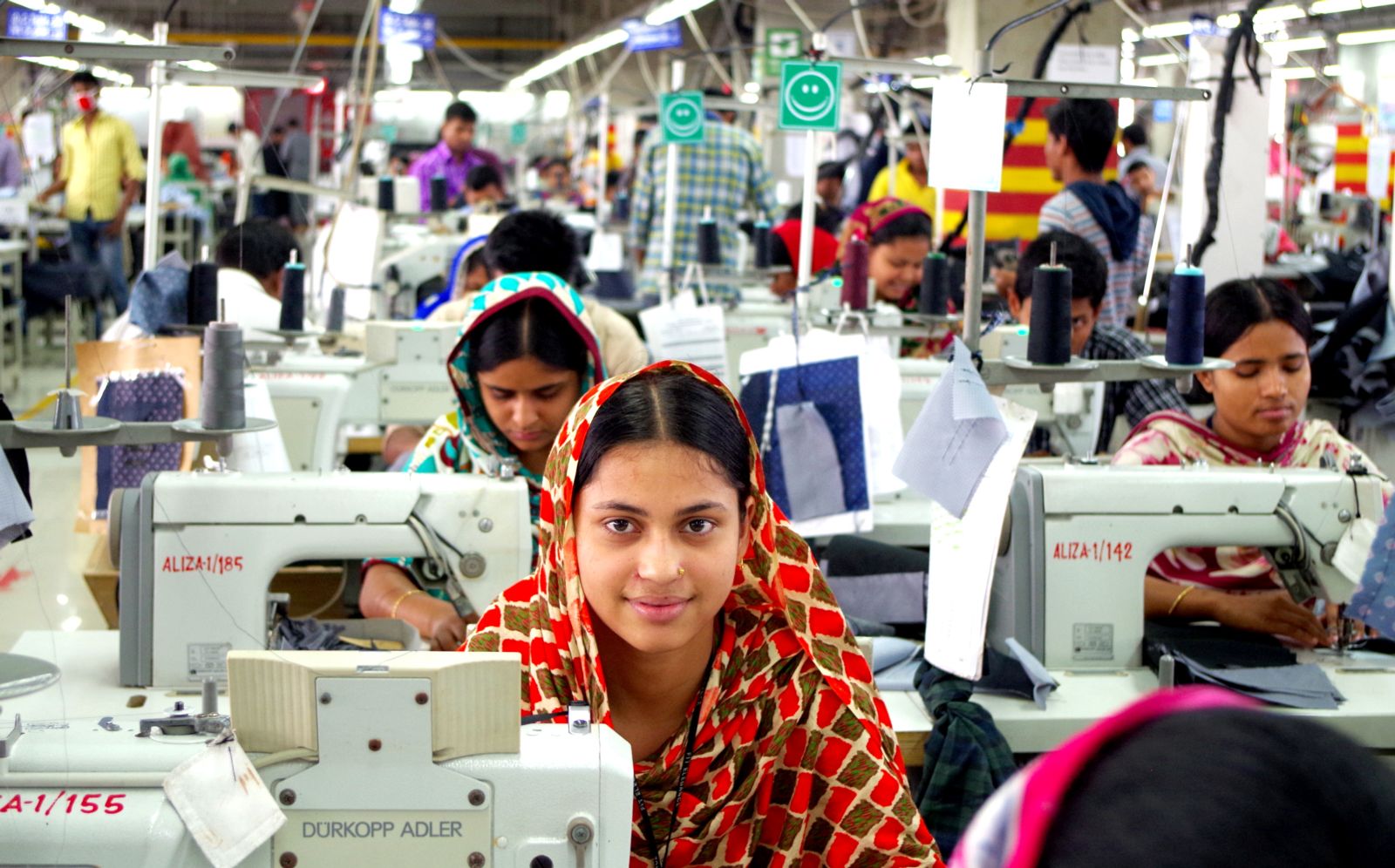
Labour rights defenders regularly experience violence and restrictions on their rights in various ways, including clamp downs on unions where governments and employers obstruct them from functioning freely and independently, laws that limit collective bargaining, and dismissals. In the past year, the International Trade Union Confederation reported an increase in violence, especially to prevent unionizing, and the safety of trade union leaders remains precarious. In Colombia, 19 trade unionists were killed in 2017; in Cambodia, trade union leaders are criminalized; and in Zimbabwe trade union leaders are regularly harassed by government authorities. With respect to laws that limit labour rights, 81% of countries deny some or all workers the right to collective bargaining and 65% of countries exclude some groups of workers from labour law, such as domestic, agricultural and contract workers, up 5% from 2017. Peaceful protests by workers are often met with heavy handed policy or army responses. In addition, the most common reprisal workers face for speaking up about violations are dismissals, a tactic used by employers to stifle civic action. As one example, over 12,000 garment factory workers in Bangladesh were fired for their protests in December 2018 and January 2019 over wages.
The Business & Human Rights Resource documents attacks against defenders working on corporate accountability, and our database shows that agriculture, food and beverage, and apparel are the most dangerous sectors for labour rights defenders. The most common forms of violence against individual union leaders and workers are arbitrary detentions and lawsuits, followed by intimidation and threats, and killings.
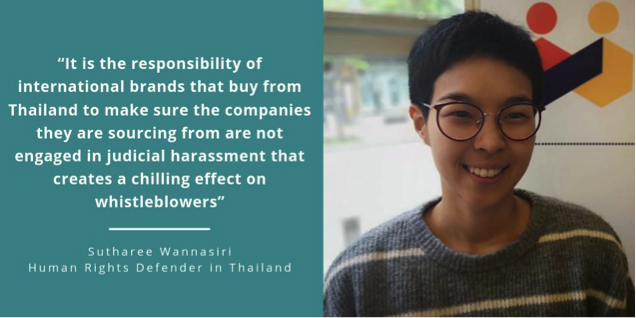
A particularly concerning trend is the use of defamation lawsuits to silence labour rights defenders. As one example, since 2016, Thammakaset Company Limited, a Thai-owned poultry company, filed more than 13 civil and criminal lawsuits against former workers who denounced labour rights violations, as well as against the activists and journalists supporting them. Governments and companies, including international brands, need to ensure such judicial attacks do not happen. As Sutharee Wanasiri, a labour rights defender from Thailand, and one of the people sued by Thammakaset, said: “It is also the responsibility of international brands that buy from Thailand to make sure the companies they are sourcing from are not engaged in judicial harassment that creates a chilling effect on whistle blowers and other defenders. They should establish mechanisms that allow workers and defenders to communicate with the brands directly and ensure that they are protected from any retaliation from suppliers during the investigation. The results should be made public and bring accountability for the abuses.”
…
With long and fragmented supply chains, it is particularly important to ensure that we hear workers’ voices, especially those of the most marginalized at the bottom of economic hierarchies, and guarantee dignified and decent work. This includes people working in the informal economy. Workers and civil society organizations are currently focusing on redefining legal employment terms, and reconsidering union strategy in light of changing labour relations, especially in the gig economy, in which non-conventional workers are not afforded adequate legal protection—either because they do not fall within the definition of a “regular employee” under national laws, or because of gaps in legislation when it comes to regulating new forms of employment. The lack of an applicable legal protection and collectively agreed terms of employment hinders the ability to exercise work-related rights, including the right to organise and collectively bargain.
……..
Labour rights defenders should be seen as critical allies in building equitable and sustainable societies. Several businesses are also beginning to recognise that the protection of human rights defenders and the ability for them to do their work is in their interest, and that an attack on defenders is an attack on responsible business. This is encouraging, as now more than ever we need to be brokering connections and building solidarities across movements and sectors to counter threats to the shared space we all depend upon.
During International Civil Society Week, which was held in Serbia from 8 to 12 April 2019 [see: https://humanrightsdefenders.blog/tag/2019-international-civil-society-week/] Ana Zbona, who is Civic Freedoms and Human Rights Defenders Project Manager at the Business and Human Rights Resource Centre (BHRRC). spoke to three human rights defenders on what companies can do to help protect civic freedoms:
Sutharee Wannasiri (Thailand)
Sutharee has been supporting the 14 Myanmar workers that have denounced labour rights abuses at the Thammakaset Farm in Thailand. She has actively engaged in public advocacy to demand business accountability on labour rights abuses, and an end to the judicial harassment workers are facing in retaliation for reporting these. To date, Thammakaset Farm has filed more than 13 criminal and civil complaints against the workers and the local CSO staff from Migrant Worker Rights Network and the journalists supporting them, including her – many of them are ongoing. The majority of the cases have been dropped by the courts.
Sutharee said:
“It is also the responsibility of international brands that buy from Thailand to make sure the companies they are sourcing from are not engaged in judicial harassment that creates a chilling effect on whistleblowers and other defenders. They should establish mechanisms that allow workers and defenders to communicate with the brands directly and ensure that they are protected from any retaliation from suppliers during the investigation. The results should be made public and bring accountability for the abuses.”
Amanda Segnini (Brazil)
The organization engajamundo focuses on youth empowerment in Brazil, with a particular focus on climate change. Its main goal is to make young people ware of their power to transform their communities. The organization is concerned about how civic freedoms will be negatively affected under the new government of President Jair Bolsonaro. Engajamundo is open to dialogue and ongoing engagement with companies if there is an alignment in values. Amanda believes that companies and civil society could engage more with one another if they find a shared purpose.
Amanda said:
“It might be right for companies to say something in support of activists that are under attack – but only if they have been working with the community long-term and have an ongoing relationship with them: for example, if they work with local producers and source responsibly from them. If such a community is under attack, a brand should say or do something in their support. But if they only say something without having that relationship, it’s like they are just ‘riding on the wave’, taking advantage of the buzz. Companies also should not censor civil society they engage with. For example, once we were invited to take part in a corporate event, but they tried to censor what we wanted to say. We decided not to participate in the end.”
Sasa Uzelac (from Serbia)
Sasa is the Solidarity Center‘s Regional Coordinator for South East Europe. Solidarity Center was established by AFL-CIO, and is the biggest international organization supporting trade unions and associations working to protect labour rights in South East Europe. He says trade unions and workers’ associations are increasingly under attack from governments, companies, and far-right political organizations and movements. Sasa says the tide of far-right populism is creating additional problems for organizations and people advocating for labour rights. Workers’ rights are being endangered on a daily basis by “ruthless” employers and “mindless” government officials. Freedom of association, decent working conditions, and human rights in the field of work are at risk due to governments’ failure to sanction unlawful activities by employers.
Sasa said:
“The best thing brands can do is to introduce union practices from their country of origin, rather than exploiting the weaknesses of the local system and local practices in their operations. But sadly they are not doing that to a high enough standard in this region. When big international companies enter the market, they should also make sure that the health and safety standards are brought to the levels of their countries of origin.”
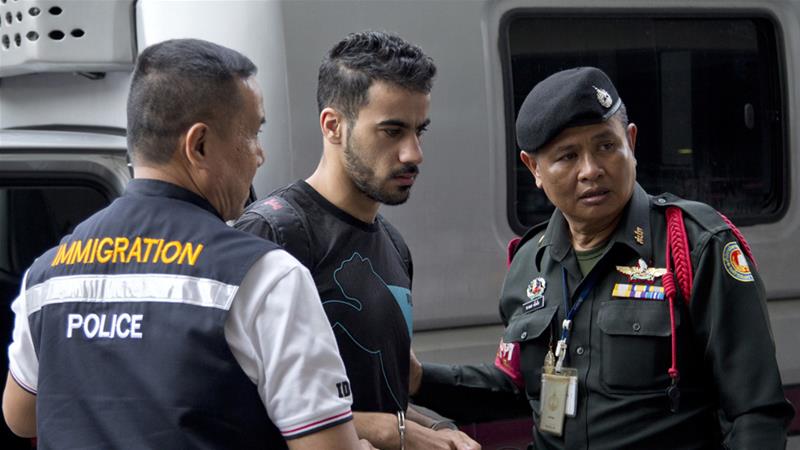
That international’s pressure can have a good result – sometimes – is shown in today’s court order in Thailand to release Bahraini refugee footballer Hakeem al-Araibi. Bahrain dropped the extradition request, said the prosecutor working on the case.
Araibi fled Bahrain in 2014 and subsequently received refugee status in Australia [Gemunu Amarasinghe/AP]
Monday’s decision comes after the 25-year-old footballer Hakeem al-Araibi was jailed for weeks in Bangkok’s Klong Prem Remand Prison. Bahrain wanted him returned to serve a 10-year prison sentence he received in absentia in 2014 for an arson attack that damaged a police station. Al-Araibi denied those charges. See also Craig Foster, Australian footballer and …human rights defender!
Al-Araibi, who fled Bahrain in 2014 and received refugee status in Australia, was arrested in November at a Bangkok airport while on his honeymoon following an Interpol notice issued at Bahrain’s request.
Australian Prime Minister Scott Morisson, meanwhile, praised the decision and said al-Araibi was on his way to the airport, where he should arrive in 12 hours from now.
“This is a huge victory for the human rights movement in Bahrain, Thailand and Australia, and even the whole world,” said Sayed Ahmed Alwadaei, director of advocacy of the Bahrain Institute for Rights and Democracy. “Let’s continue the fight to release all political prisoners who languish in Bahrain’s prisons.”


 The Ramon Magsaysay Award, one of Asia’s best known prizes, celebrates transformative leadership. In the past five decades, the award has been bestowed on over three hundred men, women and organizations whose selfless service has offered their societies, Asia, and the world successful solutions to some of the most intractable problems of human development. For more on this regional award,




 Hans Thoolen on Human Rights Defenders and their awards