During International Civil Society Week, which was held in Serbia from 8 to 12 April 2019 [see: https://humanrightsdefenders.blog/tag/2019-international-civil-society-week/] Ana Zbona, who is Civic Freedoms and Human Rights Defenders Project Manager at the Business and Human Rights Resource Centre (BHRRC). spoke to three human rights defenders on what companies can do to help protect civic freedoms:
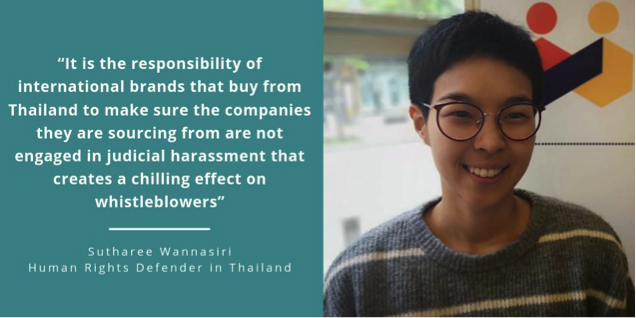
Sutharee Wannasiri (Thailand)
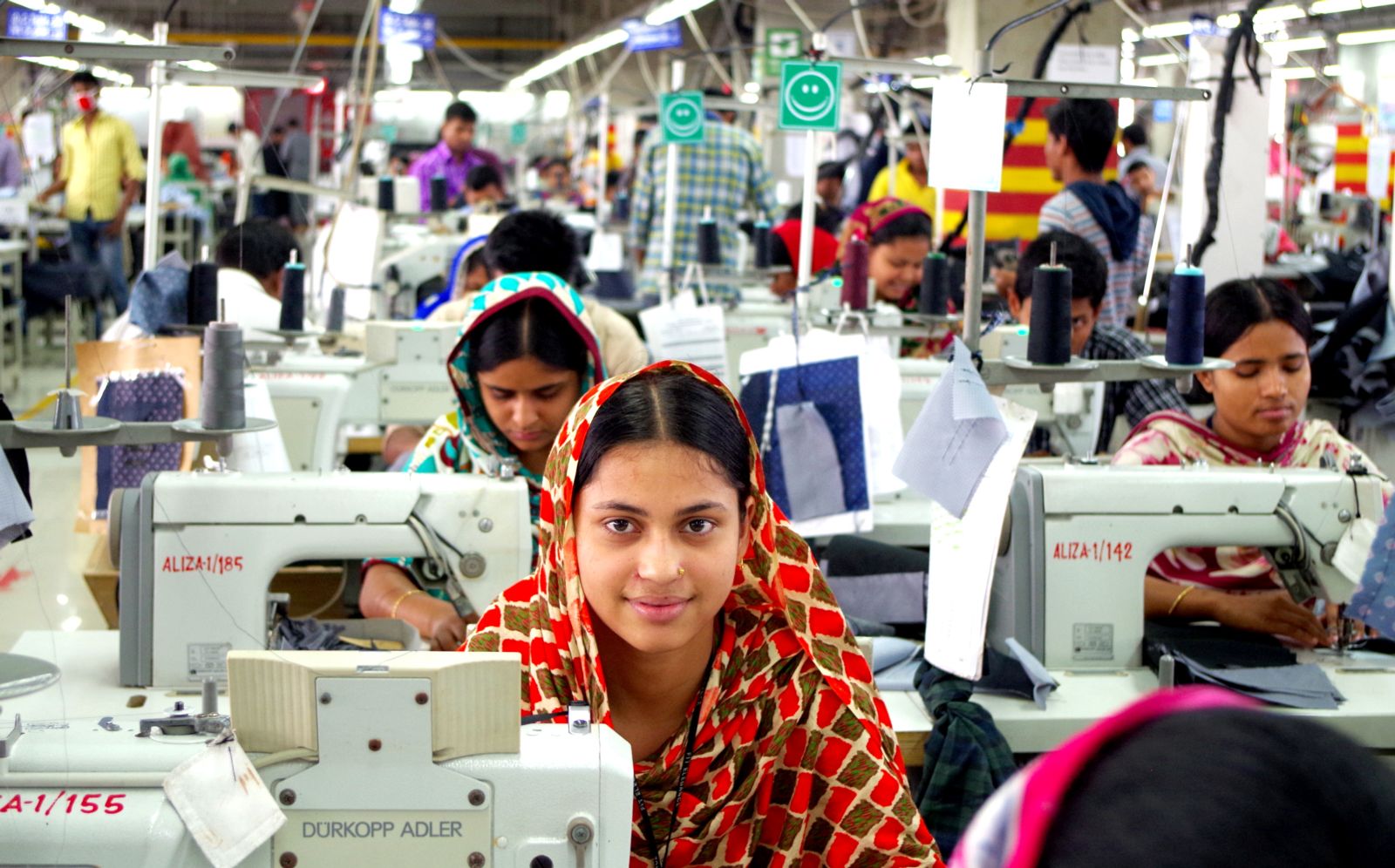
Sutharee has been supporting the 14 Myanmar workers that have denounced labour rights abuses at the Thammakaset Farm in Thailand. She has actively engaged in public advocacy to demand business accountability on labour rights abuses, and an end to the judicial harassment workers are facing in retaliation for reporting these. To date, Thammakaset Farm has filed more than 13 criminal and civil complaints against the workers and the local CSO staff from Migrant Worker Rights Network and the journalists supporting them, including her – many of them are ongoing. The majority of the cases have been dropped by the courts.
Sutharee said:
“It is also the responsibility of international brands that buy from Thailand to make sure the companies they are sourcing from are not engaged in judicial harassment that creates a chilling effect on whistleblowers and other defenders. They should establish mechanisms that allow workers and defenders to communicate with the brands directly and ensure that they are protected from any retaliation from suppliers during the investigation. The results should be made public and bring accountability for the abuses.”
Amanda Segnini (Brazil)
The organization engajamundo focuses on youth empowerment in Brazil, with a particular focus on climate change. Its main goal is to make young people ware of their power to transform their communities. The organization is concerned about how civic freedoms will be negatively affected under the new government of President Jair Bolsonaro. Engajamundo is open to dialogue and ongoing engagement with companies if there is an alignment in values. Amanda believes that companies and civil society could engage more with one another if they find a shared purpose.
Amanda said:
“It might be right for companies to say something in support of activists that are under attack – but only if they have been working with the community long-term and have an ongoing relationship with them: for example, if they work with local producers and source responsibly from them. If such a community is under attack, a brand should say or do something in their support. But if they only say something without having that relationship, it’s like they are just ‘riding on the wave’, taking advantage of the buzz. Companies also should not censor civil society they engage with. For example, once we were invited to take part in a corporate event, but they tried to censor what we wanted to say. We decided not to participate in the end.”
Sasa Uzelac (from Serbia)
Sasa is the Solidarity Center‘s Regional Coordinator for South East Europe. Solidarity Center was established by AFL-CIO, and is the biggest international organization supporting trade unions and associations working to protect labour rights in South East Europe. He says trade unions and workers’ associations are increasingly under attack from governments, companies, and far-right political organizations and movements. Sasa says the tide of far-right populism is creating additional problems for organizations and people advocating for labour rights. Workers’ rights are being endangered on a daily basis by “ruthless” employers and “mindless” government officials. Freedom of association, decent working conditions, and human rights in the field of work are at risk due to governments’ failure to sanction unlawful activities by employers.
Sasa said:
“The best thing brands can do is to introduce union practices from their country of origin, rather than exploiting the weaknesses of the local system and local practices in their operations. But sadly they are not doing that to a high enough standard in this region. When big international companies enter the market, they should also make sure that the health and safety standards are brought to the levels of their countries of origin.”
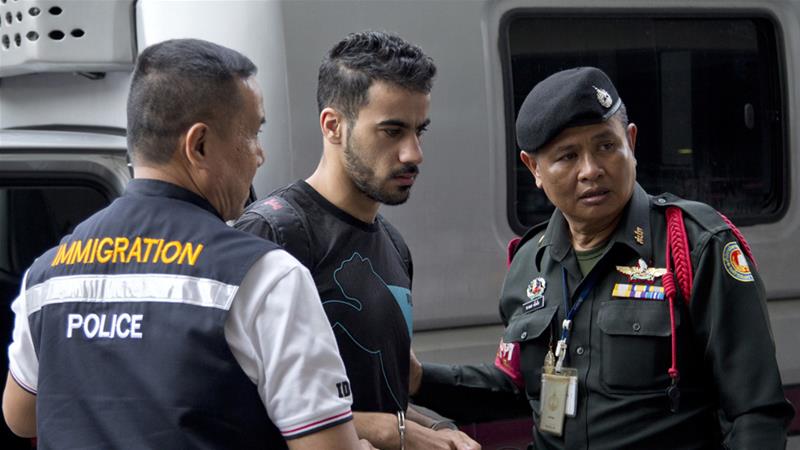
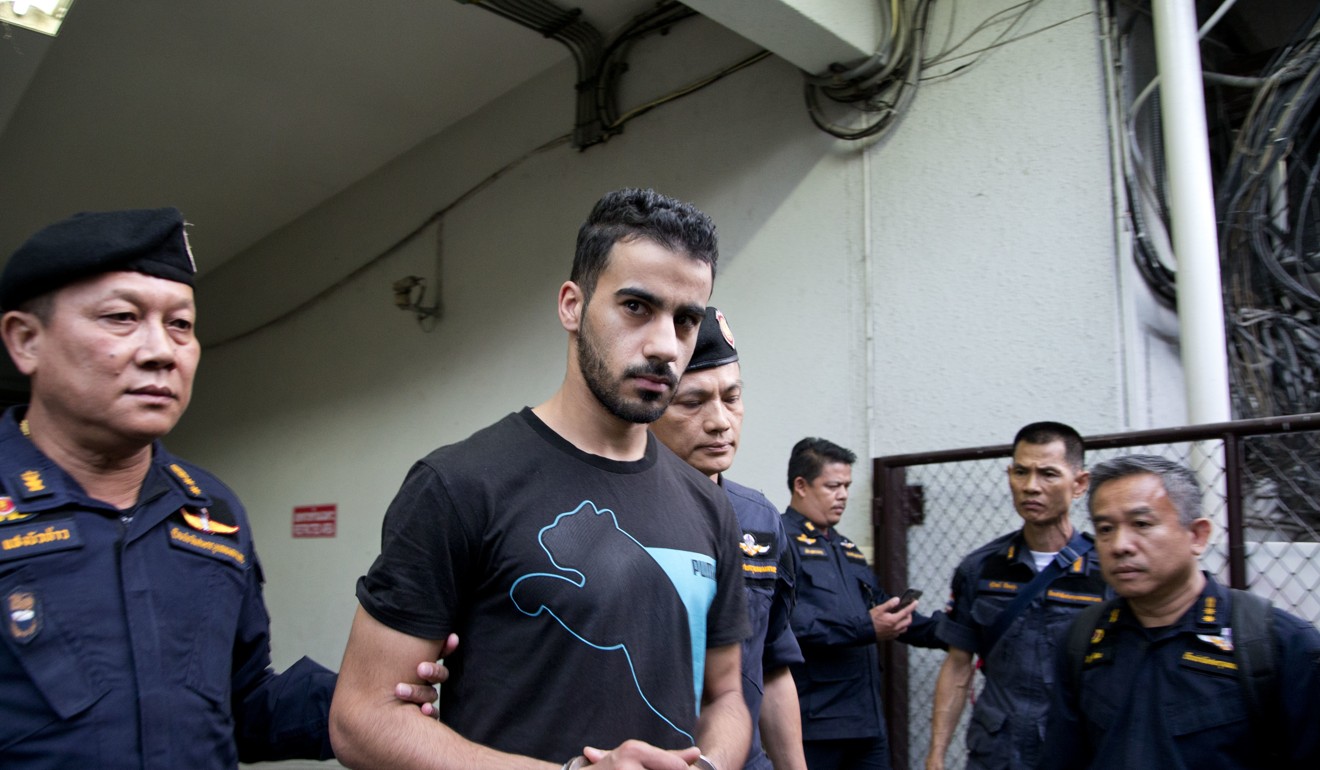
That international’s pressure can have a good result – sometimes – is shown in today’s court order in Thailand to release Bahraini refugee footballer Hakeem al-Araibi. Bahrain dropped the extradition request, said the prosecutor working on the case.
Araibi fled Bahrain in 2014 and subsequently received refugee status in Australia [Gemunu Amarasinghe/AP]
Monday’s decision comes after the 25-year-old footballer Hakeem al-Araibi was jailed for weeks in Bangkok’s Klong Prem Remand Prison. Bahrain wanted him returned to serve a 10-year prison sentence he received in absentia in 2014 for an arson attack that damaged a police station. Al-Araibi denied those charges. See also Craig Foster, Australian footballer and …human rights defender!
Al-Araibi, who fled Bahrain in 2014 and received refugee status in Australia, was arrested in November at a Bangkok airport while on his honeymoon following an Interpol notice issued at Bahrain’s request.
Australian Prime Minister Scott Morisson, meanwhile, praised the decision and said al-Araibi was on his way to the airport, where he should arrive in 12 hours from now.
“This is a huge victory for the human rights movement in Bahrain, Thailand and Australia, and even the whole world,” said Sayed Ahmed Alwadaei, director of advocacy of the Bahrain Institute for Rights and Democracy. “Let’s continue the fight to release all political prisoners who languish in Bahrain’s prisons.”
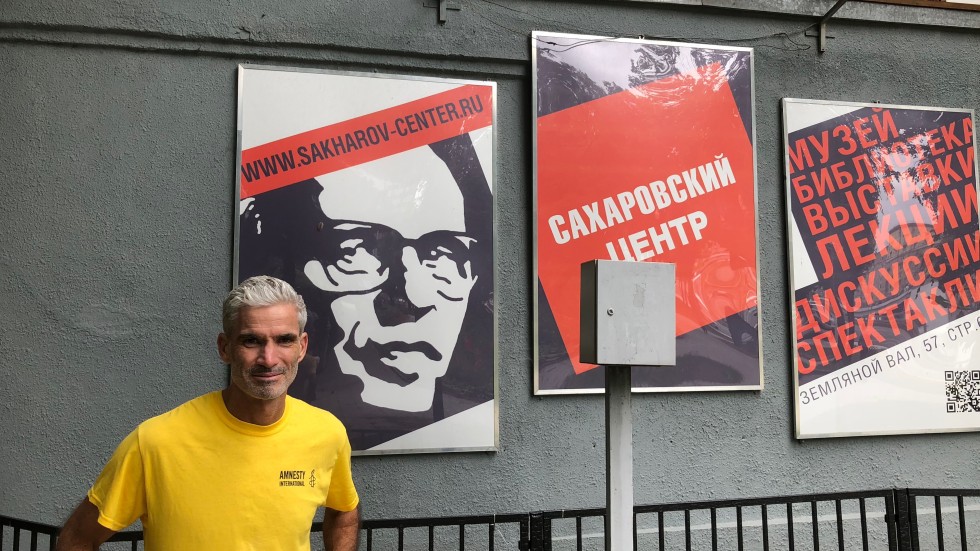
Football’s power to fight injustice motivates Craig Foster. The former Socceroos captain who played for Hong Kong’s Ernest Borel in the early ’90s is a broadcaster in Australia and also works for Amnesty International as a human rights and refugee ambassador. He is among the most vocal of activists in calling out human rights transgressions in football and sport and is one of the many prominent figures fighting for the release of Bahrain’s Hakeem al-Araibi, an Australia-based refugee footballer who is in a Thai jail awaiting extradition to his home country where he fears torture and persecution. [For some of my other posts on football and human rights, see: https://humanrightsdefenders.blog/tag/football/]
On Tuesday, 01 January, 2019, Nazvi Careem wrote a long piece about Craig Foster’s work and dedication:
And if he ever doubted just how powerful this sport can be, he only needs to recall the heartbreaking words of a young African refugee who had lost everything – fleeing his war-torn homeland after his parents, sibling and other members of his family were killed. “He was involved in a football programme over a period of time. He was very, very quiet and said very little,” said Foster. “He was in a new country and was experiencing psychological difficulties, which is totally understandable. “When he was asked why he liked the programme, he simply said: ‘The only thing that still exists in my life is football. It is the only thing that hasn’t been taken away from me’. And he was crying when he said it.
…Since retiring as a player in 2002, Foster became involved in social issues related to football, working with disadvantaged, minority and indigenous communities in a variety of programmes. “I’m just finishing my law degree, which has given me some further insight into the challenges of human rights and international refugee law. I feel strongly about these issues and in football, we are at an advantage because we are the most diverse, multicultural community in Australia.
…..Foster, who played for Portsmouth and Crystal Palace in England and also had a stint in Singapore, said he felt an obligation to give something back to the sport. As an ex-player and a broadcaster with the SBS organisation in Australia, Foster is in an ideal position to reach out to the masses. At the same time, he puts his contribution to social issues in perspective, admitting that he is in a position of comfort compared with activists whose lives are on the line in their efforts to effect change.
“Of course, you can’t fight every battle, but there are key ones which take a huge amount time. But the people I have immense respect for are the human rights defenders in their countries….In Australia we have serious human rights issues, with indigenous Australians and also in terms of refugees and arrivals.
(This article appeared in the South China Morning Post print edition as: using football to fight injustice)
Looking ahead to next month’s UN Forum on Business and Human Rights, ISHR featured this profile ISHR trainee and Thai lawyer Sor Rattanamanee Polkla. Sor describes her work improving access to justice for those affected by development projects in rural Thailand, and explains how she plans to use the connections she made with ISHR and others at the Forum to expand her network and support her community on the ground.
British labor rights activist Andy Hall (Associated Press)
The Washington Post and many others reported on this development. The Monday ruling involves four defamation suits filed by pineapple canning company Natural Fruit, which employed migrant Myanmar workers who claimed the company had abused them and broke labor regulations.Hall’s legal troubles stem from a 2013 report he researched for the Finnish consumer organization Finnwatch that alleged labor abuses at Natural Fruit’s facilities. They also concern an interview that he gave to Al-Jazeera on the subject, which was the focus of Monday’s ruling. Natural Fruit claimed that the report Hall helped research and his interview comments both hurt their business.
(Hall left Thailand in 2016, citing intolerable legal harassment after another company, poultry producer Thammakaset Farm, sued him in another case, but still works on labor rights issues concerning migrants in Thailand.)
“This verdict is a major setback for rights of human rights defenders, migrant workers, labour/migration activists and researchers everywhere and casts a dark shadow over recent positive progress the Thai government and Thai industry has made to improve migrant worker conditions,” Hall commented Monday on his Twitter account.
International Human Rights Day 2017was celebrated all over the world by governmental and non-governmental entities alike. Here some cases of MIND THE GAP as reported in the media in Asia:
Cambodia:
The government celebrated Human Rights Day under the theme of ‘peace’, but 103 civil society groups spoke out against state ‘attacks’. KT/Mai Vireak
The government yesterday celebrated the 69th anniversary of International Human Rights Day under the theme of peace, while 103 civil society groups called for more protection for human rights defenders. Prime Minister Hun Sen posted on his Facebook page to say how the rights and freedoms of Cambodian people have been restored since the end of the Khmer Rouge regime in 1979: “December 10 is International Human Rights Day, which people all over the world celebrate. On January 7, 1979, the rights and freedoms of the Cambodian people were restored and have been until this day.”
Civil society meanwhile marked the day at different locations around Phnom Penh and in other provinces. A group of 103 civil society organisations issued a joint statement calling for justice and respect for human rights from the government. “On the occasion of International Human Rights Day, we, the undersigned members of Cambodian civil society, call for an end to government attacks on human rights defenders and civil society groups and the lifting of unjustifiable restrictions on fundamental freedoms,” the statement said.
Philippines:
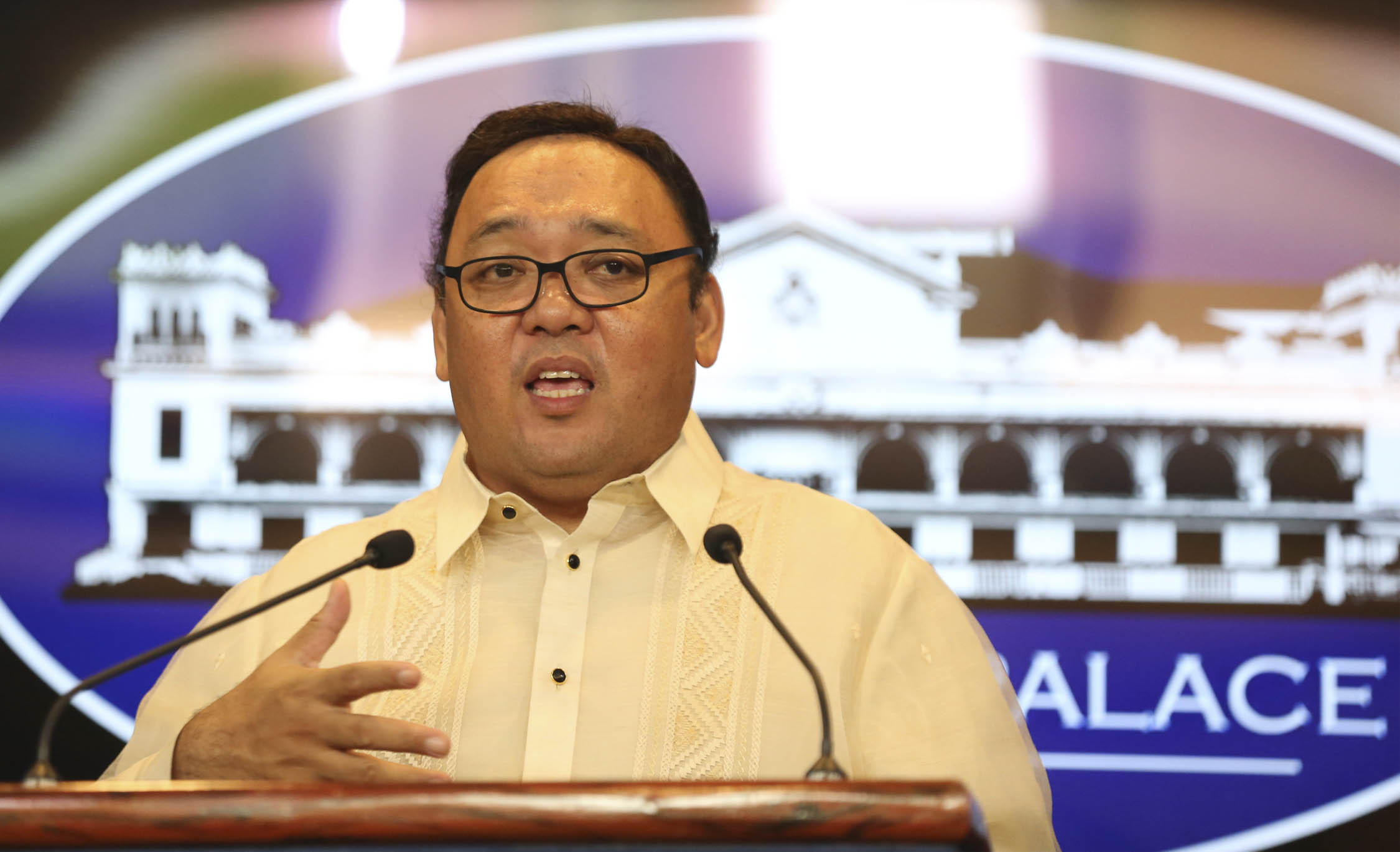
Presidential spokesperson Harry Roque INQUIRER PHOTO/JOAN BONDOC
On the observance of the International Human Rights Day, Presidential Spokesperson Harry Roque reiterated President Rodrigo Duterte’s commitment to uplift the lives of Filipinos, especially the poor, marginalized and vulnerable. Noting that the Philippines is an active member of the United Nations Human Rights Council and that respect for human rights is enshrined in the 1987 Constitution, Roque assured that the Duterte administration “works hard with the best interest of every Filipino.” ..“That direction is what inspires the government’s compliance with its human rights obligations. As a Nobel Peace Prize winner once said, ‘poverty is the absence of human rights” .
The Philippines has experienced a precipitous drop in basic human rights standards since President Rodrigo Duterte came to power last year, resulting in large, mass mobilizations across the country for the occasion of December 10, Human Rights Day. At least 12 rallies were held across the archipelago on Sunday, with human rights group KARAPATAN and progressive alliance BAYAN taking the lead alongside a range of like-minded groups calling for an end to what they describe as the U.S.-Duterte regime. In addition to over 13,000 small-time drug dealers and addicts killed during Duterte’s “war on drugs,” Karapatan has documented 113 victims of political killings, 81 victims of torture, 54,573 victims of threat, harassment, and intimidation, 364,617 who have suffered due to indiscriminate firing and aerial bombing, and 426,170 internally displaced who were subject to forced evacuation.
Turkey:
Turkish President Recep Tayyip Erdogan. Photo: AA
“Respect for human rights based on the principles of equality and non-discrimination of individuals before the law is the irreplaceable nature of the Republic of Turkey,” said Erdogan, according to state-run Anadolu Agency, on the occasion of Human Rights Day on Sunday. Erdogan specifically referenced Turkey’s commitment to “all oppressed people and victims from Palestine to Syria and Asia to Africa.”
National Human Rights Commission (NHRC) commissioner and human rights defender Angkhana Neelaphaijit said that despite the government’s claim that it cherished human rights and had made them a priority, in reality it had done nothing to do so.
Angkhana Neelaphaijit
Thailand is still far from its goal of valuing human rights since the junta’s policies and actions have eroded rights, while many people do not even understand the principle. Prominent Thai campaigners marked Human Rights Day yesterday to lament that the country was still far from its professed goal of ensuring everyone was accorded the freedoms they deserve. The nation’s most severe human rights violation was the lack of freedom of expression, they said in an appeal to the National Council for Peace and Order (NCPO) to restore democracy to truly guarantee human rights for every citizen. They also said Thailand faced many serious human rights crises. For instance, social movements across the country continued to be suppressed by authorities, the justice system was being used against human rights defenders, and many people in society still did not understand human rights and harmed others. National Human Rights Commission (NHRC) commissioner and human rights defender Angkhana Neelaphaijit said that despite the government’s claim that it cherished human rights and had made them a priority, in reality it had done nothing to do so. On the contrary, Angkhana said the government was doing the very opposite, enforcing many laws and regulations that violated human rights and curbing the activities of campaigners, both through law enforcement and by force. In effect, the regime was deepening Thailand’s human rights crisis, she said.
Pakistan:
Message by Foreign Minister of Pakistan : ”On behalf of the people and Government of Pakistan, I wish to reiterate our strong commitment to promote and protect human rights and fundamental freedoms, as well as needs. Pakistan has demonstrated its resolve by enacting wide ranging legislation, establishing strong institutional machinery and putting in place robust policy measures in the field of human rights. Pakistan’s Constitution serves as an anchor and guarantor of fundamental freedoms and human rights of all Pakistanis. The Government of Pakistan accords high priority to advancing mutually reinforcing objectives of development, human rights and democracy…This year is also significant for Pakistan in the field of human rights. Pakistan actively engaged with the UN human rights institutions and partners through regular submission of national reports, participation in review processes and implementation of recommendations arising from such mechanisms. Pakistan filed reports and participated in the review mechanism of three international treaty bodies, namely CAT, ICESCR and ICCPR. Pakistan also successfully presented its third national report on Universal Periodic Review (UPR) on 13 November 2017. This level of engagement, participation and contribution demonstrates Pakistan’s commitment as well as actions to advance the cause of human rights. Pakistan’s success as the newly elected member of the Human Rights Council (HRC) this year is a testimony to the confidence reposed in Pakistan by the international community as a consensus builder within the international human rights policy framework.
The struggle against enforced disappearance was seen in Sindh alone while though there have been cases of missing persons in other provinces but Sindh has dared to raise voice against such violations of human rights. These views were expressed at a seminar on occasion of Human Rights Day organized here by SAFWCO and Social Change. Noted Human Rights activist and lawyer Faisal Siddiqui said only voice against forced disappearances was being heard from Sindh while voice of Balochistan has been crushed with force. Though many persons were missing in KPK and Punjab but from there no voice is heard. He said our judiciary has come out of colonization era and was giving right decisions. He said it was he who had filed petition in SHC for IG Sindh A.D.Khwaja. He said he was harassed for being advocate against Baldia Factory burning of 258 persons, Shahzeb Jatoi case and other cases for which he was harassed and could not open his office for many months. He said now powerful forces were active human rights. The gathering paid tributes to Pubhal Saryo, convener of missing persons forum who was whisked away by agencies and released after more than 2 months. Punhal Saryo said it has become very difficult to work for human rights in situation where human rights defenders were also not safe.
—————–
On 15 August 2017, Jatupat Boonpattararaksa received a two and a half years jail sentence after pleading guilty to violating the lèse majesté law. The human rights defender – also known as Pai Dao Din – has been detained since 3 December 2016 in connection with his sharing of a BBC article on the life of King Vajiralongkorn on social media. Pai Dao Din, is leader of a student activist group called Dao Din based in Khon Kaen University. (https://www.frontlinedefenders.org/en/profile/jatupat-boonpattararaksa). The group advocates for community rights, social justice and democracy. He is also a member of New Democracy Movement (NDM), which opposes the military dictatorship in Thailand, a regime in place since the coup d’etat in May 2014. In May 2017, Jatupat Boonpattararaksa was awarded the Gwangju Prize for Human Rights [https://humanrightsdefenders.blog/2017/05/10/gwangju-award-for-human-rights-defender-pai-dao-din-upsets-thai-government/]The defender was originally sentenced to five years in jail, however this sentence was reduced after he pleaded guilty to sharing material deemed insulting towards the country’s monarchy.
{While authorities did not file charges or even a complaint against the London-based BBC for publishing the article, only Jatupat was arrested. His bail requests were consistently rejected as authorities regarded lèse majesté as a serious charge possibly entailing severe punishment. Domestic and international campaigns over recent months have failed to free him on bail. Prior to the court judgment, Jatupat, who had maintained his innocence for months, agreed to plead guilty after consulting with his family and legal team to get a more lenient sentence.}
“It appears that Jatupat was singled out, from thousands of people who shared the BBC article, and prosecuted for his strong opposition to military rule rather than any harm incurred by the monarchy,” said Brad Adams, Asia Director at Human Rights Watch. “His guilty verdict and jail sentence show yet again how Thailand’s draconian ‘insulting the monarchy’ law has been misused to punish dissenters.”
This week, to mark the International Day in Support of Victims of Torture, celebrated annually on 26 June, Just Asia has a special report on Hong Kong’s plan [not sure but still…] to withdraw from the UN Convention against Torture. The reason for such a withdrawal is a misguided attempt to address the rise in torture protection claimants in Hong Kong and block “fake” refugees, as well as solve the issue of illegal workers. In the video report Just Asia speaks to three prominent persons in the city to discuss their views. Puja Kapai is the Director of Hong Kong University’s Centre for Comparative and Public Law; Mark Daly is a human rights lawyer with Daly and Associates; as is Patricia Ann Ho. The three discuss how such a withdrawal will impact Hong Kong’s international standing, Hong Kong’s human rights protections, and whether it will truly make a difference to the city’s numerous torture claimants. [for other Just Asia posts: https://humanrightsdefenders.blog/tag/just-asia/]
In the same context of anti-torture work in Asia, Amnesty International and the International Commission of Jurists issued today a statement calling on Thailand to finally follow through on commitments to prevent torture and ill-treatment. They regret repeated delays to the finalisation and passage of Thailand’s Draft Prevention and Suppression of Torture and Enforced Disappearance Act……Similarly, Amnesty International and the International Commission of Jurists urge Thailand to move ahead with its commitment to ratify the Optional Protocol to the Convention against Torture, which obligates authorities to establish a National Preventive Mechanism.. as well as to allow such visits by an international expert body. Such independent scrutiny is critical to prevent torture and other ill-treatment, including through implementing their detailed recommendations based on visits. Authorities should also act immediately on the commitment made at Thailand’s Universal Periodic Review before the United Nations Human Rights Council in 2016, to inspect places of detention in line with the revised UN Standard Minimum Rules for the Treatment of Prisoners, also known as the Nelson Mandela Rules….
Acts of torture and other ill-treatment in Thailand have rarely been investigated in a prompt, impartial, independent and efficient manner, as required by the Convention against Torture, and perpetrators of such acts have seldom been held to account. Amnesty International and the International Commission of Jurists urge authorities to ensure that such investigations are undertaken into all credible reports of torture and other cruel, inhuman or degrading treatment or punishment. The scope, methods and findings of such investigations should be made public. Where sufficient, admissible evidence is gathered, perpetrators should be prosecuted in fair trials in civilian courts.
Amnesty International and the International Commission of Jurists also notes with concern the criminal prosecution or threats of prosecution—often under criminal defamation provisions—of victims of torture, their family members, and human rights defenders who have raised allegations of torture, including with a view to seeking redress. The organizations urge that such threats, investigations, charges, prosecution or other proceedings against these persons be are withdrawn and charges dropped, and that authorities take steps to create an enabling environment for freedom of expression in which people are able to seek redress and raise concerns about torture publicly without fear of reprisal or recrimination….
The Thai Ministry of Foreign Affairs gets upset easily as shown by the reaction to the granting of the 2017 Gwangju Prize for Human Rights (South Korea) to detained student activist Jatupat Boonpattararaksa, better known as Pai Dao Din. He has been in prison in Khon Kaen on lese majeste and computer crime charges since 22 December 2015, when 10 Khon Kaen University’s students from “Dao Din” group were arrested at the Khon Kaen Democracy Monument.
Pai Dao Din a day after the Khon Kaen court denied him bail again (FB/Jom Petchpradab)
Now the Thai ambassador to Seoul has written to the human rights award giver in South Korea asking it to ‘reconsider ‘ honouring jailed activist Jatupat Boonpattararaksa.
In a copy of the letter was acquired by the Bangkok Post (copy below):
The detained defender had been hoping to make bail so he could attend the award presentation ceremony in person, but his request was denied. In refusing Mr Jatupat’s bail requests, the Region 4 court and Khon Kaen Provincial Court described him as a flight risk who could tamper with evidence. The laureate is thus unlikely to be abel to travel on 18 May to the award ceremony in Gwangju and Mr Jatupat’s mother Prim Boonpattararaksa and her husband Viboon will represent their son and receive the award on his behalf.
National Human Rights commissioner Angkhana Neelapaijit, who won the Gwangju Award for Human Rights in 2006, described it as a prestigious accolade.