On 22 September 2022 Forum Asia announced the Call for Applications for its “Global Advocacy Learning Programme on Human Rights and Development” which provides a comprehensive set of knowledge and skills to human rights and development activists. Extremely qualified and experienced facilitators, as well as international experts, will guide the participants through the most relevant and pressing issues related to human rights and development. The participants will learn and engage in interactive sessions throughout the 7-day programme touching upon, among others, human rights advocacy and mechanisms at national, regional, and international level, business and human rights, gender, and environment. All participants will receive high-quality reading and training materials. All sessions will be conducted in English.
Dates and Venue
The fourth edition of the Global Advocacy Learning Programme on Human Rights and Development will take place in Thailand from 29 November to 5 December 2022. Details about the venue will be communicated to all confirmed participants.
Participants
Participants from all over Asia are expected to participate in the fourth edition of the Global Advocacy Learning Programme on Human Rights and Development. Their participation will be fully covered by FORUM-ASIA. Participants will be selected based on the following criteria:
Genuine interest in issues related to human rights/sustainable development/gender/environment
Being currently employed or actively partner with a national, regional or international civil society organization and/or community-based group;
Preferably 3 years working experience in organisations addressing issues related to human rights/ development/environment/gender (applicants with less than 3 years will be considered on an exceptional basis);
Excellent command of English, both spoken and written.
Only those selected will be contacted.
All interested applicants should apply promptly by submitting the duly filled application Online Application Form by Friday 7 October 2022.
This article – originally published by Prachatai, an independent news site in Thailand – was republished by Global Voices on 5 September 2022
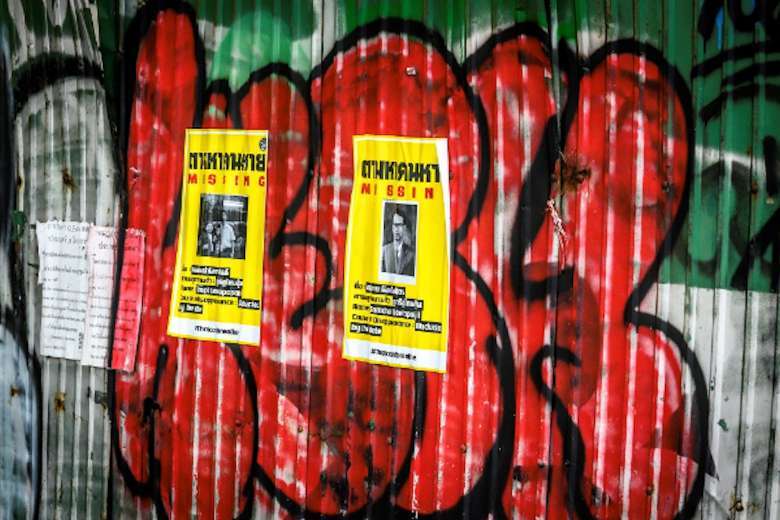
To mark International Day of the Disappeared on August 30, a dozen people affiliated with the Mok Luang Rim Nam student activist group gathered at Ratchaprasong Intersection in downtown Bangkok. A small parade was held by activists in Siam Square to raise awareness about forced disappearances. The marchers carried portraits of abducted activists, some of whom were later found dead.
The group carried photos of Porlajee Rakchongcharoen, Surachai Danwattananusorn, Wanchalearm Satsaksit, and Siam Theerawut — Thai victims of forced disappearance. Hanging photos of the victims around their necks, some covered their heads with plastic bags in imitation of a suffocation torture technique.
Surachai Danwattananusorn, a veteran activist who fled the country after the 2014 coup, disappeared in December 2018 in a neighboring country, and his dead body was later found at the Thai-Laos border. Siam Theerawut also fled in 2014 and was arrested by Vietnamese authorities in 2019 before his reported extradition to Thailand. His whereabouts are still unknown.
Speaking on the occasion, activist Tanruthai Thaenrut said that the group wanted to raise awareness about forced disappearances, to tell people that the government is ignoring these disappearances and silencing the people to make disappearance seem normal.
A 2020 report by the UN Working Group on Enforced or Involuntary Disappearances estimates there are at least 75 victims of enforced disappearance in Thailand .
Uniformed police were seen standing guard at the National Police Headquarters on the way to Siam Square. Plainclothes police were reportedly taking photographs of event participants before the event started. When they reached their destination, the Superintendent of Pathumwan police station arrived with other police officers, to quietly monitor the situation.
During the gathering, activists staged a performance symbolizing an abduction. One of the participants placed a black bag over Tanruthai’s head while she was giving a speech. Two others then carried her away while other activists shouted, “Free our friends.”
Mint, a Thai traditional dancer-turned-activist who participated in the march, said that the performance signified that anyone could become a victim of forced disappearance. She noted that human rights lawyer Somchai Neelapaijit was abducted in the middle of Bangkok, and added that the fates of most people who disappeared remain unknown
On August 15, 2022, the Attorney General’s Office formally notified the Justice Ministry’s Department of Special Investigation (DSI) of its decision to indict four park officials accused of abducting and murdering Porlajee “Billy” Rakchongcharoen in April 2014. The charges include illegal confinement, premeditated murder, and concealing the victim’s body.
“Thai officials have long hindered justice for Billy through cover-ups and exploitation of legal loopholes,” said Elaine Pearson, acting Asia director at Human Rights Watch. “The authorities can right this wrong by ensuring that the attorney general’s decision to indict four officials moves promptly to an effective and fair prosecution.”
Billy was last seen on April 17, 2014, in the custody of Chaiwat Limlikitaksorn, then-head of Kaeng Krachan National Park in Phetchaburi province, and his staff. The park officials said they released him after questioning him briefly and had no information regarding his whereabouts. On September 3, 2019, DSI officials announced that his remains had been found in Kaeng Krachan National Park. Chaiwit was among the four indicted.
Pinnapa Prueksapan, Billy’s wife, told Human Rights Watch that she hoped there would be answers to basic questions, such as who had abducted and killed her husband, and who had obstructed justice.
Thailand is obligated under international human rights treaties to which it is a party to investigate and appropriately prosecute enforced disappearance, torture, custodial deaths, and other alleged human rights violations. In addition, in September 2019, Prime Minister Gen. Prayut Chan-ocha ordered the Department of Special Investigation to ensure that the case was watertight so the culprits could be brought to justice, regardless of their rank or position.
However, the investigation has suffered from a cover-up, Human Rights Watch said. Despite a long list of allegations against Chaiwat for serious abuses and misconduct during his tenure as head of Kaeng Krachan National Park, he has never been held to account.
In addition, Thai law does yet not recognize enforced disappearances as a crime. Human Rights Watch has repeatedly urged Prime Minister Prayut and his government to ratify the International Convention for the Protection of All Persons from Enforced Disappearance, which Thailand signed in 2012, and make enforced disappearance a criminal offense.
Chaiwat and his staff arrested Billy on April 17, 2014, for alleged illegal possession of a wild bee honeycomb and six bottles of honey.
At the time of his enforced disappearance, he was traveling to meet with ethnic Karen villagers and activists in preparation for an upcoming court hearing in the villagers’ lawsuit against Chaiwat and the National Park, Wildlife, and Plant Conservation Department of the Ministry of Natural Resources and Environment.
The villagers alleged in the lawsuit that, in July 2011, park authorities had burned and destroyed the houses and property of more than 20 Karen families in the Bangkloy Bon village. Billy was also preparing to submit a petition about this case to Thailand’s monarch. When he was arrested, he was carrying case files and related documents with him. Those files have never been recovered.
In September 2014, Police Region 7 officers filed malfeasance charges under article 157 of the penal code against Chaiwat and three other park officials for unlawfully detaining him. The other suspects named in the case are Boontaen Bussarakham, Thanaseth or Pitoon Chaemthes, and Krissanapong Jitthes. The DSI found traces of human blood in a vehicle belonging to the park office, but was not able to verify if the blood belonged to Billy because the vehicle was cleaned before forensic experts could examine it.
On September 3, 2019, the DSI announced that his remains had been found in Kaeng Krachan National Park, where he was last seen in custody of the park officials. The investigation team found an oil barrel, its lid, two steel rods, a burned wooden piece, and two bones at the bottom of the reservoir on April 26, 2019.
The Central Institute of Forensic Science subsequently confirmed the genetic trace of one of the bones found inside the barrel matched Billy’s mother. The investigation team then concluded it was part of his remains. The condition of this piece of human skull, which was burned, cracked, and shrunk due to exposure to heat of 200 to 300 degrees Celsius, suggests the killers burned his body to conceal the crime.
“The indictment of Chaiwat and other park officials is an important step for justice for Billy and all those whom Thai government officials have forcibly disappeared and killed,” Pearson said. “Thai authorities should recognize that they can’t escape being held accountable for the most heinous crimes.”
The authorities in Thailand should urgently investigate an incident intended to intimidate a prominent human rights defender, Human Rights Watch said on 13 April, 2022.
On April 12, 2022, at about 6 a.m., an unidentified assailant threw a pair of 9-inch-long scissors at the house of Angkhana Neelapaijit in Bangkok, making a hole in her front door. Security camera footage showed what appeared to be a woman wearing a face mask and a dark t-shirt with the Thai numeral 9 standing in front of the house, throwing the scissors, and then running away. Angkhana, 66, is a former commissioner of the National Human Rights Commission of Thailand and a newly appointed member of the United Nations Working Group on Enforced or Involuntary Disappearances. See: https://www.trueheroesfilms.org/thedigest/laureates/0D5DED3E-F79F-4AB4-8261-F6A19486F062
“Violent acts intended to intimidate a well-known figure like Angkhana not only pose a threat to her and her family, but send a spine-chilling message to the entire Thai human rights community,” said Elaine Pearson, acting Asia director at Human Rights Watch. “The Thai government should respond immediately by undertaking a serious investigation to ensure that everyone responsible for this incident is held accountable.”
Angkhana told Human Rights Watch that she and her family felt vulnerable after the Justice Ministry canceled her protection under the government’s witness protection program on April 1. The authorities claimed the service was no longer needed because Angkhana’s life would no longer be in danger after the Department of Special Investigation ended its investigation of the enforced disappearance of her husband, the prominent human rights lawyer Somchai Neelapaijit. [See also: https://humanrightsdefenders.blog/2021/03/17/where-is-somchai-a-brave-wifes-17-year-quest-for-the-truth/]
“The Thai government should not ignore this disturbing incident, which appears to be a response to Angkhana’s effective human rights advocacy,” Pearson said. “Foreign governments and the United Nations should press the Thai government to urgently act to protect Angkhana and other human rights defenders in the country.”
On 2 March 2022, Fortify Rights called on the Thai authorities to drop all remaining cases brought by Thai chicken company Thammakaset Company Limited against human rights defenders and protect the right to freedom of expression. On February 22, the Bangkok South Criminal Court rescheduled the start of the criminal defamation trial against Angkhana Neelapaijit to 25 April. See: https://www.trueheroesfilms.org/thedigest/laureates/0D5DED3E-F79F-4AB4-8261-F6A19486F062
“Delaying the trial affects access to justice and leaves the defendant in fear and worry,” said Angkhana Neelapaijit. “It affects the person’s livelihood and freedom during the bail process. The delays are incredibly traumatizing.”
Thammakaset first filed a complaint against Angkhana Neelapaijit more than two years ago, on October 25, 2019, alleging criminal defamation for posting two tweets on social media on December 3, 2018 and June 28, 2019 that expressed support for human rights defenders facing lawsuits by the company. On August 16, 2021, the court concluded that the case should proceed to trial following four preliminary hearings that spanned more than 17 months. The court originally scheduled the trial to start on March 3, 2022 but postponed the start due to rising COVID-19 cases in Thailand.
Angkhana Neelapaijit also faces a second criminal defamation complaint brought by Thammakaset in June 2020 that is part of a combined case that includes charges against Fortify Rights Senior Human Rights Specialist Puttanee Kangkun and Thanaporn Saleephol, a former Fortify Rights Communications Associate. The complaints against the three women all relate to similar social media posts expressing solidarity with others facing lawsuits brought by Thammakaset. The Bangkok South Criminal Court is scheduled to continue preliminary hearings on the combined case on March 21.
The Community Resource Center Foundation—a Thai nonprofit and legal aid organization committed to promoting human rights, community rights, and environmental protection – is providing legal representation to human rights defenders facing complaints by Thammakaset, including in the cases against Angkhana Neelapaijit, Puttanee Kangkun, and Thanaporn Saleephol.
“Thailand should be proud and promote the work and achievements of Angkhana Neelapaijit as a strong Thai woman human rights defender, a winner of the prestigious Magsaysay award, and a former National Human Rights Commissioner,” said Amy Smith, Executive Director of Fortify Rights. “These types of lawsuits create an insecure environment for human rights defenders, hampering their ability to conduct critical activities that benefit the public. The case against Angkhana Neelapaijit and others should be dropped.” See: https://humanrightsdefenders.blog/2019/08/03/magsaysay-awards-2019-honor-4-outstanding-asians/
On March 31, the Court of Appeal will also decide whether to uphold an earlier decision by the Criminal Court to acquit human rights defender and former Thammakaset employee Nan Win and former Fortify Rights Thailand Human Rights Specialist Sutharee Wannasiri of criminal defamation charges brought by Thammakaset in October 2018.
Since 2016, Thammakaset has filed at least 37 complaints against 22 human rights defenders. The courts have dismissed or ruled against the company in almost all cases.
In 2018, the National Legislative Assembly amended Section 161/1 of the Thailand Criminal Procedure Code, allowing judges to dismiss and forbid the refiling of a complaint by a private individual if the complaint is filed “in bad faith or with misrepresentation of facts to harass or take advantage of a defendant.” Section 165/2 also allows the presentation of evidence to show that the complaint “lacks merit.” Despite these amendments and specific requests for the court to apply Section 161/1 to prevent cases brought by Thammakaset from moving forward, the courts have allowed these cases to proceed.
When the United Nations High Commissioner for Refugees (UNHCR), feels the need to speak out publicly – as it did on 22 November 2021 – it must be serious: It said that it deplored Thailand’s deportation of a Cambodian refugee, which occurred only ten days after the authorities deported two other Cambodian refugees. This action contravenes the principle of non-refoulement, which obliges States – including Thailand – not to expel or return people to a territory where their life or freedom would be threatened.
On 19 November, the Cambodian refugee was arrested. UNHCR immediately notified the authorities of the individual’s refugee status and urged the Government not to return the individual to Cambodia over serious concerns for the safety of the refugee. The refugee was held in a detention centre in Aranyaprathet overnight and deported to Cambodia the following day, on 20 November.
“We are extremely alarmed by this trend of forcibly returning refugees to Cambodia, where they face a serious risk of persecution. Given recent developments, we are very concerned about the safety of UNHCR recognised Cambodian refugees in Thailand,” said Gillian Triggs, UNHCR’s Assistant High Commissioner for Protection.
“We urge the Royal Thai Government to refrain from deporting recognized refugees and to abide by its international obligations, particularly the principle of non-refoulement. UNHCR continues to offer its full support to the Government in ensuring the protection of those in need in Thailand,” she added.
UNHCR is seeking urgent clarification from the Thai authorities regarding the circumstances leading to this most recent deportation and the fate of those returned in Cambodia. UNHCR exhorts Cambodian authorities to uphold international human rights standards and to allow human rights organisations access to the deportees.
Nearly 60 percent of the world’s population (4.66 billion people) uses the internet. It’s our source of instant information, entertainment, news, and social interactions.
But where in the world can citizens enjoy equal and open internet access – if anywhere?
In this exploratory study, our researchers have conducted a country-by-country comparison to see which countries impose the harshest internet restrictions and where citizens can enjoy the most online freedom. This includes restrictions or bans for torrenting, pornography, social media, and VPNs, and restrictions or heavy censorship of political media. This year, we have also added the restriction of messaging/VoIP apps.
Although the usual culprits take the top spots, a few seemingly free countries rank surprisingly high. With ongoing restrictions and pending laws, our online freedom is at more risk than ever.
We scored each country on six criteria. Each of these is worth two points aside from messaging/VoIP apps which is worth one (this is due to many countries banning or restricting certain apps but allowing ones run by the government/telecoms providers within the country). The country receives one point if the content—torrents, pornography, news media, social media, VPNs, messaging/VoIP apps—is restricted but accessible, and two points if it is banned entirely. The higher the score, the more censorship. https://datawrapper.dwcdn.net/IBnNS/3/
The worst countries for internet censorship
North Korea and China (11/11) – No map of online censorship would be complete without these two at the top of the list. There isn’t anything either of them doesn’t heavily censor thanks to their iron grip over the entire internet. Users are unable to use western social media, watch porn, or use torrents or VPNs*. And all of the political media published in the country is heavily censored and influenced by the government. Both also shut down messaging apps from abroad, forcing residents to use ones that have been made (and are likely controlled) within the country, e.g. WeChat in China. Not only does WeChat have no form of end-to-end encryption, the app also has backdoors that enable third parties to access messages.
Iran (10/11): Iran blocks VPNs (only government-approved ones are permitted, which renders them almost useless) but doesn’t completely ban torrenting. Pornography is also banned and social media is under increasing restrictions. Twitter, Facebook, and YouTube are all blocked with increasing pressures to block other popular social media sites. Many messaging apps are also banned with authorities pushing domestic apps and services as an alternative. Political media is heavily censored.
Belarus, Qatar, Syria, Thailand, Turkmenistan, and the UAE (8/11): Turkmenistan, Belarus, and the UAE all featured in our “worst countries” breakdown in 2020. But this year they are joined by Qatar, Syria, and Thailand. All of these countries ban pornography, have heavily censored political media, restrict social media (bans have also been seen in Turkmenistan), and restrict the use of VPNs. Thailand saw the biggest increase in censorship, including the introduction of an online porn ban which saw 190 adult websites being taken down. This included Pornhub (which featured as one of the top 20 most visited websites in the country in 2019).
The DVB made on 10 May 2021 the following emergency statement :
Three senior DVB’s journalists and two activists, who escaped to Thailand after the military crackdown in Burma, were arrested by the police on Sunday, May 9th in Chiang Mai, Thailand. They were arrested during a random search by the police and charged for illegal entry into Thailand. DVB strongly urges the Thai authorities to not deport them back to Burma, as their life will be in serious danger if they were to return. They have been covering the demonstrations in Burma until March 8 – the day the military authority revoked DVB’s TV license and banned DVB from doing any kind of media work. We also appeal to the United Nations High Commissioner for Refugees in Bangkok to intervene to help guard their safety. We request the international community to help call the Thai authorities to waive their deportation. Thank you in name of all DVB journalists, Aye Chan Naing, Executive director and chief editor DVB
I was taking a train in Manila in March 2004 when I received a call from Munir Said Thalib, then chairperson of my former organization, the Asian Federation Against Involuntary Disappearances. Munir requested me to issue a statement on the enforced disappearance of Thai lawyer Somchai Neelaphaijit on March 12, 2004. It has been exactly 17 years since Somchai involuntarily disappeared. Somchai, a prominent Muslim lawyer who was seen being dragged into a car in Bangkok, had filed a case of torture against the police in southern Thailand on behalf of five men who were in its custody.
Five policemen who were charged with pulling Somchai away from his car were released. Police major Ngern Thongsuk was convicted by the Court of First Instance in 2006. Five years later, the Supreme Court overturned the decision. All the accused were acquitted.
I witnessed one of the first hearings of the Somchai case in 2004. It was then that I met his wife Angkhana, a nurse, who vowed never to leave any stone unturned to uncover the hidden truth about her husband’s disappearance….
Angkhana is as determined and as indefatigable as Argentina’s members of the Madres de Plaza de Mayo-Linea Fundadora. She has learned to wholeheartedly embrace the issue of enforced disappearance as her own. She became one of Thailand’s commissioners on the National Commission on Human Rights but had to resign over issues of independence. Angkhana is one of the family members of the disappeared who transcended their state of victimization and chose to become human rights defenders. [
With them and with the innumerable victims of enforced disappearances, she finds the real meaning of solidarity. She forges lasting friendships with people who, like her, envision a world without desaparecidos. By virtue of her crusade to search for truth and justice for her husband and for the countless other victims in her country and in the rest of the world, she has garnered prestigious human rights awards, which include, among many, the Gwangju Prize for Human Rights and the Ramon Magsaysay Award. See: https://www.trueheroesfilms.org/thedigest/laureates/0D5DED3E-F79F-4AB4-8261-F6A19486F062]…
Unknown to many, Thailand is smeared with many other cases of enforced disappearance and human rights violations, including the unresolved case of the 1992 Black May massacre. The Democracy Monument immortalizes the 1992 victims of enforced disappearance and other rights violations and is a manifestation of the Thai people’s continuing struggle for democracy.
Anathema to democracy, enforced disappearance is one of the cruelest forms of human rights violations. The 17-year old unresolved case of Somchai Neelaphaijit is in stark contrast to Thailand’s beautiful image as the “Land of the Free.”
A Thai scholar, Vitit Muntarbhorn, has been proposed for appointment as the new Special Rapporteur on the situation of human rights in Cambodia by president of the United Nations Human Rights Council Nazhat Shameem Khan.
Muntarbhorn was listed in the candidates proposed for the six vacancies of special procedure mandate holders scheduled to be filled at the 46th session of the Human Rights Council, according to a letter from Shameem Khan on Monday.
If the 46th session of the Human Rights Council approves, Muntarbhorn will be appointed as the UN Special Rapporteur on Human Rights Situation for Cambodia, replacing Rhona Smith, whose tenure ended in January.
Cambodian Human Rights Committee (CHRC) spokesman Chin Malin said Cambodia will welcome and work with whomever is selected as the Special Rapporteur.
Muntarbhorn was designated in September 2016 as the first UN independent expert on violence and discrimination based on sexual orientation and gender identity by the Human Rights Council. He is an international law professor..
He is currently a professor emeritus of law at the Chulalongkorn University in Bangkok, having taught international law, human rights, the law of regional organisations, migration and refugee law, child rights, international humanitarian law and European Union law. He was awarded the Unesco Human Rights Education Prize in 2004. [see: https://www.trueheroesfilms.org/thedigest/laureates/DB1D6BB8-85F5-7BBA-A715-5DA728579021]
Muntarbhorn has served on many United Nations bodies. He was formally the United Nations Special Rapporteur on the situation of human rights in South Korea. He has also been Special Rapporteur of the UN Commission on Human Rights on the sale of children, child prostitution and child pornography.