Posts Tagged ‘politics’

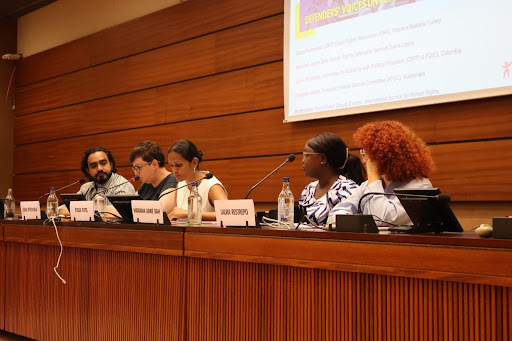
ISHR Executive Director Phil Lynch called on States to support the work of defenders and to pay their UN due

June 24, 2025

Watch a recording of the statement at an interactive dialogue on the annual report of the High Commissioner by ISHR Executive Director Phil Lynch

High Commissioner, this statement addresses four themes from your update.

First, the work of human rights defenders is essential for the realisation of all human rights. We deplore the criminalisation and arbitrary detention of defenders in all regions. We call for the release of Eduardo Torres in Venezuela, Ibrahim Metwally in Egypt, Mahmoud Khalil in the US, and Sophia Huang Xueqin in China, among thousands of defenders imprisoned globally for their work for freedom and justice.

Second, principled respect for international law protects us from tyranny. The failure of States with influence to end Israel’s genocide against Palestinians, and the double standards of States which fail to condemn Russia’s atrocity crimes in Ukraine, erode the foundations of peace, security and development everywhere.

Third, impunity for atrocity crimes denies justice to victims and fuels violations. This Council should mandate investigative mechanisms on Afghanistan and China. All States should respect international courts and sanction authorities – including US officials – who seek to pervert international justice.

Finally, no business, however efficient, can survive when customers don’t pay their bills. States which don’t pay their UN dues in full or on time, especially the US and China, benefit from the system while causing a liquidity crisis, with devastating human rights impacts. They should lose the right to vote at the General Assembly and the Security Council until they pay their dues. Humanity’s future depends on all States increasing their human rights investment.

Thank you.

https://ishr.ch/latest-updates/hrc59-humanitys-future-depends-on-all-states-increasing-their-human-rights-investment

ICJ demands that Russia immediately release lawyer Maria Bontsler

June 23, 2025
International Commission of Jurists

photo_2025-06-10_07-29-51

On 10 June 2025 The International Commission of Jurists (ICJ) condemned the arrest and detention of prominent Kaliningrad lawyer and human rights defender Maria Bontsler and called on the Russian authorities to release her immediately.

The ICJ is concerned that the charges against Maria are spurious and likely to be related to Bontsler’s legitimate activities. Proceedings against her have been undertaken in a shroud of secrecy and the ICJ calls on the authorities to immediately clarify their legal and factual basis for the charges against her.

Maria Bontsler was arrested on 28 May 2025 under Article 275.1 of the Russian Criminal Code, which provides for criminal liability for “confidential cooperation with a foreign State” aimed at “undermining the security of the Russian Federation”.

Available information indicates that a court hearing concerning Maria Bontsler’s detention or the filing of charges was held behind closed doors, at the Prosecutor’s request, on grounds of State secrecy. However, no official justification has been provided to demonstrate that the secrecy of the proceedings was necessary and proportionate as required under international human rights law. The ICJ is concerned that this lack of transparency undermines Bontsler’s right to a fair hearing.

“This prosecution reflects a broader campaign of retaliation against lawyers in Russia who engage in what the authorities see as politically sensitive cases. Such actions serve to intimidate and discourage other lawyers from vigorously defending their clients,” Temur Shakirov, Director (ad interim) of ICJ Europe and Central Asia Programme said.

Maria Bontsler has a long record of defending politically persecuted individuals, including critics of Russia’s unlawful military intervention in Ukraine.

Irrespective of any charges, the ICJ stresses that it is inappropriate to keep Maria Bontsler in pre-trial detention.

In a broader context of interference with the legal profession, searches were also carried out at the homes of her colleagues, Roman Morozov and Ekaterina Selizarova, with electronic devices and legal documents seized. According to available reports, Morozov was questioned in relation to his alleged connections to the human rights organisation Memorial.

The ICJ stresses that under international law and standards, including the UN Basic Principles on the Role of Lawyers, lawyers must be able to perform their professional activities without hindrance, including the collection and dissemination of information essential to protecting effectively their clients’ rights.

Maria Bontsler is a well-known human rights lawyer who represents individuals in politically charged cases and has been recognized by the Moscow Helsinki Group for her human rights defence work. Her clients include critics of the Russian Federation’s unlawful military intervention in Ukraine.

….Previously, Maria Bontsler was fined under administrative proceedings for courtroom statements made in defence of her clients, part of a systematic harassment faced by lawyers handling “political” cases in Russia

https://www.icj.org/russian-federation-authorities-must-immediately-release-lawyer-maria-bontsler/

see also: https://www.civicus.org/index.php/fr/medias-ressources/112-news/7777-key-highlights-civicus-at-59th-session-of-the-un-human-rights-council

IKON journalists’ case in El Salvador: finally justice after more than 40 years!!

June 7, 2025

In a previous post I explained my personal involvement in this case [https://humanrightsdefenders.blog/2018/09/25/murder-of-dutch-ikon-journalists-in-1982-in-el-salvador-revisted/] and had several follow ups [https://humanrightsdefenders.blog/tag/ikon/].

Now finally there is some closure as reported by ANP on 4 June 2025:

In El Salvador, three suspects have been found guilty of murdering four Dutch journalists that were working for IKON in 1982. All three were handed a prison sentence of 15 years, several Salvadorian media outlets reported, including the newspaper Diario El Salvador. 

After a hearing that took longer than 11 hours, the jury ruled that all the suspects were involved in the death of the journalists. The suspects are the former Minister of Defense, Guillermo Garcia (91), former director of a special police service, Francisco Antonio Moran (93), and former colonel Mario Reyes Mena (85). 

Koos Koster, Jan Kuiper, Hans ter Laag, and Joop Willemsen, four journalists who worked for the now defunct broadcaster IKON, were reporting on the civil war in the country in 1982. They walked into an ambush at Chalatenango and were killed. A now-repealed amnesty law prevented the prosecution of the perpetrators for years.

Sonja ter Laag (70), the sister of Hans ter Laag, responded to the verdict. “I am very happy that the people who murdered my brother have been convicted. And that they will go to their graves as murderers. We can finally close this after 43 years.” 

She added that the victim’s relatives have been living in a state of hope and desperation for the convictions for 43 years. “That costs a lot of energy, you don’t want to know. And now it is over. The people who gave the order to murder my brother, an innocent 25-year-old boy, will be punished.” Ter Laag did not mind that the elderly men would not have long to live anymore. “In any case, they will not go to their grave decorated.”

The judges imposed a lower sentence than the maximum set by the law. Instead of a prison sentence of 30 years, they imposed 15 years because of the defendants’ age and poor health.

García and Morán are being treated in a private hospital. El Salvador has requested the extradition of Reyes Mena. He currently lives in the U.S.

https://nltimes.nl/2025/06/04/three-former-soldiers-convicted-dutch-journalists-murder-el-salvador-1982

seehttps://jsis.washington.edu/humanrights/2025/07/18/uwchr-provides-historical-documentation-of-1982-killings-of-dutch-journalists-in-el-salvador/

https://nos.nl/artikel/2372944-zaak-vermoorde-ikon-journalisten-na-39-jaar-voor-de-rechter-in-el-salvador.html

EU’s Annual Report on Human Rights and Democracy in the World 2024 is out

May 28, 2025
Low angle of children standing in a circle reaching out to join hands.

© UNFPA

‘In 2024, we have witnessed extraordinary levels of hostility towards democracy, from rampant disinformation and information manipulation by foreign actors, to the silencing of media and human rights defenders, and a strong pushback against gender equality and diversity, undoing years of progress in many countries across the globe. Today, only 29% of the world’s population live in liberal democracies. At the heart of these challenges lies peace. Peace is not simply the absence of war. It is the active cultivation of justice, the protection of the most vulnerable, the realisation of all human rights and the commitment to dialogue and reconciliation.’ 
– High Representative, Kaja Kallas 

The publication of the EU’s Annual Human Rights Report takes place in the context of multiple and cascading crises, including war on the European continent and the resurgence of conflict in many other areas of the world. These developments underscore the strong links between peace, human rights and democracy. Climate change, digital transformation, and rising inequalities add to the growing human rights challenges worldwide.

The report follows the structure of the EU’s Action Plan on Human Rights and Democracy, particularly the EU’s work on protecting and empowering individuals, building resilient, inclusive and democratic societies, promoting a global system for human rights and democracy, harnessing opportunities and addressing challenges, and ensuring that the EU delivers by working with our partners.

The EU continues to support the strengthening of inclusive, representative and accountable institutions, and promoted a collaborative approach to democracy through the Team Europe Democracy initiative. The fight against information manipulation and interference also continues to be a priority through initiatives such as EUvsDisinfo. Over the past year, the European Endowment for Democracy has kept up its work on fostering democracy and working with free media and civil society in challenging circumstances in Belarus, and Ukraine among others. The EU has carried on supporting and empowering people on the frontlines of human rights advocacy.

While the global outlook is challenging, the EU is steadfastly pursuing deeper international cooperation and stronger early warning and prevention mechanisms. Efforts to ensure accountability for violations and abuses of human rights continue to be a key priority. Together with its partners, the EU is determined to protect the multilateral human rights system and uphold the central role of human rights and democracy in fostering peace, security and sustainable development.

NGOs alarmed by draft law “TRANSPARENCY OF PUBLIC LIFE” in Hungary

May 27, 2025

Human Rights Watch, Civil Rights Defenders and many, many other NGOs are deeply alarmed by a new legislative proposal in Hungary that, if passed, would institutionalise sweeping, opaque, and politically motivated repression of independent civil society, the press, and private organisations that receive foreign support or have any kind of income that the Hungarian government feels would threaten the country’s sovereignty. 

The draft law, which is deceptively titled ‘On the Transparency of Public Life’, would give the authorities unchecked powers, allowing it to recommend the registration of organisations deemed to be ‘influencing public life’ with foreign funding in ways that ‘threaten Hungary’s sovereignty’. Because this phrasing is vague and ideologically loaded, it risks including any kind of criticism of government policy, including the promotion of human rights, press freedom, gender equality, and the rule of law. 

Potential disastrous consequences

  • No legal remedy: If the government demands an organisation register itself, the organisation in question would not be able to appeal this decision. Once listed, organisations would have no access to effective legal redress; 
  • Broad definitions: ‘Foreign support’ is defined as any financial input, no matter how small, from practically any international source (including EU institutions and dual citizens) as well as commercial revenue; 
  • Sweeping prohibitions and sanctions: Listed organisations would have to seek permission from the tax authorities to receive foreign support. Financial institutions would be required to report and block transfers, meaning NGOs would effectively be permanently monitored; 
  • Loss of domestic support: Listed organisations would lose access to Hungary’s 1% income tax donation scheme, which would prevent them from receiving support from regular Hungarian citizens; 
  • Political targeting: Leaders of registered organisations would be labelled ‘politically exposed persons’, which would expose their private financial transactions to invasive scrutiny; 
  • Severe penalties: Any violations could lead to fines of up to 25 times the amount received, suspension of the organisation’s advocacy activities, and even forced closure.

EU must speak out against proposed law

Hungary’s draft law is not about transparency: it is a calculated attempt to criminalise dissent, silence watchdogs, and entrench one-party control over the democratic public sphere and civic space. If passed, the law would violate multiple provisions of the EU Charter of Fundamental Rights and the European Convention on Human Rights, including freedom of expression and association and the right to an effective remedy. 

In an open letter to President Ursula von der Leyen and Commissioner Michael McGrath of 22 May 2025, the NGOs urge to take the following immediate steps:

  • Immediately request the Court of Justice of the European Union (CJEU) to grant interim measures in the ongoing infringement procedure on the Law on the Defence of National Sovereignty (Case C-829/24). The Sovereignty Protection Office is crucial to the new bill and therefore this is an imminent and effective way to halt the progress and impact of the bill. Cognizant of the impending danger, the European Parliament and civil society have been calling for this step since 2024. Interim measures are designed to prevent irreparable harm — in this case, the effective paralysis of civil society organisations, independent media and dissenting voices – and with this new development comprehensive interim measures should be requested immediately.
  • At the same time, call on the Hungarian government to withdraw the bill and if unsuccessful, open a new infringement procedure on new violations that are not linked to the ongoing case on the Defence of National Sovereignty.
  • With the forthcoming Article 7 hearing on Hungary on 27 May 2025 and recognising the escalation of a systematic breakdown of the rule of law, support the Council of the EU to move to a vote on Article 7(1).

This new bill represents a severe and existential threat to democratic principles, human rights and the rule of law in Hungary and in the EU as a whole. If the existing tools are not effectively deployed, we risk an unravelling of the rules on which the EU was founded and a clear step towards authoritarian practices. We call on you to stand in solidarity with Hungarian civil society and their counterparts across the region and remain available to provide additional information and support.

https://www.hrw.org/news/2025/05/23/open-letter-hungarian-bill-entitled-transparency-public-life

https://www.coe.int/nb/web/commissioner/-/commissioner-asks-hungary-s-parliament-not-to-adopt-law-that-stifles-civil-society

New report: Human rights defenders at risk in the renewable energy transition

May 27, 2025

A new report by the research organization Swedwatch of 29 April 2025 highlights critical human rights risks associated with the global transition to renewable energy. The report reveals that human rights and environmental defenders face serious threats and reprisals in countries where renewable energy projects are being rapidly developed.

More than half of the world’s total prospective wind farm capacity, and more than two thirds of the prospective solar farm capacity, is estimated to take place in countries with obstructed, repressed or closed civic space.

While scaling up wind, solar, and hydropower is essential to limiting global warming to 1.5°C, this growth must not come at the expense of human rights.

–We cannot build a green future on the backs of those who are silenced or displaced. The renewable energy transition must not come at the cost of human rights. Defenders are not obstacles – they are essential allies in ensuring that this is just, equitable, and sustainable, says Alice Blondel, Director Swedwatch.

Renewable energy projects require large land areas, often affecting local communities, ecosystems, and livelihoods. Swedwatch’s analysis shows that the renewable energy transition will largely take place in countries with restricted civic space and poor human rights protections, where defenders who raise concerns often face harassment, legal persecution and at times even deadly violence.

The report Renewables and Reprisals – Defenders at risk in the green energy transition in Brazil, Honduras, Mozambique, and the Philippines is based on a global mapping of such high-risk areas for defenders, where civic space is restricted and where renewable energy expansion is projected to accelerate. Additionally, the report presents four case studies from Mozambique, Honduras, Brazil, and the Philippines, where defenders and affected community members describe restrictions and reprisals of defenders linked to renewable energy projects.

The report is authored by Swedwatch with input from Terramar Institute (Instituto Terramar), Network of Women Human Rights Lawyers and Defenders (Red de Abogadas Defensoras de Derechos Humanos) and Jalaur River for the People’s Movement (JRPM).

-The report underscores the urgent need for stronger protections for defenders, transparent consultation processes, and corporate accountability. Without immediate action, the rapid expansion of renewables risk repeating the same human rights abuses seen in industries such as mining and agribusiness, rather than fostering a truly just energy transition, says Alice Blondel.

Expansion of renewables in countries with high risks for defenders
Swedwatch’s findings indicate that a large share of the expansion of renewable energy is taking place in countries where civic space is restricted, and defenders are at significant risk.

Case studies: Defenders under threat
In the four case studies, defenders from Mozambique, Honduras, Brazil and the Philippines described restrictions of basic civic freedoms and risks of verbal, legal or violent physical attacks when reporting about impacts of renewable energy projects.

Mozambique: According to interviews in the report, the planning of the Mphanda Nkuwa hydropower project has been marred by inadequate social and environmental impact assessments, lack of transparency, and suppression of civic engagement. Defenders reported threats, violation of freedom of assembly, and an overall disregard for their right to participate in decision-making processes.

Honduras: Human rights defenders have faced legal intimidation through SLAPPs (Strategic Lawsuits Against Public Participation) for their criticism of the Los Prados solar power project, according to a group of women human rights lawyers. Community members involved in protests have allegedly been surveilled and subjected to repressive actions by security forces. Defenders also reported smear campaigns in the media, further restricting their ability to voice concerns.

Brazil: In Brazil, the wind power project Bons Ventos failed to properly include impacted communities, including marginalized groups, traditional fishing, and quilombola communities, in consultations, according to interviews. Defenders decided to remain anonymous in the interviews out of fear of reprisals, citing increasing threats and violence against defenders in the past years.

The Philippines: Indigenous defenders from the Tumandok communities were allegedly threatened, harassed, and killed when the national police and the armed forces raided their communities after community leaders criticized the Jalaur River Multipurpose project, according to a CSO operating in the area. Defenders reporting on the dam project outlined persecution, surveillance and red-tagging – terror-labelling by the government accusing defenders of being communist insurgents, creating an environment of fear and impunity.

Swedwatch´s recommendations
As the world races to meet climate targets, a just transition must include the voices of those most affected by energy projects, and defenders are essential in ensuring that renewable energy projects respect human rights and the environment.

-Governments, businesses, and financial institutions must work together to ensure that human rights are protected, and that defenders can operate without fear of repression or violence. Engaging with defenders as valuable partners rather than as adversaries can help governments and businesses ensure renewable energy projects’ alignment with international human rights obligations, mitigate conflicts, and promote sustainable development, says Jessica Johansson.

Detailed recommendations to different actors can be found in the report, below the main ones are summarized:

Recommendations for governments:

  • Adopt legislation on mandatory human rights due diligence (HRDD) for companies, highlighting risks to defenders and meaningful consultation with defenders.
  • Adopt laws on company transparency laws and access to information.
  • Establish and enforce protections for defenders, ensuring they can operate without fear of retaliation, and provide effective legal remedies for those affected by violations.

Recommendations for companies and investors:

  • Strengthening their HRDD processes by integrating civic space risks and ensuring meaningful stakeholder engagement with defenders.
  • Adopt and enforce a zero-tolerance policy against reprisals targeting defenders (and affected communities).
  • Take appropriate action when business partners or third parties commit violations in relation to their business activities.

…

https://www.mynewsdesk.com/swedwatch/pressreleases/new-report-from-swedwatch-human-rights-defenders-at-risk-in-the-renewable-energy-transition-3382176?utm_source=rss&utm_medium=rss&utm_campaign=Alert&utm_content=pressrelease

Young Syrian human rights defenders working for truth and justice express cautious hope

May 26, 2025

“Removing a dictator is not enough; real change requires a shift in governance, security, justice.”

Syrians gather in celebration days after the fall of Bashar Assad’s government at Umayyad Square in Damascus on Dec. 12, 2024. | Leo Correa/AP

On 19 May 2025 Bassam Alahmad, Noah Abbas, and Simav Hasan wrote in Global Citizen an interesting piece on how Syrian human rights defenders feel about the changes in their country:

In a previously published Global Citizen In My Own Words article, human rights defender Bassam Alahmad detailed his experiences of being a stateless citizen residing in Syria who stands for justice. In this article, following the fall of Al-Assad, Bassam Alahmad is joined by colleagues from Syrians For Truth and Justice, Simav Hasan, and Noah Abbas, as they share their reflections on what the regime change in the country means for them personally and for their hopes for a democratic Syria.

How would you describe your relationship with Syria and how has the decades-long conflict impacted you?

Bassam Alahmad: I think ‘complicated’ or ‘complex’ is the best way to describe my relationship with Syria. Being born stateless means having no rights, but we love our country because we were born there. We know the people and communities and we belong to the land but I didn’t feel as though I belonged politically. I didn’t feel as though I had full citizenship in the country. I like my country but unfortunately, the way in which the Kurdish people were treated for decades made it so we didn’t feel like we were equal parts of this country.  

Noah Abbas: As a Kurdish Syrian national, the long-standing conflict in Syria has profoundly influenced both my personal and professional life. It has not only shaped my views on war and peace, but has also deepened my understanding of resilience and the value of community. Witnessing the enduring struggles of friends, family, and the broader Syrian community has motivated me to advocate for humanitarian causes and pursue solutions that aim to bring lasting peace to the region. The impact of this conflict extends into my academic pursuits as well; I am currently engaged in postgraduate studies in military intelligence and security.

This academic path was chosen with a clear purpose: to shift the perspective on the role of intelligence in Syria. Under Al-Assad’s governance, intelligence agencies were often viewed as instruments of fear, particularly against opponents of the regime. As a human rights activist, I believe it is our duty to transform this perception and demonstrate how intelligence can serve as a cornerstone for justice and societal safety. Joining the efforts of Syrians for Truth and Justice has been crucial in my journey.

Simav Hasan: I am a Kurd from Qamishli, and so my existence here has always been shaped by layers of oppression, resistance, and hope. The decades-long conflict has left scars on my community and on me personally. I’ve witnessed forced displacement, the suffering of victims, and the destruction of lives and history. But more than that, I’ve felt the weight of injustice firsthand — whether through the fight for accountability, the struggle for basic rights, or the ongoing humanitarian crises. Despite everything, I refuse to detach myself from this reality. My work as a journalist and human rights activist is my way of pushing back against the violence, ensuring that the voices of the victims are heard, and trying to carve out a future where justice isn’t just a distant dream. The war has taken much, but it has also strengthened my resolve. Even in the darkest moments, I believe in the power of truth, memory, and resistance.

………

In 2024 the Al-Assad government fell, how did this make you feel? 

Alahmad: To be honest, while part of me is very happy that there is no longer the Assad regime, part of me also thinks that there is a big obstacle in the road to democracy, open civic society, and citizenship. As people working in human rights we must not be naive because we know the history and we know that there are human rights violations committed. The main issue is there is a huge gap betweenwhat they say to the west — to the EU, to the US, to the UN — and what they ultimately decide. For example, the national dialogue was kind of a missed opportunity, where instead of having a good version of national dialogue in Damascus and to be more inclusive, they excluded a huge part of Syria, including Kurds and other minorities.

It was a missed opportunity. The same is true with the constitutional declaration adopted in March 2025. They didn’t recognize the Kurdish people or the Kurdish language. They did not recognize diversity. Most of the authority was in the hands of the president. Our main problem is that Syria without the Assad regime is good, but there is no guarantee that we are going towards democracy. The recent Human Rights Watch report on the constitutional declaration clearly states that this constitutional declaration is not a road to a democratic country. This should be very clear for our partners in the US, the EU, and the international community. The most serious thing that happened in the coastal area in Latakia and Tartus is that hundreds of Alawite people were killed based on their identity, because they are from this minority group. A lot of violations happened by the groups linked to the government. 

Abbas: The fall of the Al-Assad government, as welcomed by human rights organizations, provoked a complex mix of emotions within me. On one hand, I felt a profound sense of relief and happiness that the brutal regime, known for its relentless human rights violations and oppressive rule, had come to an end. The release of prisoners of conscience and the acknowledgment of the sacrifices made by countless human rights defenders brought a wave of hope for a future where justice and accountability could finally be addressed. However, as a Kurdish-Syrian national, this transition also brought with it significant fears and concerns. The potential for ethnic conflicts or even ethnic cleansing within the new power structures (such as the factions that committed violations in Efrin city, my home town, and other Kurdish cities across the country) was alarming, especially given the historical challenges faced by Kurdish communities in asserting their rights and safety within Syria.

Despite these fears, the fall of the regime marked a critical moment for Syria — an opportunity to rebuild and redefine the nation on the principles of freedom, justice, and human dignity. It was a moment to champion the efforts of Syrians for Truth and Justice and engage more actively in the civil society space dedicated to transitional justice and documenting human rights violations. 

Hasan: With the fall of the Assad government, I felt a sense of cautious optimism. It marked the end of a regime responsible for decades of repression, war crimes, and mass atrocities — a moment many victims and survivors had long awaited. There was hope that this could be the beginning of rebuilding Syria on principles of justice, accountability, and human rights. However, I remained wary. The fall of a regime does not automatically guarantee freedom or stability. Power vacuums in Syria have often led to new forms of repression and external interference. Many armed actors still operate with impunity, and the path to true justice remains uncertain. While this moment was significant, real change depended on what came next. Would justice be pursued? Would the voices of victims and marginalized communities — especially Kurds and other oppressed groups — be heard? The fall of Assad was a turning point, but Syria’s future was still being written.

https://www.globalcitizen.org/en/content/syria-justice-human-rights-after-al-assad/

Amnesty International declared “undesirable organization” in Russia

May 25, 2025

Reacting to the news that the Russian authorities have declared Amnesty International an “undesirable organization” thereby criminalizing its activities and any association with the organization in Russia, Agnès Callamard, Amnesty International’s Secretary General, said19 May 2025 

“This decision is part of the Russian government’s broader effort to silence dissent and isolate civil society. In a country where scores of activists and dissidents have been imprisoned, killed or exiled, where independent media has been smeared, blocked or forced to self-censor, and where civil society organizations have been outlawed or liquidated, you must be doing something right if the Kremlin bans you.  

“The authorities are deeply mistaken if they believe that by labelling our organization “undesirable” we will stop our work documenting and exposing human rights violations – quite the opposite. We will not give in to the threats and will continue undeterred to work to ensure that people in Russia are able to enjoy their human rights without discrimination. We will keep documenting and speaking worldwide about the war crimes committed in Ukraine by Russia. We will redouble our efforts to expose Russia’s egregious human rights violations both at home and abroad.  

The authorities are deeply mistaken if they believe that by labelling our organization “undesirable” we will stop our work documenting and exposing human rights violations – quite the oppositeAgnès Callamard, Amnesty International’s Secretary General

“We will never stop fighting for the release of prisoners of conscience detained for standing up for human rights or for the repeal of repressive laws that prevent people in Russia from speaking up against injustice. We will continue to work relentlessly to ensure that all those who are responsible for committing grave human rights violations, whether in Russia, Ukraine, or elsewhere, face justice. Put simply, no authoritarian assault will silence our fight for justice. Amnesty will never give up or back down in its fight for upholding human rights in Russia and beyond.” 

Background 

On 19 May 2025, the Russian Prosecutor General’s Office declared Amnesty International an “undesirable organization” under repressive 2015 Russian legislation which allows the authorities to ban arbitrarily any foreign organization and criminalize its activities in Russia. The announcement accused Amnesty International of promoting “Russophobic projects” and indicated that it was prompted by the organization’s work on freedom of expression and association in Russia, and its documentation and exposition of crimes under international law committed by Russian forces in Ukraine. The decision is based on a Russian law which in itself violates international law, and the language of the decision goes against facts accusing Amnesty International of activities which, within its statutory documents and policies, it is prevented from undertaking.

The designation comes three years after the Russian authorities blocked access to Amnesty International’s websites in Russia and de-registered – effectively closed down – the organization’s office in Moscow. The designation puts at risk of prosecution in Russia partner organizations and individual supporters, journalists, other persons who now work with, or are seen by the authorities as supporting or promoting, the organization.

Under Russian legislation, participation in the activities of an “undesirable organization” is punishable by law. First-time “offenses” may result in administrative fines of up to 15,000 rubles (around US$185). Repeated violations as well as funding or managing such organizations carry criminal liability and can lead to prison sentences of up to six years. The law has previously been applied to the distribution or reposting of any materials from the designated organization, including publications and hyperlinks predating its designation as “undesirable”.

This designation places Amnesty International among dozens of independent NGOs and media outlets that have been targeted in recent years as part of a sweeping campaign to suppress dissent and dismantle civil society in Russia and prevent international watchdogs and partners from providing support or showing solidarity with them. These moves are the backbone of a pattern whereby the Russian authorities are using authoritarian practices to silence voices, undermine accountability and entrench power. [see also: https://humanrightsdefenders.blog/2019/01/22/in-russia-first-criminal-case-under-undesirable-organizations-law/]

https://www.fidh.org/en/issues/human-rights-defenders/russian-federation-designation-of-amnesty-international-as

Venezuela: Where is Eduardo Torres? 

May 13, 2025

ISHR, T

ISHR, the Observatory for the Protection of Human Rights Defenders, a partnership of the World Organisation Against Torture (OMCT) and the International Federation for Human Rights (FIDH), request your urgent intervention in the following situation in Venezuela.

The Observatory has been informed of the disappearance of Mr. Eduardo Torres, a labour lawyer who has been a member for over five years of the Venezuelan Education-Action Program on Human Rights (PROVEA), an FIDH member organisation.

According to witnesses, Eduardo Torres was last seen on Friday, 9 May 2025 at 4:00 p.m. in Parque Central in Caracas, after attending a meeting. At that moment, Mr. Torres contacted his family and informed them he was heading home, near Av. Fuerzas Armadas in Caracas, but he never arrived.

Seeking information about Eduardo Torres’ whereabouts, his wife, Ms. Emiselys Nuñez, accompanied by PROVEA members, have visited various detention centres in Caracas, including the Bolivarian National Intelligence Service (SEBIN) at El Helicoide, several National Bolivarian Police (PNB) stations in Maripérez, Boleíta and Petare, as well as the General Directorate of Military Counterintelligence (DGCIM) in Boleíta. As of the publication of this urgent appeal, his whereabouts remain unknown.

On 11 May 2025, Ms. Emiselys Nuñez and PROVEA’s legal team went to the Palace of Justice to submit a “Habeas Corpus” petition before the Judge of First Instance in Control Functions of the Criminal Judicial Circuit of the Metropolitan Area of Caracas, Specialised in protection matters, to request information on whether Eduardo Torres had been detained by the Venezuelan State. However, after more than seven hours of waiting, they were not “authorised” to receive the document, without providing details, and in clear violation of Article 27 of the National Constitution and Articles 2, 3, and 4 of the Organic Law of Personal Liberty and Security.

On 12 May 2025, the PROVEA team, along with Mr. Torres’ wife and mother, went to the Constitutional Chamber of the Supreme Court of Justice and handed the “Habeas Corpus” petition at 12:10 pm.

The Observatory highlights that Mr. Torres has been repeatedly been subjected to threats and acts of harassment by Venezuelan police officers. Like the rest of the PROVEA team, he is a beneficiary of precautionary protection measures granted by the Inter-American Commission on Human Rights (IACHR) due to repeated threats, criminalisation, and harassment in connection with his human rights work in Venezuela.

The Observatory recalls that on 7 January 2025, Mr. Carlos Correa, former PROVEA coordinator, was intercepted in the centre of the capital Caracas by hooded officials. His whereabouts remained unknown for several days before he was released on 16 January 2025.

The Observatory also recalls that on 15 October 2024, the passport of Mr. Torres, among other human rights defenders and/or persons identified as opponents, was cancelled in a selective and discretionary manner as a mechanism of repression and intimidation to prevent him from leaving the country and/or cooperating with international protection mechanisms, thus violating his rights to identity, free transit and mobility.

The Observatory expresses its deepest concern due to the high probability that Mr. Eduardo Torres is in a condition of arbitrary detention and enforced disappearance, due to his work as a human rights defender and given the constant threats against him. If confirmed, these acts would increase the risk of torture and ill-treatment against him.

The Observatory underlines that this disappearance occurs two weeks before the national and regional elections scheduled for 25 May 2025, again highlighting the risks against human rights defenders in Venezuela and exemplifying a systematic attempt to silence all critical voices committed to human rights and democracy in the country.

The Observatory urges the Venezuelan authorities to guarantee the physical and psychological security of Mr. Eduardo Torres, to disclose his whereabouts and to proceed to his immediate and unconditional release, in case he is indeed detained by State actors.

https://www.fidh.org/en/issues/human-rights-defenders/venezuela-disappearance-of-eduardo-torres-member-of-provea

Environmental defenders and the Escazú Agreement

April 28, 2025

From 7-10 April, the Latin American and Caribbean Forum on Environmental Human Rights Defenders brought together environmental defenders, Indigenous Peoples, civil society, and government representatives in Basseterre, Saint Kitts and Nevis.

The Escazú Agreement is a landmark regional human rights treaty that guarantees access to environmental information, public participation and justice in Latin America and the Caribbean. Article 9 describes States’ obligation to protect human rights defenders in environmental matters and guarantee their rights, including those related to access to information, participation, and justice, as set forth in the agreement.  

As of today, 17 countries are parties to the agreement, while other key countries in the region still haven’t signed or ratified it. In February 2025, Special Procedures mandate holders sent a communication to these countries urging them to sign and ratify the agreement.  

The 2024 Action Plan adopted by the parties to the Escazú Agreement aims to implement practical protections for human rights defenders in environmental matters. It outlines capacity building and assessment, calling for urgent national action to address immediate threats and ensure the continuity of defenders’ work.

Since April 2024, individuals who believe that a State is not complying with its obligations as a party to the Escazú Agreement can send information (‘communications’) to the treaty’s Implementation and Compliance Support Committee. At a 2024 Conference of the Parties (COP) to the Agreement, States agreed to incorporate a gender perspective within the Escazú Agreement, recognising the unique risks faced by women human rights defenders in environmental matters.

This decision further requires States to consider gender-based violence and ensure women’s participation, enhancing security and effectiveness for all defenders. 

At the Forum on Environmental Human Rights Defenders, the #EscazuEnlaCorteIDH initiative was presented during the Third Forum. This initiative seeks to ensure that Escazú standards are included in the Inter-American Court’s forthcoming advisory opinion on the climate emergency.

A central piece of this effort was the amicus brief co-submitted by ISHR. 

see also: https://humanrightsdefenders.blog/tag/escazu-agreement/

https://ishr.ch/latest-updates/better-protection-and-participation-of-environmental-human-rights-defenders-through-effective-implementation-of-the-escazu-agreement