On 17 September 2025 Global Witness published its annual report , documenting killings and long-term disappearances of land and environmental defenders. 2024 shows continuing bad news.
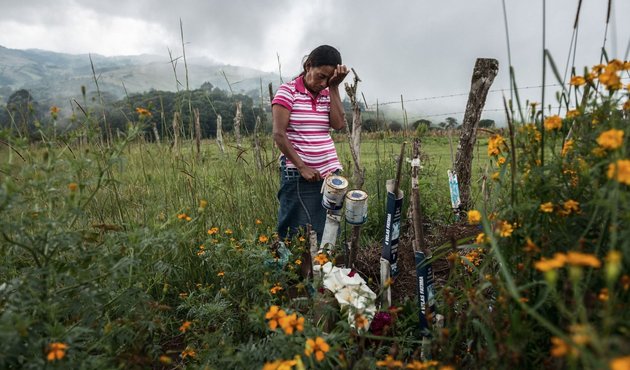
Julia Francisco Martínez stands at the graveside of her husband Juan, a Honduran Indigenous defender who was found murdered in 2015. Giles Clarke / Global Witness
Every year, Global Witness works with partners to gather evidence, verify and document every time a land and environmental defender is killed or disappeared. Our methodology follows robust criteria, yet undocumented cases pose challenges when it comes to analysing data
Global Witness documents killings and long-term disappearances of land and environmental defenders globally. In partnership with over 30 local, national and regional organisations in more than 20 countries, we produce an annual report containing these figures, and we have done so since 2012.
Our methodology involves a year-long process of cross-referencing data from different sources to ensure its credibility. Over 2,200 killings or long-term disappearances of defenders appear in our database since 2012 – with 146 cases documented in 2024.
Every year, we maintain a database to keep a record of these crimes and create a comprehensive global picture of the systematic violence defenders face.
The data provides a snapshot of the underlying drivers behind reprisals and indicates how some defenders and their communities face increased risks. Exposing these trends is the first of many steps to ensure that defenders and their communities are protected and can exercise their rights without fearing for their lives.
Killings and disappearances documented between 2012 and 2024
2,253 defenders have been killed or disappeared since 2012 Global Witness
146 of these attacks occurred in 2024 Global Witness
The accompanying press release goes into considerable detail on the methodology used.
The Philippines recorded the highest number of alleged abductions involving human rights defenders (HRDs) across Asia from 2023 to 2024, according to a biennial report released on 19 July 2025 by the Asian Forum for Human Rights and Development (Forum-Asia).
The country topped the list of 24 nations with 15 documented abduction cases, surpassing Bangladesh with nine, and both Afghanistan and Pakistan with seven each. The report accounted for at least 32 Filipino victims, though it did not specify how many remain missing.
These incidents were compiled through the Asian Human Rights Defenders Portal, a publicly accessible database maintained by Forum-Asia using verified reports from civil society, media, and UN sources. Only cases with clear identification of victims and a link to their human rights work are recorded.
One cited case involved indigenous activists Job David, Peter del Monte Jr., and Alia Encela, who were reportedly abducted by military forces in Bongabong, Oriental Mindoro in September 2023. The Philippine Army denied the allegations, asserting that the three were members of the New People’s Army captured during an operation and are currently detained. However, Forum-Asia noted that the case mirrored earlier incidents where so-called “Red-tagging” was used to justify human rights violations.
Red-tagging, the practice of labeling activists as communist rebels or terrorists, has long been criticized for exposing individuals to threats, violence, and in some cases, fatal attacks.
The report also revealed that abduction is only one of many repressive methods used to target HRDs. Judicial harassment emerged as the most widespread, with 868 cases across Asia. This includes arbitrary arrests, the use of oppressive laws, and denial of fair trials.
Threats, intimidation, and censorship were also rampant, totaling 376 incidents. The Philippines accounted for 41 of these, with 18 cases of vilification—all allegedly perpetrated or backed by state actors.
Environmental, indigenous, land, and community-based defenders were among the most targeted groups, with 60 harassment cases documented in the Philippines—second only to Indonesia. The country also ranked second in attacks on labor rights defenders, tallying 16 cases.
A new report by the research organization Swedwatch of 29 April 2025 highlights critical human rights risks associated with the global transition to renewable energy. The report reveals that human rights and environmental defenders face serious threats and reprisals in countries where renewable energy projects are being rapidly developed.
More than half of the world’s total prospective wind farm capacity, and more than two thirds of the prospective solar farm capacity, is estimated to take place in countries with obstructed, repressed or closed civic space.
While scaling up wind, solar, and hydropower is essential to limiting global warming to 1.5°C, this growth must not come at the expense of human rights.
–We cannot build a green future on the backs of those who are silenced or displaced. The renewable energy transition must not come at the cost of human rights. Defenders are not obstacles – they are essential allies in ensuring that this is just, equitable, and sustainable, says Alice Blondel, Director Swedwatch.
Renewable energy projects require large land areas, often affecting local communities, ecosystems, and livelihoods. Swedwatch’s analysis shows that the renewable energy transition will largely take place in countries with restricted civic space and poor human rights protections, where defenders who raise concerns often face harassment, legal persecution and at times even deadly violence.
The report Renewables and Reprisals – Defenders at risk in the green energy transition in Brazil, Honduras, Mozambique, and the Philippines is based on a global mapping of such high-risk areas for defenders, where civic space is restricted and where renewable energy expansion is projected to accelerate. Additionally, the report presents four case studies from Mozambique, Honduras, Brazil, and the Philippines, where defenders and affected community members describe restrictions and reprisals of defenders linked to renewable energy projects.
-The report underscores the urgent need for stronger protections for defenders, transparent consultation processes, and corporate accountability. Without immediate action, the rapid expansion of renewables risk repeating the same human rights abuses seen in industries such as mining and agribusiness, rather than fostering a truly just energy transition, says Alice Blondel.
Expansion of renewables in countries with high risks for defenders Swedwatch’s findings indicate that a large share of the expansion of renewable energy is taking place in countries where civic space is restricted, and defenders are at significant risk.
Case studies: Defenders under threat In the four case studies, defenders from Mozambique, Honduras, Brazil and the Philippines described restrictions of basic civic freedoms and risks of verbal, legal or violent physical attacks when reporting about impacts of renewable energy projects.
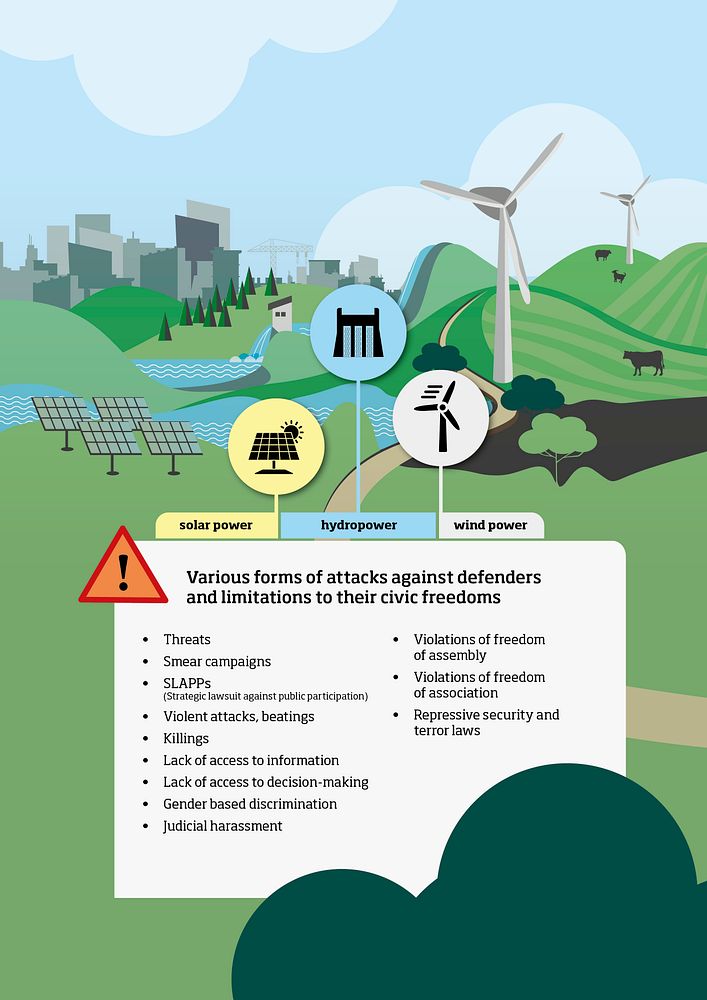
Mozambique: According to interviews in the report, the planning of the Mphanda Nkuwa hydropower project has been marred by inadequate social and environmental impact assessments, lack of transparency, and suppression of civic engagement. Defenders reported threats, violation of freedom of assembly, and an overall disregard for their right to participate in decision-making processes.
Honduras: Human rights defenders have faced legal intimidation through SLAPPs (Strategic Lawsuits Against Public Participation) for their criticism of the Los Prados solar power project, according to a group of women human rights lawyers. Community members involved in protests have allegedly been surveilled and subjected to repressive actions by security forces. Defenders also reported smear campaigns in the media, further restricting their ability to voice concerns.
Brazil: In Brazil, the wind power project Bons Ventos failed to properly include impacted communities, including marginalized groups, traditional fishing, and quilombola communities, in consultations, according to interviews. Defenders decided to remain anonymous in the interviews out of fear of reprisals, citing increasing threats and violence against defenders in the past years.
The Philippines: Indigenous defenders from the Tumandok communities were allegedly threatened, harassed, and killed when the national police and the armed forces raided their communities after community leaders criticized the Jalaur River Multipurpose project, according to a CSO operating in the area. Defenders reporting on the dam project outlined persecution, surveillance and red-tagging – terror-labelling by the government accusing defenders of being communist insurgents, creating an environment of fear and impunity.
Swedwatch´s recommendations As the world races to meet climate targets, a just transition must include the voices of those most affected by energy projects, and defenders are essential in ensuring that renewable energy projects respect human rights and the environment.
-Governments, businesses, and financial institutions must work together to ensure that human rights are protected, and that defenders can operate without fear of repression or violence. Engaging with defenders as valuable partners rather than as adversaries can help governments and businesses ensure renewable energy projects’ alignment with international human rights obligations, mitigate conflicts, and promote sustainable development, says Jessica Johansson.
Detailed recommendations to different actors can be found in the report, below the main ones are summarized:
Recommendations for governments:
Adopt legislation on mandatory human rights due diligence (HRDD) for companies, highlighting risks to defenders and meaningful consultation with defenders.
Adopt laws on company transparency laws and access to information.
Establish and enforce protections for defenders, ensuring they can operate without fear of retaliation, and provide effective legal remedies for those affected by violations.
Recommendations for companies and investors:
Strengthening their HRDD processes by integrating civic space risks and ensuring meaningful stakeholder engagement with defenders.
Adopt and enforce a zero-tolerance policy against reprisals targeting defenders (and affected communities).
Take appropriate action when business partners or third parties commit violations in relation to their business activities.
2024 Right Livelihood Laureates face off against the marginalisation of Indigenous Peoples, Israel’s illegal settlements, dangerous development projects in Mozambique and human rights violations committed with impunity to demand a just future for all.
THE 2024 LAUREATES:
Joan Carling “For raising Indigenous voices in the face of the global ecological breakdown and her leadership in defending people, lands and culture.” Joan Carling is a Filipino Indigenous activist who has been defending the rights of Indigenous Peoples for more than 30 years. Her work spans grassroots and international levels, focusing on human rights, sustainable development, climate justice and the fight against land exploitation. [https://humanrightsdefenders.blog/2016/11/02/joan-carling-indigenous-land-rights-defender-from-the-philippines/]
Issa Amro / Youth Against Settlements “For their steadfast non-violent resistance to Israel’s illegal occupation, promoting Palestinian civic action through peaceful means.” Issa Amro is a Palestinian human rights activist who has dedicated his life to peaceful resistance against Israeli occupation in the West Bank city of Hebron. Together with the activist group he founded, Youth Against Settlements, he strives to create a future where Palestinians live freely and with dignity. [https://humanrightsdefenders.blog/tag/issa-amro/]
Anabela Lemos / Justiça Ambiental! “For empowering communities to stand up for their right to say no to exploitative mega-projects and demand environmental justice.” Anabela Lemos is a Mozambican environmental activist and Director of Justiça Ambiental! (JA!), an organisation committed to fighting corporate-led projects that displace communities, damage livelihoods and intensify climate change in Mozambique.
Forensic Architecture “For pioneering digital forensic methods to ensure justice and accountability for victims and survivors of human and environmental rights violations.” Forensic Architecture is a pioneering research agency dedicated to uncovering and documenting the truth about environmental and human rights violations using cutting-edge open-source investigation and digital modelling techniques.
“Amid the chaos of violence, greed and injustice that is affecting so many people around the world, the 2024 Right Livelihood Laureates reignite hope,” said Ole von Uexkull, Right Livelihood’s Executive Director.
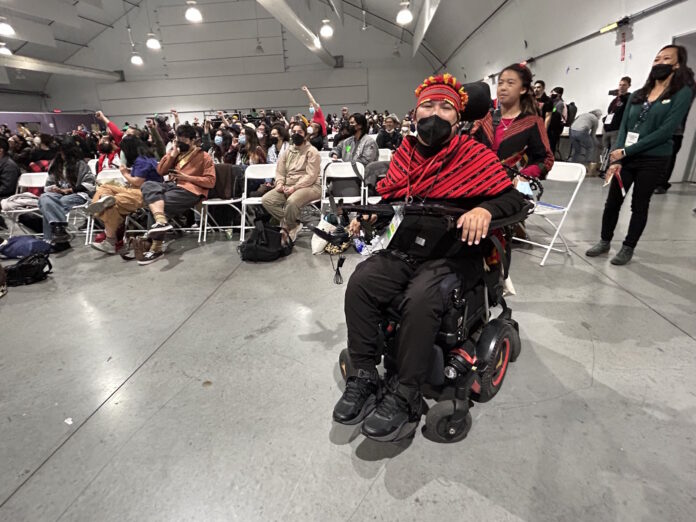
Brandon Lee and his daughter Jesse Jane at the People’s Counter Summit of the No To APEC Coalition, Nov. 11, 2023. Photo by Jia H. Jung
Jia Jung wrote on 20 November, 2023 about Chinese American Bay Area native Brandon Lee who gave the keynote speech at the No to APEC People’s Counter Summit, “People Over Profit and Plunder,” at San Francisco State University on Saturday, Nov. 11, 2023.
Lee was living with his wife and daughter in the Philippines and working as a human rights advocate, land defender, and journalist for the Northern Dispatch when he was shot by Philippine armed forces on Aug. 6, 2019. He survived – as a quadriplegic who remains steadfast in his international activism. Lee said, inter alia:
In high school, I was voted most shyest. I always preferred to work behind the scenes behind the camera, never in front. I was working security during rallies or painting posters the day before.
…In 2003, I transferred to this campus and joined the League of Filipino students at San Francisco State University. That’s where I learned that our country, the United States, continues to dominate and stagnate the Philippine economy, politics, and culture.
Around this time, I also started volunteering for the Chinese Progressive Association. That’s where I learned about the conditions and struggles of immigrant Chinese workers, and tenants. It was at that time I met Pam Tau Lee, the founder of the Chinese Progressive Association.
She was one of my mentors. And that’s where I learned that in the late nineties, San Francisco had 20,000 garment workers. But in less than 10 years, many of the immigrant monolinguistic women workers lost their jobs, with 88% of the workers being offshored to countries with weaker labor protection. It was during these years that I learned how interconnected our struggles are, and I became an internationalist and an anti-imperialist.
In 2007, I went on a life changing exposure trip to the Philippines. I met Youth and Students who are now movement leaders. I joined with workers boycotting Nestlé on their picket line. Ka Fort [Diasdado Fortuna], the chair of their union, was killed in cold blood by state agents. Ka Fort was dearly, dearly loved by the Nestlé workers for his leadership in building the union and his ultimate sacrifice.
So workers also launched a public campaign – “there’s blood in your coffee” – to draw international attention against Nestlé. Nestlé believes that water is a corporate right and not a human right. In this same trip, we visited many sectors, including the most oppressed majority and largest class – the peasants – as well as the Igorot Indigenous people in the northern part of the Philippines.
The Igorots, who live on resource-rich lands, are considered squatters on their own land because the Philippine government considers any land with a slope of 18 degrees Philippine land. The Igorots have been fighting against foreign occupation and colonization for hundreds of years.
And until now, they have continued their fight against government neglect and development aggression, militarization, and for the recognition for the right to ancestral land and self-determination.
On that exposure trip, our group also attended the one-year death anniversary of Alyce Claver, the wife of Chandu [Constancio]Claver, who was the provincial chair of the progressive party, Bayan Muna, and the president of the Red Cross. Chandu and Alyce were driving their kids to school when a motorcycle pulled up and shot at their car. Alyce shielded her husband and was riddled with two dozen bullets. Chandu made it out alive and is now in Canada with his kids after filing for political asylum, but the family today continues to be traumatized.
During this trip, we joined a medical and fact-finding mission to a remotevillage, and thankfully, the military had pulled out. The Indigenous peasants taught us about how the soldiers had blindfoldedthem and pointed a gun to their nape. The soldiers accused the farmers of supporting the land defenders and the resistance fighters known as the New People’s Army. The Philippine militarypretended to have a fake medical mission, giving out expired medicine to the local Indigenous people.
This trip, 16 years ago, changed the direction of my life.
I believe that we are shaped by our experiences, and this exposure program gave me new direction. It fortified my commitment to serving the fight for the Philippine liberation from U.S. imperialism. And to this day, the stories and sacrifices of Alyce Claver, Ka Fort, and so many others continue to fuel my commitment.
Two years later in 2009, I decided to deepen my commitment and decided to do a three-month integration in a remote area deep in the mountains. When I returned, I learned about Melissa Roxas, who was also from the U.S. and was abducted by the Armed Forces of the Philippines. She was conducting a medical mission. After a week, her captors released her as long as she promised to shut up.
She didn’t, though – she didn’t shut up. As she was she was released, she told the world what happened. As a health worker, Melissa diagnosed the Philippines’ societal problems and saw the illness of neoliberal policies from living among the poor. Melissa was brave. Her journey back from the trauma perpetuated by the Philippine military would soon follow for me.
The year following, 2010, I went all in and decided to live and serve the Igorot Indigenous people. I married my girlfriend, who is an Indigenous Ifugao, and we had a daughter, Jesse Jane, who is here with us today. I lived nine years with Indigenous people in the northern part of the Philippines, and I learned how they defended their land rights and lives in the resource-rich area known as the Cordillera region.
I saw firsthand how neoliberal policies promoted by APEC, such as the Philippine Mining Act of 1995, liberalize the mining industry, allowing foreign mining companies to reap 100% profit from the plundering of Indigenous people’s lands, unbridled large-scale destructive mining, dams, energy and other foreign projects, masquerading as development projects, and destroy the environment and forcibly displace Indigenous people who have been living there for generations.
Now, 13 years later, I’m speaking in front of you, a survivor of state violence and war that is spread by APEC and neoliberalism. They say APEC will promote sustainability. The Indigenous community say no. They are robbed of their life, land, culture, and worse, their future. Despite decades of people’s resistance, the plunder the natural resources, of indigenous – of ancestral – domains, continues. The region is blanketed with 176 large-scale mining and more than 100 energy projects, such as hydropower and geothermal projects awarded to private corporations.
One such energy project is the Chevron geothermal power project, which covers a large area in Kalinga. If left unchallenged and unopposed, all these could mean the ethnocide of the Igorots and the massive destruction of the ecosystem in the Cordillera region…
Indigenous communities were militarized, bombed, and strafed with artillery shelling, but they did not cower and they did not back down. They remained steadfast. They took care of each other. And they continued to hold the line.
They say APEC is innovative and will solve our problems. Hell, no.
Because I protested alongside the Indigenous communities, and, as a journalist, wrote about the daily attacks they face, I was also threatened and harassed. I was placed under surveillance. Tailed. Followed. They watched our office. They took pictures of us at our office and homes, as well as the tricycle, jeep, and bus terminal. I was red-tagged and politically vilified as a terrorist. I experienced death threats in the form of the burial blanket for the dead. I was detained and had my bag illegally searched at a military checkpoint the week before members of the 54th Infantry Battalion of the Philippine Army shot me in front of my daughter in front of my home on August 6th, 2018.
They had visited me at my house and office looking for me. They said they wanted to partner with my organization, the Ifugao Peasant Movement, but we refused. I told them two names – William Bugatti and Ricardo Mayumi – on why we do not want to partner with them.
While their assassination attempt against me was unsuccessful, I am permanently scarred and paralyzed. I am now quadriplegic, unable to use my hands and legs. I am considered one of the lucky ones. But I live with trauma every day. [see also: SF human rights activist fights for his life after being shot in the Philippines]
I know firsthand that the backdoor trade deals handled by APEC will not benefit the people; they only benefit the corporations and imperialist countries like the United States. That is why the United States sends its military around the world, finance schools, support fascist governments – to open up industries.
In fact, I have no doubt that the bullets lodged in my body today are paid by our taxpayer dollars.
Although I am paralyzed physically, they have failed to shut me up.
Today, I am proud to be standing with you, metaphorically speaking, in fighting back against APEC. Against state and political repression. Against corporate greed and power. Against the wealthy elite. Against the plunder of our planet. Against foreign domination of our peoples.
The Indigenous communities are resilient also. Like millions of people in the Global South, they are fighting back. They continue to protest despite being attacked. They have successfully barricaded several mines, rejecting countless mining and dam projects.
They have been on the frontlines of fighting the WTO [World Trade Organization], dismantling the Chico Dam equipment during the late dictator Marcos, which launched a coordinated people’s response that brought the Indigenous people to the national liberation struggle.
They are also on the frontlines of fighting APEC; a fight has led thousands to take up armed struggle as an appropriate response to defending their land, which is their life.
One of their martyr freedom fighter, Arnold “Ka Mando” Jaramillo, favorite expression ispayt latta! It means fight to the end, or continue to fight, and it’s today emulated by the Cordillera mass movement. Payt latta.
I will continue to fight as long as I breathe. Take a look around – my story is just one of many. There are a thousand people here today, diverse and multigenerational, coming from across the world, each with their own journey, own experiences, and reason for being here. But what unites us all is our opposition to APEC and neoliberal policies. We have so much in common – so much we can unite and rage against. A common enemy – APEC – and the neoliberal policies that prioritize profit and plunder over people and planet.
We will not go gently into that night. Rage. Rage! We will fight!
We will fight for a better future for all. Let us continue to talk, to build and work together, now and after APEC. For now, are you ready? Are you ready to shut down APEC?
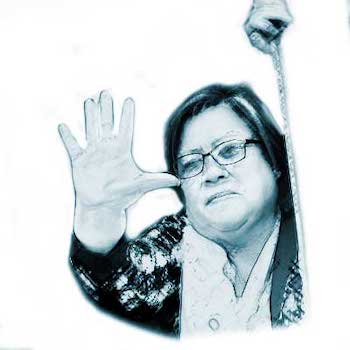
In response to the news that the court granted former Philippine Senator Leila de Lima bail for the third and last drug-related charge against her, Butch Olano, Amnesty International’s Philippines Director, said: “This is a welcome development and a step towards justice.
As a human rights activist and former Senator, she has been one of the staunchest critics of the human rights violations under the administration of former President Rodrigo Duterte. Since her arrest, Amnesty alongside many other organisations have repeatedly said that the charges against her were fabricated and that the testimonies by witnesses against her were manufactured. See: https://www.trueheroesfilms.org/thedigest/laureates/35cd51c0-93fb-11e8-b157-db4feecb7a6f
The authorities arrested de Lima after she sought to investigate violations committed in the context of the so-called “war on drugs” under the former Duterte administration, including the extrajudicial execution of thousands of people suspected of using or selling drugs, which Amnesty has said may amount to crimes against humanity. As in the case of de Lima, there has been almost no justice or accountability for the victims of these abuses and their families.
Court proceedings against de Lima in the last six years have been marked by undue delays, including the repeated failure of prosecution witnesses to appear in court and changes in judges handling the cases against her. In 2018, the UN Working Group on Arbitrary Detention concluded that the detention of de Lima was arbitrary because of the lack of legal basis and the non-observance of international norms relating to the right to a fair trial.
The arbitrary detention of de Lima reflects the broader context of increasing impunity for human rights violations in the Philippines. These violations include killings, threats and harassment of political activists, human rights defenders, members of the media and other targeted groups.
“Activism is not terrorism” . . . five Filipino indigenous peoples’ leaders and advocates have been branded as “terrorist” individuals and their property and funds have been frozen. Image: CIVICUS
On 28 July, 2023 CIVICUS, a global alliance of civil society organisations, has protested to Philippine President Ferdinand “Bongbong” Marcos Jr in an open letter over the “judicial harassment” of human rights defenders and the designation of five indigenous rights activists as “terrorists“.
CIVICUS, representing some 15,000 members in 75 countries, says the harassment is putting the defenders “at great risk”.
It has also condemned the “draconian” Republic Act No. 11479 — the Anti-Terrorism Act — for its “weaponisation’ against political dissent and human rights work and advocacy in the Philippines.
The CIVICUS open letter said there were “dire implications on the rights to due process and against warrantless arrests, among others”.
The letter called on the Philippine authorities to:
Immediately end the judicial harassment against 10 human rights defenders by withdrawing the petition in the Quezon City Regional Trial Court Branch 84;
Repeal Resolution No. 35 (2022) designating the six human rights defenders as terrorist individuals and unfreeze their property and funds immediately and unconditionally;
Drop all charges under the ATA against activists in the Southern Tagalog region; and
Halt all forms of intimidation and attacks on human rights defenders, ensure an enabling environment for human rights defenders and enact a law for their protection.
Front Line Defenders announced the five winners of its 2023 Award for Human Rights Defenders at Risk, at a special ceremony in Dublin on 26 May 2023. Laureates from each of the major global regions travelled to Ireland to accept the Award, including:
“This year’s laureates are a courageous and inspiring group of people who reflect the determination, dynamism and diversity of human rights defenders (HRDs) who are on the front lines of fighting for a more just world,” said Olive Moore, Interim Director of Front Line Defenders. “Their vital work in defence of human rights in DRC, Ecuador, Jordan, Philippines and Ukraine impacts countless people in their communities and beyond. By shining an international spotlight on their struggles and empowering them to continue their work, we at Front Line Defenders hope this Award will touch the lives of many more people on whose behalf they act.”
Olivier Bahemuke Ndoole (Democratic Republic of the Congo) is a leader among environmental and land defenders in DRC and one of the most trusted advocates on behalf of communities impacted by land grabs, trafficking, and illegal resource extraction activities. He is also the only advocate who organises judicial training and capacity-building sessions for DRC citizens on topics related to environment and community rights in Goma, eastern DRC.
AMERICAS
Segundo Ordóñez (Ecuador), an Afro-descendant human rights defender, is one of the most visible faces and the community representative in the two legal proceedings brought against the Japanese-owned company Furukawa Plantaciones C. A. and the State of Ecuador. The cases have focused on how workers on abacá (Manila hemp) plantations suffer labour exploitation as they farm the raw materials in slavery-like conditions.
ASIA AND THE PACIFIC
Jeany ‘Rose’ Hayahay (Philippines) is a woman human rights defender based in Mindanao, the Philippines. Since 2019, she has been the spokesperson of the Save Our Schools Network (SOS Network), a coalition of child-focused NGOs, church-based groups and other stakeholders advocating for children’s right to education in Mindanao.
EUROPE AND CENTRAL ASIA
Digital Security Lab Ukraine (Ukraine) is a team of specialists in the field of digital security and internet freedom. They help Ukrainian journalists, human rights defenders and public activists solve problems with digital security, as well as promote the realisation of human rights on the internet by influencing government policy in the field of digital rights.
MIDDLE EAST AND NORTH AFRICA
Hala Ahed (Jordan) is a Jordanian human rights lawyer who has worked with a number of human rights and feminist organisations to defend women’s rights, workers’ rights, and the freedoms of opinion, expression and peaceful assembly in Jordan.
De Lima, who has now been in detention for more than six years, was acquitted for allegedly trading illegal drugs while she was secretary of justice, after being acquitted in the first case against her in 2021. Both cases were evidently fabricated and there is no reason to think that the third case against her is any more credible.
Then-President Rodrigo Duterte directed de Lima’s persecution in response to her attempts to investigate killings that took place in the early stages of Duterte’s “war on drugs” in 2016. But Duterte’s enmity toward her started in the late 2000s when, as chair of the Commission on Human Rights, de Lima began an investigation into killings attributed to a “death squad” operating in Davao City, where Duterte was the mayor. The International Criminal Court (ICC) is investigating those killings as well as numerous “drug war” killings that took place while Duterte was president. In 2019, as part of his efforts to avoid international justice, Duterte withdrew the Philippines from the ICC’s Rome Statute, which obligates states party to the treaty to cooperate with the court.
While de Lima’s latest acquittal brings hope that her unjust detention may be ending sooner rather than later, she never should have been prosecuted or held in pretrial detention without bail. Duterte’s improper influence over the Department of Justice was evident by the recanting of the testimony of three key witnesses in this case, saying they had been coerced.
This is an opportunity for the Department of Justice to regain some of its credibility by dropping the outstanding case against de Lima. But there also needs to be accountability. President Ferdinand Marcos Jr., who last week conceded abuses were committed in the “war on drugs,” should urgently launch an inquiry into how the levers of the justice system were manipulated against de Lima and implement reforms to ensure such politicization of the justice system never happens again.
This is echoed by anOpen Letter to the Government of the Philippines on 24 May 2023 by
Asian Forum for Human Rights and Development (FORUM-ASIA)
Balay Alternative Legal Advocates for Development in Mindanaw (Balaod Mindanaw)
Karapatan Alliance Philippines (KARAPATAN)
Philippine Collective for Modern Heroism (Dakila)
Purple Action for Indigenous Women’s Rights (LILAK)
They welcome the acquittal of Leila de Lima, former Senator and chairperson of the Commission on Human Rights of the Philippines, on one of her two remaining politically motivated charges on 12 May 2023 by a Muntinlupa court….
De Lima’s arrest is in violation of her constitutional rights as a sitting senator and in contravention of international human rights law. The arrest is purely based on politically-motivated charges, following her senate investigation into the thousands of extrajudicial killings under Duterte’s ‘war on drugs.’….De Lima should never have been detained in the first place.
The arbitrary detention and mistreatment of former Senator de Lima reflect the Duterte administration’s judicial harassment of human rights defenders as well as the Philippines’ shrinking civic space. Nearly a year after President Ferdinand Marcos Jr. took office in June 2022, de Lima’s case remains stagnant. The slow progression of the case demonstrates both the previous and current Philippine administrations’ unwillingness to seek justice and accountability…
FORUM-ASIA alongside its reputable Philippine member organisations urge your Excellencies 1) to immediately and unconditionally drop the remaining politically motivated charges against de Lima; 2) to request the Muntinlupa court to grant her bail petition for release; 3) and to provide compensation and other reparations for the human rights violations she was made to endure.
Philippine authorities should release and allow de Lima to be reunited with her loved ones after six long years.
We demand the immediate release of de Lima and all other political prisoners who have been persecuted for their work and beliefs in human rights and social justice.
Earlier on Monday, 9 January 2023 the International Network for Economic, Social and Cultural Rights had rejoiced in the acquittal of members of Karapatan, – the Alliance for the Advancement of People’s Rights – and their allies GABRIELA – National Alliance of Women – and the Rural Missionaries of the Philippines (RMP) in the face of the perjury charges brought against them by the Philippine authorities.
The Quezon City Metropolitan Trial Court Branch 139 issued its judgment on the retaliatory and trumped-up perjury case against ten human rights defenders, Karapatan Chairperson, Elisa Tita Lubi; Karapatan Secretary General, Cristina “Tinay” Palabay; Karapatan Deputy Secretary General, Roneo Clamor; Karapatan Treasurer, Gabriela Grista Dalena; Karapatan National Council members, Edita Burgos, Wilfredo Ruazol, and Jose Mari Callueng; GABRIELA Chairperson, Gertrudes Ranjo Libang; GABRIELA Secretary General, Joan May Salvador, and member of the Rural Missionaries of the Philippines, Emma Cupin, acquitting them of all charges.
In a case of judicial harassment, which started in July 2019, the then-National Security Adviser Hermogenes Esperon Jr. submitted a perjury complaint against the three organizations related to the registration of the Rural Missionaries of the Philippines. Although the case was initially dismissed for lack of probable cause and sufficient evidence, in February 2020 the Quezon City Prosecutor, Vimar Barcellano, granted a motion for reconsideration of the perjury case.
The judicial harassment resulted in global condemnation from civilsociety, Members of the EuropeanParliament and the UN Special Rapporteur on the situation of human rights defenders calling on the Philippine authorities to put an end to the judicial harassment faced by the ten human rights defenders and the wider human rights movement in the country.
While we celebrate the acquittal, we remain as committed as ever to stand in solidarity with members and the wider human rights community in the Philippines in their struggles to advance human rights and social justice for all.
Stuti Mishra in the Independent of 29 September 2022 summarises and analyses the report “A Decade of Defiance: Ten years of reporting land and environmental activism worldwide” by Global Witness
More than 1,700 environmental defenders have been killed around the world in the last decade with one death reported every other day on average…The report titled A Decade of Defiance: Ten years of reporting land and environmental activism worldwide, released by Global Witness, reveals the increasing threats environmental activists are facing as the climate and biodiversity crisis worsens.
The research states that a total of 1,733 people have been killed over the past 10 years trying to protect their land and resources. That is an average of one defender killed approximately every two days over 10 years.
The report shows Brazil has been the deadliest country for environmental defenders with 342 lethal attacks reported since 2012 with over 85 per cent of killings within the Brazilian Amazon.
The data found within the report also shows that over half of the attacks over the 10-year period have taken place in three countries — Brazil, Colombia, and the Philippines — with around 300 killings reported in these countries.
Mexico and Honduras witnessed over 100 killings while Guatemala and India saw 80 and 79 respectively, remaining one of the most dangerous countries. The report also reports 12 mass killings, including three in India and four in Mexico.
Mexico was the country with the highest recorded number of killings in 2021, totalling 54 killings, up from 30 the previous year. Almost half of those killed were again Indigenous people while over a third were forced disappearances, including at least eight members of the Yaqui community.
The report also reveals that over three-quarters of the attacks recorded in 2021 took place in Latin America. In Brazil, Peru and Venezuela, a big majority of 78 per cent of these attacks occurred in the Amazon.
Meanwhile, the biggest increase in lethal attacks was witnessed in Brazil and India in 2021 with 26 deaths reported in Mexico, up from 20 and 14 in India, up from four.
Both Colombia and the Philippines saw a drop in killings to 33 in 2021 from 65, and 19 from 30 in 2021 respectively. Yet overall they remain two of the countries with the highest numbers of killings in the world since 2012.
2021 Highlights from Global Witness report
Around 200 Land and Environmental Defenders were killed in 2021 – nearly four people a week
Over three-quarters of the attacks recorded in 2021 took place in Latin America
Nearly 40 per cent of all attacks reported were against Indigenous people
Mexico recorded the highest number of killings in 2021
Brazil and India both saw a rise in lethal attacks in 2021
50 of the victims killed in 2021 were small-scale farmers
In Africa, the Democratic Republic of Congo remained the country with the highest number of attacks — eight defenders were killed there in 2021. All eight of these killings were in Virunga National Park, which remains extremely dangerous for the park rangers protecting it.
The organisation began collecting data on attacks against those defending land and the environment in 2012 and found that the control and use of land and territory is a central issue in countries where defenders are threatened. Much of the increasing killing, violence and repression is linked to territorial conflicts and the pursuit of economic growth based on the extraction of natural resources from the land, it states. The research has also highlighted that Indigenous communities in particular face a disproportionate level of attacks — nearly 40 per cent — even though they make up only 5 per cent of the world’s population.
However, the research found that the figures also do not capture the true scale of the problem, as tightened control on media has led to severe underreporting in some countries where environmental defenders are most vulnerable. Research has also found that few perpetrators of killings are rarely ever brought to justice due to the failures of governments to properly investigate these crimes.
While a majority of these attacks are not properly investigated or reported on, a big proportion of these attacks were linked to sectors like mining and infrastructure, including large-scale agribusiness and hydroelectric dams.
Many authorities ignore or actively impede investigations into these killings often due to alleged collusion between corporate and state interests, the report says.
All over the world, Indigenous peoples, environmental activists and other land and environmental defenders risk their lives for the fight against climate change and biodiversity loss.
They play a crucial role as a first line of defence against ecological collapse, yet are under attack themselves facing violence, criminalisation and harassment perpetuated by repressive governments and companies prioritising profit over human and environmental harm.
a spokesperson for Global Witness said
“With democracies increasingly under attack globally and worsening climate and biodiversity crises, this report highlights the critical role of defenders in solving these problems,” a spokesperson for Global Witness said, adding that the organisation makes an “urgent appeal for global efforts to protect and reduce attacks against them.”
Apart from killings, the report also reveals a number of tactics being used to silence them, like death threats, surveillance, sexual violence, or criminalisation – and that these kinds of attacks are even less well reported.

 Hans Thoolen on Human Rights Defenders and their awards