Posts Tagged ‘news’

Resisting in Exile: Voice of Human Rights Defenders – side event tomorrow, 5 March 2024

March 4, 2024

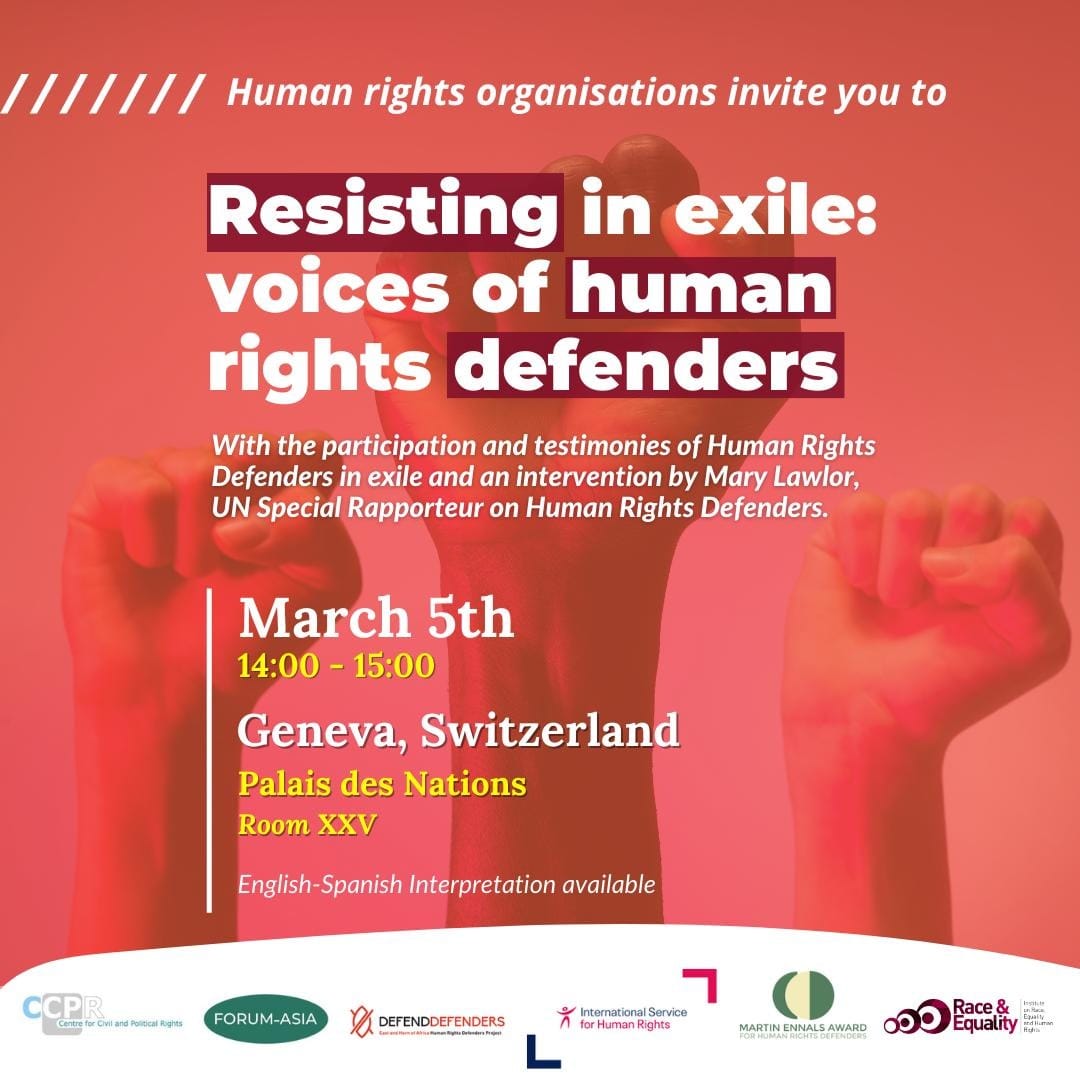
On Tuesday, 5th March, 2pm – at the Palais des Nations, Room XXV- will take place the side event Resisting in Exile: Voice of Human Rights Defenders

“I do not like the idea of being a refugee. I do not want to leave the country because I wanted to make it better.”  Human rights defender quoted by the Special Rapporteur on Human Rights Defenders in A/HRC/37/51.

In ‘People Power Under Attack’ (2022), CIVICUS reports that the number of countries where civic freedoms are being curtailed and civil society is under severe attack is increasing… In such contexts and under such pressure, defenders can see leaving the country as their only option. These defenders, along with defenders expelled by their home governments, face the huge challenges of short or protracted exile, including economic insecurity and ongoing threats. Defenders in exile question if and how they can continue human rights work from abroad and how those who remain deal with a fractured human rights community.

In this event the four organisers [Centre for Civil and Political Rights (CCPR-Centre), International Institute on Race, Equality and Human Rights, (Race and Equality), International Service for Human Rights (ISHR), and DefendDefenders] will bring the voices of human rights defenders from around the world to the Council so that States, UN experts and officials and civil society colleagues can hear their voices. What is the experience of being in exile like? What is the impact on individual work and that of the community of defenders? What demands do exile defenders make to the Council?

This event aims to raise greater awareness about the phenomenon of defenders in exile and encourage discussion and action on how to support these defenders. It is also aimed at looking at what is needed to prevent exile becoming some defenders’ only feasible option.

During this event, defenders in exile from will speak of the impact of their experience of exile on their own lives, those of their families, and their communities. They will highlight the specific needs defenders in exile have in terms of legal guarantees, and political and financial support and of their ongoing work to defend rights from exile.

Defenders in exile will also send in testimonies, to be shown in video form or read out by fellow defenders. We aim to fill the room with the voices of those in exile who cannot be in Geneva to participate directly.

Recall the recommendations made by the previous Special Rapporteur on Human Rights Defenders, Michel Forst, in his 2018 report to the Council (A/HRC/37/51), including in regard to the prohibition of non-refoulement to persecution, relocation schemes, and access to protection measures for defenders in exile.

The conversation will take place during the Council session when the Special Rapporteur on Human Rights Defenders will be presenting her report to the Council. We hope that the Special Rapporteur will be available to, highlight the need for greater attention to, and investment in the prevention of, the closure of civic space so as to forestall the need for defenders to leave the country.

See also: https://humanrightsdefenders.blog/2022/03/04/warning-human-rights-defenders-in-ukraine-and-in-exile-will-be-danger/

See also: https://bnnbreaking.com/breaking-news/human/us-drl-launches-program-to-bolster-exiled-human-rights-defenders

State repression of environmental defenders ‘a major threat’ to human rights

March 4, 2024

In a landmark paper, the UN Special Rapporteur on Environmental Defenders under the Aarhus Convention warns that the continued State efforts to repress and criminalise environmental protests, including direct action and civil disobedience, are a threat to fundamental freedoms and democracy itself.

The world is currently facing a triple planetary crisis and despite this alarming and unprecedented situation, States are failing to meaningfully address it. In response to this, environmental human right defenders (EHRDs), Indigenous Peoples, peasants movements and civil society from around the world have exercised their right to peacefully protest and participate in demonstrations to pressure their governments into taking concrete actions.

Some of these demonstrations have taken the form of civil disobedience which has been disproportionately repressed by governments and law enforcement officials.

On 28 February 2024 Michel Forst, the UN Special Rapporteur on Environmental Defenders, published a position paper highlighting a trend towards the repression and criminalisation of defenders engaging in environmental protests and civil disobedience in Europe, as well as an alarming toughening of stances against them in political discourse and the law enforcement and judicial practices. [The UNECE Convention on Access to Information, Public Participation in Decision-making and Access to Justice in Environmental Matters – known as the Aarhus Convention – was adopted in 1998. It aims to protect every person’s right to live in an environment adequate to his or her health and well-being.] See also: https://humanrightsdefenders.blog/tag/aarhus-convention/]

Forst also points to legislative attempts to ban specific organisations – citing France’s Soulèvements de la Terre, Spain’s Futuro Vegetal, or Letze Generation in Germany and Austria. These moves come alongside new or updated laws – including the UK’s ‘2022 Police, Crime, Sentencing and Courts Act’ and Italy’s 2024 ‘eco vandalism’ law -, which the paper says have virtually prohibited certain kinds of protests. 

The Special Rapporteur flags how politicians demonise environmental movements engaging in civil disobedience, while national or pan-European intelligence services no longer hesitate to label peaceful groups or individuals as potential or genuine terrorist threats.

The paper also recognises that European States have been disproportionately and increasingly used criminal, administrative and civil measures against environmental human rights defenders recurring to civil disobedience. This includes excessive and disproportionate use of force against them and extensive investigation and surveillance measures. 

Other takeaways include the use of social media by State and non-state actors that have contributed to creating negative narratives against EHRDs and the challenges that defenders and activists face to access to justice.

While civil disobedience tactics have been recently used in protests related to climate justice, they have been constantly used to advocate for other legitimate causes including international solidarity, where States have also criminalised such moves.

This paper also comes shortly after the 25th anniversary of the UN Declaration of Human Right Defenders and it is a good reminder that civil disobedience is and should be recognised as a legitimate form of exercising the rights to freedom of expression and peaceful assembly.

States must stop criminalising human right defenders exercising these rights and focus on addressing the root causes of their mobilisation.

https://ishr.ch/latest-updates/state-repression-of-civil-disobedience-on-environment-a-major-threat-to-human-rights

Side event ISHR on Guatemala: 7 March 2024

March 4, 2024


In recent years, Guatemala has witnessed a concerning erosion of its State institutions. The co-optation of the judicial system has resulted in the persecution of human rights defenders and justice operators, many of whom have had to flee the country. Despite the election of President Bernardo Arévalo, who led a campaign promising to re-establish the rule of law and fight corruption, the international community must continue to monitor the human rights situation in the country.

A side event – Human rights situation in Guatemala: From Rescuing Democracy to Guaranteeing Justice – aims to shed light on the recent socio-political developments in Guatemala, with a particular focus on the 2023 presidential elections and the dynamics of peaceful protest. It will explore the fragile state of the rule of law in the country and the significant human rights challenges it faces. A critical discussion will centre on the co-optation of the judicial system by criminal groups, which has led to the persistent criminalisation of justice operators and human rights defenders.

Additionally, the event will address the pressing crisis of forced evictions in Indigenous communities. These evictions, often driven by the interests of non-State actors like extractive companies and large-scale development projects, represent a form of cruel, inhuman, and degrading treatment, amounting to torture.

Speakers:

Clément Nyaletsossi Voule, UN Special Rapporteur on freedom of peaceful assembly and of association (TBC)

Lourdes Gómez Willis, Q’eqchi’-afrodescendant professor working on issues of Indigenous women defenders and the impacts of palm oil production

Bernardo Caal Xol, Mayan Q’eqchi community leader, teacher and environmental and land rights activist [see also: https://www.trueheroesfilms.org/thedigest/laureates/dff0ef4a-af52-4d2f-8ca3-be6d31968453]

Luis Haroldo Pacheco Gutiérrez, Ex-President of the Council of Communal Mayors of the 48 cantons of Totonicapán With the participation of

Margaret Satterthwaite, Special Rapporteur on the independence of judges and lawyers

Sponsors: Centre for Civil and Political Rights, Franciscans International, Impunity Watch, ISHR, Protection international Mesoamérica, and Peace Brigades International.

Thursday 7 March, 14:00 – 15:00 (CET), Room XXV, Palais des Nations – Geneva
Language: English / Spanish


Download the flyer here

Chinese filmmaker charged with ‘picking quarrels and provoking troubles’

February 26, 2024

Jurist of 25 February, 2024 reported that police in China have charged Chen Pin Lin, director of documentary “Not the Foreign Force,” with “picking quarrels and provoking trouble,” according to Chinese human rights news watchdogs Weiquanwang and Civil Rights and Livelihood Watch.

The Thursday charges come after Chen’s arrest in January 2024. He has been in detention for more than a month. In a letter to his family members, the authorities accused him of “picking quarrels and provoking troubles,” which is criminalized by Article 293 of the Criminal Act. Human Rights Watch previously criticized Article 293 for its elusive definition and use against human rights defenders.

The film “Not the Foreign Force,” also known as “Ürümqi Road” in Chinese, depicts the nationwide protests against COVID-19 lockdown measures in China. The demonstrations erupted in Shanghai after a fire killed 10 people in Ürümqi, where lockdown policies had slowed down fire services. During the rallies, colloquially known as the “White Paper Protests,” participants held a piece of blank paper over their heads to symbolize their speechlessness over the tragedy. The protests ultimately prompted the Chinese government to lift all COVID-19 restrictions in December 2022.

Chen published the video on China Digital Times under the pseudonym “Plato” on 27 November 2023, one year after the demonstrations started. In the caption, Chen criticized the Chinese government for shifting the blame to foreign forces. “The more the government tries to mislead, forget and conceal, the more we should speak out, remind and remember,” he wrote. “Remember the White Paper Protests.”

https://www.jurist.org/news/2024/02/china-activist-filmmaker-charged-with-picking-quarrels-and-provoking-troubles

Colombian human rights lawyer Meléndez loses security after winning prize

February 23, 2024

Haroon Siddique in the Guardian of 15 February 2024 relates the story of lawyer Adil Meléndez Márquez who received a call from his bodyguards 20 minutes after receiving the Sir Henry Brooke award from the Alliance for Lawyers at Risk. Meléndez is no stranger to death threats, but things have just got a lot scarier. With bitter irony, 20 minutes after receiving the Sir Henry Brooke award from the Alliance for Lawyers at Risk, his bodyguards called him to say that they had been stood down from, leaving him without protection.

In an interview with the Guardian in London, Meléndez said he is a human rights lawyer who hails from among those he represents. He is Afro Colombian and works predominately on cases for Afro Colombians and Indigenous communities, often in areas under the control of paramilitaries rather than the government. He was kidnapped when he was 12 so has first-hand experience of the violence which blights the country and has received threats since becoming involved with Movice (movement of victims of state crimes) in 2006. See also: https://humanrightsdefenders.blog/2014/02/12/death-threats-in-colombia-on-the-rise-again/

After receiving threats Meléndez took a case to the Inter-American Commission on Human Rights – an organ of the Organization of American States – which, in 2009, ordered Colombia to provide him with protection. For the first eight years this amounted to three personal bodyguards and a bulletproof car, then the bulletproof car was removed and later one of the bodyguards, leaving him with two until last week, he says.

Meléndez describes his work as taking on “politicians, business interests, cattle ranchers, the armed forces and paramilitary groups”.

He expands: “Rampant corruption and violence is taken advantage of by [foreign] companies. They operate in such a way that it denies the rights of communities because all they’re interested in is the exploitation of natural resources. It means that they don’t have to provide compensation or justice for the communities because the rule of law, the writ of law doesn’t apply.”

One of the projects Meléndez has been helping to resist is the upgrading of the 115km Canal del Dique in Colombia’s Caribbean region, which he helped to get temporarily suspended. He believes that proper consultation was not carried out prior to the project, as is required by law and it involves “the privatisation of rivers which are the source of life of the Afro-descendent communities”. He said that as a result of the suspension he was called an “enemy of development” by a Colombian minister, words he claims were echoed by the the paramilitary group and notorious drug cartel, Autodefensas Gaitanistas de Colombia (AGC), also known as the Gulf Clan.

While he counts Colombia’s president, Gustavo Petro, the country’s first leftist head of state, as a friend and acknowledges his lack of control over swathes of the country, at the same time he says disapprovingly: “President Petro speaks in international fora about the protection of the environment but in his own country his government is awarding contracts to a project that is damaging to the environment.”

Meléndez does not blame Petro for the removal of his bodyguards, believing it was the work of someone lower down the food chain, but he believes it is for the president to ensure they are reinstated. Not doing so would put the government in breach of the Inter-American Commission on Human Rights, he says. “I have had to stop all my activities at the moment and it’s possible even that I will have to make the decision not to return to Colombia,” says Meléndez.

However, he hopes that the prize he was presented with in London, which he calls a reward for “the rebellious and those in resistance”, might offer a degree of protection. “This prize raises my profile,” he said. “It provides evidence that I’ve got support from the international community. The organised criminal actors or others who are against me, they calculate the consequences of their actions and so the calculation now includes a much higher level of risk for them if they make a decision to act against me.”

https://www.theguardian.com/world/2024/feb/15/adil-melendez-marquez-colombia-interview

UNDP report says Thai human rights defenders are targeted by businesses

February 23, 2024

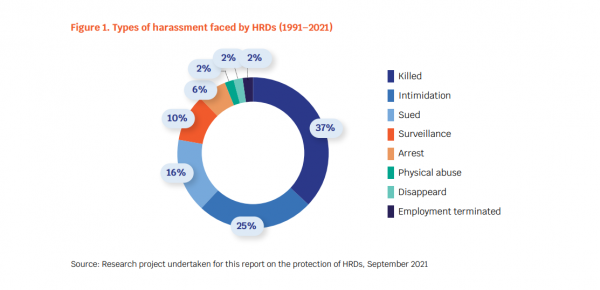
A new UN report claims that, between 2001 and 2021, 30% of outspoken Thai activists experienced violence resulting in a loss of life, by the businesses against which they had campaigned. Released by the United Nations Development Programme (UNDP), on 11 February 2024, the report says that businesses have used legal action, intimidation and violence to silence human rights defenders.

The categories of abuse faced by human rights defenders, per the report.

Activists, affected villagers and attorneys are among the groups considered to be human rights defenders in the report. Over the last 25 years, businesses filed 109 lawsuits against human rights defenders. 68.9% of these were by those with stakes in the mining, livestock and energy industries.

One anonymous interviewee said the lawsuits are used as strategic roadblocks and that they found themselves “going to court approximately once a month, incurring expenses and losing time.” Outside of the judicial system, human rights defenders were reportedly spied upon, or threatened with violence and job loss.

“After making a turn in my car, someone fired shots at me,” claims another anonymous interviewee, adding “I was in the orchard, a single home in the orchard. It was dark. Five shots were fired. I did not report the case, thinking it was an act of intimidation.”

4% of human rights defenders have died or been forcibly disappeared in the 25 years covered by the report, published on February 12th, the International Day for the Prevention of Violent Extremism.

In 2015, Thailand pledged to work towards the fulfilment of the UN’s 17 Sustainable Development Goals (SDGs), alongside other members of the organisation. SDG 16, one of the goals, asks countries to “uphold peace, justice and strong institutions,” and another, SDG 10, aims for “reduced inequalities”.

The report recommends that government and relevant agencies recognize the status and importance of human rights defenders and develop measures that protect them from violence and harassment.

https://www.undp.org/thailand/blog/human-rights-defenders-reports

https://www.thaipbsworld.com/undp-report-says-human-rights-defenders-are-targeted-by-businesses-30-are-victims-of-violence-resulting-in-loss-of-life

Deadline for nominations Right Livelihood Awards 2024

February 23, 2024

With the March 1 deadline swiftly approaching, the window to nominate for the 2024 Right Livelihood Award is closing fast! This is your opportunity to nominate individuals and organisations striving for social and environmental justice. The nomination process is open to the public— we invite you to elevate those making a significant impact through their courageous efforts.
While submissions are encouraged in English, we also welcome nominations in French and Spanish via our online form. If you have questions about the nomination process, do not hesitate to contact us via email at research@rightlivelihood.org or by phone at +41 (0)22 555 0943. NOMINATE NOW

Since 1980, Right Livelihood has celebrated the courageous and the visionary with its annual awards. It’s not just an award; it’s a global recognition of those who dare to envision and take action to create long-term social change. The Right Livelihood Award defies categories. This means the Laureates work in diverse fields across the world. Spanning from journalists who have brought truth to light to entomologists safeguarding biodiversity and poets who touch hearts and minds, the Award demonstrates that impactful work can come from anyone, anywhere.

To date, 194 Laureates from 76 countries have received the Award. See: https://www.trueheroesfilms.org/thedigest/awards/97238E26-A05A-4A7C-8A98-0D267FDDAD59

See also; https://wordpress.com/post/humanrightsdefenders.blog/25917

Report of a UN consultation on law enforcement’s role in peaceful protests

February 21, 2024

On 16 February, 2024 Sandra Epal Ratjen & Nicolas Agostini in Global Rights reported on a UN consultation on law enforcement’s role in peaceful protests which brought together practitioners and human rights defenders.

Over two days in Geneva, the UN special rapporteur on freedoms of peaceful assembly and association, Clément Voule, the UN Human Rights Office (OHCHR), and the UN Office on Drugs and Crime (UNODC) convened a consultation on the facilitation of peaceful protests by law enforcement. The event followed several regional workshops, organized in accordance with Human Rights Council resolution 50/21, which requested that the special rapporteur develop “technical and practical tools . . . to assist law enforcement officials in promoting and protecting human rights in the context of peaceful protests.” There was nothing unusual in this format—or in the event’s title. But despite its attractive feel (at least for human rights geeks), it ran the risk of turning into yet another academic discussion replete with theorizing but offering little in the way of practical solutions. 

It turned out to be one of the most refreshing, engaging, and action-oriented human rights dialogues we’ve attended.

It’s about the makeup

What made the event rather unusual was its makeup. In addition to civil society members (public assembly, law enforcement, torture, and rule of law specialists attended), the consultation brought together practitioners from all over the world. By “practitioners,” we mean not just police watchdogs (oversight bodies and disciplinary authorities) but police officers and commanders, all on active duty. 

While some activists would draw back with a wince, those human rights defenders and organizations who were present engaged with an open mind, as did law enforcement personnel. Participants weren’t going to talk amongst themselves or only preach to the converted. They were going to try to bring about an actionable outcome. After all, their aim was to devise how law enforcement can facilitate peaceful assemblies and protect rights in such contexts.

Peer pressure was minimal. On all sides, there was nothing to “prove”: no need to adopt an intransigent position, no need to show you’re smart, no need to cajole anyone—there were only incentives to share expertise and experience. 

Sure, there were precedents. Recent workshops brought together practitioners and outlined best practices. For instance, the “Istanbul Process” meeting on promoting religious tolerance held in Singapore was practitioner-centric. Since then, however, the Istanbul Process has collapsed as the Organization of Islamic Cooperation (OIC) revived the “defamation of religions” agenda.

Without naïveté but considering the “real-world” nature of the outputs of this process, we’re confident that the work done under the auspices of Clément Voule, OHCHR, and UNODC will, to some extent, enhance human rights compliance in police practice and benefit both peaceful protesters and law enforcement officials. Notably, the outcome documents are less technical than most human rights documents. 

It’s also about the substance

The consultation was also innovative because of its hands-on approach. In addition to the main working document, a “Model Protocol” for the law enforcement facilitation of peaceful protests, the project led by Clément Voule and his team, OHCHR, and UNODC will produce a “Handbook” and a “Checklist” for law enforcement professionals. The latter two will be practical documents guiding police practice. 

The magnitude and diversity of experiences in the room meant that discussions were light-years away from sterile sloganeering or divisive debates—the kind we see on social media. On civil society’s side, no one advocated “defunding the police.” On the police side, no one advocated for qualified immunity. All participants created a fertile ground for dialogue on how to ensure human rights-compliant, competent, and respected law enforcement that is able to facilitate, not hinder, public assemblies. 

Civil society participants recognized the need for well-funded, well-trained police. We kept in mind (and were reminded of) the realities of the job—what the average law enforcement officer faces daily. The challenges include understaffing, lack of adequate training, and, quite simply, fear (facing a crowd, even peaceful, will never feel like sitting on your sofa sipping a Whiskey Sour). Law enforcement participants, for their part, recognized the need for accountable police behavior and to confront discrimination and abuses of power. They kept in mind (and were reminded) that to be respectful is a sine qua non to be respected.

Also reviewed were “prior to protest,” “during protest,” and “after protest” issues, plus the situation of specific groups and accountability for violations. One section addressed police well-being, which is essential to human rights compliance, as strained police officers are much more likely to engage in misconduct. We didn’t shy away from addressing sensitive issues—police brutality, accountability, or budgeting. 

It wasn’t an echo chamber, but participants agreed on key points. Among others: the role of police vs. the role of prosecution; the need for effective communication between protesters and police, de-escalation, and adequate training for police officers; or the fact that a clear distinction must always be made between peaceful and non-peaceful elements of an assembly. 

It was a far cry from the way these conversations unfold online, and once again, one can see the toxicity of social media. Instead of fostering healthy discussions (differences aren’t that wide between most people), social media algorithms artificially promote simplistic views, entrench positions, and elevate the most divisive topics. This process distracts those seeking solutions from problem-solving. No one benefits from this situation—certainly not rights-holders. 

Don’t forget political will 

Assuredly, the outcomes of this consultation will go unheeded in many countries, where protests are rare or police have total impunity. Elsewhere, not much will happen without political will. 

But the beauty of this consultation is that political will to facilitate assemblies won’t need to come from the highest level. Once publicly available, the outcome documents—particularly the Handbook and Checklist, with their guidelines on communication, de-escalation, and risk assessment regarding protests—will be available for law enforcement agencies and officers at all levels to use. The ideal scenario, of course, will be governments publicly committing to using the outcome documents.

The final documents will stem from a dialogue that brought together people with hands-on experience who tried to build bridges and maximize their chances of having an impact on the ground. This model should inform future human rights dialogues.

The Protocol, Handbook, and Checklist will be presented at the next session of the UN Human Rights Council, February 26–April 5, 2024. Clément Voule will make his last appearance as special rapporteur. For his successor—and for all people of goodwill who want to see peaceful protests proceed without hindrance, as well as rights-compliant law enforcement, joint work will be needed to popularize, operationalize, and implement the documents. 

https://www.openglobalrights.org/sandra-Epal-Ratjen/Human-rights-dialogue-we-need
Tribute to James Lawson of the Council of Europe

February 17, 2024

Bert Verstappen – retired from HURIDOCS – wrote the following tribute to a person who – from an intergovernmental position – contributed greatly to the development of the NGO network:

It is with deep sadness that HURIDOCS has to announce the unexpected passing away on 11 February of James Lawson. James had a leading function in the field of information management in the Council of Europe. In addition, he devoted a huge amount of time and energy to HURIDOCS.

James was a visionary who introduced new tools and techniques for human rights information handling to the HURIDOCS network. He was keen to share his enthusiasm for developments in the field of information management that could and should benefit human rights organisations. He was convinced that, in the age of the Internet, librarians continue to play an important role as information sharers.

A major initiative taken by James was the multilingual human rights search engine HuriSearch. He planned HuriSearch as from 1998. HuriSearch provided a singular point of access to information published on over 5’000 websites of human rights organisations worldwide. HuriSearch indexed and crawled about 8 to 10 million web pages. It was publicly available from 2003 until 2016.

James was an active and committed member of the HURIDOCS Continuation Committee – as its Board was called for many years. He served on the CC from 1992 to 2009. He was HURIDOCS Treasurer and as leader of the Task Force on Software Development oversaw the development of HURIDOCS’ tools and techniques.

James was also Coordinator and Chairperson of a large number of meetings of the European Co-ordination Committee on Human Rights Documentation https://www.ecchrd.org/. During these meetings, he introduced advances in technology such as the use of metadata and the eXtended Markup Language XML.

James also provided various trainings on human rights documentation on behalf of HURIDOCS. Among other activities, he trained NGOs preparing evidence for Truth Commission in South Africa and was the main resource person in a training for French-speaking African trainers in Senegal. He also held HURIDOCS trainings with local human rights organisations in Burkina Faso, the DR Congo, Georgia, Ghana, Haiti, Indonesia and other countries.

HURIDOCS thanks James for his engagement and expertise. We wish strength to Hanne and his daughters.

Copenhagen International Documentary Film Festival adds major human rights award

February 16, 2024

On 15 February 2024 Ben Dalton informed that the Copenhagen International Documentary Film Festival (CPH:DOX) has unveiled the line-ups for its five competitive sections for its 2024 edition. All films in the main Dox:Award competition are world premieres for the second successive year.

The festival has launched a new section and award for 2024, the Human:Rights award, marking the 75th anniversary of the Universal Declaration of Human Rights. A €5,000 prize sponsored by the Institute for Human Rights will be given to a film that addresses human rights issues.

The festival will also include a series of events and discussions focusing on universal rights, beginning with a photo exhibition at the Pressen venue.

“This year’s competition sharpens its focus on the most urgent issues of our time, from the wars in Ukraine and Gaza to gang violence in Sweden, exploring themes of identity politics, colonialism, and the foundational struggles for democracy and the fight against climate change,” said Niklas Engstrom, artistic director of CPH:DOX.

https://www.screendaily.com/news/cphdox-unveils-competitions-adds-human-rights-award/5190553.article