Posts Tagged ‘illegal detention’
November 30, 2015
The Huffington Post of 29 November 2015 carried a good piece by Brian Dooley (Human Rights First) under the title “When Closing Civil Society Space Means Killing Human Rights Defenders”. He states that “what sometimes gets overlooked in the discussion around “shrinking civil society space” are direct, violent attacks on human rights defenders.”
He refers to this year’s Report of the UN Special Rapporteur on the situation of human rights defenders (HRDs) which details killings of HRDs in Africa, the Americas, Asia-Pacific, Europe and the Middle East. And a Note by the UN Secretary-General in July this year included how “defenders also describe their sense that they are often on their own, with the media showing little interest in reporting acts of aggression against them and with little support from political figures…”
Read the rest of this entry »
Posted in Front Line, HRF, human rights, Human Rights Defenders, UN | 3 Comments »
Tags: Brian Dooley, Dublin Platform, extra judicial killings, Front Line Defenders, Huffington Post, Human Rights Defenders, Human Rights First, illegal detention, murder, UN Resolution, USA
November 29, 2015
 On 27 November 2015, Mr Guo Feixiong was sentenced to six years in prison by the Tianhe District People’s Court in Guangzhou, China. Two other human rights defenders, Liu Yuandong and Sun Desheng, received three and two and a half year sentences respectively. In September, Guo Feixiong (pen name of Yang Madding) was awarded the 2015 Front Line Defenders Award for Human Rights Defenders at Risk [https://thoolen.wordpress.com/2015/09/12/2015-front-line-defenders-award-to-chinese-guo-feixiong-yang-maodong/].
Guo Feixiong was sentenced to six years in prison on charges of “gathering crowds to disturb social order” and “picking quarrels and provoking trouble”. The latter charge was reportedly added by the judge at the sentencing and therefore one that Guo Feixiong’s lawyers had no opportunity to defend him against, and which resulted in two years being added to his sentence. Liu Yuandong was sentenced to three years, while Sun Desheng was sentenced to two and a half years, both on charges of “gathering crowds to disrupt public order”.
Since his detention in 2013, Guo Feixiong has reportedly been held in a 30 sq metre cell with 30 other detainees. Furthermore, he has been denied permission to go outside or exercise in the prison yard since his initial detention and has alleged ill-treatment by the prison guards. According to his lawyer, Mr Zhang Lei, Guo Feixiong’s health has suffered greatly as a result. It has also been reported that Sun Desheng had had his hands cuffed and legs shackled for long periods after his detention.
Posted in awards, Front Line, Human Rights Defenders | 1 Comment »
Tags: China, fair trial, Front Line Defenders, Front Line Defenders Award for Human Rights Defenders at Risk, Guo Feixiong, Human Rights Defenders, ill treatment, illegal detention, Liu Yuandong, Sun Desheng, Yang Madding, Zhang Lei
October 9, 2015

Intigam Aliyev, President of the Legal Education Society (LES), Azerbaijan, was today named the winner of the 2015 International Bar Association (IBA) Human Rights Award. The Award was presented by IBA President, David W Rivkin. A political prisoner in Azerbaijan, Mr Aliyev was unable to collect the Award in person. His son and daughter travelled to Vienna and collected the Award, on Friday 9 October, on his behalf. For more on the IBA award: http://www.brandsaviors.com/thedigest/award/iba-human-rights-award
In a letter read by his son Necmin Kamilsoy, Mr Aliyev said, ‘When I heard about this prestigious Award, I felt honour and happiness with sadness at the same time. Today, in my country, my friends, colleagues, conscientious people, are facing prosecutions, pressures, and imprisonments. They deserve this award at least as much as I do. Therefore, I am accepting this award on behalf of them. I share my deep gratitude with the IBA for appreciating my efforts in such a way, as well as with all organisations that nominated me for this award.’
Mr Aliyev won earlier the Homo Homini Award (2012). https://thoolen.wordpress.com/2013/03/07/azerbaijan-harasses-human-rights-defenders-even-the-recipient-of-the-homo-homini-award/
To read Mr Aliyev’s acceptance letter in full click here.
Source: HRI – Intigam Aliyev receives IBA Human Rights Award 2015 for outstanding contribution to human rights
Posted in awards, human rights, Human Rights Defenders | Leave a Comment »
Tags: Azerbaijan, David W Rivkin, digest of human rights awards, Homo Homini Award, human rights award, Human Rights Defenders, human rights lawyer, IBA, illegal detention, International Bar Association Human Rights Award, Intigam Aliyev, Legal Education Society (LES)
October 8, 2015
Mutabar Tadjibayeva is remarkable, even among human rights defenders. Her story is well-known in human rights circles: arrested, detained and tortured in Uzbekistan’s prisons, she was released on medical grounds and allowed to leave the country in 2008. That year she came to Geneva to receive in person the Martin Ennals Award for Human Rights Defenders [see: http://www.martinennalsaward.org/index.php?option=com_content&view=article&id=73&Itemid=116&lang=en and https://thoolen.wordpress.com/tag/mutabar-tadjibayeva/].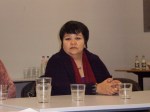
But she does not just live quietly in exile in Paris. She continues fight for her rights, lodged a complaint to the UN Human Rights Committee in 2012 and this body found on 6 October 2015 that there had been “multiple violations” of her rights, according to a press release issued by three human rights NGOs on 8 October (the Fiery Hearts Club, Redress and FIDH). Read the rest of this entry »
Posted in awards, FIDH, human rights, Human Rights Defenders, UN | 2 Comments »
Tags: FIDH, Fiery Hearts Club, Human Rights Committee, Human Rights Defenders, illegal detention, individual complaint, MEA 2008, Mutabar Tadjibayeva, REDRESS, torture, UN, Uzbekistan, woman human rights defender
June 18, 2015
On 15 June 2015, 0ver 200 human rights NGOs urge the Democratic Republic of Congo to show respect for freedom of expression and assembly by freeing the “Filimbi activists“. Expression, Assembly The two activists were arrested three months ago, on 15 March during a pro-democracy youth workshop in the Democratic Republic of Congo. Fred Bauma and Yves Makwambala were arrested at the workshop organized to launch “Filimbi,” a platform to encourage Congolese youth to peacefully and responsibly perform their civic duties. Read the rest of this entry »
Posted in AI, HRW, human rights, Human Rights Defenders, OMCT | 1 Comment »
Tags: Agence Nationale de Renseignements, ANR, ASADHO, Christopher Ngoyi, Democratic Republic of Congo, DRC, Filimbi activists, Fred Bauma, freedom of assembly, freedom of expression, HRW, Ida Sawyer, illegal detention, Joseph Kabila, LUCHA (NGO DRC), OMCT, Yves Makwambala
April 29, 2015

Human rights defenders Adelaida Kim (left) and Elena Urlaeva
I have written often about Uzbekistan’s 2008 MEA Laureate,
Mutabar Tadjibaeva [
https://thoolen.wordpress.com/tag/mutabar-tadjibayeva/], who now lives in exile in Paris, but Radio Free Europe on 29 April, 2015 carries a piece on two women human rights defenders, among the few left in Uzbekistan. Undaunted by the threats, beatings, and forced incarcerations of authorities, they continue to demand their rights. Especially the second case, that of
Elena Urlaeva, is amazing:
Adelaida Kim of the Rights Defenders Alliance of Uzbekistan (PAU) is one such person. She featured in an earlier Qishloq Ovozi. She was in court then, she was in court again in April, and, as was true in the previous post, she brought a complaint against police. It started when Kim and colleague Lyudmila Brosalina were demonstrating outside the Ukrainian Embassy in Tashkent on May 8, 2014. Kim was demanding an end to hostilities in eastern Ukraine, specifically the “vicious murders of unarmed people…”
There were only the two of them, but Uzbek authorities worry that such acts could mushroom and lead to antigovernment protests, so any picket is dispersed quickly. Kim was detained and brought to police headquarters. There, Kim says, police Colonel Bakhtiyor Egamberdyev insulted and berated her and told her she should move to Ukraine. On April 8, the hearing opened in Kim’s case against Egamberdyev and two other policemen. Bakhtiyor Egamberdyev arrived, except, as Kim pointed out, it was not the right Bakhtiyor Egamberdyev. The person who showed up in the courtroom on April 8 was a deputy district police chief who was also named Bakhtiyor Egamberdyev. Neither of the two policemen named in Kim’s lawsuit showed up for the trial either. The hearing was adjourned and scheduled to reconvene when the correct Bakhtiyor Egamberdyev was located and summoned. As of the time of this writing, there have not been any reports that the trial has resumed.
Standing outside the courthouse on April 8 was PAU leader Yelena Urlaeva, holding a sign of support for Kim. The story of Urlaeva is almost beyond belief:
Bruce Pannier in his blog Qishloq Ovozi has called her the bravest person in Uzbekistan. Urlaeva has been detained many times. She’s been forcibly committed to psychiatric clinics, physically assaulted, and regularly threatened. [see also https://www.frontlinedefenders.org/node/2004]. Under these circumstances it is indeed amazing that on April 7 sent a letter to Uzbekistan’s interior minister requesting that the head of the department for fighting terrorism in the Mirzo-Ulughbek district of Tashkent, Ilyas Mustafaev, be promoted… It’s not a joke. Urlaeva is totally sincere.
Ilyas Mustafaev (left) is a frequent visitor to Urlaeva’s apartment.
Mustafaev has been detaining Urlaeva for some 17 years, but in her letter the PAU leader said Mustafaev has always fulfilled his duties honestly — both as an officer and as a human being. “I understand Mustafaev,” she said. “He’s a soldier and carries out orders.”
Mustafaev has had to come to Urlaeva’s flat so often that he is now considered a guest “Ilyas calls my mother ‘mama’ and mama calls him ‘son’,” Urlaeva said. HE has even shown up at her birthday parties. Urlaeva recalled that when she was demonstrating in 2010, “someone in civilian clothes” started hitting her and Mustafaev pulled the attacker away and apologized “for his colleague” and took her home. In her letter recommending Mustafaev be raised in rank, Urlaeva wrote, “This worthy officer is already more than 50 years old and is still a major.” She asked that he be promoted by April 28, which Urlaeva knows is Mustafaev’s birthday.
Two Of Uzbekistan’s Best And Bravest.
Posted in Front Line, human rights, Human Rights Defenders | Leave a Comment »
Tags: Adelaida Kim, arrest, Bakhtiyor Egamberdyev, Bruce Pannier, illegal detention, Ilyas Mustafaev, Lyudmila Brosalina, Mutabar Tadjibaeva, psychiatric confinement, Qishloq Ovozi, Radio Free Europe/Radio Liberty, Rights Defenders Alliance of Uzbekistan (PAU), Uzbekistan, women human rights defenders, Yelena Urlaeva
April 8, 2015

The winner of the 2015 UNESCO/Guillermo Cano World Press Freedom Prize is the Syrian journalist and human rights defender, Mazen Darwish, currently imprisoned. The Prize will be awarded during the celebration of World Press Freedom Day, 3 May, which will this year be hosted by Latvia (National Library, Riga, 6 p.m.).
An independent International Jury of media professionals recommended Mazen Darwish in recognition of the work that he has carried out in Syria for more than ten years at great personal sacrifice, enduring a travel ban, harassment, as well as repeated detention and torture. Darwish, a lawyer and press freedom advocate, is the president of the Syrian Centre for Media and Freedom of Expression (CMFE), founded in 2004, and one of the founders of the Voice newspaper and syriaview.net, an independent news site, which has been banned by the Syrian authorities. In 2011, Darwish established Media Club, the first Syrian magazine about media affairs.
He has been detained since February 2012, when he was arrested with colleagues Hani Al-Zitani and Hussein Ghareer. Mazen won earlier awards from Roland Berger (2011), Reporters without Borders (2012) and Bruno Kreisky (2013).
The $25,000 Prize is named in honour of Guillermo Cano Isaza, a Colombian journalist who was assassinated in front of the offices of his newspaper, El Espectador, in Bogotá, on 17 December 1986. It is funded by the Cano Foundation (Colombia) and the Helsingin Sanomat Foundation (Finland).
Syrian journalist Mazen Darwish winner of UNESCO/Guillermo Cano World Press Freedom Prize | United Nations Educational, Scientific and Cultural Organization.
Posted in awards, human rights, Human Rights Defenders | 1 Comment »
Tags: detention, Guillermo Cano World Press Freedom Prize, human rights awards, Human rights defender, illegal detention, Journalist, Latvia, Mazen Darwish, Press Freedom, Syria, Unesco, UNESCO/Guillermo Cano World Press Freedom Prize, World Press Freedom Day (3 May)
April 3, 2015
Posted in HRW, human rights, Human Rights Defenders | Leave a Comment »
Tags: Azerbaijan, Council of Europe, EU, EurasiaNet, Georgia, Giorgi Godia, Giorgi Lomsadze, Human Rights Watch, illegal detention, international commitments, Intigam Aliyev, Khadija Ismayilova, Leyla Yunus, Rasul Jafarov, trial observation
February 26, 2015
HRD Alert – India (a Forum of Human Rights Defenders) and Front Line Defenders have called for the release of Mr Kalimuthu Kandhasamy who was arrested in the morning of 26 February 2015.
[Kalimuthu Kandhasamy is the District Organizer of Citizens for Human Rights Movement (CHRM), which provides legal counsel and assistance to victims of human rights violations in Tamil Nadu, including by providing assistance in complaints before courts, human rights institutions, law enforcement officials and other relevant bodies. The organisation was founded by People’s Watch, an NGO that monitors human rights violations and provides legal assistance to victims in Tamil Nadu. The human rights defender also works as an assistant to a lawyer providing legal representation in People’s Watch’s cases.]
The accusations against Kalimuthu Kandhasamy include, ‘impersonating a public servant’, cheating, and improper use of emblems. And here comes the almost funny part: the charges against Kalimuthu Kandhasamy are reportedly in relation to the fact that CHRM contains the words “human rights” in its title. It is claimed that this is in violation of the Tamil Nadu Societies Registration Act, which reportedly states that no non-governmental institution should have the terms “human rights” in its name (this amendment was made on the recommendation of the Tamil Nadu State Human Rights Commission [SIC] that no non-governmental institution should have the terms “human rights” in its name! Would seem a clear violation of the right to association). The accusations are being brought under sections 170 and 420 of the Indian Penal Code, and Section 5 of the Emblems and Names (Prevention of Improper Use) Act 1950.
The human rights defender denies that either he or CHRM have posed as a public authority.
Posted in Front Line, human rights, Human Rights Defenders | Leave a Comment »
Tags: arrest, Citizens for Human Rights Movement (CHRM), freedom of association, Front Line (NGO), HRD Alert - India, human rights violations, illegal detention, India, judicial harasment, Kalimuthu Kandhasamy, Tamil Nadu, Tamil Nadu State Human Rights Commission
February 17, 2015
Mchangama is one of the leaders of the “Madji Na Mwendje” (power and water) movement, formed by the FCC and other civil society organizations to protest the government’s inability to resolve the frequent power blackouts and water shortages plaguing the island. The movement called on all Comorian civil society groups to engage in a three-day general strike scheduled for February 9-11. The Sunday before the strike was set to start, Mchangama was summoned to appear at the police station of Moroni where he was immediately arrested and is currently being held.
“Civil society leaders like Mchangama are a threat to competitive authoritarian regimes because of their ability to channel people’s frustration at corrupt and incompetent governments. By arresting him, the government seeks to quash a legitimate demand from hundreds of thousands of Comorians living below the poverty line. He must be released immediately,” said Thor Halvorssen, president of the Human Rights Foundation. “We have seen similar instances of repressing freedom of expression in the region. In Burundi, Pierre Claver Mbonimpa was arrested for criticizing the ruling party during a radio interview; and in Swaziland Thulani Maseko and Bhaki Makubu were both arrested for questioning the independence of the judicial system. These are all legitimate concerns in any democratic society. It is these abusive governments that are at fault here, not the people,” said Halvorssen.
For more information contact: Jamie Hancock at jamie[at]thehrf.org or see the original piece:
HRF to the Comoros: Release Activist Mohamed Mchangama and Drop Incitement Charges Against Him | News | The Human Rights Foundation.
Posted in human rights, Human Rights Defenders, Human Rights Foundation | Leave a Comment »
Tags: arbitrary arrest, civil society activists, Comoros, Federation of Comorian Consumers (FCC), freedom of expression, freedom to demonstrate, Human Rights Foundation, illegal detention, Mohamed Said Abdallah Mchangama, Pierre Claver Mbonimpa, release