AFP on 25 January, 2024 reported that UN experts urge Bangladesh to carry out major human rights reforms to reverse “repressive trends” following controversial elections that were boycotted by the opposition.
Bangladeshi Prime Minister Sheikh Hasina was sworn in for a fifth term on January 11. Her ruling Awami League party won nearly three-quarters of elected seats in parliament, with allied parties and friendly independent candidates making up nearly all the remainder.
Hasina has presided over breakneck economic growth in a country once beset by grinding poverty, but her government has been accused of rampant human rights abuses and a ruthless crackdown on dissent.
The UN experts said they were “alarmed” at reports of “widespread attacks, harassment and intimidation of civil society, human rights defenders, journalists and political activists, which marred the recent elections”. See also my earlier posts on Bangladesh: https://humanrightsdefenders.blog/tag/bangladesh/.
The experts called on the Government to:
Immediately and unconditionally release all civil society and political activists detained without charge or on charges inconsistent with international human rights law; and ensure fair public trials in accordance with international human rights standards for those charged with criminal offences.
Institute urgent and substantial reforms to guarantee the integrity and independence of the judicial system.
Guarantee the free and unobstructed exercise of freedom of expression, association and peaceful assembly, refrain from imposing undue restrictions on protests and political rallies, and ensure effective accountability for serious violations of these fundamental freedoms.
Respect the independence, freedom, diversity, and pluralism of the media, and ensure the safety of journalists from threats, physical and online violence, or judicial harassment and criminal prosecution for investigative and critical reporting.
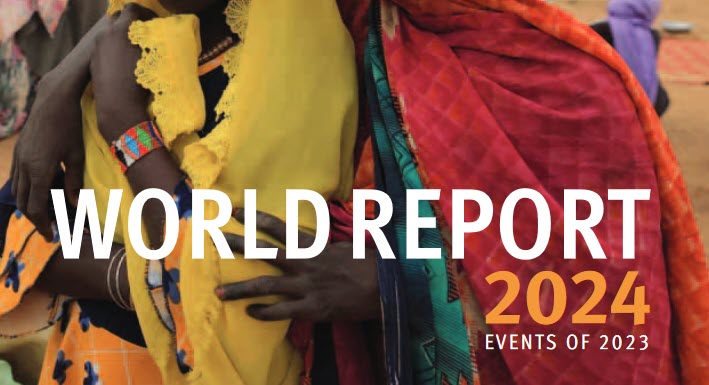
On 27 January 2024, Olivia Biliunaand Madison Whittemore in the Davis Vanguard produced a useful summary of the 2024 Human Rights Watch Report
After reflecting on the formidable human rights challenges of 2023, it has become evident that changes in how human rights are approached will be needed in 2024 to prevent the atrocious suppression and human rights crises that have been prominent in the past year, according to Human’s Rights Watch’s “World Report 2024: Our annual review of human rights around the globe.” [see: https://www.hrw.org/world-report/2024]
However, despite the human rights atrocities seen in 2023, the group added that there appears to be some hope for upholding human rights in 2024 through enforcing principles of international human rights law.
Looking back on 2023, the 2024 World Report reflects on renewed conflicts between Israel and Hamas that resulted in the abuse of many and a tragic loss of life, and other countries such as Ukraine and Myanmar that continue to struggle with their own intense conflicts.
Human Rights Watch notes that in accordance with the aforementioned conflicts, “Economic inequality rose around the world, as did anger about the policy decisions that have left many people struggling to survive.”
However, while many are quick to blame the government for being complicit in these human rights crises, the report maintains action is needed outside of just government action alone to help diminish these threats, since they “often transcend borders and cannot be solved by governments acting alone.”
In fact, the report notes the often forgotten importance of universal principles of international human rights and the rule of law which are more critical now than ever.
The 2024 World Report argues governments have the ability to help improve human rights and that they have double standards in “applying the human rights framework,” as stated in the 2024 World Report, and “chips away at trust in the institutions responsible for enforcing and protecting rights.”
The legitimate laws and universality of human rights are weakened when governments that are vocal about denouncing the Israeli government war crimes against Gaza citizens do not speak up about the crimes against humanity in Xinjiang, China, according to the 2024 World Report.
Governments have found it is easier to disregard international human rights matters because internationally there is no challenge to human rights nationally, writes Tirana Hassan, the executive director.
Hassan also noted that autocrats across regions have taken away both the independence of key institutions to protect human rights and the freedom of dissent, as stated by the 2024 World Report, “with the same endgame in mind: to exercise power without constraint.”
Hassan explains that with campaigning of civil rights groups and years of diplomatic negotiations, 83 countries were able to protect their citizens by adopting a political declaration that provided protection from explosive weapons in populated areas.
The international pledge to recognize the “long-standing practice of warring parties to use aerial bombing, artillery, rockets, and missiles in villages, towns, and cities” is the first to address this issue as the 2024 World Report states.
Some countries are addressing long-marginalized communities. With years of pressure, the Japanese government parliament has passed its first law to protect LGBT people from “unfair discrimination,” the 2024 World Report states.
With the humanitarian crises there has been questioning on the effectiveness of the human rights framework in the realm of protection, notes the 2024 World Report, adding, “especially in the face of selective government outrage, transactional diplomacy seeking short-term gain, growing transnational repression, and the willingness of autocratic leaders to sacrifice rights to consolidate their power.”
With that, the 2024 World Report also suggests the human rights framework will continue to be the plan to build “thriving, inclusive societies” and governments need to be persistent and, with urgency, defend human rights to handle the global and existential threats to humanity.
As also highlighted by Hassan in the report, the assault on Israel by Hamas-led fighters on Oct. 7 that deliberately killed hundreds of vulnerable civilians led to swift condemnation from many countries around the world.
In retaliation to the Oct. 7 attack, the Israeli government ceased all running water and electricity in the Gaza strip, “blocking the entry of all but a trickle of fuel, food, and humanitarian aid – a form of collective punishment that is a war crime,” the 2024 World Report noted.
The Israeli government and military continue frequently bombing the Gaza strip. Following these attacks, countries were outraged after they found out that Israel used a chemical called white phosphorus during the indiscriminate attacks on Gaza, with many countries even highlighting the attacks as “apparent war crimes,” stated by Human Rights Watch.
However, despite world-wide outrage after Israel’s war crimes on Gaza, countries have failed to publicly call the Israeli government out on its war crimes resulting in severe human rights abuses, the report detailed, noting even the U.S. and the European Union have acknowledged Israel’s human rights abuses on Gaza citizens, yet have continued to be complicit in the “ongoing crimes against humanity of apartheid and persecution against Palestinians.”
The report asserted the repercussions of governments failing to intervene undermine the legitimacy of the rules system designed 75 years ago to safeguard all citizen’s rights. In response to the inconsistencies, Hassan cites that governments like Russia and China aim to take advantage of the shaky legitimacy by attempting to infringe on human rights and take advantage of the system that is supposed to punish both countries.
Another example used by the 2024 World Report that displays these inconsistencies is the power battle between two influential generals in Sudan, Gen. Abdelfattah al-Burhan and Gen. Mohamed Hamdan Dagalo.
This conflict resulted in civilians facing deadly abuses and human rights infringements in the Darfur region—with numerous countries listed in the 2024 world report allegedly ignoring the horrendous abuses and abstaining from intervening.
Despite nations such as Gabon, Ghana, and Mozambique being on the Security Council, “the UN, under pressure from the Sudanese government, shuttered its political mission in Sudan.” the 2024 World Report stated, also concluding that “This marked the conclusion of the UN’s limited capacity in the country to safeguard civilians and openly address the human rights situation.”
Regardless of African governments refusing to hold the Sudanese government accountable, the report highlights that many have been strong advocates for resolving the human rights issues in other places like Palestine, even leading a full-fledged effort to investigate its human rights abuses last November and recently asserting that “Israel violated its obligations under the 1948 Genocide Convention in its military operations in Gaza.”
Domestic policies and foreign policies should hold value in human rights and their rules of laws at the forefront of governments, charged the 2024 World Report.
Even rights-respecting governments hold these principles as “optional, seeking short-term, politically expedient “solutions” at the expense of building the institutions that would be beneficial for security, trade, energy, and migration in the long term,” according to the 2024 World Report, adding transactional diplomacy carries a human cost that extends past borders, the group adds.
The 2024 Report writes that without awareness while making transactional diplomacy, risks are created. Removing human rights and the rule of law from a sensible direction creates leverage for right-violating governments too, the 2024 World Report adds, arguing, “It can also contribute to further human rights violations, including transnational repression,” which governments do when they commit human rights abuses against their nationals abroad or to those families living at home, the report continues.
According to the World Report of 2024, India, a democracy, under its Prime Minister Narenda Modi has moved toward an autocracy “with authorities targeting minorities, tightening repression, and dismantling independent institutions, including federal investigative agencies.”
Additionally, as cited in The Report, the US, Australia, the UK, and France chose trade and security over raising human rights concerns.
As reported by Executive Director Hassan, the Modi government’s repressive tactics went past borders and were empowered to do so from the Indian government’s “silence on the Indian government’s worsening rights record…including to intimidate diaspora activists and academics or restrict their entry into India.”
Rwandan’s government has had three decades of no punishment for their repression of civil and political rights at home, the 2024 World Report states, writing “to stifle dissent beyond its borders,” and noting, Rwanda, despite having risen on the international stage, has failed to recognize its problematic human rights violations.
Similarly, Chinese government abuses in Beijing escalate its repression against both Chinese and non-Chinese with failure of resistance from other countries, according to the 2024 World Report, explaining a Laos lawyer and human rights defender, Lu Siwei, received pressure from the Chinese government to return and authorities pushed out warrants.
The 2024 World Report claims nowhere is safe if repressive governments can get away with “strong approaches to silence human rights defenders, exiled politicians, journalists, and critics beyond their borders.”
As reported by the Human Rights 2024 World Report, with almost half of the global population being eligible to vote in 2024, both citizens and independent institutions need to participate in order to effectively have leaders who defend human rights, regardless of society and many institutions having “become renewed battlegrounds for autocratic leaders around the world looking to eliminate scrutiny of their decisions and actions.”
According to Hassan, the nations of Guatemala and Nicaragua are two stories of autocratic leaders consolidating power and failing to prioritize civil society.
For example, after Guatemala’s President-elect Bernardo Arévalo ran on an anti-corruption platform, a corrupt judiciary attempted to overturn Arévalo’s election triumph.
Similarly, the report refers to Nicaragua, where corrupt and authoritarian President Daniel Ortega uses “abusive legislation to shut down over 3,500 nongovernmental organizations” in order to dominate the political landscape and wield unchecked power.
The Human Rights report insists these “vital” checks and balances continue to be eroded, it poses great harm to human rights.
Judicial independence has also been drastically sabotaged in Poland, the report alleges, with the Polish government suppressing civil society groups through law enforcement and incarceration. Polish freedom and independence are extremely threatened, with the Law and Justice party most notably encroaching on women’s reproductive rights and essentially banning abortion, Hassan suggested in the report.
“In May 2023, an abortion rights activist was convicted of helping a woman to get abortion pills and was sentenced to eight months of community service – the first known prosecution of its kind in the EU,” the 2024 World Report noted.
On an environmental note, with the impending issue of global warming, the 2024 report highlights activists being shot by governments across the globe who want to “deter the climate movement.”
In another example, the report cites how one of the largest oil producers, the United Arab Emirates (UAE), continues to expand its production of fossil fuels; however, people are discouraged from exposing the UAE unless they are willing to face grave punishment.
Apart from punishing dissent, governments are using technology and social media platforms to “silence critics and censor dissent,” the 2024 World Report notes, citing a 54-year-old retired Saudi Arabian teacher named Muhammad al-Ghamdi, who received the death penalty after he expressed his opinions on X and Youtube and allegedly went against the country’s counterterrorism law.
Despite everything that occurred in 2023, there were also positive moments for human rights where institutions and movements succeeded, the 2024 World Report states, arguing, “Indeed, these successes illustrate why self-serving politicians and repressive governments work so hard to curtail them – and why all governments should recognize and support these fragile successes.”
Additionally, according to the Executive Director Hassan, the ICC issued warrants for Russia’s President Vladimir Putin and his children’s rights commissioner for war crimes related to deporting and transferring children and a court ruled that South Africa had a commitment to arrest Putin.
According to the 2024 World Report, the Xokleng Indigenous people succeeded when the Brazil Supreme Court, as noted by the 2024 World Report, “upheld all Indigenous peoples’ rights to their traditional lands,” despite efforts by the Santa Catarina state.
The 2024 World Report said, “These victories highlight the tremendous power of independent, rights-respecting, and inclusive institutions and of civil society to challenge those who wield political power to serve the public interest and chart a rights-respecting path forward” and that “all governments, in their bilateral relations and at the multilateral level, should redouble efforts to uplift key institutions and protect civic space wherever it is under threat.”
The human rights crisis highlights the importance for “mutually agreed principles of international human rights law everywhere,” the 2024 World Report notes.
It also points out that through governments centering their human rights obligations through moral governing, it will provide a diligent change to those affected.
The 2024 World Report concludes that consistently upholding human rights, “across the board, no matter who the victims are or where the rights violations are being committed, is the only way to build the world we want to live in.”
Challenges to freedom of religion and belief and abuses to the human rights of religious minorities are on the rise across the world, with increased violence, harassment, and threats often met with a lack of accountability. They occur against a backdrop of long-standing social, political, economic, and cultural marginalization and exclusion, particularly for those who face intersectional discrimination, such as religious minority women or persons with disabilities.
It is, therefore, vital to support organizations and activists representing these communities who work towards strengthening the rights of minorities of faith and belief and combatting the discrimination, prejudices and persecution these communities experience daily.
What is the course about?
The free, 7-week online course aims to build an understanding of regional and international minority rights mechanisms and ways to implement these rights frameworks at the national and local levels and build the capacity of human rights defenders (HRDs) to advocate for the rights of minorities.
The course will offer opportunities to exchange and collaborate with other HRDs to:
Monitor and report on violations against religious minorities
Raise awareness amongst key stakeholders of the human rights violations, persecution and discrimination these communities face
Campaign from local to international levels to secure commitments from key stakeholders to improve the situation of religious minorities
Train Graduates will also have the opportunity to follow up with access to a Training of Trainers that will give them the opportunity to develop their skills and share the knowledge they learned
Who can apply for this course?
Civil society organizations and activists representing religious minority and indigenous communities from two regions of the world where religious minorities are suffering from serious human rights violations, widespread discrimination and marginalization are welcome to apply.
Applicants from and/or based in the following countries will be prioritized: Bangladesh, Egypt, India, Indonesia, Iraq, Iran, Lebanon, Morocco, Myanmar, Nepal, Pakistan, Sri Lanka, Syria, Thailand, Tunisia.
Basic Concepts in Human Rights and Minority Rights
UN Declaration on the Rights of Persons Belonging to National or Ethnic, Religious and Linguistic Minorities
UN Treaties and Human Rights Mechanisms
Freedom of Religion or Belief (FoRB)
UN Mechanisms to Protect Minorities
Regional Human Rights Systems and Mechanisms
Advocacy Campaigns
To complete the course, participants must submit three written assignments: a briefer, an outline of a shadow report and an advocacy plan.
How many hours a week is the course?
The course will require approximately 3 hours per week for the duration of the course. Your participation will be facilitated by a tutor who will offer mentoring on a one-on-one basis as required. Our tutor is an expert in minority rights and community networking.
During the course we also organize a webinar, which offers a unique opportunity to learn more about the mandate of the UN Special Rapporteurs and engage in a Q&A session with them.
Nominations are open for the Martin Ennals Award 2024! The Martin Ennals Award for Human Rights Defenders honours individuals and organizations who have shown exceptional commitment to defending human rights, despite the risks involved. We are proud to celebrate the 30th anniversary of the Award in 2024, in partnership with the City of Geneva, the Jury member organizations, the extended family of Laureates around the world, and our wonderful donors. To qualify for the Award 2024, the nominees must:
Be currently active in the promotion and protection of human rights
Not employ or advocate violence
Not be self-nominated
Be in need of protection
We encourage nominations of activists under 30 years of age to reflect the growing number of young persons joining the human rights movements in their countries. Post-humous nominations are not eligible.
You can now apply for the Incident Emergency Fund, which is a rapid response mechanism for human rights defenders, journalists, activists and organisations facing digital threats and attacks.
Funding Information
The IEF provides up to €10,000 and can be used to cover costs which will directly reduce the risk or impact of a digital attack. The funding covers activities for a maximum of four months, and they aim to respond to requests within two weeks.
What does the IEF cover?
Replacement of hardware or software which has been taken, lost or stolen.
Purchase of more secure hard- and/or software and costs related to installation of the new systems.
Technical or non-technical activities to respond to urgent issues such as internet blockages.
Measures to improve physical security (related to information management and digital security).
Measures to address the psychological and psychosocial impacts of digital threats and risks.
Who can apply?
DDP target groups are women, feminist and LGTBQIA+ organisations; land and environmental rights defenders; and journalists and other actors who make information available to the public. However, each regional team defines the target groups for each call.
On January 12, 2024, Thomas Antkowiak in Just Security reflects on dangers of HRDs in Mexico and Latin america generally, motivated by the fate of his friends Ricardo and Antonio Díaz Valencia.
…Strategic use of the legal mechanisms—bolstered by the research and financial resources, political leverage, reputations, and media connections of Northern institutions—can be very effective to obtain remedies for victims of rights violations, and even to bring about legal reform and structural change. But the methods are toothless, and even misguided, without partners like Ricardo, the expert local attorneys. Truly, without such counterparts, this kind of human rights project lacks legitimacy. Without sustained connections to the affected communities, it would become just another decree handed down from the ivory tower.
In our isolated and polarized world, virtual meetings may have increased productivity in international lawyering, but they can further insulate us—cutting off deeper engagements to our clients abroad and the communities we hope to work with. In contrast, frontline defenders are fully connected and, of course, face all the risks. Authoritarian governments, criminal organizations, and complicit transnational corporations are all closing in. Can we still sense their peril?
If these human rights advocates are in more jeopardy than ever, so are the human rights themselves. Frontline defenders are the torchbearers of the international human rights movement. As such, they deserve the honors, the funding, and the protection. For the work to continue, we urgently need to do our part: the Global North’s human rights organizations, governments, universities, foundations, and businesses must coordinate to shield and support them.
Certainly, someinstitutions are already doing good work. Where to redouble our efforts? First, let’s ask the defenders themselves what they most need, recalling that their role is primary and their safety paramount. In the case of Mexico, there is almost total impunity for these types of cases. If the cartels, corrupt officials, and their accomplices cannot be held accountable, the killings will continue unabated (and thousands will keep fleeing from the violence to the southern U.S. border). When the defenders’ work becomes too hazardous, asylum must be streamlined—and the opportunity forever preserved. U.S. legislation and political pressure on Mexico play key roles here. So does divestment from colluding transnational corporations.
Every day, I wish that we could have somehow prevented the disappearance of my cherished friend and long-time collaborator. Through various channels, Global Rights Advocacy, other colleagues, and my clinic continue to push the Mexican government to find Ricardo and Antonio, and to prosecute the case. The world cannot afford the loss of another Ricardo, Berta Cáceres, Thulani Maseko. Without such guiding lights, we won’t be marking another 75 years of the international human rights movement.
In the podcast, Amnesty International’s Tatyana Movshevich discovers the story behind the declaration and meets brave activists from Chile, the USA, Nepal, Ireland and Ghana, all of whom have been fighting for the rights of marginalized people — and risking their lives in the process.
“Every day, human rights defenders are risking their lives, sometimes at a significant personal cost. They experience violence and discrimination simply for defending the rights of others,” said Tatyana Movshevich, Amnesty International’s Campaigner.
“For this podcast I have interviewed five incredible human rights defenders and it was inspiring to hear about their work, but also distressing to realise the enormous dangers they are facing. During our interview, Anas Aremeyaw Anas, a journalist from Ghana, told me a chilling story of how his investigation into killings linked to ritual magic in Malawi had gone terribly wrong. And it was not the only time when Anas found himself in mortal danger because of his human rights work. Far from it.”
Every day, human rights defenders are risking their lives, sometimes at a significant personal cost.Tatyana Movshevich, Amnesty International’s Campaigner
Others featured in the podcast include Lorena Donaire, a water defender from Chile whose life was turned upside down as she was tackling the catastrophic results of a mega-drought; Monica Simpson, a queer activist and artist from the USA and Durga Sob, a Dalit woman and Nepalese feminist activist, who have both been confronting long-ignored issues of racism and caste-based discrimination; and Sean Binder, a migrant rights defender from Ireland whose freedom was compromised while he was volunteering on an idyllic Greek island. [see lso: https://humanrightsdefenders.blog/2021/11/17/greeces-mistaken-deterrence-migrants-and-aid-workers-facing-heavy-prison-sentences/]
International experts that took part in the series include Mary Lawlor, the UN Special Rapporteur on the situation of Human Rights Defenders, and Hina Jilani, women rights activist and co-founder of Pakistan’s first all-women law firm.
On 21 November, ISHR celebrated the vital work of human rights defenders at a conference on ‘The Universal Declaration of Human Rights Seventy-Five Years On: Achievements and Current Challenges.’ A slightly shortened version of Phil Lynch’s (Executive Director of the International Service for Human Rights) speech is reproduced below.
Former High Commissioner for Human Rights, Navi Pillay, once called defenders the lifeblood of human rights. ‘They are the promoters of change,’ she said. ‘The people who ring the alarm bell about abuse’. She is right in at least two ways.
Firstly, because, even as most States take a selective and inconsistent approach to human rights principles and situations, defenders reaffirm that all human rights are universal and inalienable; that they are indivisible, interdependent and interrelated.
Defenders are also the lifeblood of human rights because defending and advocating for human rights is integral to realising them, particularly the rights of individuals and groups who have been subject to various and intersecting forms of discrimination and oppression.
This right is now firmly established in jurisprudence. UN Treaty Bodies and Special Procedures recognise that the work of defenders is so integral to the realisation of all human rights, that threats or attacks against them may amount to violations of the very rights for which they advocate…
The Declaration also went further than enshrining the fundamental right to defend rights. It elaborated existing binding international human rights law as it applies to defenders. This includes the right of defenders and their organisations to access resources, including from so-called ‘foreign sources’, as well as the right to communicate and cooperate with international bodies, free from any form of intimidation or reprisal.
Government action to implement the Declaration
25 years after its adoption, a number of States have enacted the Declaration at the domestic level with specific national law and mechanisms for the protection of defenders. Côte d’Ivoire, Burkina Faso, Mali, Niger, the DRC, Mongolia and Mexico are among the States that have taken this positive step.
Other States, including Norway, Finland, Switzerland, Ireland and Canada, among others, have adopted human rights defender guidelines heavily inspired by the Declaration, providing guidance to their embassies and diplomats about the protection of at-risk human rights defenders abroad.
Threats facing defenders
But much remains to be done.
Despite their vital work for gender justice and equality, women human rights defenders like Neda Parwan and Zholia Parsi in Afghanistan and Narges Mohammadi in Iran face systemic discrimination and arbitrary detention.
Despite their vital work for racial justice and non-discrimination, anti-racism activists like Assa Traoré in France or Marielle Franco in Brazil face judicial harassment and even death in the case of Marielle.
Despite their vital work for political justice and freedom of expression, pro-democracy activists like Abdulhadi Al Khawaja in Bahrain and Ahmed Mansoor, Maryam al-Balushi and Amina al-Abduli in the UAE all face unfair detention, torture and ill-treatment.
Despite their vital work for reproductive justice and women’s rights, defenders like Vanessa Mendoza in Andorra and Justyna Wydrzyńska in Poland face spurious legal charges and criminalisation.
And despite their vital work for environmental justice, environmental and land rights defenders like Sukhgerel Dugersuren in Mongolia and Trinh Ba Phuong in Vietnam face persecution and worse.
State pledges to recognise and protect defenders
Together with a coalition of 16 NGOs, ISHR is calling on States to make 5 key pledges on the recognition and protection of defenders.
First, States should publicly recognise the vital role of human rights defenders. Authorities should actively promote the work and achievements of defenders, so that we know them not just for the threats they face but also and foremost for their invaluable contributions to freedom, justice, equality and accountability.
Second, States should recognise and address the intersecting forms of discrimination and oppression that many defenders face. They should ensure defenders are protected and able to meaningfully participate in all relevant policy and decision-making processes.
Third, in genuine partnership with independent civil society actors, States should develop and implement specific national laws, policies and mechanisms for the protection of human rights defenders. They should also repeal or amend laws and policies which restrict and even criminalise defenders.
Fourth, States should refrain from any form of intimidation or reprisals against defenders who engage with the UN and other regional mechanisms. They should take a clear and public position against intimidation and reprisals, including by calling out and holding other States which commit such acts to account.
Fifth and finally, States should ensure that all threats and attacks against human rights defenders are the subject of prompt, impartial and independent investigations. Perpetrators must be held accountable, and effective remedies provided both to address the harms to the individual and to address any systemic or structural factors contributing to such threats or attacks.
Conclusion
Human rights defenders are essential agents of progress and positive change. Their work is vital for gender justice, racial justice, environmental justice, political justice and economic justice. Their work confronts and challenges power, privilege and prejudice. For this, they are frequently exposed to threats and attacks from governments, corporations and other unscrupulous actors. Their work contributes to good governance and accountability at the local, national and international levels.
To defend human rights is an act of bravery and solidarity and, above all, an act of hope and resolve. Hope for a future in which all peoples and communities enjoy freedom, dignity, justice and peace on a healthy planet, in line with the Universal Declaration. And resolve to work, individually and collectively, to realise that still magnificent vision.
An initiative of ProtectDefenders.eu, the EU Human Rights Defenders Mechanism implemented by international civil society
Human rights defenders have the right to carry out their legitimate work safely and to access support and protection when they are at risk, especially those who operate in the most difficult contexts. Their right to defend rights has been systematically enshrined by the European Union in its political guidelines, and statements, as well as in its financial programming and external actions. In fact, the European Union is a leading actor in the promotion and protection of human rights in the world and it is regarded by the human rights defenders’ community as an invaluable source of empowerment and legitimacy. [see the call of 2022:https://humanrightsdefenders.blog/2022/09/24/call-for-an-eu-visa-framework-for-at-risk-human-rights-defenders/]
Human rights defenders often carry out their work at great personal risk, and increasingly face killings, attacks, threats, and acts of intimidation because of their peaceful activities, in addition to being subjected to repression, restrictive legislation, and judicial harassment. For these at-risk human rights defenders, the possibility of accessing a visa to a European territory emerges as an essential security and protection tool, which empowers them to carry out their activities in their countries in a more secure and protected way. Visas and multiple-entry visas are widely regarded by the international human rights defenders community as a vital element of a comprehensive security strategy, one that enables defenders to consider the possibility to move in and out of their country in a way that allows them to manage the level of risk that they face as a result of their work, and to continue to work in their communities without forcing them to resort to permanent asylum paths when facing aggravated threats. However, despite political commitments and existing guidelines, the EU and its member states’ stated support for human rights defenders is not consistent with the current EU visa policies and practices, as human rights defenders at risk around the world lack consistent procedures to effectively and predictably access visas for the EU territory.
The community in support of human rights defenders, including the Consortium of organisations implementing the European Union Human Rights Defenders mechanism ProtectDefenders.eu,have systematically noted and documented with great concern the numerous, diverse, and blatant obstacles for defenders to access EU visas. ProtectDefenders.eu – which has supported 45,000+ human rights defenders and civil society organisations to continue their work in the most difficult situations since 2015 – encounters these obstacles also in relation to its daily operations delivering EU-funded programmes of practical support for human rights defenders. Every day, human rights defenders face an array of impediments that hinder their access to this essential security and protection tool, preventing them from accessing safe haven when necessary, as well as from engaging in existing opportunities for rest and respite and temporary relocation programmes, or carrying out essential international advocacy, mobilisation, or networking activities in the EU territory.
This lack of reliable, predictable, and coherent access for human rights defenders to EU visas unnecessarily aggravates the risk, isolation, and vulnerability they face as a result of their work – which is exacerbated for those defenders belonging to particularly threatened groups – such as women human rights defenders, LGBTI rights defenders, or indigenous rights defenders; for those facing spurious criminalisation processes aimed at impeding their mobility, or for those without secure access to basic travel documents. Major crises affecting human rights defenders and massive backlash against civil society notoriously reveal the gap in the effective implementation of the EU political commitments and guidelines related to visas, as recently illustrated by the demand for support from those human rights defenders and civil society members in Afghanistan in need of urgent evacuation. A more predictable, coordinated, and consistent policy on visas for human rights defenders – allowing for flexible and reactive protocols in critical situations, would reportedly have avoided, or at least mitigated the deficiencies of the EU response, or lack thereof.
With the exception of the positive examples of current good practices and initiatives implemented by some Member States, European institutions, or political actors in the EU, the EU as a whole has yet to make a serious effort to mainstream access to at-risk human rights defenders in their visa policies. The current legislative instruments and established practices fail to comply with the consistency required for the Union’s actions enshrined in the EU Treaties and attest to a lack of harmonisation, effort-sharing, and coordination among both the Member States and the European institutions.
ProtectDefenders.eu and the international civil society organisations participating in this initiative are convinced that with political will and clear guidelines, the EU can and should return to its political mandate in favour of human rights and human rights defenders, and lead on the implementation of concrete initiatives, good practises, and policy changes to ensure that at-risk human rights defenders can access European Union visas with guarantees, security, and predictability.
ProtectDefenders.eu and the international civil society organisations participating in this initiative are calling on all European Union actors to urgently implement all appropriate measures at all levels to develop and promote an enabling framework for human rights defenders to access visas for the EU, one that guarantees predictability, consistency, and protection for those who are most at-risk HRDs.
More specifically, ProtectDefenders.eu and the international civil society organisations participating in this initiative call on the EU stakeholders to:
propose a specific facilitated procedure for human rights defenders within the EU Visa Code, setting common criteria and defining the elements of a facilitated procedure;
include instructions in the EU Visa Handbook on granting facilitations to HRDs and their family members;
work towards amending the legal instruments on visas, particularly the Visa Code,
create an EU Directive to protect Human Rights Defenders (HRDs), outlining ways to support and protect them in accessing and staying in the EU, as well as meeting their support needs to continue their work. The Directive would provide a legal tool to grant HRDs at risk access and stay in the EU for a specified time.; and
introduce amendments to the Temporary Protection Directive that allow temporary protection status in the EU to be granted to defenders at risk.
UN experts today emphasised the need for the international community to support civil society groups expressing international solidarity in pursuit of peace and social justice and not to conflate international solidarity with antisemitism or islamophobia. It is a remarkably large group of UN experts (see below). They have issued the following statement:
We would like to raise public awareness about the need to support concrete actions by civil society groups that express international solidarity in our pursuit of peace and social justice.
The Universal Declaration of Human Rights, Article 1 establishes universal solidarity as the foundation for human rights: “All human beings are born free and equal in dignity and rights. They are endowed with reason and conscience and should act towards one another in a spirit of brotherhood [and sisterhood].”
Around the world, civil society groups have expressed international solidarity in marches and social media campaigns to call for peace and the protection of civilians in armed conflict. Moreover, they have also expressed international solidarity in pursuit of non-discrimination and equality (the core elements of positive peace) by advocating access to justice, truth, protection, and humane treatment for: children, women, members of the LGBTAIQ+ community, persons affected by leprosy (Hansen’s disease), persons with disabilities, racialized, indigenous groups, and other minorities subjected to violence, hate speech, and discrimination, families of disappeared persons, refugees and migrants, victims of terrorism/violent extremism and counter-terrorism/violent extremism measures, and the environment.
The recent significant engagement of people of all ages and diverse backgrounds in the expression of international solidarity is a powerful affirmation of the value of human rights as a narrative of emancipation in response to violence, oppression, and marginalisation.
It is imperative that civil society actors not be subject to censorship and reprisals for their expression of international solidarity, including loss of funding, loss of employment, arrest, attack, harassment, persecution, criminalisation, or other forms of penalisation.
Actions and expressions that promote transnational unity, empathy, tolerance, and cooperation are the elements of a strong culture of international solidarity in support of peace and social progress.
The most striking impact of the contemporary expressions of international solidarity is their embrace of the principle of humanity – the demand to protect life and alleviate human suffering. The combination of these two universal principles underscores the priority of exhausting peaceful dispute resolution mechanisms before using force.
We call on the international community to encourage International Solidarity expressions of civil society groups and human rights defenders that acknowledge that everyone should enjoy human rights without discrimination of any type. States should open civic spaces and refrain from criminalising non-violent actions and expressions that promote international solidarity. International Solidarity should not be conflated with antisemitism, islamophobia, or other movements that are examples of exclusionary, segregated unitary orientations which violate non-discrimination and equality principles.
International Solidarity promotes inclusion through bridge-building and invites everyone to stand up for peace as a fundamental premise for the enjoyment of human rights.”

 Hans Thoolen on Human Rights Defenders and their awards