On 22 February 2024, Human Rights Watch came with a study on governments reaching outside their borders to silence or deter dissent by committing human rights abuses against their own nationals or former nationals. Governments have targeted human rights defenders, journalists, civil society activists, and political opponents, among others, deemed to be a security threat. Many are asylum seekers or recognized refugees in their place of exile. These governmental actions beyond borders leave individuals unable to find genuine safety for themselves and their families. This is transnational repression.
Transnational repression looks different depending on the context. Recent cases include a Rwandan refugee who was killed in Uganda following threats from the Rwandan government; a Cambodian refugee in Thailand only to be extradited to Cambodia and summarily detained; and a Belarusian activist who was abducted while aboard a commercial airline flight. Transnational repression may mean that a person’s family members who remain at home become targets of collective punishment, such as the Tajik activist whose family in Tajikistan, including his 10-year-old daughter, was detained, interrogated, and threatened.
Transnational repression is not new, but it is a phenomenon that has often been downplayed or ignored and warrants a call to action from a global, rights-centered perspective. Human Rights Watch’s general reporting includes over 100 cases of transnational repression. This report includes more than 75 of these cases from the past 15 years, committed by over two dozen governments across four regions. While the term “transnational repression” has at times become shorthand for naming authoritarian governments as perpetrators of rights violations, democratic administrations have assisted in cases of transnational repression.
Methods of transnational repression include killings, unlawful removals (expulsions, extraditions, and deportations), abductions and enforced disappearances, targeting of relatives, abuse of consular services, and so-called digital transnational repression, which includes the use of technology to surveil or harass people. These tactics often facilitate further human rights violations, such as torture and ill-treatment.
This report also highlights cases of governments misusing the International Criminal Police Organization (Interpol)—an intergovernmental organization with 195 member countries—to target critics abroad.
Victims of transnational repression have included government critics, actual or perceived dissidents, human rights defenders, civil society activists, journalists, and opposition party members and others. Governments have targeted individuals because of their identity, such as ethnicity, religion, or gender. Back home, families and friends of targeted people may also become victims, as governments detain, harass, or harm them as retribution or collective punishment. Transnational repression can have far-reaching consequences, including a chilling effect on the rights to freedom of expression, association, and assembly among those who have been targeted or fear they could be next.
This report is not an exhaustive examination of cases of transnational repression. Instead, it outlines cases that Human Rights Watch has documented in the course of researching global human rights issues that point to key methods and trends of transnational repression.
Human Rights Watch hopes that by drawing attention to cases of transnational repression, international organizations and concerned governments will pursue actions to provide greater safety and security for those at risk. Governments responsible for transnational repression should be on notice that their efforts to silence critics, threaten human rights defenders, and target people based on their identity are no less problematic abroad than they are at home. This report provides governments seeking to tackle transnational repression with concrete recommendations, while raising caution against laws and policies that could restrict other human rights.
Human Rights Watch calls on governments committing transnational repression to respect international human rights standards both within and beyond their territory. Governments combatting transnational repression should recognize such abuses as a threat to human rights generally and act to protect those at risk within their jurisdiction or control.
“Effectively realising human rights for everyone, everywhere is the pathway to free, fair and just communities and a more peaceful and sustainable world“, write ISHR Director Phil Lynch and Board Chair Vrinda Grover on 8 March 2024. Here some excerpts from a piece worth reading:
We face a global climate emergency. We witness atrocity crimes being perpetrated with apparent impunity, from Afghanistan to Sudan, Palestine to Ukraine, and Nicaragua to Xinjiang. We confront rising populism and propaganda, with artificial intelligence misused to fuel disinformation and discrimination, and democracy facing a ‘make-or-break year’ in 2024, with over 70 national elections. Each of these crises and conflicts are complex, yet they are also interconnected in four fundamental ways.
First, repression and rights violations are among the root causes of all these crises and conflicts…
Second, respect for human rights, and accountability for violations, is essential to address and resolve these crises and conflicts. ..
Third, very few States, if any, have been prepared to treat human rights as paramount and apply human rights standards in a principled, consistent way to each crisis and conflict. ..The selective and inconsistent application of international human rights law undermines the integrity of the framework, as well as the credibility, legitimacy and influence of States and other actors who engage in such double standards.
Fourth and finally, the work of human rights defenders at the national level, as well as their engagement and advocacy at the international level, is essential to address and resolve each of these conflicts and crises. Defenders prevent rights violations, document abuses, promote accountability, and propose solutions that are grounded in community priorities and needs. Indigenous rights defenders carry the knowledge that is necessary to live sustainably and to respect and protect the environment. Digital rights activists are pushing for rights-based regulation of artificial intelligence to ensure that humanity benefits from its innovations and efficiencies. Whistleblowers are exposing government wrongdoing and corporate misfeasance, working to safeguard democracy, while corporate accountability activists are campaigning for an international treaty on business and human rights. Women human rights defenders from Afghanistan are leading the campaign to hold the Taliban accountable for the crime of gender apartheid, while also ensuring that humanitarian aid reaches the most vulnerable populations. In Sudan, women defenders are leading peace movements and protests at the local level, as well as international advocacy, which was instrumental in the establishment of a UN investigative mechanism, further adding to the pressure on the Sudanese Armed Forces and the Rapid Support Forces to end the war. Despite the challenges, complexities and uncertainties we collectively face, we remain convinced that, with international human rights laws and standards providing a compass, human rights defenders can chart a course to a more peaceful, just and inclusive world….
Despite the challenging times, exacerbated by declining funding for international human rights advocacy and organisations by some States and foundations, ISHR continues to pursue a positive and forward-looking agenda.
We’re pleased that in 2023 the Democratic Republic of Congo enacted a specific national law on the protection of defenders, the culmination of years of work by ISHR and national partners. With this development, the DRC joins the ranks of countries like Côte d’Ivoire, Niger, Burkina Faso, Mali, and Mongolia amongst the countries where we have worked alongside national partners to strengthen legal frameworks for defenders and establish specific defender protection laws and will continue to work to ensure effective implementation.
In the area of women’s rights, we are working with defenders from Afghanistan and Iran, together with international legal experts, to push for the explicit recognition and codification of the atrocity crime of gender apartheid. This would fill an international protection gap for women and girls, as well as impose responsibilities on third States and non-State actors to take concrete steps to prevent and end gender apartheid.
With 2023 marking the 25th anniversary of the Declaration on Human Rights Defenders, we are coordinating a broad coalition to develop an authoritative baseline document of international and regional jurisprudence in relation to the protection of defenders, which will be launched in 2024.
And throughout 2024 we’ll continue allying with Black-led organisations to promote racial justice, with feminist and LGBTIQ+ organisations to resist anti-rights narratives and movements, with corporate accountability activists to strengthen laws on business and human rights, and with Global South defenders to ensure that key multilateral fora are relevant, accessible and responsive to them.
Reflecting on our collective wins over 2023, we identified one golden thread: human rights defenders working in dynamic coalitions, movements and networks to strategically leverage international law and mechanisms to contribute to positive change. With 2023 marking both the 75th anniversary of the Universal Declaration of Human Rights and the 25th anniversary of the Declaration on Human Rights Defenders, and 2024 marking ISHR’s own 40th anniversary, it is apt to recall that the work of defenders and the integrity of the international framework are essential to the realisation of human rights on the ground.
The promise of the Universal Declaration will only be fulfilled when we work in coalition to ensure that defenders are protected and that standards are consistently respected and applied.
On 14 March 2024, a large number of leading NGOs paid tribute to Cao Shunli, and all human rights defenders targeted by the Chinese government for their commitment to uphold the promise of the Universal Declaration of Human Rights. [see also: https://humanrightsdefenders.blog/tag/cao-shunli/]:
Cao Shunli was a brave Chinese woman human rights defender and lawyer. Working with fellow activists, Cao documented abuses, including the now-abolished ‘Re-education through Labour’ extrajudicial detention system, which she was also subjected to as a result of her human rights work. She campaigned for independent civil society to be meaningfully consulted and to be able to contribute to the Chinese government’s national reports to its first and second Universal Periodic Reviews (UPR). In an attempt to speak with government officials about the UPR, Cao courageously organised peaceful sit-ins with other concerned citizens outside the Ministry of Foreign Affairs despite great risks. She also submitted information on extralegal detention and torture in China to the UN and expressed the hope that ‘if we could get even 100 words’ into a UN report, ‘many of our problems could start to get addressed.’
On 14 September 2013, Chinese authorities detained Cao at the Beijing Capital International Airport as she was traveling to Geneva to participate in a human rights training, one month before China’s second UPR. Cao was forcibly disappeared for five weeks, until she resurfaced in criminal detention and was charged with ‘picking quarrels and provoking trouble’. By October 2013, it was clear that Cao Shunli was experiencing serious medical issues while in detention. After months of denial of adequate medical treatment, rejected appeals by her lawyers for bail on humanitarian grounds, and despite multiple calls from the international community for her urgent release, Cao died of multiple organ failure on 14 March 2014 in a hospital under heavy police guard to keep out her lawyers and friends.
Cao was one of the 2014 finalists of the prestigious Martin Ennals Award for Human Rights Defenders.
To this day, there has been no accountability for Cao Shunli’s death. The Chinese government refuses to admit wrongdoing, despite repeated calls in 2014 and 2019 by UN Special Procedures experts for a full investigation into this ‘deadly reprisal’.
Her case is one of the longest-standing unresolved cases in the UN Secretary-General’s annual reports on reprisals against civil society actors for engaging with the United Nations. China is one of the most consistent perpetrators of reprisals over time, and one of the most egregious perpetrators in terms of the sheer number of individuals targeted.
Cao is not alone: her courage, but also the abuses she endured, are unfortunately those of other human rights defenders who paid a high cost for cooperating with the UN. Her close colleague, Chen Jianfang was forcibly disappeared under Residential Surveillance at a Designated Location (RSDL) from 19-20 March 2019 after paying tribute to Cao Shunli on the 5th anniversary of her death. Chen was sentenced to four years and six months in jail for ‘inciting subversion of State power’ and left prison on 21 October 2023, after which authorities subjected her to strict surveillance. UN experts have raised with the Chinese government acts of reprisals against Chen Jianfang, but also Jiang Tianyong, Li Qiaochu, Dolkun Isa, Li Wenzu and Wang Qiaoling, among others. The recent instances of intimidation and harassment against NGO participants in China’s 4th UPR in January 2024 further highlight the gravity of the situation.
Li Qiaochu, Xu Zhiyong, Ding Jiaxi, Yu Wensheng, Xu Yan, Huang Xueqin, Li Yuhan, Chang Weiping: many other Chinese human rights defenders are today detained, disappeared, and at grave risk, for upholding the promise of the Universal Declaration of Human Rights.
These documented acts do not account for the even greater self-censorship and refusal to engage with the United Nation as a result of a generalised climate of fear.
Ten years ago, when ISHR and many other human rights groups sought to observe a moment of silence at the Human Rights Council in her memory, the Chinese delegation, together with other delegations, disrupted the session for an hour and half.
Cao Shunli is a paradigmatic case of reprisals, not only because of her prominence, but also due to the array of severe human rights violations against her, committed in total impunity. These range from Chinese authorities blocking her exit from her own country, enforced disappearance, arbitrary detention, lack of due process, torture or ill-treatment and denial of adequate medical care, to subsequent death in custody, and the lack of accountability for these abuses. The lack of any progress in achieving accountability underscores the urgent need for continued international attention and pressure on the Chinese government to ensure justice for Cao and all human rights defenders who face persecution for their work.
Cao Shunli said before her death: ‘Our impact may be large, may be small, and may be nothing. But we must try. It is our duty to the dispossessed and it is the right of civil society.’
Today, we pay tribute to Cao Shunli’s legacy, one that has inspired countless human rights defenders in China and abroad. We urge UN Member States to call for a full, independent, impartial investigation into her death. We reaffirm that no perpetrator of reprisals, no matter how powerful, is above scrutiny, and that reprisals are fundamentally incompatible with the values of the United Nations and of the Universal Declaration of Human Rights.
On 12 March 2024 the U.S. and European Union issued new joint guidance on Monday for online platforms to help mitigate virtual attacks targeting human rights defenders, reports Alexandra Kelley, Staff Correspondent, Nextgov/FCW.
Outlined in 10 steps, the guidance was formed following stakeholder consulting from January 2023 to February 2024. Entities including nongovernmental organizations, trade unionists, journalists, lawyers, environmental and land activists advised both governments on how to protect human rights defenders on the internet.
Recommendations within the guidance include: committing to an HRD [human rights defender] protection policy; identifying risks to HRDs; sharing information with peers and select stakeholders; creating policy to monitoring performance metric base marks; resource staff adequately; build a capacity to address local risks; offer safety tools education; create an incident reporting channel; provide access to help for HRDs; and incorporate a strong transparent infrastructure.
Digital threats HRDs face include target Internet shutdowns, censorship, malicious cyber activity, unlawful surveillance, and doxxing. Given the severity and reported increase of digital attacks against HRDs, the guidance calls upon online platforms to take mitigating measures.
“The United States and the European Union encourage online platforms to use these recommendations to determine and implement concrete steps to identify and mitigate risks to HRDs on or through their services or products,” the guidance reads.
The ten guiding points laid out in the document reflect existing transatlantic policy commitments, including the Declaration for the Future of the Internet. Like other digital guidance, however, these actions are voluntary.
“These recommendations may be followed by further actions taken by the United States or the European Union to promote rights-respecting approaches by online platforms to address the needs of HRDs,” the document said
Lorenzo Tondo in Palermo reported in the Guardian of 22 February 2024 that people and groups who assist asylum seekers are reporting a disturbing trend of escalating intimidation, with aid workers facing direct threats including being held at gunpoint and having their phone communications monitored by government authorities, according to a report from the Council of Europe’s commissioner for human rights.
“Organisations and people assisting refugees, asylum seekers, and migrants have been subjected to beatings, had their vehicles or equipment destroyed, or have been targeted by vandalism of their property, and even by arson or bomb attacks,” she wrote.
Mijatović said she had observed in certain member states how authorities had engaged with human rights defenders in an aggressive or intimidating manner. During the humanitarian crisis at the Poland-Belarus border, thousands of refugees from the Middle East were offered a route by the Lukashenko regime to try to reach the EU from Belarus, highlighting the restrictions by Poland on access to the border zone for people and organisations providing humanitarian assistance and legal aid.
The commissioner noted how “the emergence of an approach in which migration issues are increasingly addressed by member states from a security perspective” had led to the building of fences and deployment of military personnel, equipment and surveillance in border areas that has also affected NGOs.
“These physical obstacles deny asylum seekers the chance to seek protection and the right to a fair and efficient asylum procedure [and] this approach has also created an extremely difficult environment for human rights defenders,” she wrote.
“Those who assist refugees, asylum seekers, and migrants may be seen by states as an obstacle to the implementation of asylum and migration policies focused on deterrence and security, and therefore are faced with hostility. The rolling back of human rights, which is often part of states’ policies in this area, also leads to measures explicitly or implicitly targeting those helping.”
NGO rescue boats have also faced violence, including the use of firearms, from non-European countries with which Council of Europe member states cooperate on external migration control. NGO workers on some of these vessels have documented how often the Libyan coastguard has fired gunshots and endangered crew members and people in distress in the central Mediterranean. [see e.g. https://humanrightsdefenders.blog/2019/12/18/international-migrants-day-the-story-of-the-ocean-viking/]
Mijatović also noted the growing use of surveillance technologies. “During discussions for the preparation of this document concerns were raised that, in some member states, pervasive surveillance activities created mounting challenges for human rights defenders, including lawyers and journalists,” she wrote.
“Governments, in the name of national security concerns, often employ advanced surveillance tools to intercept communications and monitor online activities, including human rights defenders’ social media.”
In 2022, the Greek journalists Thanasis Koukakis and Stavros Malichudis were allegedly targeted for investigating sensitive topics such as financial crime cases and migration. The Italian justice minister in 2021 dispatched inspectors to Sicily after revelations that prosecutors had intercepted hundreds of telephone conversations involving no fewer than 15 journalists and covering migration issues and aid workers in the central Mediterranean.
Mijatović wrote: “Invasive surveillance practices, whether through physical surveillance, phone and internet tapping or by using spyware not only infringes on the personal security and privacy of individual human rights defenders, but also threaten the confidentiality between human rights defenders and the refugees, asylum seekers and migrants they assist, which is often crucial to working effectively.”
She added that people helping refugees, asylum seekers and migrants often experience extremely high levels of online hate and even death threats. Human rights defenders who are themselves refugees or from an ethnic minority background may also receive racist abuse, online and offline.
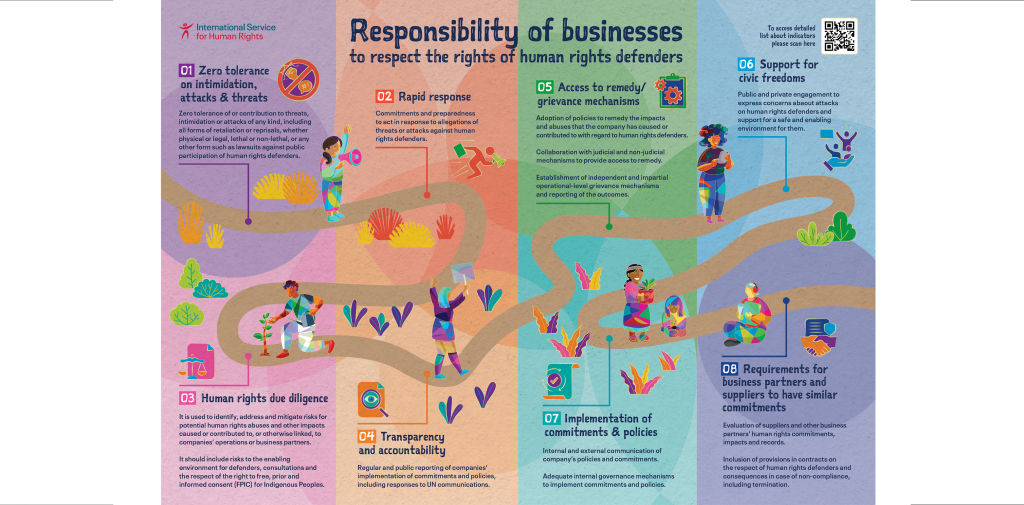
According to the Business and Human Rights Resource Center (BHRRC), since January 2015, there have been nearly 5,000 attacks on human rights defenders working on business and human rights issues. Defenders and UN experts have long worked to hold businesses accountable for meeting their responsibilities to defend civic freedoms and protect human rights defenders. Part of this work has included articulating what these responsibilities are and practical steps to meet them.
Inspired by and building from the United Nations Guiding Principles on Business and Human Rights, the BHRRC and ISHR 2018 report, ‘Shared Space Under Pressure: Business Support for Civic Freedoms and Human Rights Defenders, Guidance for Companies,’ lays out the normative framework that clarifies the corporate responsibility to act and to do no harm against HRDs. The UN Working Group on Business and Human Rights reaffirmed this in their 2021 Guidance on ensuring respect for human rights defenders. This guidance develops the implications of the Guiding Principles for engaging with and safeguarding the rights of human rights defenders– providing both States and businesses with a set of recommendations to follow.
Over the last few years, there has been an increasing articulation of the responsibility of businesses to respect and promote civic freedoms and the rights of Human Rights Defenders. Some recent examples of these efforts include the 2023 Unilever human rights policy and implementation guide and the BHRRC Human Rights Defender Policy Tracker.
In this same spirit, ISHR is launching a set of Indicators on Business and Human Rights that cover the following areas:
Zero tolerance on intimidation, attacks and threats against HRDs
Human rights due diligence
Transparency and accountability
Access to remedy/grievance mechanisms
Support for civic freedoms
Requirements for business partners and suppliers to have similar commitments
The indicators come in list and poster form. ISHR has also produced a ‘snapshot’ of the UN Working Group’s Guidance on ensuring respect for human rights defenders, in the form of an explainer, available in multiple languages.
We created a wonderful “Responsibility of businesses” roadmap poster for you. It shows the important steps to take on the journey to a responsible business, respecting the rights of human rights defenders amongst all people. You can download it in poster size print quality in the download section and print it yourself to go on your office wall, to remind everyone about the little steps and big responsibility to take everyday.
Global Voices has released a special coverage called Empowering voices: Women in politics, which explores the state of women’s political participation around the world.
Human Rights First referred to a new report reveals that WHRDs face increasing harassment and threats from a global movement against gender equality and LGBTQI+ rights. The Kvinna till Kvinna Foundation, a leading feminist women’s rights organization, released Hope and Resistance Go Together: The State of Women Human Rights Defenders 2023, a report that found discouraging growth in harassment of WHRDs. The foundation surveyed 458 women’s and queer rights activists and interviewed 25 activists representing WHRDs from 67 countries affected by violence or conflict.
They found that 75% reported facing harassment for their activism, a 15% increase from two years ago, and 25% of respondents have received death threats. Most harassment comes from government authorities, but increased harassment from far-right groups and anti-gender equality actors is also driving these startling statistics. Human Rights Defenders (HRDs) across the world face resistance and violence. In 2022, at least 401 HRDs were killed for their peaceful work. But some of the obstacles facing WHRDs are distinct. https://humanrightsfirst.org/library/recognizing-women-human-rights-defenders-on-international-womens-day/
Human Rights Watch on 7 March carried a piece by Macarena Sáez who says inter alia:
On this International Women’s Day, we march for the one in three women who experience physical or sexual violence in their lifetime. We cheer for countries like Argentina, Colombia, and Ireland that value our autonomy to choose to be pregnant and have legalized access to safe abortion, while protesting that abortion is still or again illegal in many places, including US states like Alabama and Texas. At the same time, we march to honor the women who marched before us, like the Mexican women who organized the first feminist congress in 1916 to push for family law reforms and their right to vote, and the Nigerians who waged their “Women’s War” against colonization and patriarchal laws in 1929. Their struggles sadly mirror the reality of many women around the world today – especially women who belong to historically marginalized groups – who continue to rally against violence and abuse.
Fearing the power of women’s solidarity and collective actions, governments have stifled women’s speech through restrictions on movement, censorship, smear campaigns, and criminal prosecutions. In highly repressive contexts, like Afghanistan and Iran, women suffer arbitrary detention, and even enforced disappearance and torture, for their activism. Meanwhile, social media companies have not done enough to protect women from online violence, chilling women’s freedom of expression on and offline. These barriers make it hard for women’s equality to become reality. Gender justice requires an enabling environment in which women can express themselves, speak and spread their political views, and participate in political and public life. Instead of repressing or tolerating the repression of women, governments should recognize our collective actions – and consequent power – and enshrine our rights in laws, policies, and practice. [https://www.hrw.org/news/2024/03/07/womens-voices-have-power-drive-change]
On 8 March 8, 2024 Almyra Luna Kamilla and Rosalind Ratana opined in IMHO on “Navigating the storms of repression: The resilience of young women rights defenders in Asia”
In recent years, Asia has been witnessing rising authoritarianism and shrinking civic space. Among those in the frontlines of resistance are young women human rights defenders. As we celebrate International Women’s Day, let us demand for an enabling world where women human rights defenders can continue their noble pursuits without fear of reprisals.
In Thailand, the royal defamation law is being excessively used to silence criticisms against the monarchy. Meanwhile in Sri Lanka, economic and political mismanagement has sparked peaceful protests that are met with violence and intimidation. The fate of Asia’s political climate hangs by a thread as elections are held across many countries, including Bangladesh, Indonesia, India, South Korea, and Pakistan. Now more than ever, governments across the region are finding ways to solidify their power, putting an even tighter grip on civil society to the detriment of democracy and people’s fundamental rights and freedoms.
Despite such challenges, many are courageously speaking out and taking collective action to reclaim power for the people. This includes young women human rights defenders – or Youth WHRDs – who are claiming space to call out human rights violations and to demand accountability from oppressive governments. [https://www.rappler.com/voices/imho/young-women-rights-defenders-asia/]
The Alliance for Human Rights in Afghanistan(a coalition of 9 major NGOs) urgently appealed to the international community to significantly bolster its support and actively safeguard the human rights of Afghan women and girls, including Afghan women human rights defenders who face persecution for their peaceful campaigns for rights and basic freedoms.
In 2023, the Taliban further intensified its oppressive policies toward women, girls, the LGBTIQ+ community, and religious minorities. Afghan women and girls have seen their rights and prospects increasingly curtailed, from greater enforcement of restrictions on education – including a ban on girls attending secondary schools and universities – to intensifying exclusion of women from political and public life. Women have been banned from a growing list of forms of paid employment, and economic barriers, such as the ban on women registering organisations and undergoing vocational training, have contributed to a sharp decline in women’s participation in the labour market, impeding their right to make a living. This exacerbates financial insecurity, widens gender disparities, and further confines women to the private sphere. Lesbian, bisexual, and transgender women face severe threats, including torture, sexual violence, forced marriage, and death. Victims of gender violence, including those who identify as such, lack minimal legal and practical support. Obstacles to healthcare and education have exacerbated poverty and vulnerability among women and girls. In 2023, new discriminatory restrictions imposed by the Taliban included the closure of all beauty salons, blocking women from overseas travel for study, mandating female health workers in some areas to have a male chaperone while travelling or at work, and prohibiting women from entering a famous national park.
The oppressive environment extends to female activists, NGO leaders and journalists. Notable cases include the arrests of women’s rights activists Neda Parwani and Zholia Parsi, the enforced disappearance and subsequent discovery of Manizha Seddiqi in Taliban custody to date, the arrest of Matiullah Wesa, founder of an NGO advocating for girls’ education rights, and the arbitrary detainment of Ahmad Fahim Azimi and Seddiqullah Afghan—both dedicated girls’ education activists, among many others. Journalists reporting on the Taliban, facing arrests and threats, equally illustrate the difficulties encountered by the media, particularly women, when covering crimes against women or advocating for women’s rights. Collectively, these cases underscore the near-total denial of freedom of expression, gender equality, or any other internationally recognized right in Afghanistan under the Taliban.
Amid this growing oppression, segregation and fear, Afghan women human rights defenders have urged the international community to exert greater pressure on the Taliban. They call on international bodies to involve Afghan women in all negotiations with the Taliban and to facilitate direct meetings between women and the de facto authorities to address their concerns. Afghan women have also stressed the importance of advocacy for women’s rights by external actors based on the voices and realities of women inside Afghanistan. They call for coordinated efforts between organisations inside and outside the country to defend the rights of Afghan women and girls.
The UN Special Rapporteur on the situation of human rights in Afghanistan, Richard Bennett, called on the Taliban to release women human rights defenders as the world marks International Women’s Day.
I reiterate my appeal to the Taliban to respect all the human rights of women and girls in Afghanistan, including to education, work, freedom of movement and expression, and their cultural rights, and I urge the meaningful and equal participation of Afghan women and girls in all aspects of public life. I call on the Taliban to immediately and unconditionally release all those who have been arbitrarily detained for defending human rights, especially the rights of women and girls.”
On International Women’s Day, the a group of NGOs (ALQST for Human Rights, Amnesty International, CIVICUS, European Saudi Organization for Human Rights (ESOHR), Front Line Defenders, Gulf Centre for Human Rights (GCHR), HuMENA for Human Rights and Civic Engagement, International Service for Human Rights (ISHR),MENA Rights Group, Salam for Democracy and Human Rights) renewed their call on Saudi Arabian authorities to release all women human rights defenders (WHRDs), women’s rights activists and their supporters who are detained in contravention of international human rights standards. The organisations further call on Saudi authorities to lift travel bans imposed on WHRDs and their relatives, and to abolish the male guardianship system. [https://ishr.ch/latest-updates/civil-society-reiterates-their-call-on-saudi-authorities-to-release-jailed-womens-rights-activists/]
The President of Georgia awarded severl with mesla of honor: co-founder of “Safari” organization Babutsa Pataraia, human rights defender Ana Arganashvili, founders of “National Network for Protection from Violence”: Eliso Amirejibi and Nato Shavlakadze and founder of “Vedzeb” organization Tamar Museridze.
On 7 March 2024, the ISHR report that the Inter-American Court of Human Rights examined the Escazú Agreement’s role in safeguarding environmental defenders, a landmark move for climate justice and human rights
The Advisory Opinion, which has already garnered a record number of interventions – over 250, a record in the history of the court – will mark a rare instance in which the Court will analyse a treaty that is not part of the Inter-American System, but of the Economic Commission for Latin America and the Caribbean: the ‘Regional Agreement on Access to Information, Public Participation and Justice in Environmental Matters in Latin America and the Caribbean’, also known as the ‘Escazú Agreement‘. For more on this, see: https://humanrightsdefenders.blog/tag/escazu-agreement/
In order to support the protection of environmental defenders, ISHR filed an intervention on environmental defenders, in collaboration with CIEL, FARN, and other international, regional and national organisations and human rights experts.
The obligation to effectively protect EHRDs
The Inter-American Court of Human Rights has already recognised that States are obliged to protecthuman rights defenders, arising from the general obligations to protect the rights to life and integrity of the person, among others. However, the Court has yet to expressly establish whether protecting environmental defenders is an obligation that also derives from environmental commitments made by States, as these stakeholders are an indispensable partner in the fight against climate change.
This is an opportunity for the Court to recognise that, in order to guarantee the right to a clean, healthy and sustainable environment, States must protect environmental defenders, as violating their rights also violates the rights they are defending.
The Court is also called to elaborate upon the specific protection needs of Indigenous, women and youth defenders. These groups face particular forms of attacks which must be addressed with cultural and gender perspectives, taking into account not only the particularities of the attacks they suffer, but also of their needs and desires.
In the case of Indigenous groups, the existing jurisprudence of the Court on recognising collective rights, along with the language used in article 9 of the Escazú Agreement – which establishes that ‘persons, groups and organisations’ can defend human rights – provides an opportunity to firmly establish the existence of a collective right to defend human rights, as well as the State’s obligation to set up and adapt their protection measures and mechanisms to ensure that collective protection is available when needed.
Environmental defenders and ‘access rights’
While the express mention of environmental defenders in the Escazú Agreement is extremely important, it is not its main focus. The treaty contains several obligations for States to guarantee access to information, to decision-making spaces and to justice in environmental matters.
These ‘access rights’ are applicable to all persons, but the Inter-American Court must reaffirm and elaborate upon its own jurisprudence related to their applicability for environmental defenders, which states that: ‘defenders cannot properly defend environmental rights if they cannot exercise their own rights of access to information, freedom of expression, assembly and peaceful association, guarantees of non-discrimination and participation in decision-making‘.
This is also an opportunity for the Court to clearly assert that private actors are also under the obligation to respect these rights, which includes conducting meaningful consultations and ensuring the free, prior and informed consent of communities affected by their projects.
The extent of the Advisory Opinion
Latin America is the region with the most and the oldest laws and protection mechanisms regarding human rights defenders, so it was only logical that it would be the first region to adopt the first treaty that expressly protects them.
The Inter-American Court has also been a pioneer in this regard. It was the first regional human rights court to deal with human rights defenders’ cases and order structural reforms to better protect them.
These successes must be celebrated, but there is still work to be done. The coming years will see an increase in three areas, all linked with one another: climate crisis, the amount of environmental defenders, and the risks faced by defenders.
The Court must seize this opportunity and set an example for countries in the region and beyond on how to properly defend the rights of those that defend our rights.
Now in its 18th year, the Secretary of State’s IWOC Award recognizes women from around the globe who have demonstrated exceptional courage, strength, and leadership in advocating for peace, justice, human rights, gender equity and equality, and the empowerment of women and girls, in all their diversity – often at great personal risk and sacrifice. The 2024 awardees and many earlier laureates can be found via the Digest link above.
USAID Administrator Samantha Power had the following to say: It has always taken bravery and stubbornness to stand up for human rights. But today the threats that human rights activists and defenders face – from threats to their families to legal retribution to imprisonment and outright violence at the hands of those who would prefer to see them silenced – those threats are grave, and sadly they are growing. In 2022, more than 400 human rights defenders were murdered, the highest number ever recorded in a single year. I am in awe of the women we are honouring today for their courage.
They refuse to back down because of a shared conviction captured by Fatima Corazon, one of the women we are recognizing today. As she puts it, courage, even in the face of danger and fear is the driving force to achieve positive change. The women we are honoring live this conviction every minute of every day. They have been unjustly imprisoned, they have been driven from their homes or trapped inside their homes, they have seen their families and their colleagues attacked, or they have received death threats and been assaulted themselves.
But they do not relent. They go on fighting, they fight for the rights of political prisoners, they organize movements to bring services to marginalized communities, they publish articles, they host rallies, and they call out injustice wherever they can. Even in the most dangerous places against all odds, they are continuing their work demonstrating incredible, inspiring courage and putting their lives on the line to defend human rights.
Benafsha Yaqoobi has dedicated her life to defending the rights of women and girls in Afghanistan. A former attorney and member of the Afghanistan Independent Human Rights Commission, she has helped women escape violence and visually impaired children attend school. Today, she continues to fight for the future of Afghanistan – one that respects human rights and human dignity.
Born in Isla Luis Vargas Torres, one of the most violent enclaves within Esmeraldas, Ecuador, Fátima Corozo has put her life on the line to draw hundreds of young people away from rising gang violence and help them get the education and job opportunities they need to build the futures they want for themselves.
Martha Beatriz Roque Cabello was the only woman amongst 75 people imprisoned during the black spring, Cuba’s crackdown on dissidents two decades ago, Martha was jailed for her activism. After her release, she continued to fight for the rights of political prisoners documenting fraudulent court hearings and supporting activists and their families. Unfortunately, as the Secretary relayed, the Cuban government is preventing Ms. Roque Cabello from leaving the country. So she is not here to accept the award, but let us give her a heartfelt round of applause.
As a result of Fariba Balouch’s outspoken activism for the rights of women and systematically oppressed ethnic minorities in Iran’s poorest province of Sistan and Baluchestan, Iranian authorities have threatened her life. And after she escaped to London, they detained her son and brother in a further attempt to intimidate her. Yet, Ms. Balouch believes the only way forward is resistance, and she continues to advocate for marginalized communities in Iran refusing to be silenced.
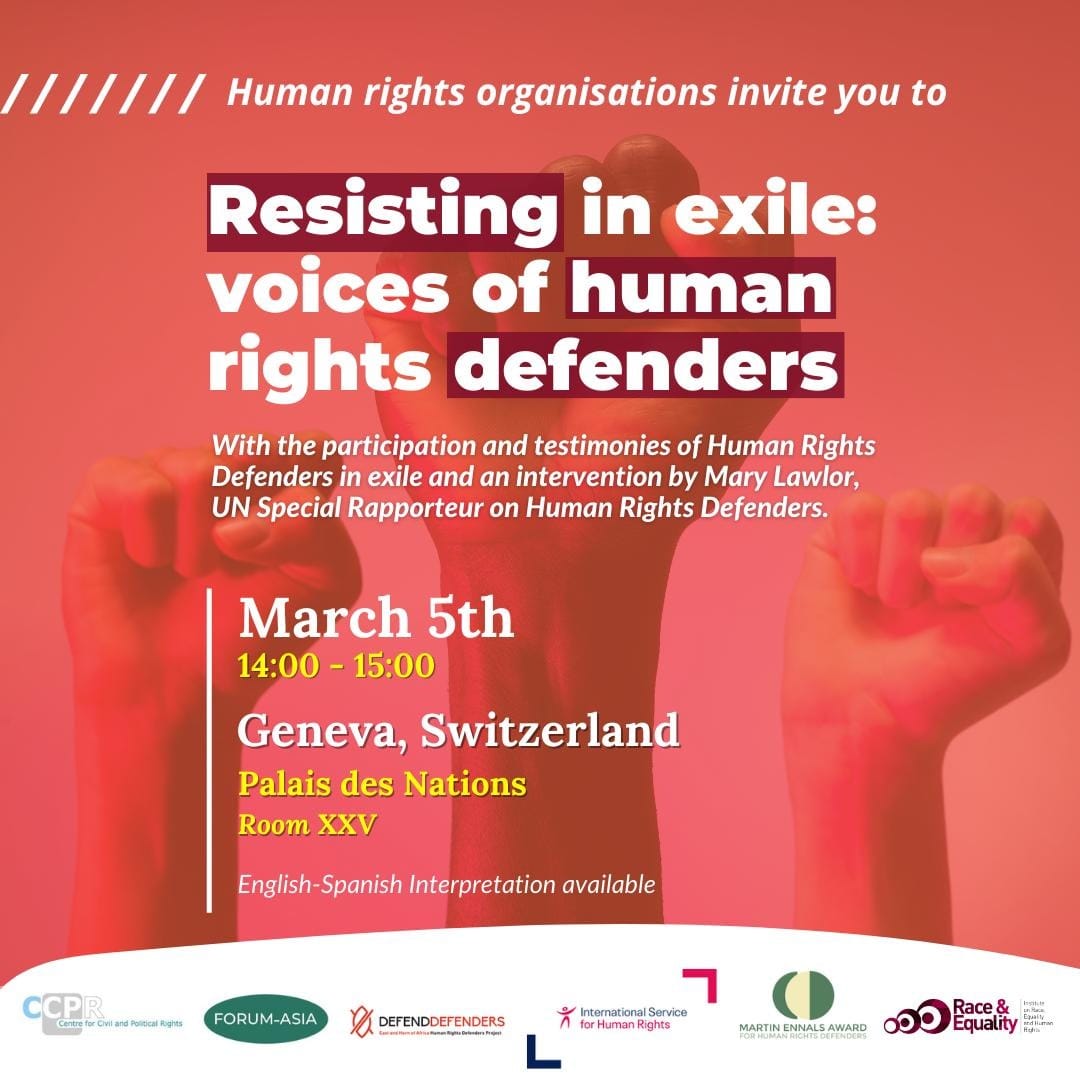
On Tuesday, 5th March, 2pm – at the Palais des Nations, Room XXV- will take place the side event Resisting in Exile: Voice of Human Rights Defenders
“I do not like the idea of being a refugee. I do not want to leave the country because I wanted to make it better.” Human rights defender quoted by the Special Rapporteur on Human Rights Defenders in A/HRC/37/51.
In ‘People Power Under Attack’ (2022), CIVICUS reports that the number of countries where civic freedoms are being curtailed and civil society is under severe attack is increasing… In such contexts and under such pressure, defenders can see leaving the country as their only option. These defenders, along with defenders expelled by their home governments, face the huge challenges of short or protracted exile, including economic insecurity and ongoing threats. Defenders in exile question if and how they can continue human rights work from abroad and how those who remain deal with a fractured human rights community.
In this event the four organisers [Centre for Civil and Political Rights (CCPR-Centre), International Institute on Race, Equality and Human Rights, (Race and Equality), International Service for Human Rights (ISHR), and DefendDefenders] will bring the voices of human rights defenders from around the world to the Council so that States, UN experts and officials and civil society colleagues can hear their voices. What is the experience of being in exile like? What is the impact on individual work and that of the community of defenders? What demands do exile defenders make to the Council?
This event aims to raise greater awareness about the phenomenon of defenders in exile and encourage discussion and action on how to support these defenders. It is also aimed at looking at what is needed to prevent exile becoming some defenders’ only feasible option.
During this event, defenders in exile from will speak of the impact of their experience of exile on their own lives, those of their families, and their communities. They will highlight the specific needs defenders in exile have in terms of legal guarantees, and political and financial support and of their ongoing work to defend rights from exile.
Defenders in exile will also send in testimonies, to be shown in video form or read out by fellow defenders. We aim to fill the room with the voices of those in exile who cannot be in Geneva to participate directly.
Recall the recommendations made by the previous Special Rapporteur on Human Rights Defenders, Michel Forst, in his 2018 report to the Council (A/HRC/37/51), including in regard to the prohibition of non-refoulement to persecution, relocation schemes, and access to protection measures for defenders in exile.
The conversation will take place during the Council session when the Special Rapporteur on Human Rights Defenders will be presenting her report to the Council. We hope that the Special Rapporteur will be available to, highlight the need for greater attention to, and investment in the prevention of, the closure of civic space so as to forestall the need for defenders to leave the country.
![[OPINION] Navigating the storms of repression: The resilience of young women rights defenders in Asia](https://www.rappler.com/tachyon/2024/03/women-rights-defenders-asia-mar-7-2024.jpg)
 Hans Thoolen on Human Rights Defenders and their awards