Sometimes it is good to look at how people can support human rights defenders elsewhere. Here an example from West Sussex, UK, where – using a script compiled exclusively from the first-hand accounts of Afghan women human rights defenders – Crawley’s Pitchy Breath Theatre Group voices testimony, underlining the risks to women’s freedom posed by any resurgence of the Taliban. The reading – on Monday 19 May – will be followed by an opportunity to ask questions and discuss the issues raised with Chris Usher, Amnesty International UK’s Country Co-ordinator for Afghanistan. There will also be the opportunity to take part in actions in support of Afghan women. This event forms part of Amnesty International UK’s campaign on women’s rights in Afghanistan. The local AI Group are hoping that “Even If We Lose Our Lives” can inspire the local community and contribute to more action protecting these women and the rights they are fighting fight for.
[Afghan women are too often portrayed as faceless, passive victims who are powerless to change the grave human rights abuses which regularly affect them. The script is based on the actual accounts of three women – Parween, whose teenage son was kidnapped and killed because she runs a girls’ school, Dr D, a gynaecologist whose son was injured in a bomb blast, and Manizha, who runs the largest Afghan organisation working on violence against women and girls at great personal cost.]
It is not often that we can write about Trinidad and Tobago but when the Inter-American Commission on Human Rights [IACHR] calls on Trinidad and Tobago “to fully investigate and prosecute” those responsible for the murder of prominent Senior Counsel, Dana Seetahal, there is a good reason. The former state prosecutor and magistrate, was shot and killed on 4 May. This is reinforced by the legal reasoning of the IACHR which recalls “”. ….in this sense, acts of violence and other attacks perpetrated against human rights defenders not only affect the guarantees that every human being must enjoy, but also seek to undermine the fundamental role that human rights defenders play in society and leave all those for whom they fight defenseless. “The work of human rights defenders is essential to building a solid and enduring democratic society, as they play a leading role in the pursuit of the full attainment of the rule of law and the strengthening of democracy.”
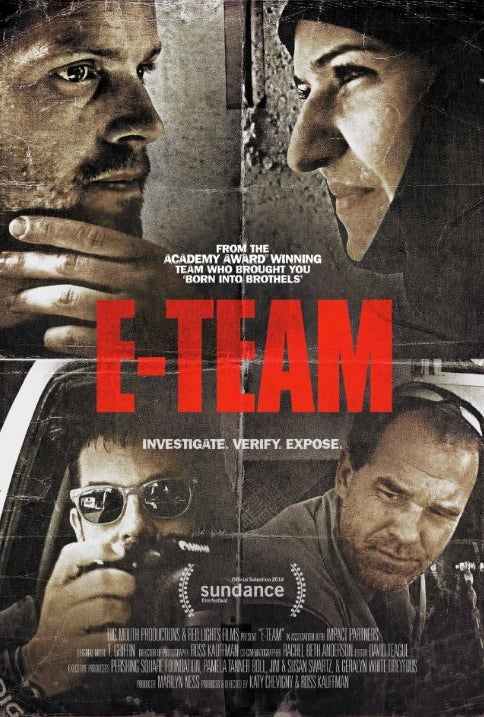
Yesterday I referred to the upcoming Human Rights Watch Film Festival in June. One of the films shown there will also appear on Netflix and therefore be able to reach a much larger audience. Interesting development for human rights films!!
The Associated Press reported on May 8 that Netflix Inc. had purchased E-TEAM as a high-profile “Netflix original,” and would distribute the film via its vast online platform as well as through a limited theatrical release in the United States. The film focuses on four researchers in the Human Rights Watch emergencies division, or E-Team, as they interview witnesses and gather other evidence of rights abuses and war crimes in Syria, Libya, and Kosovo. It highlights the personal commitment required to stop human rights violations over the long term. The filmmakers, Ross Kauffman and Katy Chevigny, operated with full creative control and had free rein from Human Rights Watch to produce a “warts and all” portrait of human rights activists in the field. It is the first time filmmakers have documented Human Rights Watch’s work so extensively.
[The film has won numerous awards on the festival circuit, including for best cinematography at Sundance. Variety called it “a documentary that’s devastating, entertaining and inspiring in equal measure.”]
The Human Rights Watch Film Festival, which celebrates 25 years, announces a line-up of 22 features, which includes 20 documentaries and 2 fiction films – 16 of which were made by women. It will run from 12 to 22 June 2014 in New York. There is a special section on “Human Rights Defenders, Icons and Villains”, which features: “E-TEAM” (New York premiere) Filmmaker(s): Katy Chevigny and Ross Kauffman, directors; Marilyn Ness, producer Year: 2013 / 89m
“Dangerous Acts Starring the Unstable Elements of Belarus” (New York premiere) Filmmaker(s): Madeleine Sackler Year: 2013 / 76m
“The Green Prince” (New York premiere) Filmmaker(s): Nadav Schirman Year: 2014 / 101m
“Nelson Mandela: The Myth and Me” (US premiere) Filmmaker(s): Khalo Matabane Year: 2013 / 84m
“Watchers of the Sky” (New York premiere) Filmmaker(s): Edet Belzberg Year: 2014 / 114m
This is a fundraising appeal which this blog normally would not relay but as (1) it is done jointly by two organisations, (2) comes with images, and (3) has such a clear focus on human rights defenders, I make an exception. It was published on 8 May 2014by the International Service for Human Rights and the East and Horn of Africa Human Rights Defenders Project, to ensure that human rights defenders have the skills and resources they need. To donate, go to www.ishr.ch/donate.
Nobel Laureate Aung San Suu Kyi, must sometimes be doubting her power: on 5 May 2014, human rights defender Mr Ko Htin Kyaw was arrested by the police for distributing pamphlets in Yangon, Burma. On 9 May 2014, two of his colleagues were also arrested when they attended the trial against him. Ko Htin Kyaw is director of the Movement for Democracy Current Force (MDCF), a community-based organisation working to promote development and democracy. Read the rest of this entry »
On 12 May 2014 Charter97 brings a story that shows that Belarus finds it awkward to let human rights defenders into the country but it equally that high-level intervention by sports officials can help. According to Christer Englund, the President of the Swedish Ice Hockey Association, the detention of Paulina Kluge and the earlier detention of Martin Uggla are obvious violations of the arrangements between the International Ice Hockey Federation and the Belarusian authorities. “No visas are needed for those having a ticket for a hockey match. It shouldn’t matter what your name is,”Christer Englund said. “The issue is now being discussed on the level of Lukashenka and Fasel.” Paulina Kluge was allowed to enter Belarus in the end he said in interview with SVD sport.
Human rights defender Martin Uggla, who had been deported from Belarus earlier, wrote on Facebook: “Another Swedish human rights activist from Östgruppen – Paulina Kluge – was detained at the airport in Minsk on May 9. She was waiting for the deportation. My case was being discussed at the highest level (Fasel and Lukashenka) at that time. They began to discuss both issues. As a result, Paulina was allowed to enter the country! They said it was a ‘technical error’. As for my status, there’s no new information so far”. https://thoolen.wordpress.com/2014/04/25/human-rights-defenders-call-for-release-political-prisoners-during-ice-hockey-world-championship-in-belarus/
[About 30 opposition activists have been detained by the police in the last two weeks]
On 30 April 2014, an investigative officer in Russia ordered the psychiatric assessment of human rights defender Ms Tatiana Kotlyar in relation to an ongoing criminal investigation into the allegations that she falsely allowed dozens of migrants to illegally register her own apartment as their place of residence. [Tatiana Kotlyar is the deputy of Obninsk city council and is the chair of the Kaluga movement “For Human Rights”, which specialises in the protection of minority rights, including the rights of Roma and migrants. Since 2011, Tatiana Kotlyar has been allowing dozens of migrants to register her apartment as their place of residence for free. The Investigative Officer Zimin ordered the psychiatric examination, even though Tatiana Kotlyar has no history of psychiatric difficulties and has never received psychiatric treatment. Front Line believes that the decision may be linked to the fact that the human rights defender did not require payment for providing residence registration for more than a hundred people.] For actions see: http://www.frontlinedefenders.org/node/25865/action
In the meantime Front Line Defenders informs us of the death of Elena Ryabinina, a much admired Russian human rights defender, on 4 May 2014 in Moscow, aged 59. Since 2002, Ryabinina had been fighting for the rights of refugees seeking asylum from Central Asian countries. She was renowned for the compassion, enthusiasm, and optimism with which she worked to achieve better rights for refugees and asylum seekers. She must have saved dozens of Uzbeks and Tajiks who sought asylum. Although she did not have formal legal training, Ryabinina developed an impressive knowledge of asylum laws, and consulted and defended people seeking political and religious asylum. She worked with the Civic Assistance Committee and the Memorial Human Rights Center and headed the Right to Asylum program at the Institute for Human Rights.
For the weekend a longer read: On 22 April 2014, human rights defender Dr Yuri Melini in Guatemala discovered that intimidating text had been painted on his front gate. The text names the member of the police provided as personal security to the human rights defender since an assassination attempt was made against him. Yuri Melini is the Director of the Centro de Acción Legal, Ambiental y Social de Guatemala (CALAS) – Legal, Environmental and Social Action Centre of Guatemala. CALAS is an organisation working for the strengthening of environmental issues, community participation and respect for the collective rights of indigenous communities in relation to environmental concerns. The human rights defender was awarded the Front Line Defenders Award in 2009. The human rights defender has previously faced harassment, intimidation, defamation and an attempt on his life as a result of his human rights work, see: http://www.frontlinedefenders.org/node/23190 [Last year eighteen human rights defenders were assassinated, a 72-percent increase over 2012, even as the country’s general murder rate has decreased.]
To place this incident in context one should read the report by Patricia DAVISpublished in Eurasia Review of 28 April 2014: “GUATEMALA: SUPPRESSING DISSENT AT HOME AND ABROAD – ANALYSIS”
After a lengthy introduction concerning the ad personam attack by Guatemalan President Molina on Tim Rieser, majority clerk on the Senate State and Foreign Operations Appropriations Subcommittee (for blocking military aid), the article dives into the numerous human rights problems in the country. Read the rest of this entry »
Having posted on the Natalia bracelet and the Panic Button recently as alarm systems for human rights defenders in danger, it is good to also draw attention to the dangers that are inherent in the ‘normal’ use of mobile phones. Tactical Tech has quite a bit to say about mobile phone security: Human Rights Defenders are exposed to many potential threats – from governments, private companies, organised groups – in the course of their work. Therefore, they should be aware of dangers and necessary security measures to be taken if deciding to communicate by mobile phone, which remains an easy-to-spy-on device. Tactical Tech has produced a number of resources about phone security.
Finally, have a look at the Guardian Project’s website, created by a group of activists dedicated to creating open source apps to increase security and privacy on smartphones.



 Hans Thoolen on Human Rights Defenders and their awards