The always reliable Monitor of the ISHR wraps up the latest session of the UN Human Rights Council in Geneva with a comment on the Council’s missed opportunity to strengthen the protection of human rights defenders who work to corporate accountability for human rights violations: Read the rest of this entry »
Posts Tagged ‘Human Rights Defenders’
Human Rights Council concludes with missed opportunity to protect defenders working on corporate accountibility
June 30, 2014Egypt: Extended detention of human rights defenders protesting the “Protests Law”
June 24, 2014 reports that 0n 23 June 2014, the Public Prosecutor in Egypt ordered that the detention of human rights defenders Ms Yara Sallam and Ms Sanaa Seif be extended by four days. The day before, the human rights defenders were accused of breaching the ‘Protests Law’ by demonstrating without a permit, committing acts of violence, possession of inflammable material and Molotov cocktails, blocking a road, sabotaging public and private property, and belonging to the banned group ‘April 6’. The human rights defenders were among 24 persons arrested on 21 June 2014 during a demonstration against the ‘Protests Law’.
Yara Sallam is a human rights researcher who currently works with the NGO Egyptian Initiative for Personal Rights (EIPR). She is also the winner of the African Shield Human Rights Defenders in 2013. Sanaa Seif is a student who has participated in previous protests in the defence of human rights. The human rights defender was arbitrarily detained during Magles El Wuzara events on 16 December 2011, and was released on the same day. Sanaa Seif is also the sister of human rights defender Mr Alaa Abd El Fattah, who was sentenced in absentia on 11 June 2014 http://www.frontlinedefenders.org/node/26164 and of Mona Seif, MEA Nominee of 2013 (https://thoolen.wordpress.com/2013/05/03/egyptian-hrd-and-mea-nominee-mona-seif-under-attack/)
Twenty-three of the individuals arrested at the protest have had their detention extended by four days and one was released on bail. A decision on whether to charge the human rights defenders is expected shortly. The human rights defenders’ lawyer, Mr Mohamed Khedr, has highlighted inconsistencies in the testimonies of witnesses for the prosecution, as well as within the police’s own statements. In particular, the police secretary accused the protesters of damaging a police vehicle at 9:30pm on 21 June 2014, despite the demonstrators having been arrested at 5:30pm that day outside a kiosk when they were not present at the protest, and a police report having been filed against them at 9:30pm. The police found no inflammable objects within the possession of the demonstrators.
The human rights defenders are two of several Egyptian human rights defenders, such as Maheinour Al Masry <http://www.frontlinedefenders.org/node/25996> , who have been targeted through the ‘Protests Law’ (Law no 107 of 2013 on the Right to Public Meetings, Processions and Peaceful Demonstrations). The law was approved on 24 November 2013 by interim Egyptian President Adly Mansour and has been condemned by the United Nations High Commissioner for Human Rights, Navi Pillay, as well as the UN Special Rapporteur on the rights to freedom of peaceful assembly and association, Maina Kiai.
Today official launch of AI’s Panic Button – a new App to fight attack, kidnap and torture
June 23, 2014
Today, 23 June 2014, Amnesty International launches its open source ‘Panic Button’ app to help human rights defenders facing imminent danger. The aim is to increase protection for those who face the threat of arrest, attack, kidnap and torture. In short:
Bangladesh also to use funding controls to restrict human right defenders
June 14, 2014Bangladesh is trying to restrict human rights defenders such as Adilur of the NGO ODHIKAR, final nominee of the MEA 2014. The cabinet has approved the “Foreign Donations (Voluntary Activities) Regulations Bill, 2014”, which will likely become law soon. The Bill empowers bureaucrats to decide the fate of NGOs. All individuals or collectives, from NGO’s to volunteer groups, receiving foreign funds for implementing projects will be under constant surveillance under this law.
In a statement of 13 June the Asian Legal Resource Centre says that the law will usher even more arbitrary executive actions in Bangladesh. Read the rest of this entry »
Human Rights Defenders in Hungary: not yet ‘foreign agents’ but getting close
June 13, 2014The Observatory for the Protection of Human Rights Defenders, an FIDH-OMCT joint programme, expressed its concern that the Hungarian government is alarmingly shrinking the space of civil society by hindering their access to funding, conducting unexpected inspections and blacklisting prominent human rights organizations. The Observatory – not by accident – did so on 12 June 2014, the day the Hungarian Government was meeting representatives from a group of donor Governments including Norway.

25 Years Tiananmen ‘celebrated’ with over 100 detentions
June 13, 2014 (A map of all individuals detained in the wake of the Tiananmen anniversary. Some of these persons have already been released. Photo: CHRD)
Yesterday China Human Rights Defenders has released a list of over 100 activists, journalists, lawyers, dissidents and other assorted individuals who are thought to have been detained by the government in the wake of the 25th anniversary of the 1989 Tiananmen Square protests. As of June 11, 116 individuals from various parts of China, including Beijing, Shanghai, Sichuan, Xinjiang and Guangdong are all listed, with an estimated 49 criminal detentions and two confirmed arrests. Many who were not detained were invited by local authorities to “drink tea” – a veiled phrase for questioning – and were warned to avoid participating in any anniversary activities. Chief among the detainees is veteran human rights lawyer Pu Zhiqiang, who was placed in criminal detention on May 6 under charges of “picking quarrels and provoking trouble” after he attended a May 3 Tiananmen commemoration.
 (
(Pu was … a student lawyer in the 1989 protests, [and he] became a prominent human rights lawyer and advocate, taking up some of the most politically sensitive rights-defending cases,” said David Zhao, researcher and representative for CHRD. “He [has made] earlier remarks that he is still ‘deeply emotionally tied to [Tiananmen]’ and has ‘no regrets over his involvements’.”

(Yu Shiwen (left) and Chen Wei (right). Photo: Screenshot via RFA)
Other persons on CHRD’s list include Wang Xiuying, an 83-year-old activist who had her home searched by Beijing police after signing a Tiananmen commemoration petition, Chen Wei and Yu Shiwen, an activist couple who organised Tiananmen memorial services, and Wu Wei, a former South China Morning Post journalist in Beijing who interviewed Pu Zhiqiang in the past. “The clampdown on commemorative events this year is the most severe of all years and this reflects the [government’s] determination to wipe out the memory of Tiananmen,” Zhao said.
View CHRD’s list in full here.
A few days earlier, 6 June, Mary Lawlor of Front Line wrote a thoughtful piece on the same issue stating that it “would be fitting that the 25th anniversary of the Square massacre be marked by a renewed international effort to provide greater support to Chinese human rights defenders.“

Human rights defenders (HRDs) currently working in China are frequently seen as challenging the Party and as such must be prepared to risk everything, including death, to continue their work. Although the Party’s methods may have changed in the past quarter of a century, its intention to crush dissent at any cost has not. On 3/4 June 1989 hundreds of peaceful demonstrators were killed in the approach roads to Tiananmen Square in Beijing, bringing an end to seven weeks of protests which had drawn up to a million people onto the streets. What started off as a student protest in the capital calling for political reform quickly morphed into a mass movement supported by broad cross-sections of society which spread to dozens of other cities throughout the country.
The legacy of these protests and the massacre that followed is still keenly felt by HRDs in today’s China. The events of 1989 remain a key touchstone to many Chinese HRDs and as the CCP works to erase the memory of what happened that June, HRDs are equally determined to keep that memory alive, and honor those who died. They do this not only through yearly commemorations of the dead, but also through their day-to-day work defending the rights for which the 1989 protesters struggled. These HRDs highlight injustice, campaign against discrimination, defend in court those who have been arrested for expressing themselves freely and shine a spotlight on the myriad of abuses, including corruption, carried out by the CCP.
So threatened does the Party feel by the memory of its actions 25 years ago that it criminalizes the very act of remembering. In early May, five HRDs were arrested following a low-key memorial at a private residence in Beijing. They are being held on charges of “picking quarrels and provoking trouble.” The only “quarrel” these HRDs “picked” was with the CCP’s whitewashed version of history, and the Party’s hysterical overreaction to such a commemoration is as clear an admission of guilt as any signed confession. The author then refers to groups such as the The Tiananmen Mothers and the New Citizens Movement…
On the surface, the China of today is a much changed place to the China of 1989… Yet beneath the confident exterior lies the reality that the CCP remains a fragile entity, haunted by the possibility that the values of equality, justice and dignity espoused by HRDs in China might threaten its legitimacy, which is based almost solely on an economic growth model…..While various countries trip over each other in a race to secure lucrative trade deals with China, emphasis on human rights gets pushed further and further down the agenda. The CCP knows that no matter how egregious its abuse of rights – as in the recent death of human rights defender Cao Shunli in custody – international reaction will be muted at best. These are the same rights which workers and students died for twenty five years ago and whose deaths were met at the time with a robust international response.
The weakening of such international support for HRDs working today can only be seen as a betrayal of the values espoused in 1989. It would be fitting that the 25th anniversary of the massacre be marked by a renewed international effort to provide greater support to Chinese HRDs as they bravely continue their work in advancing and protecting internationally recognized rights, despite knowing with full certainty that they will be targeted as a result of this work.
Tiananmen 25: More than a Symbolic Legacy | Sharnoffs Global Views.
42 Human Rights Defenders also want to win in World Cup
June 12, 2014“If just a fraction of the global attention given to football could be given to securing human rights, we would all be celebrating victory.”

Front Line Defenders and Brazilian NGO partners Justiça Global and Terra de Direitos launched today an online and social media campaign to focus attention on the plight of 42 human rights defenders (HRDs) from each of the participating World Cup nations (www.sportshrd.org). The international campaign kicks off in a few hours just before the first World Cup match between Brazil and Croatia with an event in Dublin.
“Front Line Defenders draws attention to these heroes in our societies who work at great personal risk, against seemingly insurmountable odds to secure fundamental rights and freedoms for others,” announced Mary Lawlor, Executive Director of Front Line Defenders.
The campaign site allows visitors to send messages of solidarity, which will be delivered to the HRDs. On Twitter, please use #sportshrd to enlarge the reach of the campaign.
For more information contact adam[at]frontlinedefenders.org
World Cup Countdown: Front Line Defenders HRD Team | Front Line.
Retaliation against Iranian Human Rights Defender for meeting with Ashton
June 12, 2014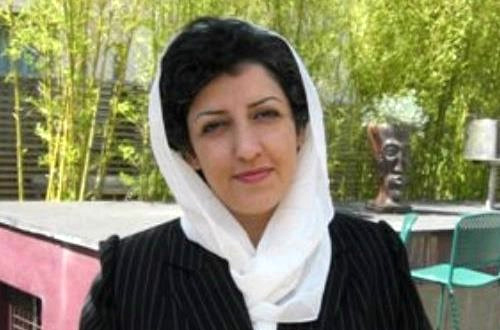
Reprisals are not limited to human rights defenders cooperating with the UN. Narges Mohammadi, a prominent human rights defender in Iran, told the NGO ‘International Campaign for Human Rights in Iran’ that new charges have been brought against her stemming from her March 8, 2014 meeting with the EU foreign policy chief Catherine Ashton. Mohammadi was charged with “propaganda against the state” and “collusion against national security” for her meeting with Ashton at the Austrian Embassy in Tehran. She was released on $10,000 bail. [Mohammadi was one of several women activists who accepted an invitation to meet the EU foreign policy head during her March visit to Tehran. The meeting took Iranian officials by surprise and unleashed a flurry of criticism by conservatives who described the meeting as “foreign interference in Iranian domestic affairs” and labeled the Iranian participants as foreign collaborators.]
Mohammadi stated: “I have been ‘charged’ with every single civil activity I have engaged in since my release from Zanjan Prison in August 2012, such as participating in gatherings on women’s rights, air pollution, and [Rouhani’s] Citizenship Rights Charter. I was also accused of honoring families of political prisoners at meetings, or attending a gathering with Gonabadi Dervishes in front of the Prosecutor’s Office, or giving interviews to media outside Iran. I told them there that when you fit all my civil activities into these two charges, it means that I must remain silent and still.”
Mohammadi was arrested in 2009 and charged with “assembly and collusion against national security,” “membership in the Defenders of Human Rights Center,” and “propaganda against the state.” She was first sentenced to 11 years in prison, but Branch 54 of the Tehran Appeals Court reduced her sentence to six years in prison. She was released in 2013 for medical reasons after a severe illness in Zanjan prison.
Corporate leader receives award as Human Rights Defender in Minneapolis
June 12, 2014
On 25 June 2014, Marilyn Carlson Nelson will receive The Advocates’ 2014 Don and Arvonne Fraser Human Rights Award in Minneapolis [see http://www.trueheroesfilms.org/thedigest/award/don-and-arvonne-fraser-human-rights-award]. The winner this year is an interesting choice as it is rare to give a human rights award to a corporate leader. Named as one of the “World’s 100 Most Powerful Women” by Forbes, Marilyn Carlson Nelson, the former CEO and chairman of Carlson, is an unusual human rights defender. Under her leadership, Carlson became the first major U.S.-based travel company to commit to training its hotel employees to watch for and report child sex abuse when she signed the travel industry’s International Code of Conduct to end sexual exploitation and trafficking of children. She also helped to defeat the Minnesota marriage amendment that was before the state’s voters in 2012. The op-ed she wrote for the Star Tribune went viral and encouraged other Minnesota business leaders to voice their support for LGBTI rights.
via Outstanding Human Rights Defenders Being Honored at Awards Dinner, June 25 | The Advocates Post.
OSCE publishes Guidelines on the Protection of Human Rights Defenders
June 11, 2014
Didier Burkhalter (r), OSCE-Chairperson-in-Office and Swiss Foreign Minister, alongside Janez Lenarčič, Director of the OSCE Office for Democratic Institutions and Human Rights, at a conference on human rights defenders, Bern, 10 June 2014. (FDFA)
The two-day conference “The OSCE and Human Rights Defenders: The Budapest Document 20 Years On” brings together national human rights experts, human rights defenders and civil society representatives from across the OSCE region. Opening the conference, the OSCE Chairperson-in-Office and Swiss Foreign Minister Didier Burkhalter, stressed the role of political will in supporting the work of human rights defenders: “The implementation of human rights norms first and foremost needs one thing: political will … Allowing the voices of human rights defenders and civil society to be heard – even when these are uncomfortable voices – is at the basis of a well-functioning democracy,” .. “These men and women working to increase awareness and respect for human rights often take high risks to help their fellow citizens be able to live their lives in dignity. They need and deserve our support.” In his keynote address, Stavros Lambrinidis, the EU Special Representative for Human Rights, told participants that human rights have never been a battle between different cultures, but within them. He added that human rights have always been the universal language of the powerless against the relativism of the powerful: “Freedom of expression makes sense when we disagree, and especially when we strongly disagree,” Lambrinidis said. “Governments don’t have the obligation to agree with civil society; they have clear obligations, including providing human rights defenders with a safe and enabling environment. Strong confident countries speak to human rights defenders.” The first day of the conference saw the launch of the ODIHR Guidelines on the Protection of Human Rights Defenders, a publication designed to assist OSCE participating States in promoting security for human rights defenders, in light of the increasing risks they face in carrying out their work. Ambassador Janez Lenarčič, Director of ODIHR, stressed that the approach presented in the Guidelines to ensuring such protection has to be based on co-operation. “The Guidelines will only prove as effective as their implementation will be,” Lenarčič said. “I believe the key to success is precisely that genuine partnership that the Budapest Document spoke of 20 years ago. It has to include all those involved in efforts to protect human rights defenders – from States and civil society to regional and international governmental organizations. This remains as important today as it was two decades ago.”

