Posts Tagged ‘Human Rights Defenders’

Human Rights Defenders – among the top 10 issues for Business and Human Rights in 2016

December 20, 2015

The Institute for Human Rights and Business has published: Human Rights Defenders and Business – Searching for Common Ground. This is the fourth in a series of Occasional Papers by IHRB to provide independent analysis and policy recommendations about timely subjects on the business and human rights agenda. In this instance, this paper is co-published with Civil Rights Defendersand Front Line Defenders, both organisations with practical research, campaigning, and advocacy experience of the issues raised in the paper.

As cases in this Paper show, journalists exposing corruption, Internet activists demanding accountability, and community activists campaigning for land rights have all faced pressure.

More than sixty governments have passed laws in the last three years to place restraints on the ability of human rights defenders to hold their governments to account. Among those targeted are individuals and organisations who challenge economic policies or business conduct. Human rights defenders’ activities are being criminalised and they face surveillance, intimidation, lawsuits, arrests, and torture – in some cases, even death.

Companies are engaging with civil society, but mutual suspicions remain. Companies share common goals with human rights defenders – accountability, transparency, the rule of law, and due process. Companies should build on these common interests and engage human rights defenders, and where possible, speak out in their defense. To download:

The same institution – to mark International Human Rights Day 2015 – published the seventh annual list of the Top 10 Business & Human Rights Issues for the 2016 (these issues are not ranked in order of importance). The one specific on human rights defenders reads:
Defending Defenders: A Role for Business in Championing Civil Society

More than sixty governments have passed laws in the past three years to place restraints on the ability of human rights defenders to hold their governments to account for actions that undermine respect for international standards. Among those targeted are individuals and organisations who champion alternate economic paradigms or challenge government policies or business conduct. Some have faced intimidation, surveillance, lawsuits, arrests, and torture.

Twenty years ago, after a trial that failed to meet international standards, the Nigerian Government executed Ken Saro-Wiwa and eight other Ogoni leaders who opposed the activities of Shell in the Niger Delta. The case sparked global awareness of business’ human rights responsibilities beyond the factory walls, leading to the development of standardsadvocacyinitiativescodes of conducts, and eventually a comprehensive UN framework and principles for business and human rights.

Despite some progress over the past two decades, suppression of activists too often continues. The UN has passed a resolution recognising the legitimate role of peaceful activists who call out abusive behaviours, including business actions that undermine respect for human rights. Yet a growing number of governments are also passing new laws to restrain civil society activities.

Human rights defenders are like canaries in a mine. When they campaign against abuses, they highlight society’s fundamental problems, such as lack of accountability, transparency, or the rule of law. Courts have jailed journalists exposing corruption, governments have tried Internet activists, authorities have prevented activists from travelling abroad, and states have cracked down on funding sources of non-governmental organisations. International financial institutionsare also under focus. The international community is increasingly paying attention to their cause. At the 2015 UN Forum on Business & Human Rights, there was special focus on human rights defenders and the role of business.  

In the year ahead, some governments, businesses, and NGOs will likely sharpen criticism of states that unjustifiably attack human rights defenders, as well as the companies that benefit from such crackdowns and choose to say nothing. With rising concerns over terrorism and the resulting tendency in many countries to emphasise security threats over protecting human freedoms, the road ahead for those who dissent will not be easy. The combined voice of global business will be critical in effectively promoting the legitimate role of individuals and organisations that champion human rights principles and standards in societies around the world. 

Sources:

Top 10 Business and Human Rights Issues for 2016 – Top 10 Emerging Issues

http://www.ihrb.org/publications/reports/human-rights-defenders.html?utm_source=IHRB+Subscribers&utm_campaign=0e75f77298-eNews_Update_Quarterly_Update_2&utm_medium=email&utm_term=0_94694639e6-0e75f77298-120645865

see also: https://thoolen.wordpress.com/tag/business-and-human-rights/

UN General Assembly adopts Resolution on human rights defenders with increased majority

December 18, 2015
For the record, the Resolution on the protection of human rights defenders was adopted by the plenary of the United Nations General Assembly on Thursday 17 December 2015, with 127 States voting in favour (i.e 10 more than in the Third Committee!). See: https://thoolen.wordpress.com/2015/12/05/follow-up-on-the-human-rights-defenders-resolution-in-the-un/.

127 States supported the resolution, including South Africa, which had voted against it in the Third Committee, while 14 States (Burundi, Cambodia, China, Cuba, North Korea, Iran, Myanmar, Nicaragua, Nigeria, Pakistan, Russia, Sudan, Syria and Zimbabwe) continue to vote against it. This list is not surprising (they figure regularly in this blog), although one would have hoped that Myanmar (after the elections) would have had a change of heart while Nigeria’s position remains a mystery.

Read the rest of this entry »

Azerbaijan: Khadija Ismayilova remains in jail but Council of Europe takes exceptional step

December 18, 2015

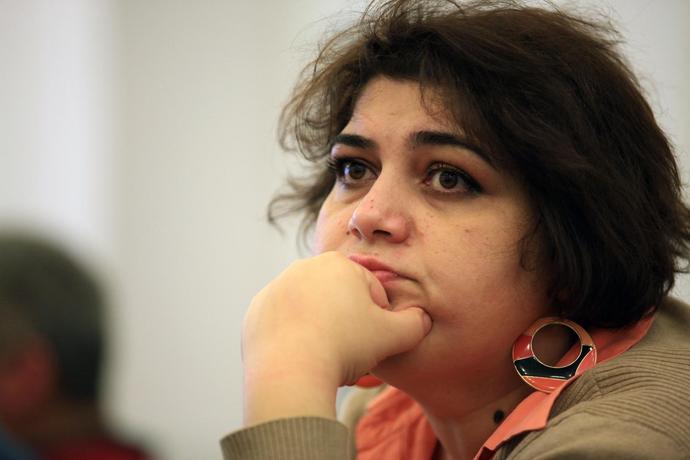
While there has been a small let up in the incarceration of human rights defenders in Azerbaijan [see e.g. https://thoolen.wordpress.com/tag/leyla-yunus/], it remains the worst place in Europe for human rights defenders. On 25 November the appeal lodged by investigative journalist and human rights defender Khadija Ismayilova was dismissed. She has to remain in jail for 7.5 years!

[Ms. Ismayilova was arrested on December 5, 2014 on charges of “inciting” her ex-partner “to commit suicide”. Although in April 2015 the alleged victim retreated his accusations, claiming his testimony was given under pressure, blackmail and torture, the prosecution did not take it into account and maintained the charges. In February 2015, Ms. Ismayilova was further accused of embezzlement, illegal entrepreneurship, tax evasion and abuse of office. During the hearings in first instance, no evidence of these accusations was presented.On September 1, 2015, the Baku Court of Grave Crimes had sentenced Ms. Khadija Ismayilova to 7,5 years imprisonment on charges of “embezzlement”, “illegal entrepreneurship”, “tax evasion”, and “abuse of office].

As an independent reporter and journalist of the Azerbaijani radio Azadliq (“Radio Freedom”) she has shown great courage (see: https://thoolen.wordpress.com/2014/12/11/khadija-ismayilova-azerbaijan-is-not-deterred/), and received several international prizes, such as the 2015 Alison Des Forges Award for Extraordinary Activism (HRW), the 2015 Freedom to Write Award, the 2012 Fritt Ord/Zeit Press Prize, and the 2012 Courage of Journalism Award by the Washington-based International Women’s Media Foundation.  Read the rest of this entry »

UN and NGOs try to deal with Burundi on 17 December

December 16, 2015
Tomorrow 17 December there will be a Special session of the Human Rights Council on preventing further deterioration [now that is diplomatic language!] of the human rights situation in Burundi. The International Service for Human Rights (ISHR) is using the occasion to organize a side event on:  “Escalation of Violence in Burundi: Human rights defenders voices from the ground” from 09.00-10.00 am in Room XII, Palais des Nations, Geneva. It will be webcast live on www.ishr.ch/webcast. Follow on twitter using the hash-tag #BurundiHRDs.ISHR-logo-colour-high

Panelists (moderator Nicolas Agostini of FIDH):

  • Mr Pierre Claver Mbonimpa, Association for the Protection of Human Rights and Incarcerated Persons (APRODH), MEA Laureate 2007.
  • Ms Margaret Barankitse, Maison Shalom
  • Mr Anschaire Nikoyagize, Ligue ITEKA
  • Ms Carina Tertsakian, Human Rights Watch
There has been almost unanimity on the need for international attention and action. For those who want to see some of the major reports that came out recently, see the summary below. See also my earlier post: https://thoolen.wordpress.com/2015/11/10/burundi-what-more-early-warning-does-one-need/

Read the rest of this entry »

Human Rights Day 2015: human rights defenders are main topic

December 10, 2015

International Human Rights Day is an occasion for many organizations to publish statements on human rights. For those who have not enough time to go through all of them, here a selection of four main statements that focus on human rights defenders:  Read the rest of this entry »

One of Azerbaijan’s key human rights defenders, Leyla Yunus, freed – now the others

December 10, 2015


Read the rest of this entry »

Council of Europe: draft resolution addresses reprisals with priority

December 9, 2015

An interesting read is the latest report to the Council of Europe’s Parliamentary Assembly by Rapporteur: Ms Mailis REPS, Estonia, Alliance of Liberals and Democrats for Europe. The (draft) report is entitled: “Strengthening the protection and role of human rights defenders in Council of Europe member States“.

[On 19 March 2013, the Committee on Legal Affairs and Human Rights appointed Ms Mailis as rapporteur, following the departure from the Assembly of the previous rapporteur, Mr György Frunda.]

The Draft resolution and draft recommendation (AS/Jur (2015) 37) were adopted by the Committee on Legal Affairs and Human Rights on 8 December 2015 and here are some highlights:

Read the rest of this entry »

Thailand returns recognized refugees to China (and falsely claims they did not know about their status)

December 8, 2015

Anneliese Mcauliffe in Al Jazeera on 6 December 2015 reported that two Chinese human rights defenders recognised as UN refugees were forcibly deported from Thailand to China last month and have appeared on Chinese state-run television and confessed to human-trafficking offenses. CCTV reported that Jiang Yefei was arrested for “assisting others to illegally cross the national border”, and Dong Guangping was charged with using a trafficking network to flee China while awaiting trial on sedition charges. It was the first time the two men were seen since being taken from a detention centre in the Thai capital Bangkok in November and deported to China.

Read the rest of this entry »

Short report by EEAS on the 17th EU-NGO Human Rights Forum, 3-4 December 2015

December 5, 2015

The 17th EU-NGO Human Rights Forum took place in Brussels on 3 and 4 December 2015, bringing together hundreds of civil society organisations from across the globe, representatives from international and regional human rights mechanisms and from the EU institutions and Member States. The Forum is a joint venture between the European External Action Service (EEAS), the European Commission, and the Human Rights & Democracy Network [http://www.hrdn.eu/index.php?menu_selected=122&language=US&sub_menu_selected=768].

The overarching theme for this year’s Forum is Protecting and Promoting Civil society Space. In her address to the Forum, High Representative of the Union for Foreign Affairs and Security Policy, Federica Mogherini, stated: I believe that the civil society has a crucial role to play in any policy and in our foreign policy. It is not only a key player, but a main driver for change in all societies, in terms of democracy, good governance, resilience, cohesion, promotion of fundamental human rights.   Freedom of expression is one of the most powerful weapons against radicalisation and terrorism. To better protect our citizens we need above all to build strong democratic institutions and a healthy democratic dialogue. I am very often asked whether security should not be the main focus, more than human rights. But there is no security without human rights”.

She also called for renewed efforts to fight attempts to control the work of civil society in many countries around the world: “During the last years, the space for civil society has shrunk in many countries”. “These trends demand a redoubling of our efforts in the human rights sphere. The European Union, the institutions and myself personally, will do all we can to protect civil society organisations fighting for human rights and protect human rights defender on an individual basis.”

The theme of this year’s NGO Forum – Protecting and Promoting Civil Society Space – reflects the EU’s strong commitment to put Freedom of Association and Freedom of Expression at the heart of the EU’s human rights policy as essential foundations for democracy, rule of law, peace, stability, sustainable inclusive development and participation in public affairs.

This year’s event saw contributions from the current UN Special Rapporteur on Freedom of Association, Maina Kiai; the UN Special Rapporteur for Human Rights Defenders, Michel Forst; Vice-Chair of the European Parliament Subcommittee on Human Rights, MEP Barbara Lochbihler; the Secretary General of the Community of Democracies, Amb. Maria Leissner; Sakharov Prize recipient Memorial, represented by Oleg Orlov; alongside many representatives from civil society, Human Rights Defenders, NGOs, the EU Institutions and many representatives from EU member states.

The forum looked at the recent EU Guidelines on Human Rights Defenders and the EU Guidelines on Freedom of Expression, as key tools enabling the EU to promote and protect freedom of opinion and expression and to counter the clear and disturbing trend over the last few years towards an increasingly restricted space for independent civil society as well as outright threats, intimidation and violence that civil society organisations and representatives, journalists, media actors and other individuals face in many countries across the world because of the exercise of their rights.

Given the scale of the problem and its constantly changing manifestations, urgent action is required not just to understand the scale and evolving nature of the threats, but particularly to identify ways to achieve effective and concerted policy responses and counter actions.

The EU is committed, as indicated in the EU strategy on human rights and democracy and its Action Plan (2015-2019), to address threats to civil society space, through actions that support laws and policies to protect human rights defenders; report on and counter threats to civil society space; and oppose unjustified restrictions to freedoms of assembly and association.

Engagement with civil society is essential for the ongoing work the EU is undertaking to help realise human rights, indivisible and universal for all people. The Forum discussions provided a significant opportunity for an interactive dialogue among representatives from the EU member states, the European Institutions (European Parliament, Council, European External Action Service, European Commission) and global civil society and human rights defenders from all over the world, working on the promotion and protection of human rights. The outcome of the Forum will be an important stepping stone for ensuring effective EU action and future policy developments in this field.

see also: https://thoolen.wordpress.com/2015/12/04/international-cooperative-consortium-protect-the-defenders-launched-on-2-december/


Source: European Union – EEAS (European External Action Service) | PRESS RELEASE: PROTECTING & PROMOTING CIVIL SOCIETY SPACE: 17th EU-NGO Human Rights Forum, 2015

Follow up on the Human Rights Defenders Resolution in the UN

December 5, 2015

Last week I wrote about how the UN Resolution on HRDs did in the 3rd Committee of the UN General Assembly [https://thoolen.wordpress.com/2015/11/26/unfortunately-the-un-voted-on-the-resolution-on-human-rights-defenders/] and how South Africa has turned around [https://thoolen.wordpress.com/2015/11/30/south-africa-does-about-turn-on-un-resolution-on-human-rights-defenders/]. The date of the vote in the Plenary is not yet confirmed but is likely to be 18 or 21 December. The voting record is available: http://www.un.org/en/ga/third/70/docs/voting_sheets/L.46.Rev.1.pdf

Fourteen States voted no on the resolution (China, Russia, Syria, Burundi, Kenya, Myanmar, Nigeria, Saudi Arabia, Zimbabwe, North Korea, South Africa, Iran, Pakistan, and Sudan). In some of these countries civil society has expressed disappointment. e.g.

In Pakistan the Human Rights Commission of Pakistan (HRCP) in a statement issued on Tuesday, said: “At the same time, HRCP must express alarm and great disappointment that Pakistan chose to be one of the 14 nations that voted against the resolution.“ “While regretting Pakistan’s decision to oppose the resolution, the civil society is entitled to ask what rights defenders have done to deserve this step-motherly treatment. It is unfortunate that the government wishes to see civil society as an adversary. The civil society cannot, and must not, surrender its role as a watchdog for people’s rights because that constitutes an entitlement, by virtue of citizens’ social contract with the state, and not as a concession” “The HRCP also stresses people’s right to know through an explanation in parliament the reason why the government chose to deny the need for protection for HRDs, who include, besides human rights groups, journalists, lawyers, political and social activists.Read the rest of this entry »