Posts Tagged ‘Human rights defender’

Tunisian authorities should immediately drop the unfounded charges and release Ahmed Souab

March 3, 2026
e465df4f-5702-47d7-81db-742d13799bef
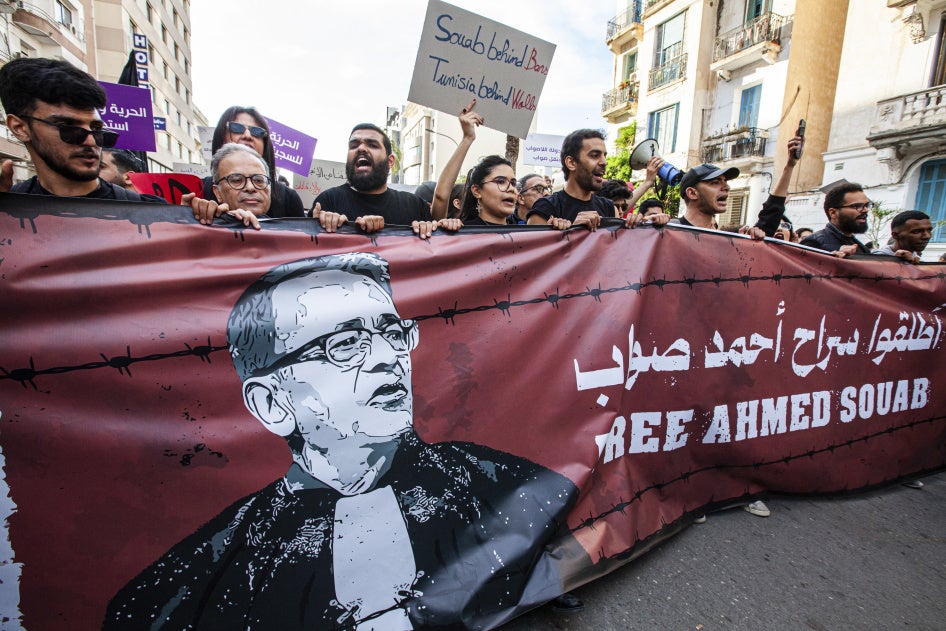
Supporters show support for the lawyer and human rights defender, Ahmed Souab, who was arrested on terrorism-related charges, in Tunis, Tunisia, April 25, 2025. © 2025 Ons Abid/AP Photo

A Tunisian lawyer and human rights defender, Ahmed Souab, who was sentenced to prison on terrorism-related charges, will face a new trial on appeal on February 12, 2026, Human Rights Watch said. The Tunisian authorities should immediately drop the unfounded charges and release him, and stop retaliating against critics and the lawyers defending them.

Tunisian authorities prosecuted Souab, 69, for statements he made outside of court while representing defendants in a notorious case of “conspiracy against state security.” On October 31, 2025, a Tunis anti-terrorism court sentenced him to five years in prison and three years of administrative supervision. His trial lasted just minutes; Souab was not present, and journalists were reportedly barred from attending.

“Ahmed Souab, a lawyer, former administrative judge, and fierce advocate for judicial independence, is behind bars simply for his defense work and outspoken views,” said Bassam Khawaja, deputy Middle East and North Africa director at Human Rights Watch. “His abusive prosecution for defending others from abusive prosecution shows the sheer extent of the Tunisian authorities’ crackdown on any dissent.”

Anti-terrorism agents arrested Souab in his home on April 21, following comments he made after the “conspiracy case” verdict on April 19. That day, 37 people, including lawyers, activists, and opponents, were sentenced after a sham trial for terrorism and security-related offenses to prison terms ranging from 4 to 66 years.

Standing outside the headquarters of Tunis Bar Association, Souab reportedly said: “It seems that it is not the detainees who have a knife turned on them, but rather, it’s the president of the chamber who has a knife [at his throat].” Video excerpts of his statement circulated widely on social media. Souab’s defense committee explained that he was referring to pressure exerted on judges.

Human Rights Watch has documented the authorities’ repeated attacks on the judiciary in Tunisia, including President Kais Saied’s dismantling of the High Judicial Council in February 2022. The attacks have severely undermined the rule of law, allowed the executive to weaponize the judiciary for political ends, and jeopardized Tunisians’ right to a fair trial, Human Rights Watch said. 

The Tunisian authorities are increasingly relying on remote trials for terrorism cases, especially for politically motivated trials against dissidents. The practice of remote trial by video is inherently abusive, including by undermining detainees’ right to be brought physically before a judge to assess their well-being and the legality and conditions of their detention.

On October 31, Souab was convicted of “endangering the lives of people entitled to protection by deliberately disclosing information that could reveal their identities” and of “making threats in connection with a terrorist offense,” his family told Human Rights Watch. 

Souab’s family said he has a history of cardiac conditions and experienced a deterioration in his health in prison. He has suffered several nosebleeds, the cause of which was not determined, they said.

Over the past three years, the authorities have increasingly relied on an aggressive legal toolbox, including unfounded security and terrorism charges under the penal code and 2015 Counterterrorism Law, to target critics and lawyers with judicial harassment, abusive criminal prosecution, arbitrary detention, and travel bans for the legitimate exercise of their profession. see also: https://humanrightsdefenders.blog/tag/tunisia/

https://www.hrw.org/news/2026/02/10/tunisia-prominent-lawyer-arbitrarily-detained

Interview with Jawad Fairooz, a Bahraini human rights defender,

February 25, 2026

Jawad Fairooz is a Bahraini human rights defender, Founder of OMCT’s SOS-Torture Network member organisation SALAM for Democracy and Human Rights. He is also a former Member of the Bahraini Council of Representatives, currently living in exile after years of persecution by the authorities, including detention, torture, and the revocation of his nationality. In Bahrain, severe restrictions on civic space persist alongside widespread impunity and ongoing allegations of torture. As the UN Committee Against Torture reviews Bahrain’s record, Jawad Fairooz reflects on the human rights climate in the country, the personal cost of his advocacy, and the urgent need for accountability, drawing on his experience and the findings highlighted by OMCT and partners’ Global Torture Index.Since the crackdown on the Arab Spring protests in 2011, Bahrain has been marked by grave human rights violations. .. More than 435 people have had their nationality revoked [see also: https://humanrightsdefenders.blog/2018/02/25/i-am-bahraini-website-launched-in-effort-to-stop-denationalizations/], and over 300 prisoners of conscience remain behind bars, including opposition leaders. Freedom of speech and assembly are criminalised, torture has not been systematically banned, and political and civil rights continue to be restricted. The core violations that began years ago are still continuing today.

What has been the cost of your advocacy in Bahrain?

From the moment I became active in public life, I knew there would be a high price to pay. In 2004, while leading a large protest against the US invasion of Iraq, I was shot in the head with a live bullet. Since then, I have been targeted repeatedly through detention, torture, and eventually the revocation of my nationality.

The Global Torture Index classifies Bahrain as facing a “very high risk” of torture. Why?

Torture is not taken seriously by the authorities. There are no accountability and no clear mechanism to hold senior officials responsible. Victims are denied remedies, redress, and rehabilitation. Even after release, former detainees struggle to regain basic civil and political rights. They face obstacles in obtaining employment, housing, and other services. International recommendations from bodies such as the UN Committee Against Torture have not been implemented. There have been no meaningful legal amendments to fully prohibit torture or establish independent investigations. Semi-government institutions lack independence and cannot be trusted to address these abuses. All of this shows a clear lack of political will.

What are the main obstacles facing survivors of torture when seeking justice?

The government focuses on public relations rather than real reform. Institutions like the National Institution for Human Rights, the Special Investigation Unit, and other bodies exist, but they are not independent. Cases referred to them rarely result in accountability or fair trials. Victims consistently report that justice is denied. Torture has evolved from overt physical abuse to psychological and “soft” methods, including deprivation of rights, travel bans, revocation of nationality, deportation, and denial of documents and services. These practices show that torture continues in different forms, and the authorities are not serious about ending it at its roots…

You have been in exile. How do defenders continue their work despite reprisals?

Human rights defenders in exile pay a heavy price. Many are banned from entering Bahrain or face fabricated cases, Interpol notices, travel restrictions, and harassment of their families. Smear campaigns label activists as terrorists or foreign agents. Despite this, defenders continue out of belief in the cause and responsibility toward victims. It is extremely difficult, but repression cannot last forever, especially under international scrutiny.

What gives you hope to continue your work?

Silence only strengthens repression. The resilience of victims and their families gives me hope. Standing with them is a moral and spiritual duty. I believe oppression has a short life, and that by continuing this work, we help ensure that future generations do not inherit a reality of torture, executions, statelessness, and detention.

https://www.omct.org/en/resources/blog/silence-only-strengthens-repression-interview-with-bahraini-human-rights-defender

Ugandan human rights lawyer Sarah Bireete detained ahead of elections

January 8, 2026

Sarah Bireete was arrested on December 30, 2025, after police and military personnel surrounded her home in Kampala. Shortly before her arrest, she posted on X, “My house is under siege by police and army”. As reported by East and Horn of Africa Election Observation Network (E-HORN) on 2 January 2026

The Police Reforms Working Group (PRWG) Kenya has called for the immediate release of Uganda’s human rights lawyer and civil society leader, Dr Sarah Bireete, warning that her detention ahead of the January elections threatens civic space and undermines democratic processes.

The Uganda Police confirmed her arrest in a brief social media post, stating she would be produced in court “in due course”. Police spokesperson Rachel Kawaala described the detention as part of “ongoing operations” but offered no further details.

“Dr Bireete is widely recognised for her unwavering passion for the protection of civil liberties, her lifelong quest for justice, and her steadfast commitment to democracy, a clarion call that has consistently advanced accountable governance across the region,” the Group said.

Bireete currently serves as Executive Director of the Centre for Constitutional Governance (CCG), Chairperson of the East Africa Civil Society Forum (EACSOF), and Chairperson of the Horn of Africa Election Observers Network (E-HORN).

PRWG Kenya described these roles as reflective of her integrity, credibility and long-standing contributions to human rights, electoral integrity and democratic governance.

The group urged Ugandan authorities to respect civil liberties, the rule of law and democratic processes.

“Respect for civil liberties, rule of law and democratic processes is fundamental to ensuring free, fair, and transparent elections,” PRWG Kenya said.

The statement also highlighted that Uganda’s constitution, under Article 23, guarantees that anyone arrested must be promptly informed of the reasons for their detention, a step that has not been followed in Dr Bireete’s case.

Bireete’s arrest follows her recent advocacy for Starlink, a satellite internet service operated by SpaceX, as a safeguard against potential internet shutdowns during the elections.

In a post dated December 23, 2025, she wrote, “Dear Ugandans, are you thinking of ways to navigate internet shutdown during elections? Starlink got you covered.”

https://eastleighvoice.co.ke/uganda/263965/rights-group-demands-release-of-ugandan-human-rights-lawyer-sarah-bireete?amp=1

As the country approaches general elections on 15 January 2026, UN experts* today warned that the pervasive climate of fear in Uganda, marked by allegations of enforced disappearance, the use of disproportionate force against political opposition supporters, and the intensified suppression of civil society and independent media, is not conducive to peaceful elections.

https://www.ohchr.org/en/press-releases/2026/01/uganda-un-experts-urge-stronger-human-rights-safeguards-ahead-2026-elections

https://www.hrw.org/news/2026/01/08/arrest-of-ugandan-activist-ahead-of-elections-spells-trouble

https://english.news.cn/20260118/c21ddafd3d1c4ca6964cd2d5270eddd8/c.html

https://eastleighvoice.co.ke/news/273392/un-rapporteur-publishes-letter-faulting-uganda-over-oyoo-njagi-abductions?amp=1

and

https://www.monitor.co.ug/uganda/news/national/activist-bireete-granted-bail-not-to-leave-uganda-without-court-s-permission-5340756

https://www.omct.org/en/resources/urgent-interventions/uganda-arbitrary-arrest-and-pre-trial-detention-of-eight-environmental-rights-defenders

and then on 28 January 2026: https://76crimes.com/2026/02/09/uganda-sarah-bireete-freed/

UN expert urges Togo to release human rights defender Abdoul Aziz Goma

December 29, 2025

On 23 December 2025, the Special Rapporteur on human rights defenders, Mary Lawlor, renewed her call on authorities in Togo to release Togolese-Irish citizen and human rights defender Abdoul Aziz Goma from prison on the seventh anniversary of his arrest.

Abdoul has now been arbitrarily detained for seven years and has been on hunger strike since 8 November 2025, protesting against the injustices he has faced. As he marks his 44th day without food, I am seriously concerned for his life,” Lawlor said.

Abdoul Aziz Goma was arrested in Lomé in 2018 after providing shelter to a group of young people who had travelled to the capital to demonstrate. Although he did not participate in any protests himself, Aziz Goma offered help to the youths when approached by an acquaintance.

Aziz Goma was initially held in secret for a number of years before being transferred to Togo’s formal prison system in 2022. He has been reportedly subjected to ill-treatment and denial of adequate medical care in prison, which have left him with a debilitating health condition.

In February 2025, when he was finally tried, Aziz Goma was convicted on multiple charges, including undermining national security, in a single day procedure and sentenced to ten years in prison.

Aziz Goma is reportedly very weak from hunger and reduced to spending much of the day lying down.

In September 2023, the UN Working Group on Arbitrary Detention determined that Aziz Goma’s ongoing detention was arbitrary.

The Special Rapporteur has also raised her concerns about Aziz Goma’s treatment and ongoing detention with Togolese authorities in 2021 and 2024.

https://www.ohchr.org/en/press-releases/2025/12/un-expert-urges-togo-release-human-rights-defender-abdoul-aziz-goma

https://www.jurist.org/news/2025/12/un-expert-urges-togo-to-release-human-rights-defender-from-prison/

Salvino Oliveira – how education helped him to go from a Rio Favela to City Hall

December 22, 2025

Salvino Oliveira was honored as a 2025 Young Activist Summit Laureate. | Courtesy of Jefferson Teófilo

On 22 December 2025, Global Citizen published the story of how at 27, Salvino Oliveira went from being a street vendor in Rio’s Cidade de Deus to a city councilor leading education reform. This was followed by him starting his first social project: making tuition free for poor children at 15 years old. In recognition of his efforts towards making education more accessible, Oliveira has been honored as a 2025 Young Activist Summit Laureate. Here, Oliveira shares how education transformed his life,  and why he’s committed to making that transformation accessible to every young person in Brazil’s favelas.

My name is Salvino Oliveira, and I am everything I’ve been.

I say this because my story begins in a tiny house in Cidade de Deus, meaning City of God, a favela in Rio de Janeiro. At 13, I started working to help my family survive: selling water bottles at traffic lights, candy on buses, working as a street vendor, upholsterer, construction helper — anything honest that could put food on the table.​

But Cidade de Deus is more than poverty. It’s the Rio neighborhood with the most public squares, making it a natural place for culture, leisure, and community gathering. It’s the birthplace of funk carioca — the soundtrack of favela resistance and joy. It’s also home to Olympic athletes and artists. These public spaces and that cultural richness shaped who I became, the friends I made, my first loves, the things I believe in.​

Then I got lucky. I was selected by lottery to study at Colégio Pedro II, one of Brazil’s most prestigious tuition-free public schools. In Brazil, elite families typically send their children to private schools, while public schools serve the poor; a few exceptional public institutions, like Pedro II, offer quality education through competitive lottery systems. That education changed everything. It opened a door that seemed permanently locked for someone from my background. At 15, even while working and living with gun violence all around me, I understood that if this access had reached me, I had a responsibility to give it back.​​

At 15, I created my first social project: free tutoring for children in Cidade de Deus.

When I entered Brazil’s federal university system to study Public Administration at Universidade Federal do Rio de Janeiro (UFRJ), a tuition-free institution, like all public universities in Brazil, that social project grew into AfroEducando (later renamed Mais Nós), a community prep course for university entrance exams. Within one year, we had 22 units across Rio’s metropolitan region, all volunteer-run, helping first-generation Black students from favelas access higher education.​​

When the “social bug” bites you, there’s no going back — and so the projects continued. I co-founded Projeto Manivela to train community leaders to engage with the government and turn demands into policies. Then came PerifaConnection, a media platform where young people from favelas across Brazil write columns in major national newspapers about politics, economics, culture, climate, and human rights. The idea was simple and radical: we refuse to let other people tell our story for us. Mainstream Brazilian media have historically portrayed favelas primarily through the lens of crime and poverty. Today, favela youth occupy editorial space in national media, changing how Brazil sees its peripheries.​​

I became an activist in 2018 during the federal military intervention in Rio’s security forces. Working at the Public Security Observatory, I saw firsthand how policies treated favelas like war zones, with heavily armed police operations causing civilian casualties. As I became more visible in my community, friends warned me: “Be careful, you’re an activist now. This can put you at risk.” That’s when I understood that fighting for education and rights in Rio means challenging power structures involving politics, money, and organized crime that often operate in contested urban territories.

https://www.globalcitizen.org/en/content/rio-favela-to-city-hall-education-oliveira-yas/

Oldest children NGO in Iran shut down and its founder Hossein Mirbahari arrested

November 8, 2025

On 3 November 2025, the Centre for Human Rights in Iran reported that the arbitrary arrest of child rights defender Hossein Mirbahari and the forcible closure of the Society for the Protection of Child Laborers and Street Children—one of the country’s oldest and most respected NGOs supporting vulnerable children.

Mirbahari, a founding member of the organization, was arrested by security forces at his sister’s home in Tehran on October 15, 2025, and detained without charge. His whereabouts remain unknown, as does the status of his case, and he is being denied access to his family and lawyer. There are serious concerns about his state of health. Security agents also sealed the organization’s office and confiscated equipment and communication devices, effectively halting its operations.

“Mirbahari’s unlawful arrest and the closing of the organization mirror the Islamic Republic’s dismantling of other NGOs, and reflect its intensifying drive to wipe out independent civil society organizations,” said Hadi Ghaemi, executive director of the Center for Human Rights in Iran (CHRI).

In a pattern of increasing judicial harassment, Mirbahari was previously arbitrarily arrested on June 20, 2025, and released after 30 days in solitary confinement upon posting bail, again without lawful cause or disclosed charge.

This latest act of repression comes amid an escalating campaign by Iranian authorities to criminalize humanitarian work and silence independent voices advocating for social justice and the rights of children, women, and marginalized groups.

A knowledgeable source told CHRI that Mirbahari’s physical condition is fragile, following chemotherapy, and his whereabouts and charges against him remain unknown. His family and lawyer have had no contact with him since his arrest.

Two Decades of Children’s Rights Advocacy

Since its founding in 2002, the Society for the Protection of Child Laborers and Street Children has been a lifeline for working and street children across Iran, advocating for the eradication of child labor and all forms of exploitation, and promoting equal rights and humane living conditions for every child, regardless of gender, ethnicity, or religion.

Its activities included providing educational programs, health services, psychological support, and advocacy for social protections such as child and family insurance coverage. The organization also sought to raise public awareness about the plight of working children in Iran and to encourage community participation in child protection.

Operating through eight specialized units —public relations, health, arts, library, education, social work, finance, and research— the society was one of the few NGOs in Iran maintaining a consistent focus on children’s welfare amid tightening restrictions on civil society….

Reza Shafakhah, a prominent human rights lawyer, in an interview with Shargh newspaper on October 13, 2024, said: 

“It is not possible for you to open a curtain and look out the window in the farthest reaches of Iran and not see a child going through a trash can. The fact that nearly 120,000 street children are active in Iran is a form of child abuse.”

Egyptian human rights defender Alaa Abdel Fattah finally free!

September 23, 2025

Egyptian media reported on 22 September, 2025, that President Abdel Fattah al-Sisi had issued a presidential pardon for the imprisoned Egyptian-British activist Alaa Abdel Fattah. On 23 September the Guardian, HRW and others reported that the British-Egyptian human rights activist Alaa Abd el-Fattah has indeed been released from jail after serving six years for sharing a Facebook post.

Early on Tuesday morning his campaign said in a statement that Abd el-Fattah was released from Wadi Natron prison and was now in his home in Cairo. “I can’t even describe what I feel,” his mother, Laila Soueif, said from her house in Giza as she stood next to her son surrounded by family and friends. “We’re happy, of course. But our greatest joy will come when there are no [political] prisoners in Egypt,” she added.

Peter Greste, an Australian journalist who was imprisoned alongside Abd el-Fattah, told Australian Associated Press: “It’s absolutely wonderful news, I’m absolutely overjoyed, I think it vindicates all the work and the efforts of the people who lined up behind him. See also: https://humanrightsdefenders.blog/2025/01/19/i-owe-alaa-abd-el-fattah-my-life-which-is-why-i-am-going-on-a-hunger-strike-to-help-free-him/

Alaa Abd el-Fattah stands next to his mother, Laila Soueif, and sister, Sanaa, at their home in Giza.
Alaa Abd el-Fattah stands next to his mother, Laila Soueif, and sister, Sanaa, at their home in Giza. Photograph: Mohamed Abd El Ghany/Reuters

Amnesty International’s Erika Guevara Rosas said the release was welcome but long overdue. “His pardon ends a grave injustice and is a testament to the tireless efforts of his family and lawyers, including his courageous mother Laila Soueif and activists all over the world who have been relentlessly demanding his release,” she said. The following quote can be attributed to Amr Magdi, senior Middle East and North Africa researcher at Human Rights Watch: “President Sisi’s pardon of the imprisoned Egyptian activist Alaa Abdel Fattah is long overdue good news. Though we celebrate his pardon.

The campaign for Abd el-Fattah’s release was led by his family, including his mother, who was admitted to hospital in London twice after going on hunger strikes trying to secure his release. The UK prime minister, Keir Starmer, is also known to have telephoned Sisi three times to lobby for Abd el-Fattah’s release. see: https://humanrightsdefenders.blog/2022/07/07/mona-seifs-letter-a-cry-for-help-for-alaa/

https://www.theguardian.com/world/video/2025/sep/23/egyptian-british-activist-alaa-abd-el-fattah-reunited-with-family-after-release-from-prison-video

https://www.hrw.org/news/2025/09/22/egypt-presidential-pardon-for-activist-alaa-abdel-fattah

https://www.theguardian.com/world/2025/nov/14/british-egyptian-activist-alaa-abd-el-fattah-stopped-from-flying-to-uk-says-family

However, in December 2025 a political storm broke about Alaa Abdel Fattah’s earlier social media posts: https://www.bbc.com/news/articles/cg5mr0gdnmeo

still, see also: https://www.jewishvoiceforlabour.org.uk/article/defend-british-egyptian-human-rights-activist-from-deportation-calls/

Mali: UN experts demand activist El Bachir Thiam’s release, four months after enforced disappearance

September 23, 2025
United Nations logo

On 9 September 2025 UN experts called on authorities in Mali to disclose the fate and whereabouts of journalist and activist El Bachir Thiam, who disappeared four months ago.

Mali must immediately and unconditionally release El Bachir Thiam and other victims of enforced disappearance, and cease the crackdown on civil society actors, human rights defenders, and political opponents or those perceived as such,” the experts said.

El Bachir Thiam is a journalist for the MaliActu website and a member of several civil society organisations and political movements, including the political party Yelema – Le Changement, led by former Prime Minister Moussa Mara, the Collectif Sirako, and a youth movement calling for a return to constitutional order, for which he serves as spokesperson and communications officer.

Thiam was allegedly kidnapped on 8 May 2025, in front of several witnesses in Kati town, by a group of at least five hooded and unidentified men suspected of being Malian intelligence agents – more specifically from the the Agence Nationale de la Sécurité d’Etat (ANSE) – or elements of the Bamako gendarmerie du Camp I, who were traveling in a gray TOYOTA V8 4×4 vehicle with tinted windows and no license plate. His relatives and colleagues reportedly searched for him in vain in police stations and gendarmeries of Bamako and Kati. Since then, Thiam’s fate and whereabouts have remained unknown.

“As time goes by, Thiam’s condition risks deteriorating further and will take a profound toll on his physical and psychological health,” the experts said.

On 17 July 2025, Thiam Mariam Dagnon, wife of El Bachir Thiam, filed a complaint for kidnapping and disappearance with the Public Prosecutor of the Kati Court of First Instance. Thiam’s alleged kidnapping and enforced disappearance took place in the context of peaceful protest movements initiated in early May 2025 by several political movements and parties, as well as civil society actors and organisations, following the adoption of draconian laws further restricting civic space by Malian transitional authorities in April 2025.

The experts stressed that Malian authorities are allegedly making increased use of enforced disappearance as a weapon to instill fear and silence civil society actors, human rights defenders, political opponents or those perceived as such.

“These actions have a pattern. The frequency of the practice, its organised nature and the methods used indicate a systematic character,” they said.

“Thiam’s case reflects the persistent and escalating pattern of human rights violations against members of opposition political parties, civil society organisations, journalists and human rights defenders in Mali,” the experts said, recalling that several mandate holders had expressed similar concerns in 2021, 2024 as well as in February, April and August 2025.

They noted that the situation has continued to further deteriorate, as illustrated by the signature or adoption of several draconian laws, including a presidential decree on 13 May which dissolved all political parties and “organisations of a political nature” in Mali.

The experts have written to the Government of Mali and will continue to closely monitor the situation.

https://www.ohchr.org/en/press-releases/2025/09/mali-un-experts-demand-activist-el-bachir-thiams-release-four-months-after

Enforced disappearances: UN expert group to review 1317 cases from 44 countries at 137th Session

Brian Dooley awarded the University of Oslo’s Human Rights Award 2025

September 16, 2025

Brian J. Dooley is an Irish human rights activist and author. He is Senior Advisor at Washington DC–based NGO Human Rights First. In October 2023 he was made an Honorary Professor of Practice at the Mitchell Institute, Queen’s University Belfast. He is a visiting scholar at University College, London (UCL). He is a prominent human rights voice on Twitter (@dooley_dooley).

From April 2020 to March 2023 he was Senior Advisor to Mary Lawlor, the United Nations Special Rapporteur on the situation of human rights defenders. He is as an advisory board member of the Gulf Centre for Human Rights, and was a visiting scholar at John Jay College, City University of New York from 2022 to 2023, and at Fordham University Law School in New York from 2019 to 2020.

He receives the award for having dedicated his career to advocating human rights and bringing greater global attention to less visible issues. Congratulations with a big DISCLAIMER : I am a good friend and admirer of Brian [see posts: https://humanrightsdefenders.blog/tag/brian-dooley/] and he has represented Human Rights First on the MEA Jury for years.

For more on the University of Oslo Human Rights Award and its laureates see: https://www.trueheroesfilms.org/thedigest/awards/41A114AE-182E-4EB3-8823-4A5AA6EEEF28

Dooley has written numerous reports on human rights defenders and human rights issues based on research in countries including Bahrain, Egypt, China (Hong Kong), Hungary, Kenya, Lebanon, Northern Ireland, Palestine, Ukraine, the USA (Guantanamo), and the United Arab Emirates.  His efforts have played a crucial role in exposing human rights violations, and he has actively supported justice in conflict areas, including Ukraine and Northern Ireland.

Commenting on the Award, Brian Dooley said: “This is such a great honour for me, and I’m very grateful to the University of Oslo for recognising my work.  I’ve been very lucky over decades that my work with Amnesty International, with The Gulf Centre for Human Rights, with Mary Lawlor – the Special Rapporteur on Human Rights Defenders – and with Human Rights First has enabled me to meet and work with Human Rights Defenders working in some of the most difficult places in the world.  Too often great work by local activists in wars or revolutions, or those living under oppression, goes unseen and unreported.  This award helps bring attention to this work, and to those who do it.

Brian will receive his Award during the Oslo Peace Days this coming December.

https://www.qub.ac.uk/Research/GRI/mitchell-institute/news/15092025-ProfessorBrianDooleyAward.html

https://www.uio.no/english/about/news-and-events/news/2025/uios-human-rights-award-2025.html

Reprisal: Turkish human rights defender Enes Hocaoğulları arrested for a speech he made at a Council of Europe

August 13, 2025

On 5 August 2025, human rights defender Enes Hocaoğulları was detained at the Ankara Esenboğa Airport, on his return to Türkiye due to an arrest warrant issued by an Istanbul court, in connection with ongoing investigations into a speech he made at the 48th session of the Congress of Local and Regional Authorities of the Council of Europe on 27 March 2025.

Enes Hocaoğulları is a youth and LGBTI+ rights defender based in Ankara, Türkiye. Since 2022, he works as the International Advocacy and Fundraising Coordinator at ÜniKuir Association, an LGBTI+ rights organisation in Türkiye. His focus is on diplomatic engagement, monitoring youth rights, reporting and advocacy. His climate activism during his high school years eventually evolved into a fight for human rights and democracy. In February 2025, he was selected as the youth delegate from Türkiye for the Congress of Local and Regional Authorities of the Council of Europe.

On 5 August 2025, human rights defender Enes Hocaoğulları was detained at the Ankara Esenboğa Airport, on his return to Türkiye due to an arrest warrant issued by an Istanbul court, in connection with ongoing investigations into a speech he made at the 48th session of the Congress of Local and Regional Authorities of the Council of Europe on 27 March 2025.

The judgeship ruled for the pre-trial detention of Enes Hocaoğulları, justifying the decision by stating that there is strong suspicion that the human rights defender might flee. This is despite the fact that he returned to Türkiye aware of the risk of arrest upon arrival. Following the pre-trial arrest decision, he was transferred to Sincan Prison in Ankara.

In February 2025, Enes Hocaoğulları was selected as the youth delegate of Türkiye for the Congress of Local and Regional Authorities of the Council of Europe. On 24-27 March 2025, the human rights defender attended the 48th session of the Congress, where he delivered several speeches, including on 27 March 2025, when he gave a speech detailing police violence imposed on protesters in Türkiye, including attacks with tear gas, rubber bullets and water cannons, and the strip search of detained students. He called on the international community to act against the human rights violations in Türkiye.

The speech, which was recorded and posted online, went viral on social media. This led to a smear and hate campaign against the youth and LGBTI+ rights defender, accusing him of being a traitor, foreign agent and a queer who wants to “spread LGBTI+ ideology”. Additionally, investigations were initiated by Ankara and Istanbul Chief Public Prosecutors’ Office under articles 216 (inciting public to hatred and hostility) and 217/A (defamation law) of the Turkish Penal Code respectively, which were later consolidated under Ankara prosecutor’s office. An additional investigation was initiated by the Kırşehir Prosecutor’s Office under article 301 of the Turkish Penal Code (insulting the Turkish nation, the Republic of Turkey, or the institutions and organs of the state).

Front Line Defenders believes that the human rights defender was solely arrested for his peaceful human rights work and for exercising his right to free expression to explain the human rights violations that he has personally witnessed. It is particularly worrying that he was targeted for a speech that he made at the Council of Europe, which Türkiye is a member of.

https://www.frontlinedefenders.org/en/case/human-rights-defender-enes-hocaogullari-arrested-speech-he-made-council-europe-meeting

https://www.frontlinedefenders.org/en/profile/enes-hocaogullari