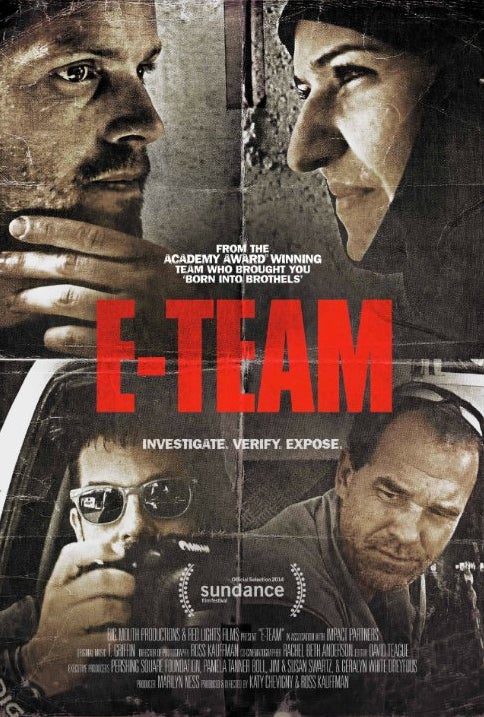
Yesterday I referred to the upcoming Human Rights Watch Film Festival in June. One of the films shown there will also appear on Netflix and therefore be able to reach a much larger audience. Interesting development for human rights films!!
The Associated Press reported on May 8 that Netflix Inc. had purchased E-TEAM as a high-profile “Netflix original,” and would distribute the film via its vast online platform as well as through a limited theatrical release in the United States. The film focuses on four researchers in the Human Rights Watch emergencies division, or E-Team, as they interview witnesses and gather other evidence of rights abuses and war crimes in Syria, Libya, and Kosovo. It highlights the personal commitment required to stop human rights violations over the long term. The filmmakers, Ross Kauffman and Katy Chevigny, operated with full creative control and had free rein from Human Rights Watch to produce a “warts and all” portrait of human rights activists in the field. It is the first time filmmakers have documented Human Rights Watch’s work so extensively.
[The film has won numerous awards on the festival circuit, including for best cinematography at Sundance. Variety called it “a documentary that’s devastating, entertaining and inspiring in equal measure.”]
Former US intelligence contractor and whistleblower Edward Snowden’s latest allegations point to a very real risk that human rights defenders have been the targets of mass surveillance by the US and British spy agencies. Snowden, who is living in exile in Moscow, made the remarks this afternoon, 8 April 2014, via a videoconference link to the Parliamentary Assembly of the Council of Europe (PACE) in Strasbourg, France. When asked if the US National Security Agency (NSA) or its British counterpart Government Communications Headquarters (GCHQ) were actively spying on human rights organizations such as Amnesty International, Human Rights Watch and others, he said: “Without question, yes, absolutely …The NSA has in fact specifically targeted the communications of either leaders or staff members in a number of purely civil or human rights organizations of the kind described”.
A column in the South African City Press under the title “A chilling point of order for SA” written by Juliette De Rivero on 26 March 2014 makes a punchy statement about the disappointment felt all though the human rights movement when South Africa opted to support China’s point of order in the UN Council of Human Rights. In my post about this ‘court drama’ (reference below) I did not list all the countries coming out against allowing a moment of silence for the deceased Chinese human rights defender Cao Shunli and indeed the position of South Africa was in many way the most surprising, in de Rivero’s words: “…The South African delegate took the floor and warned that allowing the activists to proceed with the moment of silence would “create a dangerous precedent” that the council would not be able to sustain in the future.He noted that the action was “irregular and incompatible with the rules of procedure of this council”.South Africa’s choice to stand with the government that prevented Cao Shunli from participating in the UN came as a blow to the activist community – a community that was willing to stand up for Cao just as it had been willing to denounce the injustice of apartheid.South Africa’s concern that the moment of silence – not the death of the activist – was setting a bad precedent in the UN body sent such a chilling message to the human rights community that it should not be ignored…”
Let me add: That silence is a way of speaking should be clear to all, including South Africa, e.g. when on 6 December 2013 the General Assembly held a moment of silence to honour the memory of Nelson Mandela (“Madiba”).
(Cao Shunli, the Chinese activist who died in custody (c) Photograph: Reuters)
For those with an interest in how the UN Council deals with criticism – in this case of China – should follow the debate on the UN webcast (or see the video on demand later) [http://webtv.un.org/live-now/watch/25th-regular-session-of-the-human-rights-council/2178978642001/#]. What happened in short is that during the debate on the adoption of China’s UPR report on 20 March, the International Service of Human Rights (ISHR) called for a few moments of silence to remember Cao Shunli, the human rights defender who recently died in detention (see references below). China then invoked a point of order saying that speakers should make general statements and that did not include asking for silence. During a long procedural debate many views were expressed – mostly supportive of China – but some others clearly stating that freedom of speech included the right not to speak. The interpretation of the rules of procedure then seemed to lead to the conclusion that the UPR (Universal Periodic Review) should not be ‘politicized”….and that from the eminently political entities called Governments! Sensing that a majority would support it, China insisted on a ruling by the Chairman that this kind of intervention needs to be ruled out for the future. The big majority of States, fearing a ‘precedent-setting’, rejected even the compromise proposal by the Chair to discuss the issue further in the Bureau (at a later time) with a vote of 20 against 13 (and 12 abstentions). The World Organisation Against Torture (OMCT), the second NGO to get the floor, then continued the request for a minute of silence for Cao Shunli. This was of course again interrupted. So, the Council ended up supporting China’s tough stance, in spite of several other NGOs and a few countries coming out with strong support for the moment of silence.
When the FIDH then let one its member organisations (including the Campaign Against Tibet) speak on its behalf, the Chinese delegation (perhaps emboldened by its earlier success) decided to interrupt again asking that the FIDH only identifies itself and not its members. This led to another procedural debate on whether NGOs with consultative status are allowed to mention other NGOs that have no such status (a standing practice I should add, which was established far back in the 80s when Argentina tried – in vain – to stop the ICJ from letting an Argentinian lawyer, Emilio Mignone, to speak about the disappearance of his own daughter).
Perhaps there will be further debate on these procedural aspects, but it is unlikely that the UPR comes out of this as a serious innovation in dealing with human rights violations.
While the whole of the Syrian population suffers terribly, it is important to recognize that human rights defenders, activists, media and humanitarian workers have been particularly targeted for their work since the beginning of the Syrian uprising three years ago. Many have been arrested or abducted by either government forces and pro-government militias or by non-state armed groups. The channels for obtaining reliable information are drying up and that is certainly not a coincidence.
Now several international NGOs such as Amnesty International, the Euro-Mediterranean Human Rights Network, FIDH, Frontline Defenders, Human Rights Watch and Reporters Without Borders have come together to work jointly, with other international, regional and Syrian organizations, to campaign for the release of these Silenced Voices of Syria. The campaign is starting with the documentation of 37 emblematic cases.
This campaign will use a three-pronged strategy of 1. Research and Documentation, 2. Information/Sensitisation and 3/ Mobilization.
(High Commissioner for Human Rights Navi Pillay at the 25th session of the Human Rights Council. UN Photo/Jean-Marc Ferré)
Yesterday, 3 March 2014, the top UN functionaries opened the 25th session of the UN Human Rights Council with calls for the protection of members of civil society who pursue justice in their countries (a long euphemism for Human Rights Defenders).
“Streets, airwaves, entire countries are buzzing with demands for economic, social and political justice,” UN High Commissioner for Human Rights Navi Pillay said. Setting out this agenda and acknowledging the hard work that lay ahead in ensuring that all people enjoyed equal rights, Ms. Pillay emphasized the important role of civil society in those efforts. “We need to work together to ensure that the space, voice and knowledge of civil society is nurtured in all our countries,” she stressed. Recalling reports of what she labelled “intolerable” reprisals against people who coöperate with the UN’s human rights activities, she called for more action to protect them. “The UN itself is required to protect and support those who contribute to its work, often at great personal risk,” she said.
Secretary-GeneralBan Ki-moon added on this point that, “No one should have to risk their life for standing up and speaking out on violations of human rights and international humanitarian law.” Civil society was the representative of “We the Peoples,” as cited in the opening of the UN Charter, and that it must be able to carry out its vital work, “free of reprisals and intimidation.” In that context, the Secretary-General highlighted the “Rights Up Front” action plan that he launched last year to ensure that human rights considerations were the top priority in all UN activities. “This initiative seeks to ensure that the United Nations system leverages the full breadth of its mandates to protect people at risk,” he said. [https://thoolen.wordpress.com/2013/12/26/rights-up-front-presented-by-jan-eliason-it-is-irrefutable-that-serious-human-rights-violations-are-the-best-early-warning-of-atrocities/]
Interesting to note that while in Geneva, the Secretary-General met 4 NGOs: the International Service for Human Rights, Amnesty International, Human Rights Watch and the International Commission of Jurists. Their discussion certainly stressed human rights defenders and the importance of protecting them from attacks.
Here two recent examples of non-cooperation in relation to requests for access by international human rights mechanisms:
On 11 February 2014 five international human rights organisations issued a statement decrying Algeria’s lack of cooperation in allowing UN human rights experts and international human rights organizations to visit the country. Algeria may have joined the UN Human Rights Council in January 2014, but it has not agreed to visits by the UN Special Rapporteur on Torture and the Working Group on Enforced or Involuntary Disappearances, despite their repeated requests. Similarly the Algerian authorities have refused to grant visas to nongovernmental human rights organizations for several years. “Algeria remains the only country among its neighbors that generally restricts access to human rights organizations,” said Eric Goldstein, of Human Rights Watch. [The 5 NGOs making the appeal are Amnesty International, Euro-Mediterranean Human Rights Network, Human Rights Watch and the Observatory for the Protection of Human Rights Defenders, a joint program of the International Federation for Human Rights FIDH, and the World Organization Against Torture OMCT].
Today, 14 February it became known that the European Union Special Representative for Human Rights, Stavros Lambrinidis, was denied a request to visit prisoners during his visit to Egypt [he announced this on Twitter after meeting with Prosecutor General Hisham Barakat.] Lambrinidis described the refusal as a “direct contradiction” to the Ministry of Interior’s “press release promising greater openness to such visits”. Only two days earlier – amid mounting allegations of torture inside places of detention – the Ministry of Interior had issued a statement welcoming requests from NGOs wishing to visit prisons. [Lambrinidis held an open discussion with 30 human rights defenders from local and international NGOs earlier this week, stating that the Egyptian government must respect peaceful free expression and human rights communities.]
It sounds almost like a joke but it truly happened. On 9 February 2014 Ukrainian border officials barred a Russian human rights defender from entering the country, according to Human Rights Watch: Andrei Yurov, a member of Russia’s presidential human rights council and the Head of its permanent commission on human rights outside Russia, was deported to Russia upon his arrival at Borispyl airport in Kiev. Yurov was to meet in Kiev with Council of Europe Human Rights Commissioner Nils Muiznieks, and to work within the International Human Rights Defenders’ Group on the Situation in Ukraine, which was founded on December 1, 2013, in response to the November 30 police violence against peaceful protesters in Kiev.
“Yurov’s expulsion is an unprecedented and wholly regrettable step,” said Rachel Denber, deputy Europe and Central Asia director at Human Rights Watch. “Instead of driving out human rights defenders the Ukrainian government should be open to scrutiny of its human rights record during this crisis.”
The United Arab Emirates [UAE] authorities have refused to allow Sarah Leah Whitson, Middle East and North Africa director of Human Rights Watch, to enter the country on 24 January, 2014, for a planned two-day visit to Dubai. The move followed the country’s forced cancellation on 23 January of a Human Rights Watch news conference to release its annual World Report 2014 in the UAE. Whitson had traveled to the UAE on numerous occasions.“These petty tactics by the UAE authorities to muzzle Human Rights Watch only demonstrate the government’s intolerance of free speech and fear of critical discussion,” said Kenneth Roth, executive director. “Human Rights Watch will continue to document abuses in the UAE and to urge the government to comply with its most basic human rights obligations.” “While UAE newspapers regularly use the work of Human Rights Watch from around the world, it’s a pity the government can’t tolerate any review of its own record,” Roth added.
 The Associated Press reported on May 8 that Netflix Inc. had purchased E-TEAM as a high-profile “Netflix original,” and would distribute the film via its vast online platform as well as through a limited theatrical release in the United States. The film focuses on four researchers in the Human Rights Watch emergencies division, or E-Team, as they interview witnesses and gather other evidence of rights abuses and war crimes in Syria, Libya, and Kosovo. It highlights the personal commitment required to stop human rights violations over the long term. The filmmakers, Ross Kauffman and Katy Chevigny, operated with full creative control and had free rein from Human Rights Watch to produce a “warts and all” portrait of human rights activists in the field. It is the first time filmmakers have documented Human Rights Watch’s work so extensively.