Posts Tagged ‘HRW’
November 27, 2014
This blog has always had keen interest in awards and in celebrities abusing their reputation. The current row over Tony Blair receiving an award from Save the Children USA as described by Katie Nguyen of Reuters on 26 November 2014 is exactly at the crossroads of these two interest.
(former British Prime Minister Tony Blair at International donors conference on October 12, 2014.
CREDIT: REUTERS/MOHAMED ABD EL GHANY/FILES)
Save the Children’s U.S.A chapter gave its annual Global Legacy Award to former British prime minister Tony Blair last week. It stated that it was to recognise Blair’s role in persuading the G8 to agree to debt relief of $40 billion for the poorest nations. Staff working for the charity were furious about the award, the Guardian newspaper reported and more than 100,000 people have signed a petition demanding that Save the Children revoke the award.
Read the rest of this entry »
Posted in awards, HRW, human rights, Human Rights Defenders | Leave a Comment »
Tags: awards, celebrities, children, controversy, Guardian, HRW, human rights award, Kanye West, Katie Nguyen, Kazakhstan, Kenneth Roth, Nursultan Nazarbayev, Reuters, Save the Children, Save the Children USA, Tony Blair
October 17, 2014
Pamela Constable describes with passion in the Washington Post of 14 October 14 the work of the Colibri Center for Human Rights in Tucson as recipient of one of the three Letelier-Moffitt Human Rights Awards of 2014. The other awards go to veteran international human rights lawyer Juan Mendez and Mesoamerican Women Human Rights Defenders, a nonprofit based in Mexico City that assists women in Mexico and Central America who are involved in defending social and human rights. Juan E. Mendez, 69, is a well-known human rights defender and now U.N. special rapporteur on torture human rights official. He was born in Argentina, jailed for defending political prisoners and then exiled after an international campaign. He worked for many years for human rights NGOs, especially Human Rights Watch.
The regional awards, given by the Institute for Policy Studies, are named for the two victims of a 1976 car bombing in which former Chilean diplomat Orlando Letelier and his American assistant Ronni Moffitt were assassinated by agents of Chile’s military regime.
via Letelier-Moffitt Human Rights Awards go to border activists, lawyer, Latina organizers – The Washington Post.
Posted in awards, human rights, Human Rights Defenders | Leave a Comment »
Tags: awards, Chile, HRW, human rights award, Human Rights Defenders, Immigration, Juan Mendez, Letelier-Moffitt Human Rights Awards, Mesoamerican Human Rights Defenders' Initiative, Mesoamerican Women Human Rights Defenders, Mexico, regional award, the Washington Post, UN Special Rapporteur, USA, women human rights defenders
October 1, 2014
In a Q&A released on 29 September, Human Rights Watch addresses some of the recurring criticisms of the Human Rights Act and the European Convention.
The Q&A responds to the criticism that human rights make it difficult to deport foreigners who have committed serious criminal offences. In fact, the UK already has legal powers to deport foreigners convicted of a serious criminal offence, but human rights law prohibits the deportation of a person in the limited cases where they would face a real risk of death, torture, or ill-treatment in the country of destination or have no prospect of a fair trial. Courts can also block a deportation if there would be a serious adverse impact on the deportee’s family, but in reaching such decisions courts must weigh the potential harm to the individual, the individual’s family (who may be British citizens), and the impact on society if he or she were allowed to remain.
The Q&A also addresses the criticism that the Human Rights Act is undemocratic. If a domestic court finds a UK law to be inconsistent with the Human Rights Act, it cannot strike down that law. It can only note that incompatibility and it is then for parliament to decide whether and how to change the law, in comparison to many other democratic countries where courts can strike down laws. As a last resort, people who invoke those rights unsuccessfully before UK judges can still seek to take their case to the court in Strasbourg, an arrangement approved by British governments for many decades.
The European Convention and the rulings of the European Court of Human Rights are binding on governments across the 47 countries that are part of the Council of Europe. The European Court has played a key role in protecting the rights of 800 million people across the Council of Europe region. Its rulings have been instrumental ending torture in police custody, ensuring victims of abuses by state authorities have access to justice and allowing people to express themselves freely. In many countries the court offers the only meaningful chance for justice for those whose rights are abused.
Reaffirming human rights at home is essential for any UK government that seeks to promote respect for human rights around the world. If the UK is to have any credibility on human rights in its foreign policy, it should strengthen, not weaken, its own human rights protections, Human Rights Watch said.
Attacks in the UK on the European Court of Human Rights undermine those efforts and provide succor to abusive governments in the Council of Europe that would prefer to ignore the European Court. The only European country currently not a member of the Council of Europe is Belarus. The only country to have withdrawn from the ECHR was Greece in 1969, while it was under a military dictatorship.
“The UK’s withdrawal from the European Convention would be welcomed by abusive governments everywhere,” Leghtas said. “But it would gravely weaken an institution that has done so much to safeguard and advance basic freedoms across Europe and it would destroy the credibility of the UK when discussing human rights internationally.”
UK: Parties Should Commit to Rights | Human Rights Watch.
Posted in HRW, human rights | 1 Comment »
Tags: anti-terrorist laws, binding international law, complaint procedure, deportation, Europe, European Convention, European Convention on Human Rights, HRW, Human Rights Act (UK), Human Rights Watch, Izza Leghtas, political debate, UK, withdrawal
August 22, 2014
Gulnara Karimova (pictured above), the glamorous daughter of Uzbekistan’s president, used to be one of the more powerful people in Central Asia. But now, in secret recordings obtained by the BBC, she says she and her teenaged daughter are being treated “worse than dogs” and need urgent medical help since she has fallen out with her dictator father President Islam Karimov. The BBC news correspondent Natalia Antelava on 21 August reports on this exceptional story. Natalia Antelava reports that in March 2014, she received and authenticated a handwritten letter from Karimova, in which she said she and her daughter had been placed under house arrest and now the short audio recordings were smuggled out of Uzbekistan.
Uzbekistan has a history of human rights violations and Karimova has fully played her role in this sorry state of affairs (see e.g.
https://thoolen.wordpress.com/2011/07/04/daughter-of-uzbek-dictator-loses-defamation-case-in-paris/. Stroehlein of Human Rights Watch (which will publish next month a report on wrongfully imprisoned people in the country) is understandably cautious when it comes to Karimova’s recent concern for human rights in Uzbekistan, since it follows a decade-long period when the woman known as “
Googoosha” wielded immense power in the country. “
She almost certainly had top-level regime access to critical information regarding serious and systematic rights abuses in Uzbekistan, and she has had many opportunities to hand that information over to journalists and human rights groups,” he says .
“She hasn’t.” Read the rest of this entry »
Posted in HRW, human rights | 1 Comment »
Tags: BBC, dictatorship, Googoosha, Gulnara Karimova, House arrest, HRW, human rights groups, human rights in Uzbekistan, Islam Karimov, Karimova, MEA Laureate 2008, Mutabar Tadjibayeva, Natalia Antelava, President Islam Karimov, Stroehlein, Uzbekistan
August 18, 2014
An array of international human rights organisations have over the last weeks focused on Azerbaijan. These four reports together give a shocking picture of the kind of repression that awaits human rights defenders: Read the rest of this entry »
Posted in Civil Rights Defenders (NGO), Front Line, HRW, human rights, Human Rights Defenders | 4 Comments »
Tags: Abdul Abilov, Azerbaijan, blogger, Civil Rights Defenders – Civil Rights Defenders, corruption, Council of Europe, Emin Huseynov, Extractive Industries Transparency Initiative (EITI), foreign funding, freedom of association, Front Line (NGO), HRW, Human Rights Defenders, Human Rights House Foundation, Intigam Aliyev, journalists, Leyla Yunus, Rasul Jafarov, resource extraction
May 31, 2014
I announced the HRW film festival in an earlier post [https://thoolen.wordpress.com/2014/05/13/human-rights-watch-film-festival-celebrates-25th-anniversary-with-5-films-on-human-rights-defenders/] but now that the Huffington post of 31 May 2014 has listed the 10 films it says every human rights defender should see, I gladly share their pick:
1. Sepideh — Reaching for the Stars (Denmark/Iran/Germany/Norway/Sweden) The story of a teenage girl named Sepideh, living in a rural village outside of Tehran, who dreams of becoming a famous astronomer. The documentary tackles gender roles in Iran while showcasing one young woman’s ambition and strength in the face of her family’s discouragement, university pitfalls and societal expectations. Directed by Berit Madsen. [youtube https://www.youtube.com/watch?v=wTzbIc6oiqs?wmode=opaque]
2. Dangerous Acts Starring the Unstable Elements of Belarus (US/UK/Belarus) Made up of smuggled footage and uncensored interviews, this documentary gives audiences a glimpse into Belarus’ dissident movement as it takes the shape of stage performances and public activism. Directed by Madeleine Sackler. [youtube https://www.youtube.com/watch?v=LGALySJ3O24?wmode=opaque]
3. Lady Valor: The Kristin Beck Story (US) A veteran shares her story moving from one identity, a former U.S. Navy Seal named Chris Beck, to another, a transgender woman named Kristen Beck. Directed by Sandrine Orabona. [youtube https://www.youtube.com/watch?v=r21OdLSTfQY?wmode=opaque]
4. A Quiet Inquisition (US) Here you’ll meet OBGYN Dr. Carla Cerrato, who must navigate the perilous territory of Nicaragua’s anti-abortion policies, which prohibit abortion, even in cases of rape, incest, or when a woman’s life is at stake. Directed by Alessandra Zeka and Holen Sabrina Kahn.
5. Scheherazade’s Diary (Lebanon) This “tragicomic documentary” follows women inmates in Lebanon as they stage a theater/drama therapy project titled “Scheherazade in Baabda,” revealing personal stories of domestic violence, failed relationships and traumas associated with motherhood. Directed by Zeina Daccache. [youtube https://www.youtube.com/watch?v=5VnZGmd6EMg?wmode=opaque]
6. Siddharth (Canada/India) One father’s desperate journey to locate his son, a 12-year-old boy who was sent to work in another province to support his family, but did not return and is feared to have been kidnapped or trafficked. Directed by Richie Mehta.
7. The Supreme Price (US) The film covers the evolution of the Pro-Democracy Movement in Nigeria and efforts to increase the participation of women in leadership roles. Directed by Joanna Lipper.
8. Private Violence (US) Questioning the accepted discourse on domestic violence, the documentary introduces audiences to two women survivors who advocate for justice while exploring “the fact that the most dangerous place for a woman is her home.” Directed by Cynthia Hill.
9. The Beekeeper (Switzerland) This is the touching story of Ibrahim Gezer, a Kurdish beekeeper from southeast Turkey who, robbed of his family, possessions and 500 bee colonies, moves to Switzerland to make a new life. Directed by Mano Khalil.
10. Abounaddara Collective Shorts from Syria (Syria) The Abounaddara Collective is a group of filmmakers who came together in 2010 to help provide an alternative image of Syrian society, one not seen in mainstream media. This portion of the festival will showcase 90 minutes of their short films.
The Human Rights Watch Film Festival will run from June 12 to June 22, 2014. See a complete schedule of screenings here.
10 Films Every Human Rights Advocate Should Watch.
Posted in films, HRW, human rights, Human Rights Defenders | Leave a Comment »
Tags: awareness raising, Belarus, Documentary film, film festival, films, HRW, Huffington Post, Human Rights Defenders, human rights film festival, Human Rights Watch, images, New York, YouTube
May 27, 2014
On 27 May RIA Novosti picked up the press release by Human Rights Watch calling for four prominent human rights defenders allegedly in custody of an armed opposition group in Syria to be immediately released. HRW together with 45 co-signing organizations states that irregular armed opposition groups in Syria are threatening and harassing journalists and human rights defenders.“Abductions of human rights defenders by armed groups in Syria are an assault on the very freedoms the armed opposition groups claim to be fighting for”. Almost six months a group of armed men kidnapped human rights defenders Razan Zeitouneh [or Zaitouneh], Wael Hamada, Samira Khalil, and Nazem Hammadi in a city outside Damascus, then controlled by a number of armed opposition groups, but there has been no information on the status or whereabouts of Zeitouneh and her colleagues, and no group has claimed responsibility for their abduction.
See previous post with video message by Zaitouneh: https://thoolen.wordpress.com/2014/01/27/human-rights-defender-razan-zaitouneh-still-missing-in-syria-after-one-month/
via HRW Demands Syrian Militants Release Rights Defenders Working to Expose Rebel Abuses | World | RIA Novosti.
Posted in films, HRW, human rights, Human Rights Defenders | Leave a Comment »
Tags: disappearances, freedom of expression, HRW, Human Rights Defenders, Human Rights Watch, journalists, kidnapping, Razan Zaitouneh, Razan Zeitouneh, rebel groups, reporting, RIA Novosti, Syria
May 22, 2014
On Tuesday 27 May 2014, will take place a Conference on the human rights situation in Belarus, from 14h00 –17h00 in the International Conference Centre in Geneva (room 3)
Speakers include:
- Florian Irminger, Human Rights House Foundation
- Tatsiana Reviaka, Human Rights Centre “Viasna” and Belarusian Human Rights House
- Aleh Hulak, Belarusian Helsinki Committee
- Anna Gerasimova, Belarusian Human Rights House
- Volodymyr Yavorskyy, Working group on the development of the Guidelines on Definition of Political Prisoner
- Andrzej Poczobut, journalist
- Nicolas Agostini, International Federation for Human Rights (FIDH)
- Andrei Paluda, Human Rights Centre “Viasna”
- Pavel Levinau, Belarusian Helsinki Committee
- Natallia Pinchuk, wife of Belarus political prisoner Ales Bialaitski
- Marina Adamovich, wife of Belarus political prisoner Mikola Statkevich
For more information contact: anna.innocenti[at]humanrightshouse.org
The meeting is cosponsored by Amnesty International, Human Rights Watch, FIDH, Civicus, Belarusian Human Rights House and the Human Rights House Foundation.
Posted in AI, FIDH, HRW, Human Rights Defenders | Leave a Comment »
Tags: AI, Ales Bialaitski, Anna Gerasimova, Belarus, Belarusian Human Rights House, CIVICUS, conference, FIDH, Geneva, HRW, Human Rights House Foundation, human rights situation, meeting, political prisoners, Viasna Human Rights Centre
May 18, 2014
In a 28-page report, Under Attack: Violence against health workers, patients and facilities, Human Rights Watch and the Coalition “Safeguarding Health in Conflict” highlight recent attacks in countries around the world. Major examples include the targeted killing of more than 70 polio vaccination workers in Pakistan and Nigeria; the arrests of health workers for providing care to protesters in Bahrain and Turkey; the bombing of hospitals and deaths of hundreds of patients and health workers in Syria; and attacks targeting health workers in South Sudan and Afghanistan. The report is released in advance of a meeting from 19-24 May 2014, of health ministers from around the world.
Posted in books, HRW, Human Rights Defenders | Leave a Comment »
Tags: Afghanistan, Bahrain, conflict, HRW, Human Rights Defenders, humanitarian workers, Nigeria, Pakistan, patients and facilities, polio vaccination, right to health, Safeguarding Health in Conflict Coalition, South Sudan, Syria, Turkey, UN, Under Attack: Violence against health workers, war
May 14, 2014
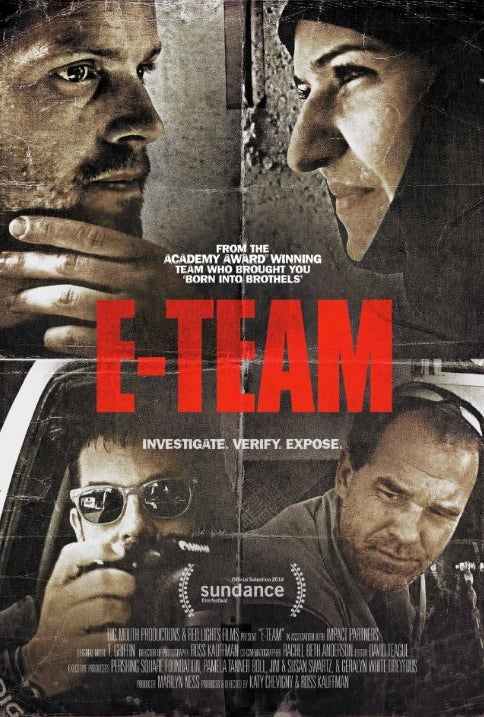
Yesterday I referred to the upcoming Human Rights Watch Film Festival in June. One of the films shown there will also appear on Netflix and therefore be able to reach a much larger audience. Interesting development for human rights films!!
Posted in films, human rights, Human Rights Defenders | Leave a Comment »
Tags: Documentary film, E-team, film, HRW, Human Rights Defenders, human rights film festival, human rights films, Human Rights Watch, images, Kosovo, Libya, monitoring, Netflix, Syria