Posts Tagged ‘Geneva’

China’s tactics to block voices of human rights defenders at the UN – major report

April 28, 2025

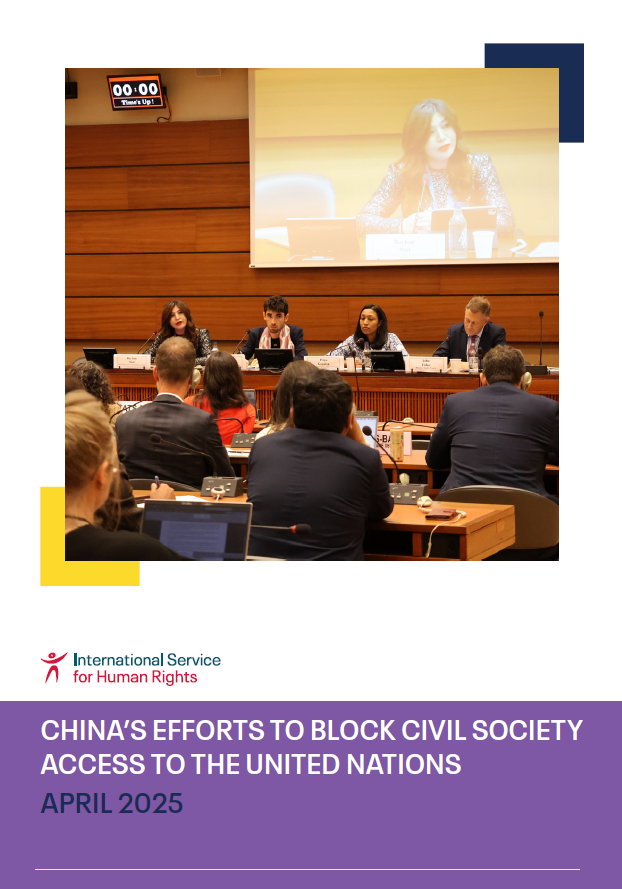
In a new report, ISHR analyses China’s tactics to restrict access for independent civil society actors in UN human rights bodies. The report provides an analysis of China’s membership of the UN Committee on NGOs, the growing presence of Chinese Government-Organised NGOs (GONGOs), and patterns of intimidation and reprisals by the Chinese government.

In the report, published on 28 April 2025 the International Service for Human Rights (ISHR) uncovers the tactics deployed by the Chinese government to restrict access to UN human rights bodies to independent civil society actors and human rights defenders, and intimidate and retaliate against those who do so.  

These tactics include using its membership of the UN Committee on NGOs to systematically defer NGO applications, increasing the presence of GONGOs to limit space for independent NGOs and advance pro-government narratives, systematically committing acts of intimidation and reprisals against those seeking to cooperate with the UN, weaponising procedural tactics to silence NGO speakers and threatening diplomats not to meet with them, and opposing reform initiatives and efforts at norm-setting on safe and unhindered civil society participation at the Human Rights Council. 

These tactics strongly contrast China’s stated commitment to being a reliable multilateral leader. They stem from the Chinese Party-State’s primary foreign policy objective of shielding itself from human rights criticism and enhancing its international image by restricting and deterring critical civil society voices, crowding out civil society space with GONGOs, and stalling and diverting reform initiatives. 

While China is the focus of this report, the issues addressed are systemic. Based on this report’s findings, ISHR puts forward a set of targeted recommendations to UN bodies and Member States, aimed at protecting civil society space from interference and restrictions. The recommendations are designed to strengthen UN processes and prevent any State from manipulating international mechanisms to suppress independent voices. These include: 

  • Reforming the Committee on NGOs to increase transparency, limit abuse of deferrals, and ensure fair access to UN bodies for independent NGOs;
  • Strengthening protection mechanisms against reprisals, including rapid response to incidents inside UN premises, public accountability for perpetrators, and consistent long-term follow-up on unresolved cases; 
  • Curbing the influence of GONGOs by distinguishing clearly between independent and State-organised NGOs, and better documenting their presence and impact; and, 
  • Strengthening measures at the Human Rights Council and other UN bodies to make civil society participation safer, more inclusive, and less vulnerable to obstruction

The report has been featured prominently in a global investigation by the International Consortium of Investigative Journalists (ICIJ) launched on 28 April 2025.

See also the earlier report in February 2023: https://humanrightsdefenders.blog/2023/02/08/ngo-report-on-chinas-influencing-of-un-human-rights-bodies/

https://ishr.ch/defenders-toolbox/resources/un-access-china-report

https://www.france24.com/en/live-news/20250428-china-deploys-army-of-fake-ngos-at-un-to-intimidate-critics-media-probe

Strange case of inter-arab feud by using HRDs in Geneva

April 3, 2025

Watan News on 30 March 2025 came with a rather remarkable story about the UAE’s covert efforts to damage Qatar and Saudi Arabia’s reputations through paid campaigns using African NGOs Human rights sources in Geneva. Whether this is all true or not I cannot say, but it is worth reporting on.

Watan writes that “human rights circles in Geneva’ have revealed the United Arab Emirates’ involvement in leading coordinated incitement campaigns against its adversaries, using African organizations in exchange for financial bribes to attack Abu Dhabi’s opponents and whitewash its own dire human rights record. According to the source, Abu Dhabi’s campaign aims to bring in so-called “victims,” such as migrant workers, to testify before the UN Human Rights Council in an effort to damage Qatar’s international reputation.

Reliable reports indicate that the UAE has continuously funded this campaign over the past three years. Several human rights organizations and active institutions in Geneva have reportedly received large sums of money to support anti-Qatar activities. The funds are reportedly channeled through the UAE Embassy in Geneva and a key intermediary, Issa Al-Arabi, a Bahraini national who acts as a liaison for the UAE in supporting various rights groups at the UN.

According to the source, the campaign is being executed by the Rencontre Africaine pour la Défense des Droits de l’Homme (African Meeting for the Defense of Human Rights) under the leadership of Nishkarsh Singh, along with the Tomoko Development and Cultural Union (TACUDU) led by Fazal-ur-Rehman, and the International Network for Human Rights (INHR).

Another UN source said that the UAE’s campaign is coordinated by key figures within the diplomatic and human rights community in Geneva and Washington, primarily operating within the INHR network.

This organization plays a major role in organizing human rights events at the UN, with a team of participating legal and diplomatic experts.

Notable individuals involved include:

  • Biro Diawara – A veteran human rights activist in Geneva for over 20 years, representing African civil society including journalists, parliamentarians, religious leaders, and human rights defenders. He has strong ties to African delegations in New York, Geneva, and the continent, with a focus on Sudan, West Africa, and his native Guinea.
  • Clément N. Voule – Former UN Special Rapporteur on the Rights to Freedom of Peaceful Assembly and of Association. After completing his term in the summer of 2024, he joined the Geneva Human Rights Institute in September. A Togolese international lawyer, he specializes in human rights and security sector reform and holds multiple roles within Geneva’s human rights community.
  • Jane Galvão – Director of Resource Mobilization at INHR and Global Health Advisor. With over 20 years of experience managing health programs, she has worked on infectious diseases and women’s and children’s health, managing over $750 million in funding for organizations like UNITAID and WHO.
  • Eric N. Richardson – Founding President of INHR. A former U.S. diplomat and attorney, he led the U.S. team at the UN Human Rights Council in Geneva from 2013 to 2016. With experience in countries like China, North Korea, Libya, Tunisia, New Zealand, and Israel, he now focuses on mediation efforts with Amnesty International and teaches law at the University of Michigan and UC Berkeley.
  • John Shyamana – Expert in Social and Economic Rights, New York. With over 30 years of experience, he specializes in child policy, labor rights, and social welfare, having worked with the U.S. Congress and state legislatures on legislative and advocacy efforts.
  • Kumar – Senior Human Rights Advisor, Washington D.C. Former Advocacy Director for Amnesty International USA. With more than two decades of experience, he has championed human rights and humanitarian causes worldwide, particularly in Asia, Afghanistan, and Myanmar.
  • Jeff Landsman – Managing Director and Treasurer at INHR. A certified financial planner and seasoned international buyer, he oversees the institute’s financial operations and strategic planning.
  • Asel Alimbayeva – Program Officer and Director, INHR Geneva. Fluent in English, French, Russian, and Kazakh. She has worked at the UN Office in Geneva and Kazakhstan’s Permanent Mission, leading social media and HR operations at the institute.
  • Pedro Cherinos Terrones – Legal Advisor, Lima. A Peruvian lawyer specializing in international trade, business law, human rights, and compliance with international law.
  • Sean Wessing – AI and Innovation Specialist, Bologna. Holds dual Master’s degrees from SAIS–Johns Hopkins and Bologna Business School. Leads fundraising and AI governance projects at INHR.
  • Zaf Haseem – Videographer and Reconciliation Specialist, Asia. A conflict mediator who has worked in Sri Lanka, Burma, Indonesia, and the Central African Republic, using film as a training tool for peacebuilding.

UAE’s Smear Campaign Targeting Qatar and Saudi Arabia

Diplomatic sources indicate that the UAE is recruiting African civil society organizations to conduct media and human rights attacks against Qatar. These efforts are expected to intensify during the UN Human Rights Council sessions in June and September 2025, with a major campaign planned for the September session. Additionally, the UAE is reportedly preparing similar activities within the African Union Commission, targeting both Qatar and Saudi Arabia as part of its escalating geopolitical rivalry in Africa.

These developments underscore rising regional tensions in Africa, where the UAE is leveraging human rights tools and diplomatic influence to advance its political agenda.

They also raise serious concerns about the independence of some Geneva-based human rights organizations, which are increasingly being used as instruments of political influence rather than neutral advocacy.

https://www.watanserb.com/en/2025/03/30/uae-accused-of-funding-smear-campaigns-through-african-ngos/?amp=1

Side event 7 March 2025 on Protection of defenders against technology-facilitated rights violations

February 25, 2025
  • Location: Physical
  • Date: 07 March 2025
  • Time: 1:00PM – 2:00PM CET
  • Address: Room XXV, Palais des Nations
  • Event language(s) English
  • RSVP Needed: no

New and emerging technologies have become a fundamental tool for human rights defenders to conduct their activities, boost solidarity among movements and reach different audiences. Unfortunately, these positive aspects have been overshadowed by negative impacts on the enjoyment of human rights, including increased threats and risks for human rights defenders. While we see the increased negative impacts of new technologies, we do not see that governments are addressing these impacts comprehensively.

Furthermore, States and their law enforcement agencies (often through the help of non-State actors, including business enterprises) often take down or censor the information shared by defenders on social media and other platforms. In other cases, we have seen that businesses are also complicit in attacks and violations against human right defenders.

Conversely, lack of access to the internet and the digital gaps in many countries and regions, or affecting specific groups, limits the potential of digital technologies for activism and movement building, as well as access to information. 

The Declaration on Human Rights Defenders, adopted in 1998, does not consider these challenges, which have largely arisen with the rapid evolution of technology. In this context, and, as part of activities to mark the 25th anniversary of the UN Declaration on human rights defenders, a coalition of NGOs launched a consultative initiative to identify the key issues faced by human rights defenders that are insufficiently addressed by the UN Declaration, including on the area of digital and new technologies. These issues are also reflected in the open letter to States on the draft resolution on human rights defenders that will be considered during HRC58. 

This side event will be an opportunity to continue discussing the reality and the challenges that human rights defenders face in the context of new and emerging technologies. It will also be an opportunity to hear directly from those who, on a daily basis, work with defenders in the field of digital rights while highlighting their specific protection needs. Finally, the event will also help remind States about the range of obligations in this field that can contribute to inform the consultations on the HRC58 resolution on human rights defenders. 

Panelists:

  • Opening remarks: Permanent Mission of Norway
  • Speakers:
    • Carla Vitoria – Association for Progressive Communications 
    • Human rights defender from Kenya regarding the Safaricom case (via video message)
    • Woman human rights defender from Colombia regarding use of new technologies during peaceful protests
    • Human rights defender from Myanmar regarding online incitement to violence against Rohingya people
  • Video montage of civil society priorities for the human rights defender resolution at HRC58
  • Moderator: Ulises Quero, Programme Manager, Land, Environment and Business & Human Rights (ISHR)

This event is co-sponsored by Access Now, Asian Forum for Human Rights & Development (FORUM-ASIA), Association for Progressive Communications (APC), Business and Human Rights Resource Centre (BHRRC), DefendDefenders (East and Horn of Africa HRD Project), Huridocs, Gulf Centre for Human Rights (GCHR), International Lesbian, Gay, Bisexual, Trans and Intersex Association (ILGA World), International Service for Human Rights (ISHR), Peace Brigades International, Privacy International, Protection International,  Regional Coalition of WHRDs in Southwest Asia and North Africa (WHRD MENA Coalition). 

for the report, see: https://ishr.ch/latest-updates/human-rights-defenders-and-new-emerging-forms-of-technology-a-blessing-or-a-curse/

https://ishr.ch/events/protection-of-defenders-against-new-and-emerging-forms-of-technology-facilitated-rights-violations

Urgent vacancy at FIDH for Delegate to the United Nations in Geneva

January 15, 2025

Posted on 6 January 2025 – Closing date 15 January 2025

The International Federation for Human Rights (FIDH) is an international non-governmental organisation (NGO) composed of nearly 200 national human rights organisations from more than 115 countries. FIDH is a nonpartisan, non-sectarian, apolitical, and not for profit organisation. Since 1922, FIDH has been defending all human rights – civil, political, economic, social, and cultural – as set out in the Universal Declaration of Human Rights.

https://www.fidh.org/en

FIDH are now recruiting : A Delegate to the United Nations (F∕M) – Indefinite-term contract based in FIDH Geneva office

The FIDH’s Delegation in Geneva

  • Represents FIDH before Geneva-based international organizations and institutions, the Office of the United Nations High Commissioner for Human Rights (OHCHR); in particular, the UN Human Rights Council (HRC) and the UN Human Rights Treaty Bodies;
  • Organizes the participation of FIDH’s member and partner organizations in the work of UN human rights bodies and mechanisms (support and assistance with regard to the submission of “parallel” or “alternative” reports, lobbying and advocacy, communication, etc.): mainly the UN Human Rights Council (including the Universal Periodic Review (UPR) mechanism), treaty monitoring bodies, and special procedures;
  • Prepares and implements the interventions of lobbying and advocacy at the Human Rights Council, and defines advocacy strategies;Feeds UN human rights protection bodies and mechanisms, in particular UN special procedures and OHCHR’s sections and branches, based on information from FIDH member and partner organizations and develops the strategic analysis of institutional developments and advocacy opportunities;

Relays and reports on activities and events to FIDH’s International Secretariat based in Paris.

Direct superviser : The representative, Head of the FIDH Delegation to the United Nations in Geneva

Applicants should send their CV and a brief cover letter (in English) by email recrutement@fidh.org quoting reference FIDH DELEGATE in the subject line.

https://reliefweb.int/job/4122938/delegate-united-nations-indefinite-term-contract-based-fidh-geneva-office

Call for Nominations Martin Ennals Award 2025

December 14, 2024

The Martin Ennals Award for Human Rights Defenders honors individuals and organizations who have shown exceptional commitment to defending human rights, despite the risks involved. The Martin Ennals Award aims to support the tireless struggles of these activists.[For more on the award and its laureates, see: https://www.trueheroesfilms.org/thedigest/awards/043F9D13-640A-412C-90E8-99952CA56DCE]

To qualify for the Award 2025, the nominees must:

  • Be currently active in the promotion and protection of human rights
  • Not employ or advocate violence
  • Not be self-nominated
  • Be in need of protection

We encourage nominations of activists under 30 years of age to reflect the growing number of young persons joining the human rights movements in their countries. Post-humous nominations are not eligible. The deadline for nominations is open ended for now. Nominees must also read and acknowledge the Martin Ennals Foundation Ethical Guidelines.

Nominate your human rights champion now by filling out the nomination form
(available in ENGLISH, FRENCH) and send it to info@martinennalsaward.org.

Nomination form in English

Nomination form in French

The Martin Ennals Award is a unique collaboration between ten of the world’s leading human rights organizations, who form the independent Jury that selects winners of the Award. In the first half of each year, a nomination cycle takes place over several months, at the end of which the winners of the Martin Ennals Award — or Laureates — are selected by the Jury. The names of the Laureates will be publicly announced to the public shortly before the ceremony. Mark your calendar for the Award Ceremony 2025 which will take place in the third trimester of the year in Geneva.

Learn more about the nomination process and our ethical guidelines here:

Ethical Guidelines and Code of Conduct

Download the document (PDF)

International Art Contest celebrates minority human rights defenders

December 1, 2024

27 November 2024, from UN Human Rights:

Mga Nalimutan [The Forgotten], inspired by a photography taken by Joe Galvez New York City, United States, 2017.

© Francis Estrada

The top awards for the 2024 International Contest for Minority Artists were presented to five award winners — Bianca Broxton, Joel Pérez Hernández, Francis Estrada, Laowu Kuang and youth laureate Jayatu Chakma — during a special ceremony in Geneva, Switzerland.

UN Human Rights partnered with civil society organizations, Freemuse, Minority Rights Group International, the City of Geneva, the Centre des Arts of the International School of Geneva, and with the support of the Loterie Romande. The theme, Memory in the Present, celebrates the creativity and cultural expression of minority artists whose artwork explores themes relating to memory and memorialization around the globe.

“Naturally, such collective identities will largely be grounded in a collective memory of events, generating or perpetuating values or traditions that shape the way persons belonging to a minority feel bound together by common experiences,” said Nicolas Levrat, United Nations Special Rapporteur on Minority Issues. “Such memories often define how and why these past experiences shared by persons belonging to a given minority (or by previous generations) make them singular, different from other groups.”

The winners and honourable mentions at the awards ceremony in Geneva, Switzerland (shown from left to right) — Francis Estrada, Maganda Shakul, Jayatu Chakma, André Fernandes, Bianca Broxton, Joel Pérez Hernández, Chuu Wai, Laowu Kuang. © OHCHR/Irina Popa

The contest serves as a platform for minority artists human rights defenders who play a key role worldwide to build bridges of understanding, dialogue and empathy through creative and artistic means. It celebrates minority artists who have made significant contributions to raise awareness, inspire action, and foster deeper understanding of human rights across diverse communities.

The Winners

Bianca Broxton in one of her performance pieces, A Conversation, in Boston, Massachusetts, USA. She invited audience members to engage in a dialogue about their personal relationships with hair, racism, and beauty, while she crocheted dreadlocks to add to the piece. © Bianca Broxton

Bianca Broxton is an American interdisciplinary artist who focuses on raising awareness of health inequalities among minority women in the United States. She frames historical narratives and memories around the marginalized voices using sculptures and collages to portray minorities with dignity and a focus on restorative justice.

“My experience as a Black woman drives me to tell the histories of those who have faced systemic oppression and to portray them positively. I refuse to have my subjects seen only as victims of systemic injustice,” she said.

Visual artist Laowu Kuang accepting his award at the ceremony in Geneva, Switzerland. © OHCHR/Irina Popa  

Laowu Kuang is a visual artist belonging to the Tibetan minority in China. Through a vivid interplay of colors and textures displayed on large canvases, his artwork navigates themes of memory and memorialization in contemporary China, through traditional Tibetan symbols and motifs.

“In contrast to Western painting, with its excessive color scale, and Han Chinese painting, with its muted and elegant concept of applying colors, Tibetan painting has a strong and intense contrast of colors,” he said. “The stone carvings of Tibetan folk art are a perfect combination of religion and nature, which is a communication and dialogue between human beings and gods, between heaven and earth.”

Joel Pérez Hernández is a visual and plastic artist from the Maya Tseltal people, born in the Lacandón jungle of Chiapas, Mexico. Hernández has dedicated years to studying traditional techniques and motifs with elder artisans and creators of his community.

“Much knowledge is asleep in our mountains, voices are trapped in the rivers, colors sleep under the stones, and in our collective memory, as well,” he said. “My people nourish me and motivate me to awaken all that; that is what I include in my works. I find no need to sign my pieces, because my people, my family, my friends make up the essence of each one of them.”

Born in the Philippines, Francis Estrada is a visual artist and educator, currently residing in the United States. Estrada’s artwork focuses on culture, history, and perception, and questions the influence of historical photographs, mass media, political propaganda, and personal archives on social narratives and collective memory.

“My art is a tool through which I confront how our understandings of culture are mediated, and the methods through which history and memory are created and perpetuated,” he said. “I think of my work as partial narratives for the viewers to complete based on their own experiences and associations.”

Youth laureate Jayatu Chakma is an artist belonging to the Chakma Indigenous community of the Chittagong Hill Tracts region in Bangladesh. His artwork features ink, acrylic, watercolor, and natural elements like mud and colors from leaves, as a way to reflect on the life of his community in relation with forced displacement and the loss of their lands.

“Chittagong Hill Tracts is a part of Bangladesh which represents a culture of variation in terms of people and landscape,” he said. “But there are stories hidden behind the decorated valleys of Chittagong Hill Tracts: my artworks are influenced by the stories of being displaced, losing belongings and relatives. I want to create artworks that show a different side of Chittagong Hill Tracts, besides its natural beauty and cultural diversity that we see on TV.”

https://www.ohchr.org/en/stories/2024/11/international-art-contest-celebrates-minority-human-rights-defenders

ISHR’s training for human rights defenders 2025:

November 27, 2024

Are you a human rights defender keen to use the UN to push for change at home? If so, apply for the 2025 edition of ISHR’s flagship training, the Human Rights Defender Advocacy Programme (HRDAP)!

After a successful edition in 2024, [https://humanrightsdefenders.blog/2023/11/07/human-rights-defender-advocacy-programme-2024-applications-now-open/] ISHR launches the call for applications for the 2025 Human Rights Defender Advocacy Programme (HRDAP25), which will take place both remotely and in Geneva! Below are some important dates to consider before applying:

  • Mandatory distance learning course: 14 April – 8 June 2025 (part time)
  • In-person course in Geneva: 10- 20 June 2025 (full time) 
  • Deadline to apply: 10 January 2025, midnight CET (Geneva Time)
  • Programme description with all the information can be downloaded here.
  • Application form can be found here. 

Learn more about why you should apply for HRDAP by watching this video!

What is the Human Rights Defender Advocacy Programme 2025 (HRDAP25)?

The course equips human rights defenders with the knowledge and skills to integrate the UN human rights system into their existing work at the national level in a strategic manner and provides an opportunity for participants to prepare for and engage in advocacy activities at the UN with the aim to effect change back home.  

Online course topics – ISHR

Defenders will complete a 10-week hybrid learning programme, online and offline, which will include: 

  • Accessing the HRDAP Platform, where they can complete e-learning courses on each key UN human rights mechanism and on advocacy strategies, and access interactive learning materials and case studies on the ISHR Academy 
  • Taking part in live Q&A sessions with human rights experts 
  • Receiving a continuous personalised advocacy support and coaching in order to develop concrete advocacy objectives to make strategic use of the international human rights system taking into account the local context
  • Building networks around the world, and learning from peers from a range of regions working on a range of human rights issues 
  • Applying their knowledge to case-studies scenarios and enhancing their advocacy toolbox according to their specific needs (elevator pitch, SMART recommendations…)
  • Receiving support and advocacy accompaniment to conduct activities during the 59th and 60th Human Rights Council sessions and other relevant opportunities. 

Participants will have the unique opportunity to apply their knowledge and skills while being in Geneva as well as to meet and share with their peers and experts (UN staff, diplomats, supporting NGOs…). The blended format of the course allows defenders to continue their vital work on the ground, while diving into the inner workings of each key UN human rights mechanism and gaining first-hand experience from advocates and UN staff on how civil society can strategically engage in the international human rights space.  The methodology we use is interactive and learner-centred and encourage participation of everyone.

By participating in HRDAP, defenders:

  1. Gain knowledge and tools, which they can use to ensure their voice is central in international human rights decision-making 
  2. Explore and compare the benefits of engagement with the Human Rights Council, the Special Procedures, the OHCHR, the Universal Periodic Review and the Treaty Bodies, and examine how they can use them to bolster their work at the national level 
  3. Develop strategies and advocacy techniques to increase the potential of their national and regional advocacy work 

This programme is directed at experienced human rights defenders working in non-governmental organisations, with existing advocacy experience at the national level and some prior knowledge of the international human rights system. 

ISHR supports, and promotes solidarity with and between, defenders working in the following areas or contexts, which we recognise as intersectional and interdependent: 

  1. Equality, dignity and non-discrimination
  2. Environmental justice and sustainability 
  3. International accountability for the repression of human rights defenders 
  4. Transparency and rule of law 

The hybrid programme will bring together around 16 committed human rights defenders from different backgrounds, who work on a wide range of areas that are linked with our programmes to ensure a sustainable collaboration. This can include, but is not limited to, defenders working on the following thematics: women rights; Indigenous people’s rights; the human rights of LGBTIQ+ persons; anti-racism; reclaiming civil society space and increasing protection of human rights defenders.  

What do former HRDAPers say? 

16 human rights defenders from 15 countries took part in the last edition, HRDAP24. At the end of the training, 98% of the participants were either extremely satisfied or very satisfied with the programme and felt that they would be able to apply what they learnt to their own day-to-day work. Find out more about the outcomes of HRDAP24 here. 

More testimonials from HRDAP Alumni here.  

How to apply?

First, download and read carefully the HRDAP 2025 Programme Description to find out more about modalities, requirements and funding. If you meet the criteria, take some time to apply using this online form before midnight Geneva time on Friday 10 January 2025! 

As only a limited number of human rights defenders are able to participate in HRDAP each year, in addition to our range of guides and handbooks, ISHR has developed an e-learning space in English, French and Spanish to help human rights defenders strengthen their advocacy skills with the UN for greater impact on the ground: the ISHR Academy. The learning modules demystify the UN human rights system and build capacity to push for change. Discover new tools, insider tips, defender stories, and more! 

For more information, please contact us: training@ishr.ch

https://ishr.ch/latest-updates/hrdap-2025-apply-now-for-ishrs-hybrid-training-for-human-rights-defenders

Save the date: MARTIN ENNALS AWARD 2024

November 5, 2024

Thirty two years ago, I and some other good friends of Martin Ennals decided to create an award in the name of this human rights pioneer [see: https://youtu.be/tAhUi2gOHmU?si=6RxI5TduzLfLeJym]. I am very proud and happy that in two weeks time I wil be in Geneva to participate in the 30th edition of the award ceremony. I very much hope that many others wil be able to join, in person or via the live-stream.

The Award was given out for the first time in 1994 to recognize, promote and protect human rights defenders at risk or from under-reported contexts. It culminates every year in a public ceremony in Geneva, co-hosted with the City of Geneva. Over the years, the Award has offered defenders a platform to issues that are of global concern and the connections to steer the movement for human rights and larger freedoms.

The Jury has recognized 53 defenders in the past 30 years, from 37 countries and from all walks of life: lawyers, journalists, academics, medical practitioners, religious practitioners, housewives, students and grassroots activists. Their voices have illustrated some of the most important human rights demands of the past decades: free and fair justice for violations committed by security forces; access to information and freedom of expression to denounce repressive practices and authorities; the fight against gender discrimination and the importance of women’s full and equal participation in society; the essential role of civil society in conflict and post conflict resolution; the role of businesses in exploiting natural resources against the rights to land of indigenous people; or the role of global powers in the violations of the right to life of migrants.

The 2024 Martin Ennals Award continues the legacy and will honour two outstanding human rights defenders who have made it their life mission to protect human rights in their communities and countries despite evolving in deeply repressive environments.

A public discussion with Jury members later in the evening of ceremony will also be the opportunity to showcase the issues that will shape the future of the Award.

Get to know the 2024 Laureates by joining our traditional Award ceremony on Thursday 21 November at 18:30 CET, in Salle communale de Plainpalais, Rue de Carouge 52, Geneva.

The ceremony, co-hosted together with the City of Geneva, is the opportunity to learn about the two 2024 Laureates: who they are, their aspirations and what they have been doing to bring human rights at the forefront. Their inspiring stories illustrate key human rights struggles that the world needs to hear, for peace, dignity and equality of all. The Award ceremony will be followed by a cocktail offered by the City of Geneva.

Register here

You cannot join in person? We got you! The ceremony and the debate will be livestreamed on our media platforms.

JURY INSIGHTS

A public discussion on current global issues

Festivities will continue on Thursday 21 November with a late-night discussion to celebrate the 30th anniversary of the Martin Ennals Award. Since 1994, it is the careful deliberations of the Jury that have led to the recognition of some of the most outstanding human rights defenders and organisations. The Foundation is pleased to offer a special opportunity to listen in the inner thoughts of leading organisations on the state of human rights in the world and how to reclaim them.

The one-hour discussion will start at 21:15 CET in Salle communale de Plainpalais, after the cocktail, and will be the occasion for a young human rights defender to ask everyone’s most burning questions!

Geneva Roadmap 40/11 series on 4 July: How are environmental defenders protected in the regions?

June 27, 2024

This event, organized on the occasion of the 56th session of the Human Rights Council and of the 28th Working Group of the Parties to the Aarhus Convention, as part of the Geneva Roadmap 40/11 series, provides a platform for experience sharing around with different protection mechanisms.

About this Session

Today, some specific instruments, such as the Aarhus Convention, regional processes and mechanisms are playing a growing and rapidly transforming role for environmental defenders in terms of new standards, collaborative efforts and plans. Yet, how effective are these instruments, processes and mechanisms in supporting and protecting environmental defenders in different parts of the world? What are the lessons in terms of the relevance and effectiveness of regional human rights and environmental protection mechanisms? How can ongoing experiences by civil society organizations and defenders help shape new and strengthened regional approaches? There is wide recognition of the different situations across regions as well as relevant lessons from ongoing initiatives.

On the occasion of both the 56th Session of the UN Human Rights Council and of the 28th Working Group of the Parties to the Aarhus Convention, on access to information, public participation and access to justice in environmental matters, this event will aim to gather views from various stakeholders on the question: “How are environmental defenders protected in the regions?”

Geneva Roadmap 40/11 Series

Five years ago, on 21 March 2019, the Human Rights Council adopted Resolution 40/11 – Recognizing the contribution of environmental human rights defenders to the enjoyment of human rights, environmental protection and sustainable development – without a vote.

Following the adoption of the resolution, platforms, coalitions and networks of defenders met in February 2020 to launch the Geneva Roadmap 40/11 to foster the implementation of this Resolution.

Building on previous Geneva Roadmap 40/11 efforts in relation to global human rights mechanisms, this year’s events organized by the University of Geneva, Earthjustice, the International Service for Human Rights, with the support of the Geneva Environment Network, will focus on the protection mechanisms provided at the regional level for environmental defenders.

To attend on-line, register with: https://ungeneva.webex.com/webappng/sites/ungeneva/meeting/register/3e557712421b4e8ead22641b4d3bab74?ticket=4832534b000000078514d3e000931fd016c9cc18835becb6ccd518f1a5e9a6bf63a5563f32a1a932&timestamp=1719521373667&RGID=r18b54211d7fc07219656ed6fdab82df1

https://www.genevaenvironmentnetwork.org/events/how-are-environmental-defenders-protected-in-the-regions-geneva-roadmap-40-11/#scroll-nav__3

Launch of the HRD Declaration+25

June 8, 2024

Wednesday 19 June 2024 from 1:00 pm- 2:00 pm CEST there will be a HRC56 Side Event for the launch of the Declaration+25, a civil society-led authoritative document endorsed by experts that supplements the UN Declaration on Human Rights Defenders and sets standards to protect them.

Palais des Nations Room XXV Geneva. This in-person event will be moderated by ISHR on behalf of a Secretariat of 18 organisations, and include a panel of exceptional human rights defenders.