Posts Tagged ‘film’

Transnational repression by China reaches New York

November 8, 2025

On 6 November 2025 Human Rights Watch issued a press release on how Chinese Police Harass Filmmakers, Families to Undermine Free Expression Abroad

9da2a6d2-e1fd-4b3d-a322-ba3c24f25b37
A still from Jiangnan Xu’s film “Friends from Jiangnan.” © Zhu Rikun

Chinese authorities harassed several dozen Chinese film directors and producers, as well as their families in China, causing them to pull films from the inaugural IndieChina Film Festival in New York City. On November 6, 2025, the festival’s organizer, Zhu Riku, announced that the film festival, scheduled for November 8-15, had been “suspended.”

The Chinese government reached around the globe to shut down a film festival in New York City,” said Yalkun Uluyol, China researcher at Human Rights Watch. “This latest act of transnational repression demonstrates the Chinese government’s aim to control what the world sees and learns about China.

Chiang Seeta, a Chinese artist and activist, reported that nearly all participating directors in China faced intimidation. Even directors abroad, including those who are not Chinese nationals, reported that their relatives and friends in China were receiving threatening calls from police, said Chiang.

On November 1, the organizers issued an announcement on social media saying they had received messages from some film directors and producers and their families about Chinese government harassment: “We are deeply concerned about the situation. … [I]f you are under pressure not to attend the festival … we fully understand and respect it.” By November 4, more than two-thirds of participating films had cancelled their screenings.

After the festival was suspended, Zhu issued a statement that the decision was not out of fear, but rather to “stop harassment of … directors, guests, former staff, and volunteers associated with the festival, including my friends and family.”

Independent film festivals in China have faced intensifying crackdowns over the past decade, Human Rights Watch said. The Chinese authorities have shut down all three major independent film festivals in China: Yunfest, founded in 2003; the China Independent Film Festival, founded in 2003; and Beijing Independent Film Festival, founded in 2006.

When the authorities shut down the last screening of the Beijing Independent Film Festival in 2014, they cut off electricity from the venue, confiscated documents from the organizer’s office, and forced the organizers to sign a paper promising not to hold the festival. Many festival organizers have tried without success to adapt, for instance by changing their format to screenings at multiple venues.

The 14th China Independent Film Festival was shuttered in 2018, the last time such a festival took place in China.

A court in January 2025 sentenced Chen Pinlin, known as Plato, to three-and-a-half years in prison for allegedly “picking quarrels and provoking trouble” after he made a documentary about the “white paper protests” during Covid-19 lockdowns. Transnational repression can be defined as government efforts to silence or deter dissent by committing human rights abuses against their own nationals living abroad, their families at home, or members of the country’s diaspora. [see also: https://humanrightsdefenders.blog/2025/10/17/un-report-highlights-chinas-targeting-of-human-rights-defenders-abroad/]

The Chinese government’s transnational repression of the arts has not been limited to film. Chinese officials interfered with an exhibition in Bangkok and censored artwork by Uyghur, Tibetan, and Hongkonger artists in August.

https://www.hrw.org/news/2025/11/07/china-authorities-shut-down-film-festival-in-new-york

https://www.europarl.europa.eu/news/en/agenda/briefing/2025-11-12/10/combating-transnational-repression-of-human-rights-defenders

https://ishr.ch/latest-updates/un-experts-warn-of-surge-in-transnational-repression-targeting-defenders-from-china-and-southeast-asia

FIFDH and OMCT Spotlight Syrian Film Director Lina

April 3, 2025
IMG 8656

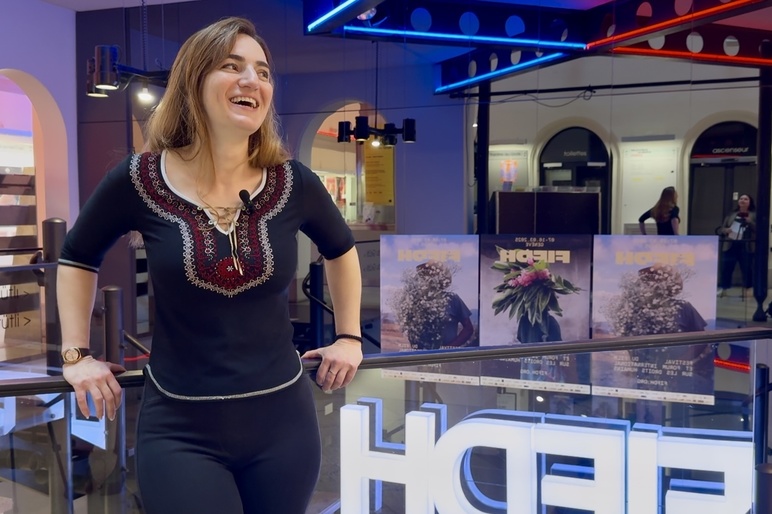
Born in Damascus, Syria, Lina is a filmmaker, journalist, and human rights defender, who in 2011 decided to pick up her camera and start filming, without a plan, but with the knowledge that she has a story to tell. What ensued are five years of conflict, arbitrary arrests, as well as torture and ill-treatment in detention, but also of hope that things would get better, despite a veto. Five Seasons of Revolution was recently screened at the International Film Festival and Forum on Human Rights in Geneva, in an event co-hosted by OMCT, partner of the festival. In this interview, Lina tells us more about her process and the challenges she encountered in the making of the film, as well as her hopes for the future of Syria.

What made you decide to start filming?

We started shooting in the summer of 2011, and a lot was already happening in Syria, but it was not clear how things were going to go. I was optimistic, thinking it would be over in six months, maybe a year, with a release within two years. It took 12 years.

It took more than five years of filming, and then many more to edit, because the country hadn’t stabilised, and the characters’ decision to participate in the film shifted with every new development, for their own safety. We had to go back, take characters out, then put them back in, and make amendments to the storyline. But it wasn’t all negative. During this time, deepfake technology improved and gave us a solution for the anonymity issue of some of the characters who chose to stay in Syria in a way that is safe and does not interfere with the visual narrative.

What was the most challenging part about the filming process?

Not knowing where it’s heading. As a filmmaker, you have, even in documentaries, a rough script, or an idea of where you are heading, but we couldn’t. It was like surfing, we just had to keep up with weird twists and turns. At some point, there were so many arrests in the group that I was filming, the characters just kept going in and out of jail, and at any given moment, we would lose one of them. I was arrested several times and the rest of the film crew had to come up with plan Bs for ‘what if we lose the director, who also happens to be the camera person and the sole contact to all the other characters, how do we finish the film?’ There was even one editing session that was held in my absence because I was detained, and they didn’t know when I would be released. It was really challenging.

What was the most challenging part about having to change your identity several times throughout filming?

It was very confusing, but it was also very necessary. In order to make it work, you have to internalise it to a certain extent, which was challenging. This confuses your relationships with the people you’re working with, with the people you’re socialising with, with the people that trust you, despite only knowing your fake name. Very strong bonds are formed under extremely difficult conditions and something always felt wrong about not being able to be fully honest with people. it also created these compartments of who I am because different parts of me had different names in different places… and they didn’t always get along. Walking out of it was also a challenge. Normalising being one person and only using one name, only answering to one name. It was quite a journey. 

Towards the end of the documentary, you talk about your experience with your arrest. Did what you experienced in custody change your approach to the film, or your activism? 

 I did not encounter anything during my arrest that I did not previously know exists and happens. What was detrimental was the repetition of detentions because you know you might get away with it once, maybe twice, if you’re lucky three times. But when I was released for the third time, I realised I did not know anybody that survived a fourth arrest. I felt like a cat with seven lives and I was really running out of them. I think this affected not only my decision-making in the film, but decision-making in my life in general, which obviously had consequences. 

What are three things you hope people remember after watching your film?

Number one is that simplistic reductionist scenarios of war into black and white, good and bad are never true. Number two is that nobody has a blueprint for what to do in these cases. People improvise, people try to find solutions on the spot under pressure, and these are not always ideal. But also, people can be much braver than they think, because at the end of the day we are survivors, all of us, and there is a lot more to us than we sometimes give ourselves credit for. And number three, friendship is really important. 

You are a filmmaker, but also a human rights defender. What are your hopes now for Syria and its people?

I hope people will be able to recover. I hope people will be given a break, given a chance to process everything they went through, given a bit of time to find a way out of this gigantic mess. It will take generations to rebuild the country. I understand that people have endured so much for so long that they cannot take one more day of it, so there is understandably also a lot of emotions. I just hope that we have the ability to open our hearts a bit more, understand each other a bit more and that people will in return give us the chance to process everything….

https://www.omct.org/en/resources/blog/it-becamefifdh-omct-spotlight-syrian-film-director-lina

The Human Rights Foundation shows the documentary “Dissidents” on 2 February

January 29, 2025
A screening of the feature documentary “Dissidents” will take place on Sunday, Feb. 2, 2025, at 2:00 p.m. EST. The event location is Firehouse Cinema, 87 Lafayette Street, New York. “Dissidents” tells the story of three Chinese dissidents who continue to fight for democracy against the Chinese Communist Party (CCP) through art, protest, and grassroots organizing despite being exiled from their own home and despite the CCP’s transnational attempts to threaten them with violence, criminal charges, and arson. The film features Juntao Wang, a primary organizer of the 1989 Tiananmen Square protests; Weiming Chen, a human rights artist whose sculpture criticizing Xi Jinping was burnt down; and asylum seeker Chunyan Wang, who was arrested for attempting to deliver a petition letter to Chinese vice premiers during the US-China trade talks.
VIEW THE TRAILER
After the film, there will be a panel discussion featuring: Yaqiu Wang, research director for China, Hong Kong, and Taiwan at Freedom House Joey Siu, Hong Kong activist and executive council member at the World Liberty Congress Weiming Chen, human rights artist known for the Liberty Sculpture Park in CaliforniaYi Chen, director of “Dissidents” at C35 FilmsPema Doma, Executive Director, Students For a Free Tibet
The event is free and open to the public, but registration is required. Please be sure to RSVP on Eventbrite as soon as possible, as reservations are granted on a first come, first serve basis.
RSVP HERE

https://mailchi.mp/hrf.org/call-for-applications-hrf-uyghur-workshop-9101325?e=f80cec329e

Geneva Human Rights Film Festival: winners announced

March 19, 2024

On 14 March 2024, the FIFDH published the film awards for its 2024 Festival. They include:

Gilda Vieira de Mello Prize

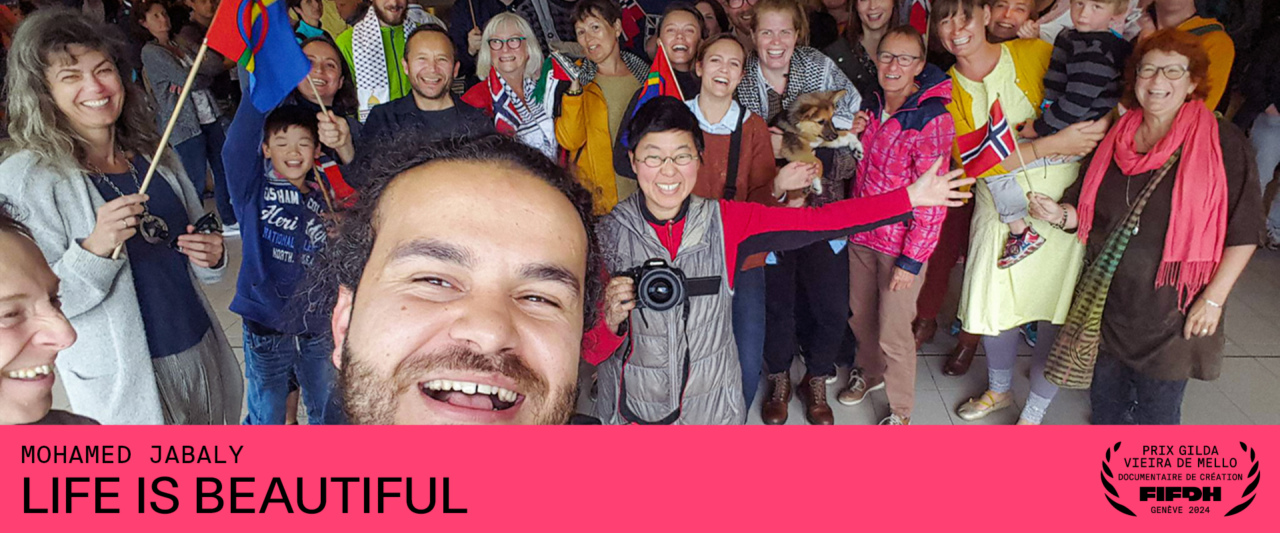
provides a moving account of the daily life of Mohamed Jabaly, who is stranded in Norway after the closure of Gaza’s borders. A call for freedom of movement, but above all freedom to pursue your dreams. “Gaza as depicted in Life is Beautiful no longer exists. Its streets, squares and the faces that populate filmmaker Mohamed Jabaly’s memories have been eradicated in the ongoing genocide in Palestine. What we are left with are the images that tell of the past, already under Israeli occupation. The violence of the borders, but also the solidarity and determination of an individual to lead a dignified existence. Cinema becomes the compass of an odyssey that takes us all to Gaza.

Prize of the World Organisation Against Torture (OMCT)

Total Trust follows the daily lives of activists who are watched and oppressed by the Chinese government through the use of technology, artificial intelligence and human rights. “Unveiling what appears to be a real-life Orwellian 1984 scenario, the documentary vividly portrays the persecution of Chinese human rights defenders and exposes the use of cutting-edge state surveillance technology tools to tightly control the lives of millions of people. This disconcerting image of rising authoritarianism prompts an important question: “Is a future controlled by technology, where we are no longer free to exercise our rights, a real risk for us all?” The prohibition of torture is what allows individuals to shape their personality and views, and establish their dignity, which is the very essence of being human.” [https://www.omct.org/en/resources/blog/one-moment-of-darkness-wont-blind-you-forever-award-winning-filmmaker-jialing-zhang-on-state-surveillance-technology-and-persecution-of-human-rights-defenders-in-china]

In March 2024, also noteworthy is that at the Thessaloniki International Documentary Festival the top prize in the International Amnesty Award competition went to Maciek Hamela’s Oscar-shortlisted In the Rearview. Hamela shot his film almost entirely within the confines of a van evacuating Ukrainian civilians fleeing the Russian invasion of their country. [https://deadline.com/2024/03/thessaloniki-internationa-documentary-festival-2024-awards-my-stolen-planet-stray-bodies-1235860706/]

For the full table of FIFDH winners, see:

https://www.euronews.com/culture/2024/03/18/human-rights-film-festival-winners-hone-in-on-russia-and-gaza

After 36 years HRW Human Rights Film Festival stops

March 14, 2024

Sad news for those of us – like me – who believe in the power of images [see e.g. https://humanrightsdefenders.blog/tag/images/ and https://humanrightsdefenders.blog/tag/images/page/2/ and https://humanrightsdefenders.blog/tag/images/page/3/ and https://humanrightsdefenders.blog/tag/images/page/4/ and https://humanrightsdefenders.blog/tag/images/page/5/ and https://humanrightsdefenders.blog/tag/images/page/7/ and https://humanrightsdefenders.blog/tag/images/page/8/]:

On 13 March 2024 Human Rights Watch announced that it would be closing its long-running film festival. Founded in 1988, the Human Rights Watch Film Festival showcased nearly 1,000 independent films, was presented in over 30 cities across the globe, and is the world’s longest running human rights film festival.

“It’s with sadness and deep regret that we have made the difficult decision to close the Human Rights Watch Film Festival,” said Tirana Hassan, executive director of Human Rights Watch. “The film festival is a celebrated cultural institution that educated and inspired hundreds of thousands of filmgoers and filmmakers around the world over three decades, providing a critical space for connection, conversation, and action on human rights issues.”

The decision to close the festival was part of a wider restructuring due to financial constraints, Human Rights Watch said. Human Rights Watch Film Festivals will take place as planned across the United Kingdom and Ireland, opening on March 14, 2024, and across Canada starting on March 21.

Human Rights Watch is immensely proud of the talented film festival leadership and staff, who built partnerships across the human rights community and film industry. The festival established a mainstream platform for impactful films and in-depth conversations about human rights issues, with a priority focus on underrepresented perspectives from around the world.

The festival staff have been instrumental in pushing for increased accessibility standards in the film industry, resulting in three fully inclusive film festivals in the last two years. During the Covid-19 pandemic and the lockdowns that shuttered cinemas, the film festival team created a digital streaming site that tripled attendance figures, encouraged festival members to tune in for live conversations, and ensured that the public would not be isolated at home. The innovative site continued the festival’s work of creating spaces for dialogue, connection, and action on human rights issues.

“We owe the Human Rights Watch Film Festival’s success and impact to the longstanding commitment of our festival staff and consultants, volunteers, partners, the filmmakers, and of course our audiences,” Hassan said. “They helped to nurture the human rights storytelling movement that we see thriving today.”

https://ff.hrw.org/news/human-rights-watch-end-its-celebrated-film-festival

Copenhagen International Documentary Film Festival adds major human rights award

February 16, 2024

On 15 February 2024 Ben Dalton informed that the Copenhagen International Documentary Film Festival (CPH:DOX) has unveiled the line-ups for its five competitive sections for its 2024 edition. All films in the main Dox:Award competition are world premieres for the second successive year.

The festival has launched a new section and award for 2024, the Human:Rights award, marking the 75th anniversary of the Universal Declaration of Human Rights. A €5,000 prize sponsored by the Institute for Human Rights will be given to a film that addresses human rights issues.

The festival will also include a series of events and discussions focusing on universal rights, beginning with a photo exhibition at the Pressen venue.

“This year’s competition sharpens its focus on the most urgent issues of our time, from the wars in Ukraine and Gaza to gang violence in Sweden, exploring themes of identity politics, colonialism, and the foundational struggles for democracy and the fight against climate change,” said Niklas Engstrom, artistic director of CPH:DOX.

https://www.screendaily.com/news/cphdox-unveils-competitions-adds-human-rights-award/5190553.article

The Swimmers: Netflix film about Syrian refugee swimmers

September 15, 2022

UNHCR announced on 9 September 2022 that a new Netflix film, The Swimmers, tells the remarkable tale of Yusra Mardini, a young Syrian refugee and UNHCR Goodwill Ambassador, who escaped conflict and went on to compete in two Olympics.

“This is a movie that any person in the world can relate to,” the 24-year-old said shortly before the film’s world premiere on Thursday at the prestigious opening night of the Toronto International Film Festival (TIFF). “We want the movie to make a difference.” UNHCR Goodwill Ambassador Yusra Mardini hopes the dramatic new film of her and her sister’s escape from conflict to new lives in Europe will challenge attitudes towards refugees.

Directed by acclaimed Egyptian-Welsh filmmaker Sally El Hosaini of My Brother the Devil, the film stars Lebanese actors and real-life sisters Nathalie and Manal Issa, as Yusra and her older sibling Sara.

It tells the story of their childhood in Damascus, their focus on swimming from a young age, and their dramatic journey to Europe in 2015 that saw them help save the lives of fellow refugees by jumping into the water and steering their stricken dinghy to shore through the Aegean Sea’s dark waters.

While the public will have to wait until 23 November for the film’s general release, Mardini has already seen it twice and says it is impossible for her to pick the best moments. “Honestly, the whole movie is my favourite scene!” she says.

She hopes it will prove much more than simple entertainment. “This movie is going to put the conversation on the table of what a refugee is, of what we want to change,” says Yusra.

El Hosaini, the director, echoes this ambition. “My greatest hope for the film is that it subverts the tired stereotypes of both refugees and young Arab women.

“I want the film to remind us that refugees are regular people with full, regular lives, with hopes and dreams. Ordinary people who’ve had to make unimaginable choices, leaving their homes and risking everything in search of a safer, better life.”

Since becoming the youngest ever UNHCR Goodwill Ambassador in 2017, and competing as a swimmer in both the Rio 2016 and Tokyo 2020 Olympics, Yusra has emerged as a leading voice for refugees, one that The Swimmers will amplify still further.e

To change perceptions of refugees, understanding must come first, she says. “The education systems have to change: they have to be more open, they have to teach the stories of migrants and refugees,” says Yusra, who hopes sharing her story far and wide, through her 2018 memoir Butterfly and now The Swimmers, will help educate people about the potential, and the value, that all refugees have. “We have to treat everyone the same,” she says.

The Olympic Games changed the way I think about being a refugee. I walked into the stadium in Rio and I realised that I can inspire so many people. I realised that ‘refugee’ is just a word, and what you would do with it is the most important thing.”

Despite being in the Hollywood spotlight, Yusra has not lost sight of her calling. “A lot still has to change for refugees,” she says. “This is not the end. This is just the beginning.”

https://www.unhcr.org/news/stories/2022/9/631b527f4/netflix-brings-yusra-mardinis-inspiring-story-world.html

Film “THE STORY WON’T DIE” about Syrian protest art

June 18, 2022

THE STORY WON’T DIE is an inspiring, timely look at a young generation of Syrian artists who use their work to protest and process what is currently the world’s largest and longest ongoing displacement of people since World War II. The film is produced by Sundance Award-winning producer Odessa Rae (Navalny). Rapper Abu Hajar, together with other celebrated creative personalities of the Syrian uprising, including post-rock musician Anas Maghrebi, members of the first all female Syrian rock band Bahila Hijazi and Lynn Mayya, breakdancer Bboy Shadow, choreographer Medhat Aldaabal, and visual artists Tammam Azzam, Omar Imam and Diala Brisly, use their art to rise in revolution and endure in exile in this new documentary reflecting on a battle for peace, justice, and freedom of expression. It is an uplifting and humanizing look at what it means to be a refugee in today’s world, and offers inspiring and hopeful vantages on a creative response to the chaos of war.

The Human Rights Foundation organised the New York Premiere of THE STORY WON’T DIE on Friday, June 17 at Cinema VillageThe screening was followed by a Q&A with award-winning filmmaker David Henry Gerson and the film’s co-producer Abdalaziz Alhamza.

https://mailchi.mp/hrf.org/you-are-invited-june-15th-screening-of-the-dissident-288999?e=f80cec329e

Neil Gaiman launches crowdsourced animated film for Syrian refugees

December 8, 2020

Neil Gaiman launches a crowdsourced animated film to help raise funds for Syrian refugees battling freezing temperatures and icy winds amid threat of Covid-19.

Neil Gaiman – celebrated author and Goodwill Ambassador for UNHCR – has joined forces with hundreds of fans and artists to release a new animated version of his poem What You Need To Be Warm.

The animated film aims to raise much needed funds for UNHCR’s Winter Appeal providing vital support for refugees in the Middle East including Syrian and Iraqi refugees, many of whom are battling their ninth winter away from home. This year is the hardest yet as refugees face snow, rain and freezing temperatures, as well as the impact of Covid-19 which has dramatically affected vulnerable families, put health at risk, devastated livelihoods, and pushed more refugees out into the cold.

Neil Gaiman said: “This animated film was a chance for people to come together to help raise awareness and life-saving funds to protect these families. I was blown away by the response and quality of drawings submitted online. People really care and want to help and they still can by making a donation

https://www.unhcr.org/news/press/2020/12/5fce20a14/neil-gaiman-launches-crowdsourced-animated-film-help-raise-funds-syrian.html

Tonight screening of “Boys State” by RFK Rights

October 6, 2020

Tonight 5 October 2020 you can participate in the virtual private screening of Boys State, which won this year’s Sundance Grand Jury Prize for documentary. This engaging film tells the story of 1,100 boys who come together to build a representative government from the ground up, and in the process examines our divided country and the health of the American democracy. Rolling Stone calls it “both sweeping and intimate” and “exhilarating.”   The screening will be followed by a Q&A session with the filmmakers and two of the film’s subjects, moderated by Kerry Kennedy.

Tonight at 7 p.m. EDT.    To RSVP to the event: email BoysStateRFK@a24films.com.   

https://mailchi.mp/rfkhumanrights/d7az6w232t-855714?e=99673fdc45