For this 31st edition, ten of the world’s leading human rights NGOs composing the Jury of the Martin Ennals Award – Amnesty International, Human Rights Watch, FIDH, HURIDOCS, Bread for the World, Human Rights First, World Organisation Against Torture, International Commission of Jurists (ICJ), International Service for Human Rights (ISHR), and Front Line Defenders – have selected, after much deliberation, three human rights defenders for their exceptional contribution to the human rights movement. [se also https://www.trueheroesfilms.org/thedigest/awards/043F9D13-640A-412C-90E8-99952CA56DCE]
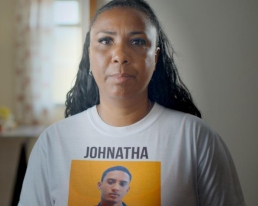
The 2025 Laureate is Ana Paula Gomes de Oliveira (Brazil), who co-founded the collective ‘Mothers of Manguinhos’ to fight for justice after the killing of her son, a 19-year-old Black man, who was shot in the back by a military police officer in the favelas of Rio on his way back from his girlfriend’s house in May 2014. The collective serves as a front for resistance and advocacy, but also as a network of emotional support and solidarity between women who share stories of similar loss. These women, in their majority Black, many of whom have lost children and other family members to violent actions by law enforcement officials, came together to denounce violence in the favelas, especially police violence that disproportionately affects poor Black youth. ‘When we are born Black and raised in the favelas, we are targeted by a racist system that is also reinforced by public security policies based on death and imprisonment,’ says Ana Paula. According to the UN, killings by the police have more than doubled in the last ten years in Brazil, with more than 6000 killings every year over the past six years. Black people, overwhelmingly men, represent a shocking rate of 82,7% of the killings by police officers in 2023. ‘The racist violence in Brazilian streets merits the full attention of the federal government and the international community,’ says Hans Thoolen, Chair of the Martin Ennals Award Jury. The collective ‘Mothers of Manguinhos’ fights for truth, memory, justice, freedom and the human rights of Black, poor, and peripheral lives. The collective is a member of the UN Antiracism Coalition (UNARC) and during the 57th session of the Human Rights Council, Ana Paula delivered a powerful message at a side event organised by UNARC on the perspectives of the Afro-Brazilian community directly affected by police violence in Brazil.
The Jury also recognised two finalists: Aloikin Praise Opoloje (Uganda) and Saadia Mosbah (Tunisia).
Aloikin Praise Opoloje is a 26-year-old Ugandan student who has become a leading voice against corruption, social injustice, and human rights abuses in Uganda. Inspired by the dire living and educational conditions in her home district of Palisa, she has mobilised thousands through social media and organised major peaceful protests, including the March to Parliament and the Nude Protest against government mismanagement, which prompted official accountability for the Kiteezi landfill tragedy. Despite repeated arrests in 2024 and ongoing legal charges, Aloikin went on to create the WeThePeople movement, which informs young Ugandans about their civic rights and non-violent resistance.
Saadia Mosbah is a leading Tunisian human rights activist and co-founder of Mnemty (‘My Dream’), the main organisation dedicated to fighting racism and racial discrimination in Tunisia. She has spearheaded initiatives through education, awareness raising and legislative advocacy, which have led to the 2016 national debate on systemic racism, the adoption of the Anti-Racism Law No. 50 (2018), and the declaration of 23 January as the National Day for the Abolition of Slavery for Tunisia (since 2019). Her work has also focused on combatting prejudice against migrant people and promoting migrant and refugee rights. Despite her legitimate activism, Saadia Mosbah and Mnemty have faced intense smear campaigns. She was arrested on 6 May 2024 on false accusations of financial crimes and remains in pre-trial detention without a set trial date. [https://www.amnesty.org/en/documents/mde30/0846/2026/en/]
The UN High Commissioner for human rights will award the selected laureate during the ceremony to take place on 26 November 2025 in Geneva, Switzerland. [https://www.martinennalsaward.org/2025-edition/]
On 29 October, 2025 Amnesty International came with a report: “Closing the door – How Europe’s Schengen area visa policies fail human rights defenders“. International travel is crucial for human rights defenders (HRDs), and the Schengen area is a key destination, offering many opportunities for human rights advocacy, networking, learning, and for temporary respite for those facing threats and burnout. The importance of mobility for HRDs has been recognized by EU institutions and Schengen states. However, gaps remain between commitments and practice.
HRDs who are nationals of the 104 visa-restricted countries and who are in their vast majority racialized as Black, Asian and/or Muslim, continue to encounter huge barriers in obtaining a visa.
The report brings together real-life cases showing the impact of these obstacles on racialized HRDs, including many examples of visa denials because HRDs were not believed for the purpose of their travel. These experiences occur within a broader context of systemic racism, a legacy of colonial practices that shape visa policies and practices to this day. The report calls on authorities to ensure the full implementation of existing flexible arrangements for HRDs applying for visas, to develop a new visa procedure specifically designed to facilitate the process for HRDs, and to eliminate and prevent racial discrimination in the context of visa policies and processes.
Cyrine Hammemi is a human rights defender and a project manager at the Association for the Promotion of the Right to Difference (ADD) in Tunisia. Her work focuses on the human rights of persons belonging to minority groups, through alerts on discriminatory situations and the violence they suffered.
Speaking to ISHR, Cyrine discussed her journey into activism and her vision for an inclusive future. She shared the personal triggers that led her to become an activist and emphasised her hopes for a world where every individual can fully enjoy their rights without discrimination based on identity, gender, religion, or sexual orientation.
TRT World published a summary of a report by the South Asia Collective “India and Pakistan no different on how they treat minorities”. Please note that Turkish Radio and Television Corporation is the national public broadcaster of Turkey. One looks there in vain for information on human rights violations in Turkey itself. Still the report referred to (produced with the financial support of the European Union and the Norwegian Agency for Development Cooperation) is of interest:
The past ten years have been abysmal for minorities and civil rights activists in South Asian countries including India, Pakistan and Sri Lanka, according to the South Asia State of Minorities Report 2020.
Governments have introduced repressive laws that curb freedom of expression, persecute journalists and bar people from organising peaceful demonstrations, says the report published by the South Asia Collective, an international group of activists and NGOs. Some laws disproportionately target minorities such as Muslims in India and Sri Lanka, and Christians in Pakistan. One policy that transcends almost all the regional governments is their attempt to restrict the role of NGOs – especially if they receive funding from abroad.
India, where minorities have faced state-sanctioned violence since the Hindu nationalist Bharatiya Janata Party (BJP) was re-elected last year, has handicapped foreign NGOs by setting limits on how they can spend money received from international donors. Most of the affected NGOs are the ones that work in areas which highlight abuse of power, government indifference towards the plight of minorities, and the brutality of security forces. [see also: https://humanrightsdefenders.blog/2020/07/06/istanbul-court-jails-four-human-rights-defenders-on-terror-charges-seven-acquitted/]
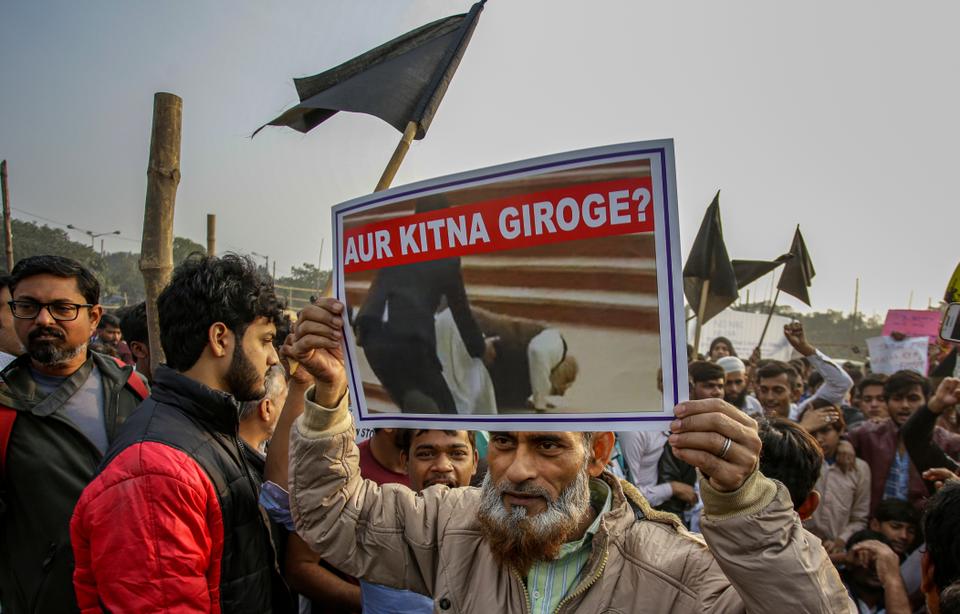
New Delhi’s discriminatory amendment to citizenship law has further alienated India’s Muslims. (AP Archive)
Other policy changes such as requiring NGOs to register with income tax authorities every five years are a similar tool of “administrative harassment”. ..
The intimidation is not limited to NGOs as journalists reporting on creeping BJP authoritarianism often feel the wrath of the state. “…between 25 March and 31 May 2020, at least 55 Indian journalists faced arrest, physical assaults, destruction of property, threats or registration of FIRs (police reports),” the report said.
New Delhi increasingly relies on internet controls to curb dissent. Internet shutdowns jumped to 106 in 2019 from only six in 2014 as authorities used different laws to control the flow of information. Kashmir faced a complete internet blackout for months after the Muslim-majority region’s nominal autonomy was withdrawn last year…
India is also using the draconian Unlawful Activities Prevention Act to target Dalits, a caste of Hindus who face widespread discrimination under the country’s hierarchical caste system… Changes in the Citizenship Act that target Muslim migrants and the brutal police reponse to subsequent protests — in which 22 people were shot dead in Utter Pradesh state in a single day — further illustrate the worsening status of minorities in India.
In neighbouring Pakistan, India’s archrival, minorities and those activists trying to help them, fare no better.
“NGOs and INGOs (international NGOs) are subject to extensive regulation involving multiple, lengthy procedures of registration, security clearance, and approvals for funding,” the report said.
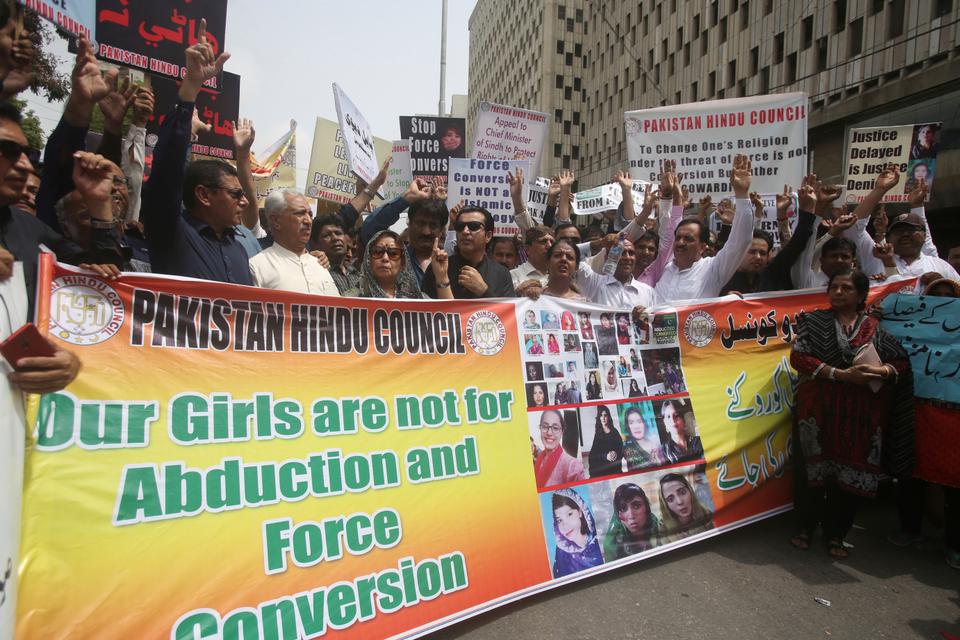
The Christians and Hindus in Pakistan regularly complain that young girls are forced to convert to Islam. (AP Archive)
In recent years, Islamabad has increased vigilance on NGOs which it fears might be working on a foreign agenda to promote dissent. What will particularly bother Pakistan’s policymakers is the report’s focus on how the country’s Blasphemy Law, meant to protect religious sentiments, continues to be misused against minorities.
“In reality, the law explicitly discriminates against Ahmadiyas since parts of it criminalise public expression of Ahmadiya beliefs and prohibit Ahmadiyas from calling themselves Muslims, praying in Muslim sites of worship and propagating their faith.” Just this week, a report by the United States Commission on International Rights Freedom pointed out that Pakistan accounts for nearly half of the incidents of mob violence against alleged blasphemers.
At times, people accused of blasphemy are killed in court in front of police and lawyers. Christians, another minority, are frequently targeted while authorities do little to protect them. For instance, a church constructed in the Toba Tek Singh district of Punjab province had to be sealed in 2016 after local Muslims agitated against it. This alienation doesn’t stop at the places of worship – young Chrsitan students are continuously harassed by their peers to convert to Islam, the report said.
Similarly, Sri Lanka witnessed rising levels of intolerance towards minorities in recent years, especially as successive governments tried to pacify extremist Buddhists to garner their votes. Muslims in Sri Lanka have felt a wave of discrimination and official apathy after the suicide attacks that killed more than 200 people last year. “After the Easter attacks, Muslims, particularly a large number of Muslim men, were arrested seemingly without reasonable cause.” Jingoistic government-aligned media has helped paint Muslims as the villain in Sri Lanka.
“The incitement of hatred and vitriol by media outlets continues unabated. For example, Muslim Covid-19 patients were identified by their faith, unlike other patients, and blamed by the media for spreading coronavirus.”
Helena Dalli – the European Union Commissioner for Equality – and Dunja Mijatović – the Council of Europe Commissioner for Human Rights – published a joint opinion piece “Stop the rain on human rights” in Euractive at the occasion of International Human Rights Day 2020 on 10 December:
The current pandemic crisis serves as a magnifying glass of all existing inequalities in Europe – racism, gender and sexual discrimination, treatment of migrants: there is still a long way to go to ensure full and real equality in Europe,
Regrettably, for all the progress of the past seven decades, there is still a long way to go to ensure full and real equality in Europe. Our societies breed divisive levels of inequality, fear and polarisation. Structural discrimination keeps millions of Europeans on the margins of our societies, especially in employment, health, education, housing, and the criminal justice system.
The current pandemic crisis serves as a magnifying glass of all existing inequalities in Europe and exacerbates them. Those who were poor before it became poorer; those who were disadvantaged faced even greater disadvantages. Inequalities affecting women, LGBTIQ people and ethnic minorities illustrate this problem well….
Restrictions to freedom of assembly and association, obstacles to legal gender recognition and lack of adequate protection at public events are evident failures of state authorities to uphold their commitments and legal human rights obligations to ensure equality for LGBTIQ people.
The situation is not much better for people from ethnic minority and immigrant backgrounds. If you are of African descent you are more likely than white people to face discrimination in the job market, in education and housing, and to be stopped by the police without reasonable suspicion.
Hate incidents also continue to scar the lives of Jews, Muslims and Roma, who are among the preferred scapegoats of those who still stigmatise some groups of people on the grounds of their ethnic origin or religion.
The unkept promise of equality betrays a long political, philosophical and judicial tradition which places equality at the centre of European democracies. Both the European Court of Justice and the European Court of Human Rights have upheld the principle of equality and non-discrimination since the 1970s.
Yet, more and more governments and parliaments seem to pay little attention to their legal obligations, and to the destabilising consequences that keeping millions of Europeans as second-class citizens is having on our societies. Hard won progress’ longevity is not a given. We must protect and reinforce it every day.
The many challenges that our societies will have to face require that Europe strengthens the place equality occupies in our societies, starting by giving a more central focus to the principle of equality and non-discrimination in relations to all human rights, be they civil, political, economic social or cultural.
We must do better for the rights of the single mother living in poverty and for the disabled child prevented from attending a mainstream school. We must protect the rights of women and girls who have been sexually harassed, of young graduates who face discrimination in the labour market because of how their name sounds.
We also must remain vigilant in the face of worrying attempts to roll back progress towards equality for women and LGBTIQ people.
There is no easy fix, but already taking the decision to address these long-standing problems together is a good start. We firmly believe that the founding principles and values of the Universal Declaration are as relevant today as they were when they emerged from bloodshed, tyranny and war. They require that governments become stronger defenders of human rights.
We are helping them do so by addressing effectively the pervasive discriminations against women in Europe. Ratifying and implementing the Council of Europe Convention on preventing and combating violence against women and domestic violence is key to advance gender equality. This Convention has been ratified by 34 European countries, and signed by the EU.
However, the EU is not yet in a position to ratify because unanimity between member states has not been reached. We will join forces to make clear that the Convention protects from violence and nothing else; contrary to the misconceptions, fallacious and uninformed claims that have circulated and sown doubts.
Likewise, we are committed to fight racism and bring about an anti-racist culture. To this end, we believe that one of the priorities is to help member states stamp out ethnic profiling and end impunity for police misconduct.
We will also strengthen our work to counter discrimination against LGBTIQ people. We will continue to raise the visibility of LGBTIQ people in our dialogue with member states, support activists and use all means at our disposal to defend the right of LGBTIQ people to equality.
For this to happen, however, our voices alone will not suffice. There is the need for a renewed commitment by national authorities to uphold the founding values and legal obligations set out by the European Union and the Council of Europe. And here we get to the heart of the problem.
At best, many politicians in our member states remain indifferent about discrimination. At worst, they instigate violence and hostility. Politicians must be champions of equality, not obstacles to it. International organisations and the human rights community too have their bit to do.
We must become more inclusive in the way we defend human rights. We deliver a public service in the interest of society, but we do not own that service. We talk about, for and sometimes with people who have suffered human rights violations.
But we rarely empower them to speak for themselves. They should take part in decision-making processes as much as possible. We should learn to listen more and they must have the space to tell their stories and shape the policies and laws that concern them.
When states adopted the Universal Declaration on Human Rights on 10 December 1948, they pledged themselves to achieve equality. Giving practical effect to that vision is still possible – but only if we choose to strengthen freedoms, promote participation and empower all people.
Living in Greece as I do, I can only warmly endorse the reactions of the international human rights community (here Human Rights Watch): In a momentous ruling today, an Athens appeals court found that the far-right neo-Nazi Golden Dawn party was operating as a criminal organization. The court also found that members of the group orchestrated or colluded in the 2013 murder of 34-year-old antifascist activist and rapper Pavlos Fyssas, the 2013 murder of 27-year-old Pakistani national Shehzad Luqman, and numerous brutal attacks against migrants, trade unionists, and human rights defenders.
It’s a landmark victory for the victims, their families, and civil society says HRW. An estimated 20,000 people who gathered in downtown Athens erupted in cheers when they heard the verdict. Magda Fyssa cried out, “You did it, my son!” perhaps finally finding some meaning in the otherwise senseless loss of her son Pavlos.
It has been a long time coming. Back in 2010-2013, when Golden Dawn flourished, Greece saw an epidemic of violence. In 2011-2012, we documented dozens of attacks on foreigners, who had been beaten, kicked, and chased down the streets of Athens by gangs of Greeks linked to Golden Dawn. Victims included migrants and asylum seekers, pregnant women, and children. Many attacks went unpunished, with police doing little to intervene and courts to hold perpetrators to account.
In January 2012, Golden Dawn leader Nikolaos Michaloliakos sat across a table from us and denied any involvement in violence. Now he and seven other former lawmakers are facing sentences of up to 15 years in jail for leading a violent, criminal organization. Many others await sentencing for membership.
Talking about Golden Dawn, Michaloliakos said to us, “We want Greece to belong to the Greeks … if that makes us racist, then yes we are.”
Today’s verdict, along with the massive crowd outside the courtroom, sends the clear message that these hateful ideas, and the violence that Golden Dawn spawned, are not welcome in Greek society anymore.
Asfreeas Jafri in Politics, of 14th July, 2020 wrote a fascinating opinion piece which I think deserves more attention. It is mostly about India but has wider implications: for ease of reference here the full text:
One complaint I often get from friends is that I say very “offensive” things online. My Facebook, Twitter, and Instagram, they accuse, are filled with the same sad and angry words against Islamophobia. Although despite my repetitive rants, they continue to ignore the agony of these words.
On July 10, 2020, the Turkish president announced that Hagia Sophia would be a mosque again.
Amongst other things, I am accused of being biased. Also, I am accused to be writing for a vested agenda. Usually, my Hindu friends make these allegations since I write a lot about the persecution of Indian Muslims. However, recently I noticed Muslim friends on social media making the same kind of accusations against those who expressed displeasure at the conversion of Hagia Sofia into a mosque.[ see also: https://humanrightsdefenders.blog/2020/07/06/the-unholy-wisdom-of-invoking-sovereignty/]
A few days back, some of them were irked after being questioned for running a homophobic WhySoProud trend on Twitter. This time the allegation against those Muslims who opposed this conversion is that they are doing this to please “Hindu liberals”.
Those who make these charges are undermining our agency and reason. It is insulting for me to think that what I and several other Muslims write, is not out of our individual agency and free will. When someone as outspoken as Umar Khalid is accused of doing that by several Muslims, I feel that we need to introspect.
The attackers are overlooking Umar’s incisive critique of Islamophobia in the Indian left. Muslims who are opposed to this are being called apologetic. I never pledged allegiance to the new sultan of Turkey. Not calling out Erdogan’s vile actions or political gimmicks does not fill any Muslims with a sense of vicarious guilt, at least in front of people we are allegedly supposed to be pleasing. But to say that those who dislike Erdogan are apologetic is quite irresponsible.
I will any day stand with someone like Umar Khalid who has been a constant ally in the fight against Islamophobia, rather than choosing a faraway ‘Sultan’ who is hardly bothered about the existence of Indian Muslims. It is people like Umar whose strong and sharp words have made young Muslims more unapologetic and bothered about their rights than their predecessors.
The other charge was against those liberals who wanted schools and hospitals on that disputed land, some congress leaders and “practising Hindu atheist” liberals like Dhruv Rathee who had strongly supported the Ayodhya verdict but are now opposed to Erdogan’s move. To many people’s shock, they had claimed that the Ayodhya verdict was respectable to all sides and that it will put a halt to the hate against Muslims. It did not halt. It actually increased.
I agree that this hypocrisy should be called out but when you also support either of the two majoritarian displays of power, are you not a hypocrite too? Also, what about those who have been vehemently opposed to the demolition and protested the SC verdict on Ayodhya? Do they have the right to comment on this?
Some found the comparison of Hagia Sofia with Babri Masjid as problematic. They said that it is not as bad in Turkey as it is in India. Umar rightly asks, ‘are we waiting for it to be that bad?’ Babri was illegally demolished and mobs killed hundreds. The history of these two events is different but what makes the comparison fair is how the Indian and Turkish governments and judiciary ignored the sentiment of the Muslim and Christian minorities. That the majoritarian will become the conscience of the state is starkly similar in both these cases.
As per media reports, Christians were blamed for spreading Coronavirus in Turkey. Consequently, some churches were attacked. The Christian community has faced mysterious disappearances and deaths, attacks and propaganda in recent years.
Turkey’s President Recep Tayyip Erdogan
Recently, a group of Erdogan backed lawyers published an article to “redo” what happened in Armenia. As somebody who often hears Hindutva extremists warning to repeat 2002, which they eventually did in North East Delhi earlier this year, I understand the consequences of these hateful words. The increasing murderous hate attacks on Kurds in Erdogan’s Turkey are known to everybody except those who deny the Armenian genocide.
Erdogan supporters see him as the emperor of the neo-Ottoman empire. The majority rallies behind his brand of Islamic nationalism. Through a constitutional referendum, he has vested immense new authority in himself. Institutions look timid. Rogue opposition is either tamed or jailed. Rivals have been pushed into a tunnel of silence.
The pandemic was used to target the feeble opposition while political prisoners languishing in jails were given no relief. Amnesty International observed that rivals have been targeted using anti-terror laws during the pandemic.
Apart from the political opposition, universities, intellectuals, writers and journalists have invited the severe wrath of the Sultan. Many “Anti-national” academics have lost their jobs in recent years. Many renowned Human rights defenders and lawyers are behind bars.
Ever since the failed coup, suspicion and divisions amongst the Turks has reached new heights. The recent losses in elections, a growing economic crisis and waning popularity of the ruling party are being seen as the reasons behind these desperate populist decisions.
Many wrote that the mosque was “bought” by the Ottomans centuries ago. I did not want to argue about that since copies of the receipt in modern digital font and scanned PDFs of the transaction are easily available on WhatsApp! Several individuals shared stories of Israel, Greece and Spain converting mosques into other structures. This was followed by “where were you then” and whataboutery. Ironically, if you are opposed to what the aforesaid nations did, then you should be opposed to what Turkey did as well.
At the same, I also acknowledge that the western media and academia in the post-cold war world villainised Islam and Muslims. The “Muslim victim” did not fit into the “war on terror” narrative pushed by the west.
The attack on Islam and Muslims did not receive the same kind of recognition or outrage, and was side-lined. Writers like Chomsky and Edward Said have noted the West’s white-washing of its crimes in that part of the world and its malicious contempt for Islam. This has increased anti-West hostility in that region.
A few months ago, I read a blog post while casually scrolling on social media. A young Erdogan critic made a very significant point which I think should be thought about more in the above-mentioned context. He said that as long as the western standards of Human rights will be limited to the people living on the American soil, as long as the west hates on ordinary refugees and working-class innocent Muslims, as long as the occupation and Persecution of Palestine are seen as Israel’s sovereign right, as long as people deny what the US did to ordinary Iraqis, people in the Middle East will continue to invest in defenders who eventually oppress.
In December, while protesting the CAA at Jantar Mantar, I spoke to the Wire and NDTV. That video went viral on social media. It was shared by hundreds of Muslims in Pakistan including actress Mehwish Hayat.
On that thread, many Pakistanis had expressed solidarity with Indian Muslims. I replied to one of the comments, “The best Pakistani Muslims can do in the interest of Indian Muslims is to set a good example for India’s Hindus by treating their minorities well.”
It angered a lot of people. They replied with “Thank you Jinnah” taunts. Many users made the same comments on Indian Muslim handles after the Delhi violence.
What were they actually mocking? They were mocking the fact that Indian Muslims refused to go to Pakistan to be a majority and instead chose to live as a minority in India. This also suggests that they believe minority persecution is natural and that Indian Muslims missed an opportunity to be a persecuting majority. The recent demolition of a Hindu religious structure in Islamabad or the post-Babri demolitions and attack on Hindu religious sites in Pakistan and Bangladesh describe majoritarian solidarity aptly.
On the recent Krishna temple debate, I saw an interesting thread on Twitter where a Pakistani Muslim was explaining it to a Pakistani Hindu that Temples are not essential to the faith20 of Hinduism while mosques are essential to the faith of Islam.
People demolishing the Babri Masjid.
In India, the judiciary applied the same principle to say that mosques are not necessary for prayers. This opens a door to another important debate: Are laws merely a manifestation of the majoritarian interpretation of morality and righteousness?
Even in the West, the so-called cradle of secularism, minorities face rampant discrimination and attacks. The recent murder of George Floyd in broad daylight attests to that. The need of the hour is strong debate around majoritarianism. It must gain global momentum.
As long as we are afraid of losing friends and being unpopular, such a debate is not possible. Right now, our only “agenda” is to rattle our people’s numbed conscience. We need to be courageous to be truthful. Sometimes, we have to offend those who like us when we offend others.
When violence becomes an everyday character of society, when irrationality overpowers reasons, when cruelty is seen defence, when injustice flows in a people’s vein, when malice rules their heads, oppression pleases their hearts and vulgarity embeds itself in their “proud” nation’s soul, writers are bound to protest, annoy, and be repetitive in what they write.
17 May 2017 was the International Day Against Homophobia, Transphobia and Biphobia (IDAHOT). It was created in 2004 to raise awareness about the violence and discrimination experienced by LGBTI people internationally. The date of May 17 was chosen specifically to commemorate the World Health Organization’s decision in 1990 to declassify homosexuality as a mental disorder. The Advocates Post lists 9 things that are useful to remember such as:
Internationally, the acronyms LGBT and LGBTI (standing for “lesbian, gay, bisexual, transgender, and intersex”) are the most commonly used terms.
SOGI stands for “Sexual Orientation and Gender Identity.”
Some countries are passing “gay propaganda” laws and other discriminatory laws that limit the rights to free speech, freedom of association, and assembly. E.g. in 2013, Russian President Vladimir Putin signed into law Federal Law 135, banning propaganda to minors about “non-traditional sexual relations.” Article 3(2)(b) of Federal Law 135 imposes administrative fines and, in the case of non-citizens, deportation….
LGBTI persons around the world experience widespread violence.
LGBTI persons around the world experience discriminatory treatment every day, in workplaces, schools, family homes, and health care settings.
While the majority of NGO interventions indeed concern developing countries, this is a good example of a statement on a western country. In October 2016 Human Rights Watch made the following Submission to the UK Parliament Joint Committee on Human Rights: “The Human Rights Implications of Brexit“. Human Rights Watch is very concerned about human rights developments in the United Kingdom since the referendum vote, and about the risks of a further deterioration of human rights protections as the UK moves towards exiting the EU. Here some excerpts:
Climate of Xenophobia and Hate Crimes
Human Rights Watch is deeply concerned at the current climate of xenophobia in the United Kingdom and increase in hate crimes since the Brexit vote. The climate of xenophobia was evident in the latter stages of the referendum campaign with the killing of the MP Jo Cox and has been acute since the vote…..It is manifest in the increase in hate crimes reported to police, including those expressing hostile sentiment or carrying out hostile acts towards EU citizens, among them assaults and arson attacks. There was a 60 percent increase in hate crimes after the referendum compared to the same period a year before, according to the National Council of Police Chiefs. By August, the number of incidents had decreased but was still 14 percent higher than the same period a year before. The killing of Arek Jóźwik in Harlow in September is being investigated as a possible hate crime.
.. The UN CERD committee recommended in August that UK “public officials not only refrain from such [hate] speech but also formally reject hate speech and condemn the hateful ideas expressed so as to promote a culture of tolerance and respect”.
…We welcome the commitment in the government’s new action plan on hate crimes to prevent them “by challenging the beliefs and attitudes that can underlie such crimes.” This philosophy needs to be applied to the government’s own policy proposals and the rhetoric of government ministers.
Risk to Family Life
Human Rights Watch welcomes recent media reports suggesting that the government is committed to allowing all EU citizens residing in the UK to remain after Brexit. This is consistent with the duty of the government to uphold its obligations to protect the right to family life. The government should now confirm without delay that this is the case, and make clear that such rights will not depend on reciprocity for UK citizens living in other EU member states…
Risk to Human Rights Protected by EU Law
EU law protects critical areas of rights affecting millions of people in the United Kingdom. ….
It is of significant concern that these rights have received very little attention during and since the campaign and in particular in discussions concerning the form of Brexit. The UK’s departure from the European Union and the jurisdiction of the EU Court of Justice could remove crucial human rights protections. It would be the first time that a significant international legal framework to protect rights, which binds the UK government and parliament, was removed from UK citizens and residents.
There is a risk that the UK government could seek to weaken the anti-discrimination and employment rights protection in UK law that arise from EU legislation. While many EU law protections would remain binding during any transitional or permanent arrangement involving EEA status, if the UK cuts itself off entirely from the EU, including from jurisdiction of the EU Court of Justice, there would be scope for the government to adopt laws that weaken those protections, subject to parliamentary approval and to the extent permissible under other UK human rights obligations, including the Human Rights Act.
It is important that the committee and parliament as a whole is vigilant about this risk, particularly in relation to weakening of employment rights protections. The UK should also look to strengthen its commitments in related areas in other international mechanisms, in particular by ratifying Protocol No. 12 to the European Convention on Human Rights, which would directly strengthen anti-discrimination protections in domestic law.
Risks to UK Participation in the Council of Europe
Human Rights Watch is concerned that the hostility to supranational oversight that drove much of the support for Brexit could lead to renewed calls for the UK to withdraw from the Council of Europe. We recognize that the Prime Minister has stepped away from her call during the referendum campaign for the UK to leave the Council of Europe, and welcome the decision by UK to seek to renew its membership of the UN Human Rights Council. Set against that is the ongoing climate of hostility towards human rights in some sections of the media and parts of the government, and the manifesto commitment by the government to replace the Human Rights Act with a British bill of rights that would give the Supreme Court, rather than European Court of Human Rights, final interpretation over violations. Leaving the Council of Europe would significantly weaken human rights protection in the UK, removing a key safeguard, in the form of the European Court of Human Rights. It could weaken the court and Council of Europe system in ways that would harm human rights protection across the Council of Europe region.





 Hans Thoolen on Human Rights Defenders and their awards