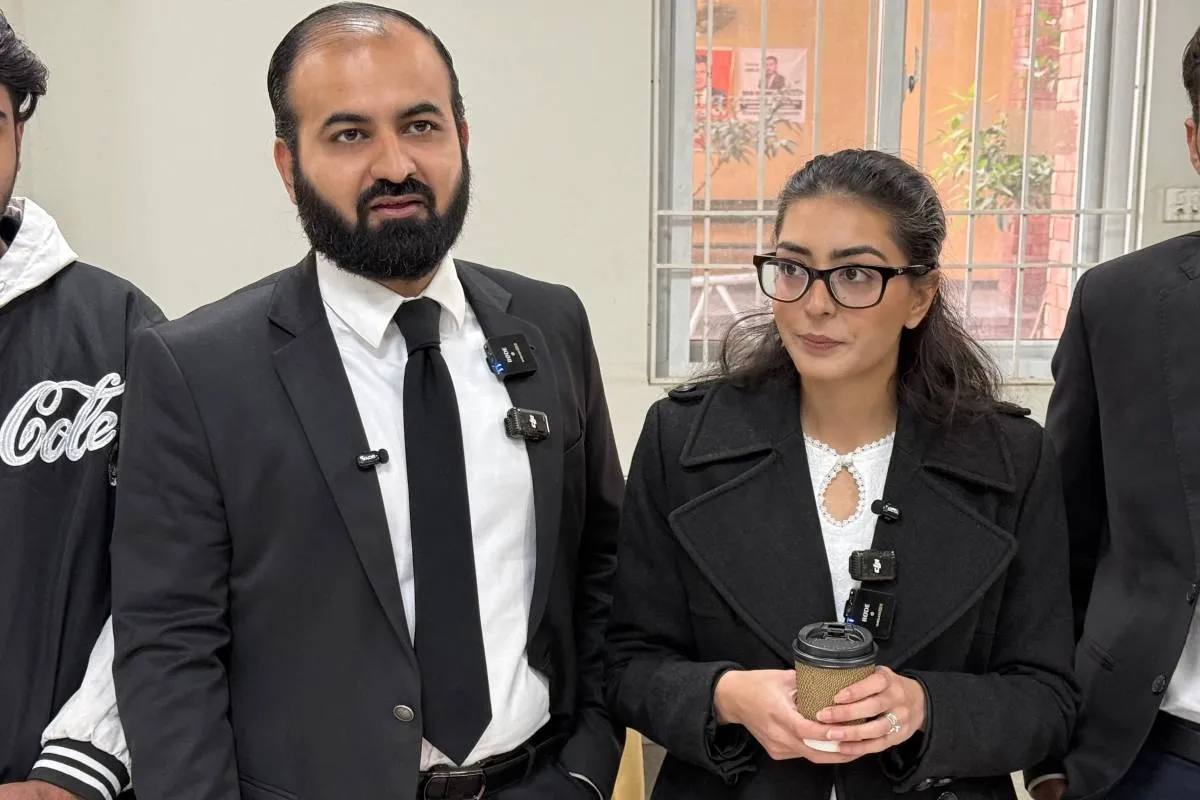
Several media (such as the CSR Journal and Barrons) and NGO (Frontline) talk about the case of human rights lawyer Imaan Mazari and her husband and fellow lawyer Hadi Ali Chattha who were sentenced 10-year-jail by an Islamabad court on 24 January 2026 over anti-state social media posts. However, the pressure and arrest haven’t been able to silence her voice. She said to media agencies, “We will not back down. Truth seems overwhelmingly difficult in this country. But we knew that when we got into this work, we’re ready to face that,”. Mazari noted that the prison term won’t dent her resolve.
Imaan Mazari is a 32-year-old human rights lawyer from Pakistan who rose to fame for fighting some of the most sensitive cases and she has been defending ethnic minorities, journalists facing defamation charges and some of her clients have been branded blasphemers. With Mazari’s coming to prominence, so did the charges by the Pakistani government for cyber terrorism and hate speech. As per a court document, Mazari has been disseminating highly offensive content.
Mazari comes from a well-known family, she is the daughter of former minister for human rights, Shireen Mazari, and her late father was one of the top paediatricians of South Asia. Because of her strong determination of fighting back despite all odds, she is being compared to Pakistan’s one of the popular human rights lawyers, late Asma Jahangir. [see: https://www.trueheroesfilms.org/thedigest/laureates/14CC52FE-5F1B-4EF8-B1F5-607ED173AACC]
Mazari is a pro bono lawyer, she has handled some of the most sensitive cases in Pakistan, e.g. enforced disappearances of ethnic Balochs, she defended Mahrang Baloch. She has also taken up blasphemy cases.
Last year, the UN special rapporteur for human rights defenders said, “Cases against her appear to reflect an arbitrary use of the legal system to harass and intimidate”. She was first targeted in a press conference held sometime in early January, where a military spokesman Lieutenant General Ahmed Sharif Chaudhry, shared Mazari’s post on X posts and filed a case against her, stating her as, “hidden elements committing subtle crimes. They operate under the guise of democracy and human rights to promote terrorism,”.
On 15 December 2025 Emma Woollacott, in Forbes, referred to a new study that shows that 7 in 10 women human rights defenders, activists and journalists have experienced online violence in the course of their work. Produced through the UN Women’s ACT to End Violence against Women program and supported by the European Commission, “Tipping point: The chilling escalation of violence against women in the public sphere” draws on a global survey of women from 119 countries.
Along with online threats and harassment, more than 4 in 10 have experienced offline harm linked to online abuse — more than twice as many as in 2020, the researchers found. This can range from verbal harassment right up to physical assault, stalking and swatting.
“These figures confirm that digital violence is not virtual — it’s real violence with real-world consequences,” said Sarah Hendricks, director of policy, programme and intergovernmental division at UN Women.
“Women who speak up for our human rights, report the news or lead social movements are being targeted with abuse designed to shame, silence and push them out of public debate. Increasingly, those attacks do not stop at the screen — they end at women’s front doors. We cannot allow online spaces to become platforms for intimidation that silence women and undermine democracy.”
And AI is only making things worse, with almost 1 in 4 women human rights defenders, activists and journalists having experienced AI-assisted online violence, such as deepfake imagery and manipulated content. This is most often the case for writers and public communicators who focus on human rights issues, such as social media content creators and influencers, for whom the figure reaches 30%.
“Gender-based online violence is not a new phenomenon, but its scale certainly is,” said report co-author Lea Hellmueller, associate professor in journalism at City St George’s and associate dean for research in the School of Communication and Creativity.
“AI tools enable the production of cheaper and faster abusive content, which is detrimental to women in public life — and beyond,” Hellmueller added.
Tech firms are partly responsible, the researchers said, with the report calling for better tools to identify, monitor, report and fend off AI-assisted online violence. The researchers also want to see more legal and regulatory mechanisms to force tech firms to prevent their technologies being deployed against women in the public sphere.
“Our next steps include publishing data from the survey about the opportunities for, and barriers to, law enforcement and legal redress for survivors of online violence,” said Julie Posetti, chair of the Centre for Journalism and Democracy at City St George’s, University of London, one of the authors of the report. “We will also focus on creative efforts to counter gender-based online violence and policy recommendations to help hold the Big Tech facilitators of this dangerous phenomenon accountable.”
The 58th regular session of the UN Human Rights Council ran from February 24 to April 4, 2025, resulting in 32 Resolutions and 14 Universal Period Review adoptions.
The session included a high-level segment attended by over 100 dignitaries, thematic panels addressing the rights of specific vulnerable groups, interactive dialogues, and debates on country-specific reports. This session also marked key anniversaries of the Beijing Declaration and the Convention on the Elimination of All Forms of Racial Discrimination. The Human Rights Council plays a crucial role in addressing global violations and continues to serve as a platform for activists and victims of violations. In the face of multiple intersecting crises and conflicts, democracy erosion, and authoritarianism on the rise, Council decisions continue to wield considerable power to improve civil society conditions, particularly in fragile contexts where civic actors are particularly affected by widespread human rights violations and abuses, while offering unique opportunities for the negotiation of higher human rights standards.
I have on the past used other such reports by the ISHR and the UHRG (see below) but thought that this time I should highlight other NGOs:
CIVICUS contributed to the outcomes of the Council session through engagement on key Resolutions, delivery of statements, and organisation of events. We sounded the alarm on the global erosion of civic space and the growing repression of civil society across multiple regions.
Regional Developments: Africa
A strong Resolution on South Sudan was adopted, extending the mandate of the Commission on Human Rights in South Sudan (CHRSS).
Regional Developments: Asia Pacific
A Resolution on Myanmar’s human rights situation was adopted by consensus amid escalating violence and widespread impunity.
Regional Developments: Americas
The Resolution on Nicaragua renewed the mandate of the Group of Human Rights Experts (GHREN) on Nicaragua.
Regional Developments: Europe
Key resolutions were adopted on Ukraine and Belarus, continuing international monitoring mechanisms.
Regional Developments: Middle East
Resolutions on Iran and Syria were adopted, with mixed results on addressing severe human rights concerns.
Several important thematic resolutions were adopted during the session.
Civil Society Challenges
Ahead of the 58th session, CIVICUS raised attention on the increasing restrictions imposed on civil society. CIVICUS engaged in key side events during HRC58, spotlighting democracy, child human rights defenders, and intersectional approaches to civic space.
A detailed post-session report is available via this link.
The International Commission of Jurists (ICJ):
The International Commission of Jurists (ICJ), together with partner organizations, participated actively in the 58th session. Civil society’s critical engagement is essential in calling on the Council and its member States to respond to the plight of victims of human rights violations. In this regard, the ICJ was pleased to ensure that our partner from the African Albinism Network delivered our joint statement on the tenth anniversary of the mandate of the Independent Expert on the enjoyment of human rights by persons with Albinism. Maintaining effective access to the UN in Geneva for civil society is key to ensure that people can themselves participate or be represented in the discussions at the Council that concern them directly. With regard to this, the ICJ denounces all attempts to undermine civil society participation, including the intimidation of human rights defenders during side events, observed again at this HRC session.
At the outset, the ICJ welcomes the adoption of a number of important resolutions renewing, extending or creating mandates under the HRC purview, among which the following were adopted without a vote:
a resolution extending the mandate of the Independent International Commission of Inquiry on the Syrian Arab Republic for a period of one year;
a resolution establishing an open-ended intergovernmental working group for the elaboration of a legally-binding instrument on the promotion and protection of the human rights of older persons;
a resolution renewing the mandate of the Special Rapporteur on the promotion and protection of human rights and fundamental freedoms while countering terrorism for a period of three years;
a resolution renewing the mandate of the Special Rapporteur on the right to food for a period of three years;
a resolution extending the mandate of the Special Rapporteur on the situation of human rights in Myanmar for a period of one year;
a resolution renewing the presence of the Office of the High Commissioner in Seoul, for a period of two years with the same resources and extending the mandate of the Special Rapporteur on the situation of human rights in the Democratic People’s Republic of Korea(DPRK) for a period of one year.
While regretting the failure to adopt them by consensus, the ICJ also welcomes the adoption of other important resolutions by a majority of the votes:
a resolution extending the mandate of the Commission of Inquiry on Ukraine for a period of one year;
a resolution renewing the mandate of the Special Rapporteur on the situation of human rights in Belarus for a period of one year and extending the mandate of the Group of Independent Experts on the Situation of Human Rights in Belarus for a period of one year;
a resolution renewing the mandate of the Group of Human Rights Experts on Nicaragua for a period of two years;
a resolution extending the mandate of the Special Rapporteur on the situation of human rights in the Islamic Republic of Iran for a period of one year and deciding that the Independent International Fact-Finding Mission on the Islamic Republic of Iran should continue for one year with an updated mandate to address the recent and ongoing violations of human rights; and
a resolution extending the mandate of the independent human rights expert tasked with undertaking the monitoring of the human rights situation in Haiti, for a renewable period of one year.
This session discussed armed conflicts whose intensity had continued to increase, including in Gaza, Ukraine, the DRC and Myanmar.
……Unsurprisingly, the situation in the Occupied Palestinian Territory was one of the most-discussed throughout the 58th session. Many countries voiced strong support for the Palestinian people and their human rights, with many calling for a two-State solution based on Israel’s withdrawal to its pre-1967 borders and with East Jerusalem as Palestine’s capital. The ICJ commends the many States who intervened during the negotiations and adoption of the resolutions on the situation in the OPT to emphasize the need for accountability, and who voiced their support for the International Criminal Court and the International Court of Justice and their respective recent decisions on Israel/Palestine. The resolution adopted at this session titled “the human rights situation in the Occupied Palestinian Territory, including East Jerusalem, and the obligation to ensure accountability and justice” invited the General Assembly to consider establishing an ongoing international, impartial and independent mechanism to assist in the investigation and prosecution of persons responsible for the most serious crimes under international law committed by all parties in the Occupied Palestinian Territory, including East Jerusalem, and Israel since 2014.
Earlier in the year, on 7 February 2025, the Council had already held a special session to discuss the human rights situation in the east of the Democratic Republic of the Congo, where armed clashes between Congolese forces and the Rwanda-backed M23 movement had been ongoing, and had escalated since January 2025. The special session had resulted in the adoption of a resolution requesting the High Commissioner to urgently establish a fact-finding mission to report on events since January 2022. The resolution had also established an independent COI composed of three experts appointed by the HRC President to continue the work of the fact-finding mission. At the 58th session, the ICJ and many countries expressed grave concern about the human rights situation in the DRC, and during the Enhanced Interactive Dialogue with the High Commissioner and the Team of Experts at the end of the session many of the same themes and concerns heard during the special session were raised again.
Threats to Multilateralism
This 58th session took place in the context of increasing threats against multilateralism. In particular, this session started in the aftermath of the United States and Israel announcing that they would boycott the Council by not engaging with it. In addition, on 27 February – the day before the interactive dialogue with the Group of Human Rights Experts on Nicaragua, when the HRC was scheduled to discuss the serious human rights violations committed by the State apparatus, including executions, torture and arbitrary detentions – Nicaraguaannounced its decision to withdraw from the Council.
Accountability
The ICJ regrets the attempts by some countries at this session to undermine accountability mechanisms by presenting them as political tools purportedly interfering in the internal affairs of the States concerned and encroaching upon their sovereignty. The human rights organization recalls that such spurious arguments contradict the international human rights law obligations freely agreed upon and undertaken by States and disregard the fact that, as the 1993 Vienna Declaration states, “the promotion and protection of all human rights is a legitimate concern of the international community”.
With regards to the situation in Syria following the fall of the Assad regime, the need for accountability was high on the HRC’s agenda throughout the 58th session. ….In this regard, the ICJ particularly welcomes the adoption of the resolution on the situation in Syria, which encouraged the interim authorities to grant the COI necessary access throughout the country and to cooperate closely with the Commission. The ICJ also notes the authorities’ declared commitment to investigating the recent spate of violations and abuses, including through the newly established fact-finding committee to investigate the events in the west of the Syrian Arab Republic in March 2025. In this connection, the human rights organization called for investigations to be demonstrably independent, prompt, transparent and impartial…
As usual, a number of country situations were not on the agenda of the Council but would actually require much greater scrutiny. At the 58th session, the ICJ expressed particular concern on the situation in Tunisiaand Eswatiniamong others, where attacks on independent judges and lawyers are a key manifestation of deepening authoritarianism in these countries…
The impact of the liquidity crisis and the withdrawal of critical support was also discussed during informal negotiations on the resolution renewing the mandate of the Special Rapporteur on the promotion and protection of human rights and fundamental freedoms while countering terrorism. While in the end the resolution is short, there was much debate about specific phrasing concerning the resources provided to the mandate. The ICJ participated in the interactive dialogue with the Special Rapporteur, stressing the need for coordination and cooperation between civil society and regional systems to address counterterrorism laws that violate human rights and fundamental freedoms of civil society actors, highlighting in particular the situations in Venezuela and Eswatini. The ICJ reiterated the importance of the Special Rapporteur being adequately resourced in order to fully address these challenges.
As we mark Nelson Mandela Day and #StandAsMyWitness campaign anniversary, the number of countries to legally harass and put activists behind bars nearly doubled in five years.
José Rubén Zamora is the latest defender featured in the international #StandAsMyWitness campaign calling for the release of 14 leading human rights defenders.
Earlier this week, two featured Eswatini activists, Bacede Mabuza and Mthandeni Dube, were brutally sentenced to long prison terms for pushing democratic reforms.
As we mark Nelson Mandela Day on 18 July and #StandAsMyWitness campaign anniversary, the number of countries abusing laws to harass and put activists behind bars has nearly doubled in five years. At least 66 countries prosecuted activists last year, up from 36 in 2019, according to the CIVICUS Monitor. In 2023, at least 63 countries detained human rights defenders (HRDs), up from 38 five years ago.
The jarring growth of repression comes as a stark contrast to the vision of President Mandela. #StandAsMyWitness, launched on Nelson Mandela Day four years ago, calls for the release of leading global human rights defenders who languish behind bars for speaking truth to power.
Guatemalan journalist José Rubén Zamora is now added as the 14th activist in the campaign. “As we add José Rubén Zamora to the #StandAsMyWitness campaign, we grow ever concerned that the world is becoming a more dangerous place for human rights defenders. He is a courageous journalist who has dedicated his life to exposing corruption and defending human rights in Guatemala,” said Isabel Rosales, Latin America advocacy officer at CIVICUS. Zamora has been languishing behind bars for two years and the newspaper he founded, el Periódico, was shut down.
Earlier this week, two #StandAsMyWitness Eswatini activists Bacede Mabuza and Mthandeni Dube were respectively sentenced to 25 and 18 years in jail. The two pro-democracy parliamentarians were convicted for demanding democratic reforms. Eswatini is an absolute monarchy where political parties are banned from elections and activists face jail, torture, and death for demanding their rights.
The 14 human rights defenders featured in the campaign represent a wave of persecution sweeping against civic freedoms and human rights around the world. Abuse of law for the prosecution of activists is ranked among the top ten rights violations according to CIVICUS Monitor.
Their stories are no different from many other activists who were silenced for standing up for human rights and justice. Among others still languishing behind bars are #StandAsMyWitness icons:
Nobel Peace Prize laureate Narges Mohammadi, who has received a total of 31 years of prison sentence for standing up for women’s empowerment and promoting the abolition of the death penalty in Iran.
Hong Kong Pro-democracy activist Chow Hang-Tung, who was arrested and detained on June 4, 2021, for publishing two social media posts calling on the public to join the peaceful vigil for the 1989 Tiananmen massacre of civilians and protesters in Beijing.
Khurram Parvez, voted one of the 100 most influential people by Time magazine in 2022, has dedicated his life to nonviolence in one of the most militarized regions in the world. He remains in jail under charges of terrorism and conspiracy in India.
This clampdown on defenders paints a bleak picture, with only two percent of the global population living in countries with open civic spaces. A staggering 72% of people in the world lived in authoritarian regimes in 2023. CIVICUS finds a discernible rise in the closure of civic spaces around the world, with the highest number of people living in closed countries since 2019.
Full list of HRDs featured in the #StandAsMyWitness campaign:
AFRICA:
Eswatini: Bacede Mabuza and Mthandeni Dube – MPs who campaigned for democratic reform
Burundi: Floriane Irangabiye – a journalist serving a 10-year prison sentence for her work
ASIA:
Hong Kong: Chow Hang-Tung – pro-democracy activist, sentenced for organising unauthorised Tiananmen Square Massacre commemoration vigil
India: Khurram Parvez – Kashmiri rights activist; listed in Time magazine’s 100 ‘Most Influential People 2022
CENTRAL ASIA:
Belarus: Viasna Human Rights Defenders – members of Viasna human rights centre; jailed for exercising their right to peaceful assembly and freedom of expression
Tajikistan: Buzurgmehr Yorov – human rights lawyer representing members of the opposition; recipient of Homo Homini human rights prize
Tajikistan: Manuchehr Kholiqnazarov – human rights lawyer serving a 16-year-long prison sentence in retaliation for his human rights work.
LATIN AMERICA:
Mexico: Kenia Hernandez – Indigenous and women’s rights activist; arrested after protest
Guatemala – José Rubén Zamora a journalist and founder of the newspaper elPeriodico. He has been detained since 29 July 2022.
MIDDLE EAST & NORTH AFRICA:
Algeria: Kamira Nait Sid – Indigenous and women’s rights activist campaigning for the rights of the Amazigh people in Algeria
Bahrain: Abdul-Hadi al-Khawaja – detained after democracy protests in 2011; recipient of the prestigious Martin Ennals Award 2022 for human rights defenders
Egypt: Hoda Abdel Moneim – human rights lawyer and former member of Egypt’s National Council for Human Rights
Iran: Narges Mohammadi – Journalist and human rights activist who received the Nobel Prize for Peace in 2023
United Arab Emirates: Ahmed Mansoor – on the advisory boards for Human Rights Watch and the Gulf Centre for Human Rights; imprisoned for publishing information on social media
To find out how to get involved, check out CIVICUS’s campaign webpage: Stand As My Witness.
Cambodia has jailed 10 environmental activists who had sounded the alarm on river pollution for plotting against the government – a case critics have decried as politically motivated. Members of the group Mother Nature were charged in 2021 after they documented waste run-off into Phnom Penh’s Tonle Sap river, near the royal palace. [see: https://www.trueheroesfilms.org/thedigest/laureates/d41428d8-4b96-4370-975e-f11b36778f51]
Three of them, including Spanish co-founder Alejandro Gonzalez-Davidson, who were also convicted of insulting the king, were sentenced to eight years’ jail and fined $2,500 (£1,980). The seven others were handed six-year terms. Prosecutors have never explained how the activists had violated the law against insulting the king or conspiring against the government.
Since its founding in 2013, Mother Nature has campaigned against environmentally destructive projects and raised questions on how natural resources are managed in the South East Asian country. They document their findings in playful and informative videos that they post on Facebook, where they have 457,000 followers.
Environmental groups have long accused Cambodia’s leaders of profiting from the country’s natural resources. The government denies this and says Mother Nature is encouraging social unrest. Gonzalez-Davidson, who was earlier banned from entering Cambodia, called the verdict a “disastrous decision by the Hun family regime”.
Opposition political parties were dismantled, independent media outlets were shut and dozens of activists were jailed under the decades-long rule of former prime minister Hun Sen, who stepped down last year to pave the way for his son, Hun Manet, to assume leadership.
Under Hun Manet, Mother Nature activists have continued to criticise what they describe as an unequal enforcement of laws in favour of companies and the wealthy elite.
Four of the convicted activists attended the hearings and were immediately arrested following the verdict. Representatives of local NGO the Cambodian League for the Promotion and Defence of Human Rights (Licadho) who were present outside the Phnom Penh court said the arrests were violent, with “at least two of [them] dragged by their necks”. Arrest warrants have been issued for the six others, including Gonzalez-Davidson.
Earlier in the day, dozens of Mother Nature supporters marched towards the court where the activists were due to receive the verdict. Dressed in white – the traditional colour of mourning in the country – some of the supporters held up hand-written posters that read “We need freedom” and “We need rights”. Others held white flowers.
The verdict “sends an appalling message to Cambodia’s youth that the government will side with special interests over the environment every chance it gets,” said Human Rights Watch’s deputy Asia director Bryony Lau.
“It is astounding to criminalise activities of youths who are advocating for clean water in Phnom Penh, protecting mangrove forests in Koh Kong and warning against the privatisation of land in protected areas and characterising it as an attack against the state,” said Licadho’s outreach director Naly Pilorge.
Several of those convicted today had already served jail terms in the past. One of them, Long Kunthea, told BBC in an interview last year that she is willing to take on the risks of her activism to “for positive change”.
CIVICUS is looking for a consultant to help further one of CIVICUS flagship campaigns – Stand As My Witness. The short-term consultancy will involve evaluating the current campaign, devising future strategy, and designing and delivering the short-term (3-month) campaign outcomes.
CIVICUS is a growing global alliance of more than 15,000 members in 175 countries. In July 2020, CIVICUS along with 190 civil society organisations (CSOs) launched the #StandAsMyWitness (SAMW) campaign to raise awareness about human rights defenders (HRDs) who were and still are facing judicial persecution and unlawful detention, and to advocate for their release.
Currently there are 13 cases profiled by the campaign and for the last three years, we have been part of successful global calls for the conditional and unconditional release of 9 HRDs as part of the SAMW campaign. The campaign also builds on a global map that features HRDs facing prosecutions, and highlights further systems built to crack down on critical voices.
Entering its fourth cycle, CIVICUS and campaign allies are keen to build upon the successes achieved so far and further the outreach and impact of the campaign.
Analyse the status of the campaign, its tactics, outreach, and propose plans, calendars and tactic for the short-term (3-month leading up to/following the anniversary (18 July).
Engage with CIVICUS Advocacy and Communications teams, regional leads, partners, families and lawyers of the HRDs, and relevant member networks to clarify the context, current status of the actions and propose plans, tactics, and outputs.
Deliver the short-term campaign plans during the first 3-month period.
– Managing and monitoring the campaign’s calendar – Creating or facilitating the creation of campaign materials such as social media messages, graphics, media, and other assets including a global campaign map – Updating and improving the campaign pages on the website – Convene on/offline events as appropriate to strengthen the campaign. This includes both public events and events targeted at CIVICUS members and partners. – Strongly link SAMW profiles and actions with other CIVICUS research, advocacy, and networking efforts.
Design a longer-term (next two years) campaign and content strategy with a cohesive engagement journey. The strategy is to capture:
– Key moments, approaches, and current and potential partners. – Explore how to better leverage the campaign actions promoted by Global Citizen. – Points for campaign improvement and expansion based on learnings to date and during the first three-month phase. – Best practices in advocating for HRDs in difficult contexts.
The consultant
The consultant will have proven experience (at least five years) at the international level designing and delivering campaigns. Experience in social change work with civil society, human rights, or development sectors is a pre-requisite.
They will bring in lived creative and innovative communications experience in terms of content ideation, creation, dissemination, etc. We welcome those with experience in creative direction, media production, systems and design thinking, and diverse public and multi-sector engagement.
The consultant will apply via sending us a:
Brief resume
Two-page brief of their approach to the consultancy
Links of creative communications and engagement campaigns/content created
Cost proposal.
Timeline
We anticipate the contract to be signed by 10th May 2024, and all deliverables must be complete by 10th August. They may apply according to the above guidelines and forward their CV, approach document and creative examples to <a href="mailto:communications<small> [AT] </small>civicus<small> [DOT] communications@civicus.org by 7th May 2024.
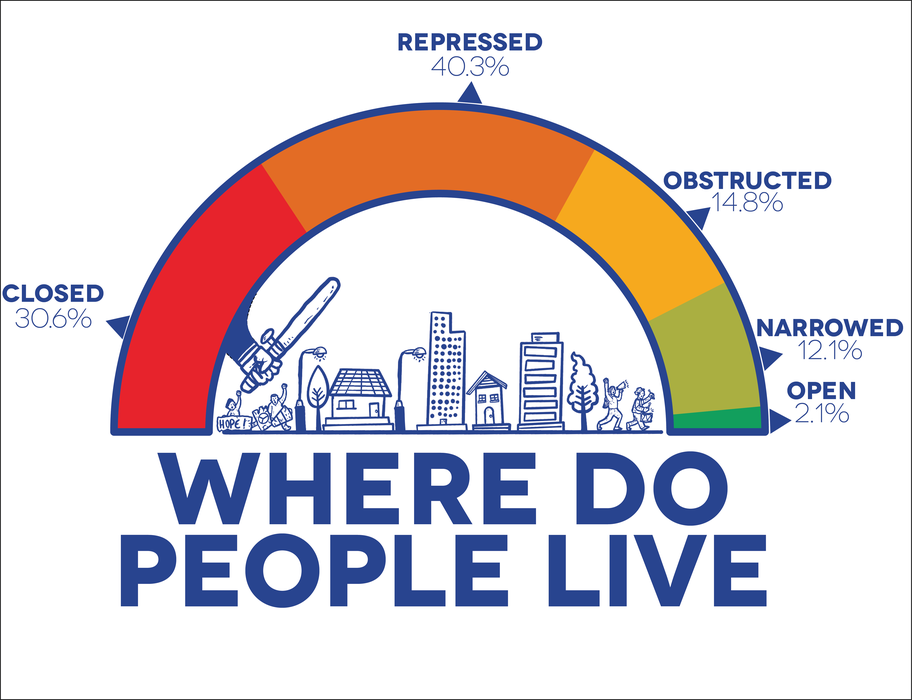
Almost a third of the world’s population now lives in countries with closed civic space. This is the highest percentage since 2018, when CIVICUS began systematically tracking civic space conditions around the world. This startling decline – from 26 per cent living in closed countries in 2018 to 30.6 per cent today – points to a major civic space crisis that requires immediate, global efforts to reverse. This year we also recorded the lowest percentage of humanity living in open countries, where civic space is both free and protected. Today, just two per cent of the world’s population enjoys the freedom to associate, demonstrate and express dissent without significant constraints, down from almost four per cent just five years ago.
Since the previous edition of this report, which covered 2022, civic space ratings have changed for 12 countries over the last year, worsening in seven countries and improving in five.
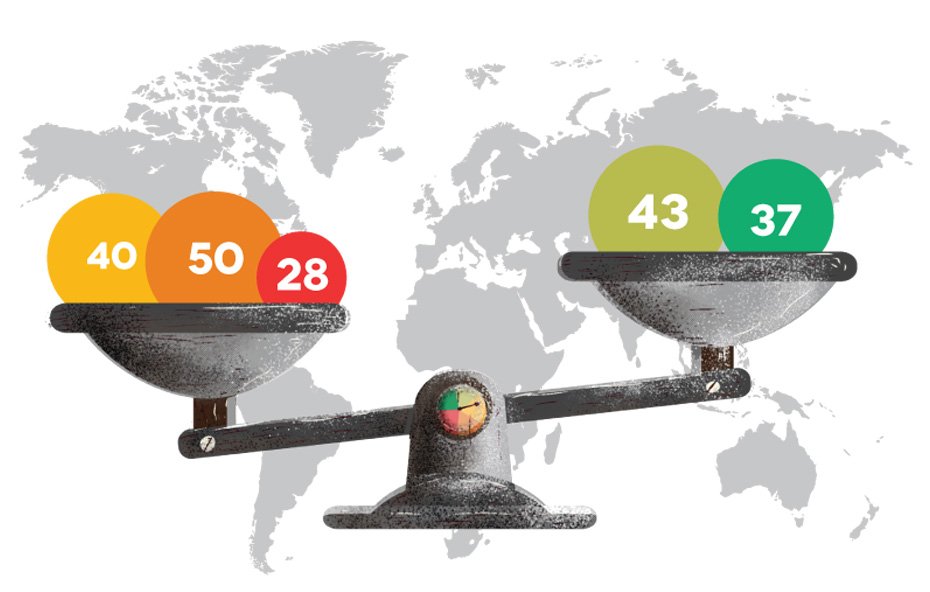
The latest CIVICUS Monitor country ratings update in December 2023 indicates that civil society faces an increasingly hostile environment. There are now 28 countries or territories with closed civic space, 50 with repressed civic space and 40 with obstructed civic space, meaning that 118 of 198 countries and territories are experiencing severe restrictions in fundamental freedoms. In comparison, 43 countries have narrowed civic space and just 37 have an open rating.
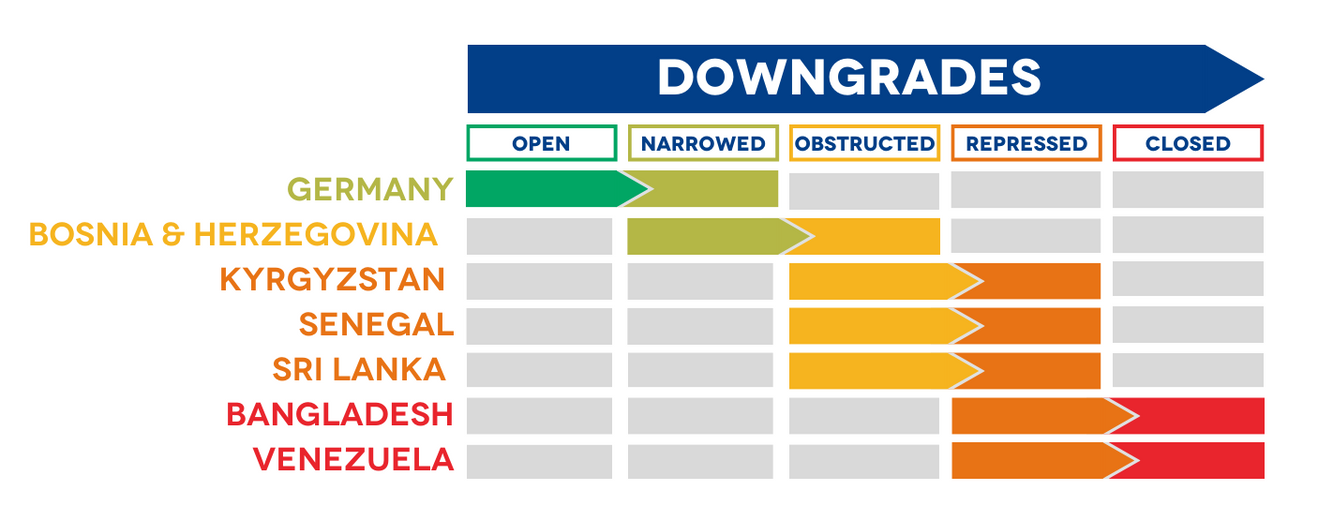
The severity of the civic space deterioration is exemplified by the number of countries moving to the repressed or closed category. Of the seven countries being downgraded, five moved to the two worst categories. Bangladesh and Venezuela are now rated as closed and Kyrgyzstan, Senegal and Sri Lanka are downgraded to the repressed rating as conditions for civil society continue to worsen.
Europe continues to add to the list of downgraded countries, with Bosnia and Herzegovina now placed in the obstructed category and Germany moving from an open to a narrowed rating. Over the past six years, 12 European countries have seen their ratings downgraded due to deteriorating civic space conditions.
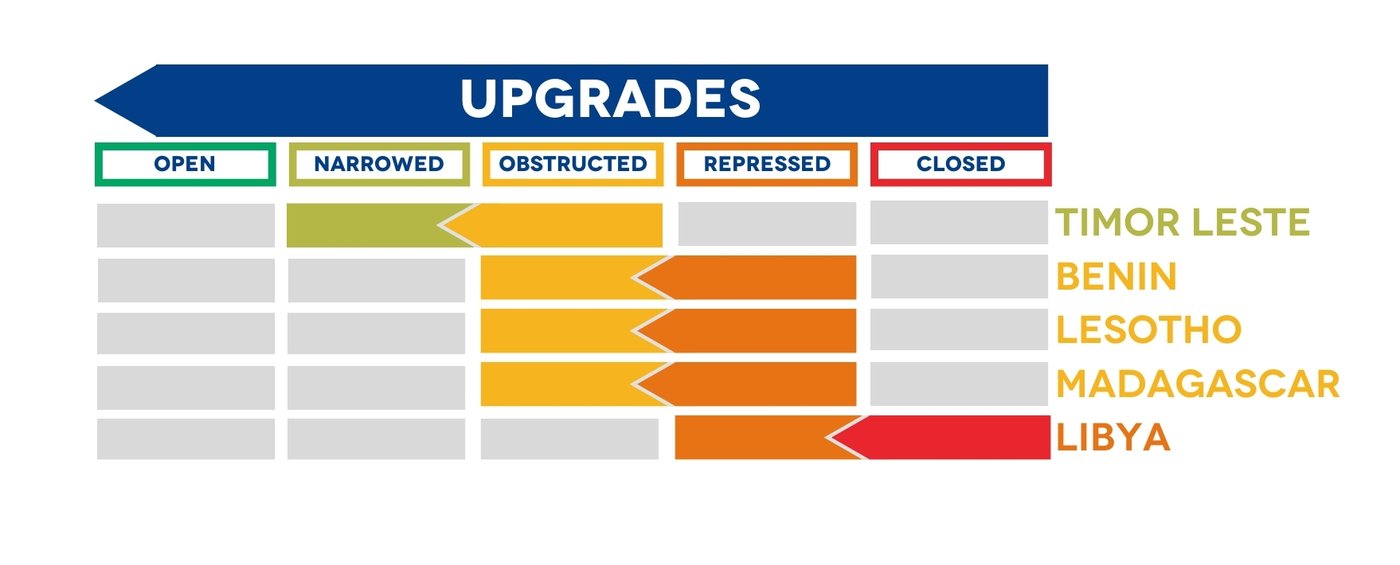
Five countries have upgraded ratings in 2023, although, as in previous years, the situation for civil society in these countries continues to be challenging. Libya moved from the closed to the repressed category. Benin, Lesotho and Madagascar have moved from the repressed to the obstructed category. Notably, Timor-Leste has joined the narrowed category. Regional sections describe the conditions that led to ratings changes.
On 20 December 2023 Jakob Guhl posted in Index on Censorship a piece stating that German authorities are increasingly silencing pro-Palestine activism in an effort to stamp out anything they fear could be seen as antisemitic. He makes some excellent points (which apply also outside Germany):
..The seemingly isolated incidents highlighted in this article are piling up and the curtailing of civic space is starting to be noticed internationally: Civicus, which ranks countries by freedom of expression rights, recently downgraded Germany in a review from “open” to “restricted” due to repression of pro-Palestinian voices, as well as of climate activists…
There are long-standing disagreements around where to draw the line between legitimate criticism of Israel and attacks on Israel that single it out because it is a Jewish state, are expressed in antisemitic ways or are motivated by antisemitic views. For example, the International Holocaust Remembrance Alliance (IHRA) definition of antisemitism acknowledges that “criticism of Israel similar to that levelled against any other country cannot be regarded as antisemitic” but identifies seven examples of when attacks on Israel may be antisemitic (taking into account the overall context). For example, it could be antisemitic to reference classic antisemitic tropes such as the blood libel conspiracy myth to describe Israel, deny the Jewish people’s right to self-determination or blame Jews collectively for the actions of Israel, according to IHRA.
The debates since 7 October have created an atmosphere in which pro-Palestinian voices are more and more stigmatised. Pro-Palestinian protests have repeatedly been banned by local authorities. Their dystopian rationale for these bans revolves around the idea that, based on assessments of previous marches, crimes are likely to be committed by protesters. The practice is not new: in the past, German police have even banned protests commemorating the ”Nakba” (Arabic for “catastrophe”), the collective mass expulsion and displacement of around 700,000 Palestinians from their homes during the 1947-49 wars following the adoption of the Partition Plan for Palestine by the United Nations. In reaction to pro-Palestine protests since 7 October, the antisemitism commissioner of North Rhine Westphalia and former federal justice minister even suggested the police should pay closer attention to the nationality of pro-Palestine protest organisers as protests organised by non-Germans could be banned more easily.
Furthermore, pro-Palestinian political symbols are being falsely associated with Hamas or other pro-terrorist organisations. In early November, the Federal Interior Ministry banned the chant “From the River to the Sea, Palestine will be free” as a symbol of both Hamas and Samidoun, a support network for the Marxist-Leninist Popular Front for Liberation of Palestine which has been designated as a terrorist organisation by the European Union.
While one plausible interpretation of the “From the River to the Sea” slogan is that it is a call for the destruction of Israel, it is equally plausible to understand it as a call for a binational state with full equality of all citizens. Without context, the slogan cannot automatically be identified as antisemitic, though it is of course entirely legitimate to criticise this ambivalence. As has been extensively documented, the slogan does not originate with nor is exclusively used by Hamas.
Apart from being based on misinformation, banning “From the River to the Sea” has also created the ludicrous situation that the German police force is asked to make assessments on whether holding a “From the River we do see nothing like equality” placard is an expression of support for terrorism. A former advisor to Angela Merkel even called for the German citizenship of a previously stateless Palestinian woman to be revoked who posted a similar slogan (“From the River to the Sea #FreePalestine”) on her Instagram.
In some cases, these dynamics venture into the absurd. On 14 October, the activist Iris Hefets was temporarily detained in Berlin for holding a placard that read: “As a Jew & an Israeli Stop the Genocide in Gaza.”
These illiberal and ill-conceived measures are not limited to protests. In response to the 7 October attacks, authorities in Berlin allowed schools to ban students from wearing keffiyeh scarves to not “endanger school peace”.
Curtailing civic spaces
While these trends have been accelerated since 7 October, they predate it. In 2019, the German Bundestag passed a resolution that condemned the BDS movement as antisemitic. It referenced the aforementioned IHRA definition of antisemitism (which does not comment on boycotts), compared the BDS campaign to the Nazi boycotts of Jewish business and called on authorities to no longer fund groups or individuals that support BDS.
BDS calls for the boycott of Israeli goods, divestment from companies involved in the occupation of Arab territories and sanctions to force the Israeli government to comply with international law and respect the rights of Palestinians, including the right of return for Palestinian refugees. Inspired by the boycott campaign against Apartheid South Africa, BDS has attracted many supporters, but critics have claimed that BDS singles out Israel and delegitimises its existence. Accusations of antisemitism within the movement should of course be taken seriously: BDS supporters have previously been accused of employing antisemitic rhetoric about malign Jewish influence and intimidating Jewish students on campus. However, many of BDS’ core demands are clearly not antisemitic. Since the BDS lacks a central leadership that would issue official stances, it is difficult to make blanket statements about the movement in its entirety.
The 2019 resolution is now being cited to shut down cultural events. A planned exhibition in Essen on Afrofuturism was cancelled over social media posts that, according to the museum, “do not acknowledge the terroristic attack of the Hamas and consider the Israeli military operation in Gaza a genocide” and expressed support for BDS. The Frankfurt book fair “indefinitely postponed” a literary prize for the Palestinian author Adania Shibli, after one member of the jury resigned due to supposed anti-Israel and antisemitic themes in her book. Shibli has since been accused by the left-wing Taz newspaper of being an “engaged BDS supporter” for having signed one BDS letter in 2007 and a 2019 letter that criticised the city of Dortmund for revoking another literary price for an author that supports BDS. A presentation by the award-winning Forensic Architecture research group at Goldsmiths (University of London), which has analysed human rights abuses in Syria, Venezuela and Palestine as well as Neo-Nazi murders in Germany, was likewise cancelled by the University of Aachen which cited the group’s founder Eyal Weizman’s support for BDS.
The curtailing of civic space increasingly affects voices that have stood up for human rights at great personal risk. The Syrian opposition activist Wafa Ali Mustafa was detained by Berlin police near a pro-Palestine protest, reportedly for wearing a keffiyeh scarf. Similarly, the Heinrich-Böll-Stiftung, which is associated with the centre-left Green Party, pulled out of the Hannah Arendt prize ceremony, which was due to be awarded to the renowned Russian dissident, philosopher and human rights advocate Masha Gessen. Despite acknowledging differences between the two, Gessen had compared Gaza to the Jewish ghettoes in Nazi-occupied Europe in an article about the politics of memory in Germany, the Soviet Union, Russia, Poland, Ukraine, Hungary and Israel.
Conversation stoppers
Alarm bells should ring as one of Europe’s major liberal democracies has taken an authoritarian turn in the aftermath of 7 October. Germany’s noble commitment to its historical responsibility in the face of rising antisemitism is morphing into a suppression of voices advocating for Palestinian political self-determination and human rights.
In this distorted reality, civic spaces are eroded, cultural symbols banned, political symbols falsely conflated with support for terrorism and events are shut down. So far, there has been little pushback or critical debate about these worrying developments. To the contrary: politicians, foundations, cultural institutions and media outlets seem to be closing ranks under the shadow of the 2019 BDS resolution and a skewed interpretation of the IHRA definition.
Following the appalling violence committed by Hamas on 7 October, and the scale of civilian suffering in Gaza due to the subsequent Israeli military offensive, polarisation and tension between communities have been on the rise. In this context, it is crucial to be able to have passionate, empathetic, controversial and nuanced discussions about the conflict, its history, the present impasse, potential ways forward and its impact on Jewish, Muslim and Arab communities abroad. With the voices of activists, authors and even internationally renowned human rights advocates being increasingly isolated, these vital exchanges are prevented from taking place.
Responding to news that the Emirati authorities have begun a mass prosecution on trumped-up terrorism charges of more than 80 Emirati human rights activists – including renowned currently-jailed Emirati human rights activists who have already spent a decade behind bars – Aya Majzoub, Amnesty International’s Middle East and North Africa Deputy Director, said:
“To begin hearings in a new sham mass trial in the midst of what it billed as ‘the most inclusive COP ever’, is a jaw-dropping show of contempt for human rights by the Emirati authorities. The timing appears to be deliberately intended to send a clear message to the world that it will not tolerate the slightest peaceful dissent and that the authorities have no intention of reforming the country’s dire rights record. COP28 has already laid bare the barriers of fear and legalised repression that smother dissent in the UAE.
“The UAE must immediately release all arbitrarily-detained prisoners, drop charges against them and end their ruthless assault on human rights and freedoms.”
The new mass trial – first reported by the Emirates Detainees Advocacy Centre and confirmed to Amnesty by exiled Emirati activists – is a joint prosecution of more than 80 defendants, including victims of a past mass trial such as Mohamed al-Siddiq, father of the late exiled Emirati human rights defender Alaa al-Siddiq, prisoners of conscience such as Khalid al-Nuaimi, Hadef al-Owais, Nasser bin Ghaith and Sultan al-Qasimi, and longstanding human rights defenders such as Mohamed al-Roken and Ahmed Mansoor (see below).
Fresh charges against Ahmed Mansoor
Last month, Amnesty UK campaigners flew a protest plane over Manchester City FC’s Etihad Stadium carrying a large banner saying “UAE – Free Ahmed Mansoor”. Mansoor is a blogger, poet and leading Emirati human rights activist who has been in jail and kept in solitary confinement in the UAE since 2017 as a direct result of his campaigning activity. In 2017, Mansoor was convicted on charges which included “insulting the status and prestige of the UAE and its symbols”, “publishing false information to damage the UAE’s reputation abroad” and “portraying the UAE as a lawless land”. The following year, Mansoor was sentenced to ten years’ imprisonment, with the sentencing court also ordering that he be placed under surveillance for three years after release. His conviction and sentence were upheld by the country’s supreme court on 31 December 2018.
The CIVICUS Monitor, which tracks freedom of association, peaceful assembly and expression in 198 countries and territories, announced in a new report – “People Power Under Attack 2023” – that almost one third of humanity now lives in countries with ‘closed’ civic space.
This is the highest percentage –30.6% of the world’s population– living in the most restrictive possible environment since CIVICUS Monitor’s first report in 2018. Meanwhile, just 2.1% of people live in ‘open’ countries, where civic space is both free and protected, the lowest percentage yet and almost half the rate of six years ago.
“We are witnessing an unprecedented global crackdown on civic space,” said CIVICUS Monitor lead researcher Marianna Belalba Barreto. “The world is nearing a tipping point where repression, already widespread, becomes dominant. Governments and world leaders must work urgently to reverse this downward path before it is too late.”
The CIVICUS Monitor rates each country’s civic space conditions based on data collected throughout the year from country-focused civil society activists, regionally-based research teams, international human rights indices and the Monitor’s own in-house experts. The data from these four separate sources are then combined to assign each country a rating as either ‘open,’ ‘narrowed,’ ‘obstructed,’ ‘repressed’ or ‘closed.’
Seven countries saw their ratings drop this year. These include Venezuela and Bangladesh, each now rated ‘closed’ due to intensifications of existing crackdowns on activists, journalists and civil society.
Democratic countries slipped too. Europe’s largest democracy, Germany, fell from ‘open’ to ‘narrowed’ amid protest bans and targeting of environmental activists. Bosnia & Herzegovina also declined to ‘obstructed,’ the twelfth European country downgraded since 2018.
One of 2023’s most dramatic slides occurred in Senegal, once considered among West Africa’s most stable democracies. Senegal entered the ‘repressed’ category amid sustained government persecution of protesters, journalists and opposition ahead of February elections.
“The range of countries where authorities restricted citizen participation in 2023 shows clampdowns are not isolated incidents but are part of a global pattern,” said Belalba. “A global backslide requires a global response. If citizens are not able to freely gather, organise and speak out, the world will not be able to solve inequality, confront the climate crisis and bring an end to war and conflict.”
CIVICUS Monitor data shows that worldwide, authorities target people’s freedom of expression above all else. Half of all documented violations in 2023 targeted free speech, with incidents ranging from a bombing outside a journalist’s house in Indonesia, the arrest of the head of a radio station in Tunisia and police pepper-spraying a reporter covering a protest in the United States.
Our research also reveals that intimidation is the number one tactic to restrict citizen freedoms. Human rights defenders, activists and media experienced intimidation in at least 107 countries. Media in particular bear the brunt, with 64% of incidents targeting journalists.
Despite these alarming trends, People Power Under Attack 2023 highlights areas of progress too. Timor-Leste’s civic space moved up to the second best rating ‘narrowed’ from ‘obstructed,’ reflecting the country’s commitment to fundamental freedoms. Four other countries saw ratings improve, though they remain in ‘repressed’ or ‘obstructed’ zones.
The report also details bright spots where countries made steps toward opening societies. Among these, Fiji repealed a restrictive media law. The Kenyan courts recognised the right of LGBTQI+ people to associate. Even Tajikistan, rated ‘closed,’ created a national human rights strategy with civil society input. Still, these and other improvements remain halting and often disconnected compared to widespread repression.
“These small steps show that even amid unprecedented restrictions, civil society is pushing back,” said Belalba. “These courageous acts of resistance by active citizens and civil society organisations give us hope that the downward trend is not permanent and can be reversed.”


 Hans Thoolen on Human Rights Defenders and their awards