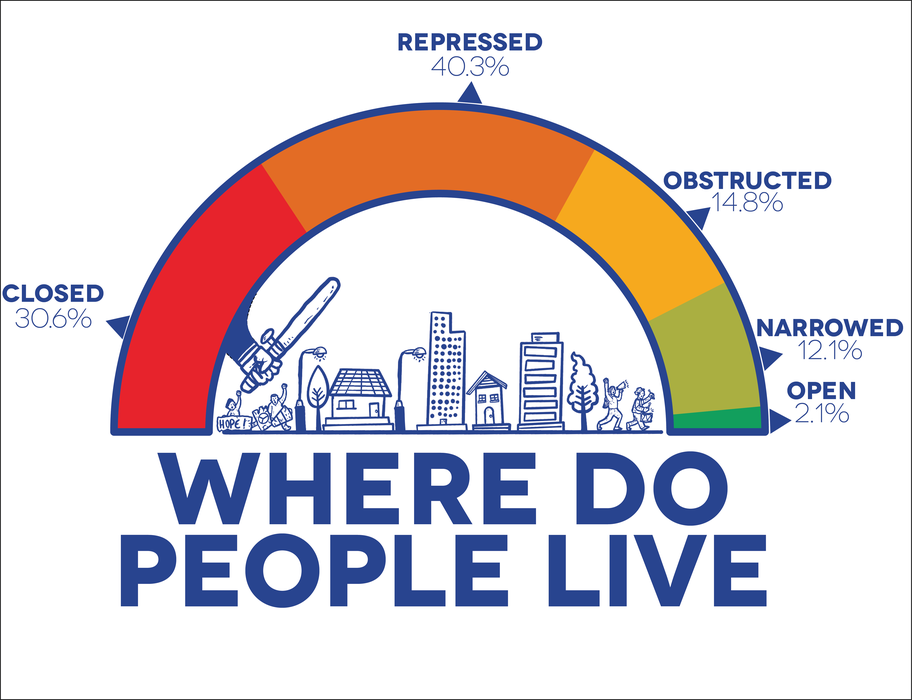
Almost a third of the world’s population now lives in countries with closed civic space. This is the highest percentage since 2018, when CIVICUS began systematically tracking civic space conditions around the world. This startling decline – from 26 per cent living in closed countries in 2018 to 30.6 per cent today – points to a major civic space crisis that requires immediate, global efforts to reverse. This year we also recorded the lowest percentage of humanity living in open countries, where civic space is both free and protected. Today, just two per cent of the world’s population enjoys the freedom to associate, demonstrate and express dissent without significant constraints, down from almost four per cent just five years ago.
Since the previous edition of this report, which covered 2022, civic space ratings have changed for 12 countries over the last year, worsening in seven countries and improving in five.
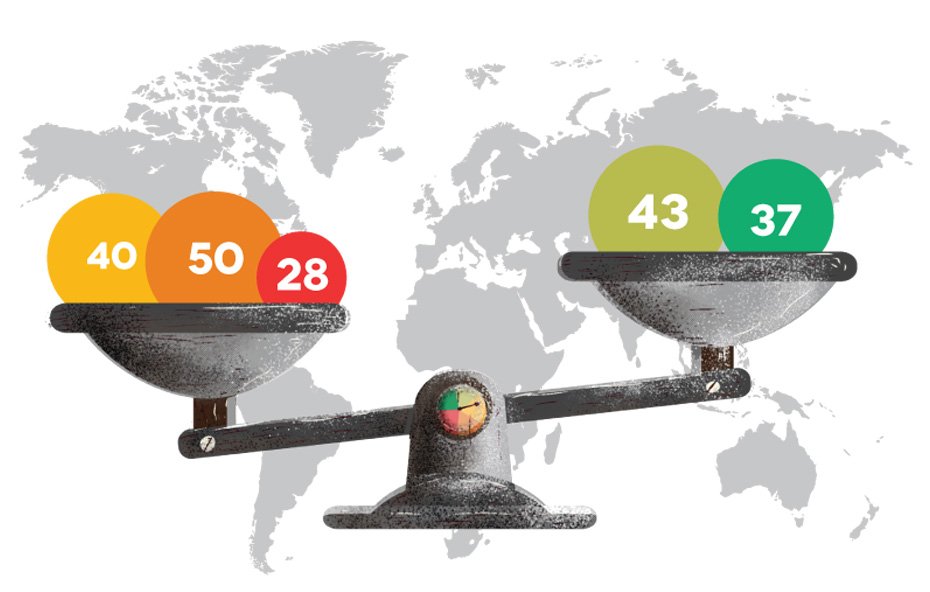
The latest CIVICUS Monitor country ratings update in December 2023 indicates that civil society faces an increasingly hostile environment. There are now 28 countries or territories with closed civic space, 50 with repressed civic space and 40 with obstructed civic space, meaning that 118 of 198 countries and territories are experiencing severe restrictions in fundamental freedoms. In comparison, 43 countries have narrowed civic space and just 37 have an open rating.
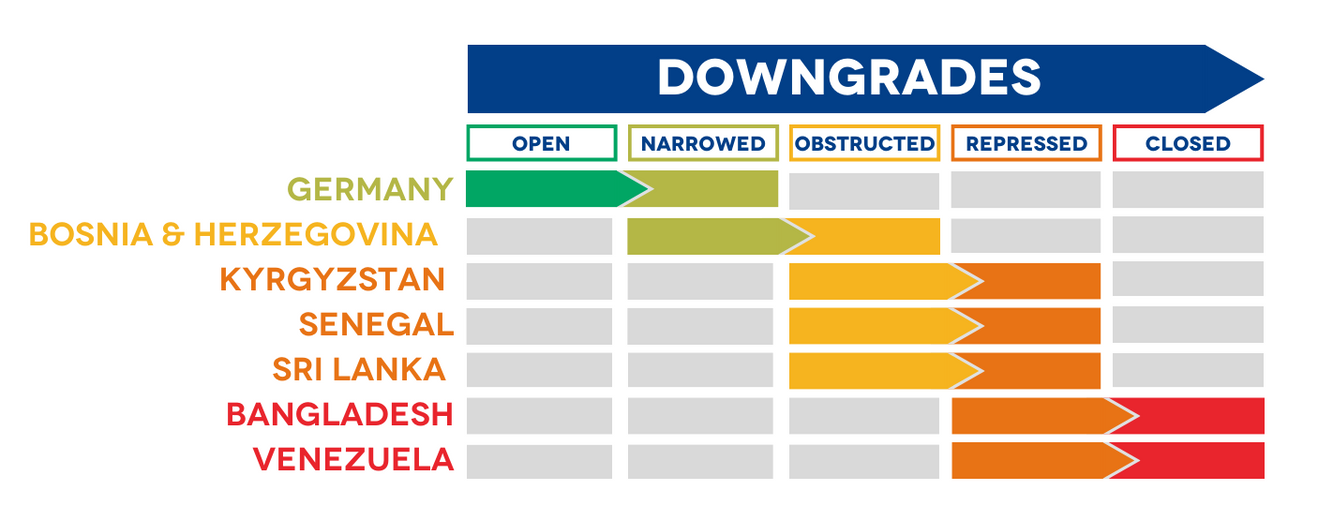
The severity of the civic space deterioration is exemplified by the number of countries moving to the repressed or closed category. Of the seven countries being downgraded, five moved to the two worst categories. Bangladesh and Venezuela are now rated as closed and Kyrgyzstan, Senegal and Sri Lanka are downgraded to the repressed rating as conditions for civil society continue to worsen.
Europe continues to add to the list of downgraded countries, with Bosnia and Herzegovina now placed in the obstructed category and Germany moving from an open to a narrowed rating. Over the past six years, 12 European countries have seen their ratings downgraded due to deteriorating civic space conditions.
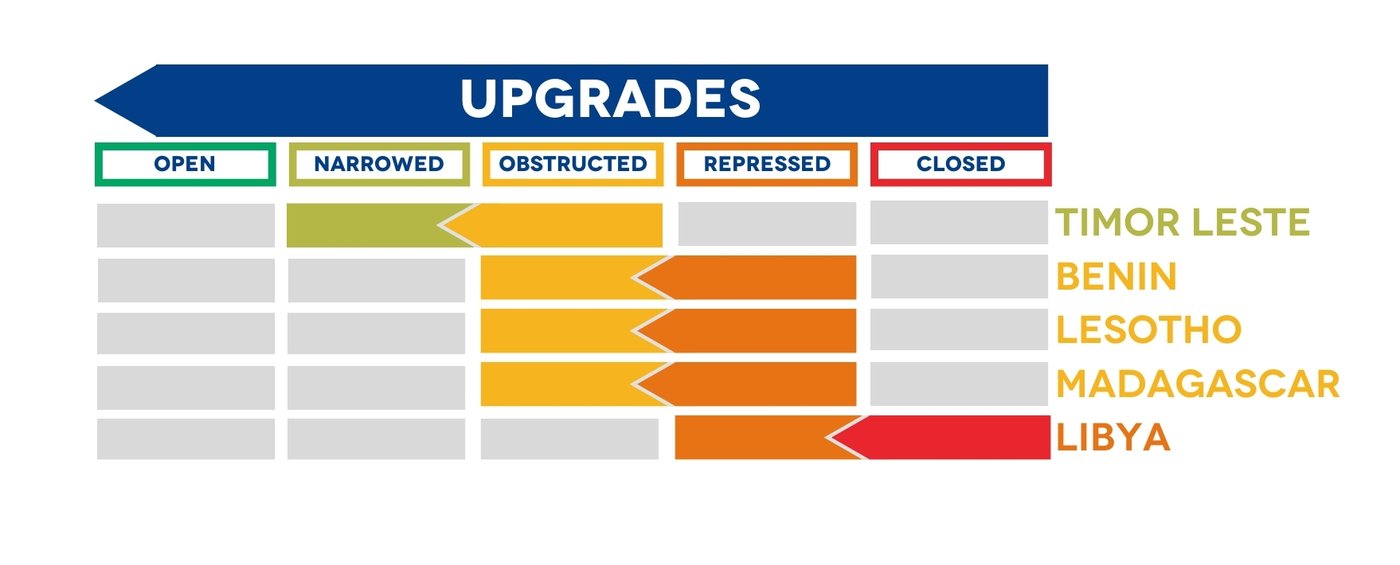
Five countries have upgraded ratings in 2023, although, as in previous years, the situation for civil society in these countries continues to be challenging. Libya moved from the closed to the repressed category. Benin, Lesotho and Madagascar have moved from the repressed to the obstructed category. Notably, Timor-Leste has joined the narrowed category. Regional sections describe the conditions that led to ratings changes.
On 20 December 2023 Jakob Guhl posted in Index on Censorship a piece stating that German authorities are increasingly silencing pro-Palestine activism in an effort to stamp out anything they fear could be seen as antisemitic. He makes some excellent points (which apply also outside Germany):
..The seemingly isolated incidents highlighted in this article are piling up and the curtailing of civic space is starting to be noticed internationally: Civicus, which ranks countries by freedom of expression rights, recently downgraded Germany in a review from “open” to “restricted” due to repression of pro-Palestinian voices, as well as of climate activists…
There are long-standing disagreements around where to draw the line between legitimate criticism of Israel and attacks on Israel that single it out because it is a Jewish state, are expressed in antisemitic ways or are motivated by antisemitic views. For example, the International Holocaust Remembrance Alliance (IHRA) definition of antisemitism acknowledges that “criticism of Israel similar to that levelled against any other country cannot be regarded as antisemitic” but identifies seven examples of when attacks on Israel may be antisemitic (taking into account the overall context). For example, it could be antisemitic to reference classic antisemitic tropes such as the blood libel conspiracy myth to describe Israel, deny the Jewish people’s right to self-determination or blame Jews collectively for the actions of Israel, according to IHRA.
The debates since 7 October have created an atmosphere in which pro-Palestinian voices are more and more stigmatised. Pro-Palestinian protests have repeatedly been banned by local authorities. Their dystopian rationale for these bans revolves around the idea that, based on assessments of previous marches, crimes are likely to be committed by protesters. The practice is not new: in the past, German police have even banned protests commemorating the ”Nakba” (Arabic for “catastrophe”), the collective mass expulsion and displacement of around 700,000 Palestinians from their homes during the 1947-49 wars following the adoption of the Partition Plan for Palestine by the United Nations. In reaction to pro-Palestine protests since 7 October, the antisemitism commissioner of North Rhine Westphalia and former federal justice minister even suggested the police should pay closer attention to the nationality of pro-Palestine protest organisers as protests organised by non-Germans could be banned more easily.
Furthermore, pro-Palestinian political symbols are being falsely associated with Hamas or other pro-terrorist organisations. In early November, the Federal Interior Ministry banned the chant “From the River to the Sea, Palestine will be free” as a symbol of both Hamas and Samidoun, a support network for the Marxist-Leninist Popular Front for Liberation of Palestine which has been designated as a terrorist organisation by the European Union.
While one plausible interpretation of the “From the River to the Sea” slogan is that it is a call for the destruction of Israel, it is equally plausible to understand it as a call for a binational state with full equality of all citizens. Without context, the slogan cannot automatically be identified as antisemitic, though it is of course entirely legitimate to criticise this ambivalence. As has been extensively documented, the slogan does not originate with nor is exclusively used by Hamas.
Apart from being based on misinformation, banning “From the River to the Sea” has also created the ludicrous situation that the German police force is asked to make assessments on whether holding a “From the River we do see nothing like equality” placard is an expression of support for terrorism. A former advisor to Angela Merkel even called for the German citizenship of a previously stateless Palestinian woman to be revoked who posted a similar slogan (“From the River to the Sea #FreePalestine”) on her Instagram.
In some cases, these dynamics venture into the absurd. On 14 October, the activist Iris Hefets was temporarily detained in Berlin for holding a placard that read: “As a Jew & an Israeli Stop the Genocide in Gaza.”
These illiberal and ill-conceived measures are not limited to protests. In response to the 7 October attacks, authorities in Berlin allowed schools to ban students from wearing keffiyeh scarves to not “endanger school peace”.
Curtailing civic spaces
While these trends have been accelerated since 7 October, they predate it. In 2019, the German Bundestag passed a resolution that condemned the BDS movement as antisemitic. It referenced the aforementioned IHRA definition of antisemitism (which does not comment on boycotts), compared the BDS campaign to the Nazi boycotts of Jewish business and called on authorities to no longer fund groups or individuals that support BDS.
BDS calls for the boycott of Israeli goods, divestment from companies involved in the occupation of Arab territories and sanctions to force the Israeli government to comply with international law and respect the rights of Palestinians, including the right of return for Palestinian refugees. Inspired by the boycott campaign against Apartheid South Africa, BDS has attracted many supporters, but critics have claimed that BDS singles out Israel and delegitimises its existence. Accusations of antisemitism within the movement should of course be taken seriously: BDS supporters have previously been accused of employing antisemitic rhetoric about malign Jewish influence and intimidating Jewish students on campus. However, many of BDS’ core demands are clearly not antisemitic. Since the BDS lacks a central leadership that would issue official stances, it is difficult to make blanket statements about the movement in its entirety.
The 2019 resolution is now being cited to shut down cultural events. A planned exhibition in Essen on Afrofuturism was cancelled over social media posts that, according to the museum, “do not acknowledge the terroristic attack of the Hamas and consider the Israeli military operation in Gaza a genocide” and expressed support for BDS. The Frankfurt book fair “indefinitely postponed” a literary prize for the Palestinian author Adania Shibli, after one member of the jury resigned due to supposed anti-Israel and antisemitic themes in her book. Shibli has since been accused by the left-wing Taz newspaper of being an “engaged BDS supporter” for having signed one BDS letter in 2007 and a 2019 letter that criticised the city of Dortmund for revoking another literary price for an author that supports BDS. A presentation by the award-winning Forensic Architecture research group at Goldsmiths (University of London), which has analysed human rights abuses in Syria, Venezuela and Palestine as well as Neo-Nazi murders in Germany, was likewise cancelled by the University of Aachen which cited the group’s founder Eyal Weizman’s support for BDS.
The curtailing of civic space increasingly affects voices that have stood up for human rights at great personal risk. The Syrian opposition activist Wafa Ali Mustafa was detained by Berlin police near a pro-Palestine protest, reportedly for wearing a keffiyeh scarf. Similarly, the Heinrich-Böll-Stiftung, which is associated with the centre-left Green Party, pulled out of the Hannah Arendt prize ceremony, which was due to be awarded to the renowned Russian dissident, philosopher and human rights advocate Masha Gessen. Despite acknowledging differences between the two, Gessen had compared Gaza to the Jewish ghettoes in Nazi-occupied Europe in an article about the politics of memory in Germany, the Soviet Union, Russia, Poland, Ukraine, Hungary and Israel.
Conversation stoppers
Alarm bells should ring as one of Europe’s major liberal democracies has taken an authoritarian turn in the aftermath of 7 October. Germany’s noble commitment to its historical responsibility in the face of rising antisemitism is morphing into a suppression of voices advocating for Palestinian political self-determination and human rights.
In this distorted reality, civic spaces are eroded, cultural symbols banned, political symbols falsely conflated with support for terrorism and events are shut down. So far, there has been little pushback or critical debate about these worrying developments. To the contrary: politicians, foundations, cultural institutions and media outlets seem to be closing ranks under the shadow of the 2019 BDS resolution and a skewed interpretation of the IHRA definition.
Following the appalling violence committed by Hamas on 7 October, and the scale of civilian suffering in Gaza due to the subsequent Israeli military offensive, polarisation and tension between communities have been on the rise. In this context, it is crucial to be able to have passionate, empathetic, controversial and nuanced discussions about the conflict, its history, the present impasse, potential ways forward and its impact on Jewish, Muslim and Arab communities abroad. With the voices of activists, authors and even internationally renowned human rights advocates being increasingly isolated, these vital exchanges are prevented from taking place.
Responding to news that the Emirati authorities have begun a mass prosecution on trumped-up terrorism charges of more than 80 Emirati human rights activists – including renowned currently-jailed Emirati human rights activists who have already spent a decade behind bars – Aya Majzoub, Amnesty International’s Middle East and North Africa Deputy Director, said:
“To begin hearings in a new sham mass trial in the midst of what it billed as ‘the most inclusive COP ever’, is a jaw-dropping show of contempt for human rights by the Emirati authorities. The timing appears to be deliberately intended to send a clear message to the world that it will not tolerate the slightest peaceful dissent and that the authorities have no intention of reforming the country’s dire rights record. COP28 has already laid bare the barriers of fear and legalised repression that smother dissent in the UAE.
“The UAE must immediately release all arbitrarily-detained prisoners, drop charges against them and end their ruthless assault on human rights and freedoms.”
The new mass trial – first reported by the Emirates Detainees Advocacy Centre and confirmed to Amnesty by exiled Emirati activists – is a joint prosecution of more than 80 defendants, including victims of a past mass trial such as Mohamed al-Siddiq, father of the late exiled Emirati human rights defender Alaa al-Siddiq, prisoners of conscience such as Khalid al-Nuaimi, Hadef al-Owais, Nasser bin Ghaith and Sultan al-Qasimi, and longstanding human rights defenders such as Mohamed al-Roken and Ahmed Mansoor (see below).
Fresh charges against Ahmed Mansoor
Last month, Amnesty UK campaigners flew a protest plane over Manchester City FC’s Etihad Stadium carrying a large banner saying “UAE – Free Ahmed Mansoor”. Mansoor is a blogger, poet and leading Emirati human rights activist who has been in jail and kept in solitary confinement in the UAE since 2017 as a direct result of his campaigning activity. In 2017, Mansoor was convicted on charges which included “insulting the status and prestige of the UAE and its symbols”, “publishing false information to damage the UAE’s reputation abroad” and “portraying the UAE as a lawless land”. The following year, Mansoor was sentenced to ten years’ imprisonment, with the sentencing court also ordering that he be placed under surveillance for three years after release. His conviction and sentence were upheld by the country’s supreme court on 31 December 2018.
The CIVICUS Monitor, which tracks freedom of association, peaceful assembly and expression in 198 countries and territories, announced in a new report – “People Power Under Attack 2023” – that almost one third of humanity now lives in countries with ‘closed’ civic space.
This is the highest percentage –30.6% of the world’s population– living in the most restrictive possible environment since CIVICUS Monitor’s first report in 2018. Meanwhile, just 2.1% of people live in ‘open’ countries, where civic space is both free and protected, the lowest percentage yet and almost half the rate of six years ago.
“We are witnessing an unprecedented global crackdown on civic space,” said CIVICUS Monitor lead researcher Marianna Belalba Barreto. “The world is nearing a tipping point where repression, already widespread, becomes dominant. Governments and world leaders must work urgently to reverse this downward path before it is too late.”
The CIVICUS Monitor rates each country’s civic space conditions based on data collected throughout the year from country-focused civil society activists, regionally-based research teams, international human rights indices and the Monitor’s own in-house experts. The data from these four separate sources are then combined to assign each country a rating as either ‘open,’ ‘narrowed,’ ‘obstructed,’ ‘repressed’ or ‘closed.’
Seven countries saw their ratings drop this year. These include Venezuela and Bangladesh, each now rated ‘closed’ due to intensifications of existing crackdowns on activists, journalists and civil society.
Democratic countries slipped too. Europe’s largest democracy, Germany, fell from ‘open’ to ‘narrowed’ amid protest bans and targeting of environmental activists. Bosnia & Herzegovina also declined to ‘obstructed,’ the twelfth European country downgraded since 2018.
One of 2023’s most dramatic slides occurred in Senegal, once considered among West Africa’s most stable democracies. Senegal entered the ‘repressed’ category amid sustained government persecution of protesters, journalists and opposition ahead of February elections.
“The range of countries where authorities restricted citizen participation in 2023 shows clampdowns are not isolated incidents but are part of a global pattern,” said Belalba. “A global backslide requires a global response. If citizens are not able to freely gather, organise and speak out, the world will not be able to solve inequality, confront the climate crisis and bring an end to war and conflict.”
CIVICUS Monitor data shows that worldwide, authorities target people’s freedom of expression above all else. Half of all documented violations in 2023 targeted free speech, with incidents ranging from a bombing outside a journalist’s house in Indonesia, the arrest of the head of a radio station in Tunisia and police pepper-spraying a reporter covering a protest in the United States.
Our research also reveals that intimidation is the number one tactic to restrict citizen freedoms. Human rights defenders, activists and media experienced intimidation in at least 107 countries. Media in particular bear the brunt, with 64% of incidents targeting journalists.
Despite these alarming trends, People Power Under Attack 2023 highlights areas of progress too. Timor-Leste’s civic space moved up to the second best rating ‘narrowed’ from ‘obstructed,’ reflecting the country’s commitment to fundamental freedoms. Four other countries saw ratings improve, though they remain in ‘repressed’ or ‘obstructed’ zones.
The report also details bright spots where countries made steps toward opening societies. Among these, Fiji repealed a restrictive media law. The Kenyan courts recognised the right of LGBTQI+ people to associate. Even Tajikistan, rated ‘closed,’ created a national human rights strategy with civil society input. Still, these and other improvements remain halting and often disconnected compared to widespread repression.
“These small steps show that even amid unprecedented restrictions, civil society is pushing back,” said Belalba. “These courageous acts of resistance by active citizens and civil society organisations give us hope that the downward trend is not permanent and can be reversed.”
With Tajikistan marking its Independence Day on 9 September 2023, CIVICUS and the Brussels-based International Partnership for Human Rights (IPHR) called on 7 September 2023 on Tajikistan’s authorities to immediately release imprisoned human rights defender Manuchehr Kholiqnazarov, and other activists and journalists detained for their human rights activities.
“Manuchehr Kholiqnazarov is a peaceful human rights lawyer and activist who has sat in jail for far too long on trumped-up charges,” said Mandeep Tiwana, CIVICUS Chief Programmes Officer. “As Tajikistan celebrates its national day, the authorities must free him and others unjustly imprisoned without hesitation.”
Authorities arrested Manuchehr on 28 May 2022 while he was a member of “Commission 44,” an official body investigating a November 2021 extrajudicial killing which sparked mass protests in Tajikistan’s Gorno-Badakhshan Autonomous Oblast (GBAO). Prosecutors falsely charged Manuchehr with participating in a criminal association and publicly calling for violent change of the constitutional order. After a closed trial which failed to meet international fairness standards, Tajikistan’s Supreme Court sentenced him to 16 years’ imprisonment in December 2022.
“It is completely absurd that the government appointed someone to a commission to investigate and report on human rights violations and then charged that same person for doing the work they were commissioned to do,” said IPHR director Brigitte Dufour. “Manuchehr should be released immediately.”
Manuchehr’s continued detention is symptomatic of the ongoing civic space restrictions in Tajikistan, which is one of the world’s most repressed countries. Tajikistan authorities have repeatedly levelled trumped-up charges of “extremism” and “terrorism” against journalists, bloggers and activists who criticise the government. CIVICUS Monitor, which assesses civic space worldwide, rates Tajikistan as “closed,” its worst possible ranking.
CIVICUS and IPHR recognise Manuchehr as part of the Stand As My Witness campaign, which advocates for the release of jailed activists and human rights defenders worldwide.
On 11 September 2023 the Norwegian Helsinki Committee, Human Rights Watch, Freedom for Eurasia, and Freedom Now demanded that he Tajik authorities drop trumped up charges against Nizomiddin Nasriddinov and immediately release him. Nasriddinov, a political activist, was recently extradited from Belarus at the request of the Tajik government.
On 4 August 2023, Jaxx Artz in Global Citizen explains the Stand As My Witness’ campaign:
Stand As My Witness was created in response to a growing trend in which civil society actors were arrested for their human rights work. Formerly known as Civil Society Behind Bars, the initiative is one of CIVICUS’ most effective strategies when it comes to sounding the alarm about the plights faced by HRDs around the world. According to the global alliance, hostile government actors and authoritarian regimes often use flawed legal processes with little oversight in order to prosecute activists. “[There are targeted attacks] against people uncovering high-level corruption, exposing very serious human rights violations, calling for accountability, and seeking to drive change in their societies,” Mandeep Tiwana, chief programs officer at CIVICUS, told Global Citizen.
As part of the campaign’s goal to spread awareness about some of the world’s imprisoned activists, CIVICUS profiles a handful of detained HRDs on their website. In actuality, these names and cases represent just a small percentage of people who are currently in prison because of their activism, and whom CIVICUS is trying to get released.
As the global conditions for civic society worsen — with only 3.2% of the world’s population living in countries where civic space is considered open, according to the international global alliance CIVICUS — human rights defenders (HRDs) like al-Khawaja increasingly face the risk of government retaliation.
“The detention of HRDs is often arbitrary and a form of reprisal for the work [they] do,” David Kode, advocacy and campaigns lead at CIVICUS, told Global Citizen. “Take al-Khawaja, for example, who has been in prison since 2011 and is serving a life sentence. Despite many advocacy efforts, the Bahraini authorities seem to be bent on ‘punishing’ him and his family for calling for democratic reforms more than a decade ago.”
Made up of civil society organizations and activists across more than 175 countries, CIVICUS has been campaigning on behalf of HRDs since its founding in 1993. As part of their work, the Stand As My Witness campaign — launched over 10 years ago — has sought to encourage investigations into unlawful imprisonments and bring global attention to cases like al-Khawaja’s.
CIVICUS has found that the tactics used to target HRDs are eerily similar across national borders and, over the years, the trends have only become more apparent and concerning.
“[The imprisonment of HRDS] is often preceded by stigmatization about their work, which includes branding activists as security risks. We saw this happen a lot after the [Arab Spring] in the Middle East and North Africa in 2011,” Tiwana said. “A lot of authoritarian regimes became fearful of people organizing and coming out into the streets to engage in civil society.”
To limit public support of pro-democracy movements and ostracize activists from society, government officials may twist the narrative surrounding an HRD’s arrest and accuse them of being spies for other nations. They may also invoke counter-terrorism or security legislation to pressure judges and quickly detain organizers or protestors without arrest warrants.
Take Khurram Parvez, an HRD from Northern India who was arrested in 2021 on charges of conspiracy and terrorism, for example. Parvez’s work documenting human rights violations — which include instances of disappearance, torture, and unlawful killing — in the Jammu and Kashmir region of India caught the attention of Indian authorities who wanted to silence his advocacy work.
CIVICUS currently advocates on behalf of Parvez through various strategies, such as raising concerns about his detention with the UN, holding meetings with diplomats in India, and encouraging the Human Rights Council in Geneva to put pressure on Indian officials to release him.
“We continue to raise concerns about his detention on social media, telling his story as a human rights defender and highlighting the gaps left by his detention in relation to the amazing work he does promoting human rights in Kashmir and supporting those who are forcibly disappeared in Asia,” Kode told Global Citizen.
In recent years, environmental activists and Indigenous land defenders have faced the brunt of the attacks as corporations file lawsuit after lawsuit restricting the right to protest, leading many activists to face house arrest, financial ruin, or imprisonment.
How Does Stand As My Witness Help Imprisoned HRDs?
Despite the myriad challenges that HRDs and civil society organizations face in their day-to-day work, CIVICUS’ Stand As My Witness campaign has been able to raise the profile of many activists who have been unjustly imprisoned.
CIVICUS and other human rights organizations were able to mount an international campaign to bring attention to the years-long persecution faced by al-Hathloul and other women activists. The hashtag #FreeLoujain popped up across social media platforms, with global citizens around the world speaking up to urge Saudi Arabian authorities to release al-Hathloul.
The Stand As My Witness campaign relies on advocacy efforts from every part of civil society — when Global Citizens take action, for example, their voices can put an immense amount of pressure on world leaders.
“Hostile governments may have [HRDs] locked up for years, and it takes a concerted effort from relevant agencies, state actors, non-state actors, organizations, civil society, the media, and others to put enough pressure that leads to their release,” Tiwana said. “But justice often moves very slowly.”
One of the biggest challenges CIVICUS experiences with the Stand As My Witness campaign is engaging people during the life cycle of a case, which can often last several years. To fight against indifference, CIVICUS encourages Global Citizens everywhere to pay attention to the humanity of each activist who has dedicated their lives to the realization and protection of human rights.
You can get involved with the Stand As My Witness campaign by engaging with CIVICUS on social media, writing letters to government officials, and sharing information about HRDs who are not currently represented on CIVICUS’ interactive map.
You can also demand that governments release HRDs from unjust imprisonment by taking action with Global Citizen on civic space issues.
“Activism is not terrorism” . . . five Filipino indigenous peoples’ leaders and advocates have been branded as “terrorist” individuals and their property and funds have been frozen. Image: CIVICUS
On 28 July, 2023 CIVICUS, a global alliance of civil society organisations, has protested to Philippine President Ferdinand “Bongbong” Marcos Jr in an open letter over the “judicial harassment” of human rights defenders and the designation of five indigenous rights activists as “terrorists“.
CIVICUS, representing some 15,000 members in 75 countries, says the harassment is putting the defenders “at great risk”.
It has also condemned the “draconian” Republic Act No. 11479 — the Anti-Terrorism Act — for its “weaponisation’ against political dissent and human rights work and advocacy in the Philippines.
The CIVICUS open letter said there were “dire implications on the rights to due process and against warrantless arrests, among others”.
The letter called on the Philippine authorities to:
Immediately end the judicial harassment against 10 human rights defenders by withdrawing the petition in the Quezon City Regional Trial Court Branch 84;
Repeal Resolution No. 35 (2022) designating the six human rights defenders as terrorist individuals and unfreeze their property and funds immediately and unconditionally;
Drop all charges under the ATA against activists in the Southern Tagalog region; and
Halt all forms of intimidation and attacks on human rights defenders, ensure an enabling environment for human rights defenders and enact a law for their protection.
On 11 April 2023 10 NGOs demanded the dropping of charges against journalist Nguyen Lan Thang and a fair trial by admitting observation.
Dear President Võ Văn Thưởng,
We are writing to express our concern about the ongoing persecution of Mr Nguyen Lan Thang, a journalist, and we demand that he be released immediately, and all charges dropped against him. Mr Nguyen Lan Thang is a victim of persecution by the Vietnamese government and has been criminally charged due to his work as a journalist. Mr Nguyen Lan Thang is one of many journalists and activists throughout the country who is facing ongoing persecution for reporting of the government of Viet Nam in a critical manner.
On 5 July 2022, Mr. Thang was arrested for “making, storing, distributing, or disseminating information, documents, and items against the State” under article 117 of the 2015 Criminal Code. He has been held in incommunicado detention in Hanoi’s Detention Centre No. 1 for more than seven months, during which time he was prohibited from meeting with his family members and legal counsel. After being arrested in July 2022, he did not meet his lawyer for the first time until 16 February 2023.
According to his lawyers, Mr. Thang will be tried on 12 April 2023 at a closed hearing at Hanoi’s People’s Court. Failing the dropping of charges and release of Mr Nguyen Lan Thang before the trial commences, we demand that his right to a fair trial be upheld, at least in part, by ensuring that media and the public may observe it, as is the obligation of the state of Viet Nam under the International Covenant on Civil and Political Rights (ICCPR).
The right to a public trial is guaranteed under Article 14 of the ICCPR with few exceptions. We understand that Mr Nguyen Lan Thang has been denied this human right. According to Article 14 of the ICCPR:
“the press and the public may be excluded from all or part of a trial for reasons of morals, public order (order public) or national security in a democratic society, or when the interest of the private lives of the parties so requires, or to the extent strictly necessary in the opinion of the court in special circumstances where publicity would prejudice the interests of justice; but any judgment rendered in a criminal case or in a suit at law shall be made public except where the interest of juvenile persons otherwise requires or the proceedings concern matrimonial disputes or the guardianship of children.”
Paragraph 28 of General Comment No 32 of the Human Rights Committee clarifies that the importance of public hearings “ensures the transparency of proceedings and thus provides an important safeguard for the interest of the individual and of society at large”. The Committee has made clear in paragraph 29 that the special circumstances that allow exclusion of the press and public from a trial are “exceptional circumstances”, and otherwise a trial must be open to ensure transparency and assist in guaranteeing the human right to a fair trial.
Despite efforts to obtain further information on the charges and the rationale the court has adopted in excluding the press and public from the trial of Mr Nguyen Lan Thang, there is no information that we possess that indicates any exceptional circumstances exist that would allow the closed nature of this trial under international human rights law.
Accordingly, we demand that the right to fair trial is respected and that members of the public, the press, the United Nations, and the diplomatic community be allowed to monitor the proceedings. We call on the government of Viet Nam, including its courts, to uphold their international obligations and ensure the human rights of those within the justice system.
Yours sincerely,
Access Now
Amnesty International
ARTICLE 19
Asian Forum for Human Rights and Development (FORUM-ASIA) CIVICUS: World Alliance for Citizen Participation
Vast-scale human rights abuses are being committed in Ukraine, women’s rights have been trampled on in Afghanistan and LGBTQI+ people’s rights are under assault in Uganda, along with several other African countries. Military rule has been normalised in countries such as Mali, Myanmar and Sudan, and democracy undermined by autocratic leaders in El Salvador, India and Tunisia, among others. Even supposedly democratic states such as Australia and the UK are undermining the vital right to protest.
But civil society continues to strive to make a crucial difference to people’s lives. It’s the force behind a wave of breakthroughs in respecting abortion rights in Latin America, most recently in Colombia, and in making advances in LGBTQI+ rights in countries as diverse as Barbados, Mexico and Switzerland. Mass protests in response to the high cost of living have won concessions on economic policy in countries including Ecuador and Panama, while union organising has gained further momentum in holding big-brand companies such as Amazon and Starbucks to account. Progress on financing for the loss and damage caused by climate change came after extensive civil society advocacy. The events of the past year show that civil society – and the space for civil society to act – are needed more than ever.
Key findings
Civil society is playing a key role in responding to conflicts and humanitarian crises – and facing retaliation
Civil society is playing a vital role in conflict and crisis settings – including in conflicts in Ethiopia, Syria and Ukraine – providing essential services, helping and advocating for victims, monitoring human rights and collecting evidence of violations to hold those responsible to account. But for doing this, civil society is coming under attack.
Catastrophic global governance failures highlight the urgency of reform
Too often in the face of the conflicts and crises that have marked the world over the past year, platitudes are all international institutions have had to offer. Multilateral institutions have been left exposed by Russia’s invasion of Ukraine. It’s time to take civil society’s proposals to make the United Nations more democratic seriously – starting with the appointment of a civil society champion.
People are mobilising in great numbers in response to economic shock – and exposing deeper problems in the process.
As it drove a surge in fuel and food prices, Russia’s war on Ukraine became a key driver of a global cost of living crisis. This triggered a mass wave of protests in at least 133 countries – from Argentina to Indonesia and from Ghana to Kazakhstan – demanding economic justice. Civil society is putting forward progressive economic ideas, connecting with other struggles for rights, including for climate, gender, racial and social justice.
The right to protest is under attack – even in longstanding democracies
Many states, unwilling or unable to concede the deeper demands of protests have responded with violence, including in Iran, Sierra Leone and Sri Lanka. The right to protest is under attack all over the world, including when people are mobilising to seek economic justice, democracy, human rights and environmental action. Civil society groups are striving to defend protest rights.
Democracy is being eroded in multiple ways – including from within by elected leaders
Economic strife and insecurity are providing fertile ground for the emergence of authoritarian leaders. In more democratic contexts, there are distinct trends of a further embrace of far-right extremism, and of the rejection of incumbency. In volatile conditions, civil society is working to resist regression and keep making the case for inclusive, pluralist and participatory democracy.
Disinformation is skewing public discourse, undermining democracy and fuelling hate
Disinformation is being mobilised, particularly in conflicts and during elections, to sow polarisation, normalise extremism and attack rights. Powerful authoritarian states and far-right groups are key sources, and social media companies are doing nothing to challenge a problem that’s good for their business model. Civil society needs to forge a joined-up, multifaceted global effort to counter disinformation.
Movements for women’s and LGBTQI+ rights are making gains against the odds
In the face of difficult odds, civil society continues to drive progress on women’s and LGBTQI+ rights. But breakthroughs have made civil society the target of a ferocious backlash. Civil society is working to resist attempts to reverse gains and build public support to ensure that legal changes are backed by shifts in attitudes.
Civil society is the major force behind the push for climate action
Civil society continues to be the force sounding the alarm on the triple threat of climate change, pollution and biodiversity loss. Civil society is urging action using every tactic available, from street protest and direct action to litigation and advocacy in national and global arenas. But the power of the fossil fuel lobby remains undimmed and restrictions on climate protests are burgeoning. Civil society is striving to find new ways to communicate the urgent need for action.
Civil society is reinventing itself to adapt to a changing world
In the context of pressures on civic space and huge global challenges, civil society is growing, diversifying and widening its repertoire of tactics. Drawing on its special strengths of diversity, adaptability and creativity, civil society continues to evolve. Much of civil society’s radical energy is coming from small, informal groups, often formed and led by women, young people and Indigenous people. There is a need to support and nurture these..
Interviews For more information or to arrange an interview, please contact: media@civicus.org
The controversial issue of the treatment of Uyghurs is continuing to play out at the UN Human Rights Council. A resolution is being considered this week to discuss the report’s findings awhich is being strongly resisted by China who is leaning heavily on smaller states to oppose it. If these efforts are successful, they could deal a severe blow to the legitimacy of the UN Human Rights Council. Groups such as CIVICUS, Human Rights Watch have been following this issue closely and are urging Member States to support a decision to AT LEAST discuss the report in the interests of transparency and accountability. But then the big disappointment: on Thursday 6 October at the Human Rights Council the motion was rejected in a tight vote of 19 states against, 17 in favour and 11 abstentions.
On 3 October 2022CIVICUS is urging UN Human Rights Council member States to do the right thing by voting in support of a resolution to debate the human rights situation in the Xinjiang Uyghur Autonomous Region (XUAR).
The resolution follows the release of a major UN report which affirms that the rights of Xinjiang’s Uyghur Muslim population are being violated through an industrial-level programme of mass incarceration, systemic torture and sexual violence. The report attracted intense criticism from the Chinese government before it was released on 31 August 2022, minutes before the High Commissioner for Human Rights, Michelle Bachelet ended her term. SEE: See: https://humanrightsdefenders.blog/2022/09/01/finally-the-long-awaited-un-report-on-china/.
The report concludes that the actions of the Chinese government in XUAR including arbitrary detention, cultural persecution and forced labour may constitute international crimes, in particular crimes against humanity. Recommendations include the taking of prompt steps to release all individuals arbitrarily imprisoned in XUAR, a full legal review of national security and counter-terrorism policies, and an official investigation into allegations of human rights violations in camps and detention facilities.
China’s government has rejected the findings and called into question the mandate of the Office of the High Commissioner for Human Rights. The Office of the High Commissioner has asserted that the report is based on a rigorous review of documentary evidence with its credibility assessed in accordance with standard human rights methodology.
A proposed resolution to hold a debate on the report’s findings at the next session of the UN Human Rights Council is being resisted by China which is also said to be pressuring states that make up the 47-member Human Rights Council not to support the resolution.
“The UN report affirms testimonies of victims belonging to the Uyghur community who have endured extreme forms of oppression. Human rights researchers and civil society groups have for years documented abuses and sounded the alarm to the international community about the situation in Xinjiang,” said Mandeep Tiwana, CIVICUS Chief Programmes Officer. “Yet the Chinese state is going to extraordinary lengths to suppress the findings and cover up its actions.”
In June 2020, 50 UN Special Rapporteurs and human rights experts issued a joint statement, that catalogued concerns over the treatment of ethnic minorities in XUAR and Tibet, alleging excessive force against protesters, as well as in Hong Kong, and reports of retaliation against people voicing their concerns publicly over COVID-19 pandemic policies. The experts urged the Human Rights Council to convene a special session on China; consider the creation of a Special Procedures mandate; and appoint a UN Special Envoy or a panel of experts to closely monitor, analyse and report annually on the human rights situation in China.
Sophie Richardson of HRW stated: ‘This week the credibility of the United Nations Human Rights Council is on the line over an extraordinarily modest request: to hold a debate on a recent report from the UN high commissioner for human rights on abuses in the Xinjiang region of China. Member states would not be obliged to take a position on the issues at hand, the government in question, or even seek a particular outcome. But the debate is an opportunity to stand together to ensure the council fulfils its bare minimum mandate.“